
The new blockchain economy Sinclair Davidson b 22
— The new blockchain economy Sinclair Davidson b 22 b https: //sites. rmit. edu. au/blockchain-innovation-hub/ 1
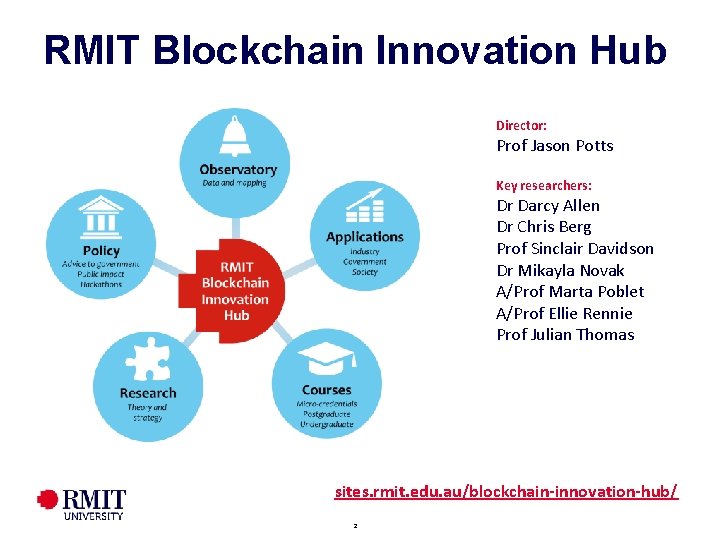
RMIT Blockchain Innovation Hub Director: Prof Jason Potts Key researchers: Dr Darcy Allen Dr Chris Berg Prof Sinclair Davidson Dr Mikayla Novak A/Prof Marta Poblet A/Prof Ellie Rennie Prof Julian Thomas sites. rmit. edu. au/blockchain-innovation-hub/ 2
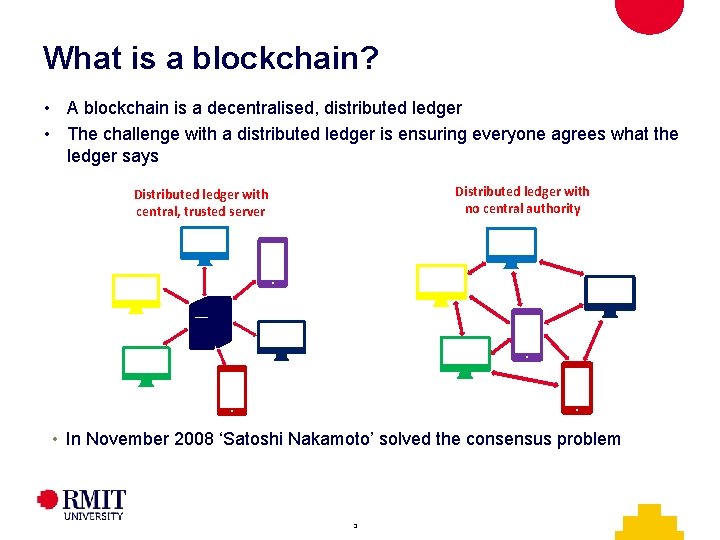
What is a blockchain? • A blockchain is a decentralised, distributed ledger • The challenge with a distributed ledger is ensuring everyone agrees what the ledger says Distributed ledger with no central authority Distributed ledger with central, trusted server • In November 2008 ‘Satoshi Nakamoto’ solved the consensus problem 3
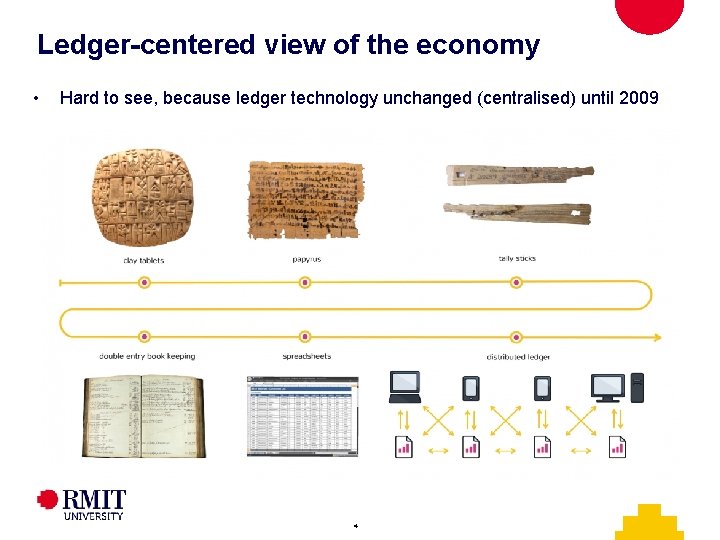
Ledger-centered view of the economy • Hard to see, because ledger technology unchanged (centralised) until 2009 4
Ledgers • Ledgers confirm identity/ ownership/ status/ exchange, map relationships • A ledger is a tool for mapping and verifying agreed facts about relationships • Ledgers are everywhere – – – • Bitcoin has shown us that money is a ledger Property rights are ledgers (see Hernando de Soto) A firm is a ledger, structuring capital, labour and processes The social security system is a ledger Citizenship is ledger Ledgers are about trust 5
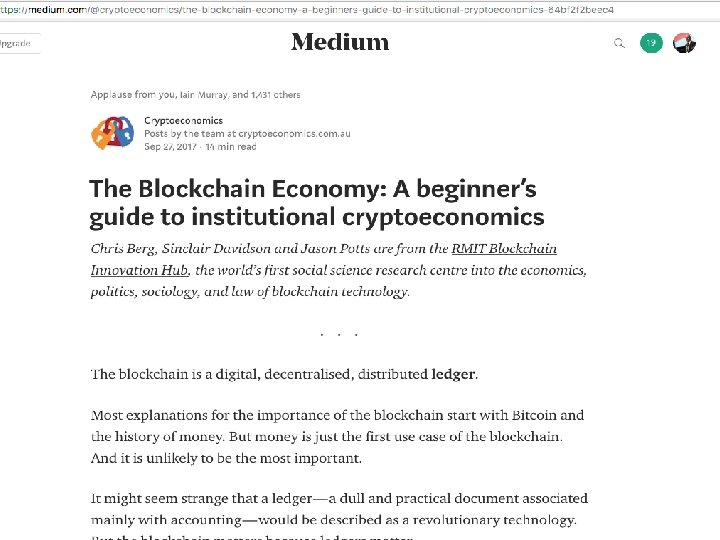
Blockchains are distributed ledgers • When ledger technologies change, so do economies – Blockchain is not just a new general purpose technology. – Blockchain is a new institutional mechanism to organise economic activity and behaviour • Blockchains industrialise trust – Right now this is very expensive – New technology often is very expensive • Blockchains are enormously successful proof of concept around distributed ledger technology Berg S, Davidson S, Potts J (2017) “The Blockchain Economy: A Beginner’s Guide to Institutional Cryptoeconomics” https: //medium. com/@cryptoeconomics/the-blockchain-economy-a-beginners-guide-to-institutional-cryptoeconomics-64 bf 2 f 2 beec 4 6
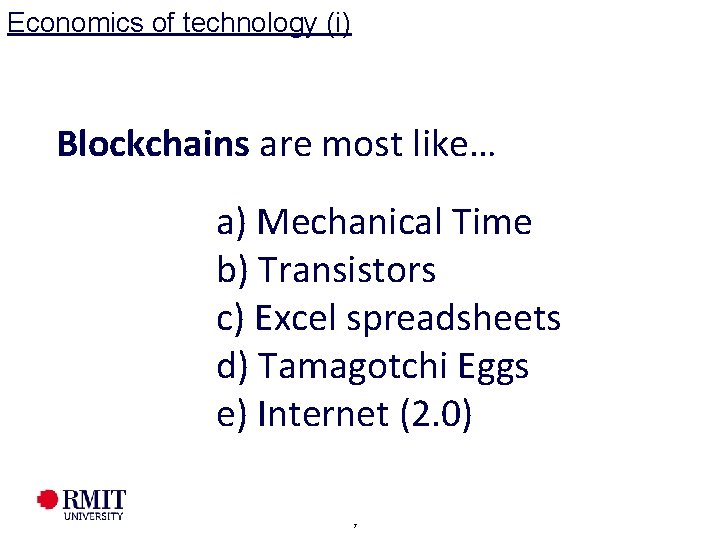
Economics of technology (i) Blockchains are most like… a) Mechanical Time b) Transistors c) Excel spreadsheets d) Tamagotchi Eggs e) Internet (2. 0) 7
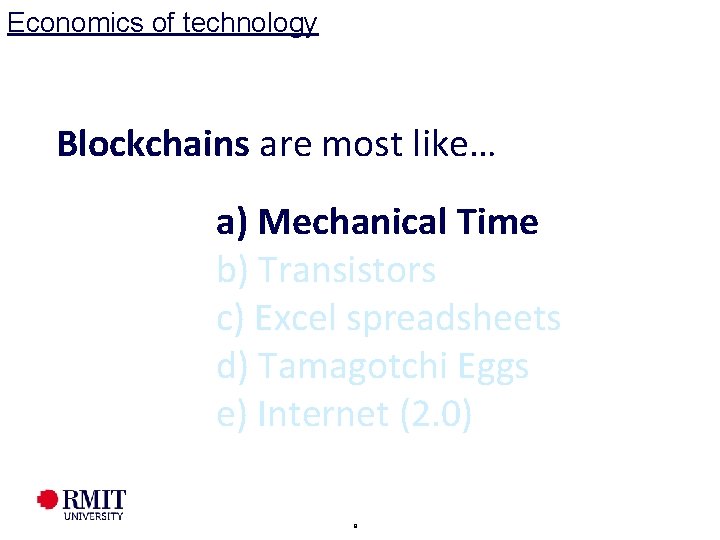
Economics of technology Blockchains are most like… a) Mechanical Time b) Transistors c) Excel spreadsheets d) Tamagotchi Eggs e) Internet (2. 0) 8
Mechanical time gave us: Reliable watches … that when many people used them gave us …decentralised coordination … which gave us. . . scheduling. . . timetables. . . work schedules. . . planning. . . industrial specialisation. . . modern corporate organisation. . . global supply chains 9
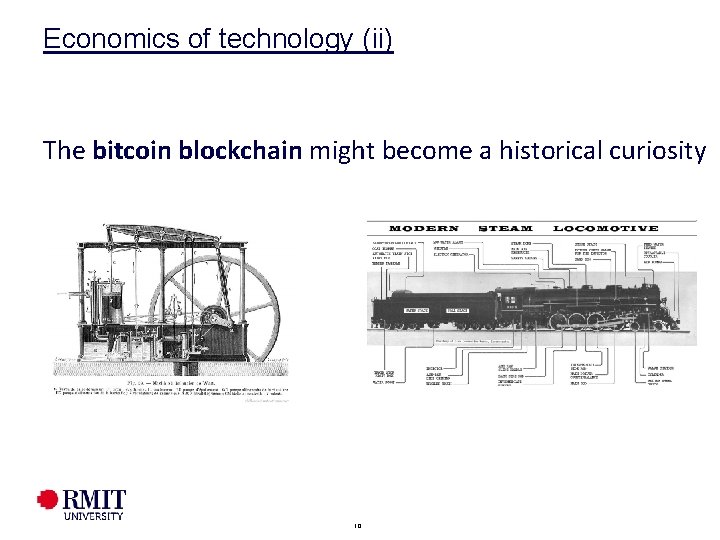
Economics of technology (ii) The bitcoin blockchain might become a historical curiosity 10
New technology ≠ Innovation • Did it matter that ARPA invented the internet? • Did it matter the CSIRO invented wifi? • Does it matter that blockchains were invented for internet money? 11
Cryptoeconomics • Cryptoeconomics is the application of economic theory to blockchains and cryptocurrencies • ‘Traditional’ cryptoeconomics is concerned with – – • Game theory Mechanism design Incentive structure Consensus algorithms Institutional cryptoeconomics is concerned with the role of blockchains – In the economy – For (and against) government – In the social system 12
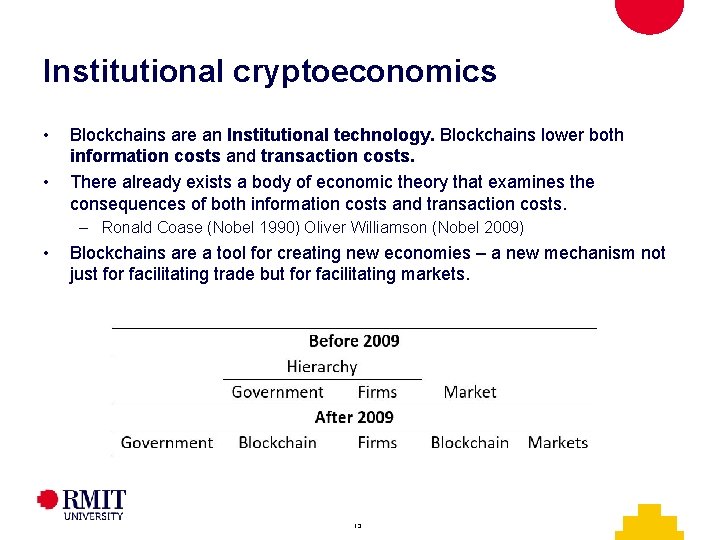
Institutional cryptoeconomics • • Blockchains are an Institutional technology. Blockchains lower both information costs and transaction costs. There already exists a body of economic theory that examines the consequences of both information costs and transaction costs. – Ronald Coase (Nobel 1990) Oliver Williamson (Nobel 2009) • Blockchains are a tool for creating new economies – a new mechanism not just for facilitating trade but for facilitating markets. 13
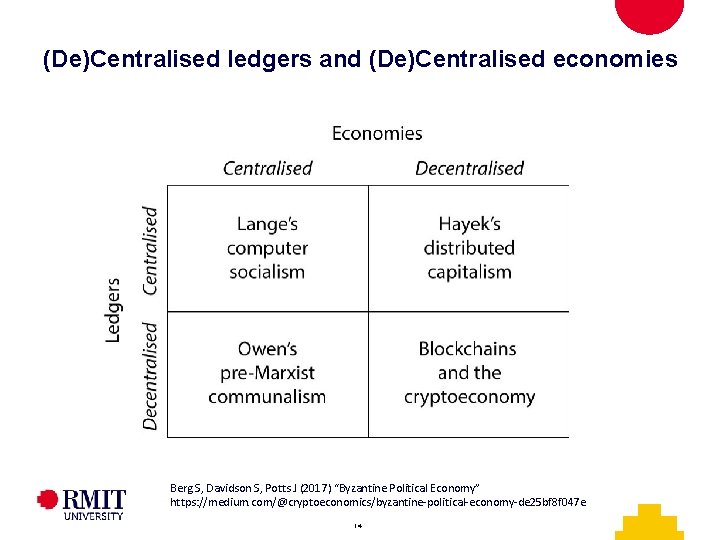
(De)Centralised ledgers and (De)Centralised economies Berg S, Davidson S, Potts J (2017) “Byzantine Political Economy” https: //medium. com/@cryptoeconomics/byzantine-political-economy-de 25 bf 8 f 047 e 14
What does this mean? • Some very frightening consequences: • Massive disruption • Future for some people could be Orwellian • Firms will be nexi of short term contracts: • Teams without the need for monitors • Where will the boundary of the firm be? • Will there be a need for shareholder capitalism? • Firms can place their income statements and balance sheets on the blockchain as a smart contract that updates in real time. • What need for accountants/Auditors? • What need for corporate regulators? • Instantaneous bankruptcy. 15
What does this mean? • The welfare system could be operated as a smart contract. • Track assets, liabilities, and income in real time and adjust welfare payments in real time. • A truly global blockchained financial system: • What will the monetary authorities actually do? • Taxation implications? • Poll tax • The future of work? • Smart workers will write sub-routines for the blockchain. • Anonymous payment in wallet when used. • Superstar effects • What will aggregated inequality statistics look like? • The future of voting? 16
What are people worried about? • Privacy. • Loss of economic opportunity. • “Order 66” problem. • “Skynet”. • Erosion of established institutions: – Hierarchy. – Information intermediation jobs are all in trouble. – Jobs that facilitate trust to generate transactions are all in trouble. 17
Conclusions • The blockchain is not just a tech upgrade • The blockchain is not just another general purpose technology • The blockchain is a new institutional technology that will both – Complement current organisational forms and economic activity – Substitute for current organisation forms and economic activity • There is a lot of work that remains to be done from demonstrating proof of concept to viable (profitable) products. 18
19
20
Keep up to date with our work http: //sites. rmit. edu. au/blockchain-innovation-hub/ http: //cryptoeconomics. com. au/ http: //medium. com/@cryptoeconomics Twitters: @Blockchain. RMIT @cryptoeconomico @chrisberg @sincdavidson @profjasonpotts 21
- Slides: 21