
The New Academic Structure for Senior Secondary Education
- Slides: 31
The New Academic Structure for Senior Secondary Education and Higher Education - Action Plan for Investing in the Future of Hong Kong May 2005 Education and Manpower Bureau 1
The Way Forward 1. Committed actions and critical milestones in response to consensus and concerns, 2. 2 nd consultation of multi-stage development of curriculum & assessment frameworks from June to Sep 2005 3. Dialogue with stakeholders on developmental issues, e. g. COS & special education, communications & partnership with all stakeholders, e. g. focus groups, web-bulletin 2
Year of Implementation: 2009 Sept 2009 - 1 st cohort of NSS students (existing P 5 students to be the first to enjoy the new structure) 2012 - 1 st HKDSE exam - 1 st cohort of SS 3 students entering the university 2016 - 1 st batch of university students to be graduated under the new structure 3
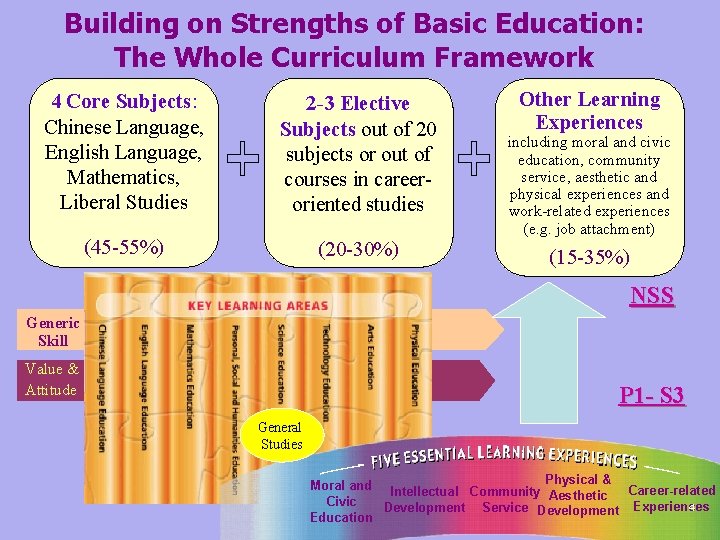
Building on Strengths of Basic Education: The Whole Curriculum Framework 4 Core Subjects: Chinese Language, English Language, Mathematics, Liberal Studies 2 -3 Elective Subjects out of 20 subjects or out of courses in careeroriented studies (45 -55%) (20 -30%) Other Learning Experiences including moral and civic education, community service, aesthetic and physical experiences and work-related experiences (e. g. job attachment) (15 -35%) NSS Generic Skill Value & Attitude P 1 - S 3 General Studies Moral and Intellectual Community Physical & Career-related Aesthetic Civic 4 Development Service Development Experiences Education
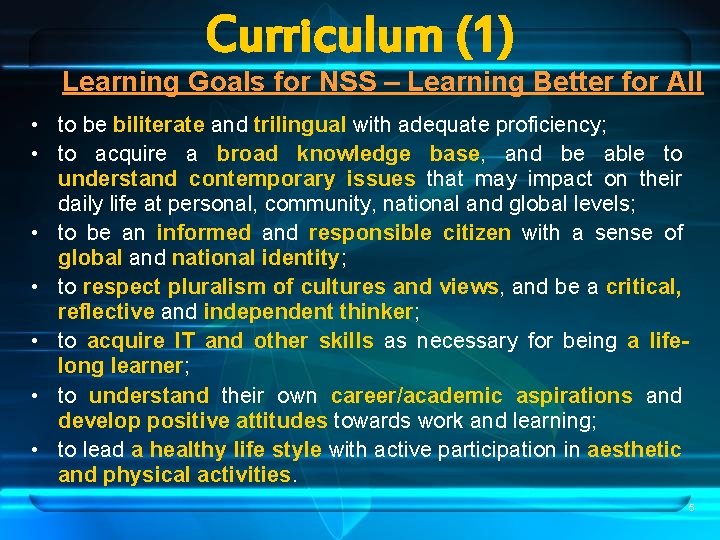
Curriculum (1) Learning Goals for NSS – Learning Better for All • to be biliterate and trilingual with adequate proficiency; • to acquire a broad knowledge base, and be able to understand contemporary issues that may impact on their daily life at personal, community, national and global levels; • to be an informed and responsible citizen with a sense of global and national identity; • to respect pluralism of cultures and views, and be a critical, reflective and independent thinker; • to acquire IT and other skills as necessary for being a lifelong learner; • to understand their own career/academic aspirations and develop positive attitudes towards work and learning; • to lead a healthy life style with active participation in aesthetic and physical activities. 5
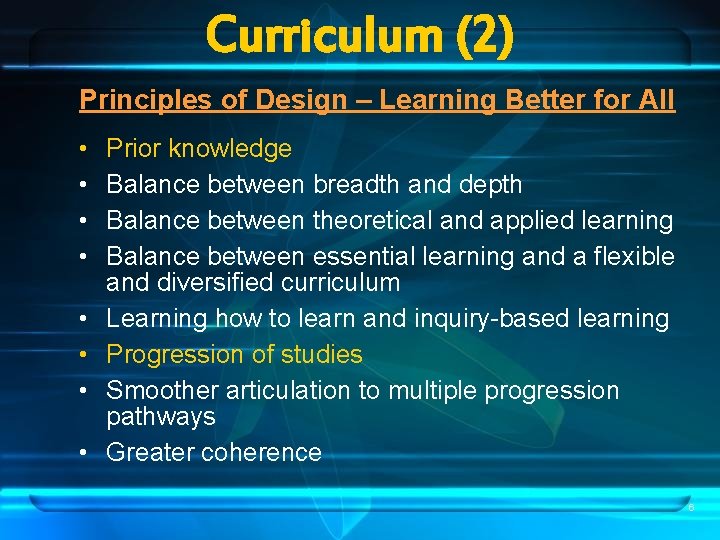
Curriculum (2) Principles of Design – Learning Better for All • • Prior knowledge Balance between breadth and depth Balance between theoretical and applied learning Balance between essential learning and a flexible and diversified curriculum Learning how to learn and inquiry-based learning Progression of studies Smoother articulation to multiple progression pathways Greater coherence 6
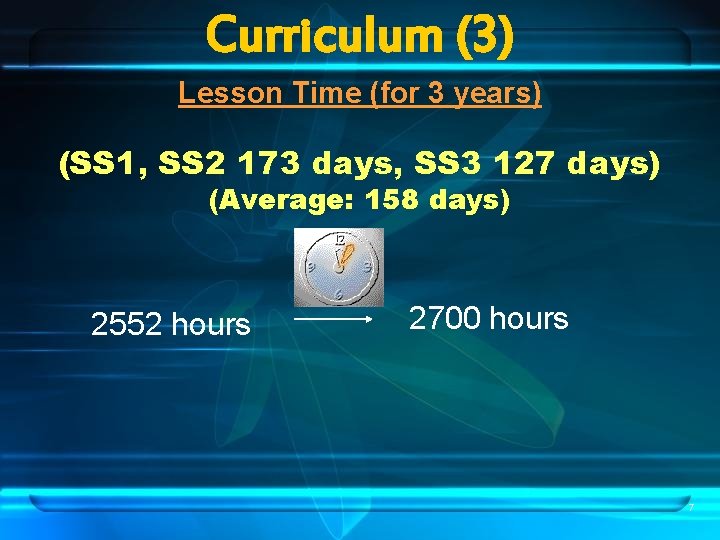
Curriculum (3) Lesson Time (for 3 years) (SS 1, SS 2 173 days, SS 3 127 days) (Average: 158 days) 2552 hours 2700 hours 7
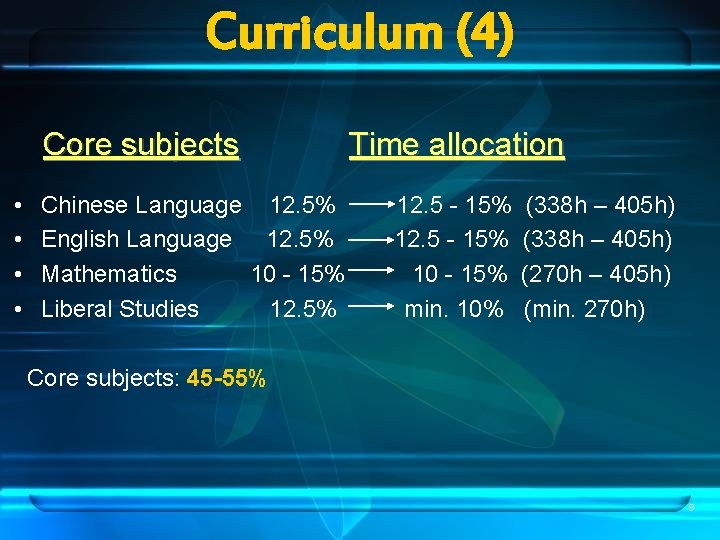
Curriculum (4) Core subjects • • Chinese Language 12. 5% English Language 12. 5% Mathematics 10 - 15% Liberal Studies 12. 5% Time allocation 12. 5 - 15% 10 - 15% min. 10% (338 h – 405 h) (270 h – 405 h) (min. 270 h) Core subjects: 45 -55% 8
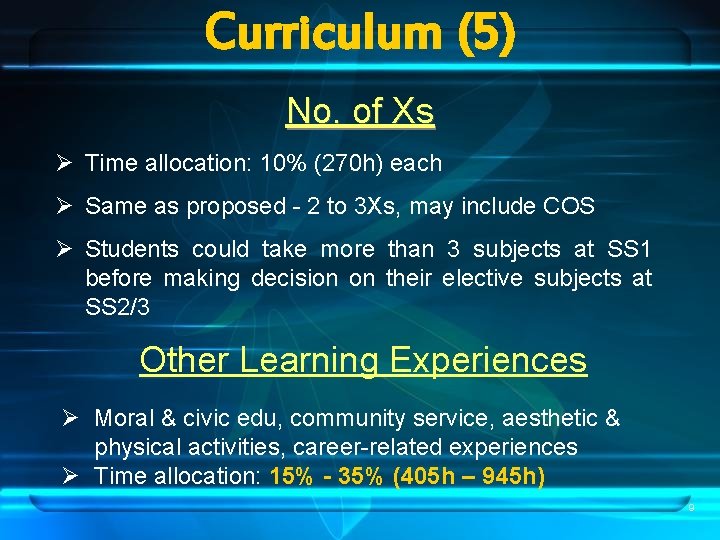
Curriculum (5) No. of Xs Ø Time allocation: 10% (270 h) each Ø Same as proposed - 2 to 3 Xs, may include COS Ø Students could take more than 3 subjects at SS 1 before making decision on their elective subjects at SS 2/3 Other Learning Experiences Ø Moral & civic edu, community service, aesthetic & physical activities, career-related experiences Ø Time allocation: 15% - 35% (405 h – 945 h) 9
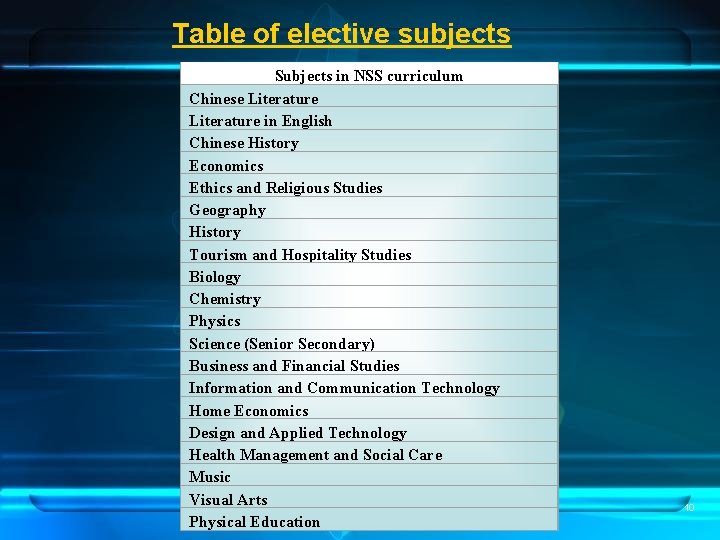
Table of elective subjects Subjects in NSS curriculum Chinese Literature in English Chinese History Economics Ethics and Religious Studies Geography History Tourism and Hospitality Studies Biology Chemistry Physics Science (Senior Secondary) Business and Financial Studies Information and Communication Technology Home Economics Design and Applied Technology Health Management and Social Care Music Visual Arts Physical Education 10
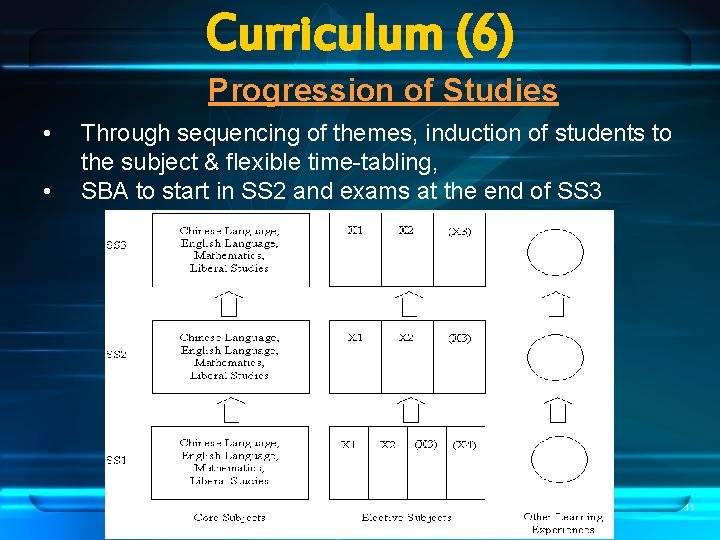
Curriculum (6) Progression of Studies • • Through sequencing of themes, induction of students to the subject & flexible time-tabling, SBA to start in SS 2 and exams at the end of SS 3 11
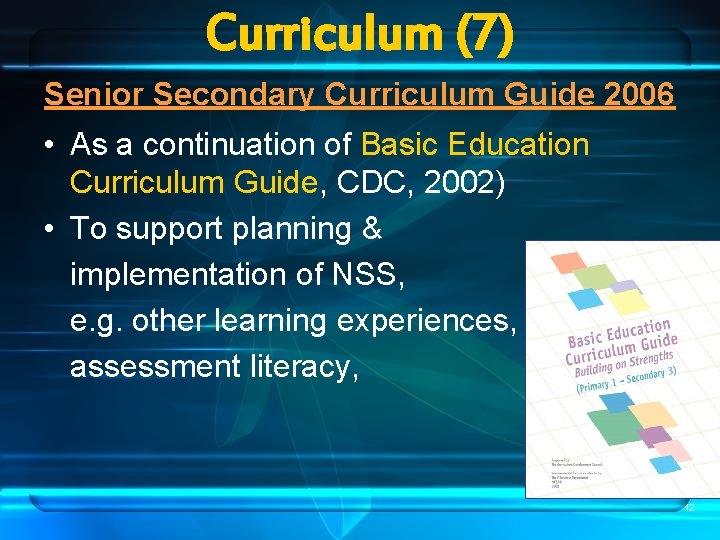
Curriculum (7) Senior Secondary Curriculum Guide 2006 • As a continuation of Basic Education Curriculum Guide, CDC, 2002) • To support planning & implementation of NSS, e. g. other learning experiences, assessment literacy, 12
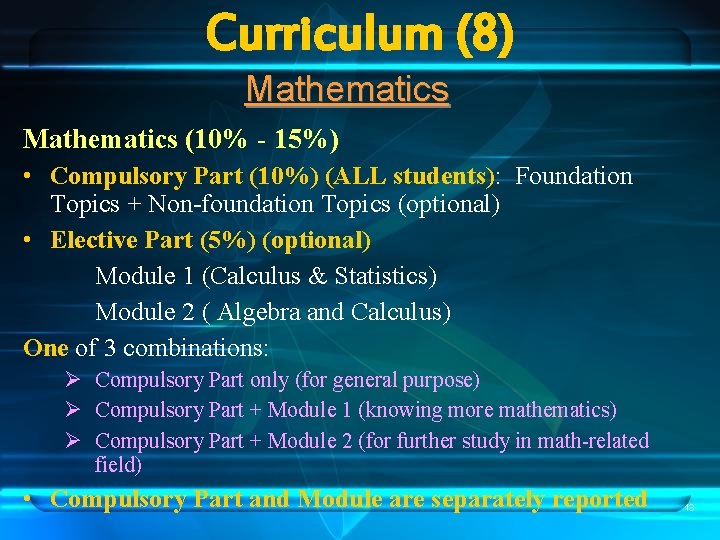
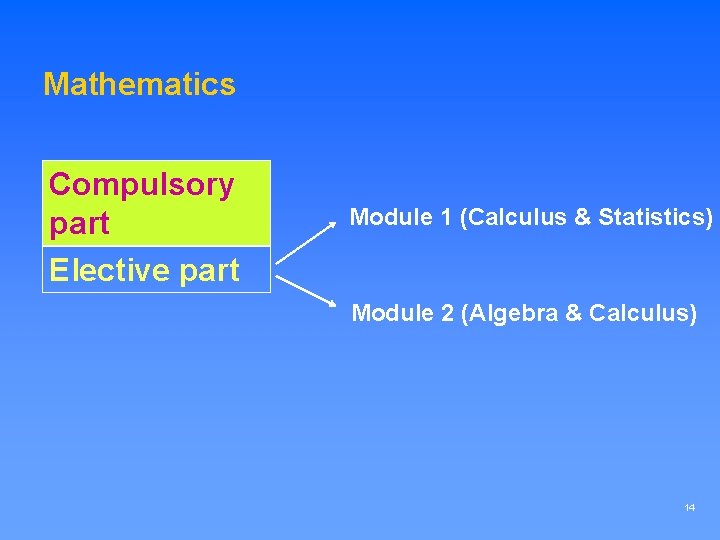
Curriculum (8) Mathematics (10% - 15%) • Compulsory Part (10%) (ALL students): Foundation Topics + Non-foundation Topics (optional) • Elective Part (5%) (optional) Module 1 (Calculus & Statistics) Module 2 ( Algebra and Calculus) One of 3 combinations: Ø Compulsory Part only (for general purpose) Ø Compulsory Part + Module 1 (knowing more mathematics) Ø Compulsory Part + Module 2 (for further study in math-related field) • Compulsory Part and Module are separately reported 13
Mathematics Compulsory part Elective part Module 1 (Calculus & Statistics) Module 2 (Algebra & Calculus) 14
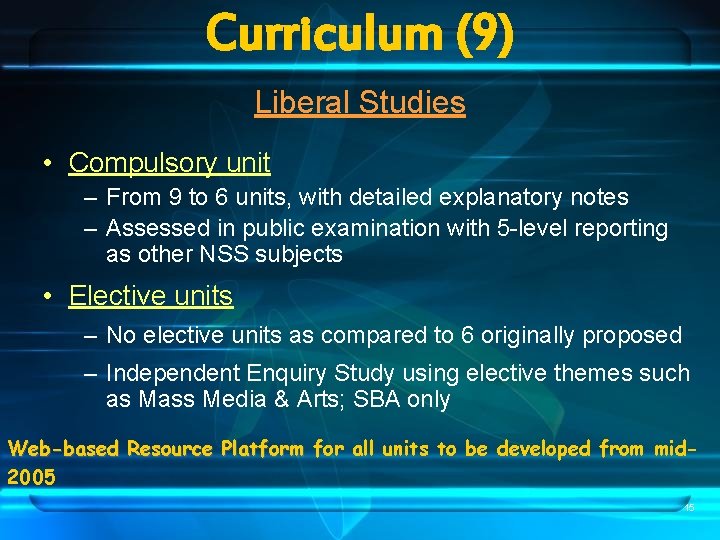
Curriculum (9) Liberal Studies • Compulsory unit – From 9 to 6 units, with detailed explanatory notes – Assessed in public examination with 5 -level reporting as other NSS subjects • Elective units – No elective units as compared to 6 originally proposed – Independent Enquiry Study using elective themes such as Mass Media & Arts; SBA only Web-based Resource Platform for all units to be developed from mid 2005 15
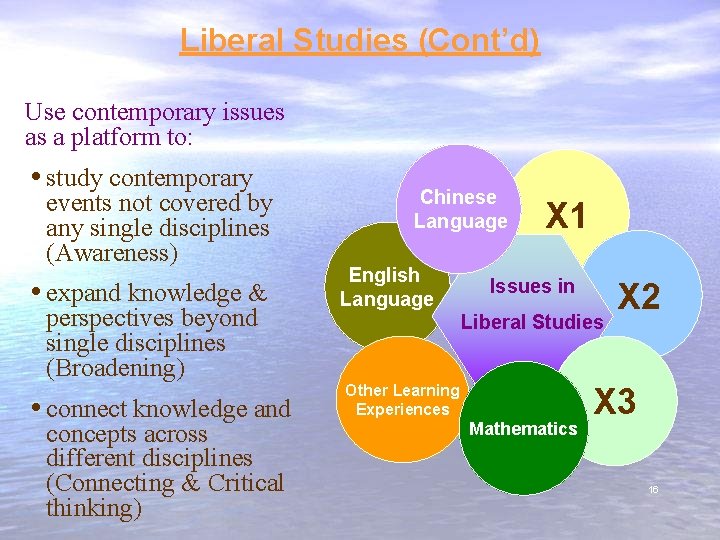
Liberal Studies (Cont’d) Use contemporary issues as a platform to: • study contemporary events not covered by any single disciplines (Awareness) • expand knowledge & perspectives beyond single disciplines (Broadening) • connect knowledge and concepts across different disciplines (Connecting & Critical thinking) Chinese Language English Language X 1 Issues in Liberal Studies Other Learning Experiences Mathematics X 2 X 3 16
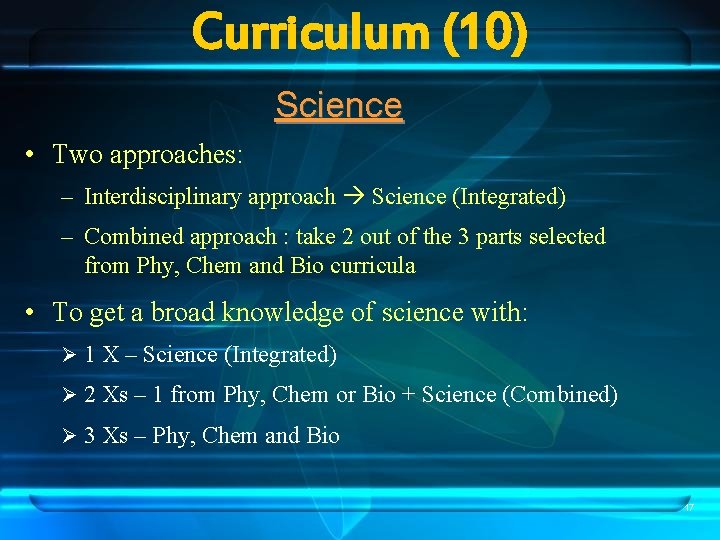
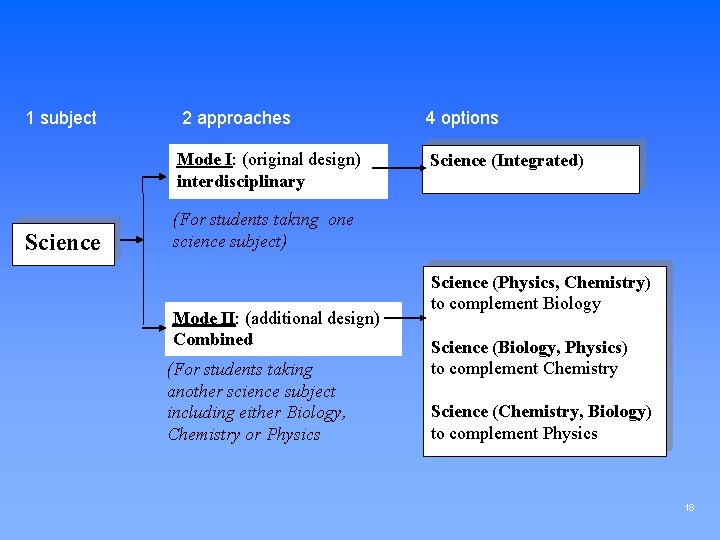
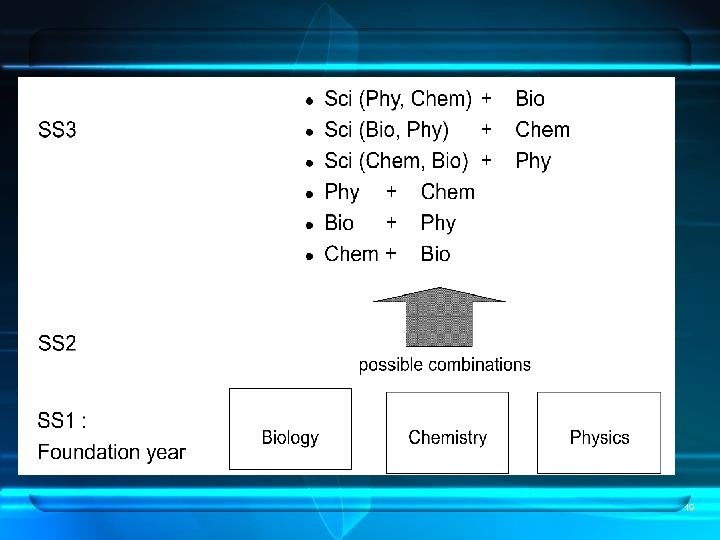
Curriculum (10) Science • Two approaches: – Interdisciplinary approach Science (Integrated) – Combined approach : take 2 out of the 3 parts selected from Phy, Chem and Bio curricula • To get a broad knowledge of science with: Ø 1 X – Science (Integrated) Ø 2 Xs – 1 from Phy, Chem or Bio + Science (Combined) Ø 3 Xs – Phy, Chem and Bio 17
1 subject Science 2 approaches 4 options Mode I: (original design) interdisciplinary Science (Integrated) (For students taking one science subject) Mode II: (additional design) Combined (For students taking another science subject including either Biology, Chemistry or Physics Science (Physics, Chemistry) to complement Biology Science (Biology, Physics) to complement Chemistry Science (Chemistry, Biology) to complement Physics 18
19
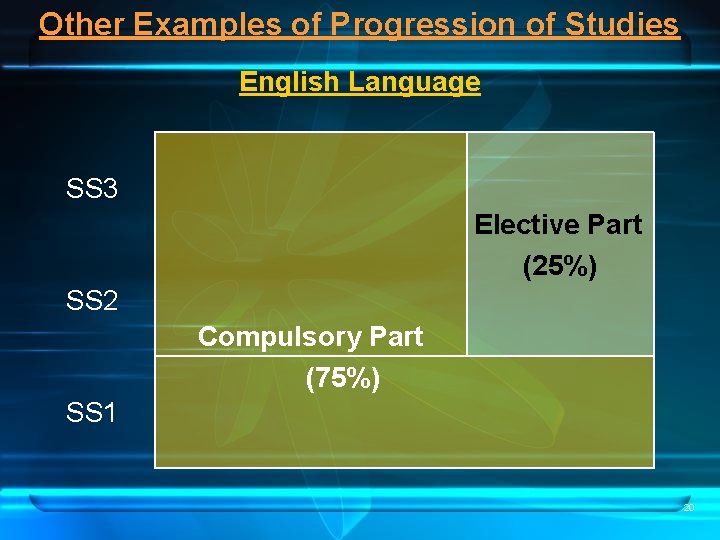
Other Examples of Progression of Studies English Language SS 3 Elective Part (25%) SS 2 Compulsory Part (75%) SS 1 20
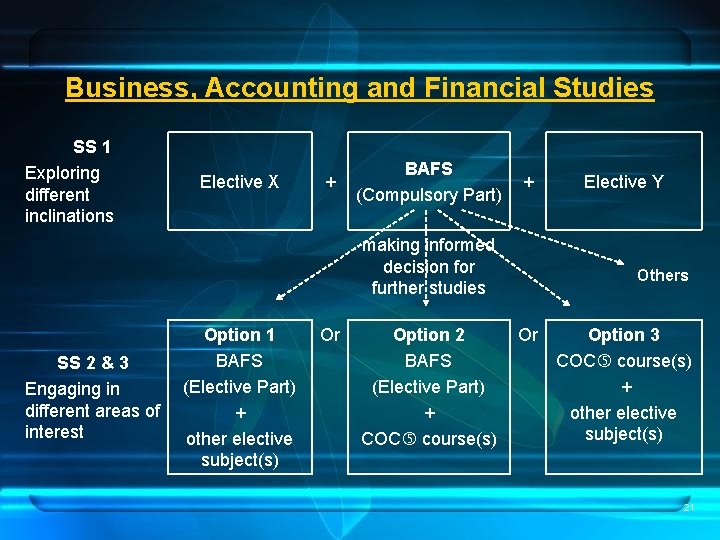
Business, Accounting and Financial Studies SS 1 Exploring different inclinations Elective X + BAFS (Compulsory Part) + making informed decision for further studies SS 2 & 3 Engaging in different areas of interest Option 1 BAFS (Elective Part) + other elective subject(s) Or Option 2 BAFS (Elective Part) + COC course(s) Elective Y Others Or Option 3 COC course(s) + other elective subject(s) 21
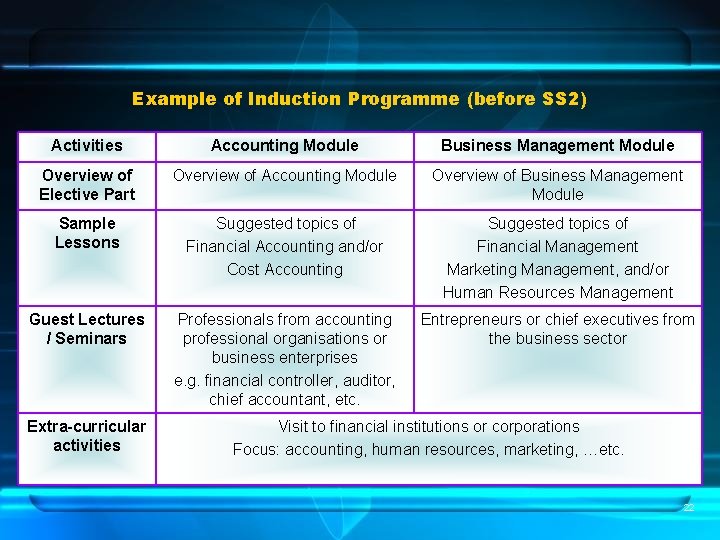
Example of Induction Programme (before SS 2) Activities Accounting Module Business Management Module Overview of Elective Part Overview of Accounting Module Overview of Business Management Module Sample Lessons Suggested topics of Financial Accounting and/or Cost Accounting Suggested topics of Financial Management Marketing Management, and/or Human Resources Management Guest Lectures / Seminars Professionals from accounting professional organisations or business enterprises e. g. financial controller, auditor, chief accountant, etc. Entrepreneurs or chief executives from the business sector Extra-curricular activities Visit to financial institutions or corporations Focus: accounting, human resources, marketing, …etc. 22
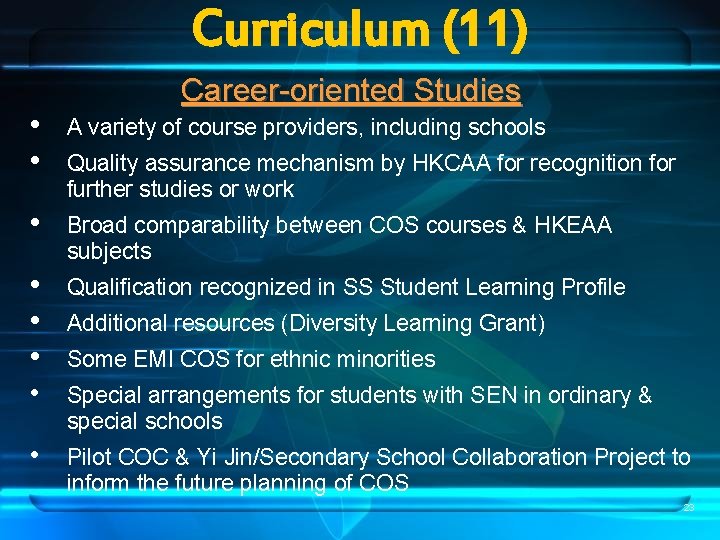
Curriculum (11) Career-oriented Studies • • A variety of course providers, including schools • Broad comparability between COS courses & HKEAA subjects • • • Qualification recognized in SS Student Learning Profile • Special arrangements for students with SEN in ordinary & special schools • Pilot COC & Yi Jin/Secondary School Collaboration Project to inform the future planning of COS Quality assurance mechanism by HKCAA for recognition for further studies or work Additional resources (Diversity Learning Grant) Some EMI COS for ethnic minorities 23
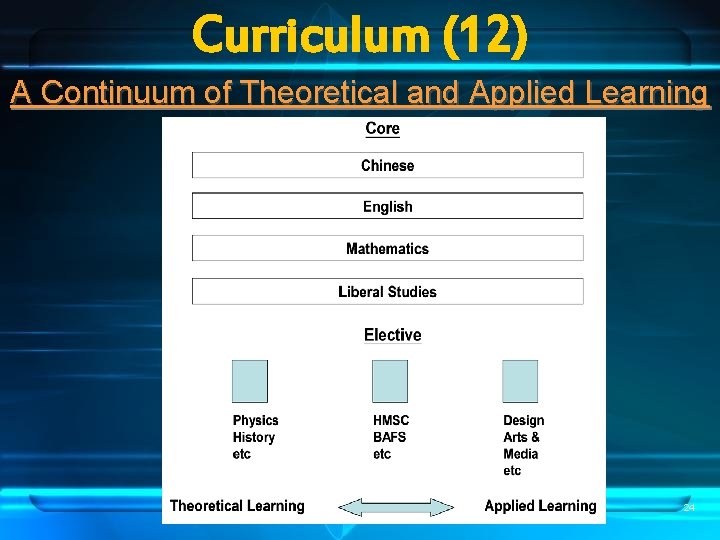
Curriculum (12) A Continuum of Theoretical and Applied Learning 24
Curriculum (13) Other Languages, PTH & Chinese Culture § Other languages, e. g. French, German, Japanese § PTH - 2 elective modules (普通話傳意和應用, 普通話表 演藝術) on PTH in Chinese Language subject for more capable students to excel - HKEAA will continue to offer oral & listening test in both Cantonese and PTH as choices to students § Strengthening of culture, values & attitudes (e. g. gender, sustainability, …) 25
Curriculum (14) Special Education • • • Students with SEN - 6 years of secondary schooling Capable students to follow the same student programme Mentally handicapped (MH) students 10+2 with clearning outcomes & assessment standards Curriculum for MH students to be built on the existing basic education, EYE experiences, aims of NSS Discussion with the sector to finalize the way forward by the year end Extra funding for special schools and ordinary schools taking a significant portion of students with SEN 26
Curriculum (15) Gifted Education • • • Stretching the potential of gifted students through a differentiated curriculum Working with universities to offer programmes for the exceptionally gifted in subjects relevant to tertiary studies and subjects not currently included under NSS Regional Gifted Education Clusters and teachers’ network in different areas Standard Referenced assessment to encourage upward aspirations Use Diversity Learning Grant 27
2 nd Stage of Consultation on Curriculum & Assessment Frameworks 1) 2) 3) 4) 5) To consult professionals on curriculum & assessment frameworks To demonstrate exemplars of learning, teaching & assessment, & other good practice To solicit information on provision of subjects, needs for professional development To provide early information for school planning (e. g. overview of Progression of Study for SS 1, SS 2, SS 3, SBA) & interface matters To establish means for further communication 28
2 Stage of Consultation (Cont’d) u u “ 3+3+4” Report to set further directions (especially chapters 2 -9) Consultation means (June – Sept 2005) l l l Web version accessible to the public Seminars for principals/vice principals & teachers Meetings with professional groups & institutions Questionnaires for schools E-mail, media, write-ins 29
Managing & Leading Change • Critical milestones – certainties & uncertainties • Communication means - • Web bulletin District focus groups E-mail Advisory bodies Coherence-making: JSEA, Education regulations/ordinance, MOI 30
31