
The Neurogenic Bowel Conservative management lifestyle and rehabilitative
The Neurogenic Bowel Conservative management - lifestyle and rehabilitative treatments ICS Annual Meeting Montreal Canada W 30 Friday October 9, 2015 Dr Beth Shelly PT, DPT, WCS, BCB PMD beth@bethshelly. com www. bethshelly. com
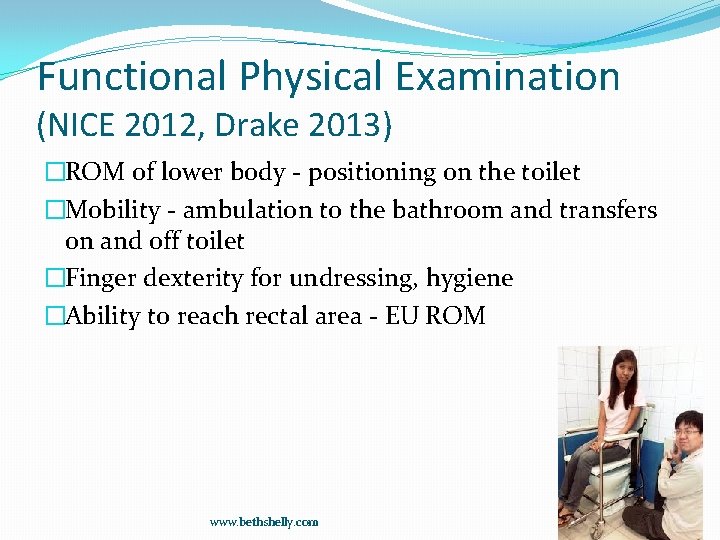
Functional Physical Examination (NICE 2012, Drake 2013) �ROM of lower body - positioning on the toilet �Mobility - ambulation to the bathroom and transfers on and off toilet �Finger dexterity for undressing, hygiene �Ability to reach rectal area - EU ROM www. bethshelly. com
Functional Physical Examination �Strength in the upper and lower extremities �Sitting balance �PFM function - Digital PFM examination for weakness or spasm per rectum �Superficial EMG assessment of PFM for contraction and valsava test for paradoxical PFM contractions during bearing down �Imagining ultra sound www. bethshelly. com
Evidence for conservative management of patient with neurogenic bowel dysfunction �Little high level evidence for any one treatment �Krassioukov 2010 - systematic review �Coggrave 2014 - Cochrane �Paris 2011, Awad 2011 - literature review �Drake 2013 - ICI guidelines www. bethshelly. com
Evidence for conservative management of patient with neurogenic bowel dysfunction �Treatment of neurogenic bowel "has remained essentially unchanged for several decades" (Krassioukov 2010) �ICCS neurogenic bowel evaluation and management "Paucity of level 1 or level 2 publications" (Bauer 2012) �Cochrane 2014 "There is still remarkably little research on this common and very significant issue" (Coggrave 2014) www. bethshelly. com
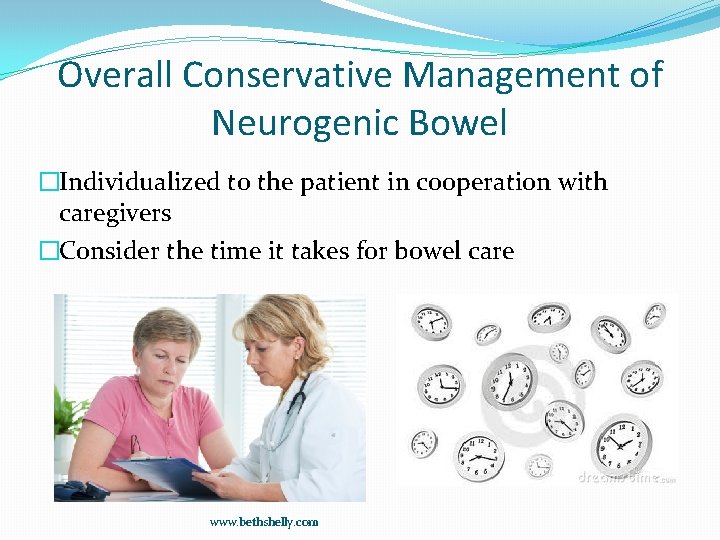
Overall Conservative Management of Neurogenic Bowel �Individualized to the patient in cooperation with caregivers �Consider the time it takes for bowel care www. bethshelly. com
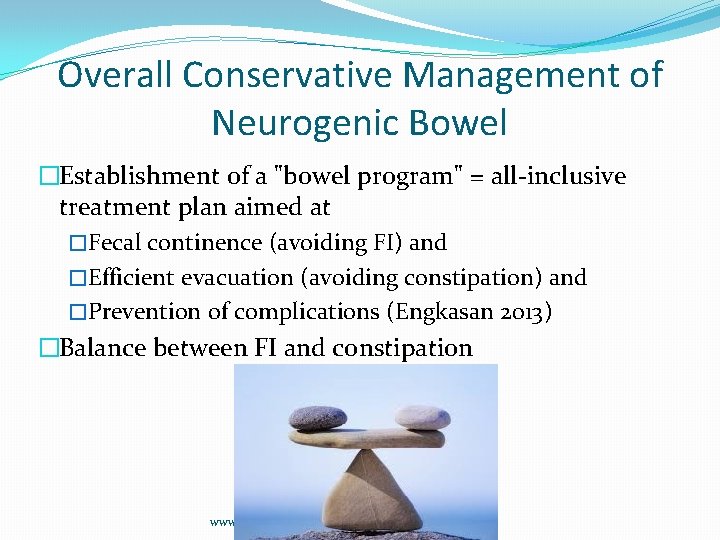
Overall Conservative Management of Neurogenic Bowel �Establishment of a "bowel program" = all-inclusive treatment plan aimed at �Fecal continence (avoiding FI) and �Efficient evacuation (avoiding constipation) and �Prevention of complications (Engkasan 2013) �Balance between FI and constipation www. bethshelly. com
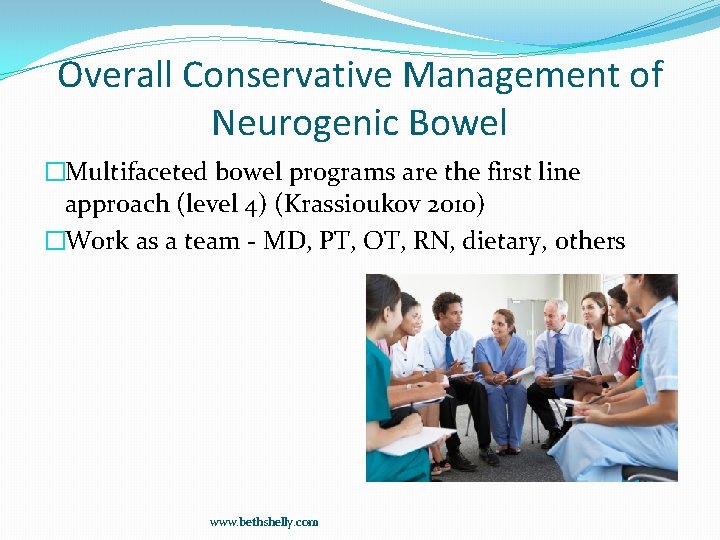
Overall Conservative Management of Neurogenic Bowel �Multifaceted bowel programs are the first line approach (level 4) (Krassioukov 2010) �Work as a team - MD, PT, OT, RN, dietary, others www. bethshelly. com
Things it would be helpful for rehabilitation staff to know �Motility of bowel and any treatments being used by patient for that reason �Anorectal sensation - hypersensitivity or decrease �EAS and or IAS defects �Results of defecography or diagnosis of paradoxical sphincter contraction �Physician plan of care - therapy can reinforce MD plan of care www. bethshelly. com

Most researched treatments - all have level 3 evidence (Drake 2013) �Multifaceted bowel programs �Digital rectal stimulation �Abdominal massage �Electrical stimulation �Patient and caregiver education www. bethshelly. com
Optimize stool consistency (more info at www. bethshelly. com) �Soft enough to pass easily �Solid enough to stay in rectum �Reflexic evacuation = soft formed stool �Areflexic evacuation (manual) = firm stool �Fiber intake ? / Fluid intake ? �Patients must understand factors that increase and decrease their own bowel transit www. bethshelly. com

�Characteristics of bowel management programs for patients with SCI (Engkasan 2013) �Bowel management in pts with SCI (Adriaansen 2015) �Common pattern of bowel training program (Benevento 2002) www. bethshelly. com
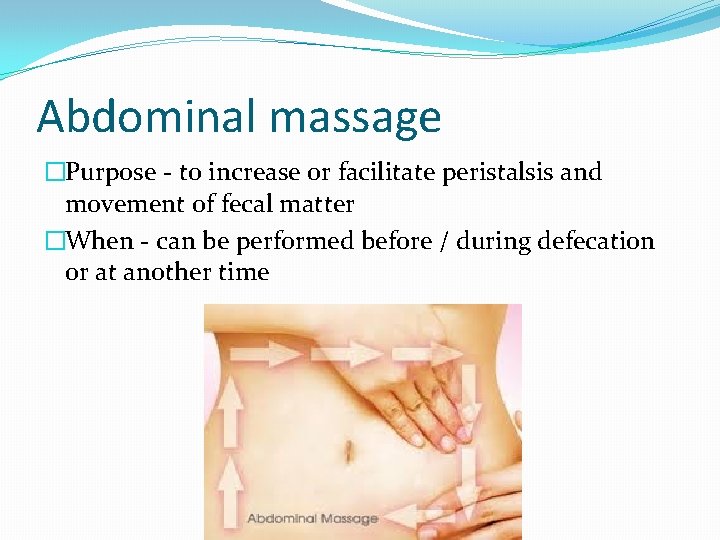
Abdominal massage �Purpose - to increase or facilitate peristalsis and movement of fecal matter �When - can be performed before / during defecation or at another time www. bethshelly. com
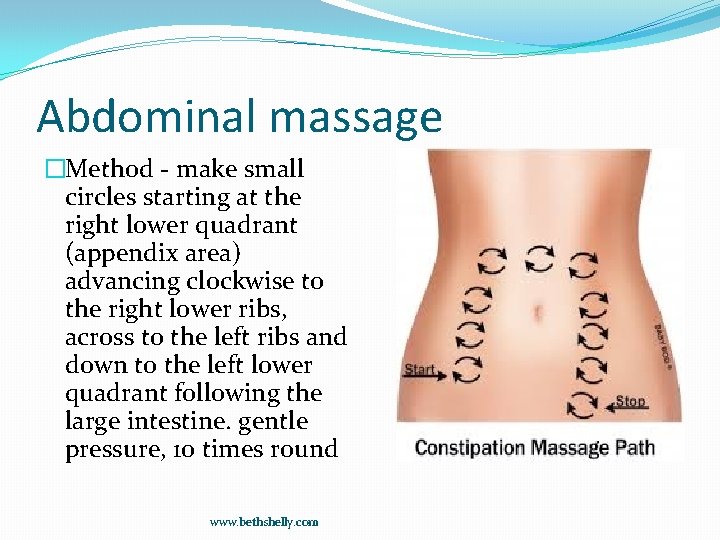
Abdominal massage �Method - make small circles starting at the right lower quadrant (appendix area) advancing clockwise to the right lower ribs, across to the left ribs and down to the left lower quadrant following the large intestine. gentle pressure, 10 times round www. bethshelly. com
Abdominal massage - Evidence � Abdominal massage plus lifestyle advice �Compared to lifestyle advice alone �In patients with MS �For the treatment of constipation. �One outcome measure was significantly improved �One outcome measure did not change. �Treatment effect stopped when treatment stopped. (Mc. Clurg 2011). www. bethshelly. com
Abdominal massage - Evidence �Bowel massage versus no massage �In pts with CVA �Favors massage for increased BM per week. (Coggrave 2014) �Bowel massage in pts with SCI � 15 min per days �Resulted in increased transit time (Ayas 2006) www. bethshelly. com
Non Implanted Electrical Stimulation (ES) (summarized in Drake 2013, Paris 2011, Krassioukov 2010) �Evidence that various ES techniques may change transit time �External abdomen ES �Functional sacral nerve root magnetic stimulation �Interferential electrical stimulation �Posterior tibial nerve ES www. bethshelly. com
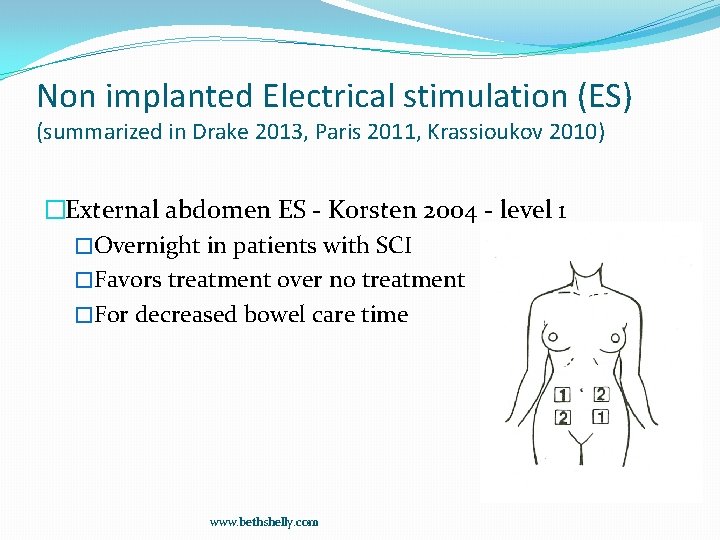
Non implanted Electrical stimulation (ES) (summarized in Drake 2013, Paris 2011, Krassioukov 2010) �External abdomen ES - Korsten 2004 - level 1 �Overnight in patients with SCI �Favors treatment over no treatment �For decreased bowel care time www. bethshelly. com
Non Implanted Electrical Stimulation (ES) (summarized in Drake 2013, Paris 2011, Krassioukov 2010) �Functional sacral nerve root magnetic stimulation (3 studies) �In SCI and Parkinson's disease �Results �Shorter transit times �Improved bowel routine �Increased rectal pressure �Decreased hyperactive rectal contraction www. bethshelly. com
Non Implanted Electrical Stimulation (ES) (summarized in Drake 2013, Paris 2011, Krassioukov 2010) �Interferential electrical stimulation - 250 us (Kajbafzadeh 2012) �For constipation �In children with myelomeningocele � 20 min, 3 times per week �Over the abdomen www. bethshelly. com
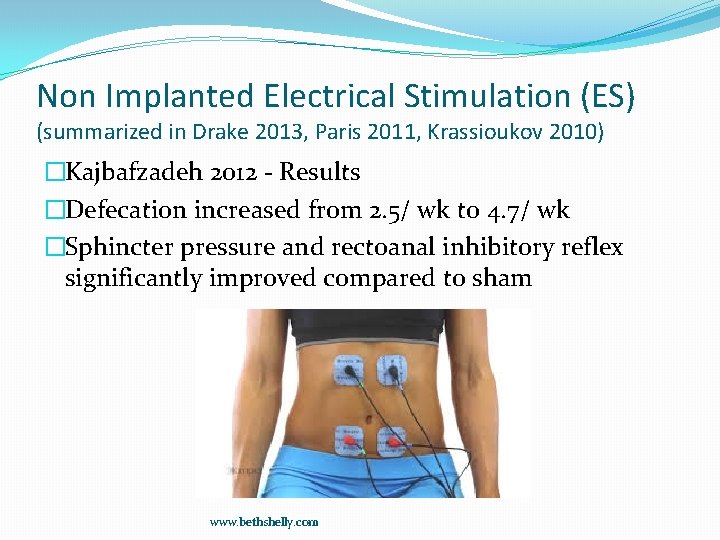
Non Implanted Electrical Stimulation (ES) (summarized in Drake 2013, Paris 2011, Krassioukov 2010) �Kajbafzadeh 2012 - Results �Defecation increased from 2. 5/ wk to 4. 7/ wk �Sphincter pressure and rectoanal inhibitory reflex significantly improved compared to sham www. bethshelly. com
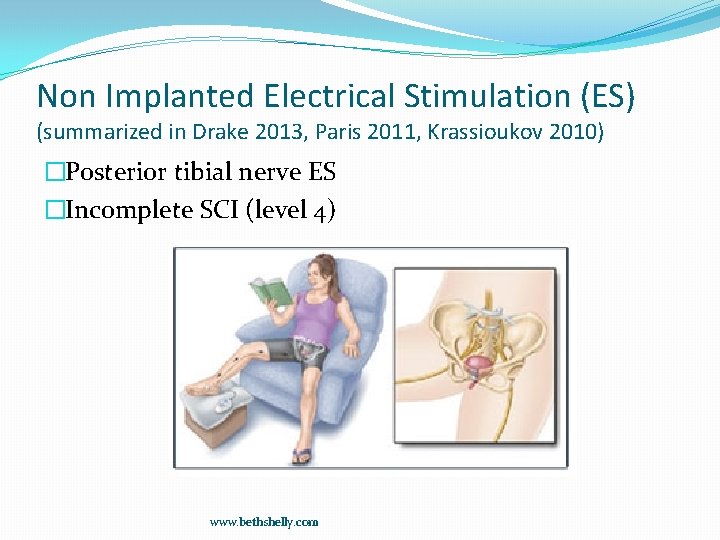
Non Implanted Electrical Stimulation (ES) (summarized in Drake 2013, Paris 2011, Krassioukov 2010) �Posterior tibial nerve ES �Incomplete SCI (level 4) www. bethshelly. com
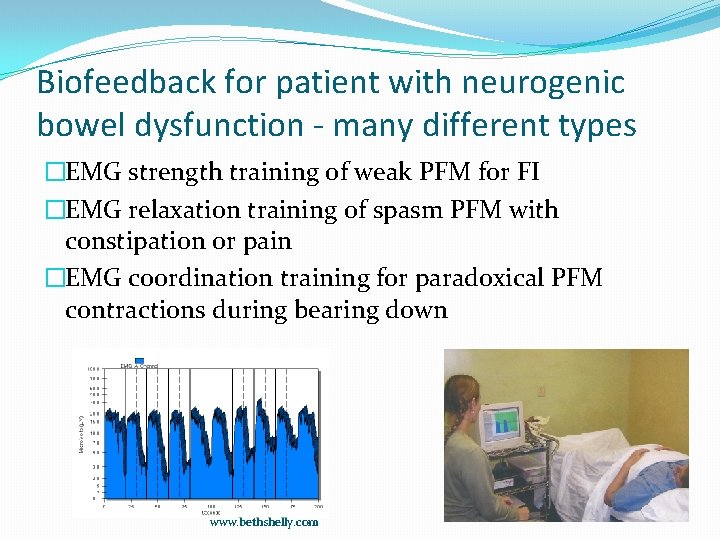
Biofeedback for patient with neurogenic bowel dysfunction - many different types �EMG strength training of weak PFM for FI �EMG relaxation training of spasm PFM with constipation or pain �EMG coordination training for paradoxical PFM contractions during bearing down www. bethshelly. com
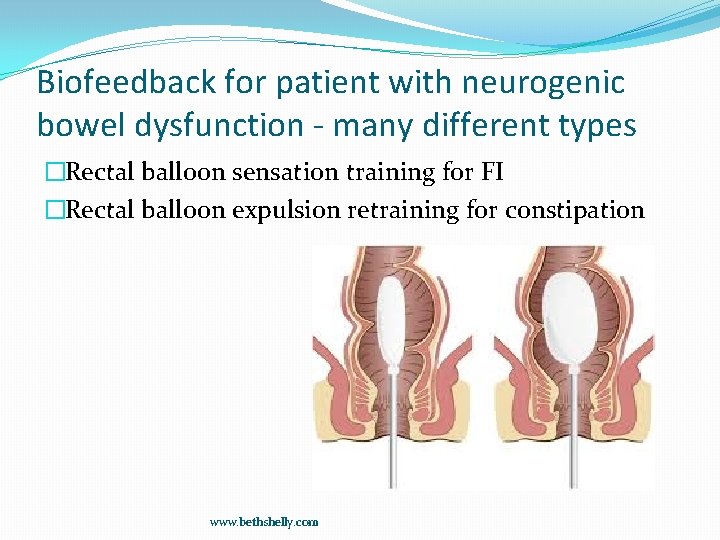
Biofeedback for patient with neurogenic bowel dysfunction - many different types �Rectal balloon sensation training for FI �Rectal balloon expulsion retraining for constipation www. bethshelly. com
Biofeedback (Paris 2011) � 6 studies �Children with myelomengocele (best results) �MS �Diabetic neuropathy �Overall 33% to 66% of patients felt the biofeedback was helpful. www. bethshelly. com
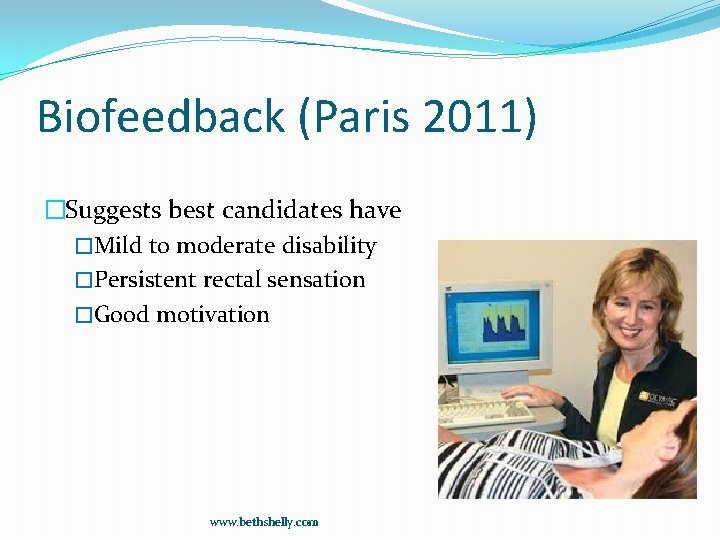
Biofeedback (Paris 2011) �Suggests best candidates have �Mild to moderate disability �Persistent rectal sensation �Good motivation www. bethshelly. com
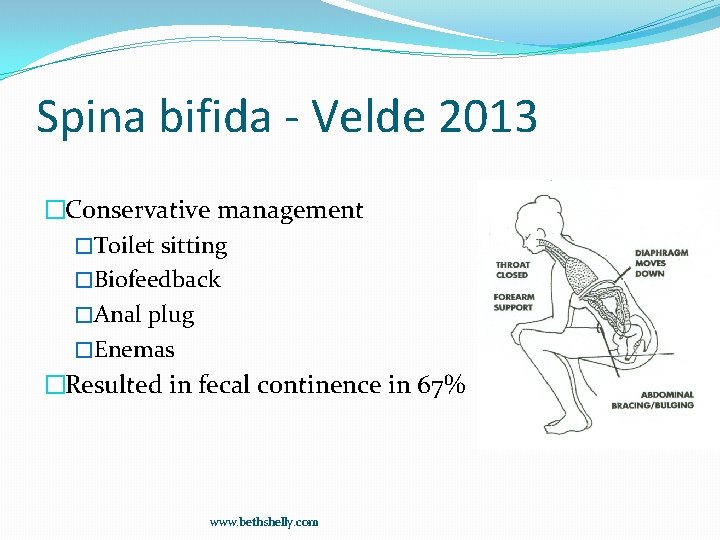
Spina bifida - Velde 2013 �Conservative management �Toilet sitting �Biofeedback �Anal plug �Enemas �Resulted in fecal continence in 67% www. bethshelly. com
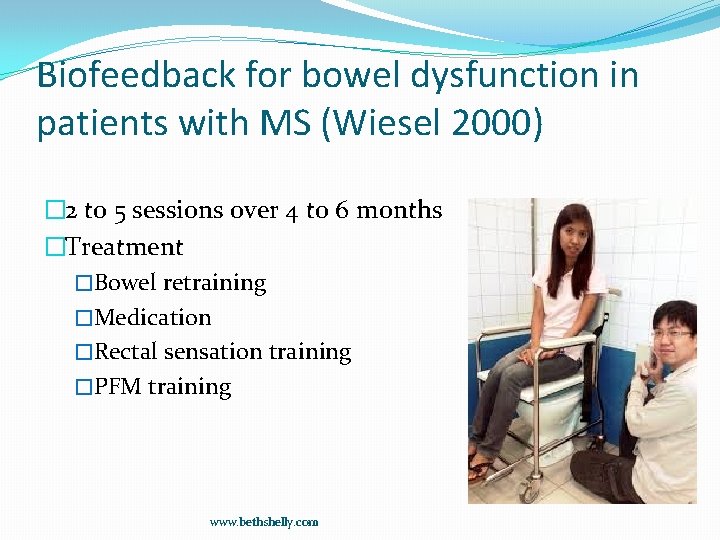
Biofeedback for bowel dysfunction in patients with MS (Wiesel 2000) � 2 to 5 sessions over 4 to 6 months �Treatment �Bowel retraining �Medication �Rectal sensation training �PFM training www. bethshelly. com
Biofeedback for bowel dysfunction in patients with MS (Wiesel 2000) �Only predictor of success was �Mild to moderate disability �Stable disease process � 5 of 13 patients reported marked to moderate benefit �With some able to decrease medications www. bethshelly. com
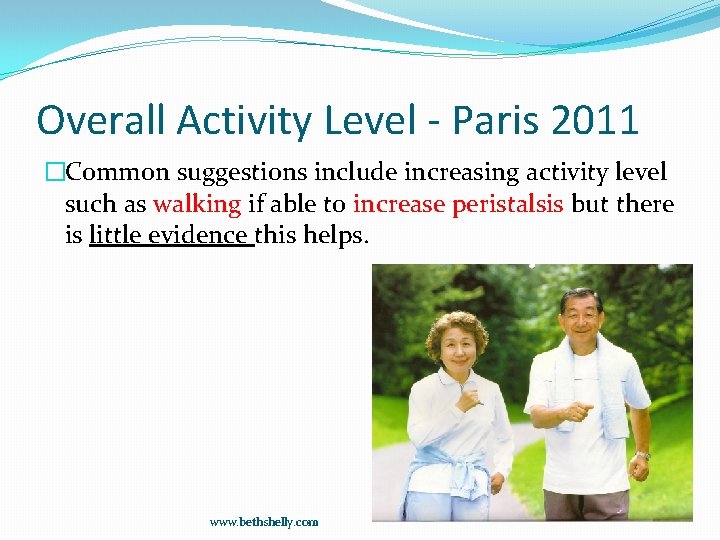
Overall Activity Level - Paris 2011 �Common suggestions include increasing activity level such as walking if able to increase peristalsis but there is little evidence this helps. www. bethshelly. com
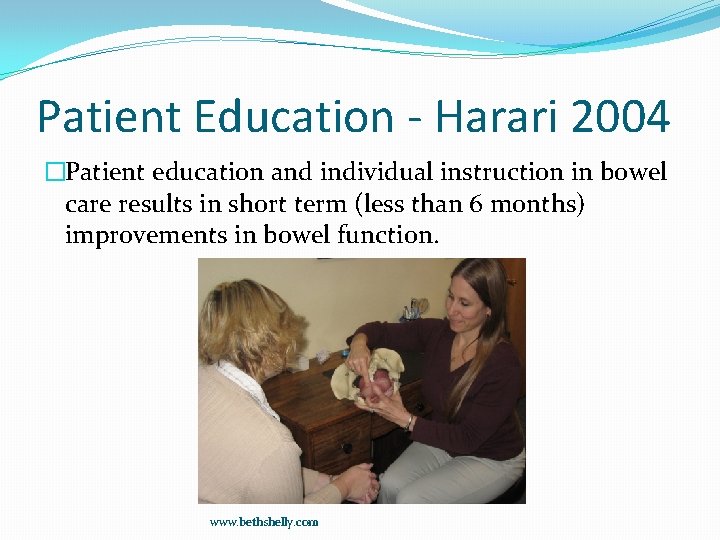
Patient Education - Harari 2004 �Patient education and individual instruction in bowel care results in short term (less than 6 months) improvements in bowel function. www. bethshelly. com
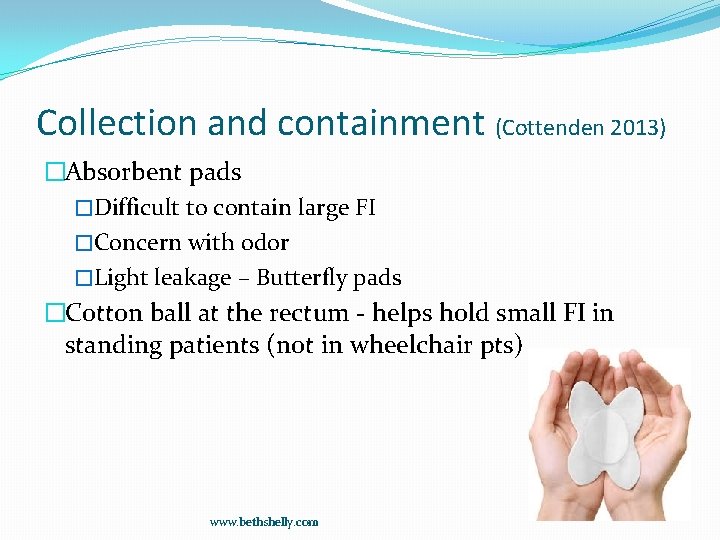
Collection and containment (Cottenden 2013) �Absorbent pads �Difficult to contain large FI �Concern with odor �Light leakage – Butterfly pads �Cotton ball at the rectum - helps hold small FI in standing patients (not in wheelchair pts) www. bethshelly. com
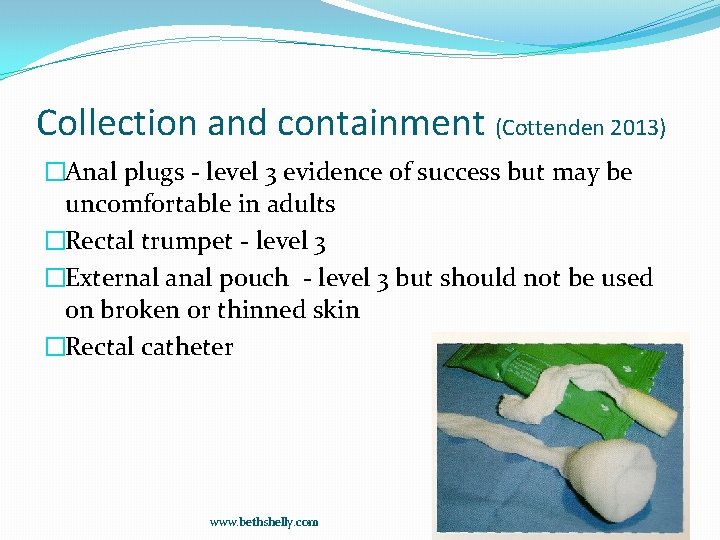
Collection and containment (Cottenden 2013) �Anal plugs - level 3 evidence of success but may be uncomfortable in adults �Rectal trumpet - level 3 �External anal pouch - level 3 but should not be used on broken or thinned skin �Rectal catheter www. bethshelly. com
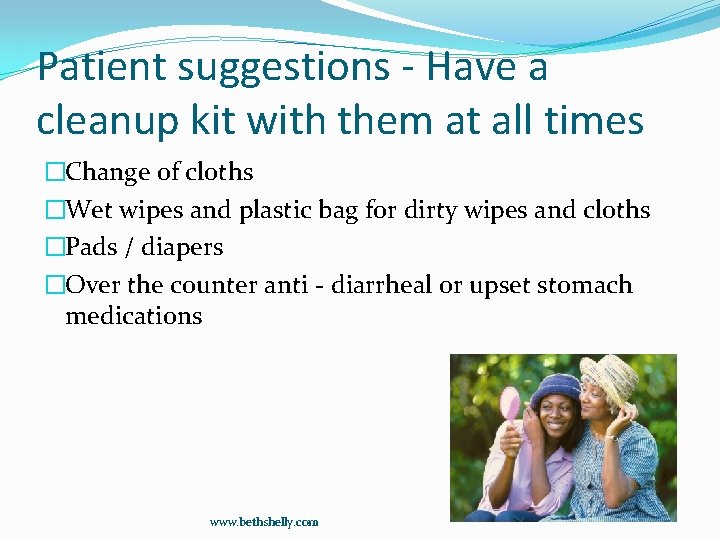
Patient suggestions - Have a cleanup kit with them at all times �Change of cloths �Wet wipes and plastic bag for dirty wipes and cloths �Pads / diapers �Over the counter anti - diarrheal or upset stomach medications www. bethshelly. com

Questions beth@bethshelly. com References and resources www. bethshelly. com
- Slides: 35