
The Neural Control of Behavior Chapter 5 Neurons
The Neural Control of Behavior Chapter 5
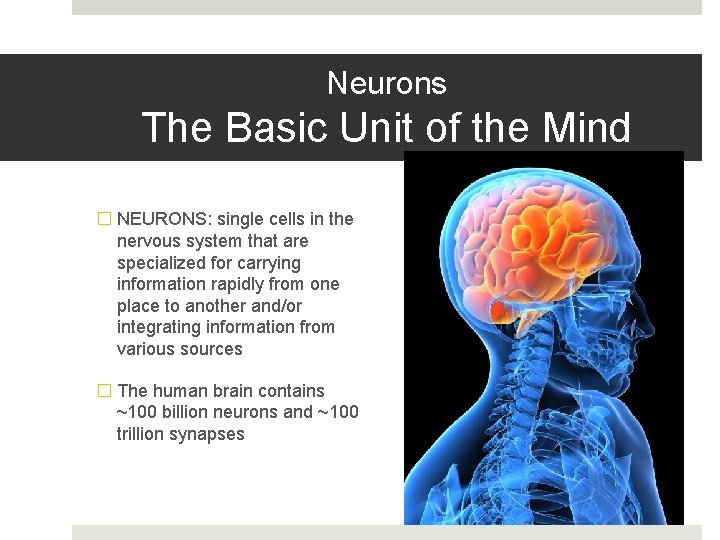
Neurons The Basic Unit of the Mind � NEURONS: single cells in the nervous system that are specialized for carrying information rapidly from one place to another and/or integrating information from various sources � The human brain contains ~100 billion neurons and ~100 trillion synapses
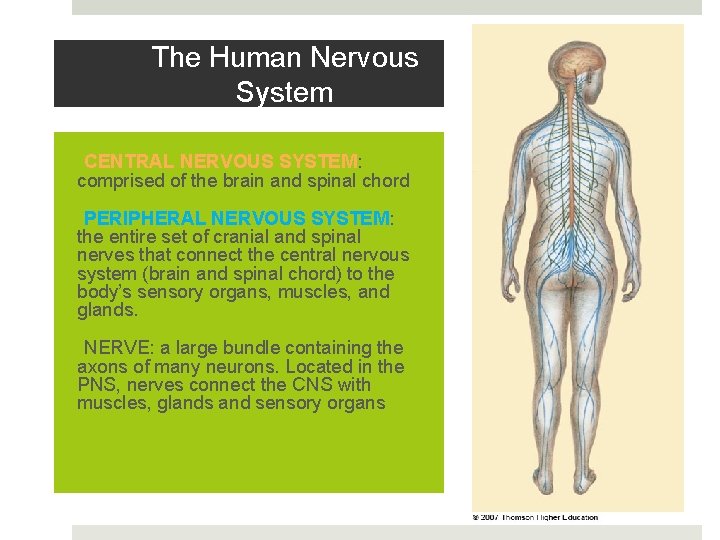
The Human Nervous System • CENTRAL NERVOUS SYSTEM: comprised of the brain and spinal chord • PERIPHERAL NERVOUS SYSTEM: the entire set of cranial and spinal nerves that connect the central nervous system (brain and spinal chord) to the body’s sensory organs, muscles, and glands. • NERVE: a large bundle containing the axons of many neurons. Located in the PNS, nerves connect the CNS with muscles, glands and sensory organs
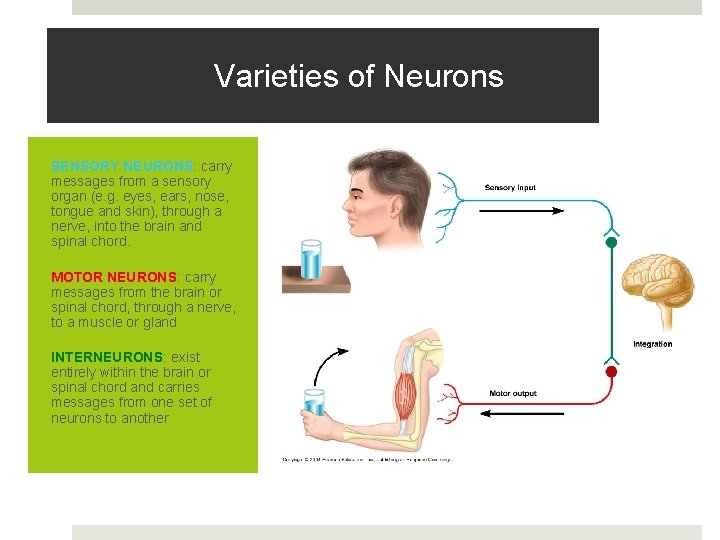
Varieties of Neurons SENSORY NEURONS: carry messages from a sensory organ (e. g. eyes, ears, nose, tongue and skin), through a nerve, into the brain and spinal chord. MOTOR NEURONS: carry messages from the brain or spinal chord, through a nerve, to a muscle or gland INTERNEURONS: exist entirely within the brain or spinal chord and carries messages from one set of neurons to another
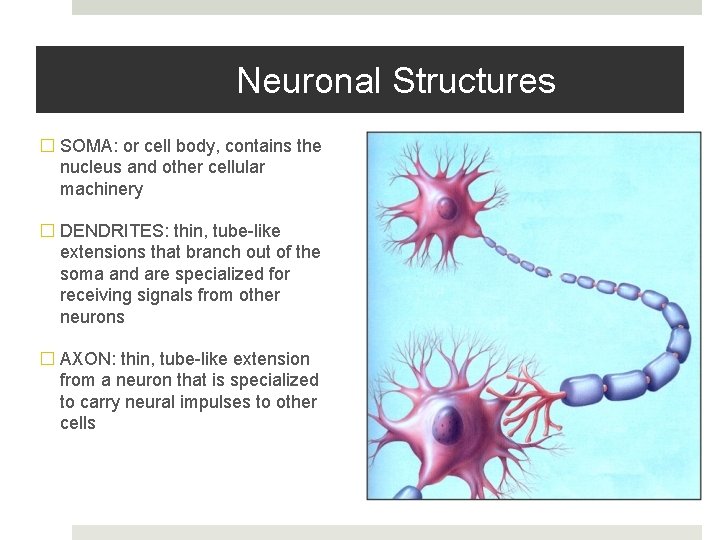
Neuronal Structures � SOMA: or cell body, contains the nucleus and other cellular machinery � DENDRITES: thin, tube-like extensions that branch out of the soma and are specialized for receiving signals from other neurons � AXON: thin, tube-like extension from a neuron that is specialized to carry neural impulses to other cells

Neuronal Structures � AXON TERMINAL : a swelling at the end of the axon that is designed to release a chemical substance onto another neuron, muscle or gland cell � MYELIN SHEATH: a casing of fatty cells wrapped tightly around the axons of some neurons
Action Potentials ACTION POTENTIAL: neural impulses; the all-ornothing electrical bursts that begin at one end of the axon of a neuron and move along the axon to the other end

The Neuronal Membrane CELL MEMBRANE: thin, porous outer covering of a neuron or other cell that separates the cell’s intracellular fluid from extracellular fluid
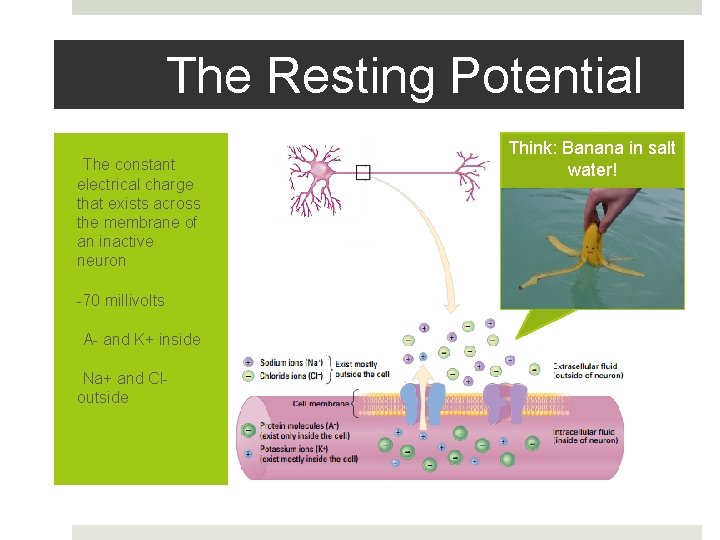
The Resting Potential • The constant electrical charge that exists across the membrane of an inactive neuron -70 millivolts • A- and K+ inside • Na+ and Cloutside Think: Banana in salt water!
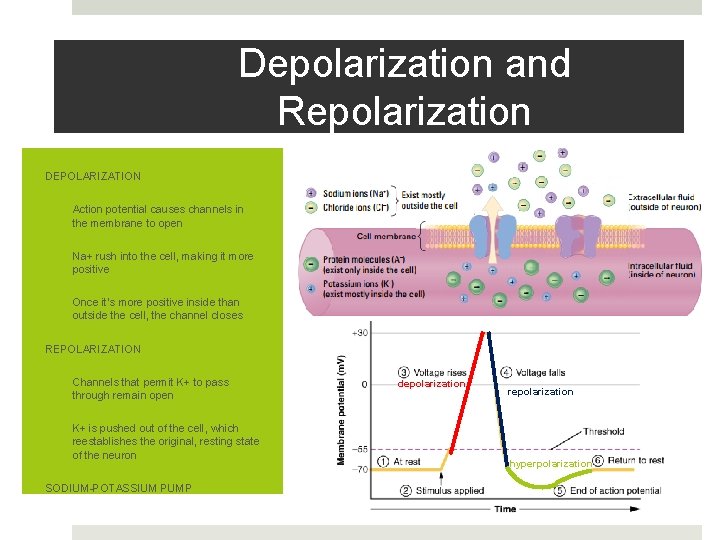
Depolarization and Repolarization DEPOLARIZATION 1. Action potential causes channels in the membrane to open 2. Na+ rush into the cell, making it more positive 3. Once it’s more positive inside than outside the cell, the channel closes REPOLARIZATION 1. Channels that permit K+ to pass through remain open 2. K+ is pushed out of the cell, which reestablishes the original, resting state of the neuron SODIUM-POTASSIUM PUMP depolarization repolarization hyperpolarization
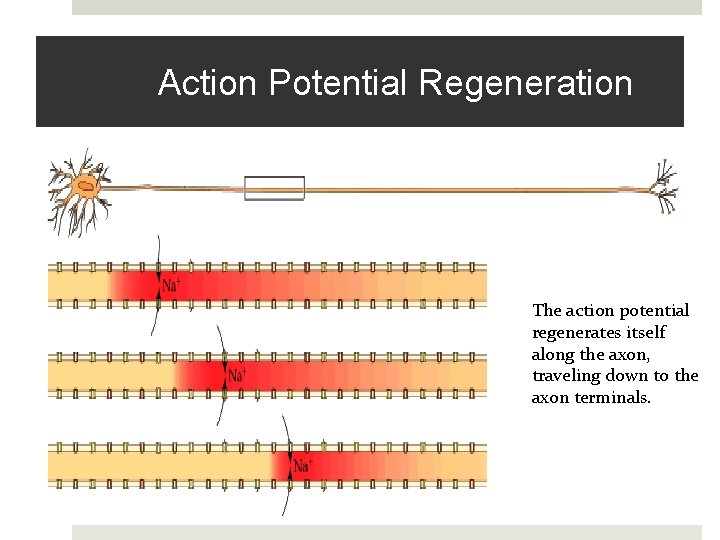
Action Potential Regeneration The action potential regenerates itself along the axon, traveling down to the axon terminals.
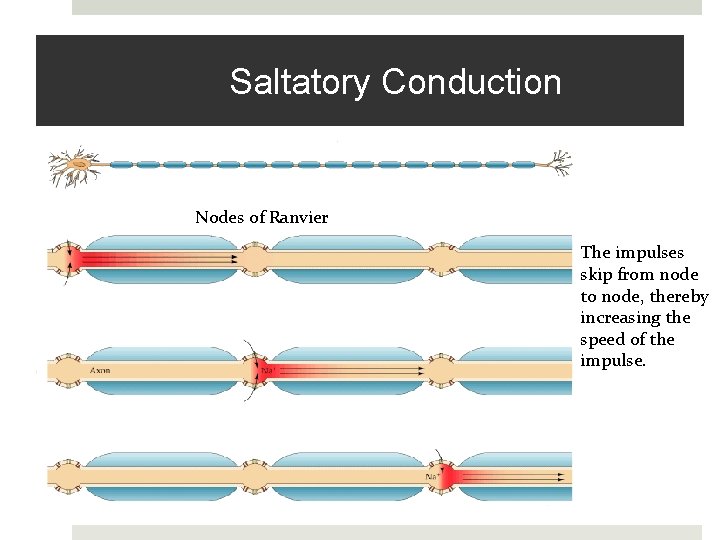
Saltatory Conduction Nodes of Ranvier The impulses skip from node to node, thereby increasing the speed of the impulse.
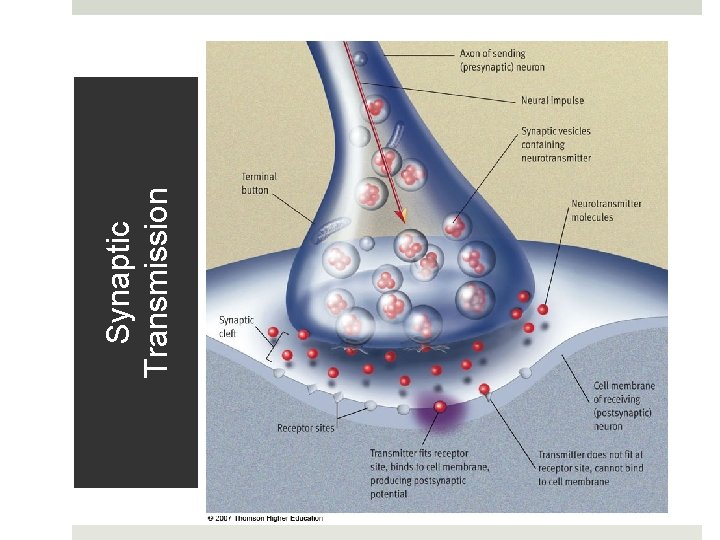
Synaptic Transmission
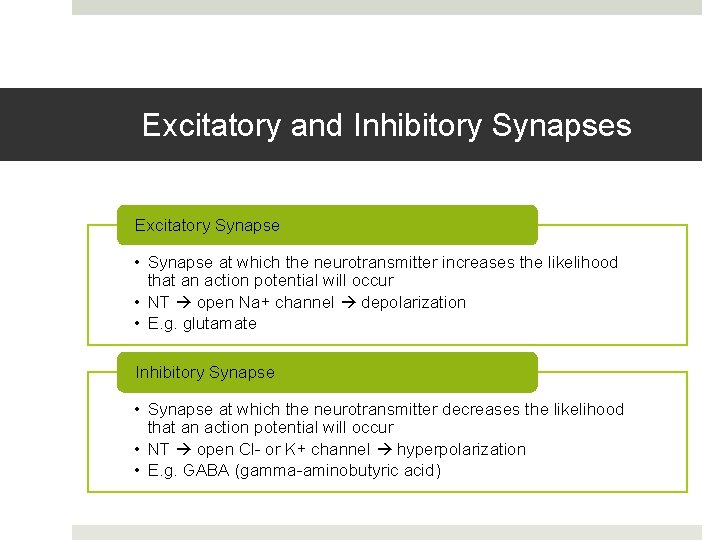
Excitatory and Inhibitory Synapses Excitatory Synapse • Synapse at which the neurotransmitter increases the likelihood that an action potential will occur • NT open Na+ channel depolarization • E. g. glutamate Inhibitory Synapse • Synapse at which the neurotransmitter decreases the likelihood that an action potential will occur • NT open Cl- or K+ channel hyperpolarization • E. g. GABA (gamma-aminobutyric acid)
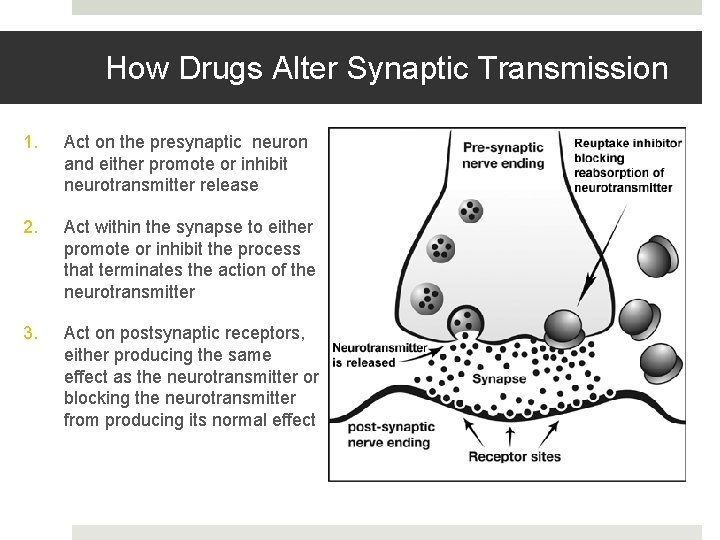
How Drugs Alter Synaptic Transmission 1. Act on the presynaptic neuron and either promote or inhibit neurotransmitter release 2. Act within the synapse to either promote or inhibit the process that terminates the action of the neurotransmitter 3. Act on postsynaptic receptors, either producing the same effect as the neurotransmitter or blocking the neurotransmitter from producing its normal effect
Neuron birth & death Neurogenesis (neuron birth) • Begins 20 wk after conception, continues into adulthood • After a neuron is born, it migrates to its position in the brain and begins to grow (differentiation) Apoptosis (neuron death) • Loss of synapses = synaptic pruning • Apoptosis is selective cell death; begins before birth and continues into the teen years • “sculpting”
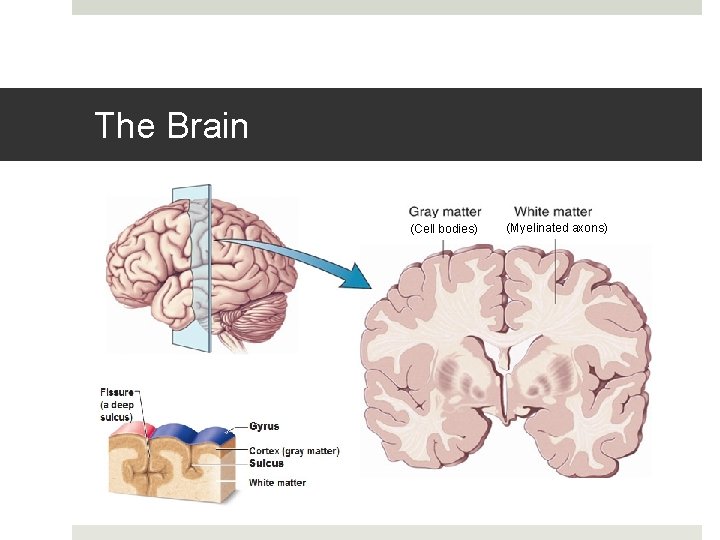
The Brain (Cell bodies) (Myelinated axons)
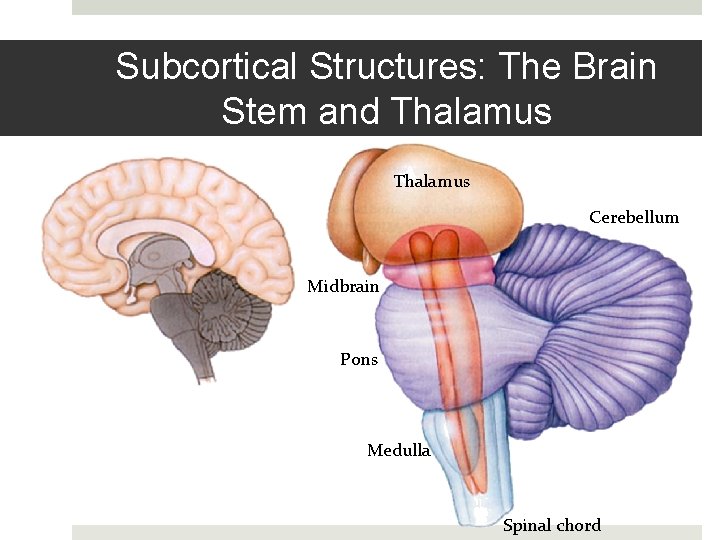
Subcortical Structures: The Brain Stem and Thalamus Cerebellum Midbrain Pons Medulla Spinal chord
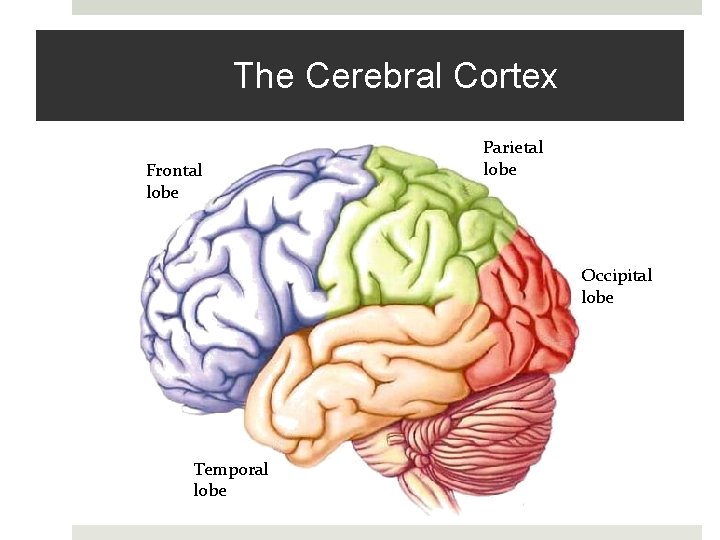
The Cerebral Cortex Frontal lobe Parietal lobe Occipital lobe Temporal lobe
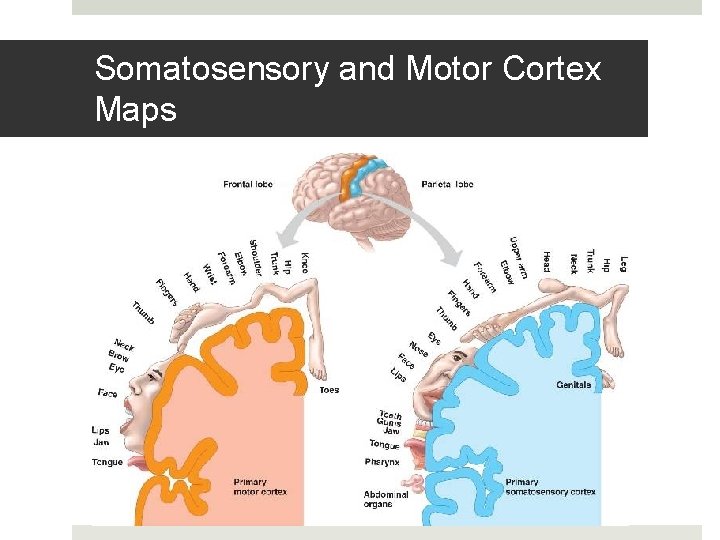
Somatosensory and Motor Cortex Maps
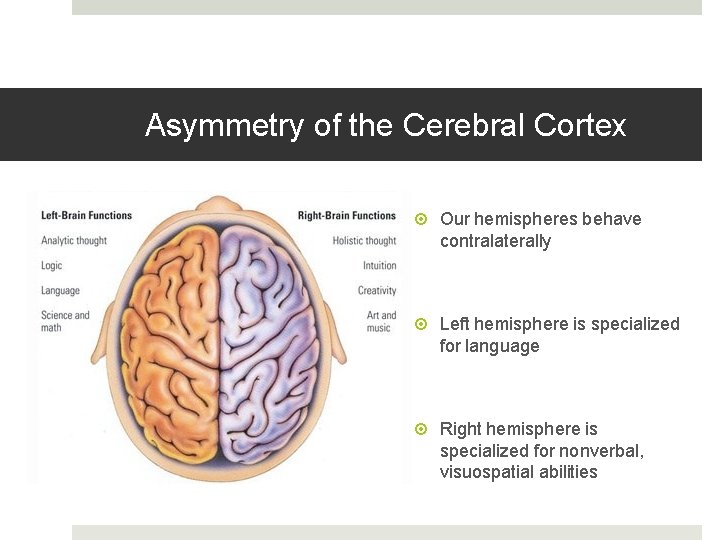
Asymmetry of the Cerebral Cortex Our hemispheres behave contralaterally Left hemisphere is specialized for language Right hemisphere is specialized for nonverbal, visuospatial abilities
Review for Exam 1 Hour, 15 minutes in our usual classroom 50 questions (2 pts each) Entire Chapters 1 -4 Chapter 5 from beginning up until “Methods of Mapping the Brain’s Behavioral Functions); page 158 (7 th edition) AND the section that begins with “Subcortical Structures of the Brain (p 168) up until “Premotor Areas Help Organize Specific Patterns of Movement” (p 174) Use the slides to GUIDE what to study; read the chapters while looking at the slides Read definitions and make sure to understand them, but focus more on thinking of an example in your head when you reach a certain concept Ex. Classical conditioning = Pavlov’s dog Operant conditioning = rat pressing lever Natural selection: peppered moth on birch tree Reliability/validity: bathroom scale DON’T WORRY ABOUT DATES!
Possible Type of Question Michael consistently neglects to help out around the house. He never does dishes. His mother takes away his televisionwatching privileges, after which he stops neglecting his chores and begins doing dishes. This is called: A. positive reinforcement B. positive punishment C. negative reinforcement D. negative punishment
Possible Type of Question Your untrained dog ”uses the bathroom” indoors on a regular basis. One day, you begin spraying him in the face with water every time he exhibits this problematic behavior. After a few days, your dog has stopped this behavior. What is this called? A. positive reinforcement B. positive punishment C. negative reinforcement D. negative punishment
Possible Type of Question Which of the following is the correct order of neuronal structures according to the movement of the action potential? A. Axon terminal Axon Soma Dendrites B. Dendrites Axon Soma Axon terminal C. Soma Dendrites Axon terminal D. Dendrites Soma Axon terminal
Possible Type of Question Which of the following individuals would likely agree with the statement, “The body can be studied, for it is physical in nature. The supernatural mind is unknowable scientifically. ” A. Thomas Hobbes B. Descartes C. Wilhelm van Osten D. Stanley Milgram
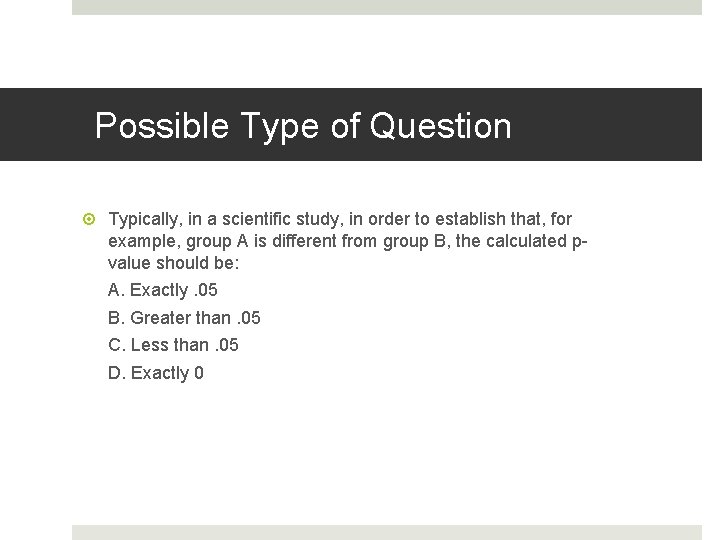
Possible Type of Question Typically, in a scientific study, in order to establish that, for example, group A is different from group B, the calculated pvalue should be: A. Exactly. 05 B. Greater than. 05 C. Less than. 05 D. Exactly 0
- Slides: 27