
The Neural Basis of Temporal Processing Michael D
The Neural Basis of Temporal Processing Michael D. Mauk Department of Neurobiology and Anatomy University of Texas Houston Medical School Dean V. Buonomano Departments of Neurobiology and Psychology University of California Los Angeles Slideshow by Paul Cornwell 1
Highlights • Temporal processing is likely distributed • Temporal and spatial processing are intrinsic properties of neural function 2

Spatial vs. Temporal Processing (by task) • Spatial processing – Orientation of a bar of light – Discrimination between pitch of two tones • Temporal Processing – Duration of a flashed bar of light – Time interval between presentation of two tones • Spatiotemporal Processing – Speech processing – Motion processing 3
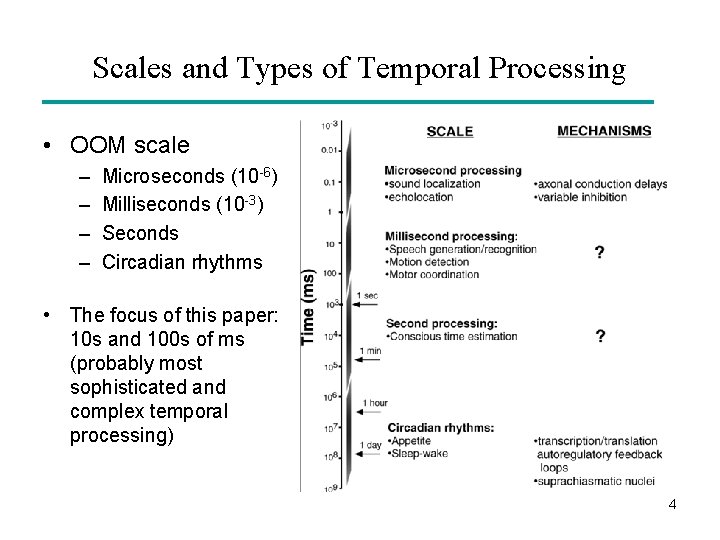
Scales and Types of Temporal Processing • OOM scale – – Microseconds (10 -6) Milliseconds (10 -3) Seconds Circadian rhythms • The focus of this paper: 10 s and 100 s of ms (probably most sophisticated and complex temporal processing) 4
Temporal Processing vs. Temporal Coding (what they are) • Temporal processing – decoding of temporal(ly coded) information – generation of timed motor responses • Temporal coding – information in the spike pattern that is not in the firing rate 5
Sensory Timing • Required for: – Motion processing – Audition • Vocalization • Speech recognition – syllable sequence – spatiotemporal (i. e. , sound frequency and timing) 6
Motor Timing • Muscles (10 s ms accuracy needed) – agonists (initiation) – antagonists (braking) • Cerebellum a general purpose timer for ~10 -100 ms? 7
Timed Conditioned Responses • Classically conditioned eyelid responses – ex. of motor timing • Tone (CS) paired with air puff (US) to eye, yields eyelid close (UR) • After 100 -200 trials, eyelids close in response to tone (CR) • Conditioning influenced by time interval between tone and puff • CR only when tone onset precedes puff in range ~100 ms to ~3 s • CR varies with tone-puff interval to statistically match puff onset • Alternation of puff onset time wrt tone onset between trials yields two response peaks 8
Psychophysical Studies • Predominate working hypothesis: central internal clock • Fixed frequency oscillator • After 100 -200 trials, eyelids close in response to tone (CR) • Alternate view: timing capabilities are distributed • many brain areas perform temporal processing • task and (sensory/motor) modality dependent • Different circuits for different timescales? 9
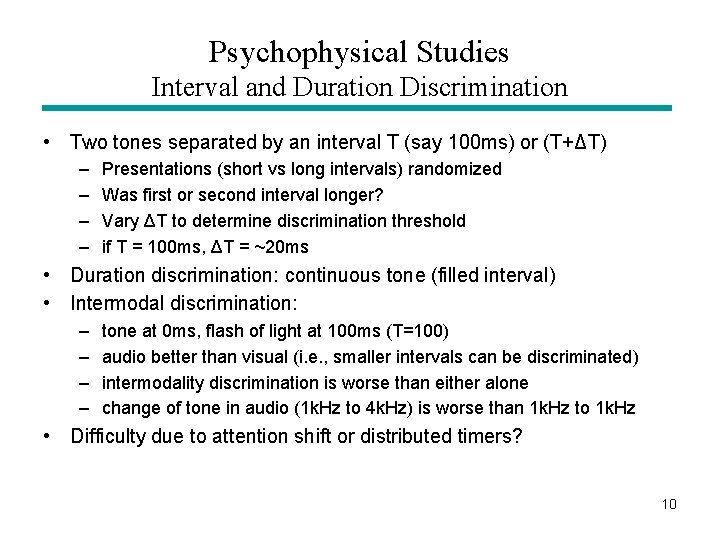
Psychophysical Studies Interval and Duration Discrimination • Two tones separated by an interval T (say 100 ms) or (T+ΔT) – – Presentations (short vs long intervals) randomized Was first or second interval longer? Vary ΔT to determine discrimination threshold if T = 100 ms, ΔT = ~20 ms • Duration discrimination: continuous tone (filled interval) • Intermodal discrimination: – – tone at 0 ms, flash of light at 100 ms (T=100) audio better than visual (i. e. , smaller intervals can be discriminated) intermodality discrimination is worse than either alone change of tone in audio (1 k. Hz to 4 k. Hz) is worse than 1 k. Hz to 1 k. Hz • Difficulty due to attention shift or distributed timers? 10
Psychopharmacology of Temporal Processing • Various drugs can impact particular timescales of processing without affecting others (e. g. , 50 -100 ms is fine, but 1 s is worse) 11
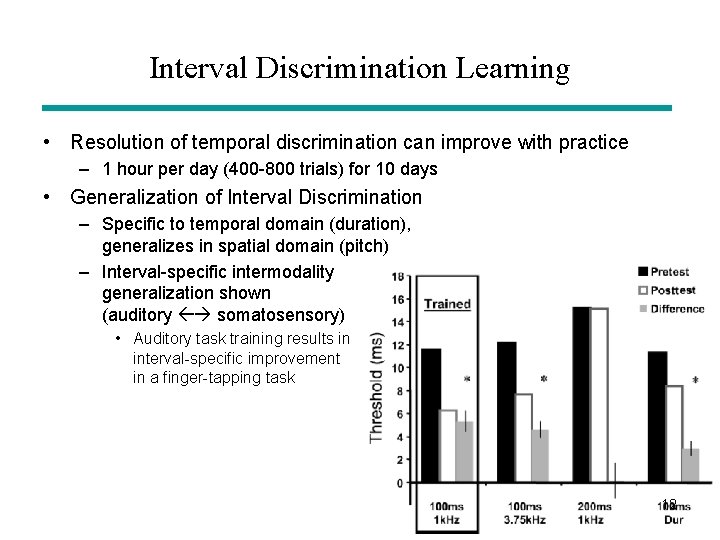
Interval Discrimination Learning • Resolution of temporal discrimination can improve with practice – 1 hour per day (400 -800 trials) for 10 days • Generalization of Interval Discrimination – Specific to temporal domain (duration), generalizes in spatial domain (pitch) – Interval-specific intermodality generalization shown (auditory somatosensory) • Auditory task training results in interval-specific improvement in a finger-tapping task 12
Temporal Selectivity and Anatomical Localization • Temporal processing seems distributed and neuro-intrinsic. . . • Brainstems of frogs and bats – neurons in frog tuned to frequency and number of auditory pulses – selectivity insensitive to intensity – bat neurons selective to pulse-echo delays or specific durations • Songbirds – neurons selectively respond to AB syllable pattern, not A or BA – earlier neurons respond to A, B individually – same neurons are active during singing, at specific points 13
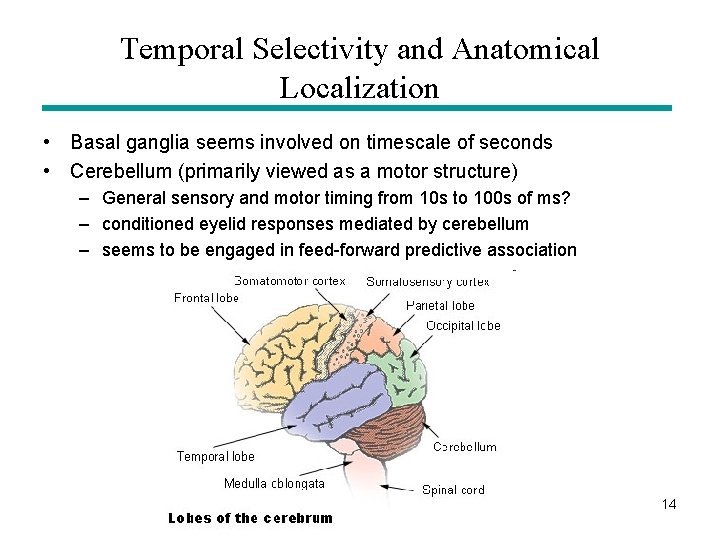
Temporal Selectivity and Anatomical Localization • Basal ganglia seems involved on timescale of seconds • Cerebellum (primarily viewed as a motor structure) – General sensory and motor timing from 10 s to 100 s of ms? – conditioned eyelid responses mediated by cerebellum – seems to be engaged in feed-forward predictive association 14
Cerebral Cortex • Which areas, if any (all? ) are involved in timing? • “Thus cortical circuits are intrinsically capable of generating timed responses on timescales well above monosynaptic transmission delays. Mechanistically, timing relied on network dynamics, specifically, activity propagated throughout functionally defined polysynaptic pathways. The propagation path was a complex function of the functional connectivity within the network and was not simply a result of spatial wave-like propagation. ” 15
Neural Mechanisms and Models of Timing • The neural basis of timing: 3 proposed computational mechanisms based on: – neural clocks – arrays of elements with differing temporal parameters – properties emergent from neural network dynamics • Result: temporal information processed such that neurons selectively respond to temporal features of stimuli • The first two proposed mechanisms are top-down, third is bottom-up 16
Conclusions • Study of neural basis of temporal processing is in its infancy • Cerebellum responsible for some forms of motor timing • Distinct neural mechanisms underlie millisecond and second timing • Views: • Temporal + spatial information generally processed together by the same circuits • No centralized clock on scale of 10 s – 100 s of ms • No special mechanisms such as oscillators or element arrays • State-dependent changes in neural dynamics result in temporal information processing capability 17
- Slides: 17