
The Networked Education Database Matthew Pittinsky Ph D
The Networked Education Database Matthew Pittinsky Ph. D. Candidate, Teachers College, Columbia University

NED: A Vision • Schools have long invested in student administrative systems. • Schools are now adopting e. Learning systems equipped with gradebooks, class rosters and Web-based survey (assessment) tools. • Both are Internet-enabled. • Could “generic” and custom data be collected through school systems automatically, and anonymously, massively reducing the cost and complexity of educational research?
NED The Problem…
Original Data Collection • Requires precious classroom time. • Informed consents difficult to secure. • Customizing instruments for context across sites and time is costly and discourages certain types of data collection (e. g. sociometric). • Data entry and coding inhibits sharing and reuse. • Incomplete responses undermine results and inhibit certain types of data collection (e. g. full classrooms).
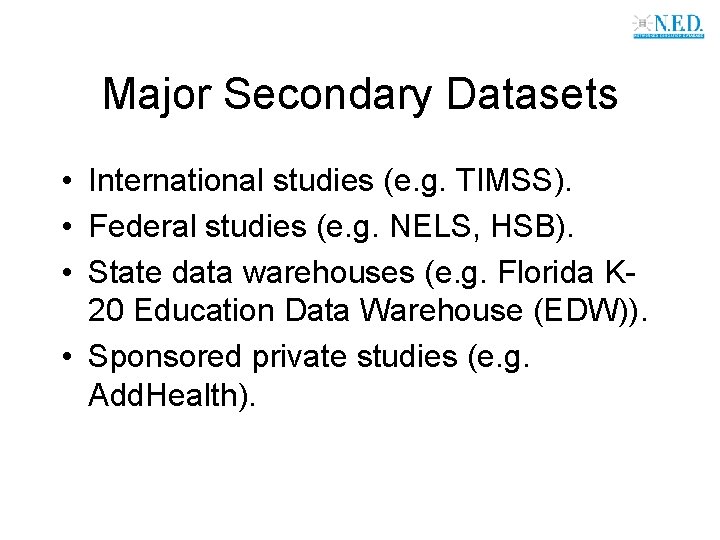
Major Secondary Datasets • International studies (e. g. TIMSS). • Federal studies (e. g. NELS, HSB). • State data warehouses (e. g. Florida K 20 Education Data Warehouse (EDW)). • Sponsored private studies (e. g. Add. Health).
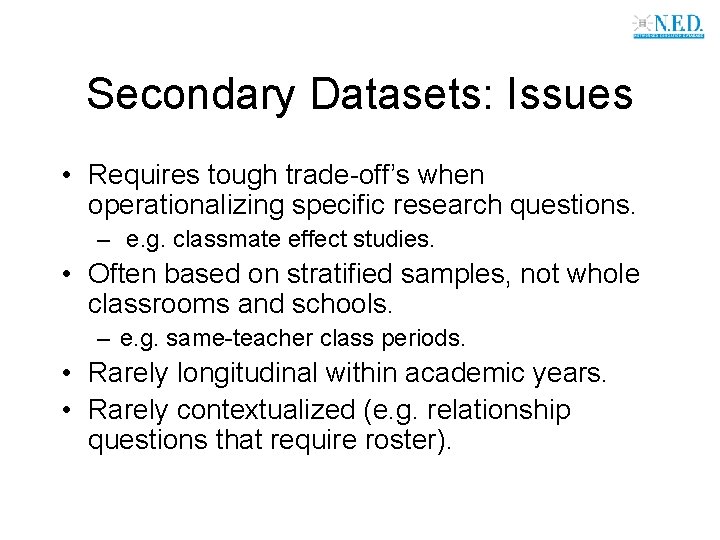
Secondary Datasets: Issues • Requires tough trade-off’s when operationalizing specific research questions. – e. g. classmate effect studies. • Often based on stratified samples, not whole classrooms and schools. – e. g. same-teacher class periods. • Rarely longitudinal within academic years. • Rarely contextualized (e. g. relationship questions that require roster).
NED The Solution…
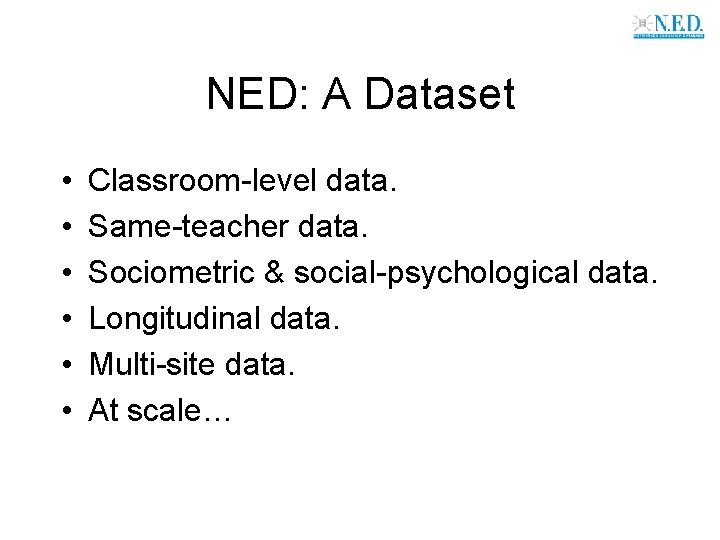
NED: A Dataset • • • Classroom-level data. Same-teacher data. Sociometric & social-psychological data. Longitudinal data. Multi-site data. At scale…
NED: A Data Collection Model • Asynchronous (outside class time) • Automatic (pre-scheduled, add/drops) • Contextual (draws on system data to generate questions) • Non-duplicative (uses already stored or entered data where possible) • Complete (form checks) • Anonymous (unique ID) • Efficient (paperless and coded) • Sustainable (self-perpetuating)
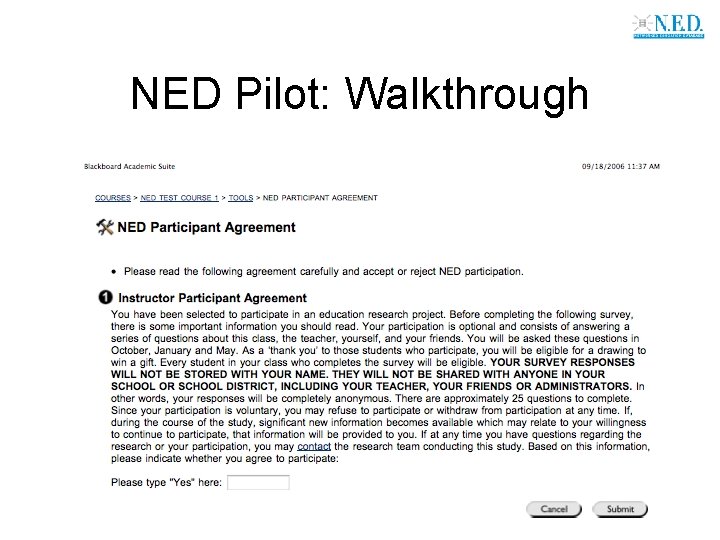
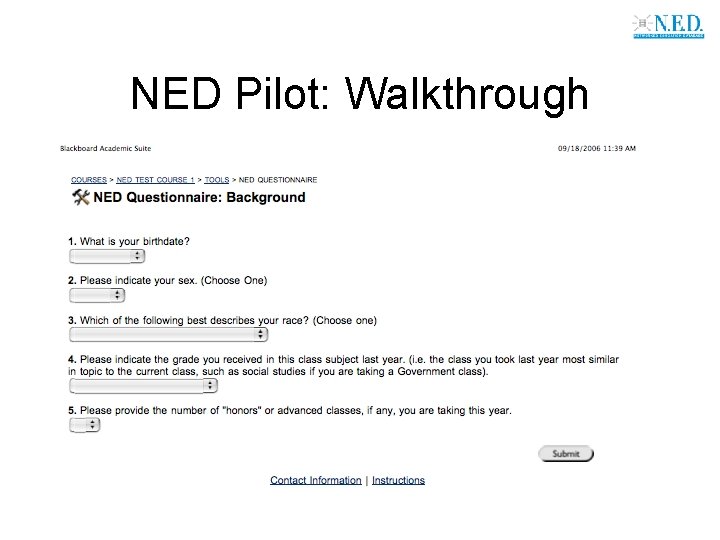
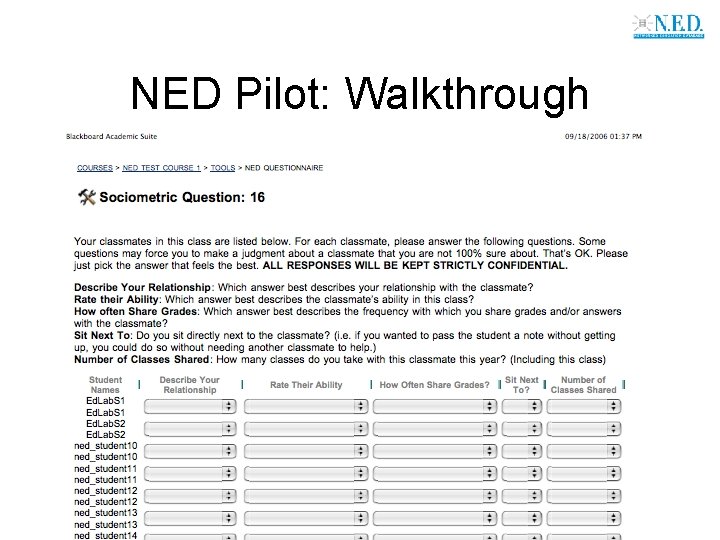
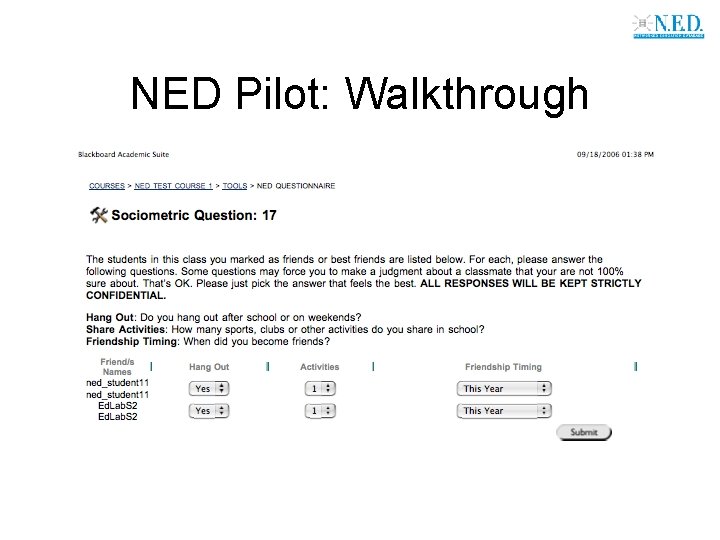
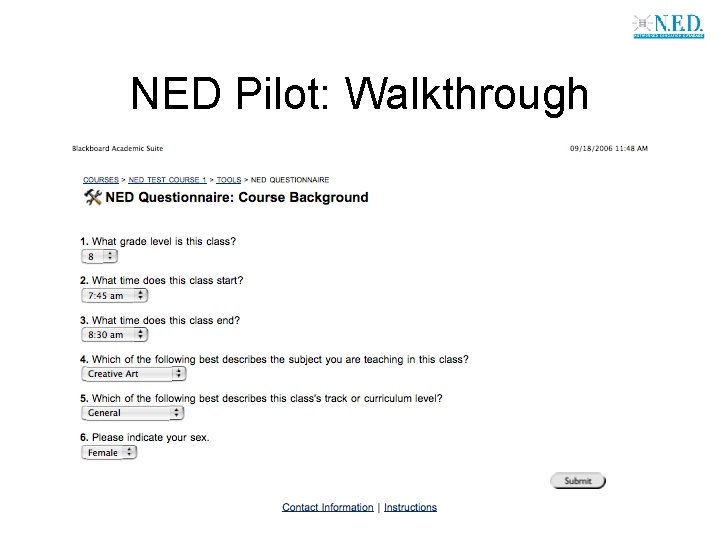
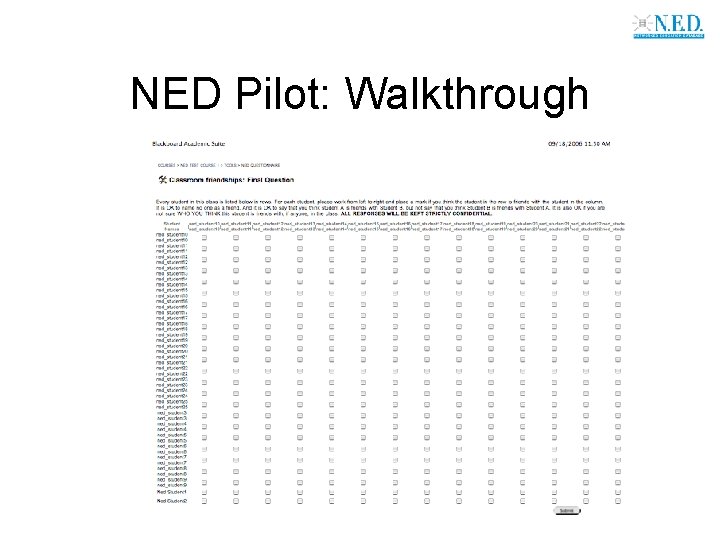
How NED Works • School installs NED extension and marks participating classes. • School’s e. Learning system automatically posts survey based on schedule (w/ announcement). • Participant provides consent. • Survey is delivered through e. Learning system GUI. • Survey draws on class context (roster, subject matter, student information, etc. ) when phrasing customized questions. • Survey enforces certain completion rules. • Survey responses stored in special encrypted tables that selfdelete after posting. • Survey responses and pre-existing data (demographic, gradebook) are packaged and securely posted to NED. • New students are “caught up” when added to course. • Teacher knows how many completes, but not who.
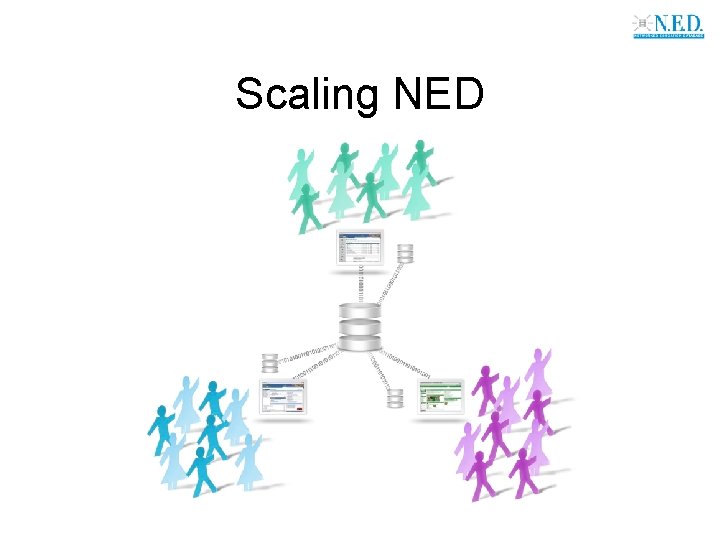
Scaling NED
Participant Anonymity • Data arrives to NED as secondary data (anonymous and coded). • Survey responses are tagged with unique participant IDs. • Generic data tagged with same ID and automatically merged with survey responses (gradebook, demographic, course overlap). • Structure of unique participant ID allows for sorting by class and school, however. . . • Data arrives at NED without any knowledge of participant’s school or classroom identity.
Participant Confidentiality • Survey responses are encrypted and automatically self-delete on local server. • No school official has access to student responses or completion status. • Data transmission is via secure protocol.
NED Data Feed: Example
NED The Pilot…
NED Pilot • Custom extension to the Blackboard Learning System. • Solicited 15 sites, 5 agreed, 3 ultimately participated. – All secondary schools (2 private / 1 public), 3 different states and regions. • 18 teachers, 37 classes, 732 participants • Three pre-scheduled NED survey administrations (October, January, May). – Each “live” for two weeks • NED staff know site names, but not names of participating schools (if district), teachers or class information. • Students provided incentive to participate. • Surveys included questions from other datasets to compare responses. • Approximately 250 development hours.
NED Status • First administration launched 10 -16 and ends today (10 -30). • Several showstopper technical issues identified and resolved. • One site dropped out. • % participation and incompletes will be assessed 11 -1.
NED Pilot: Walkthrough
NED Pilot: Walkthrough
NED Pilot: Walkthrough
NED Pilot: Walkthrough
NED Pilot: Walkthrough
NED Pilot: Walkthrough
NED Pilot: Walkthrough
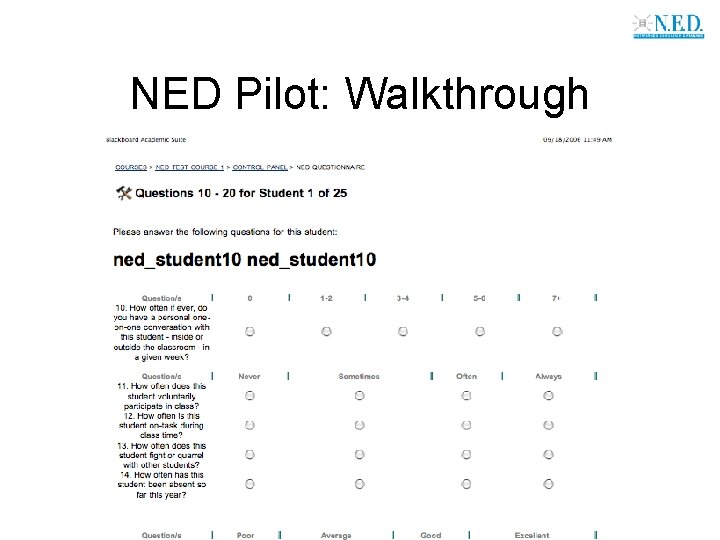
NED Pilot: Walkthrough
Implementation Issues • Not a standard “building block; ” required custom coding. – Bb installations vary, affecting custom code. • Not Bb’s standard survey tool. – Survey formatting limited. – Save and start, adaptive, and timing features limited. – Low ease of use (e. g. self-reference not grayed in sociometric questions; matrix questions scroll off screen without freezing roster). • • Gradebook entries are user-defined, without a standard taxonomy. Many schools create one mega-site for all class periods. – Pilot leans away from core subjects. – Pilot leans away from same-teacher course sections. • • Many schools do not use Bb as their gradebook or student profile of record. Relying on teacher responses for student-level data not always viable (e. g. mixed age-grade classes).
Implementation Issues • Required “enterprise license” of Blackboard. • Data transmission via local SQL scripts, not Web service. • IP address of sending site could allow for matching of school name with unique ID schema. • Different participant ID’s across classes (if student changed class periods). • System reports fragmented and unusable without additional programming. • Total eligible population not included in system report. • Ideal survey length difficult to asses. • Anonymity and class time impact concerns during site solicitation. • Will students participate?
Future Directions • Implement through standardized APIs and via e. Learning system’s survey tool. • Pilot with larger number of sites. • Pilot with smaller, more frequent surveys. • Pilot with full site participation across all classes and grades. • Pilot with full age-grade population over time. • Include non e. Learning systems (e. g. TPR) and non Bb e. Learning systems. – Formalize vendor NED interface program. • Expand to higher education.
NED: Imagine • • A national dataset. Fed from tens of thousands of sites. Collecting unique classroom-level data. Throughout the academic year and a student’s educational career. • With minimal site-specific maintenance. • Efficiently and cost effectively.
NED Team • Technical – Tim Streightiff, lead developer – Linda Merryman, project director – Basheer Azizi, database engineer • Functional – Matthew Pittinsky, principal investigator – Gary Natriello, principal investigator
The Networked Education Database A Joint Research Project Contact: Matthew Pittinsky: mp 2055@columbia. edu Gary Natriello: gjn 6@columbia. edu http: //edlab. tc. columbia. edu/index. php? q=node/904 www. blackboard. com
- Slides: 32