
The Network Model Management System By Joel Koepke
The Network Model Management System By Joel Koepke ERCOT, Network Model Engineer EMS Users Conference 1 September 23 rd – 26 th
AGENDA • • • About ERCOT NMMS Overview ERCOT CIM Submission of Model Updates ERCOT as the Registration Authority EMS Users Conference 2 September 23 rd – 26 th
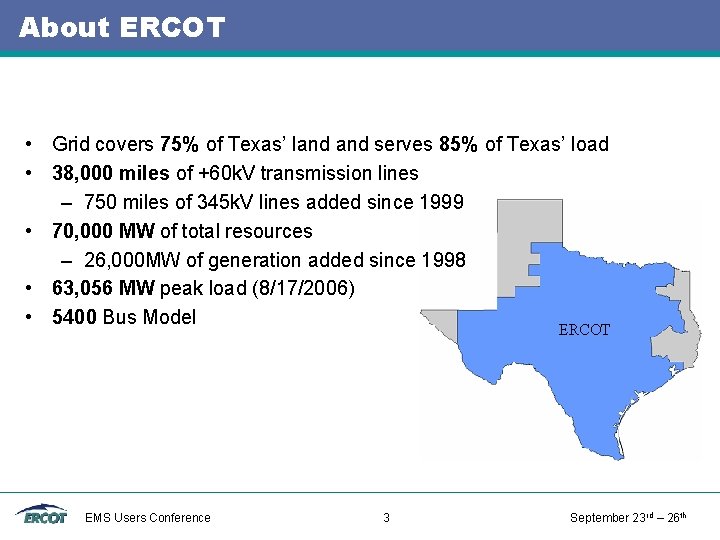
About ERCOT • Grid covers 75% of Texas’ land serves 85% of Texas’ load • 38, 000 miles of +60 k. V transmission lines – 750 miles of 345 k. V lines added since 1999 • 70, 000 MW of total resources – 26, 000 MW of generation added since 1998 • 63, 056 MW peak load (8/17/2006) • 5400 Bus Model ERCOT EMS Users Conference 3 September 23 rd – 26 th
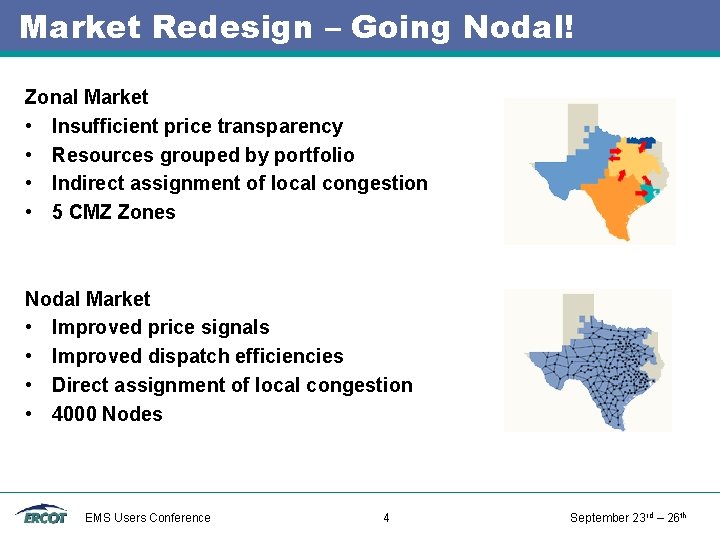
Market Redesign – Going Nodal! Zonal Market • Insufficient price transparency • Resources grouped by portfolio • Indirect assignment of local congestion • 5 CMZ Zones Nodal Market • Improved price signals • Improved dispatch efficiencies • Direct assignment of local congestion • 4000 Nodes EMS Users Conference 4 September 23 rd – 26 th
The Network Model Management System

NMMS The Network Model Management System • What is it? – The system that will perform all modeling functions in the Nodal market. • Submission of modeling changes • Storage and validation of the model data (Operations and Planning) • Creation of all required models for downstream applications • Why? – The Nodal Protocols contain requirements which significantly change ERCOT’s current modeling process • Need “Future” models • Modeling should be consistent (Operations vs. Planning) • Must accept CIM inputs and produce CIM outputs EMS Users Conference 6 September 23 rd – 26 th
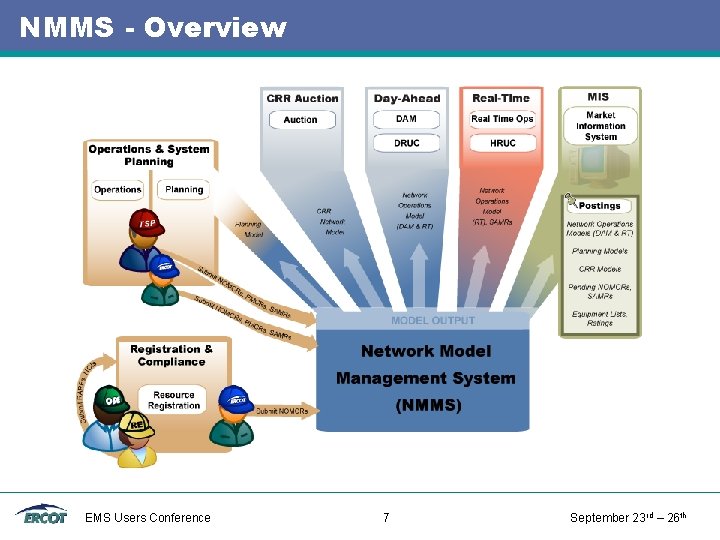
NMMS - Overview EMS Users Conference 7 September 23 rd – 26 th
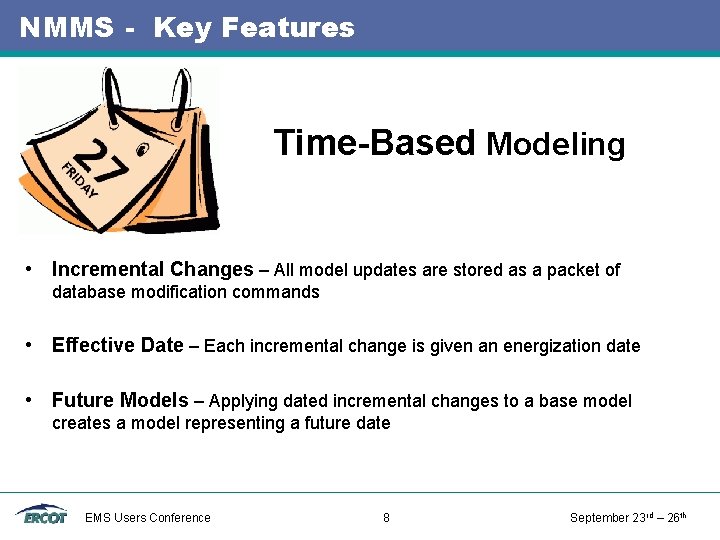
NMMS - Key Features Time-Based Modeling • Incremental Changes – All model updates are stored as a packet of database modification commands • Effective Date – Each incremental change is given an energization date • Future Models – Applying dated incremental changes to a base model creates a model representing a future date EMS Users Conference 8 September 23 rd – 26 th
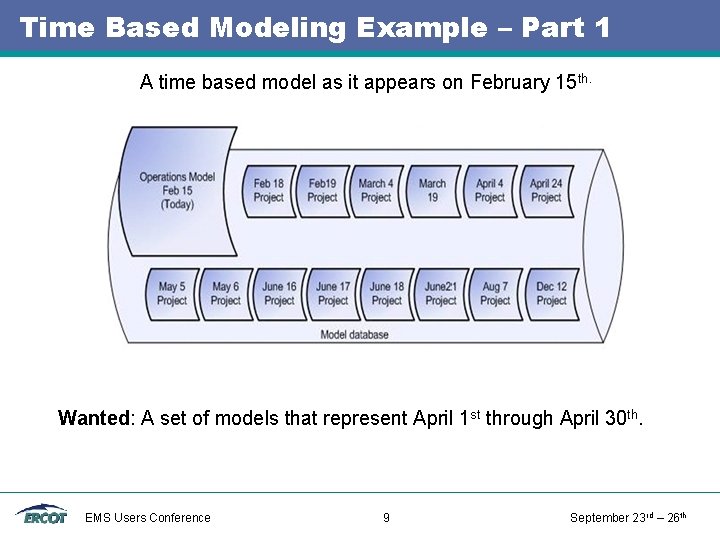
Time Based Modeling Example – Part 1 A time based model as it appears on February 15 th. Wanted: A set of models that represent April 1 st through April 30 th. EMS Users Conference 9 September 23 rd – 26 th
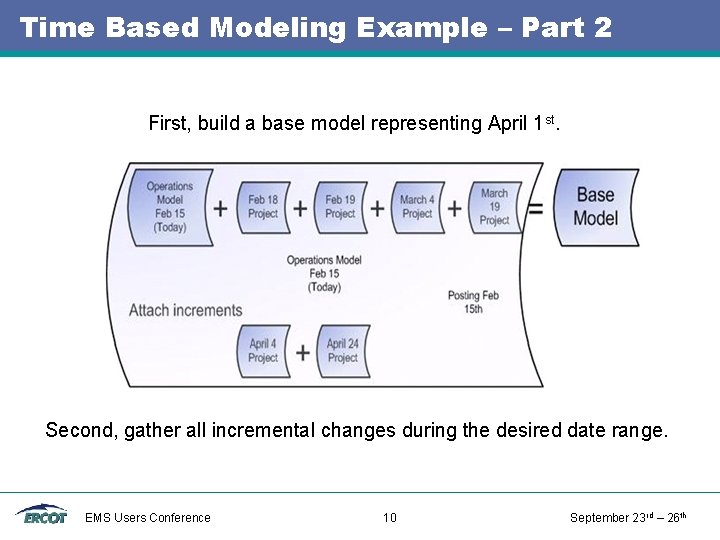
Time Based Modeling Example – Part 2 First, build a base model representing April 1 st. Second, gather all incremental changes during the desired date range. EMS Users Conference 10 September 23 rd – 26 th
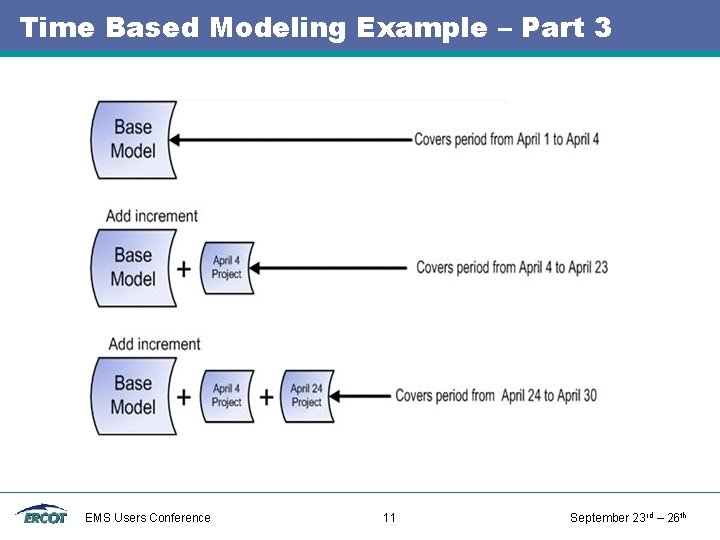
Time Based Modeling Example – Part 3 EMS Users Conference 11 September 23 rd – 26 th
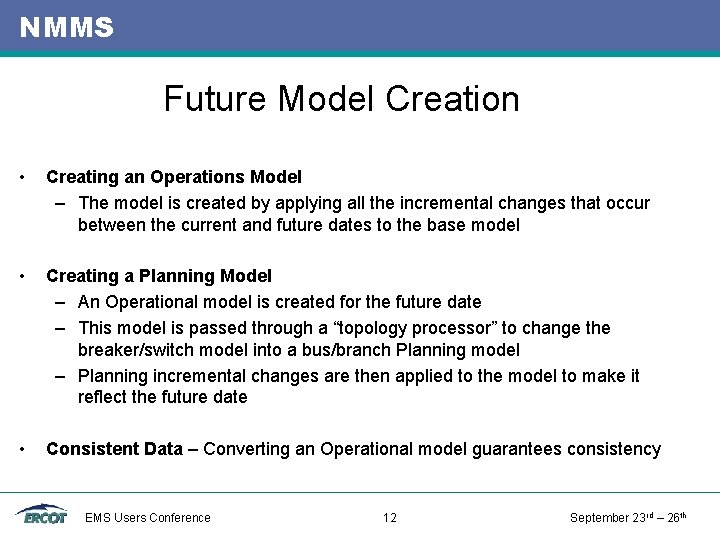
NMMS Future Model Creation • Creating an Operations Model – The model is created by applying all the incremental changes that occur between the current and future dates to the base model • Creating a Planning Model – An Operational model is created for the future date – This model is passed through a “topology processor” to change the breaker/switch model into a bus/branch Planning model – Planning incremental changes are then applied to the model to make it reflect the future date • Consistent Data – Converting an Operational model guarantees consistency EMS Users Conference 12 September 23 rd – 26 th
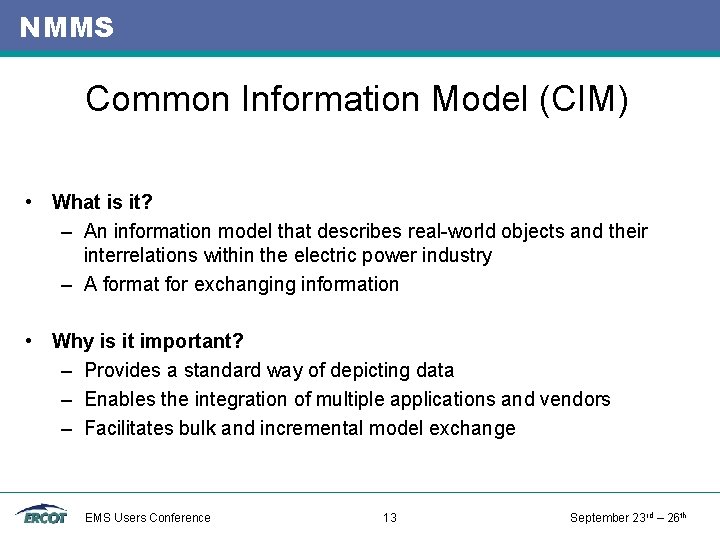
NMMS Common Information Model (CIM) • What is it? – An information model that describes real-world objects and their interrelations within the electric power industry – A format for exchanging information • Why is it important? – Provides a standard way of depicting data – Enables the integration of multiple applications and vendors – Facilitates bulk and incremental model exchange EMS Users Conference 13 September 23 rd – 26 th
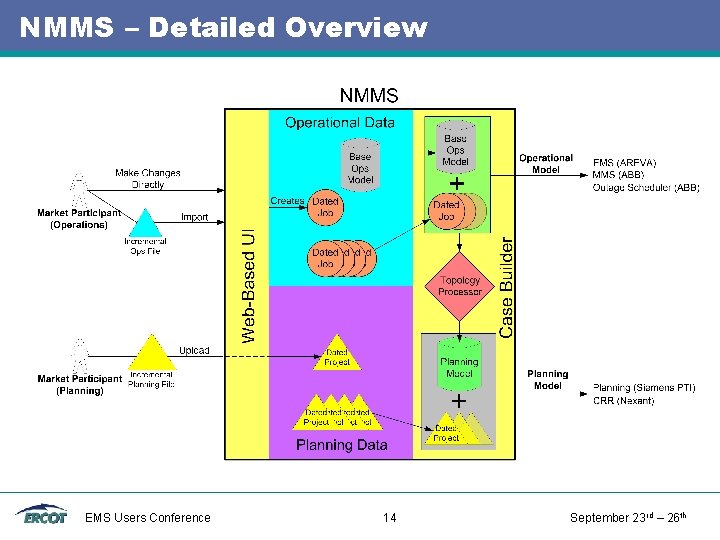
NMMS – Detailed Overview EMS Users Conference 14 September 23 rd – 26 th
Questions? EMS Users Conference 15 September 23 rd – 26 th
- Slides: 15