
The Netherlands vision on agriculture transition to circular
- Slides: 28
“The Netherland’s vision on agriculture – transition to circular agriculture” – with special attention to the diary sector Jasper Dalhuisen
Content 1. Short Introduction to the Netherlands 2. Short history of the development of the Agricultural- and Horticulture sector 3. The Dutch Agriculture- and Horticulture sector 4. The Dutch Diary Sector 5. Circular Agriculture 6. Co-operation is the key! The Dutch AKIS system 7. The future challenges 8. Questions? 2
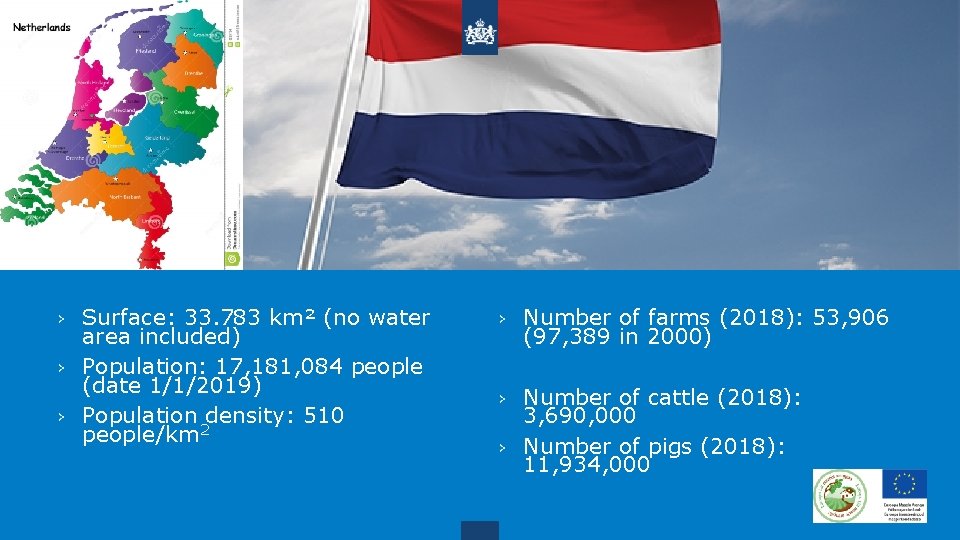
Surface: 33. 783 km² (no water area included) › Population: 17, 181, 084 people (date 1/1/2019) › Population density: 510 people/km 2 › › Number of farms (2018): 53, 906 (97, 389 in 2000) Number of cattle (2018): 3, 690, 000 › Number of pigs (2018): 11, 934, 000 › 3
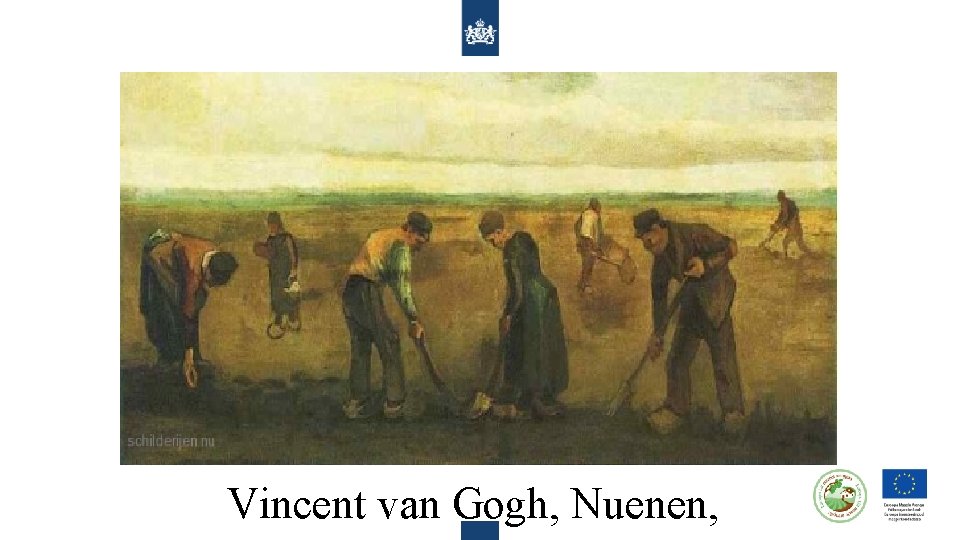
Vincent van Gogh, Nuenen,
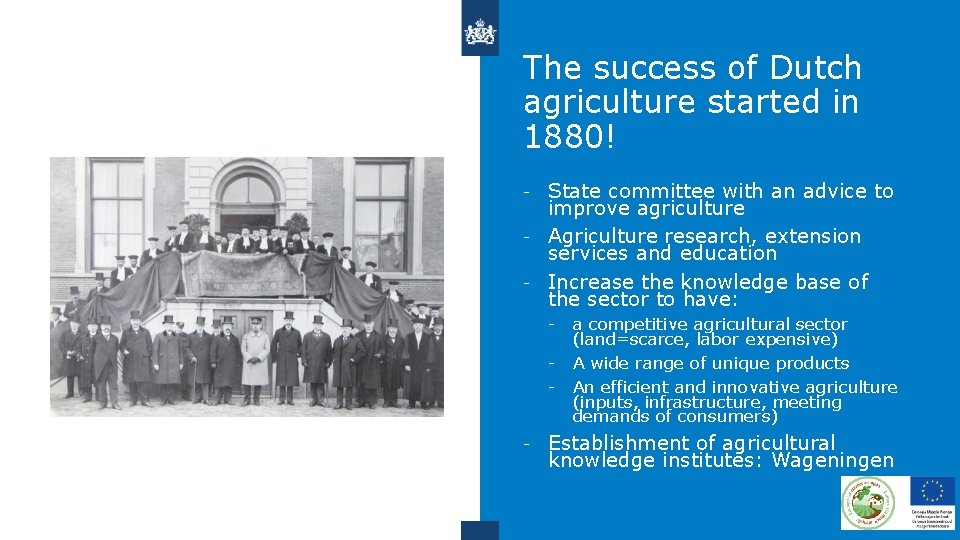
The success of Dutch agriculture started in 1880! State committee with an advice to improve agriculture - Agriculture research, extension services and education - Increase the knowledge base of the sector to have: - - a competitive agricultural sector (land=scarce, labor expensive) - A wide range of unique products - An efficient and innovative agriculture (inputs, infrastructure, meeting demands of consumers) - Establishment of agricultural knowledge institutes: Wageningen 6
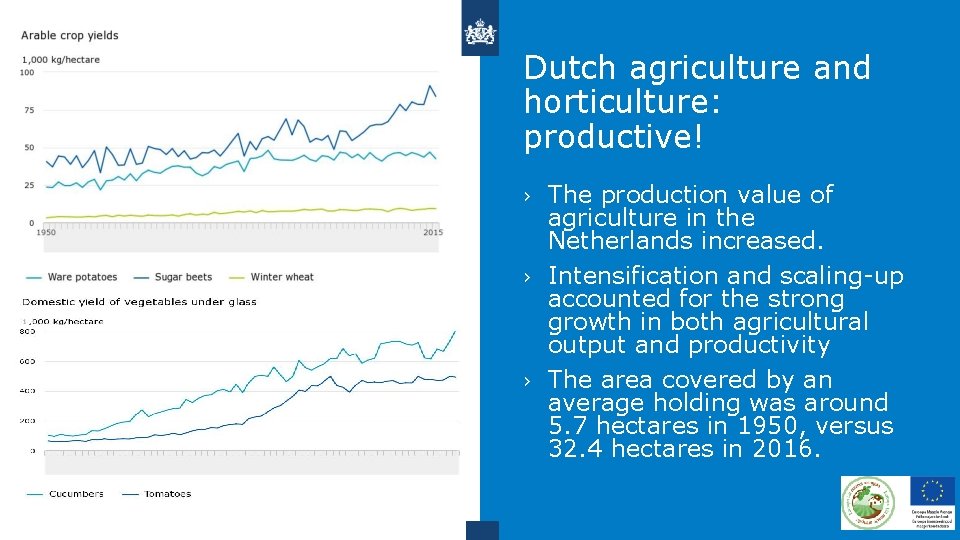
Dutch agriculture and horticulture: productive! The production value of agriculture in the Netherlands increased. › Intensification and scaling-up accounted for the strong growth in both agricultural output and productivity › The area covered by an average holding was around 5. 7 hectares in 1950, versus 32. 4 hectares in 2016. › Jasper Dalhuisen/Martijn van der Heide May 2019 7
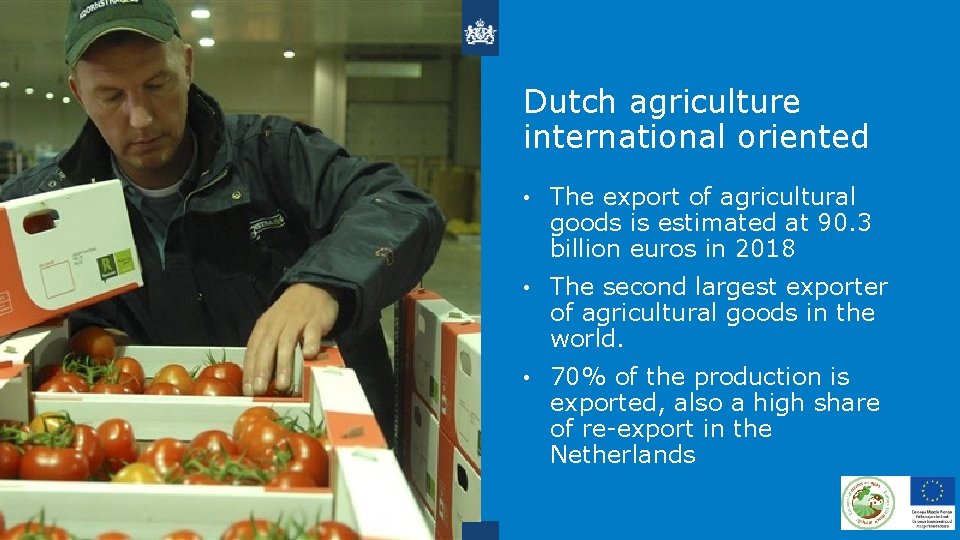
Dutch agriculture international oriented • The export of agricultural goods is estimated at 90. 3 billion euros in 2018 • The second largest exporter of agricultural goods in the world. • 70% of the production is exported, also a high share of re-export in the Netherlands 8
The Dutch Diary Sector 9
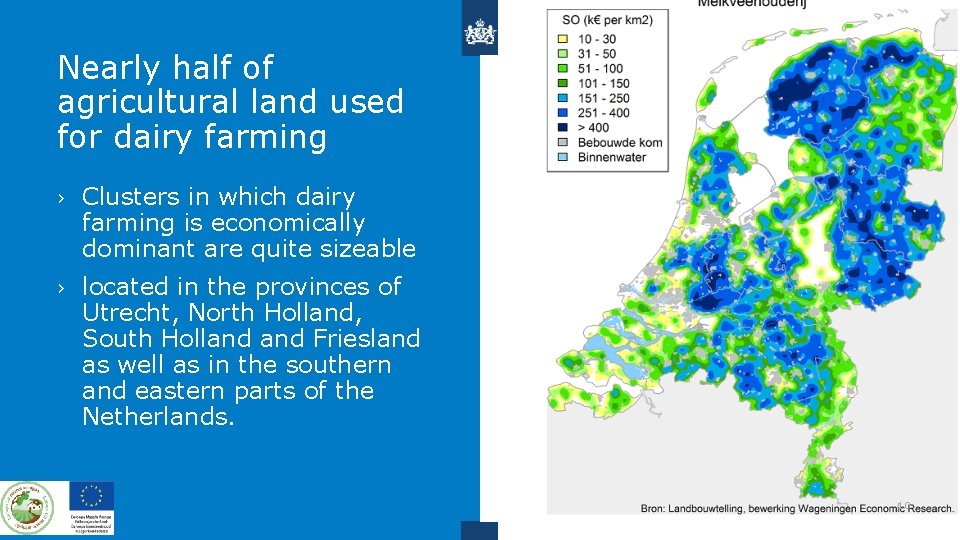
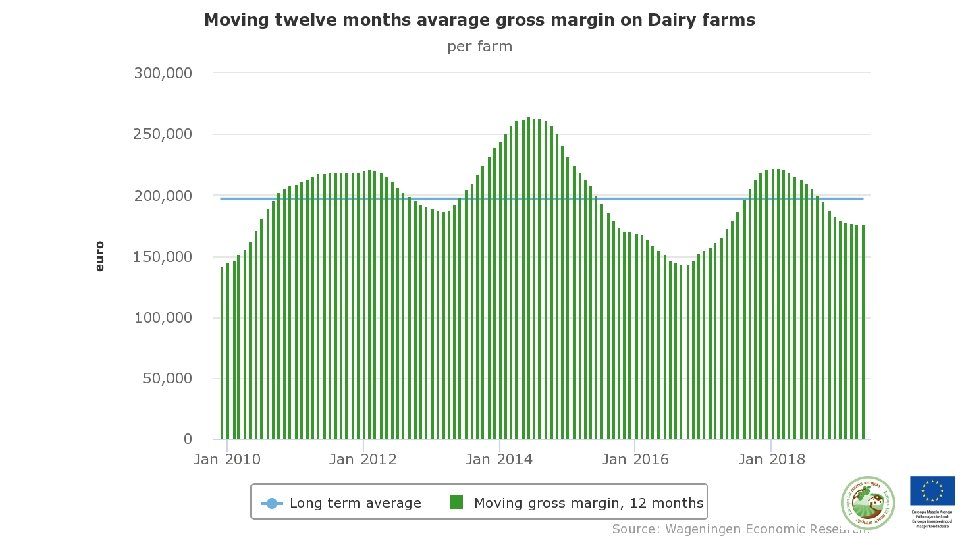
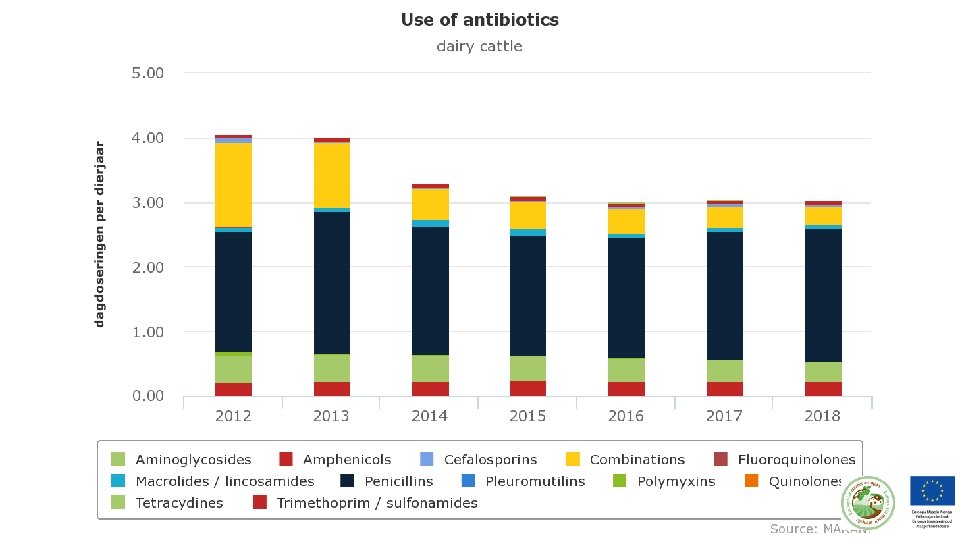
Nearly half of agricultural land used for dairy farming › Clusters in which dairy farming is economically dominant are quite sizeable › located in the provinces of Utrecht, North Holland, South Holland Friesland as well as in the southern and eastern parts of the Netherlands. 10
11
12
13
14
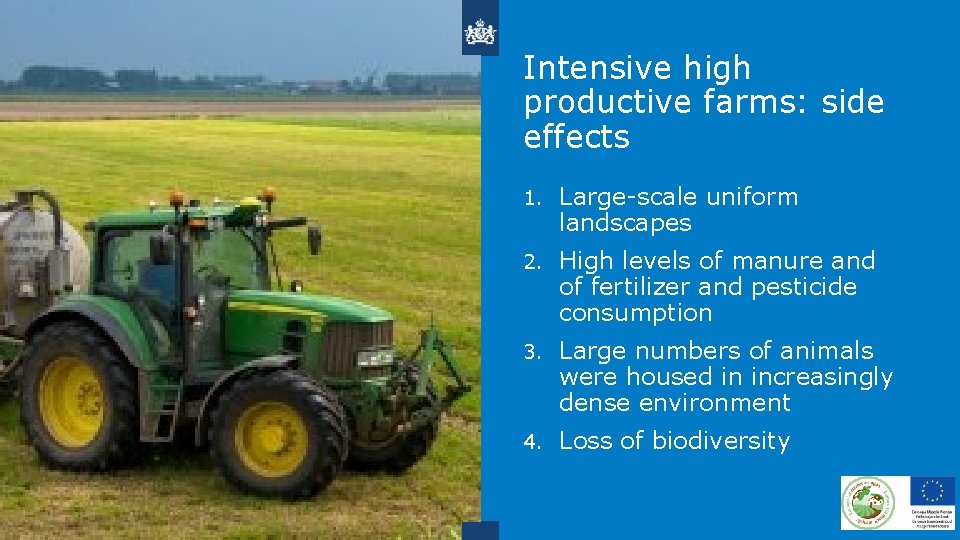
Intensive high productive farms: side effects 1. Large-scale uniform landscapes 2. High levels of manure and of fertilizer and pesticide consumption 3. Large numbers of animals were housed in increasingly dense environment 4. Loss of biodiversity 15
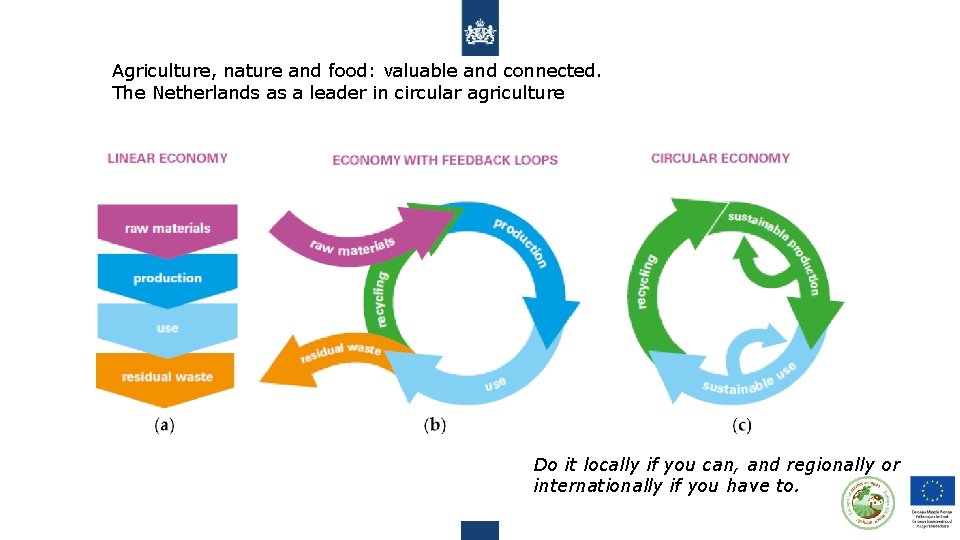
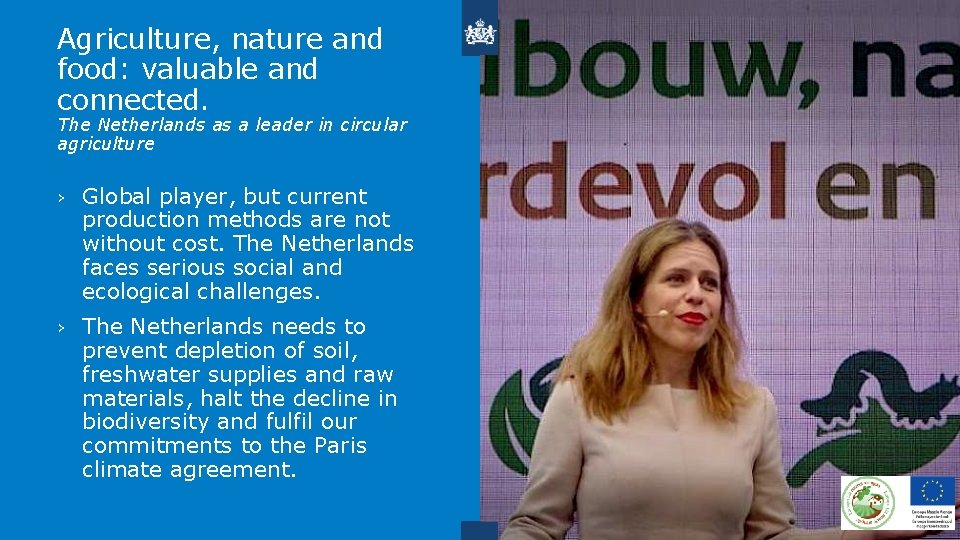
Agriculture, nature and food: valuable and connected. The Netherlands as a leader in circular agriculture Do it locally if you can, and regionally or internationally if you have to. 16
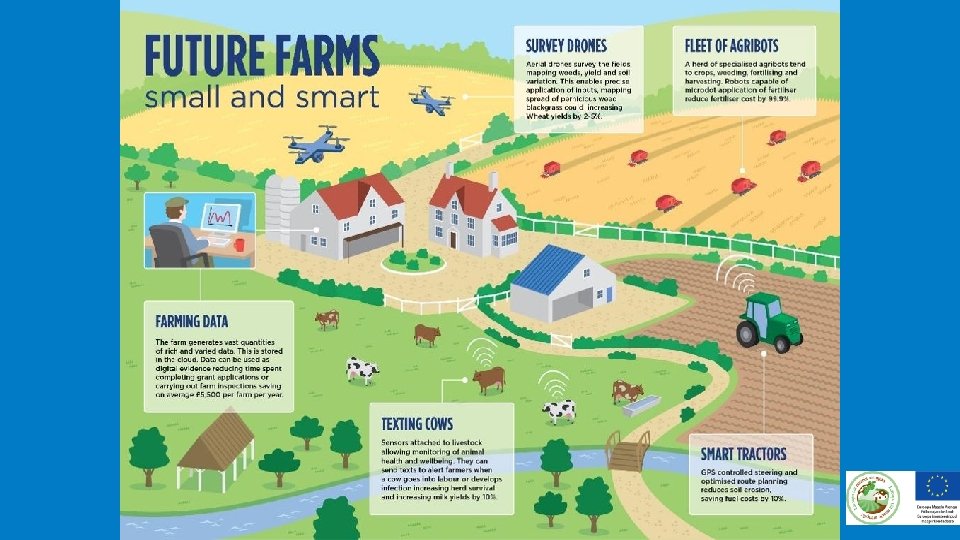
Agriculture, nature and food: valuable and connected. The Netherlands as a leader in circular agriculture › Global player, but current production methods are not without cost. The Netherlands faces serious social and ecological challenges. › The Netherlands needs to prevent depletion of soil, freshwater supplies and raw materials, halt the decline in biodiversity and fulfil our commitments to the Paris climate agreement. 17
18
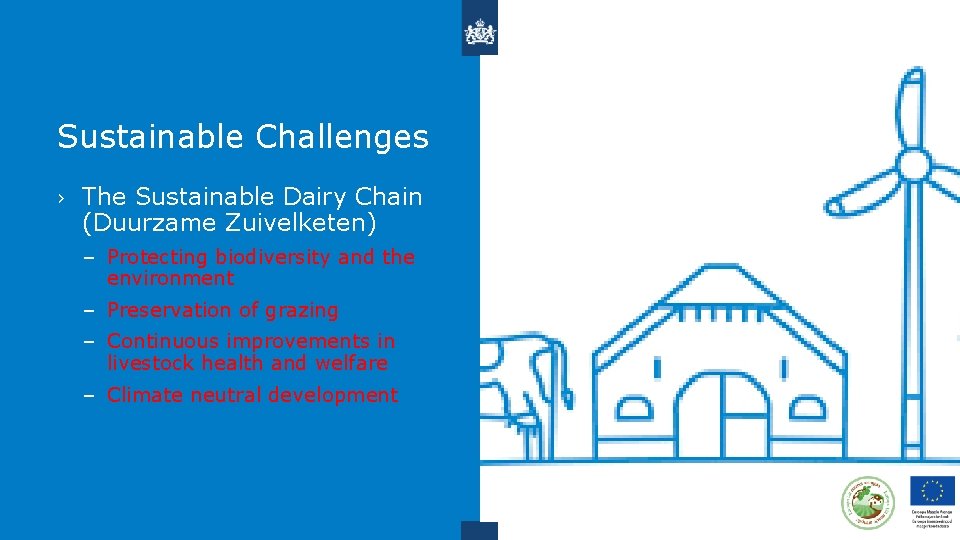
Sustainable Challenges › The Sustainable Dairy Chain (Duurzame Zuivelketen) – Protecting biodiversity and the environment – Preservation of grazing – Continuous improvements in livestock health and welfare – Climate neutral development 19
BIN › 1500 companies from the Dutch agricultural- and horticulture sectore › Particpants can benchmark themselves with comparable companies 20
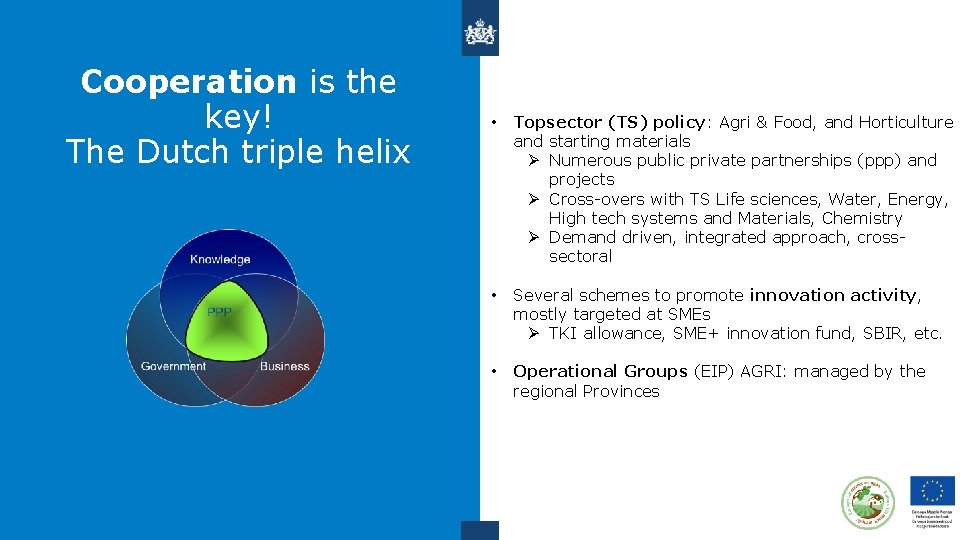
Cooperation is the key! The Dutch triple helix • Topsector (TS) policy: Agri & Food, and Horticulture and starting materials Ø Numerous public private partnerships (ppp) and projects Ø Cross-overs with TS Life sciences, Water, Energy, High tech systems and Materials, Chemistry Ø Demand driven, integrated approach, crosssectoral • Several schemes to promote innovation activity, mostly targeted at SMEs Ø TKI allowance, SME+ innovation fund, SBIR, etc. • Operational Groups (EIP) AGRI: managed by the regional Provinces 21
Knowledge institutes and government (1/2) Knowledge institutes (education and research) • Wageningen University and Research (education, fundamental and applied research) • 4 Universities of applied sciences (HBO) • 13 Institutes for Vocational Education • Research institutes: e. g. WUR, TNO, RIVM, NIZO (dairy), IRS (beets), Delphy, (other) private research and consultancy firms, R&D facilities from 12 of the global top 40 food and beverage companies 22
Knowledge institutes and government (2/2) Government (role in the governance of the AKIS) Ministries ANFQ, EAC, ECS, HWS, IWM • Correction of market failures: organise the AKIS, pooling of capacity, funding/governing of public goods, etc. Ø ANFQ: e. g. contract research and public inspection (NVWA) Ø ECS: governs agricultural education • Growing role EU – but EU-agenda is not always aligned with national and regional agendas 23
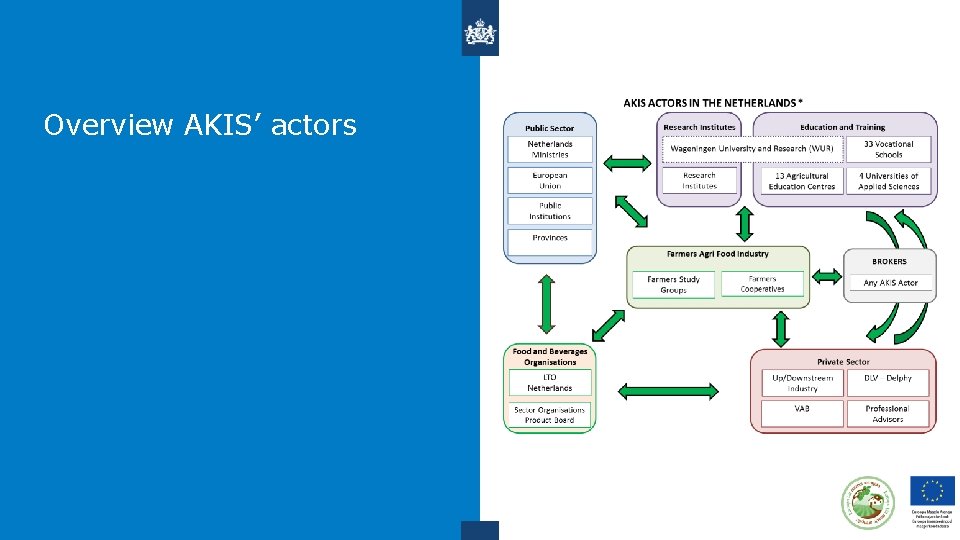
Intermediates and the sector Intermediates • Farm Advisory System: 40 private advisory firms • Elaborate network of (informal) farmer study groups (farmer driven) - extension services were privatised in the 90 s The food and agricultural sector > primary actors in innovation (farmers, food industry, supplying industries) • LTO Nederland (federation of the sector, consultants advising entrepreneurs in the sector) The Dutch AKIS is changing • Into an increasingly complex system with changing roles and topics • From a linear to a more dynamic, interactive and diversified innovation network system approach Ø changing role of government e. g. topsector policy, triple helix 24
Overview AKIS’ actors 25
Main changes from 2012 • Sectoral changes (large scale firms, intensification) -> more ability for private R&D investments but larger gap with SMEs • Transition of knowledge as a public good to knowledge as a marketable product on a worldwide market • The Dutch AKIS is under pressure e. g. by cuts in public funding • Need for linking a variety of scientific and technological disciplines – real challenge of innovation itself • Continuing internalisation of the AKIS (EU and globally) – actors and knowledge flows 26
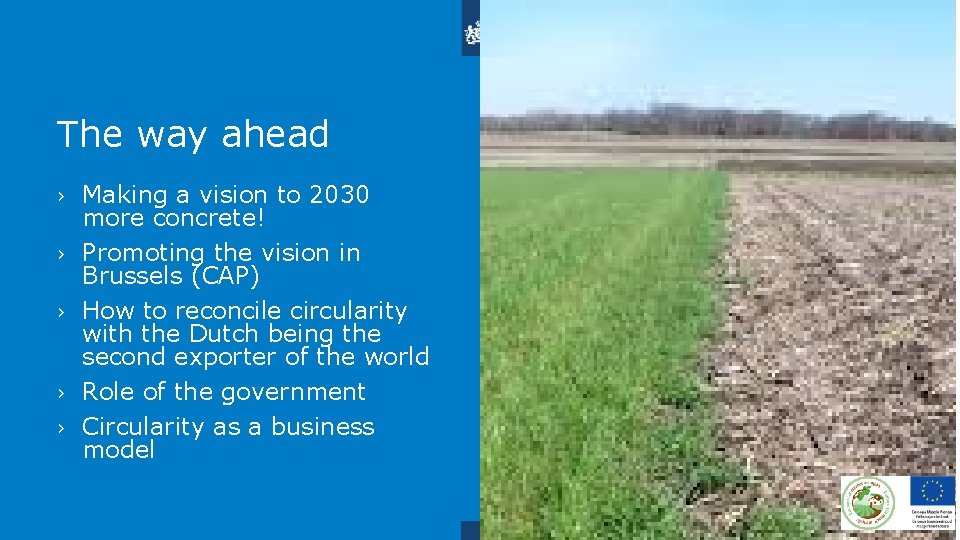
The way ahead › › › Making a vision to 2030 more concrete! Promoting the vision in Brussels (CAP) How to reconcile circularity with the Dutch being the second exporter of the world Role of the government Circularity as a business model 27
Thank you! › Questions? j. m. dalhuisen@minlnv. nl 28