
The Nervous System The Basic Structure 6 1
The Nervous System: The Basic Structure 6 -1

From “Running and ME: A Love Story” by Joan Nesbit, 1999 It’s almost like running is this great friend we both share…Anyway, that’s what I’d like to talk to you about…running as a friend, a companion, a lover even…in other words, the relationship of running. “WHAT!? ” many of you will be saying, “I thought that I was going to learn how to improve my 10 k time. ” Go read Runner’s World for that. You see, I don’t view running as what I DO or who I AM, but as thing, this force, that changes me over time….
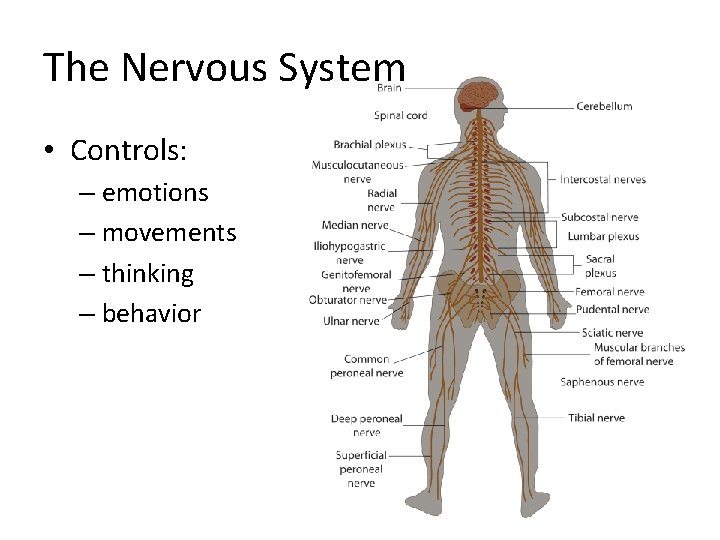
The Nervous System • Controls: – emotions – movements – thinking – behavior
The Nervous System • Parts: – central nervous system (CNS) • brain & spinal cord – peripheral nervous system (PNS) • Smaller parts/branches of the nerves that go to the parts of the body

Nervous System Protection • All parts have protection PART TYPE OF PROTECTION Brain Skull & sheathing Spinal cord Vertebrae Peripheral nerves sheathing

Neurons • long, thin cells of nerve tissue on which messages travel to and from the brain
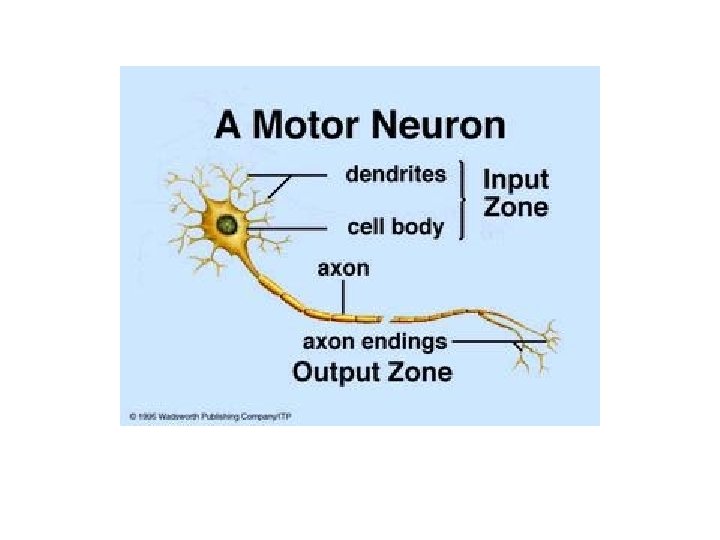
Parts of a Neuron • Cell body – Has the nucleus – Produces energy needed for the neuron to work • Dendrites – Short, thin fibers that stick out from the cell – Receive impulses, or messages, from other neurons and send them to the cell body • Axon – Can be very short, or several feet long – Long fiber that carries the impulses away from the cell body to the dendrites of another neuron
Neuron Parts cont… • Myelin sheath – Insulates and protects the axon for some neurons – Speeds the transmission of impulses • Axon terminals – Branch out at the end of the axon
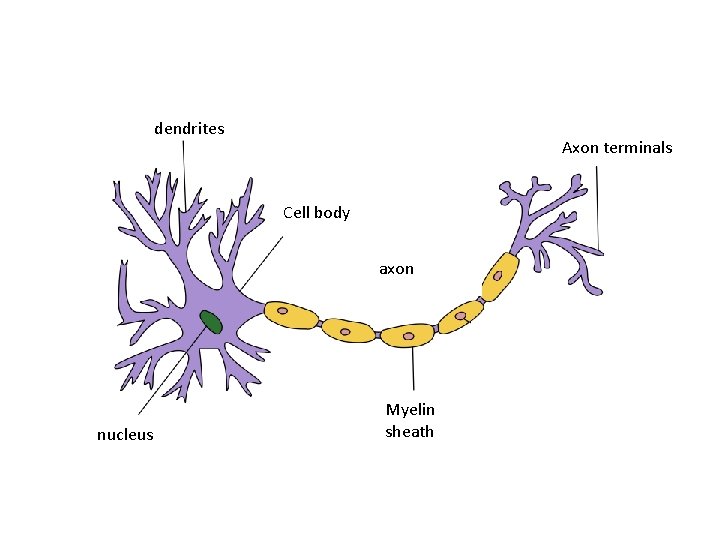
dendrites Axon terminals Cell body axon nucleus Myelin sheath
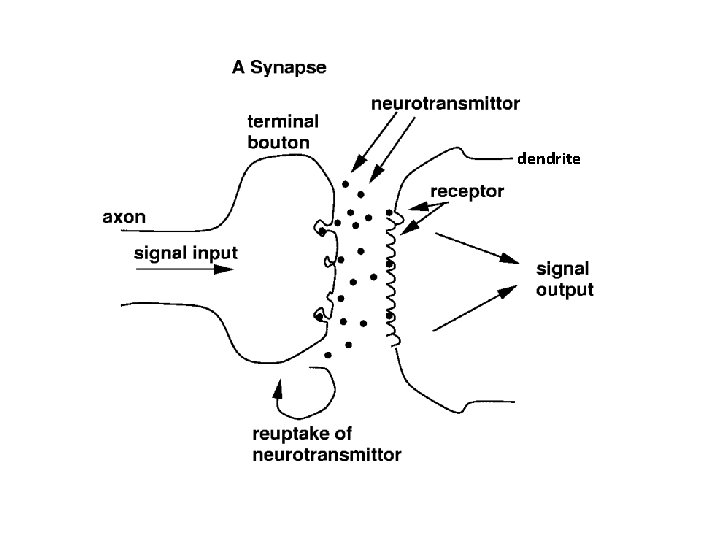
Neuron Connection • Synapse – The gap that happens between individual nerve cells • Impulses/messages are transmitted across the synapse to another neuron • Neurotransmitters – The chemicals released by neurons – Determines the rate at which other neurons fire
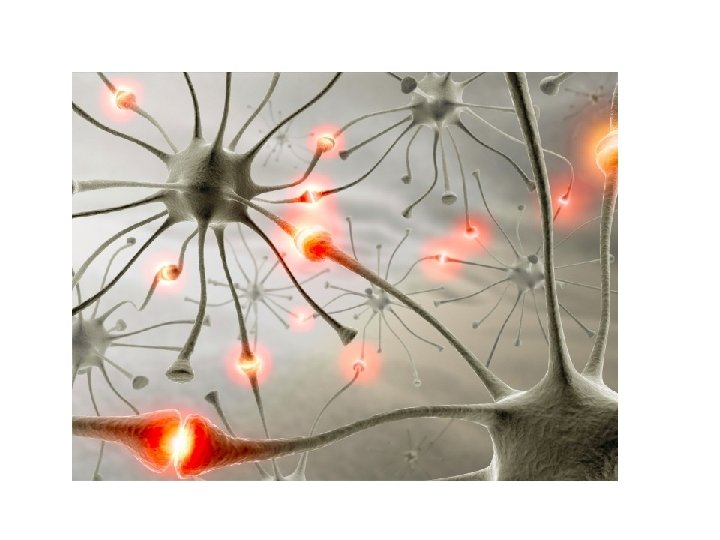
dendrite
Neurotransmitters • Excite – make the neuron transmit • Inhibit – make the neuron stop transmitting
Neuron Activity • Neurons are either ON or OFF • Neuron tracks: – Ascending – go up • Carry messages to the brain – Descending – go down • Carry messages from the brain to the body
Types of Neurons • Afferent neurons – Sensory neurons – Send messages from the organs (including eye, nose, ear, skin) • Efferent neurons – Motor neurons – Send signals from the brain to the glands and muscles • Interneurons – Carry impulses between neurons in the body
Types of Activities • Voluntary – Lifting your hand – Running – Turning your head • Involuntary – Heartbeat – Blood pressure – Size of the pupils
What systems control what? • Somatic Nervous System (SNS) – Part of peripheral nervous system – Controls voluntary actions • Autonomic Nervous System (ANS) – Controls involuntary actions
Autonomic Nervous System (ANS) Parts: • Sympathetic – Prepares the body to deal with emergencies or hard labor – Speeds up the heart to get oxygen and other nutrients to the body – Controls how much blood goes to different parts of the body – Increases blood pressure – Suspends/stops some activities (ex: digestion) • Parasympathetic – Saves energy – Helps the body recover from hard work – Reduces the heart rate & blood pressure
- Slides: 19