
The Nervous System Structure and Function of the

- Slides: 35
The Nervous System Structure and Function of the CNS
The Human Brain (13. 40)
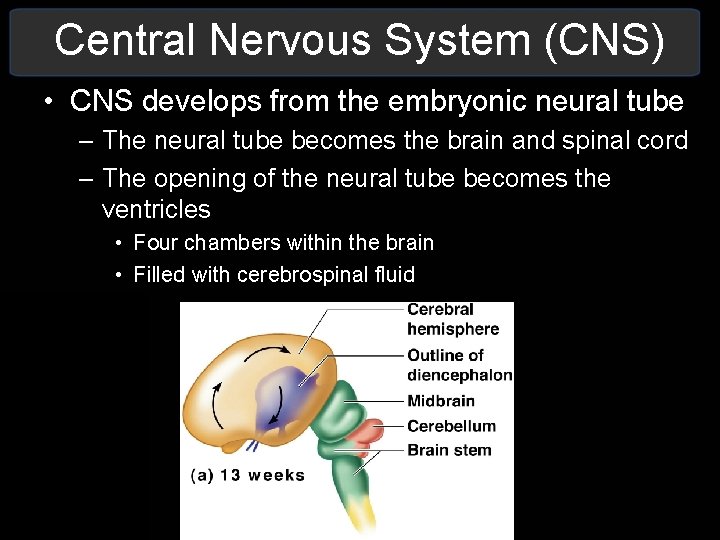
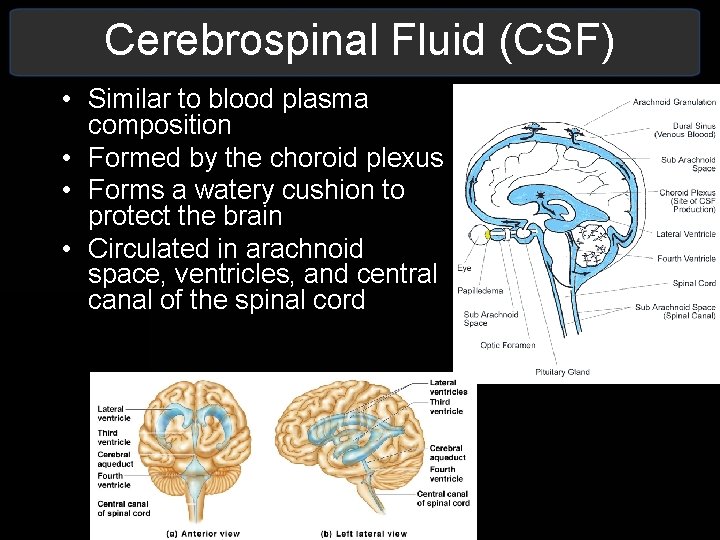
Central Nervous System (CNS) • CNS develops from the embryonic neural tube – The neural tube becomes the brain and spinal cord – The opening of the neural tube becomes the ventricles • Four chambers within the brain • Filled with cerebrospinal fluid
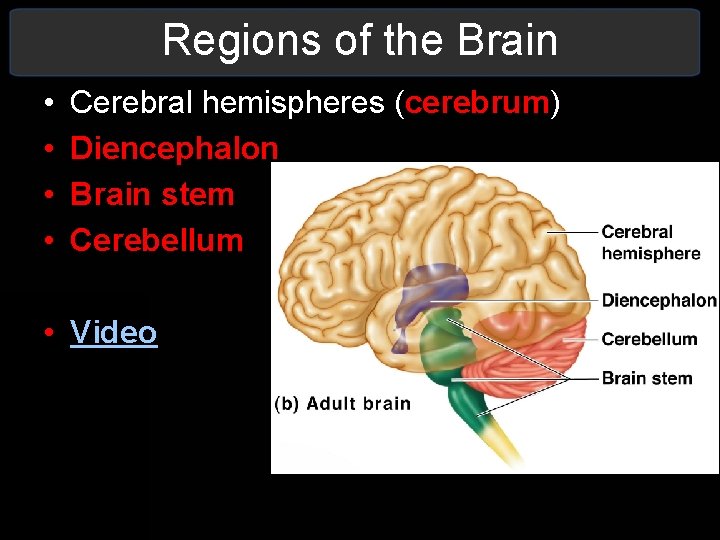
Regions of the Brain • • Cerebral hemispheres (cerebrum) Diencephalon Brain stem Cerebellum • Video
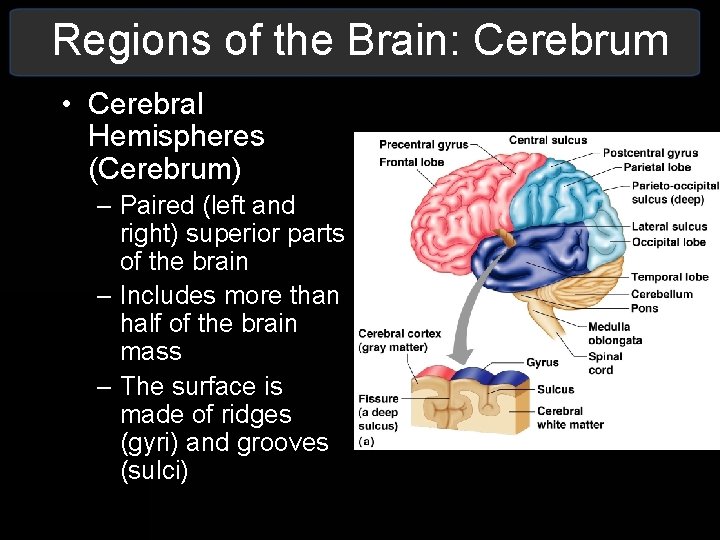
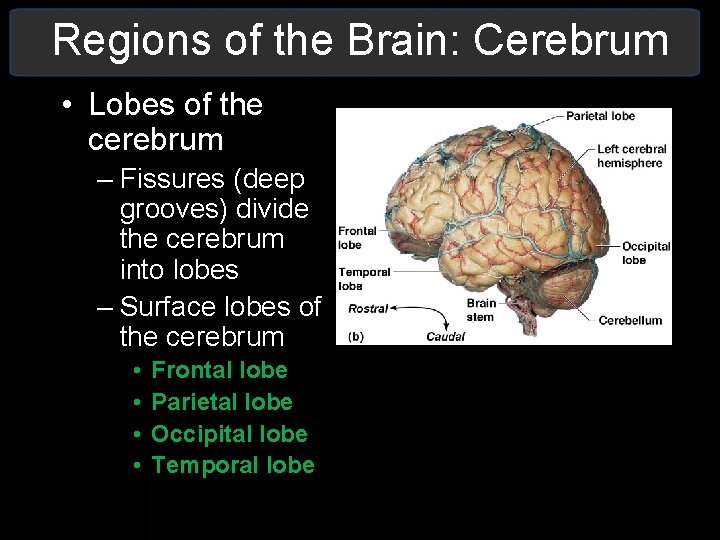
Regions of the Brain: Cerebrum • Cerebral Hemispheres (Cerebrum) – Paired (left and right) superior parts of the brain – Includes more than half of the brain mass – The surface is made of ridges (gyri) and grooves (sulci)
Regions of the Brain: Cerebrum • Lobes of the cerebrum – Fissures (deep grooves) divide the cerebrum into lobes – Surface lobes of the cerebrum • • Frontal lobe Parietal lobe Occipital lobe Temporal lobe
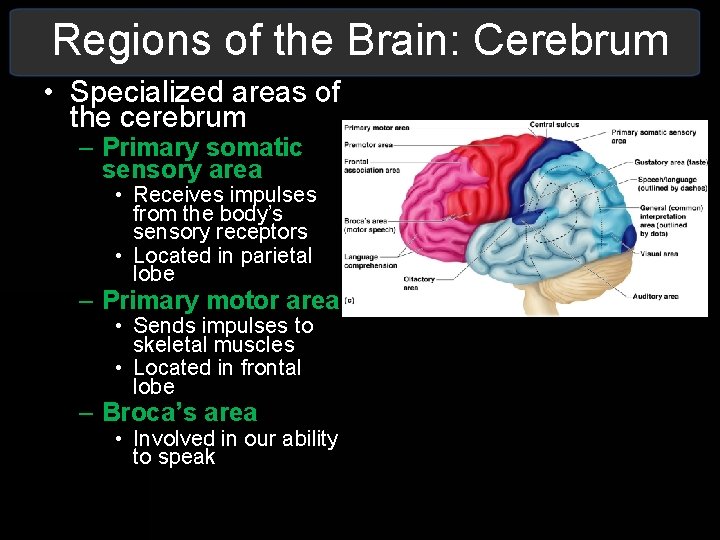
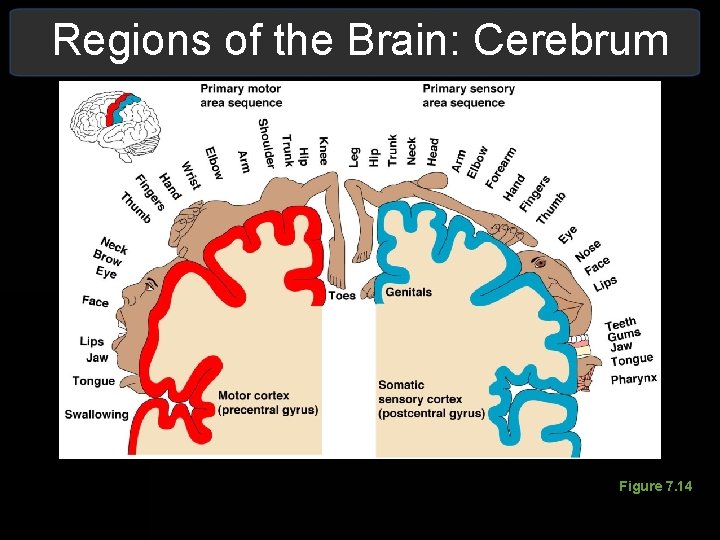
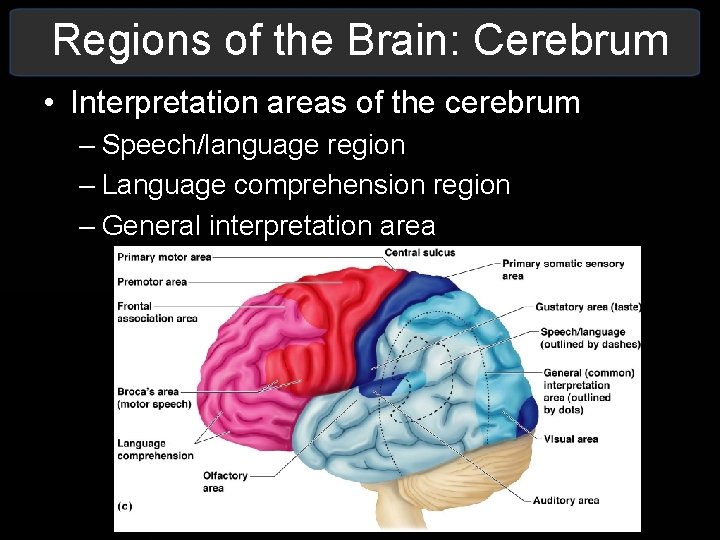
Regions of the Brain: Cerebrum • Specialized areas of the cerebrum – Primary somatic sensory area • Receives impulses from the body’s sensory receptors • Located in parietal lobe – Primary motor area • Sends impulses to skeletal muscles • Located in frontal lobe – Broca’s area • Involved in our ability to speak
Regions of the Brain: Cerebrum Figure 7. 14
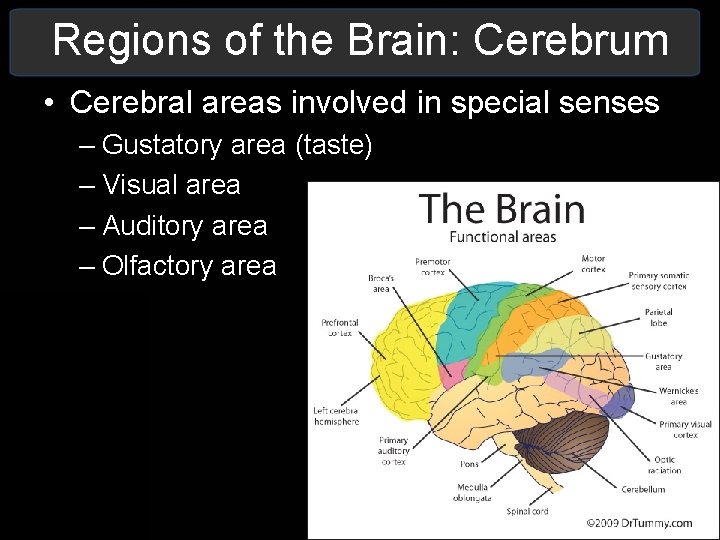
Regions of the Brain: Cerebrum • Cerebral areas involved in special senses – Gustatory area (taste) – Visual area – Auditory area – Olfactory area
Regions of the Brain: Cerebrum • Interpretation areas of the cerebrum – Speech/language region – Language comprehension region – General interpretation area
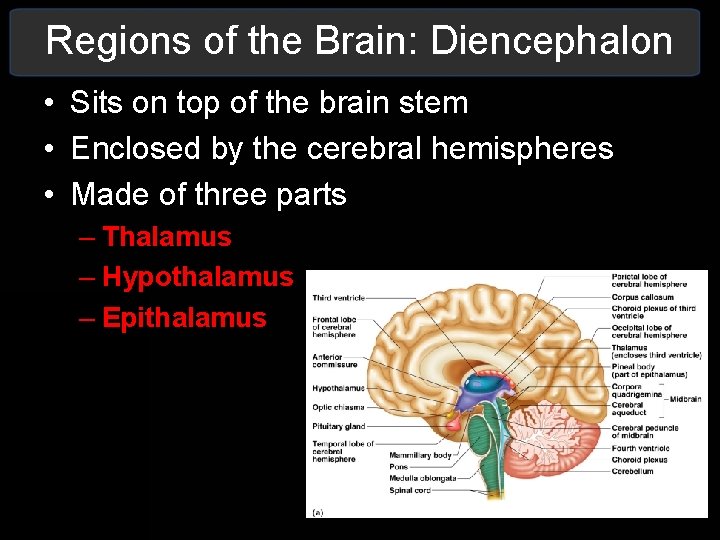
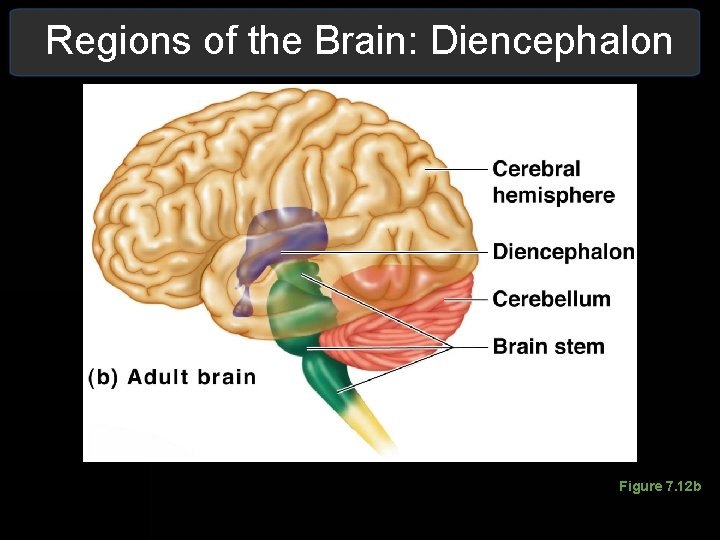
Regions of the Brain: Diencephalon • Sits on top of the brain stem • Enclosed by the cerebral hemispheres • Made of three parts – Thalamus – Hypothalamus – Epithalamus
Regions of the Brain: Diencephalon Figure 7. 12 b
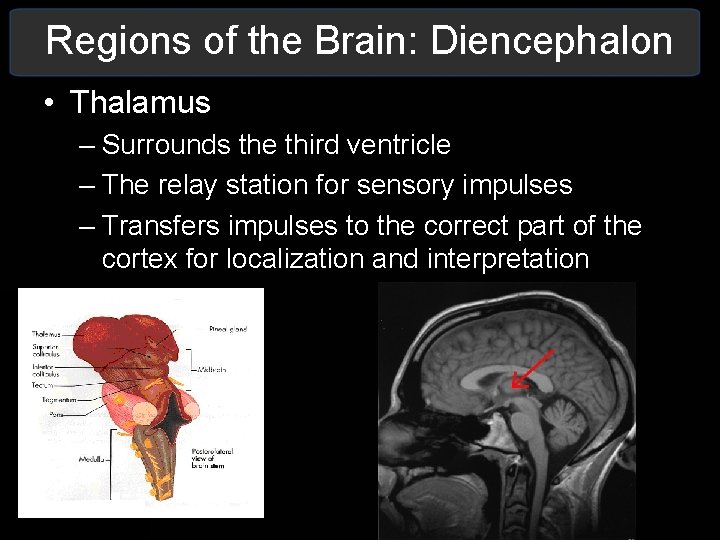
Regions of the Brain: Diencephalon • Thalamus – Surrounds the third ventricle – The relay station for sensory impulses – Transfers impulses to the correct part of the cortex for localization and interpretation
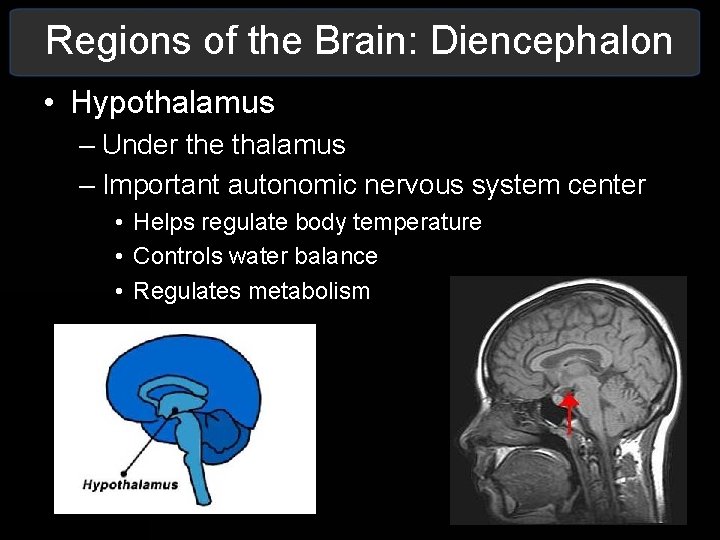
Regions of the Brain: Diencephalon • Hypothalamus – Under the thalamus – Important autonomic nervous system center • Helps regulate body temperature • Controls water balance • Regulates metabolism
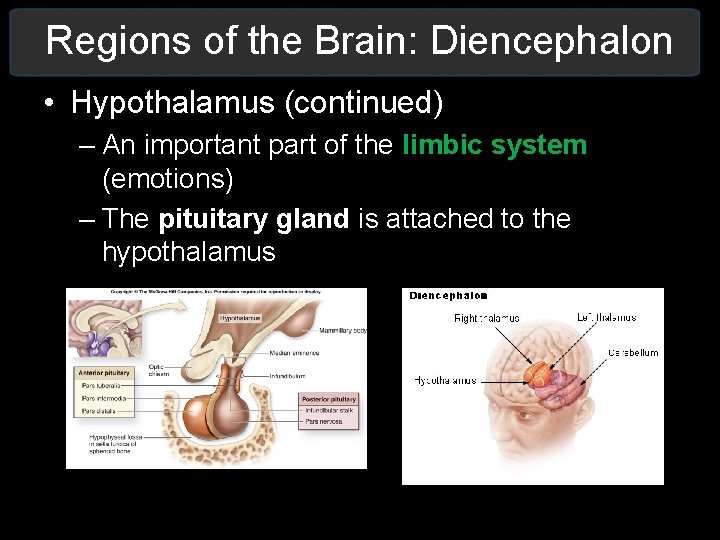
Regions of the Brain: Diencephalon • Hypothalamus (continued) – An important part of the limbic system (emotions) – The pituitary gland is attached to the hypothalamus
Regions of the Brain: Diencephalon • Epithalamus – Forms the roof of the third ventricle – Houses the pineal body (an endocrine gland) – Includes the choroid plexus—forms cerebrospinal fluid
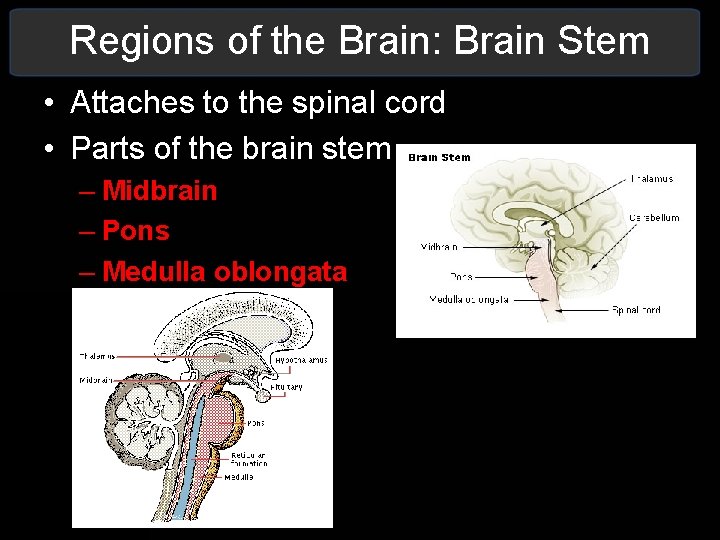
Regions of the Brain: Brain Stem • Attaches to the spinal cord • Parts of the brain stem – Midbrain – Pons – Medulla oblongata
Regions of the Brain: Brain Stem • Midbrain – Mostly composed of tracts of nerve fibers – Has two bulging fiber tracts— cerebral peduncles – Has four rounded protrusions— corpora quadrigemina • Reflex centers for vision and hearing
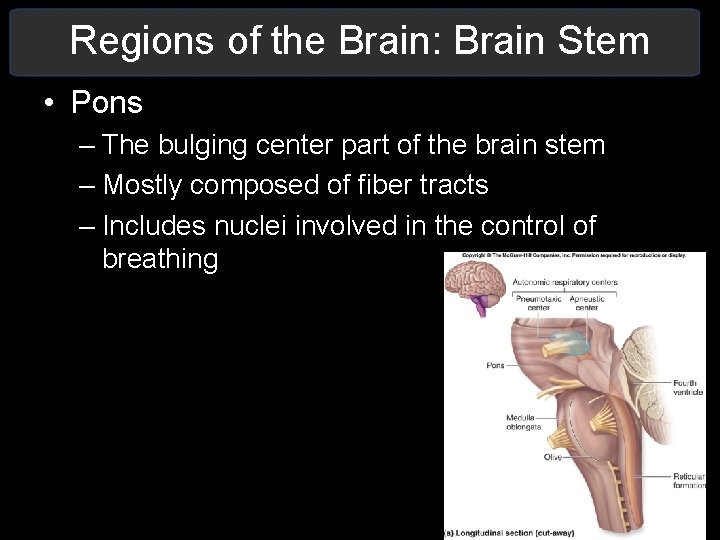
Regions of the Brain: Brain Stem • Pons – The bulging center part of the brain stem – Mostly composed of fiber tracts – Includes nuclei involved in the control of breathing
Regions of the Brain: Brain Stem • Medulla Oblongata – The lowest part of the brain stem – Merges into the spinal cord – Includes important fiber tracts (crossing over) – Contains important control centers • • • Heart rate control Blood pressure regulation Breathing Swallowing Vomiting
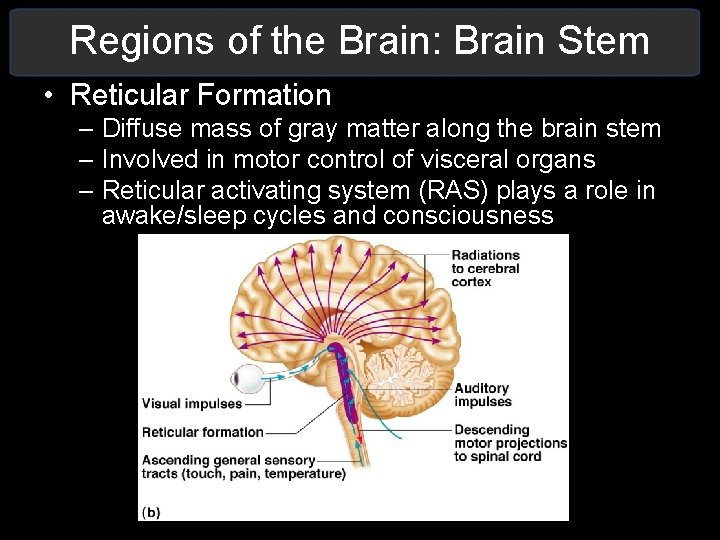
Regions of the Brain: Brain Stem • Reticular Formation – Diffuse mass of gray matter along the brain stem – Involved in motor control of visceral organs – Reticular activating system (RAS) plays a role in awake/sleep cycles and consciousness
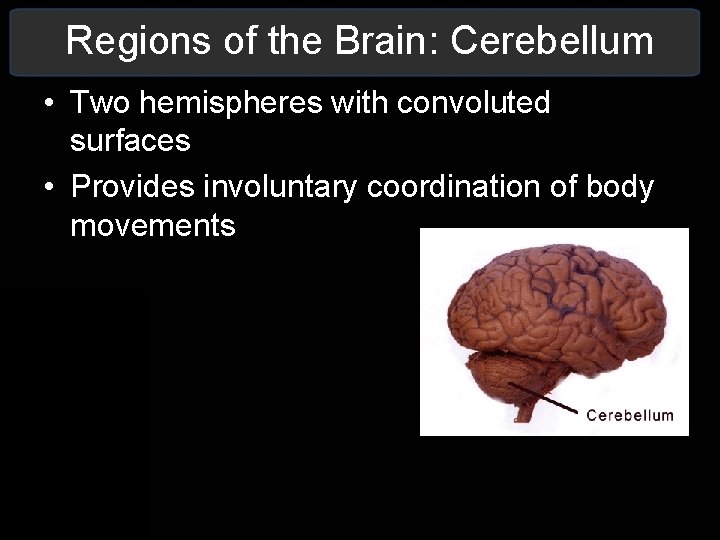
Regions of the Brain: Cerebellum • Two hemispheres with convoluted surfaces • Provides involuntary coordination of body movements
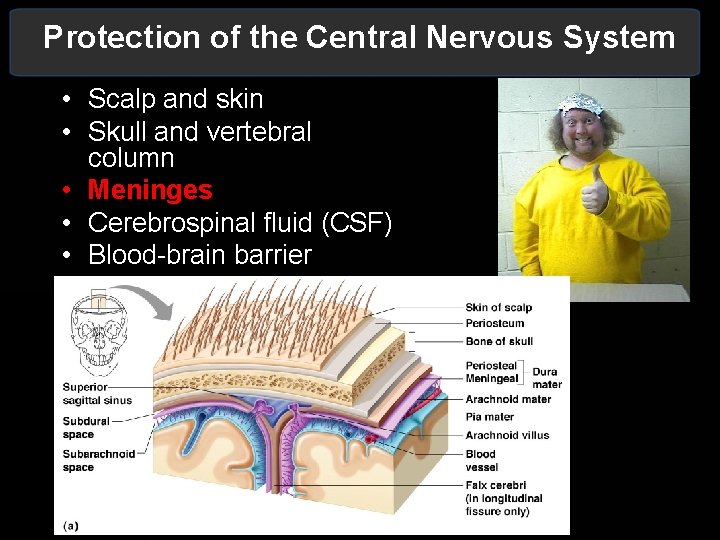
Protection of the Central Nervous System • Scalp and skin • Skull and vertebral column • Meninges • Cerebrospinal fluid (CSF) • Blood-brain barrier
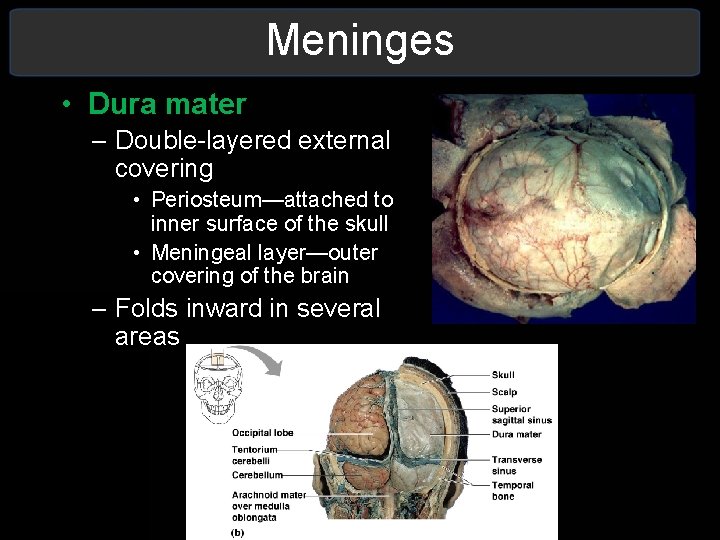
Meninges • Dura mater – Double-layered external covering • Periosteum—attached to inner surface of the skull • Meningeal layer—outer covering of the brain – Folds inward in several areas
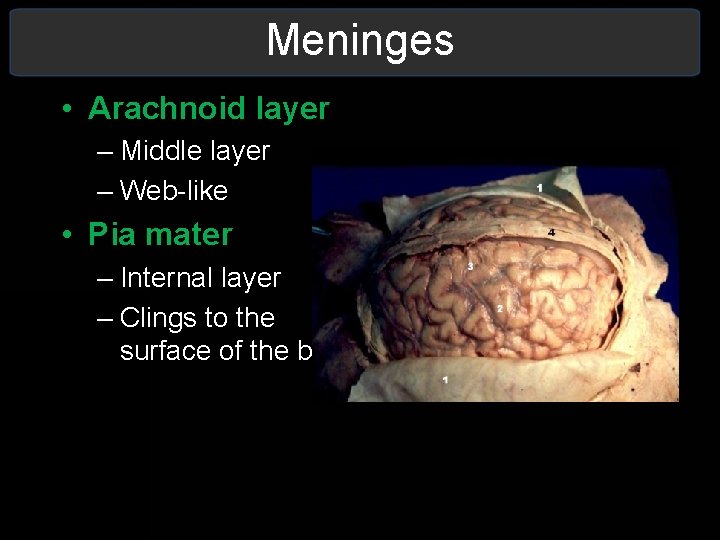
Meninges • Arachnoid layer – Middle layer – Web-like • Pia mater – Internal layer – Clings to the surface of the brain
Cerebrospinal Fluid (CSF) • Similar to blood plasma composition • Formed by the choroid plexus • Forms a watery cushion to protect the brain • Circulated in arachnoid space, ventricles, and central canal of the spinal cord
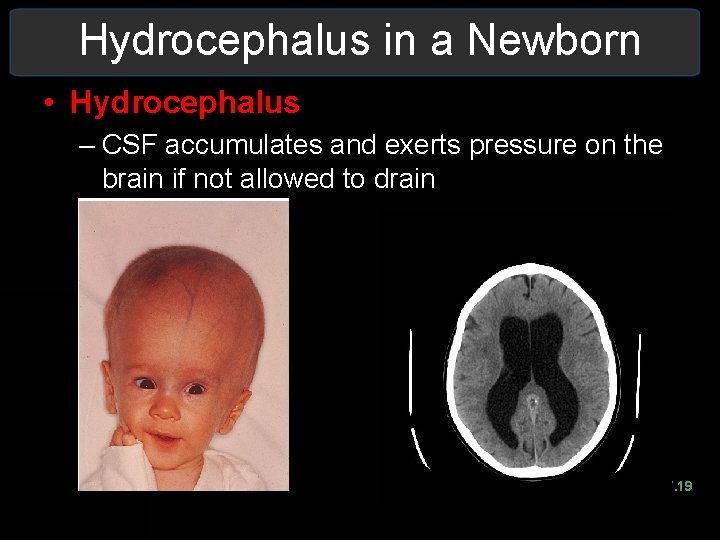
Hydrocephalus in a Newborn • Hydrocephalus – CSF accumulates and exerts pressure on the brain if not allowed to drain Figure 7. 19
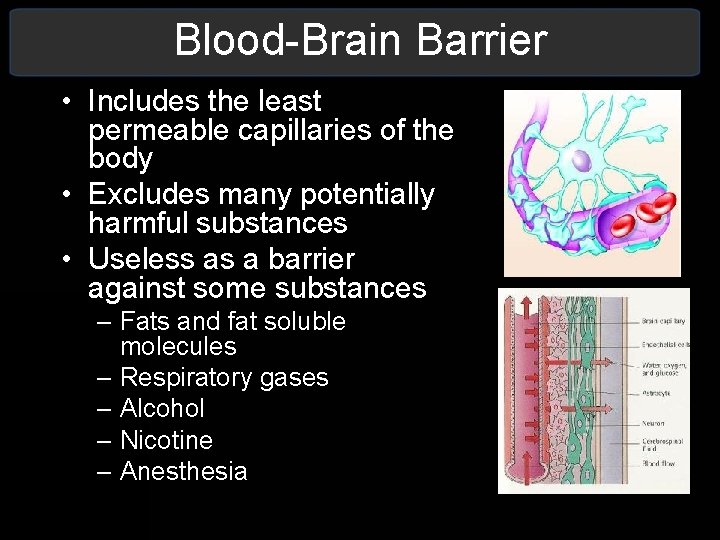
Blood-Brain Barrier • Includes the least permeable capillaries of the body • Excludes many potentially harmful substances • Useless as a barrier against some substances – Fats and fat soluble molecules – Respiratory gases – Alcohol – Nicotine – Anesthesia
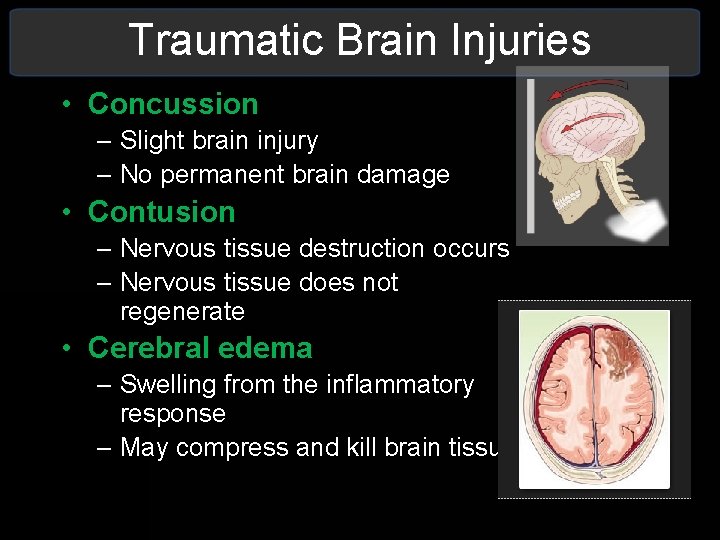
Traumatic Brain Injuries • Concussion – Slight brain injury – No permanent brain damage • Contusion – Nervous tissue destruction occurs – Nervous tissue does not regenerate • Cerebral edema – Swelling from the inflammatory response – May compress and kill brain tissue
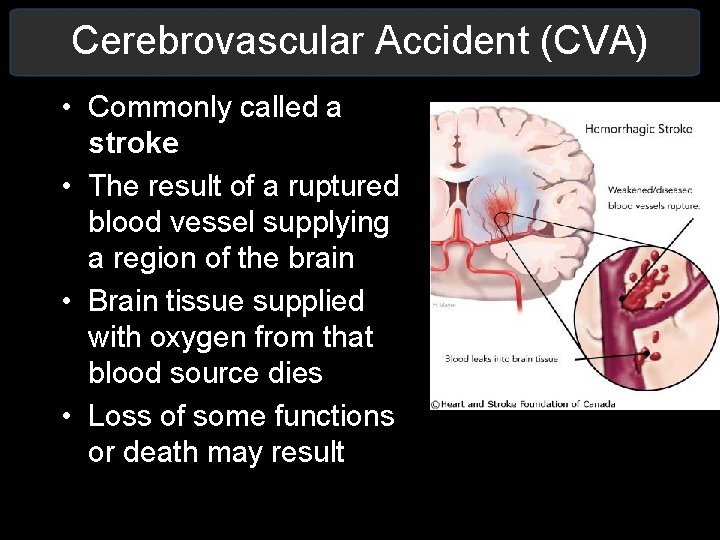
Cerebrovascular Accident (CVA) • Commonly called a stroke • The result of a ruptured blood vessel supplying a region of the brain • Brain tissue supplied with oxygen from that blood source dies • Loss of some functions or death may result
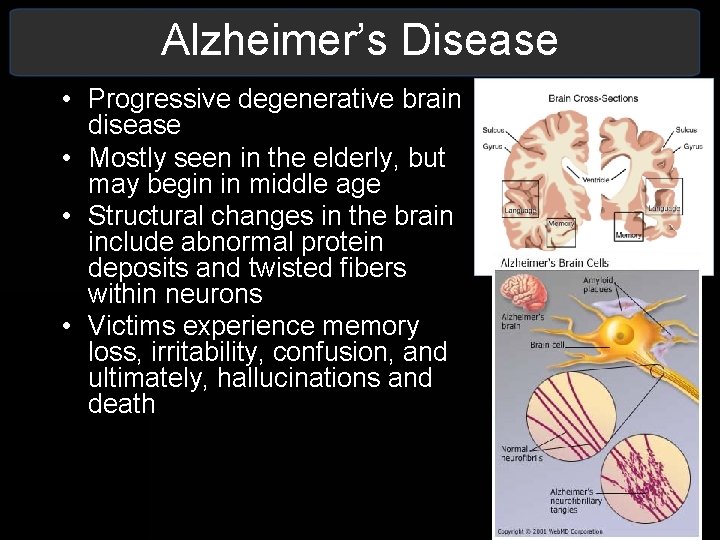
Alzheimer’s Disease • Progressive degenerative brain disease • Mostly seen in the elderly, but may begin in middle age • Structural changes in the brain include abnormal protein deposits and twisted fibers within neurons • Victims experience memory loss, irritability, confusion, and ultimately, hallucinations and death
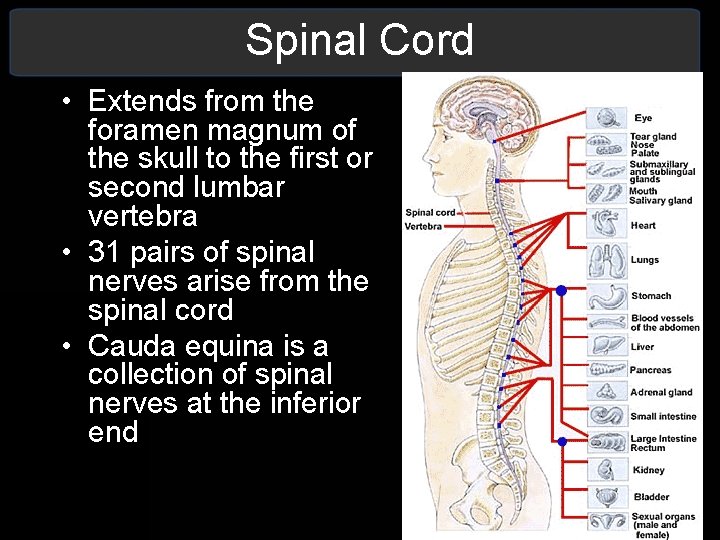
Spinal Cord • Extends from the foramen magnum of the skull to the first or second lumbar vertebra • 31 pairs of spinal nerves arise from the spinal cord • Cauda equina is a collection of spinal nerves at the inferior end
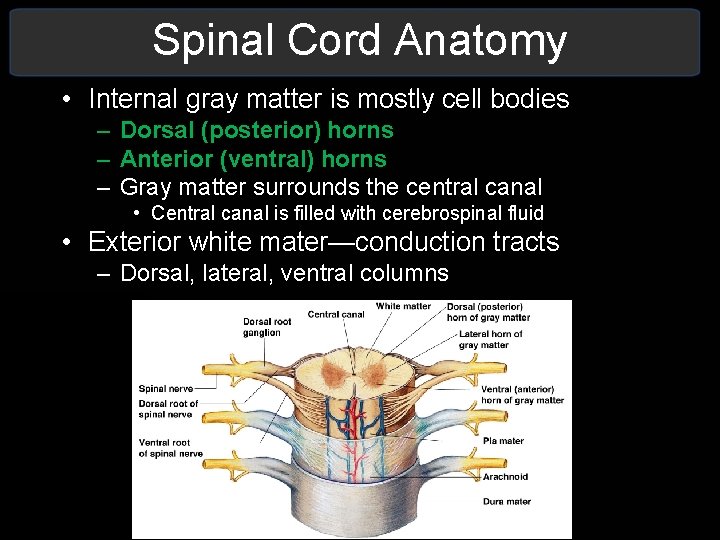
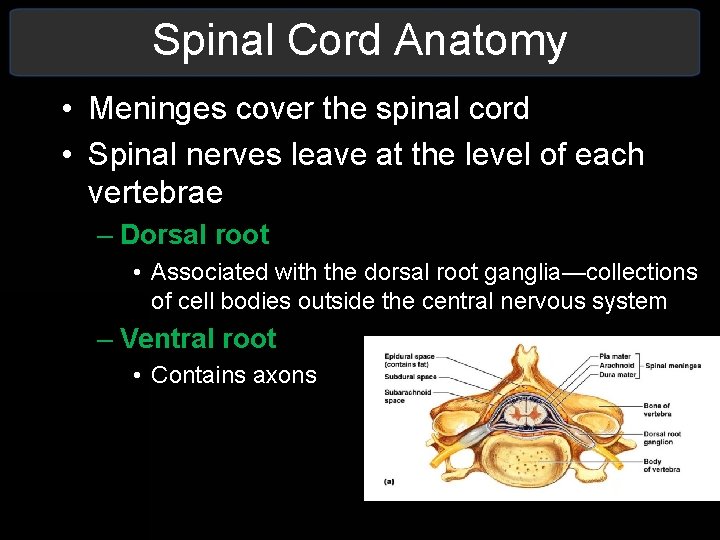
Spinal Cord Anatomy • Internal gray matter is mostly cell bodies – Dorsal (posterior) horns – Anterior (ventral) horns – Gray matter surrounds the central canal • Central canal is filled with cerebrospinal fluid • Exterior white mater—conduction tracts – Dorsal, lateral, ventral columns
Spinal Cord Anatomy • Meninges cover the spinal cord • Spinal nerves leave at the level of each vertebrae – Dorsal root • Associated with the dorsal root ganglia—collections of cell bodies outside the central nervous system – Ventral root • Contains axons
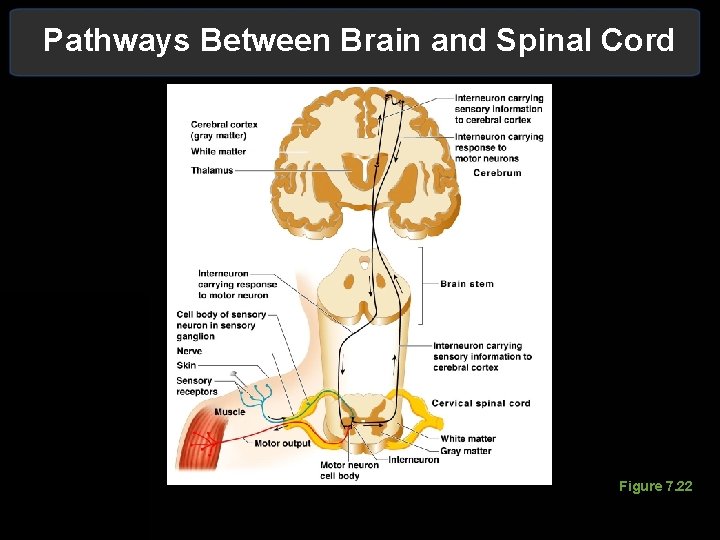
Pathways Between Brain and Spinal Cord Figure 7. 22