
The Nervous System Peripheral nervous system PNS Central
- Slides: 28
The Nervous System
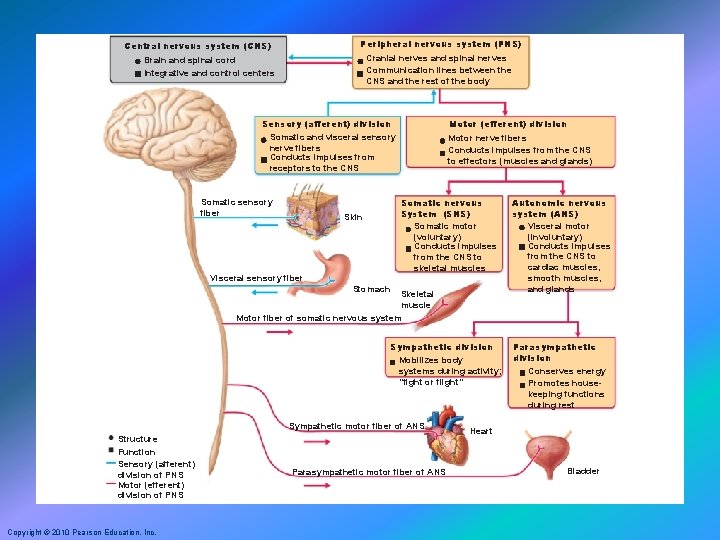
Peripheral nervous system (PNS) Central nervous system (CNS) Cranial nerves and spinal nerves Communication lines between the CNS and the rest of the body Brain and spinal cord Integrative and control centers Sensory (afferent) division Somatic and visceral sensory nerve fibers Conducts impulses from receptors to the CNS Somatic sensory fiber Motor (efferent) division Motor nerve fibers Conducts impulses from the CNS to effectors (muscles and glands) Somatic nervous System (SNS) Somatic motor (voluntary) Conducts impulses from the CNS to skeletal muscles Skin Visceral sensory fiber Stomach Skeletal muscle Motor fiber of somatic nervous system Sympathetic division Mobilizes body systems during activity; “fight or flight” Sympathetic motor fiber of ANS Structure Function Sensory (afferent) division of PNS Motor (efferent) division of PNS Copyright © 2010 Pearson Education, Inc. Parasympathetic motor fiber of ANS Autonomic nervous system (ANS) Visceral motor (involuntary) Conducts impulses from the CNS to cardiac muscles, smooth muscles, and glands Parasympathetic division Conserves energy Promotes housekeeping functions during rest Heart Bladder
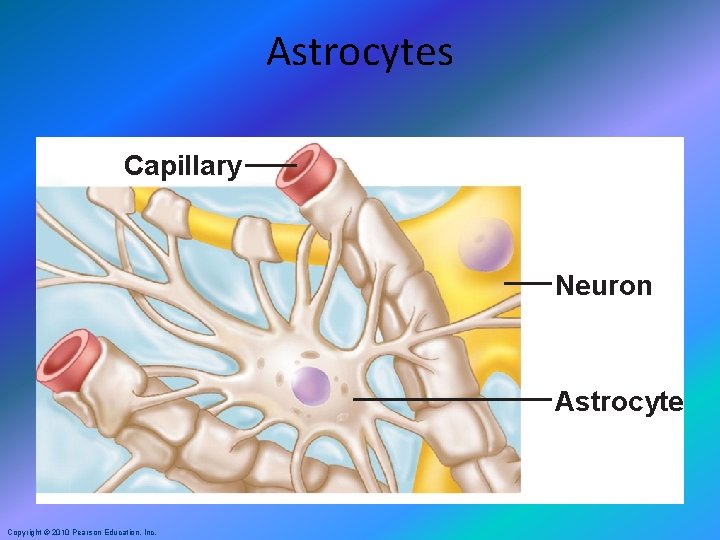
Astrocytes Capillary Neuron Astrocyte Copyright © 2010 Pearson Education, Inc.
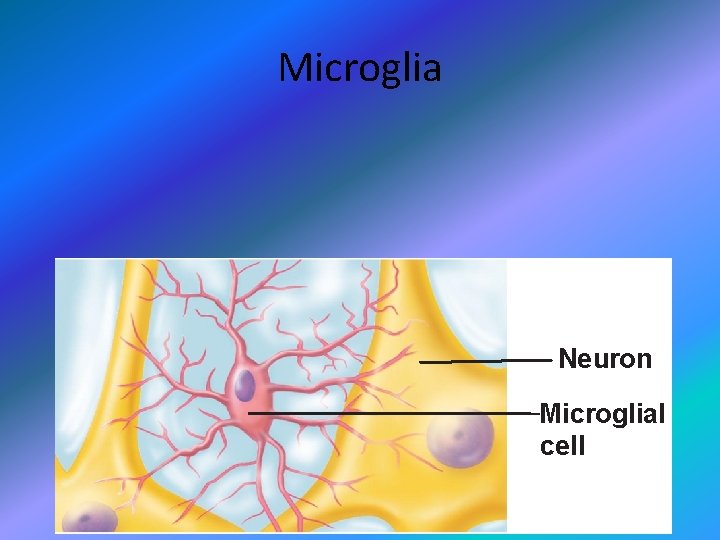
Microglia Neuron Microglial cell
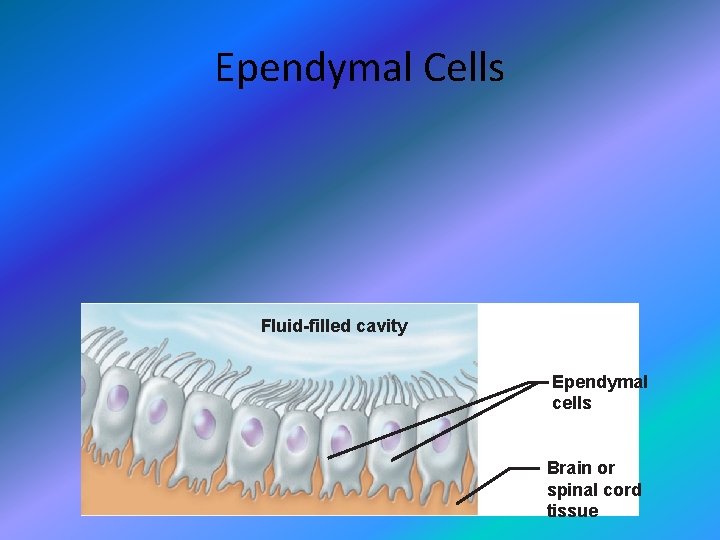
Ependymal Cells Fluid-filled cavity Ependymal cells Brain or spinal cord tissue
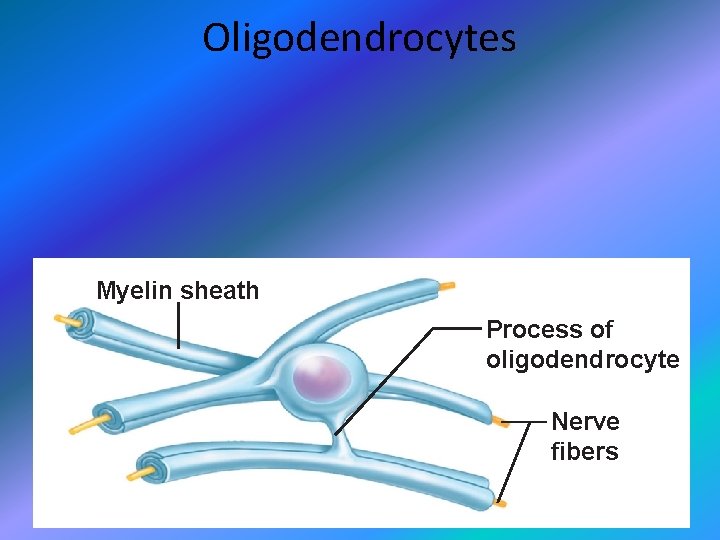
Oligodendrocytes Myelin sheath Process of oligodendrocyte Nerve fibers
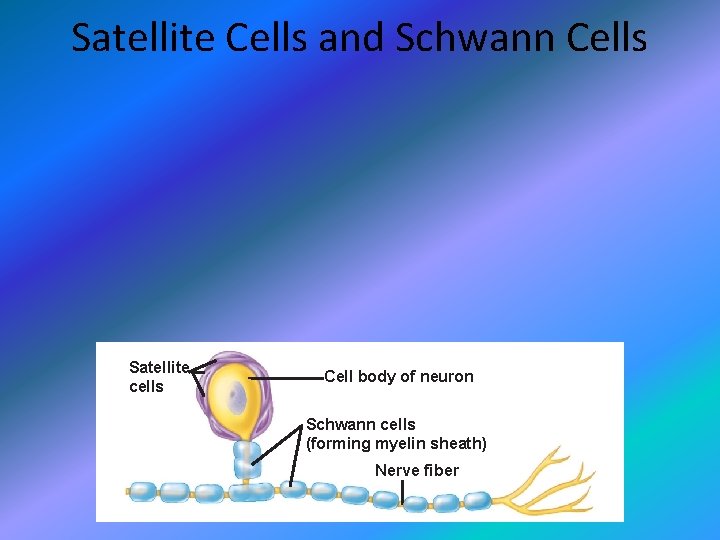
Satellite Cells and Schwann Cells Satellite cells Cell body of neuron Schwann cells (forming myelin sheath) Nerve fiber
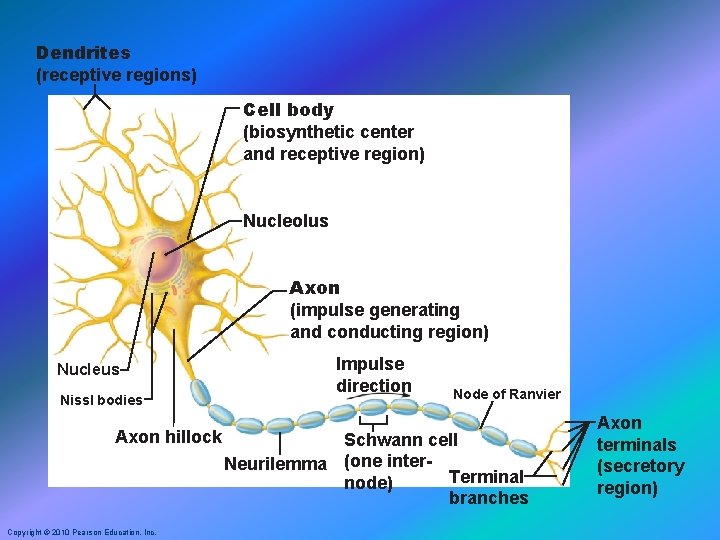
Dendrites (receptive regions) Cell body (biosynthetic center and receptive region) Nucleolus Axon (impulse generating and conducting region) Nucleus Nissl bodies Axon hillock Copyright © 2010 Pearson Education, Inc. Impulse direction Node of Ranvier Schwann cell Neurilemma (one inter. Terminal node) branches Axon terminals (secretory region)
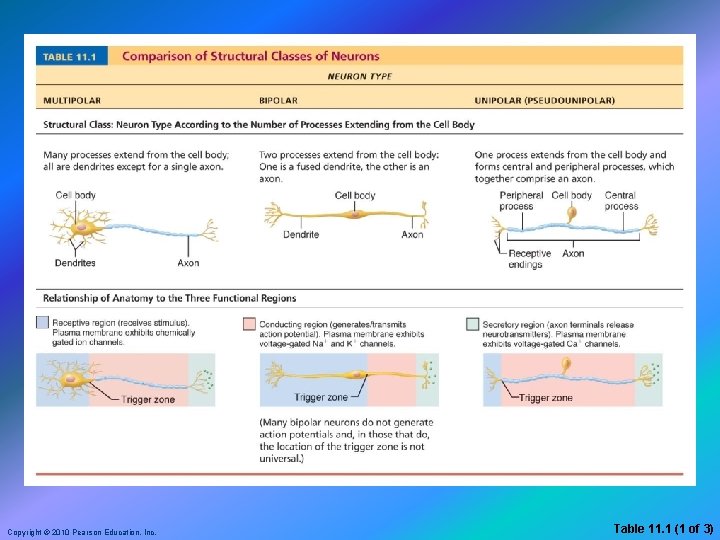
Copyright © 2010 Pearson Education, Inc. Table 11. 1 (1 of 3)
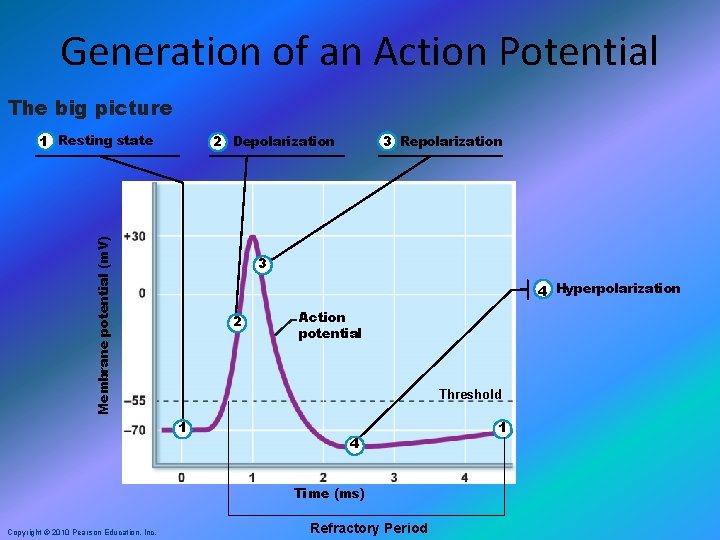
Generation of an Action Potential The big picture 2 Depolarization Membrane potential (m. V) 1 Resting state 3 Repolarization 3 4 Hyperpolarization 2 Action potential Threshold 1 4 Time (ms) Copyright © 2010 Pearson Education, Inc. Refractory Period 1
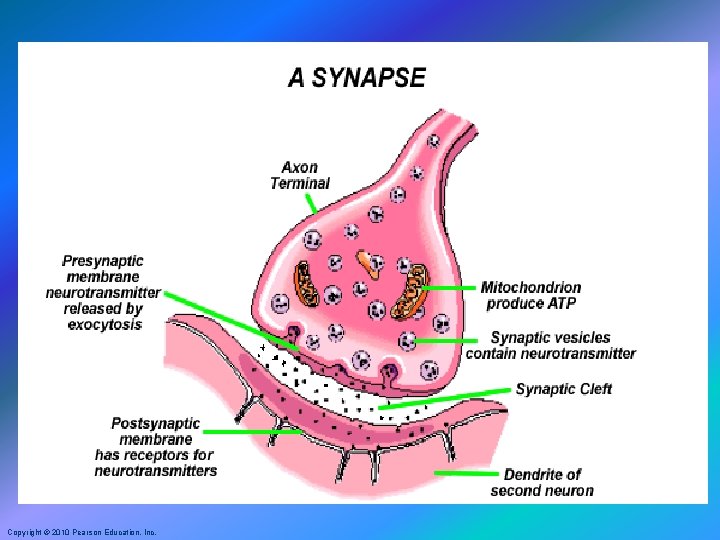
Copyright © 2010 Pearson Education, Inc.
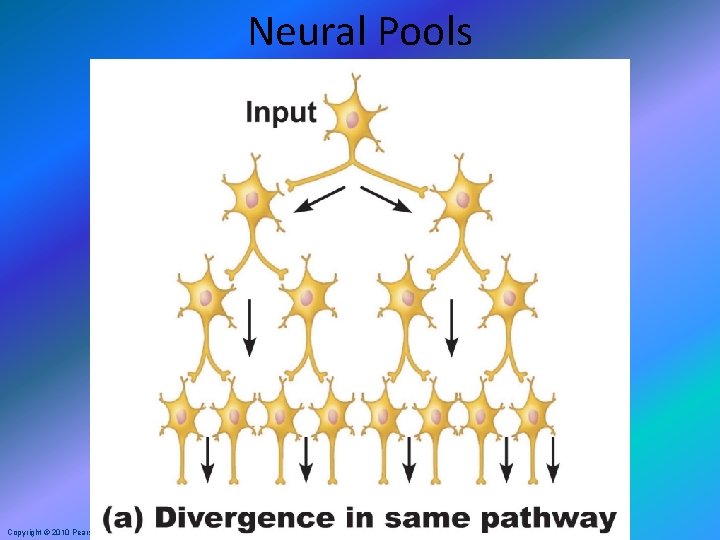
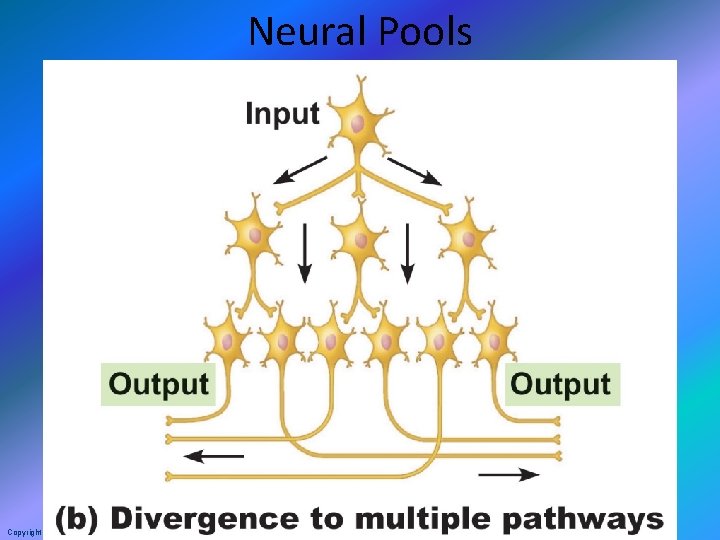
Neural Pools Copyright © 2010 Pearson Education, Inc.
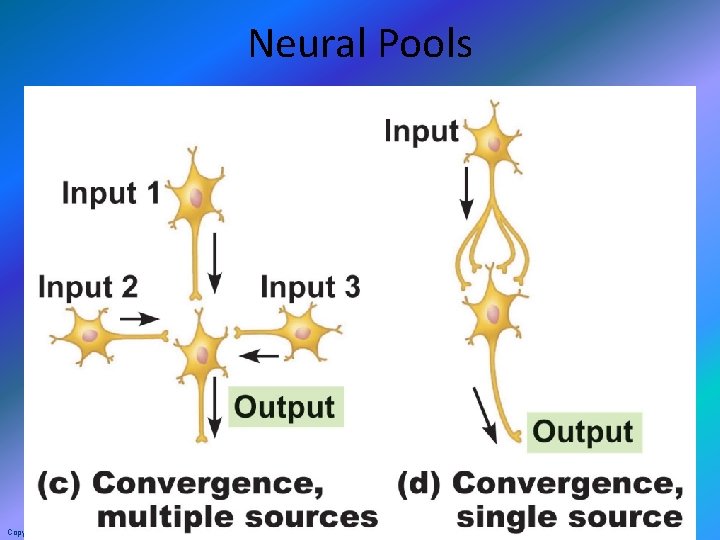
Neural Pools Copyright © 2010 Pearson Education, Inc.
Neural Pools Copyright © 2010 Pearson Education, Inc.
The Brain and Spinal Cord
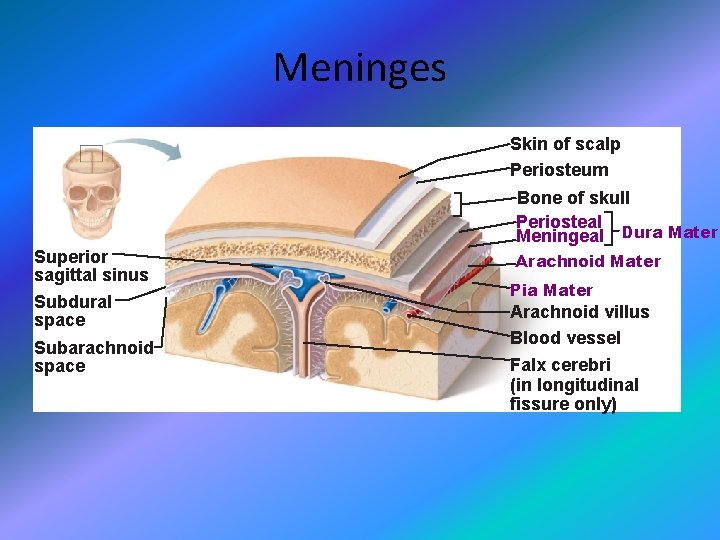
Meninges Skin of scalp Periosteum Bone of skull Periosteal Meningeal Dura Mater Superior sagittal sinus Subdural space Subarachnoid space Arachnoid Mater Pia Mater Arachnoid villus Blood vessel Falx cerebri (in longitudinal fissure only)
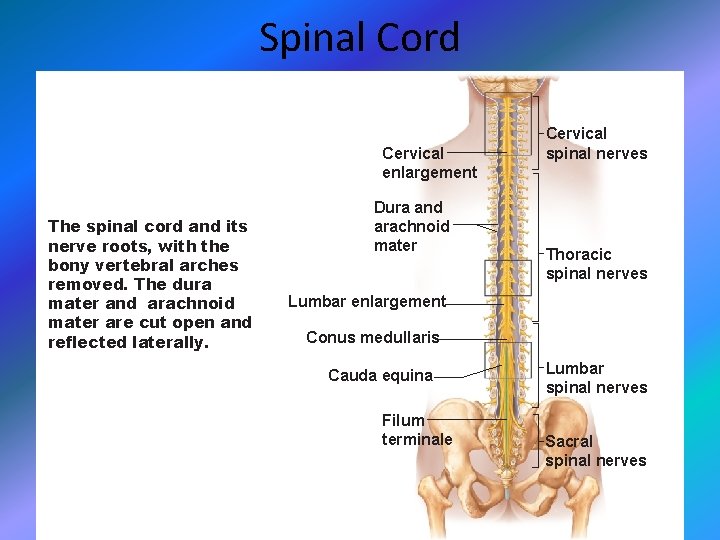
Spinal Cord Cervical enlargement The spinal cord and its nerve roots, with the bony vertebral arches removed. The dura mater and arachnoid mater are cut open and reflected laterally. Dura and arachnoid mater Cervical spinal nerves Thoracic spinal nerves Lumbar enlargement Conus medullaris Cauda equina Filum terminale Lumbar spinal nerves Sacral spinal nerves
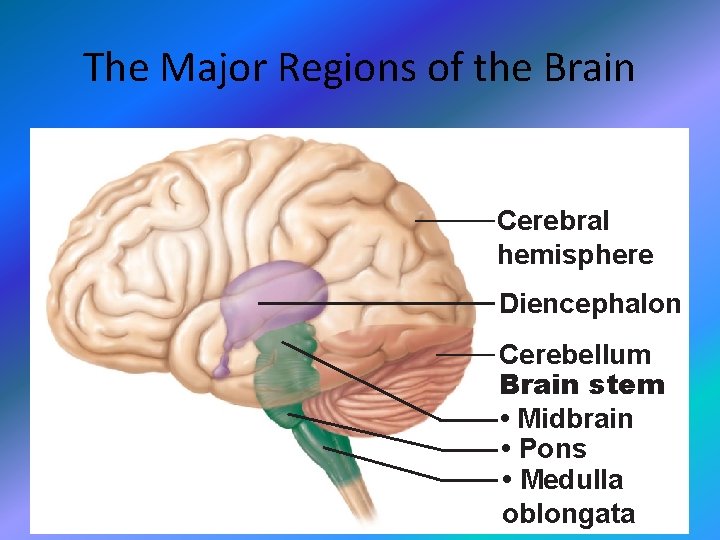
The Major Regions of the Brain Cerebral hemisphere Diencephalon Cerebellum Brain stem • Midbrain • Pons • Medulla oblongata
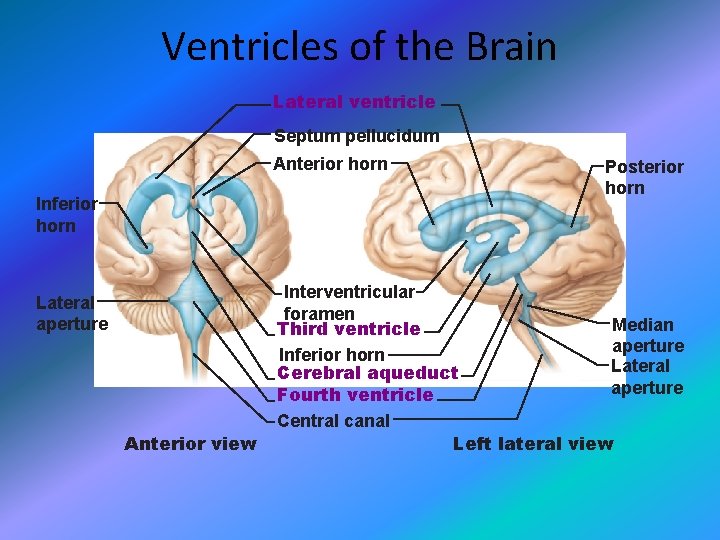
Ventricles of the Brain Lateral ventricle Septum pellucidum Anterior horn Inferior horn Lateral aperture Anterior view Posterior horn Interventricular foramen Median Third ventricle aperture Inferior horn Lateral Cerebral aqueduct aperture Fourth ventricle Central canal Left lateral view
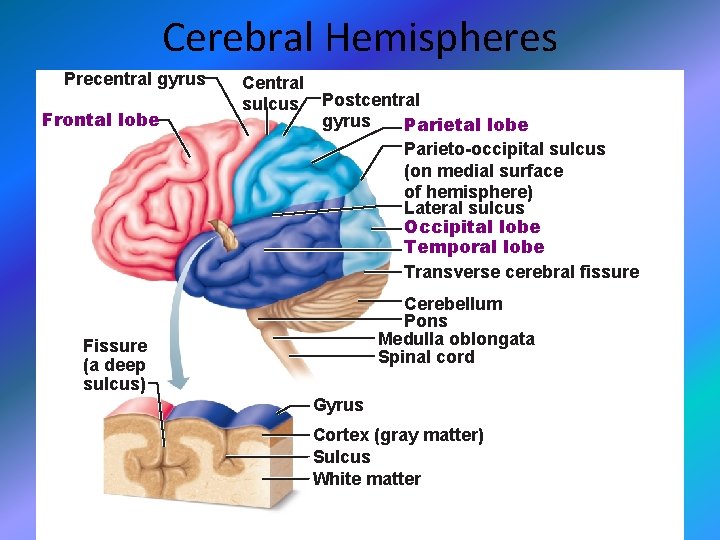
Cerebral Hemispheres Precentral gyrus Frontal lobe Central sulcus Postcentral gyrus Parietal lobe Parieto-occipital sulcus (on medial surface of hemisphere) Lateral sulcus Occipital lobe Temporal lobe Transverse cerebral fissure Cerebellum Pons Medulla oblongata Spinal cord Fissure (a deep sulcus) Gyrus Cortex (gray matter) Sulcus White matter
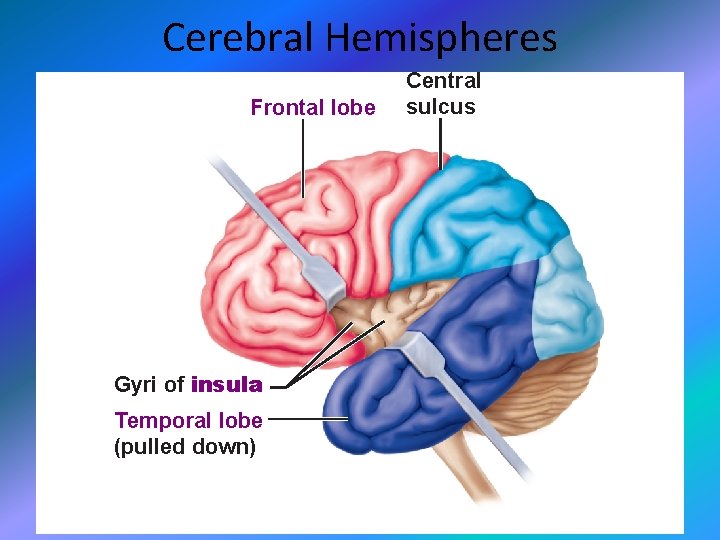
Cerebral Hemispheres Frontal lobe Gyri of insula Temporal lobe (pulled down) Central sulcus
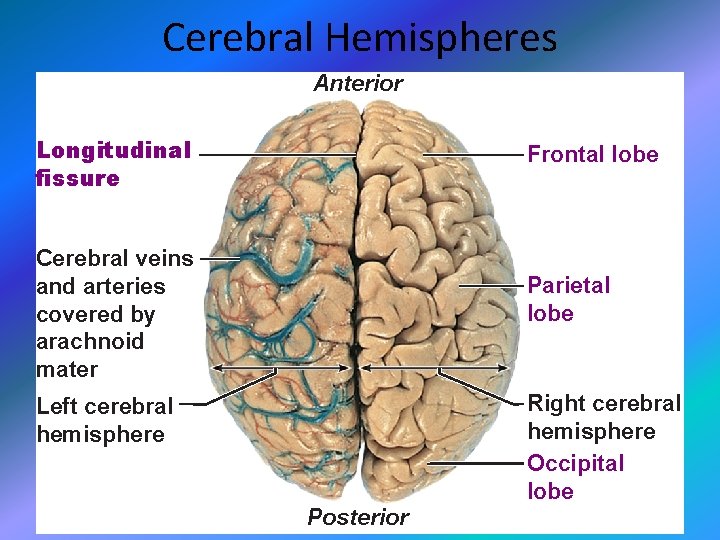
Cerebral Hemispheres Anterior Longitudinal fissure Frontal lobe Cerebral veins and arteries covered by arachnoid mater Parietal lobe Right cerebral hemisphere Occipital lobe Left cerebral hemisphere Posterior
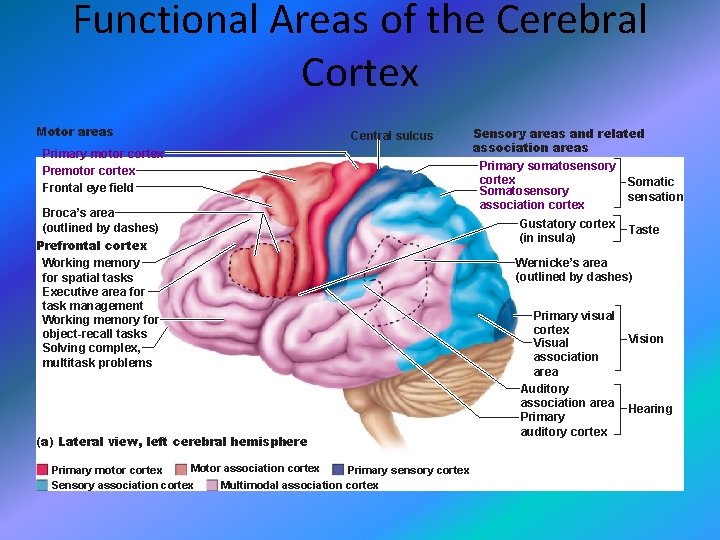
Functional Areas of the Cerebral Cortex Motor areas Central sulcus Primary motor cortex Premotor cortex Frontal eye field Broca’s area (outlined by dashes) Prefrontal cortex Working memory for spatial tasks Executive area for task management Working memory for object-recall tasks Solving complex, multitask problems (a) Lateral view, left cerebral hemisphere Motor association cortex Primary sensory cortex Primary motor cortex Sensory association cortex Multimodal association cortex Sensory areas and related association areas Primary somatosensory cortex Somatic Somatosensory sensation association cortex Gustatory cortex (in insula) Taste Wernicke’s area (outlined by dashes) Primary visual cortex Visual association area Auditory association area Primary auditory cortex Vision Hearing
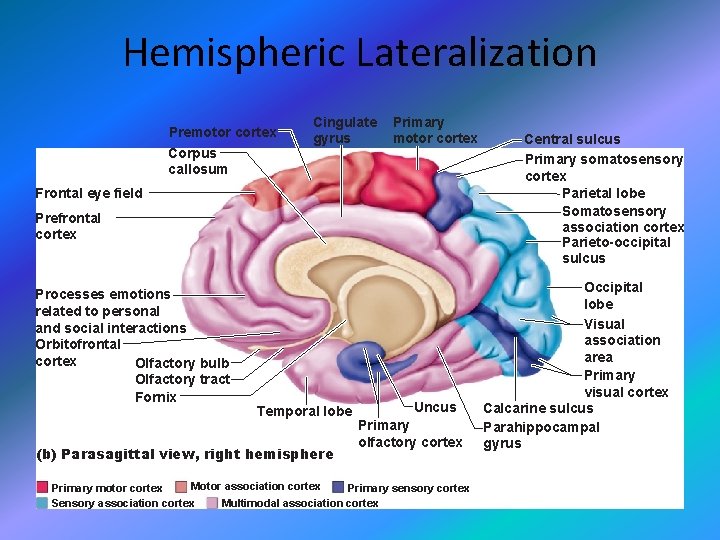
Hemispheric Lateralization Premotor cortex Corpus callosum Cingulate gyrus Primary motor cortex Frontal eye field Prefrontal cortex Processes emotions related to personal and social interactions Orbitofrontal cortex Olfactory bulb Olfactory tract Fornix Temporal lobe (b) Parasagittal view, right hemisphere Uncus Primary olfactory cortex Motor association cortex Primary sensory cortex Primary motor cortex Sensory association cortex Multimodal association cortex Central sulcus Primary somatosensory cortex Parietal lobe Somatosensory association cortex Parieto-occipital sulcus Occipital lobe Visual association area Primary visual cortex Calcarine sulcus Parahippocampal gyrus
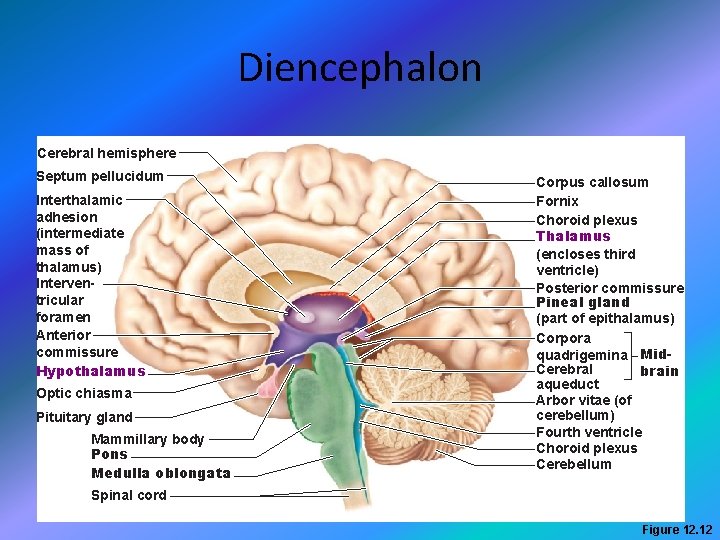
Diencephalon Cerebral hemisphere Septum pellucidum Interthalamic adhesion (intermediate mass of thalamus) Interventricular foramen Anterior commissure Hypothalamus Optic chiasma Pituitary gland Mammillary body Pons Medulla oblongata Corpus callosum Fornix Choroid plexus Thalamus (encloses third ventricle) Posterior commissure Pineal gland (part of epithalamus) Corpora quadrigemina Mid. Cerebral brain aqueduct Arbor vitae (of cerebellum) Fourth ventricle Choroid plexus Cerebellum Spinal cord Figure 12. 12
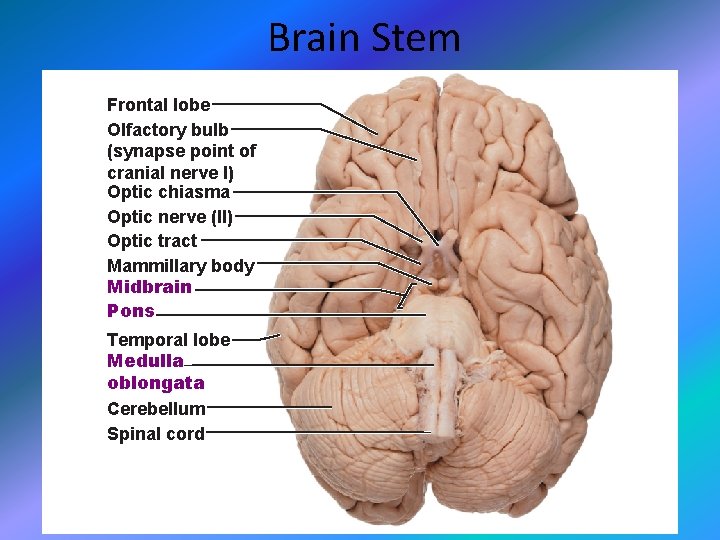
Brain Stem Frontal lobe Olfactory bulb (synapse point of cranial nerve I) Optic chiasma Optic nerve (II) Optic tract Mammillary body Midbrain Pons Temporal lobe Medulla oblongata Cerebellum Spinal cord
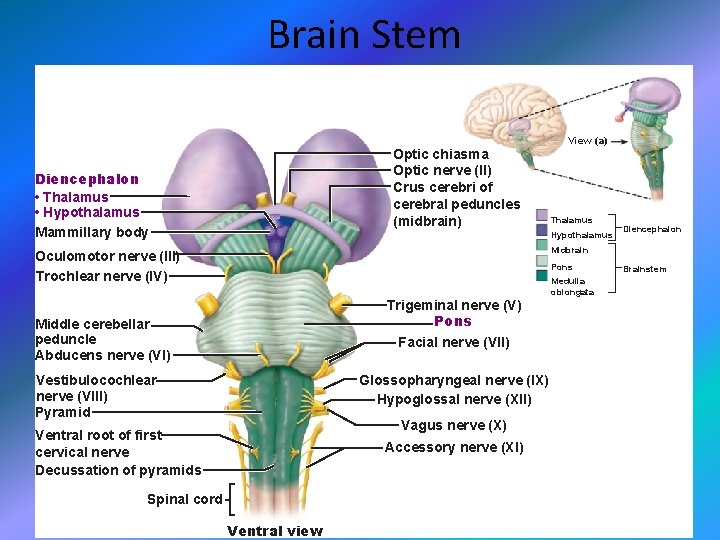
Brain Stem Optic chiasma Optic nerve (II) Crus cerebri of cerebral peduncles (midbrain) Diencephalon • Thalamus • Hypothalamus Mammillary body View (a) Thalamus Hypothalamus Diencephalon Midbrain Oculomotor nerve (III) Trochlear nerve (IV) Pons Medulla oblongata Trigeminal nerve (V) Pons Middle cerebellar peduncle Abducens nerve (VI) Facial nerve (VII) Vestibulocochlear nerve (VIII) Pyramid Glossopharyngeal nerve (IX) Hypoglossal nerve (XII) Vagus nerve (X) Ventral root of first cervical nerve Decussation of pyramids Accessory nerve (XI) Spinal cord Ventral view Brainstem
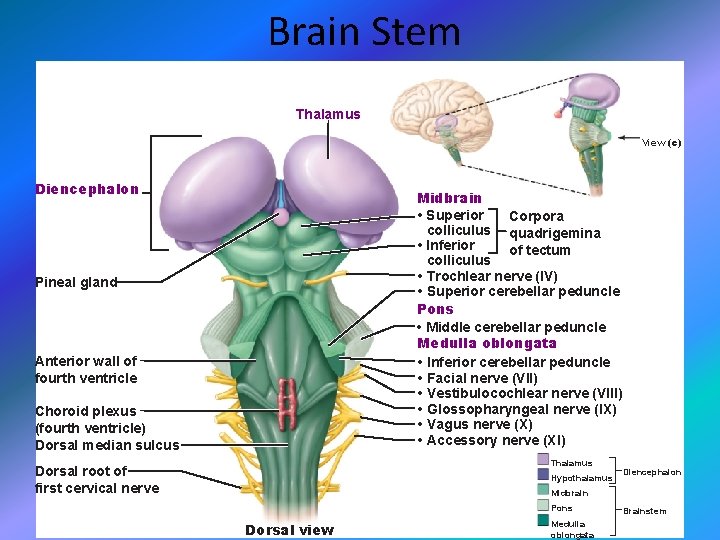
Brain Stem Thalamus View (c) Diencephalon Midbrain • Superior Corpora colliculus quadrigemina • Inferior of tectum colliculus • Trochlear nerve (IV) • Superior cerebellar peduncle Pons • Middle cerebellar peduncle Medulla oblongata • Inferior cerebellar peduncle • Facial nerve (VII) • Vestibulocochlear nerve (VIII) • Glossopharyngeal nerve (IX) • Vagus nerve (X) • Accessory nerve (XI) Pineal gland Anterior wall of fourth ventricle Choroid plexus (fourth ventricle) Dorsal median sulcus Thalamus Dorsal root of first cervical nerve Hypothalamus Diencephalon Midbrain Pons Dorsal view Medulla oblongata Brainstem