
The Nervous system Do Now Put together the


- Slides: 47
The Nervous system
Do Now • Put together the puzzle without talking, making eye contact, or using hand gestures. • Did you find this difficult? • What would make it easier? • How does this relate to your body?
Communication • Nearly all multicellular organisms have communication systems. • Specialized cells carry messages from one cell to another so that communication among all body parts is smooth and efficient.
Communicate to maintain homeostasis • There are two systems used for communication in your body: • The nervous system controls and coordinates functions throughout the body and responds to internal and external stimuli with the use of nerves • The endocrine system performs a similar function with the use of hormones
Nervous Response • Stimulus: any change that results in a change in the organism. • temperature, light, pressure, sound, smell, etc. • Response: any action resulting from a stimulus. • contraction of muscle cells • secretion by a gland • stimulation of another nerve fiber. 5
Neurons • Messages carried by the nervous system are electrical signals = impulses • Nerve cells that transmit impulses = neurons • Sensory neurons: carry impulses from sense organs to the spinal cord and brain • Motor neurons: carry impulses from the brain and spinal cord to muscles and glands • Interneurons: connect sensory and motor neurons and carry impulses between them
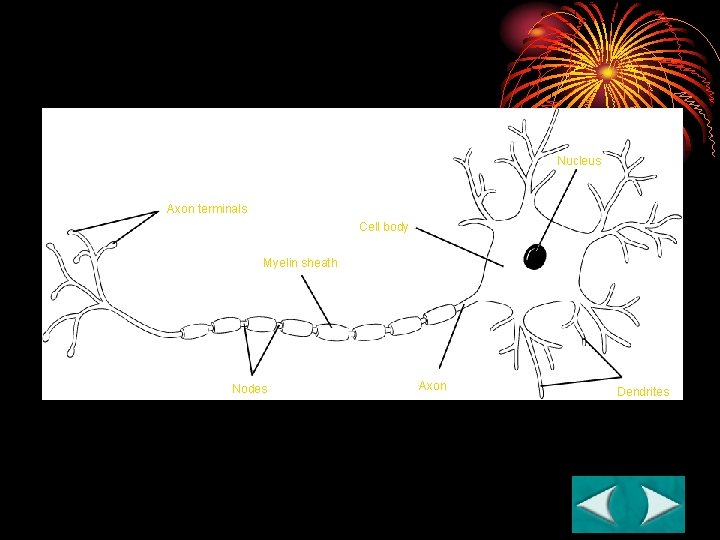
Parts of a Neuron • Cell body = largest part containing nucleus and cytoplasm (most metabolic activity occur here) • Dendrites = short, branched extensions spreading out from the cell body and they carry impulses from the environment or other neurons towards the cell body • Axon = long fibers that carry impulses away from the cell body and ends at the axon terminal
A Neuron Section 35 -2 Nucleus Axon terminals Cell body Myelin sheath Nodes Axon Dendrites
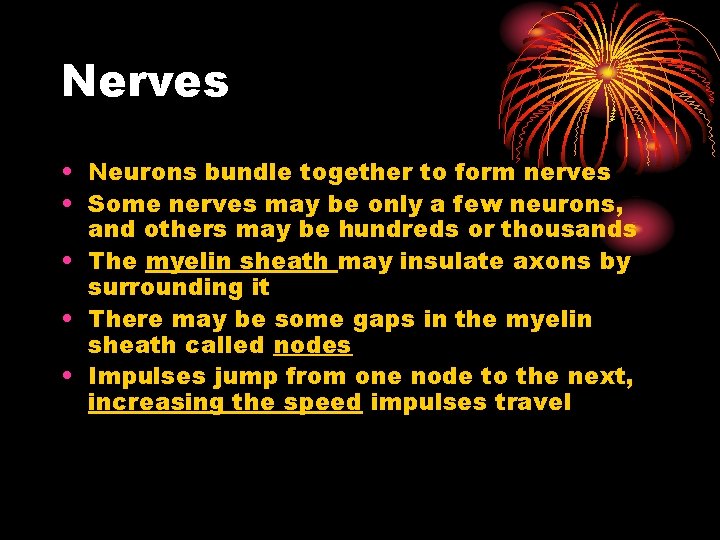
Nerves • Neurons bundle together to form nerves • Some nerves may be only a few neurons, and others may be hundreds or thousands • The myelin sheath may insulate axons by surrounding it • There may be some gaps in the myelin sheath called nodes • Impulses jump from one node to the next, increasing the speed impulses travel
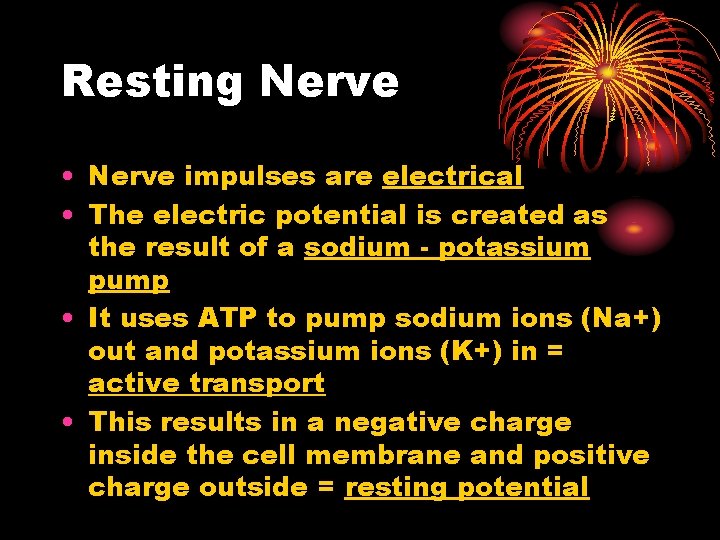
Resting Nerve • Nerve impulses are electrical • The electric potential is created as the result of a sodium - potassium pump • It uses ATP to pump sodium ions (Na+) out and potassium ions (K+) in = active transport • This results in a negative charge inside the cell membrane and positive charge outside = resting potential
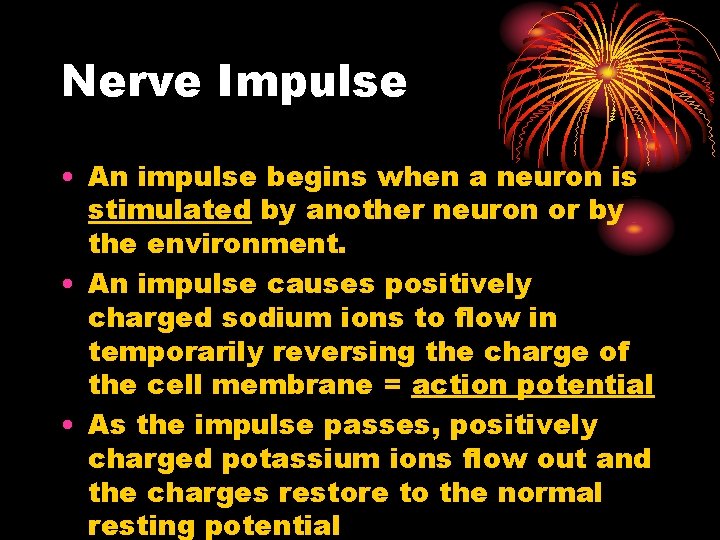
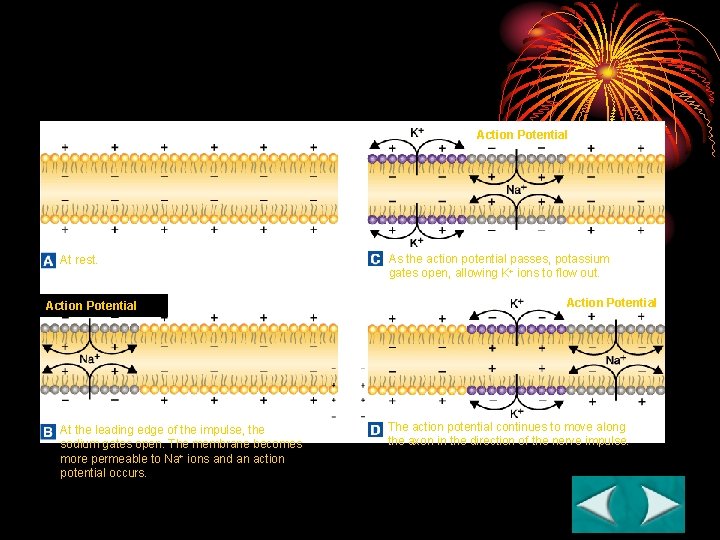
Nerve Impulse • An impulse begins when a neuron is stimulated by another neuron or by the environment. • An impulse causes positively charged sodium ions to flow in temporarily reversing the charge of the cell membrane = action potential • As the impulse passes, positively charged potassium ions flow out and the charges restore to the normal resting potential
Figure 35 -7 An Impulse Section 35 -2 Action Potential At rest. Action Potential At the leading edge of the impulse, the sodium gates open. The membrane becomes more permeable to Na+ ions and an action potential occurs. As the action potential passes, potassium gates open, allowing K+ ions to flow out. Action Potential The action potential continues to move along the axon in the direction of the nerve impulse.
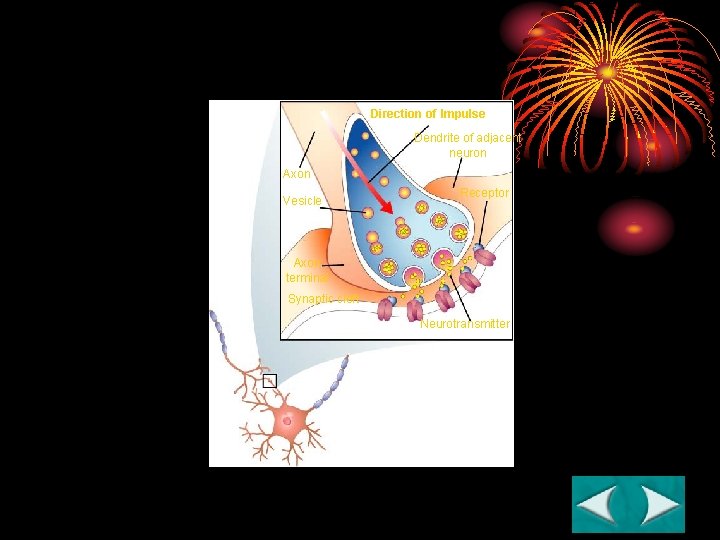
Synapse • At the end of the neuron, the impulse reaches an axon terminal where the impulse may be passed along to another neuron or another cell • The location where a neuron can transfer an impulse to another cell = synapse • The synapse is a small gap that separates the axon terminal from the dendrites of the next neuron or another cell • The terminals contain tiny sacs or vesicles filled with neurotransmitters = chemicals used by a neuron to transmit an impulse across a synapse • The neurotransmitters stimulate the next neuron • The impulse will continue with the stimulation exceeds the cell’s threshold
Figure 35 -8 The Synapse Section 35 -2 Direction of Impulse Dendrite of adjacent neuron Axon Vesicle Receptor Axon terminal Synaptic cleft Neurotransmitter
Reaction activity • Reaction time = the amount of time required for an impulse travel from your sensory neurons to your motor neurons
The Nervous System • Neurons work together forming the nervous system • There are two major divisions of the nervous system: • Central nervous system (CNS) • Peripheral nervous system (PNS)
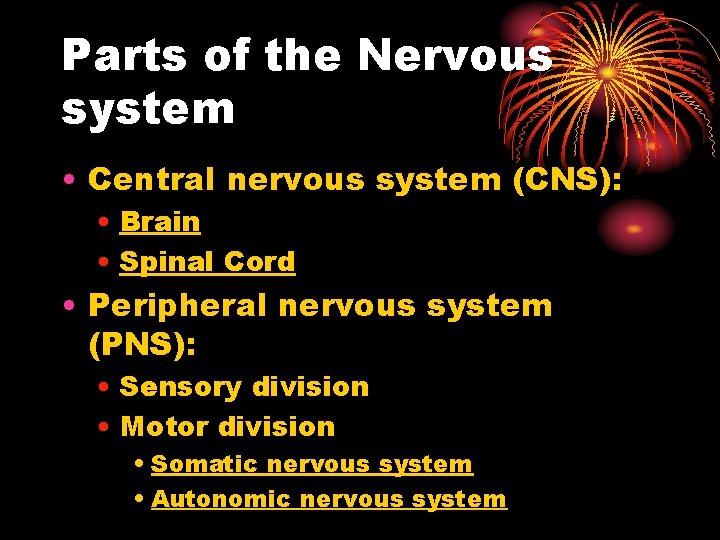
Parts of the Nervous system • Central nervous system (CNS): • Brain • Spinal Cord • Peripheral nervous system (PNS): • Sensory division • Motor division • Somatic nervous system • Autonomic nervous system
Central Nervous System • The CNS is the control center of the body: • Relays messages • Processes information • Analyzes information
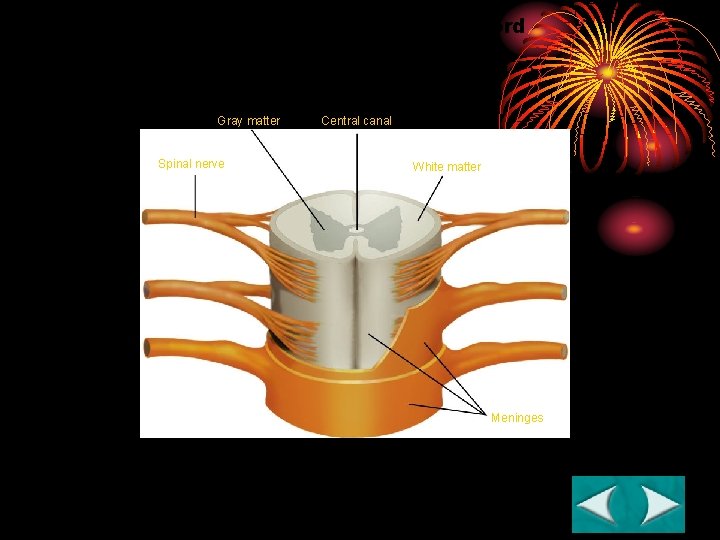
Brain and Spinal cord • Both are • protected by bone • wrapped in 3 layers of connective tissue = meninges • layers may have a space between them filled with cerebrospinal fluid which protects (shock absorber) and exchanges nutrients and waste
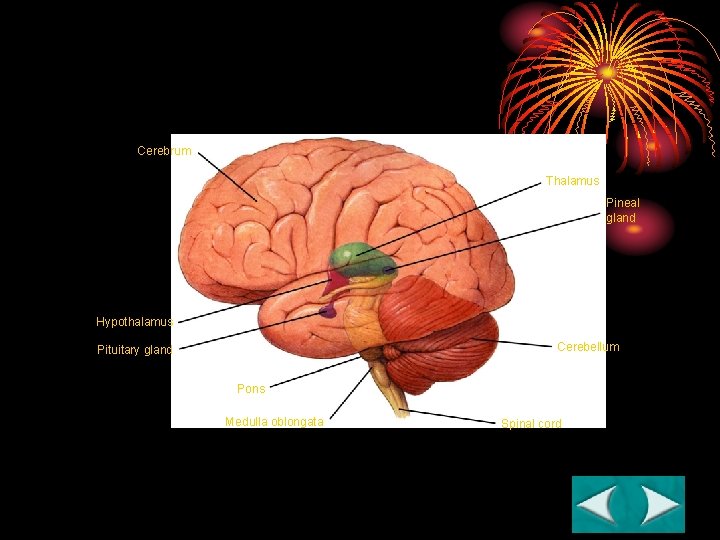
Brain • About 100 billion neurons, mainly interneurons • Major parts of the brain: • Cerebrum • Cerebellum • Brain stem • Thalamus • Hypothalamus
Figure 35 -9 The Brain Section 35 -3 Cerebrum Thalamus Pineal gland Hypothalamus Cerebellum Pituitary gland Pons Medulla oblongata Spinal cord
Spinal Cord • Links communication between the brain and the rest of the body • 31 pairs of spinal nerves branch out from the spinal cord connecting brain to body • Reflexes = quick, automatic responses to stimuli are processed directly in the spinal cord
Figure 35 -11 The Spinal Cord Section 35 -3 Gray matter Spinal nerve Central canal White matter Meninges
Peripheral Nervous System PNS animation (Pain receptor) : http: //pennhealth. com/encyclopedia/em_Disp lay. Animation. aspx? gcid=000054&ptid=17 • Consists of nerves and associated cells that are not part of the brain or spinal cord • Receives information from the environment and relays commands from the CNS to organs and glands • Divided into two parts: • Sensory division: transmits impulses from sense organs to the CNS • Motor division: transmits impulses from the CNS to the muscles or glands
Somatic System • Part of motor division that regulates activities that are under conscious control (movement of skeletal muscles) • Some reflexes too
What is a Reflex? • A reflex is an involuntary behavior. Reflexes are usually coordinated in the spinal cord not the brain. • They are present from birth • They are automatic • They are meant to protect the body • Examples: • blinking (keeps your eyes hydrated) • pulling your hand away when you touch something hot. • changing pupil size as you move from dark to light.
Receptors & Effectors • Receptor: a specialized nervous tissue that is sensitive to a specific stimulus. • • nerve cells in skin eyes ears taste buds • Effectors: the part/s of the body that respond • muscles or glands
Reflex Arc • The pathway that an impulse travels: • • 1. 2. 3. 4. 5. 6. 7. from the sensory receptor up the sensory neuron over the synapse to the spinal cord (interneuron) over another synapse back down the motor neuron to the effector Reflex arc animations: 1. http: //www. sumanasinc. com/webcontent/animations/content/reflexarcs. html 2. http: //msjensen. cehd. umn. edu/1135/Links/Animations/Flash/0016 -swf_reflex_arc. swf
Autonomic System • Part of the motor division that regulates activities that are automatic or involuntary (heart beat and smooth muscle in digestive system and blood vessels) • Two parts that have opposite effects on the organs they control: • Sympathetic (“gas pedal”) • Parasympathetic (“brake”)
Concept Map Section 35 -3 The Nervous System is divided into Central nervous system Peripheral nervous system Motor nerves which consists of that make up Somatic nervous system Autonomic nervous system which is divided into Sympathetic nervous system Parasympathetic nervous system Sensory nerves
Sensory Receptors • Neurons that react directly to stimuli from the environment and send impulses to other neuron and CNS • • • Light Sound Motion Chemicals Pressure Changes in temperature
Sense organs • Sensory receptors are concentrated in the sense organs: • Eyes • Ears • Nose • Mouth • Skin
Types of Sensory receptors • Sensory receptors within each organ enable it to respond to particular stimuli. The five general categories of sensory receptors are: • • • Pain receptors Thermoreceptors Mechanoreceptors Chemoreceptors Photoreceptors
The 5 Senses • • • See Hear Smell Taste Touch
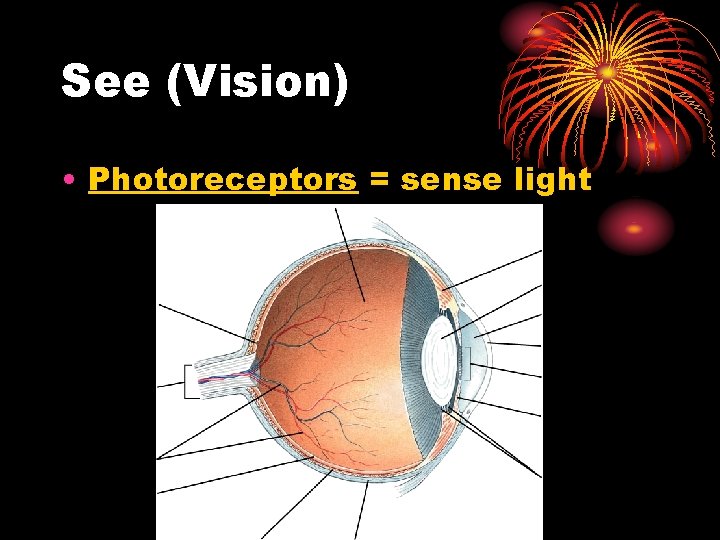
See (Vision) • Photoreceptors = sense light
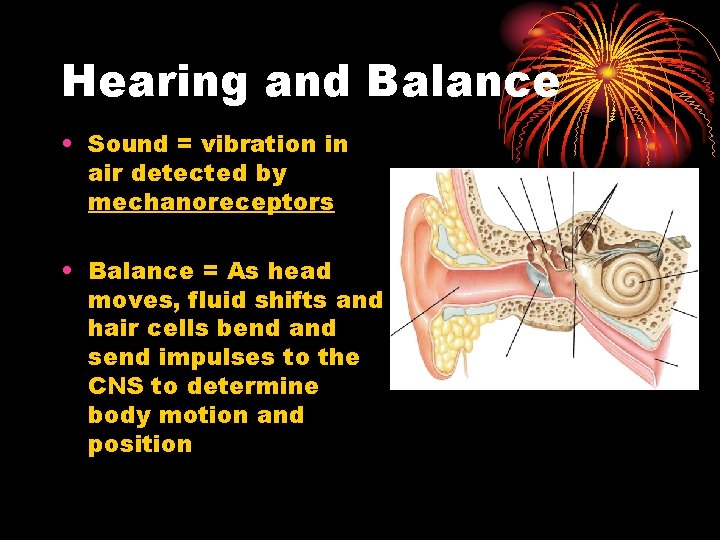
Hearing and Balance • Sound = vibration in air detected by mechanoreceptors • Balance = As head moves, fluid shifts and hair cells bend and send impulses to the CNS to determine body motion and position
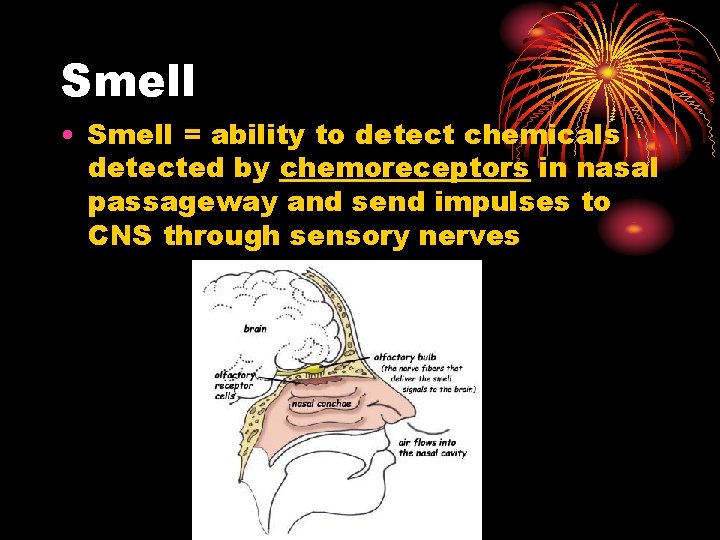
Smell • Smell = ability to detect chemicals detected by chemoreceptors in nasal passageway and send impulses to CNS through sensory nerves
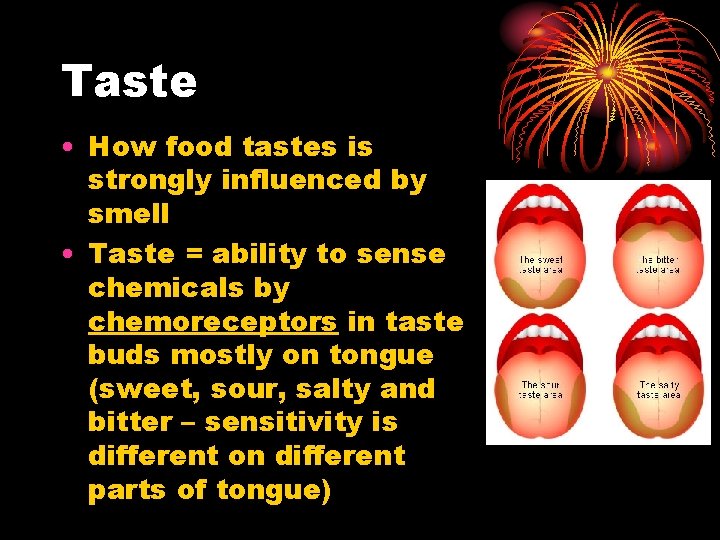
Taste • How food tastes is strongly influenced by smell • Taste = ability to sense chemicals by chemoreceptors in taste buds mostly on tongue (sweet, sour, salty and bitter – sensitivity is different on different parts of tongue)
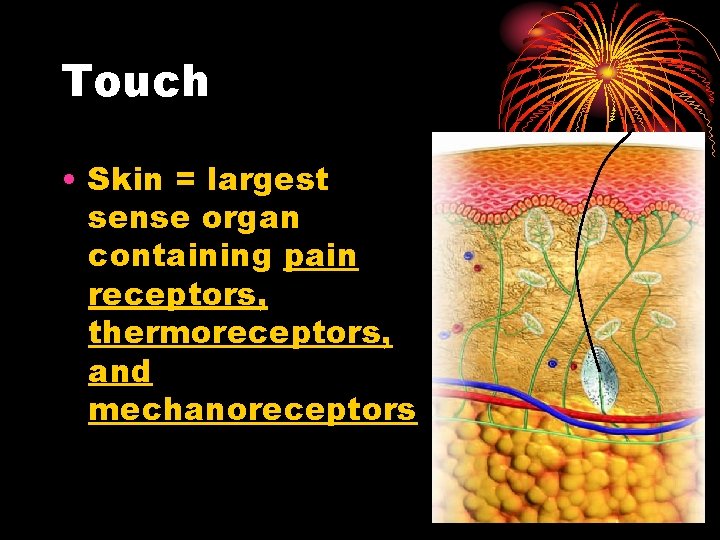
Touch • Skin = largest sense organ containing pain receptors, thermoreceptors, and mechanoreceptors
Senses activity • Different parts of skin have different sensitivity because there’s a different numbers of receptors at different locations
Problems • Drugs = substance that changes the structure or function of the body • Drugs can interfere with the action of neurotransmitters at the synapse, which can disrupt the functioning of the nervous system
Stimulants • Increase the actions regulated by the nervous system by increasing the release of neurotransmitters at synapses (increase heart rate, blood pressure, and breathing rate) • • Amphetamines Cocaine Nicotine Caffeine
Depressants • Decrease the actions regulated by the nervous system (lowering heart rate, breathing rate, blood pressure, relaxing muscles, and relieving tension) • Alcohol • Tranquilizers
Alcohol • One of the most dangerous and abused depressant drug that slows down functioning rate of CNS • Fetal alcohol syndrome (FAS) = a group of birth defects caused by the effects of alcohol on the fetus (heart defects, malformed faces, delayed growth, and poor motor development • Alcoholism = disease of people who have become addicted to alcohol • Causes damage to liver where alcohol is broken down
Addictions • Some drugs that act on neurons of the pleasure centers of the brain can produce an addiction = an uncontrollable craving for more of the drug or dependence on a drug • Cocaine – causes sudden release of the neurotransmitter dopamine • Opiates – mimic natural endorphins to overcome pain • Marijuana – produces temporary feeling of euphoria and disorientation • Drug abuse = using any drug in a way that most doctors couldn’t approve
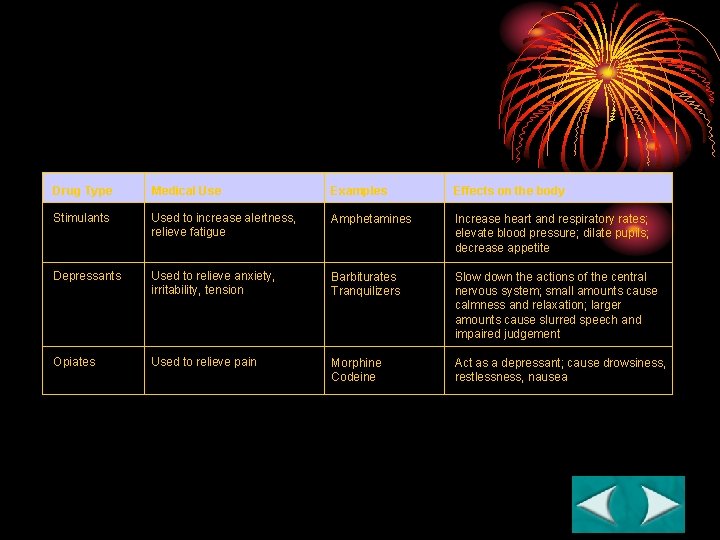
Commonly Abused Drugs Section 35 -5 Drug Type Medical Use Examples Effects on the body Stimulants Used to increase alertness, relieve fatigue Amphetamines Increase heart and respiratory rates; elevate blood pressure; dilate pupils; decrease appetite Depressants Used to relieve anxiety, irritability, tension Barbiturates Tranquilizers Slow down the actions of the central nervous system; small amounts cause calmness and relaxation; larger amounts cause slurred speech and impaired judgement Opiates Used to relieve pain Morphine Codeine Act as a depressant; cause drowsiness, restlessness, nausea