
The Nervous System Chapter 8 The Autonomic Nervous
- Slides: 10
The Nervous System Chapter 8 – The Autonomic Nervous System
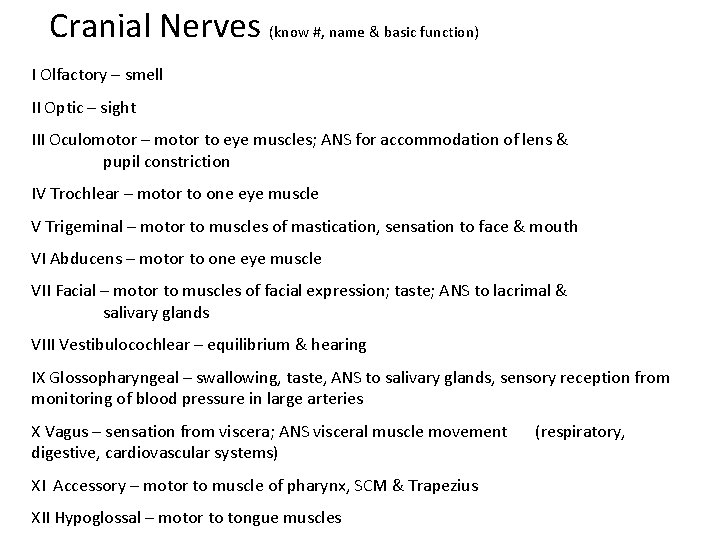
Cranial Nerves (know #, name & basic function) I Olfactory – smell II Optic – sight III Oculomotor – motor to eye muscles; ANS for accommodation of lens & pupil constriction IV Trochlear – motor to one eye muscle V Trigeminal – motor to muscles of mastication, sensation to face & mouth VI Abducens – motor to one eye muscle VII Facial – motor to muscles of facial expression; taste; ANS to lacrimal & salivary glands VIII Vestibulocochlear – equilibrium & hearing IX Glossopharyngeal – swallowing, taste, ANS to salivary glands, sensory reception from monitoring of blood pressure in large arteries X Vagus – sensation from viscera; ANS visceral muscle movement digestive, cardiovascular systems) XI Accessory – motor to muscle of pharynx, SCM & Trapezius XII Hypoglossal – motor to tongue muscles (respiratory,
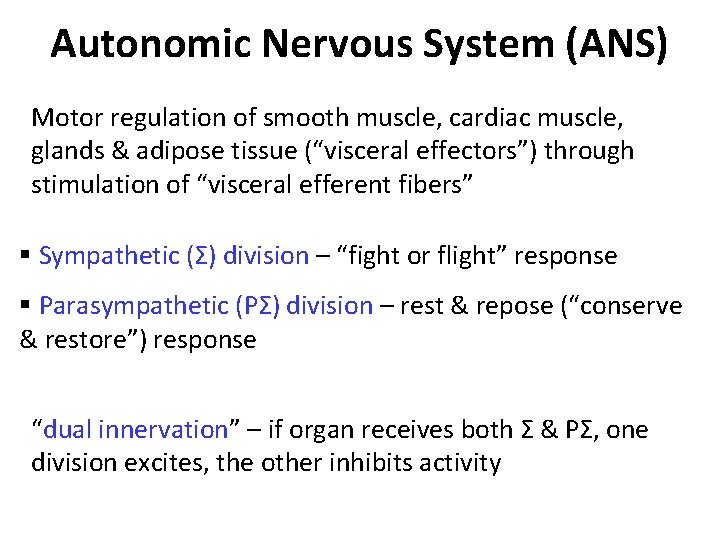
Autonomic Nervous System (ANS) Motor regulation of smooth muscle, cardiac muscle, glands & adipose tissue (“visceral effectors”) through stimulation of “visceral efferent fibers” § Sympathetic (Σ) division – “fight or flight” response § Parasympathetic (PΣ) division – rest & repose (“conserve & restore”) response “dual innervation” – if organ receives both Σ & PΣ, one division excites, the other inhibits activity
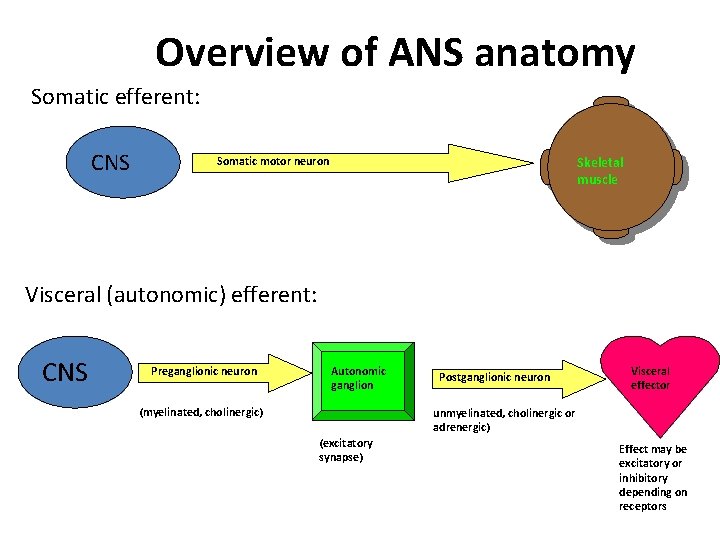
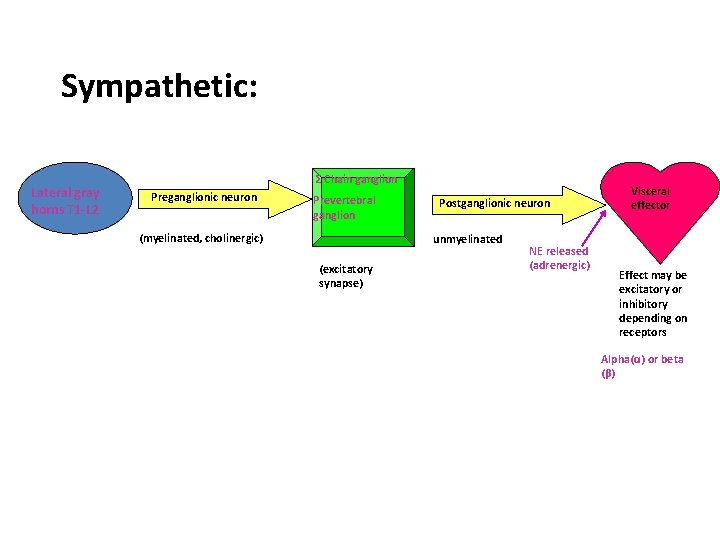
Overview of ANS anatomy Somatic efferent: CNS Skeletal muscle Somatic motor neuron Visceral (autonomic) efferent: CNS Preganglionic neuron Autonomic ganglion (myelinated, cholinergic) Postganglionic neuron Visceral effector unmyelinated, cholinergic or adrenergic) (excitatory synapse) Effect may be excitatory or inhibitory depending on receptors
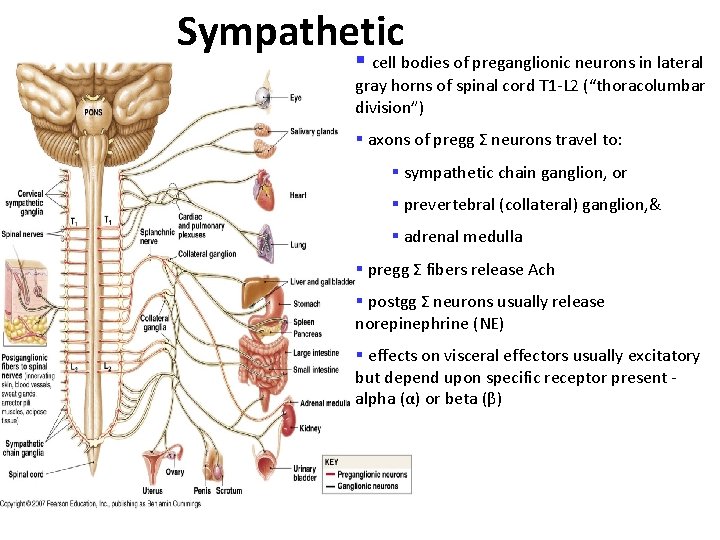
Sympathetic § cell bodies of preganglionic neurons in lateral gray horns of spinal cord T 1 -L 2 (“thoracolumbar division”) § axons of pregg Σ neurons travel to: § sympathetic chain ganglion, or § prevertebral (collateral) ganglion, & § adrenal medulla § pregg Σ fibers release Ach § postgg Σ neurons usually release norepinephrine (NE) § effects on visceral effectors usually excitatory but depend upon specific receptor present alpha (α) or beta (β)
Sympathetic: Lateral gray horns T 1 -L 2 Σ Chain ganglion Preganglionic neuron Prevertebral ganglion (myelinated, cholinergic) Postganglionic neuron unmyelinated (excitatory synapse) NE released (adrenergic) Visceral effector Effect may be excitatory or inhibitory depending on receptors Alpha(α) or beta (β)
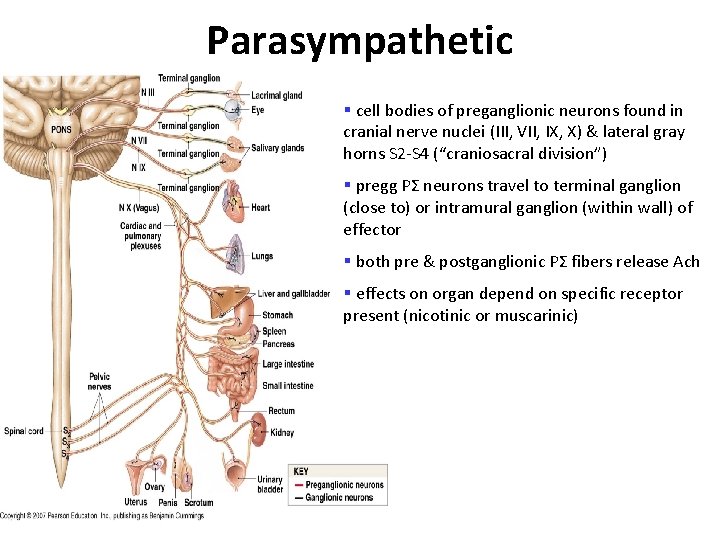
Parasympathetic § cell bodies of preganglionic neurons found in cranial nerve nuclei (III, VII, IX, X) & lateral gray horns S 2 -S 4 (“craniosacral division”) § pregg PΣ neurons travel to terminal ganglion (close to) or intramural ganglion (within wall) of effector § both pre & postganglionic PΣ fibers release Ach § effects on organ depend on specific receptor present (nicotinic or muscarinic)
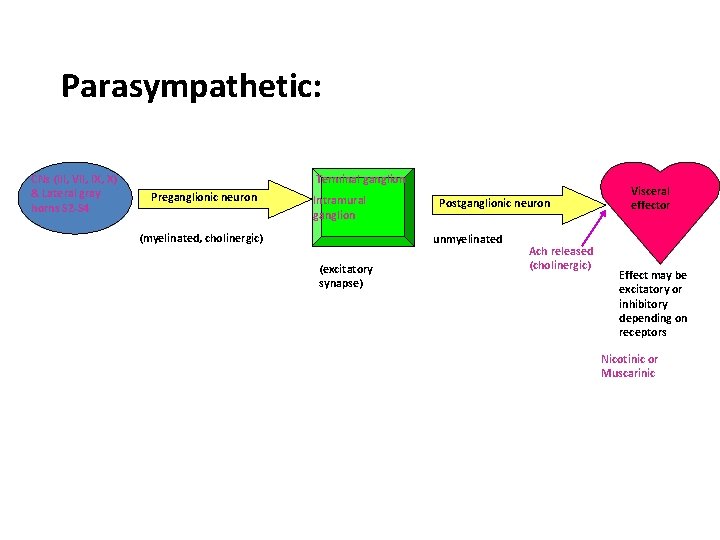
Parasympathetic: CNs (III, VII, IX, X) & Lateral gray horns S 2 -S 4 Terminal ganglion Preganglionic neuron Intramural ganglion (myelinated, cholinergic) Postganglionic neuron unmyelinated (excitatory synapse) Ach released (cholinergic) Visceral effector Effect may be excitatory or inhibitory depending on receptors Nicotinic or Muscarinic
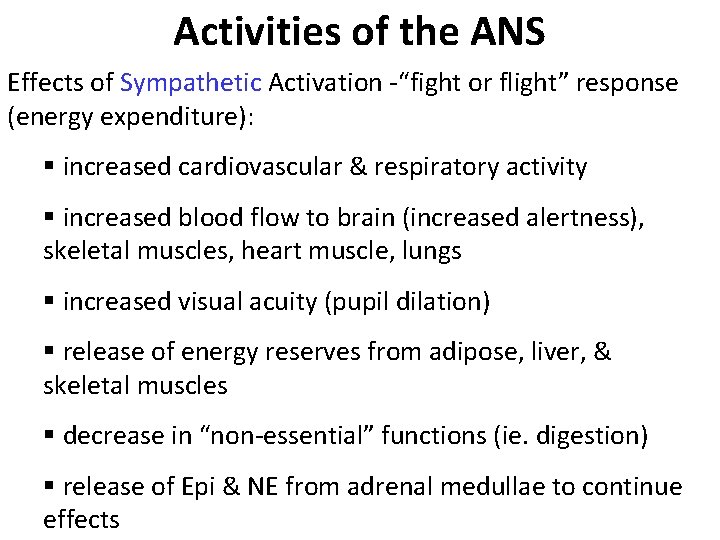
Activities of the ANS Effects of Sympathetic Activation -“fight or flight” response (energy expenditure): § increased cardiovascular & respiratory activity § increased blood flow to brain (increased alertness), skeletal muscles, heart muscle, lungs § increased visual acuity (pupil dilation) § release of energy reserves from adipose, liver, & skeletal muscles § decrease in “non-essential” functions (ie. digestion) § release of Epi & NE from adrenal medullae to continue effects
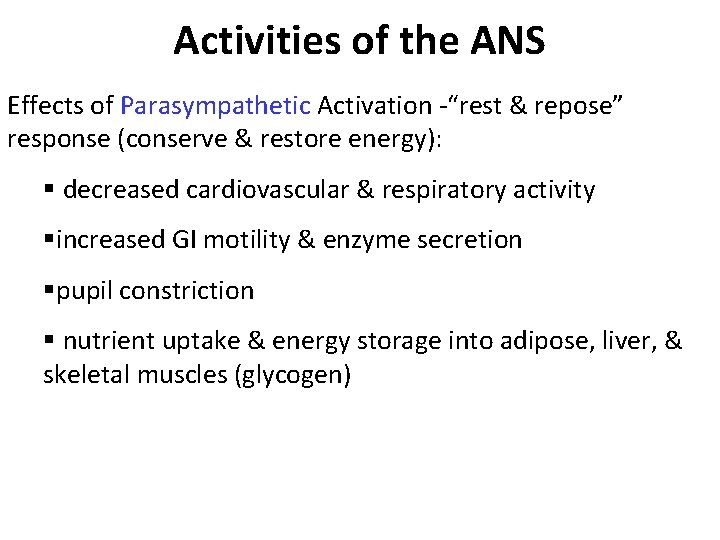
Activities of the ANS Effects of Parasympathetic Activation -“rest & repose” response (conserve & restore energy): § decreased cardiovascular & respiratory activity §increased GI motility & enzyme secretion §pupil constriction § nutrient uptake & energy storage into adipose, liver, & skeletal muscles (glycogen)