
The Nervous System Chapter 7 Functions of Nervous
- Slides: 97
The Nervous System Chapter 7
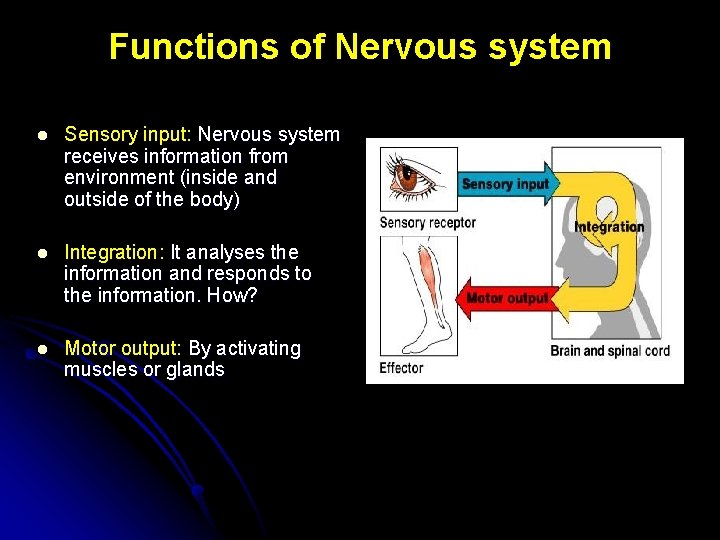
Functions of Nervous system l Sensory input: Nervous system receives information from environment (inside and outside of the body) l Integration: It analyses the information and responds to the information. How? l Motor output: By activating muscles or glands
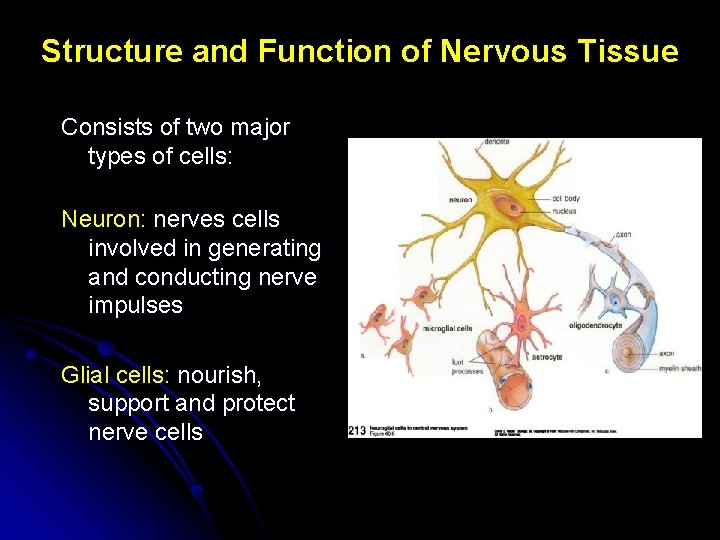
Structure and Function of Nervous Tissue Consists of two major types of cells: Neuron: nerves cells involved in generating and conducting nerve impulses Glial cells: nourish, support and protect nerve cells
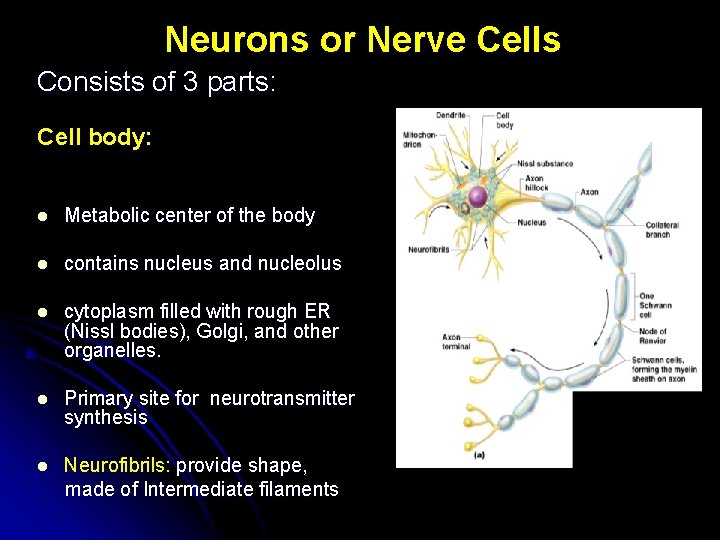
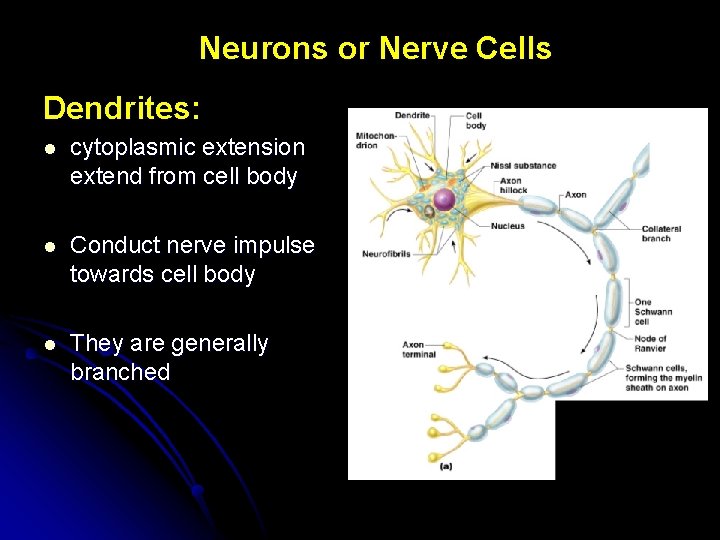
Neurons or Nerve Cells Consists of 3 parts: Cell body: l Metabolic center of the body l contains nucleus and nucleolus l cytoplasm filled with rough ER (Nissl bodies), Golgi, and other organelles. l Primary site for neurotransmitter synthesis l Neurofibrils: provide shape, made of Intermediate filaments
Neurons or Nerve Cells Dendrites: l cytoplasmic extension extend from cell body l Conduct nerve impulse towards cell body l They are generally branched
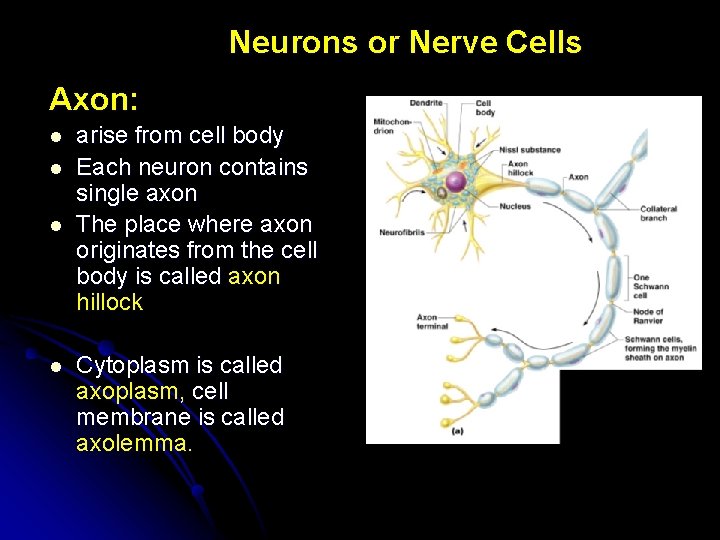
Neurons or Nerve Cells Axon: l l arise from cell body Each neuron contains single axon The place where axon originates from the cell body is called axon hillock Cytoplasm is called axoplasm, cell membrane is called axolemma.
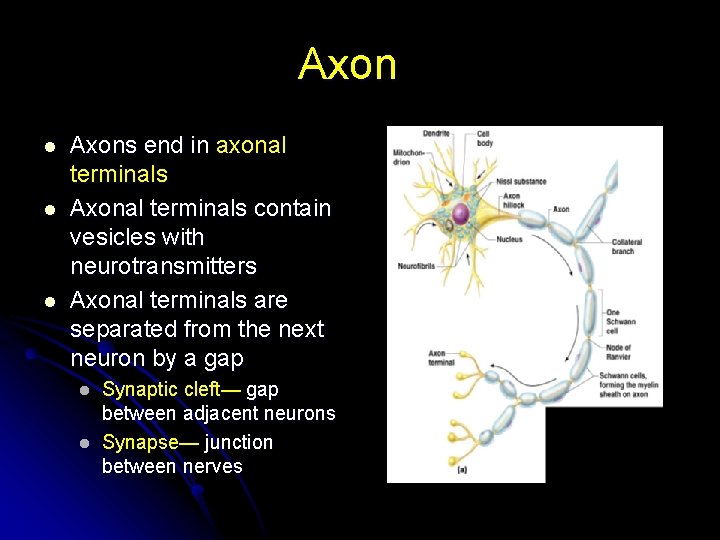
Axon l l l Axons end in axonal terminals Axonal terminals contain vesicles with neurotransmitters Axonal terminals are separated from the next neuron by a gap l l Synaptic cleft— gap between adjacent neurons Synapse— junction between nerves
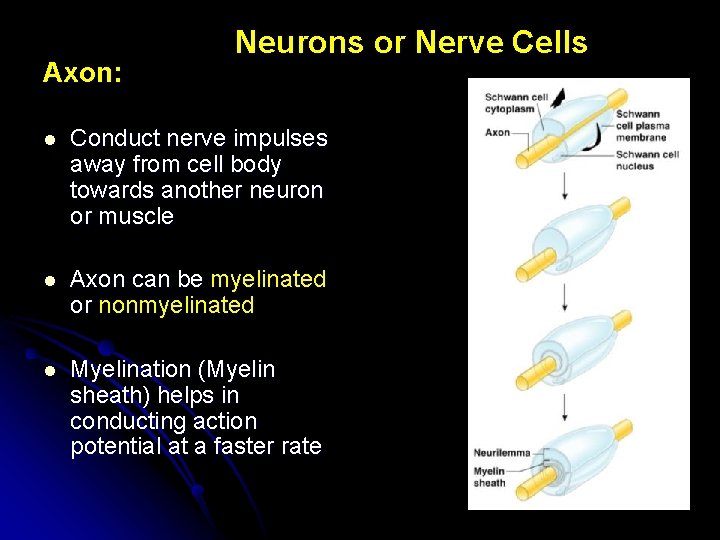
Axon: Neurons or Nerve Cells l Conduct nerve impulses away from cell body towards another neuron or muscle l Axon can be myelinated or nonmyelinated l Myelination (Myelin sheath) helps in conducting action potential at a faster rate
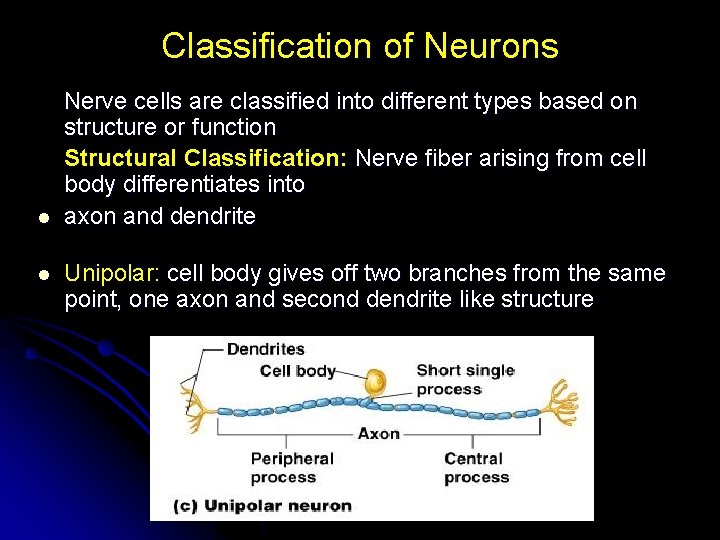
Classification of Neurons l l Nerve cells are classified into different types based on structure or function Structural Classification: Nerve fiber arising from cell body differentiates into axon and dendrite Unipolar: cell body gives off two branches from the same point, one axon and second dendrite like structure
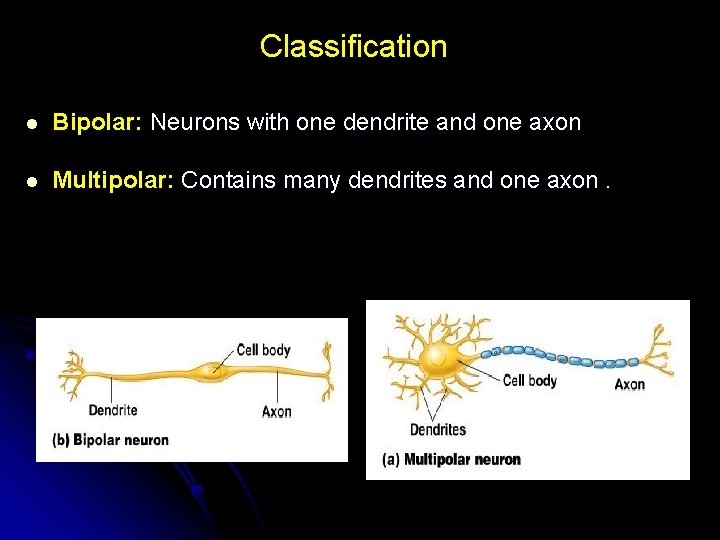
Classification l Bipolar: Neurons with one dendrite and one axon l Multipolar: Contains many dendrites and one axon.
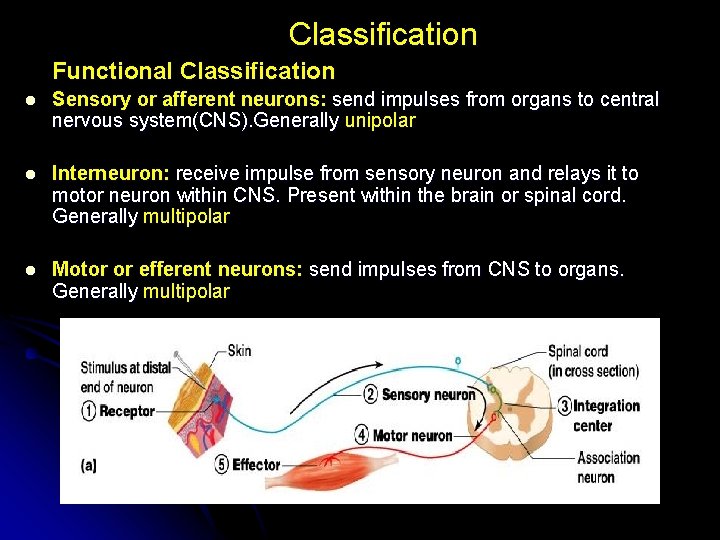
Classification Functional Classification l Sensory or afferent neurons: send impulses from organs to central nervous system(CNS). Generally unipolar l Interneuron: receive impulse from sensory neuron and relays it to motor neuron within CNS. Present within the brain or spinal cord. Generally multipolar l Motor or efferent neurons: send impulses from CNS to organs. Generally multipolar
Neuroglia or Glia Cells Different types of CNS glia cells: Astrocytes Ependymal cells Microglia Oligodendrocytes Schwann cells
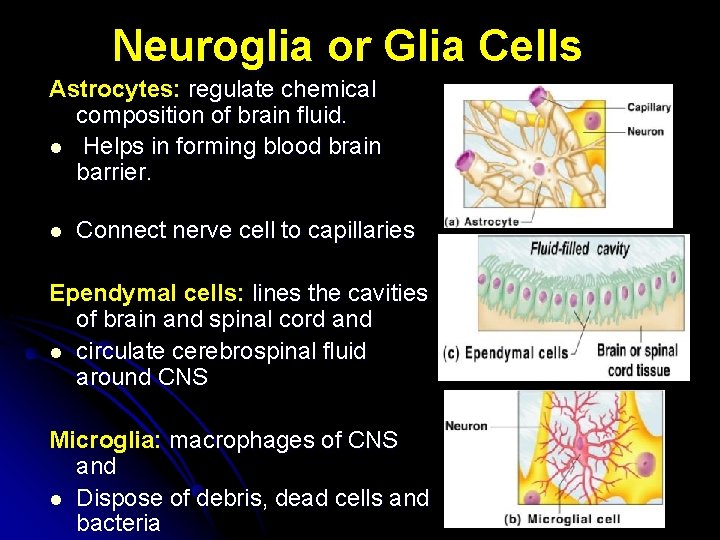
Neuroglia or Glia Cells Astrocytes: regulate chemical composition of brain fluid. l Helps in forming blood brain barrier. l Connect nerve cell to capillaries Ependymal cells: lines the cavities of brain and spinal cord and l circulate cerebrospinal fluid around CNS Microglia: macrophages of CNS and l Dispose of debris, dead cells and bacteria
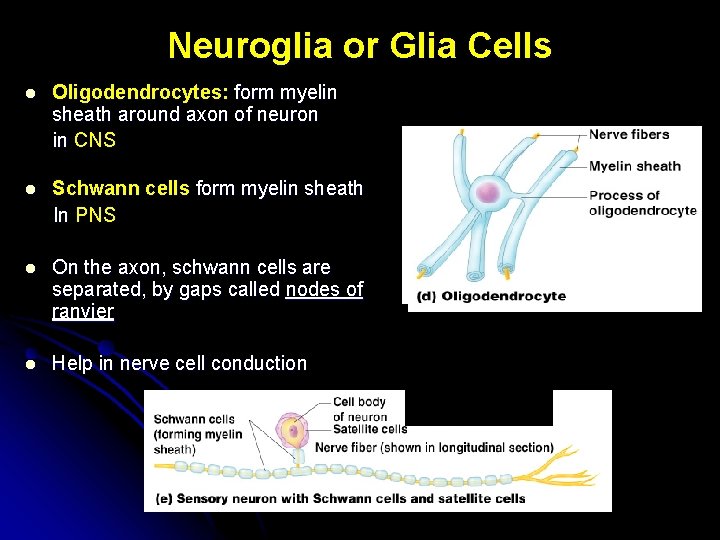
Neuroglia or Glia Cells l Oligodendrocytes: form myelin sheath around axon of neuron in CNS l Schwann cells form myelin sheath In PNS l On the axon, schwann cells are separated, by gaps called nodes of ranvier l Help in nerve cell conduction
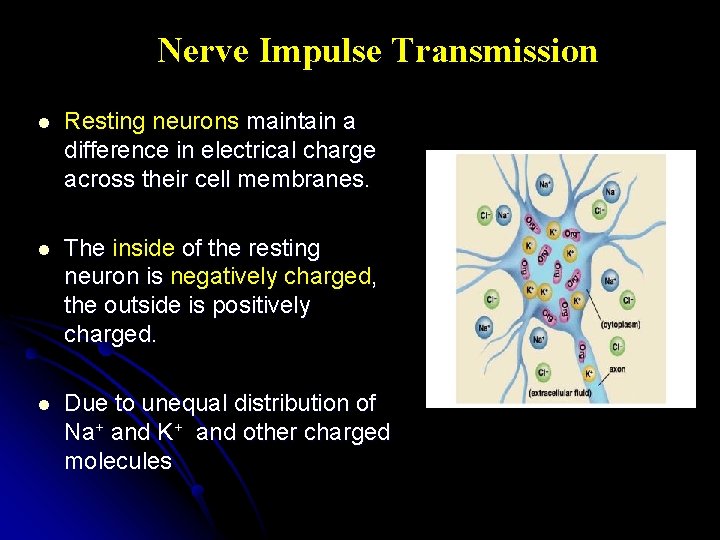
Nerve Impulse Transmission l Resting neurons maintain a difference in electrical charge across their cell membranes. l The inside of the resting neuron is negatively charged, the outside is positively charged. l Due to unequal distribution of Na+ and K+ and other charged molecules
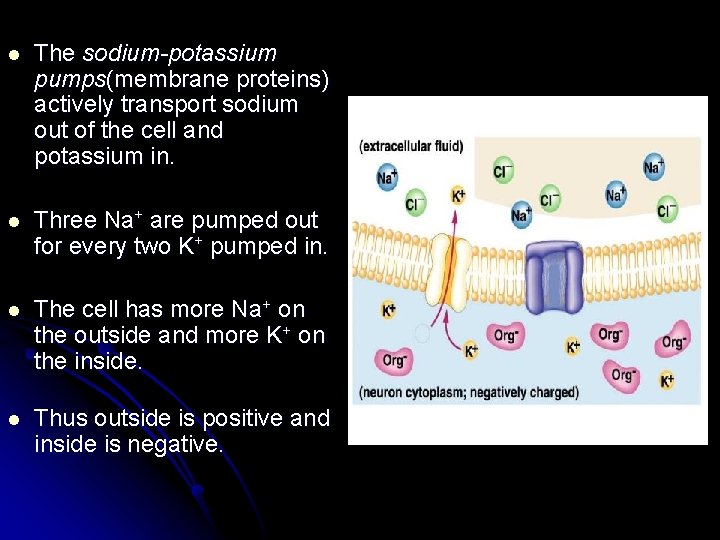
l The sodium-potassium pumps(membrane proteins) actively transport sodium out of the cell and potassium in. l Three Na+ are pumped out for every two K+ pumped in. l The cell has more Na+ on the outside and more K+ on the inside. l Thus outside is positive and inside is negative.
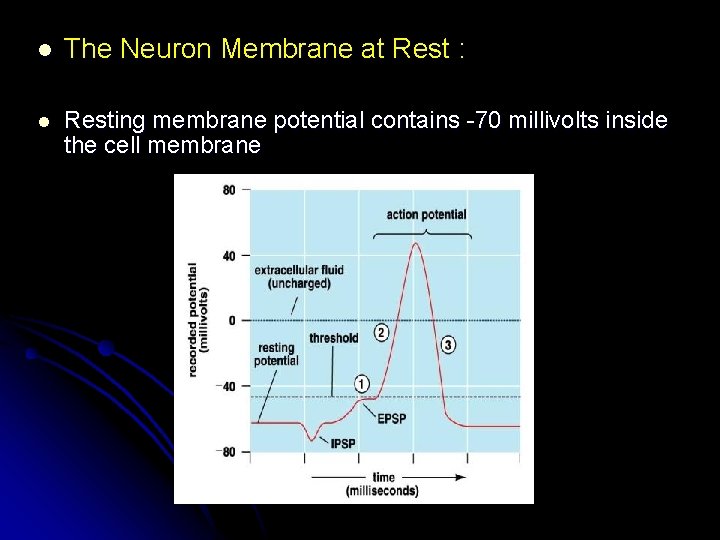
l The Neuron Membrane at Rest : l Resting membrane potential contains -70 millivolts inside the cell membrane
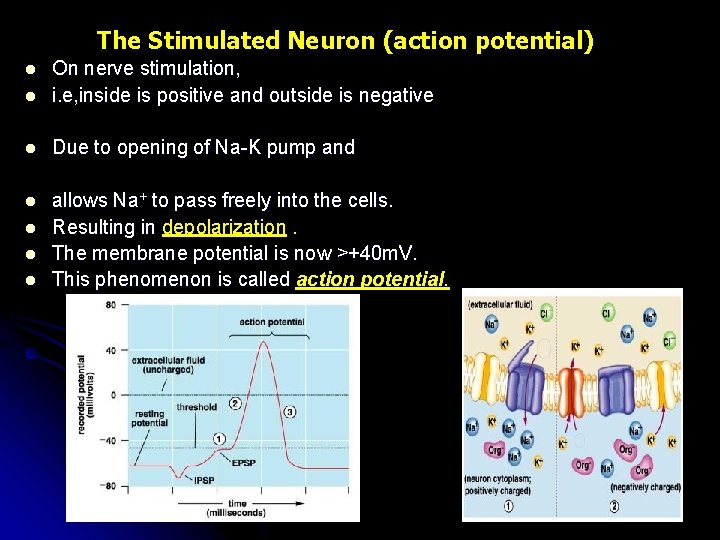
The Stimulated Neuron (action potential) l On nerve stimulation, i. e, inside is positive and outside is negative l Due to opening of Na-K pump and l allows Na+ to pass freely into the cells. Resulting in depolarization. The membrane potential is now >+40 m. V. This phenomenon is called action potential. l l
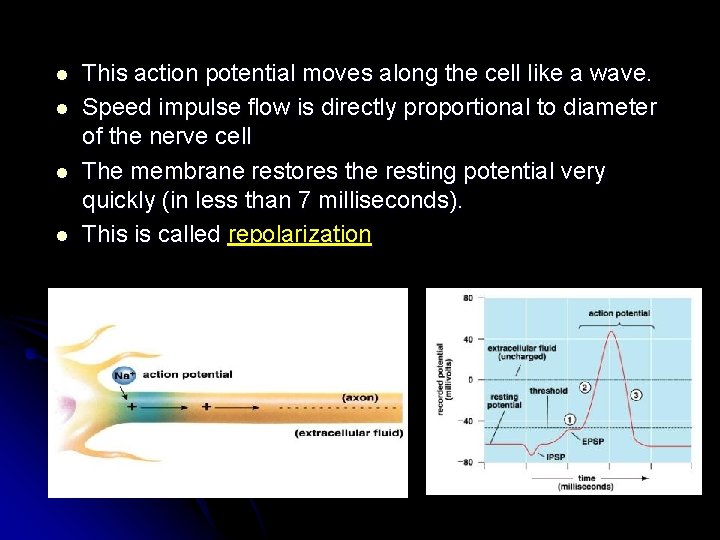
l l This action potential moves along the cell like a wave. Speed impulse flow is directly proportional to diameter of the nerve cell The membrane restores the resting potential very quickly (in less than 7 milliseconds). This is called repolarization
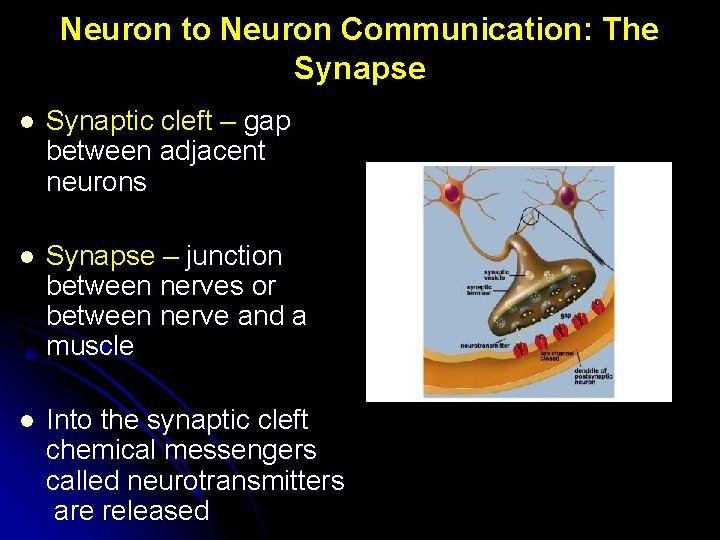
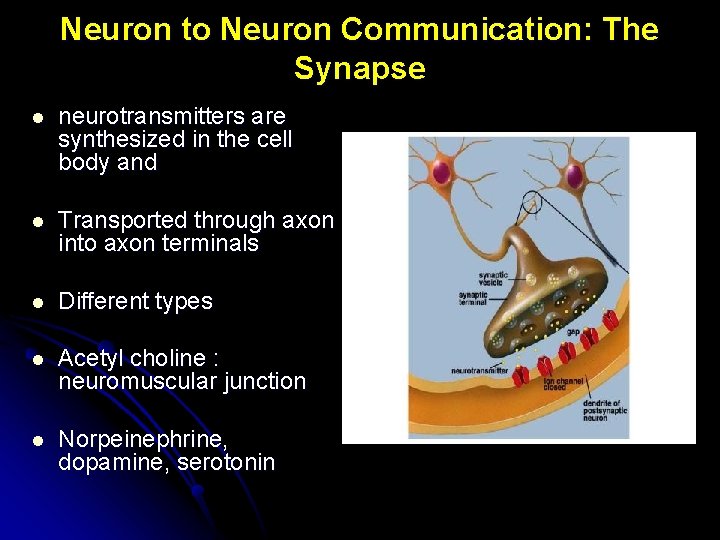
Neuron to Neuron Communication: The Synapse l Synaptic cleft – gap between adjacent neurons l Synapse – junction between nerves or between nerve and a muscle l Into the synaptic cleft chemical messengers called neurotransmitters are released
Neuron to Neuron Communication: The Synapse l neurotransmitters are synthesized in the cell body and l Transported through axon into axon terminals l Different types l Acetyl choline : neuromuscular junction l Norpeinephrine, dopamine, serotonin
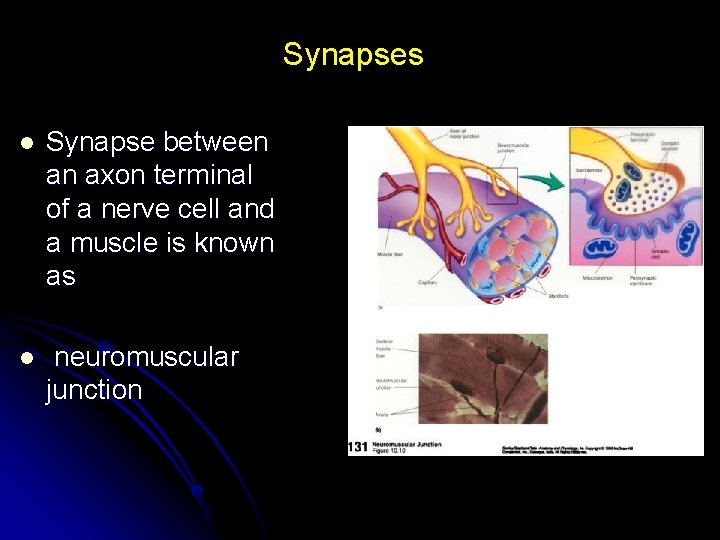
Synapses l Synapse between an axon terminal of a nerve cell and a muscle is known as l neuromuscular junction
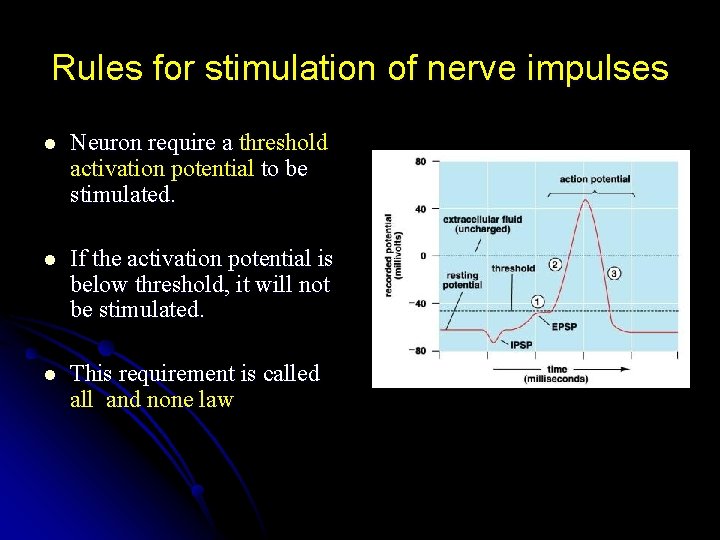
Rules for stimulation of nerve impulses l Neuron require a threshold activation potential to be stimulated. l If the activation potential is below threshold, it will not be stimulated. l This requirement is called all and none law
How are impulses processed l They produce their effect on the peripheral nervous system l Ultimately resulting in performance of a specific function by the body
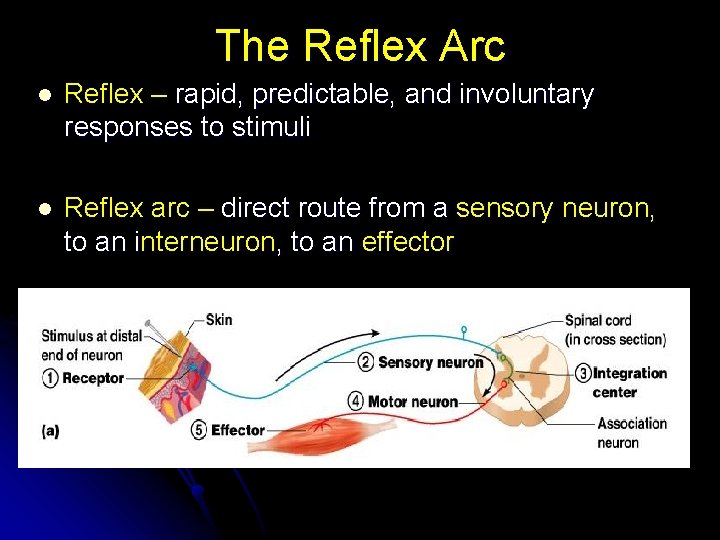
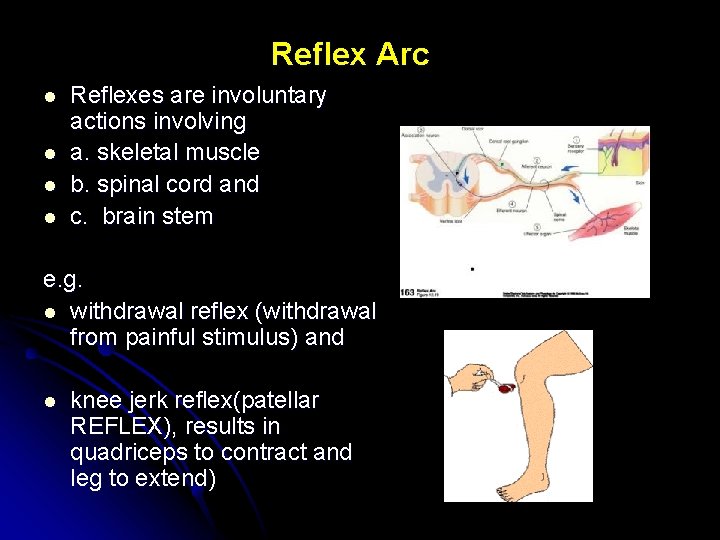
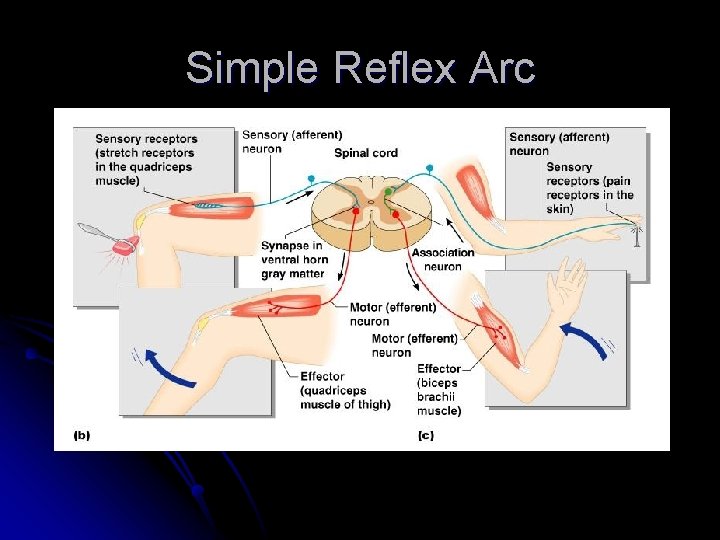
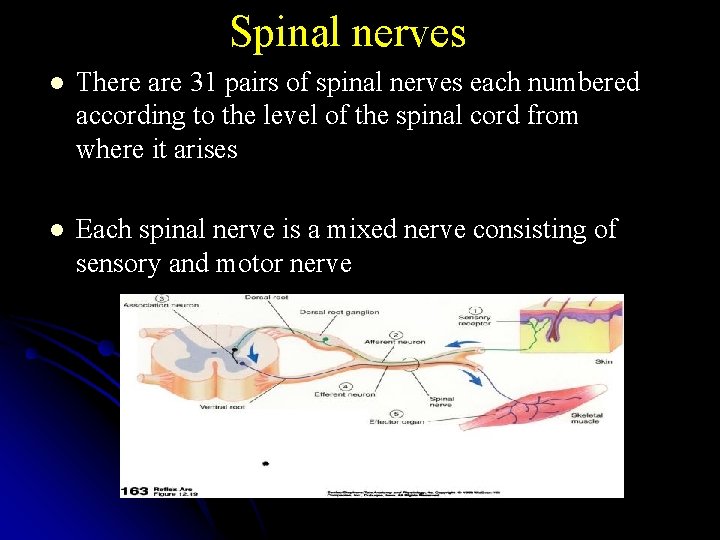
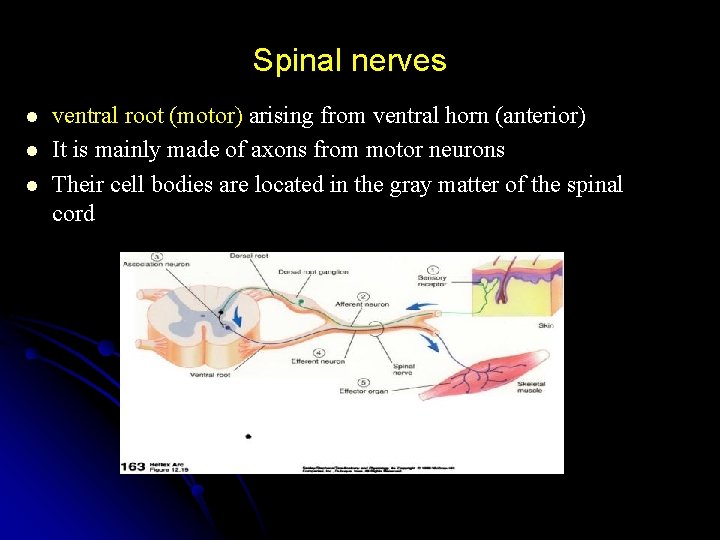
The Reflex Arc l Reflex – rapid, predictable, and involuntary responses to stimuli l Reflex arc – direct route from a sensory neuron, to an interneuron, to an effector
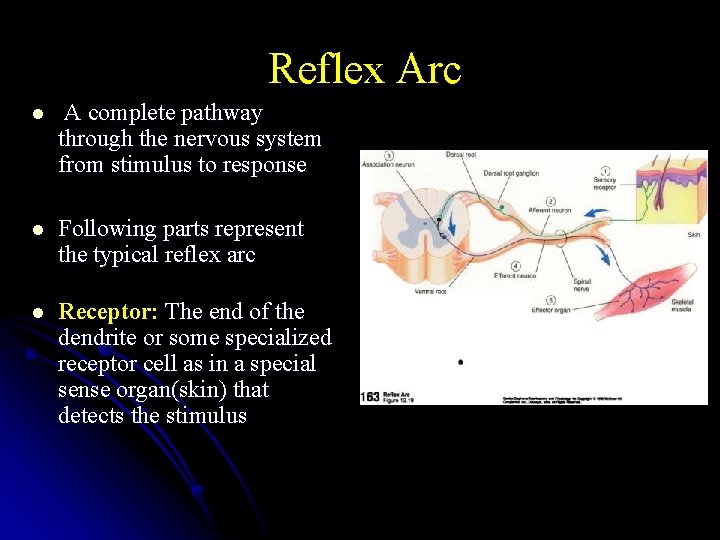
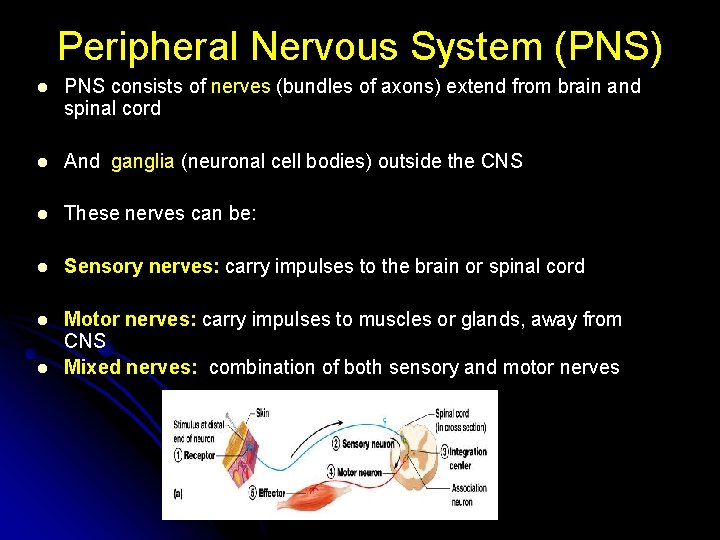
Reflex Arc l A complete pathway through the nervous system from stimulus to response l Following parts represent the typical reflex arc l Receptor: The end of the dendrite or some specialized receptor cell as in a special sense organ(skin) that detects the stimulus
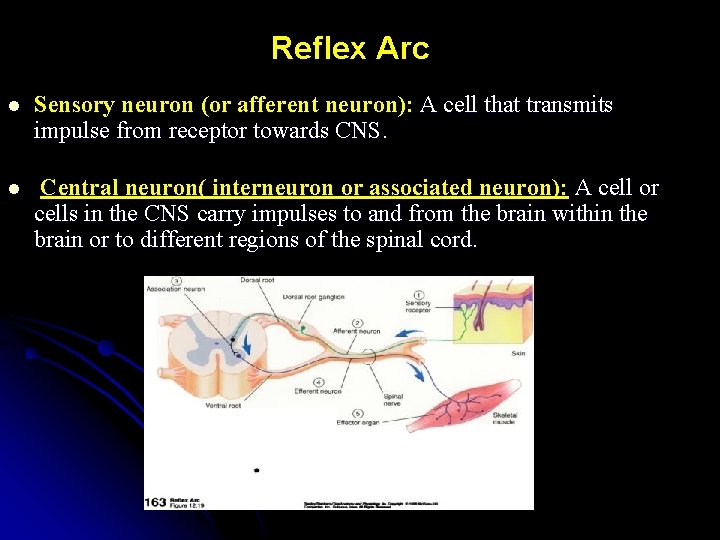
Reflex Arc l Sensory neuron (or afferent neuron): A cell that transmits impulse from receptor towards CNS. l Central neuron( interneuron or associated neuron): A cell or cells in the CNS carry impulses to and from the brain within the brain or to different regions of the spinal cord.
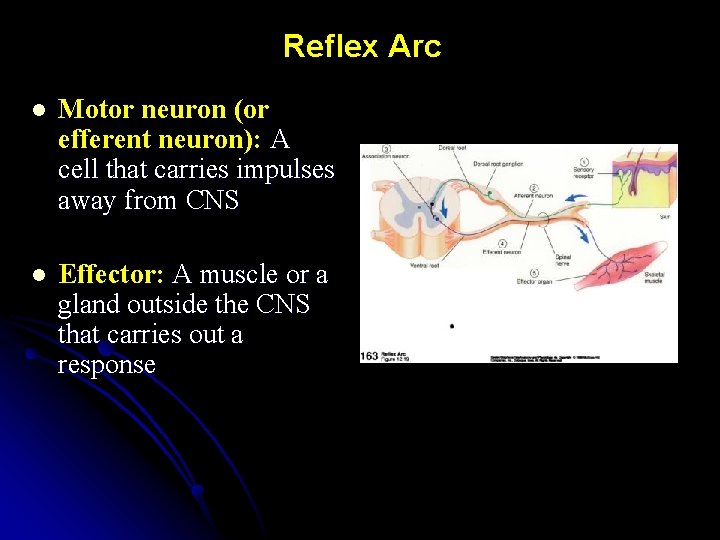
Reflex Arc l Motor neuron (or efferent neuron): A cell that carries impulses away from CNS l Effector: A muscle or a gland outside the CNS that carries out a response
Reflex Arc l l Reflexes are involuntary actions involving a. skeletal muscle b. spinal cord and c. brain stem e. g. l withdrawal reflex (withdrawal from painful stimulus) and l knee jerk reflex(patellar REFLEX), results in quadriceps to contract and leg to extend)
Simple Reflex Arc
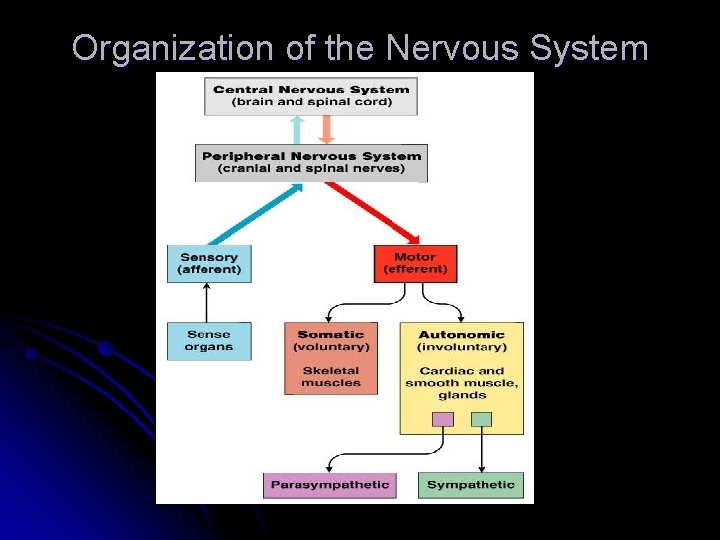
Organization of the Nervous System
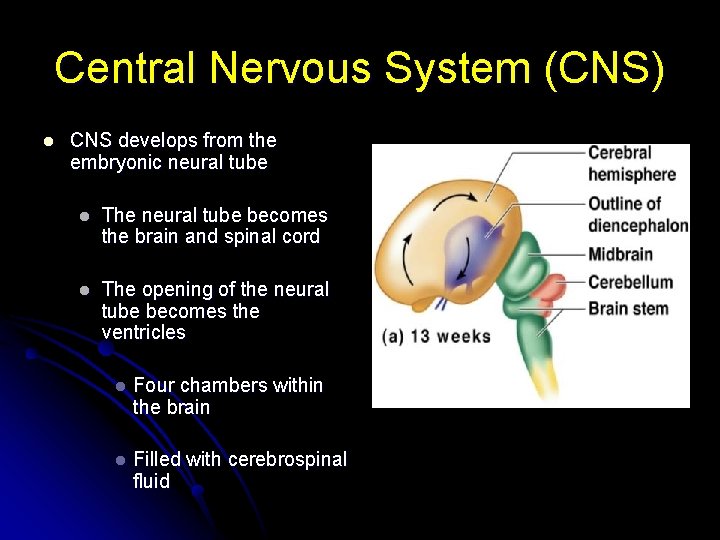
Central Nervous System (CNS) l CNS develops from the embryonic neural tube l The neural tube becomes the brain and spinal cord l The opening of the neural tube becomes the ventricles l Four chambers within the brain l Filled with cerebrospinal fluid
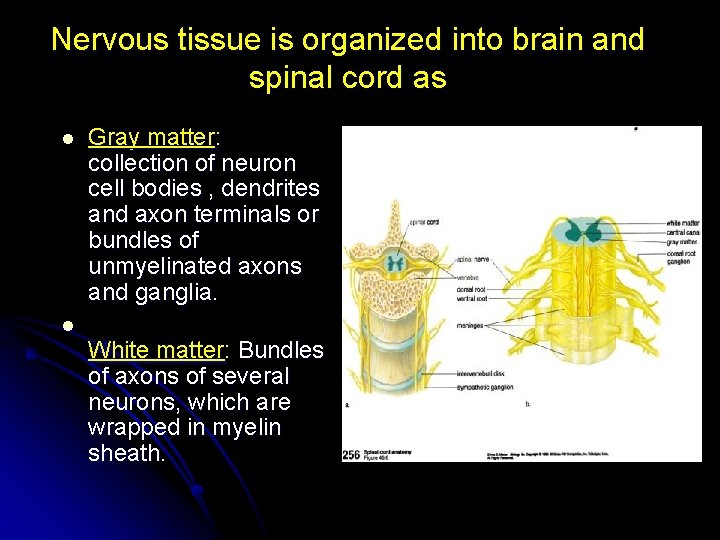
Nervous tissue is organized into brain and spinal cord as l l Gray matter: collection of neuron cell bodies , dendrites and axon terminals or bundles of unmyelinated axons and ganglia. White matter: Bundles of axons of several neurons, which are wrapped in myelin sheath.
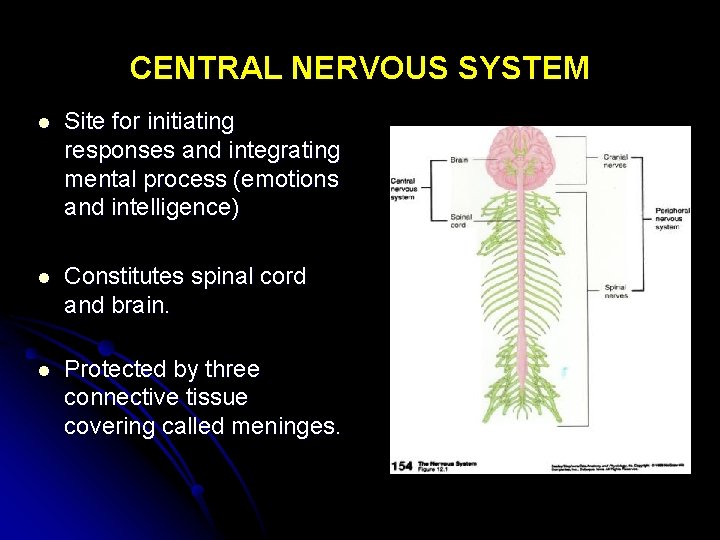
CENTRAL NERVOUS SYSTEM l Site for initiating responses and integrating mental process (emotions and intelligence) l Constitutes spinal cord and brain. l Protected by three connective tissue covering called meninges.
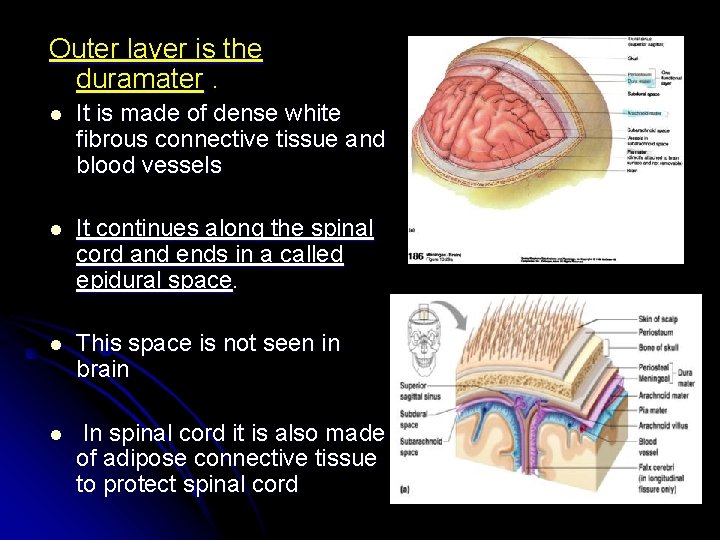
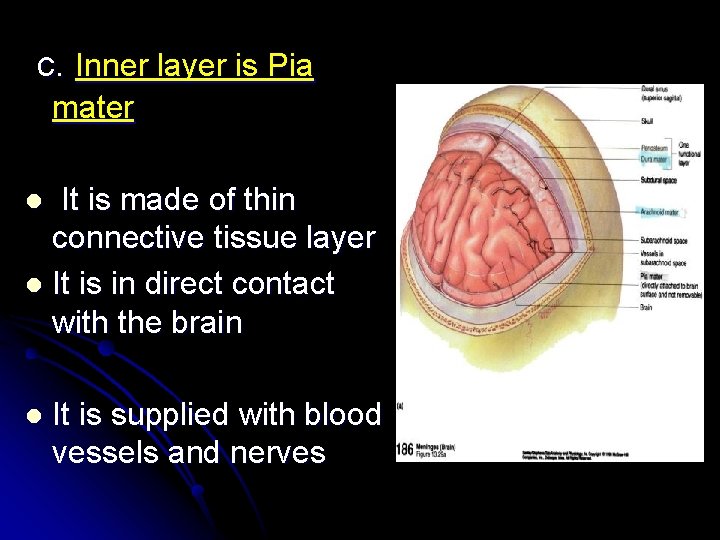
Outer layer is the duramater. l It is made of dense white fibrous connective tissue and blood vessels l It continues along the spinal cord and ends in a called epidural space. l This space is not seen in brain l In spinal cord it is also made of adipose connective tissue to protect spinal cord
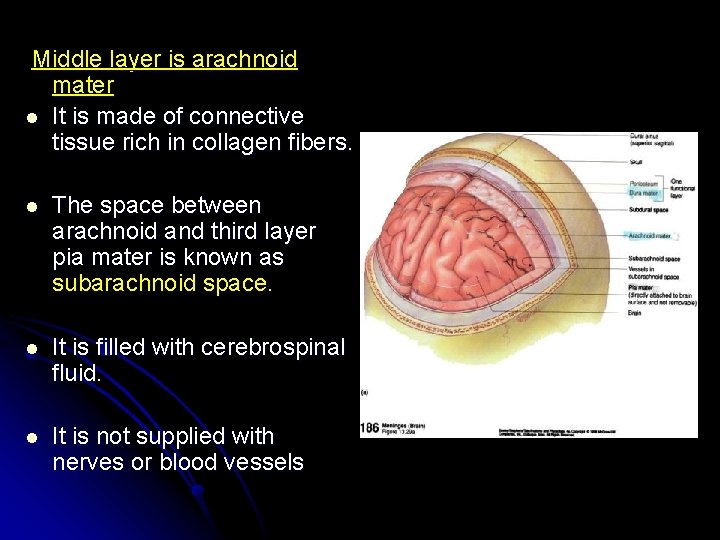
Middle layer is arachnoid mater l It is made of connective tissue rich in collagen fibers. l The space between arachnoid and third layer pia mater is known as subarachnoid space. l It is filled with cerebrospinal fluid. l It is not supplied with nerves or blood vessels
c. Inner layer is Pia mater It is made of thin connective tissue layer l It is in direct contact with the brain l l It is supplied with blood vessels and nerves
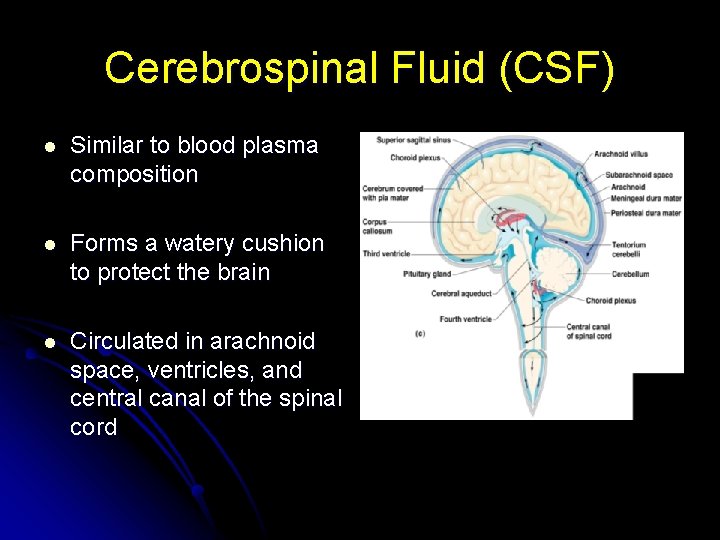
Cerebrospinal Fluid (CSF) l Similar to blood plasma composition l Forms a watery cushion to protect the brain l Circulated in arachnoid space, ventricles, and central canal of the spinal cord
Central Nervous system l Brain l Spinal Cord
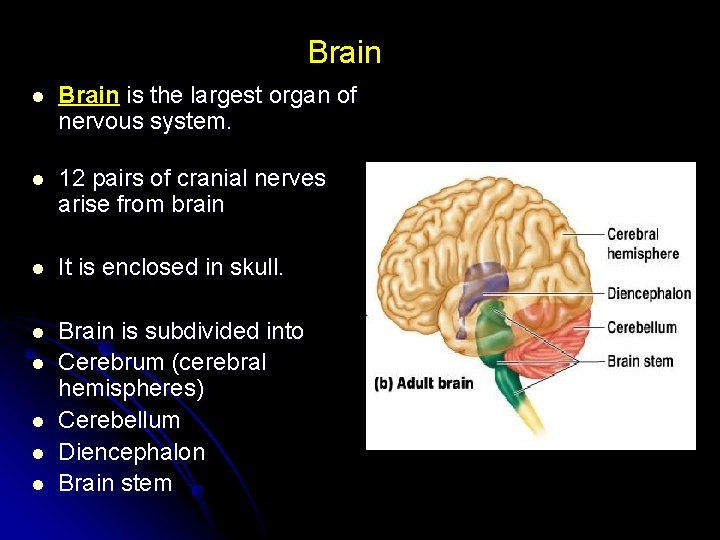
Brain l Brain is the largest organ of nervous system. l 12 pairs of cranial nerves arise from brain l It is enclosed in skull. l Brain is subdivided into Cerebrum (cerebral hemispheres) Cerebellum Diencephalon Brain stem l l
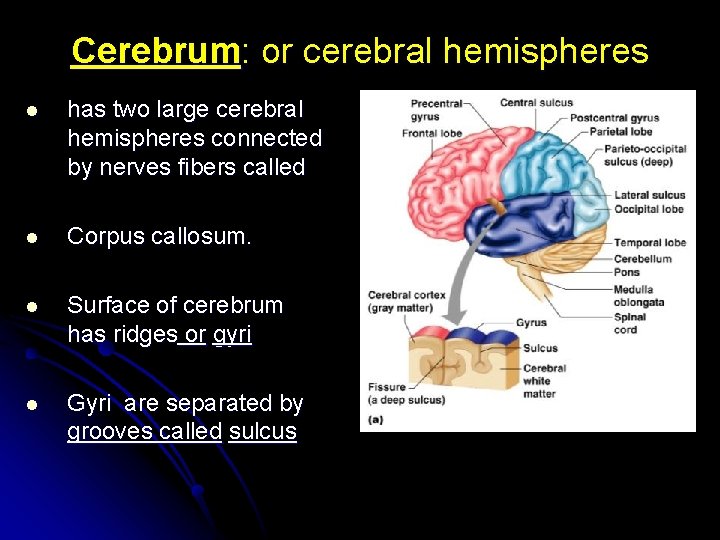
Cerebrum: or cerebral hemispheres l has two large cerebral hemispheres connected by nerves fibers called l Corpus callosum. l Surface of cerebrum has ridges or gyri l Gyri are separated by grooves called sulcus
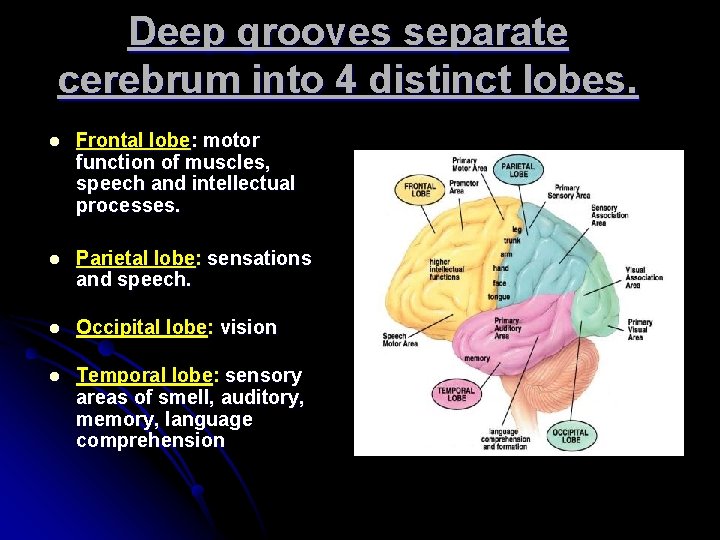
Deep grooves separate cerebrum into 4 distinct lobes. l Frontal lobe: motor function of muscles, speech and intellectual processes. l Parietal lobe: sensations and speech. l Occipital lobe: vision l Temporal lobe: sensory areas of smell, auditory, memory, language comprehension
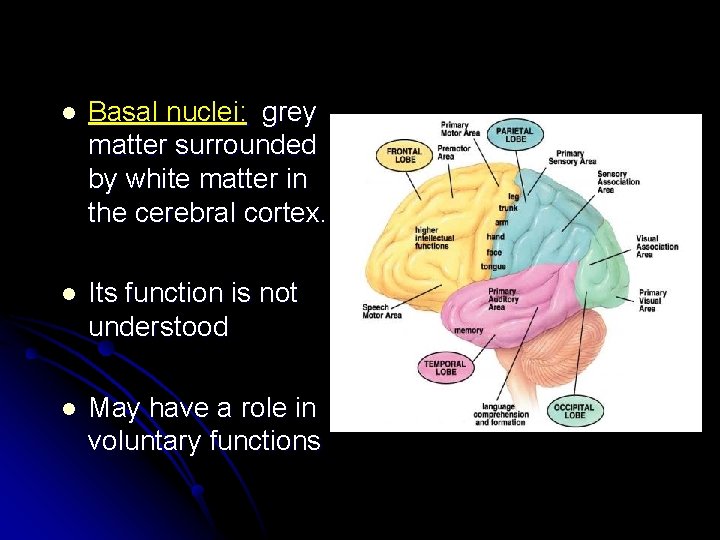
l Basal nuclei: grey matter surrounded by white matter in the cerebral cortex. l Its function is not understood l May have a role in voluntary functions
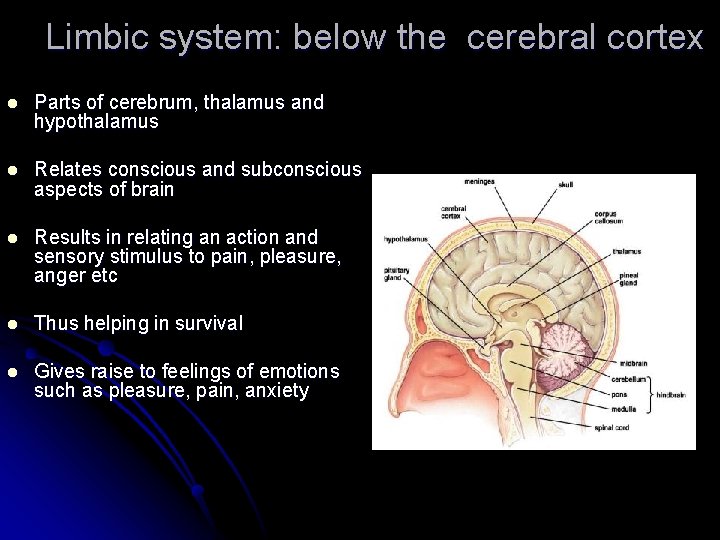
Limbic system: below the cerebral cortex l Parts of cerebrum, thalamus and hypothalamus l Relates conscious and subconscious aspects of brain l Results in relating an action and sensory stimulus to pain, pleasure, anger etc l Thus helping in survival l Gives raise to feelings of emotions such as pleasure, pain, anxiety
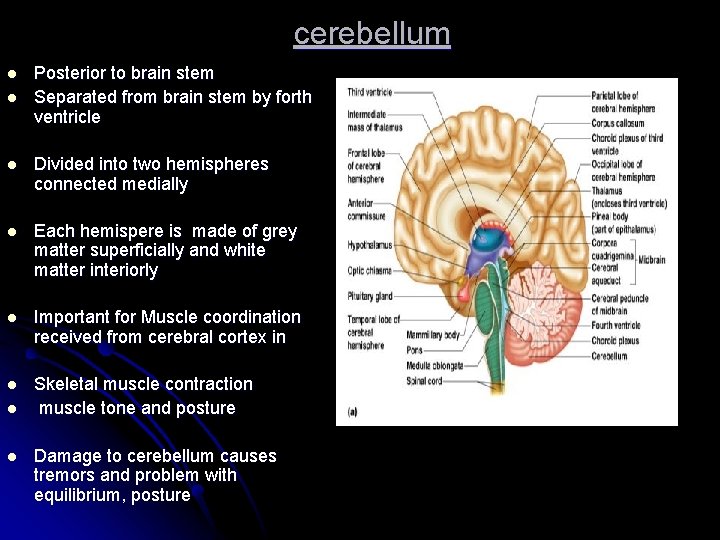
cerebellum l l Posterior to brain stem Separated from brain stem by forth ventricle l Divided into two hemispheres connected medially l Each hemispere is made of grey matter superficially and white matter interiorly l Important for Muscle coordination received from cerebral cortex in l Skeletal muscle contraction muscle tone and posture l l Damage to cerebellum causes tremors and problem with equilibrium, posture
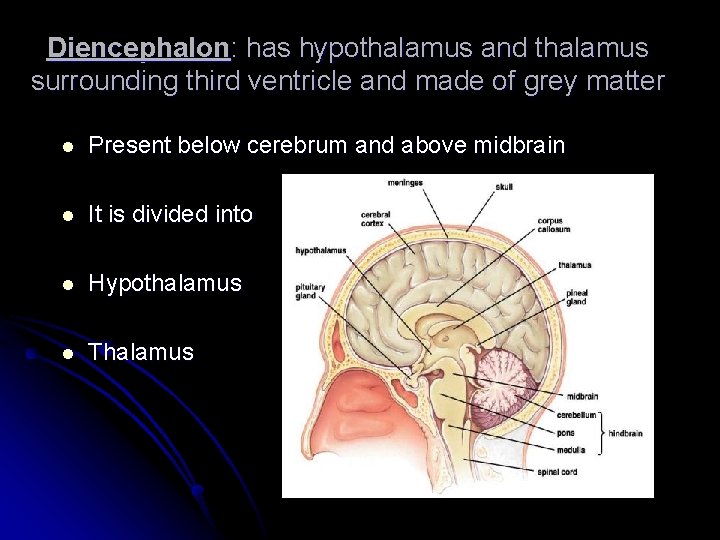
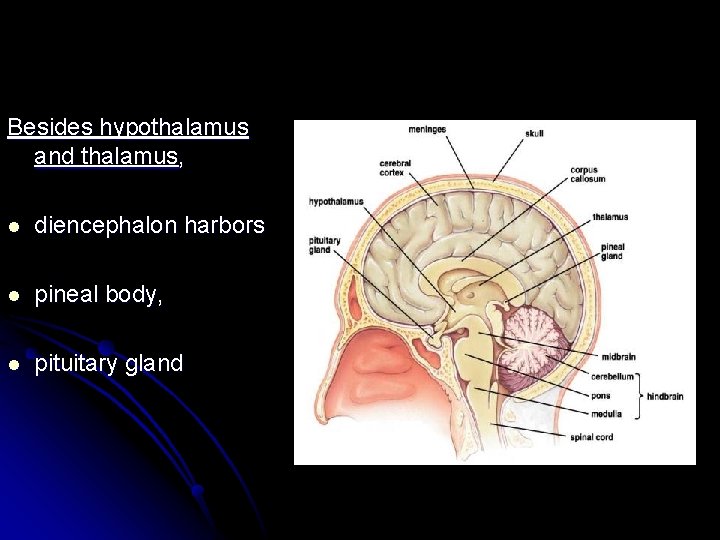
Diencephalon: has hypothalamus and thalamus surrounding third ventricle and made of grey matter l Present below cerebrum and above midbrain l It is divided into l Hypothalamus l Thalamus
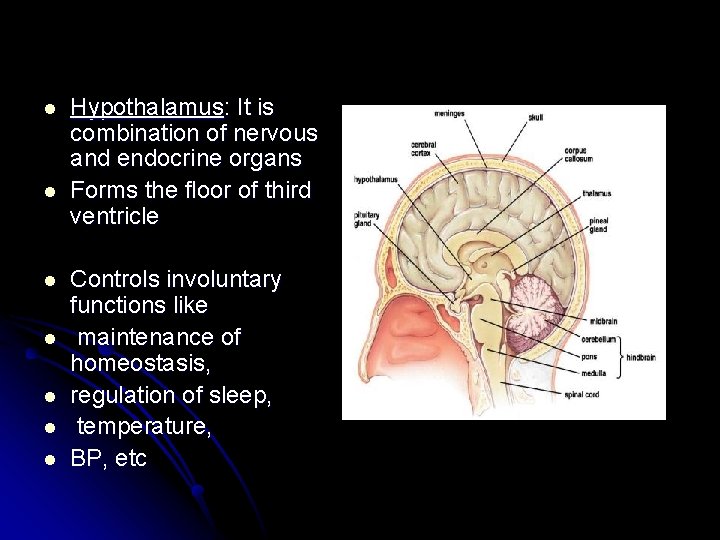
l l l l Hypothalamus: It is combination of nervous and endocrine organs Forms the floor of third ventricle Controls involuntary functions like maintenance of homeostasis, regulation of sleep, temperature, BP, etc
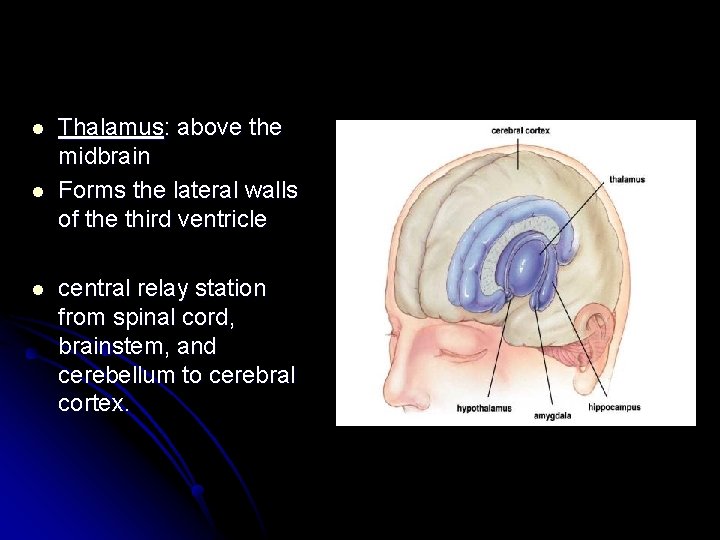
l l l Thalamus: above the midbrain Forms the lateral walls of the third ventricle central relay station from spinal cord, brainstem, and cerebellum to cerebral cortex.
Besides hypothalamus and thalamus, l diencephalon harbors l pineal body, l pituitary gland
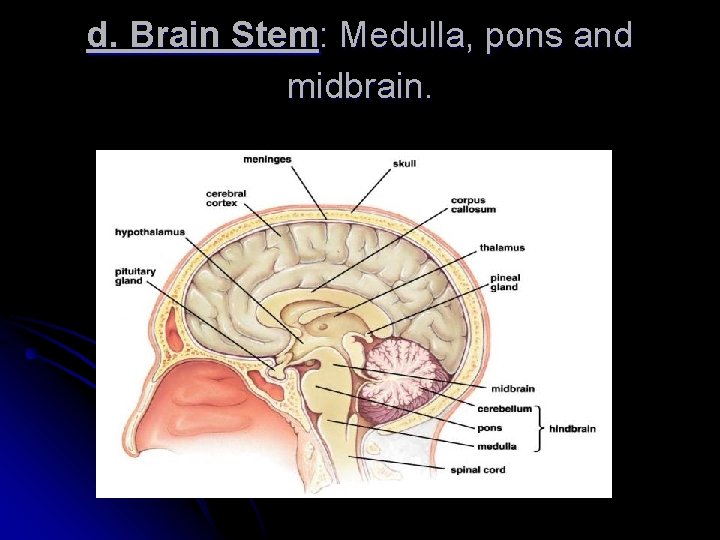
d. Brain Stem: Medulla, pons and midbrain.
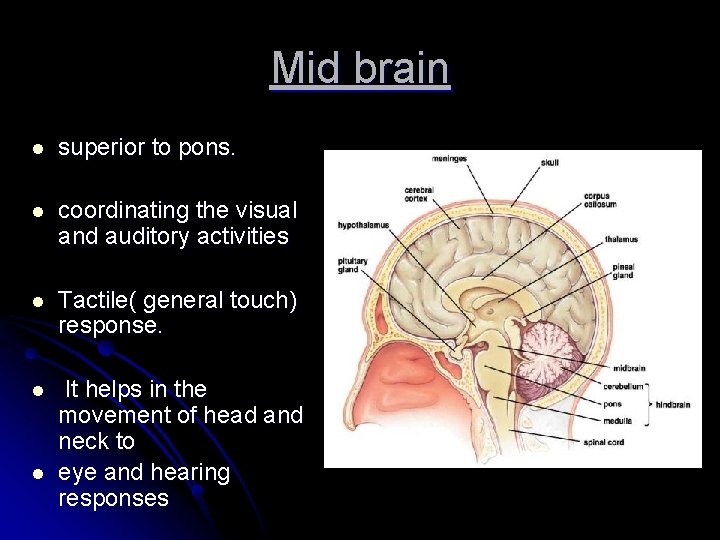
Mid brain l superior to pons. l coordinating the visual and auditory activities l Tactile( general touch) response. l It helps in the movement of head and neck to eye and hearing responses l
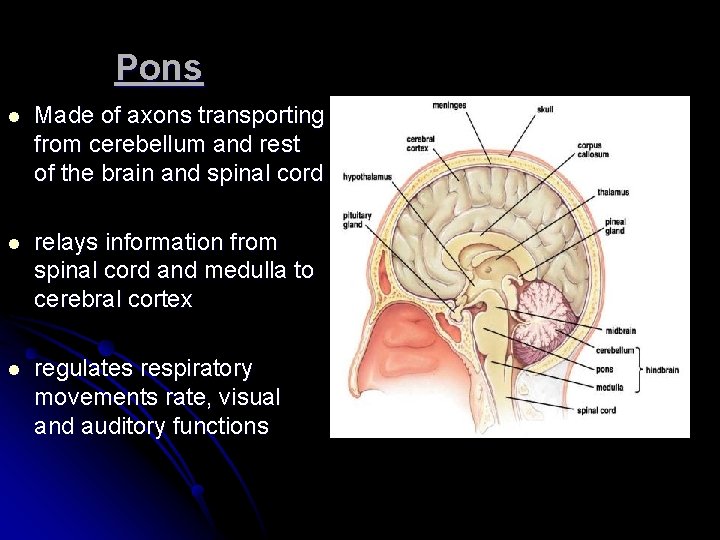
Pons l Made of axons transporting from cerebellum and rest of the brain and spinal cord l relays information from spinal cord and medulla to cerebral cortex l regulates respiratory movements rate, visual and auditory functions
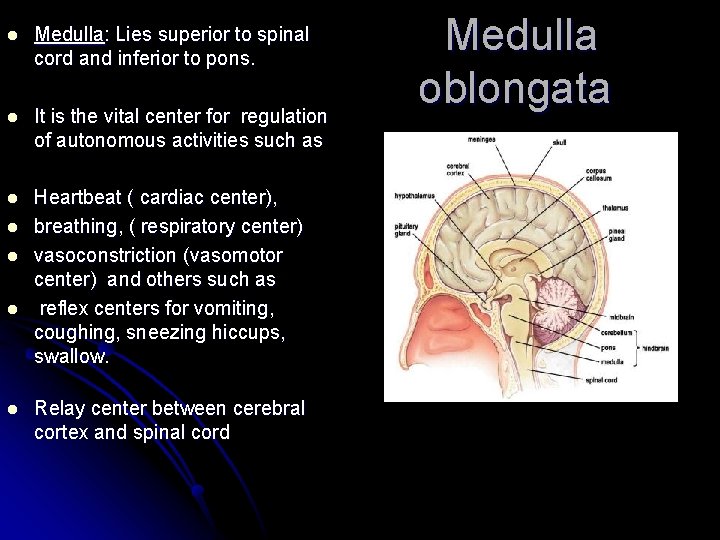
l Medulla: Lies superior to spinal cord and inferior to pons. l It is the vital center for regulation of autonomous activities such as l Heartbeat ( cardiac center), breathing, ( respiratory center) vasoconstriction (vasomotor center) and others such as reflex centers for vomiting, coughing, sneezing hiccups, swallow. l l Relay center between cerebral cortex and spinal cord Medulla oblongata
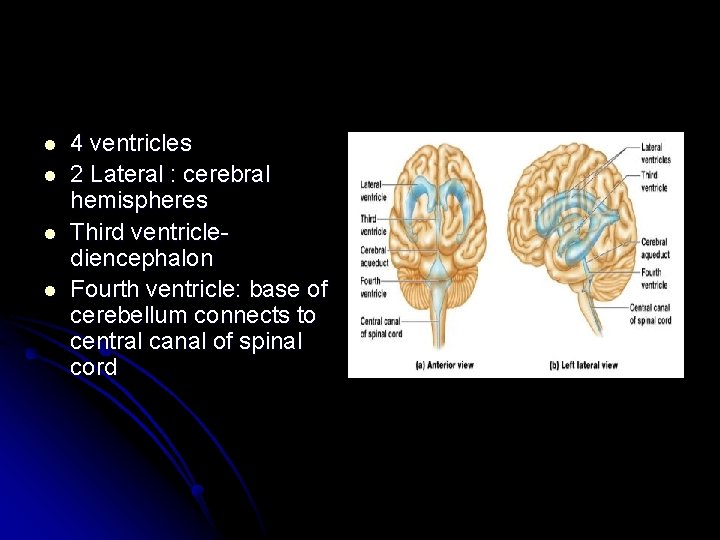
l l 4 ventricles 2 Lateral : cerebral hemispheres Third ventriclediencephalon Fourth ventricle: base of cerebellum connects to central canal of spinal cord
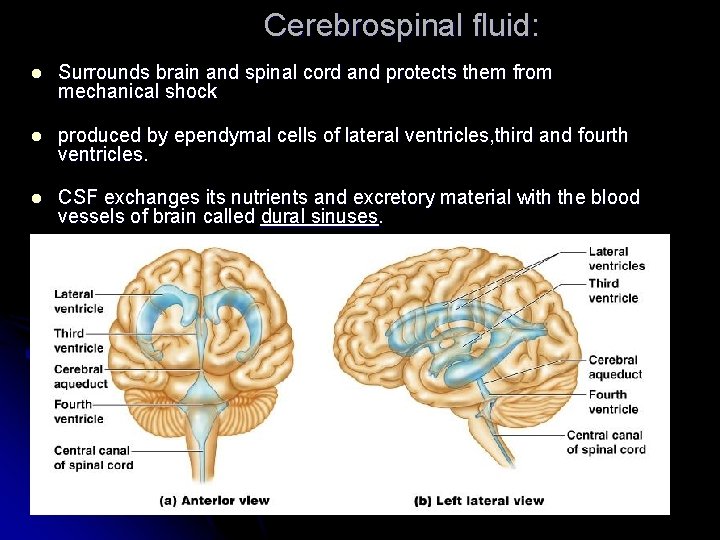
Cerebrospinal fluid: l Surrounds brain and spinal cord and protects them from mechanical shock l produced by ependymal cells of lateral ventricles, third and fourth ventricles. l CSF exchanges its nutrients and excretory material with the blood vessels of brain called dural sinuses.
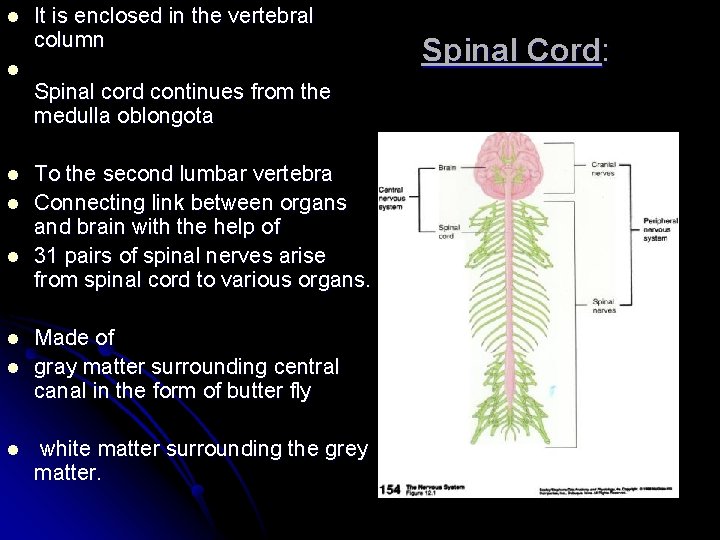
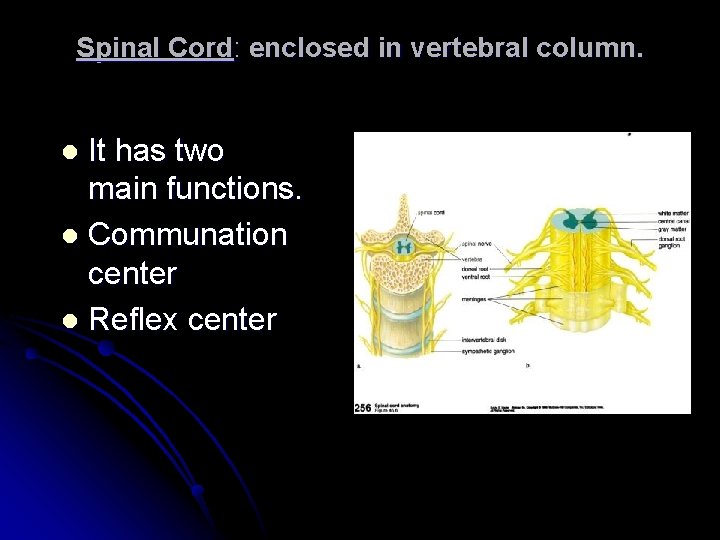
l l l l It is enclosed in the vertebral column Spinal cord continues from the medulla oblongota To the second lumbar vertebra Connecting link between organs and brain with the help of 31 pairs of spinal nerves arise from spinal cord to various organs. Made of gray matter surrounding central canal in the form of butter fly white matter surrounding the grey matter. Spinal Cord:
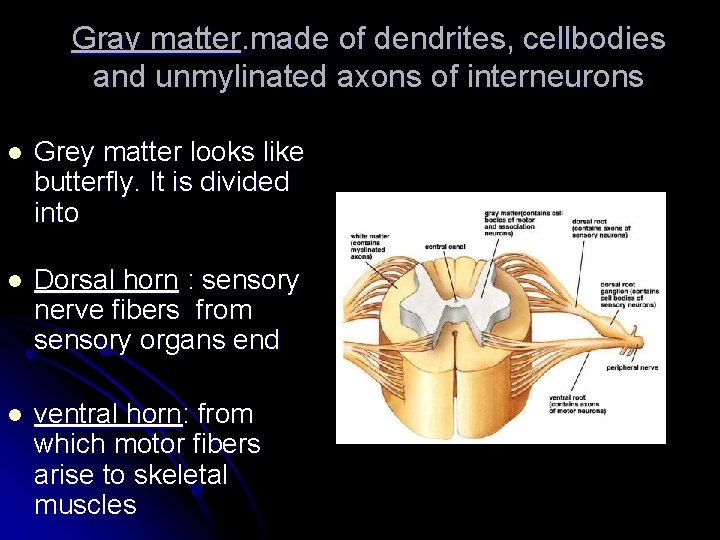
Gray matter. made of dendrites, cellbodies and unmylinated axons of interneurons l Grey matter looks like butterfly. It is divided into l Dorsal horn : sensory nerve fibers from sensory organs end l ventral horn: from which motor fibers arise to skeletal muscles
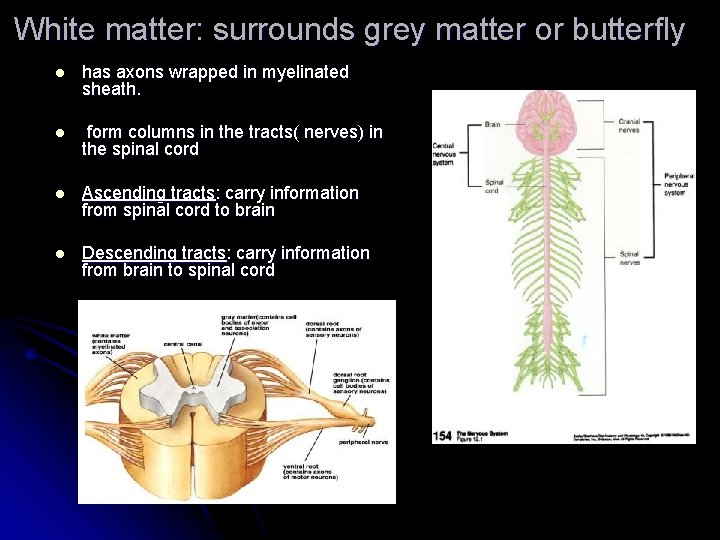
White matter: surrounds grey matter or butterfly l has axons wrapped in myelinated sheath. l form columns in the tracts( nerves) in the spinal cord l Ascending tracts: carry information from spinal cord to brain l Descending tracts: carry information from brain to spinal cord
Spinal Cord: enclosed in vertebral column. It has two main functions. l Communation center l Reflex center l
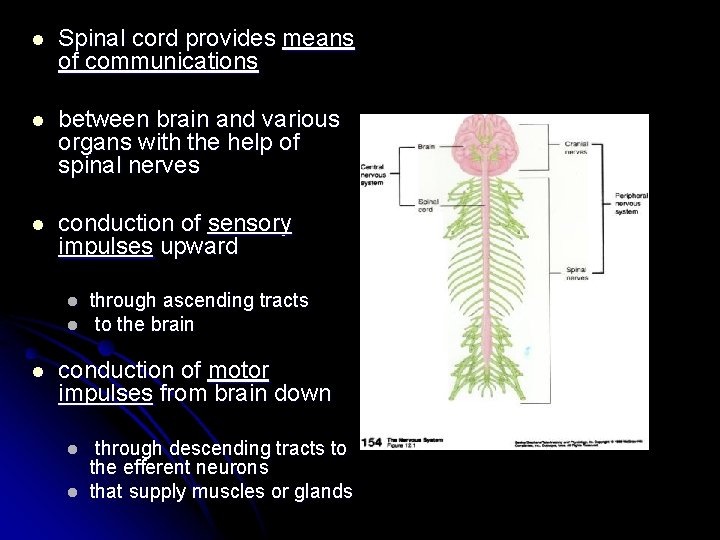
l Spinal cord provides means of communications l between brain and various organs with the help of spinal nerves l conduction of sensory impulses upward l l l through ascending tracts to the brain conduction of motor impulses from brain down l l through descending tracts to the efferent neurons that supply muscles or glands
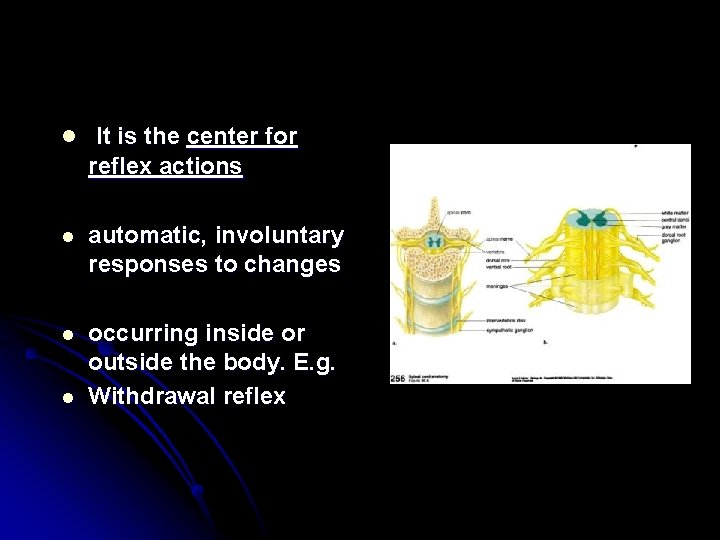
l It is the center for reflex actions l automatic, involuntary responses to changes l occurring inside or outside the body. E. g. Withdrawal reflex l
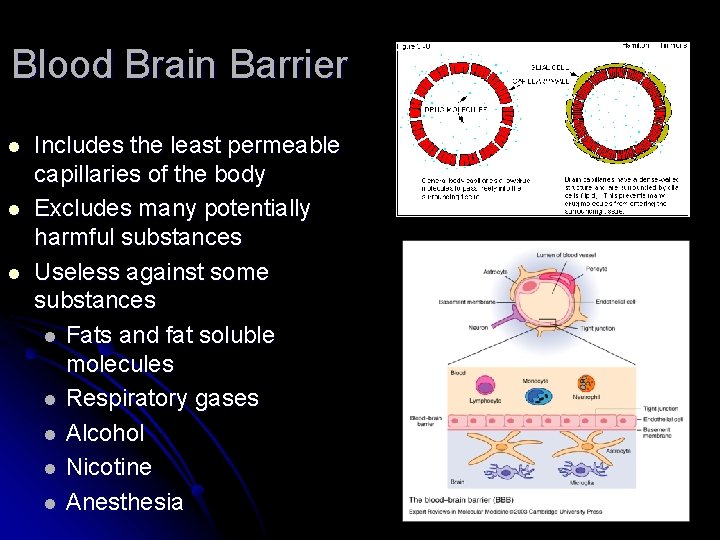
Blood Brain Barrier l l l Includes the least permeable capillaries of the body Excludes many potentially harmful substances Useless against some substances l Fats and fat soluble molecules l Respiratory gases l Alcohol l Nicotine l Anesthesia
Traumatic Brain Injuries l Concussion l l l Contusion l l l Slight brain injury No permanent brain damage Nervous tissue destruction occurs Nervous tissue does not regenerate Cerebral edema l l Swelling from the inflammatory response May compress and kill brain tissue
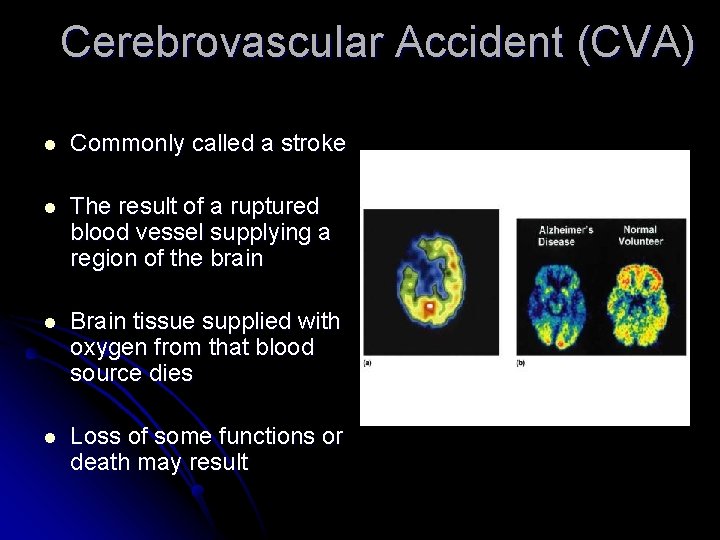
Cerebrovascular Accident (CVA) l Commonly called a stroke l The result of a ruptured blood vessel supplying a region of the brain l Brain tissue supplied with oxygen from that blood source dies l Loss of some functions or death may result
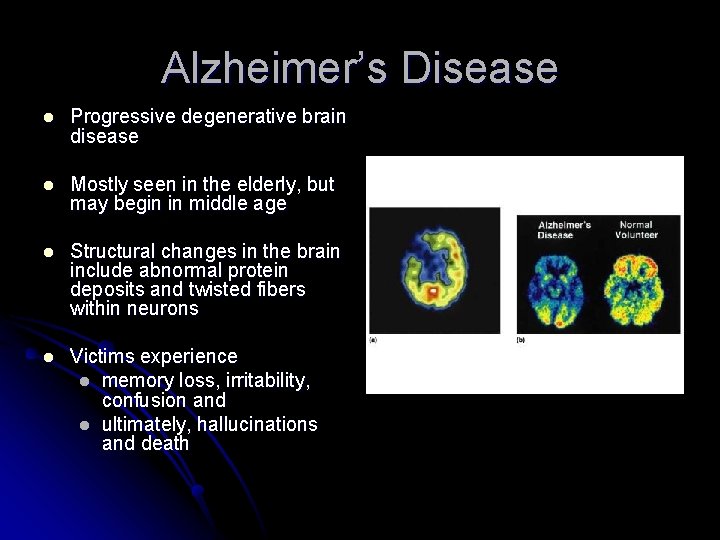
Alzheimer’s Disease l Progressive degenerative brain disease l Mostly seen in the elderly, but may begin in middle age l Structural changes in the brain include abnormal protein deposits and twisted fibers within neurons l Victims experience l memory loss, irritability, confusion and l ultimately, hallucinations and death
Peripheral nervous system (PNS) l Part of the nervous system outside the CNS l Consists of cranial nerves and spinal nerves l Carries messages to and from the spinal cord and brain
Peripheral Nervous System (PNS) Two Functional Divisions l Sensory (afferent) division l l l Carry impulses from sensory receptors located in skin, skeletal muscles, joints, visceral organs to the brain Motor (efferent) division l Transmits impulses from the CNS to effector organs, such as muscles, glands
Motor Division Motor division has two main parts: l Somatic nervous system l l l Conscious control of skeletal muscles Autonomic nervous system (ANS) Regulates smooth muscle, cardiac muscle, and glands l Two divisions of ANS: l Sympathetic l Parasympathetic l
Peripheral Nervous System (PNS) l PNS consists of nerves (bundles of axons) extend from brain and spinal cord l And ganglia (neuronal cell bodies) outside the CNS l These nerves can be: l Sensory nerves: carry impulses to the brain or spinal cord l Motor nerves: carry impulses to muscles or glands, away from CNS Mixed nerves: combination of both sensory and motor nerves l
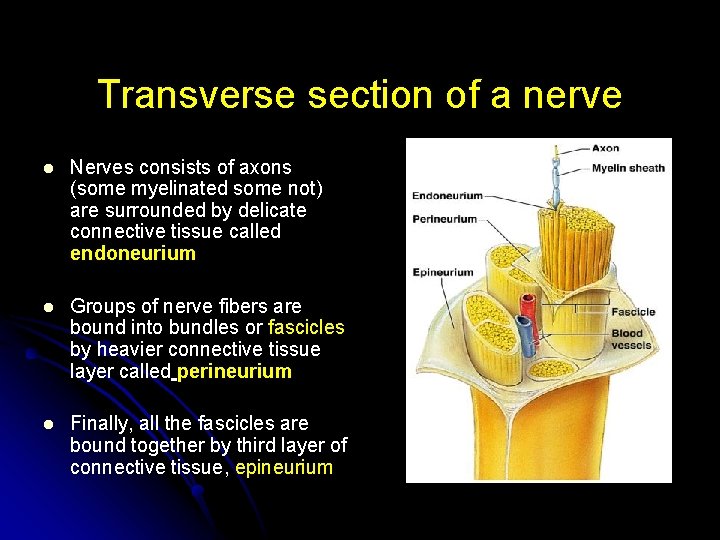
Transverse section of a nerve l Nerves consists of axons (some myelinated some not) are surrounded by delicate connective tissue called endoneurium l Groups of nerve fibers are bound into bundles or fascicles by heavier connective tissue layer called perineurium l Finally, all the fascicles are bound together by third layer of connective tissue, epineurium
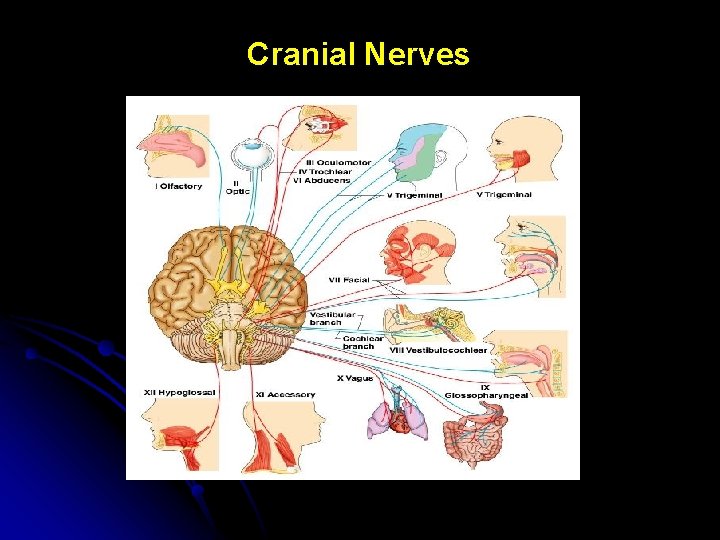
Cranial nerves v There are 12 pairs of nerves originating from the brain and serve head and neck v Only the pair of vagus nerves extend to thoracic and abdominal cavities v I and II arise from cerebral hemispheres v All others arise from brain stem v I, II and VIII ( sensory nerves) v Rest are mixed motor nerves
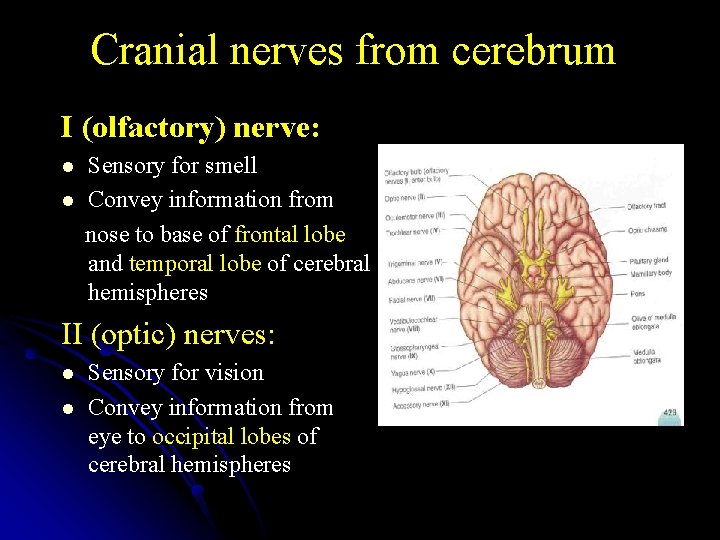
Cranial nerves from cerebrum I (olfactory) nerve: Sensory for smell l Convey information from nose to base of frontal lobe and temporal lobe of cerebral hemispheres l II (optic) nerves: l l Sensory for vision Convey information from eye to occipital lobes of cerebral hemispheres
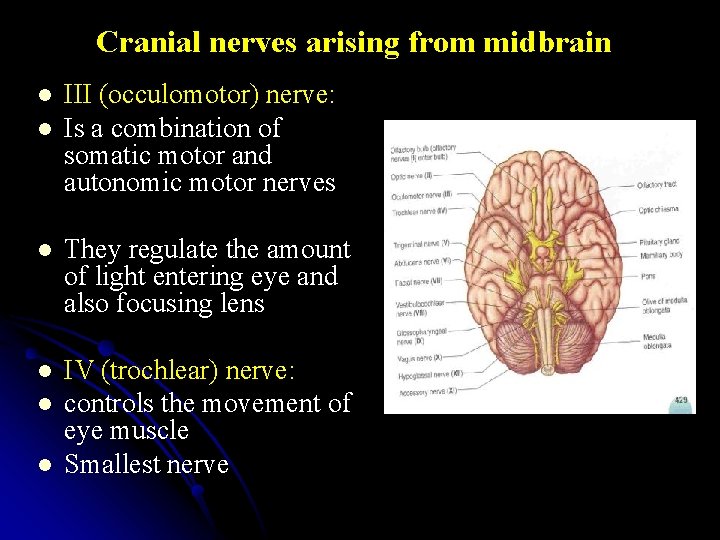
Cranial nerves arising from midbrain l l III (occulomotor) nerve: Is a combination of somatic motor and autonomic motor nerves l They regulate the amount of light entering eye and also focusing lens l IV (trochlear) nerve: controls the movement of eye muscle Smallest nerve l l
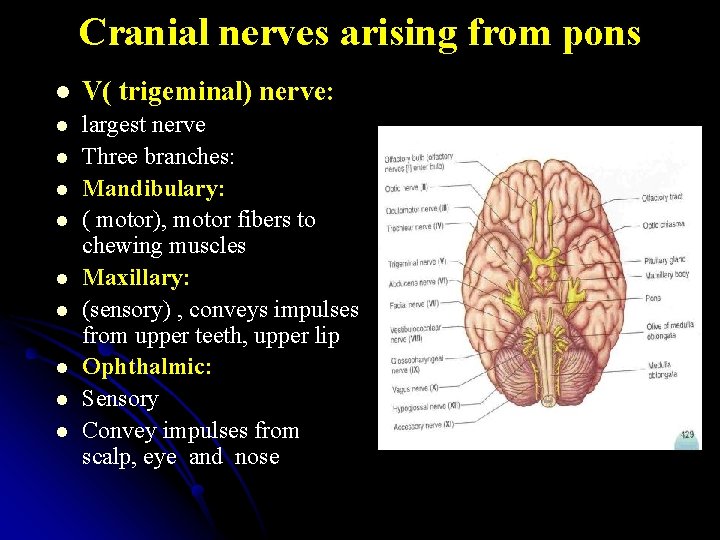
Cranial nerves arising from pons l V( trigeminal) nerve: l largest nerve Three branches: Mandibulary: ( motor), motor fibers to chewing muscles Maxillary: (sensory) , conveys impulses from upper teeth, upper lip Ophthalmic: Sensory Convey impulses from scalp, eye and nose l l l l
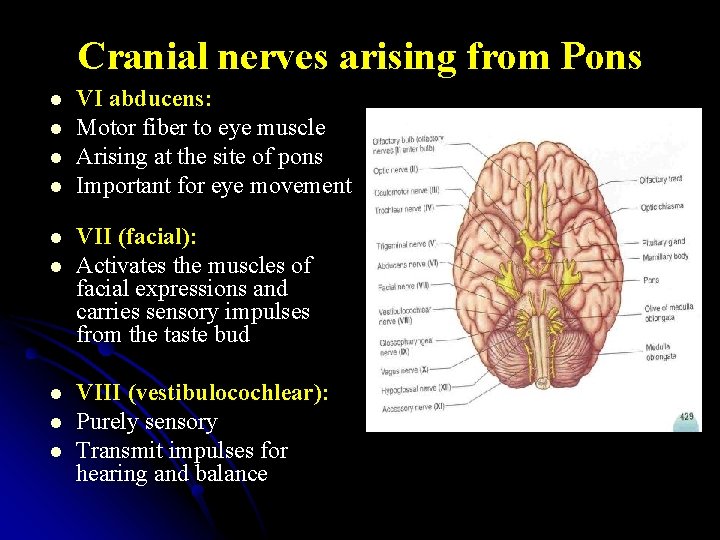
Cranial nerves arising from Pons l l l l l VI abducens: Motor fiber to eye muscle Arising at the site of pons Important for eye movement VII (facial): Activates the muscles of facial expressions and carries sensory impulses from the taste bud VIII (vestibulocochlear): Purely sensory Transmit impulses for hearing and balance
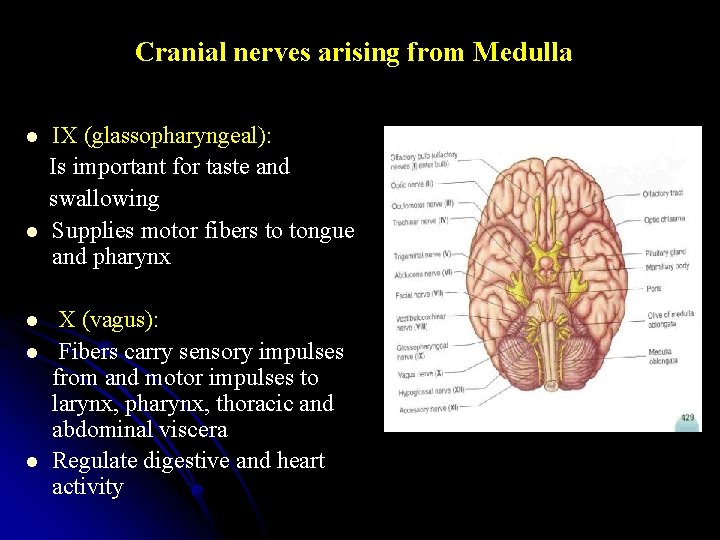
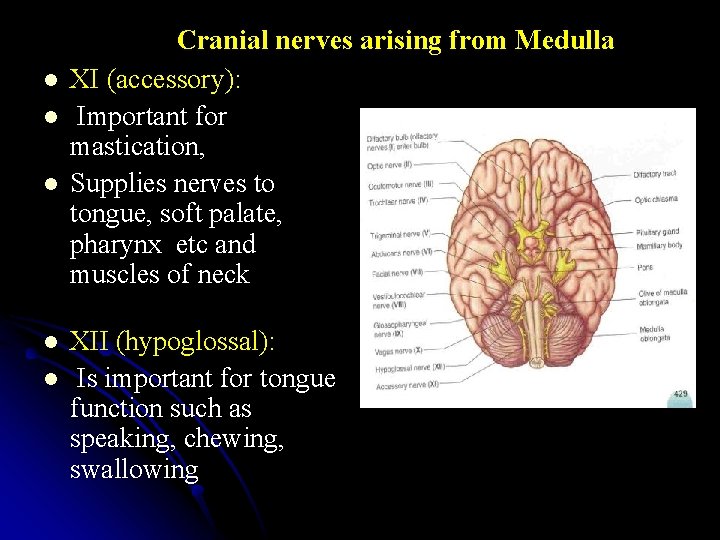
Cranial nerves arising from Medulla IX (glassopharyngeal): Is important for taste and swallowing l Supplies motor fibers to tongue and pharynx l l X (vagus): Fibers carry sensory impulses from and motor impulses to larynx, pharynx, thoracic and abdominal viscera Regulate digestive and heart activity
l l l Cranial nerves arising from Medulla XI (accessory): Important for mastication, Supplies nerves to tongue, soft palate, pharynx etc and muscles of neck XII (hypoglossal): Is important for tongue function such as speaking, chewing, swallowing
Cranial Nerves
Spinal nerves l There are 31 pairs of spinal nerves each numbered according to the level of the spinal cord from where it arises l Each spinal nerve is a mixed nerve consisting of sensory and motor nerve
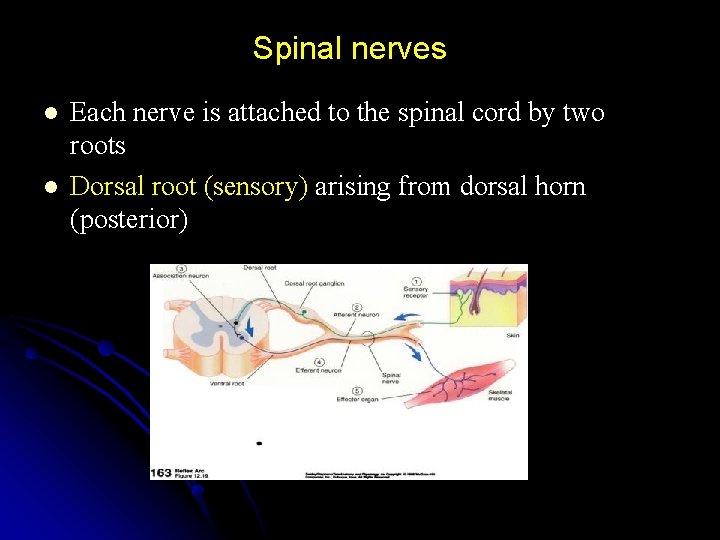
Spinal nerves l l Each nerve is attached to the spinal cord by two roots Dorsal root (sensory) arising from dorsal horn (posterior)
Spinal nerves l l l ventral root (motor) arising from ventral horn (anterior) It is mainly made of axons from motor neurons Their cell bodies are located in the gray matter of the spinal cord
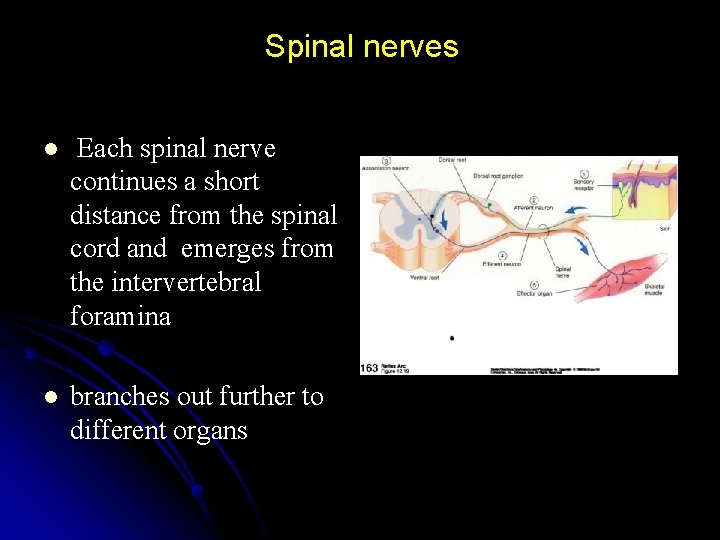
Spinal nerves l Each spinal nerve continues a short distance from the spinal cord and emerges from the intervertebral foramina l branches out further to different organs
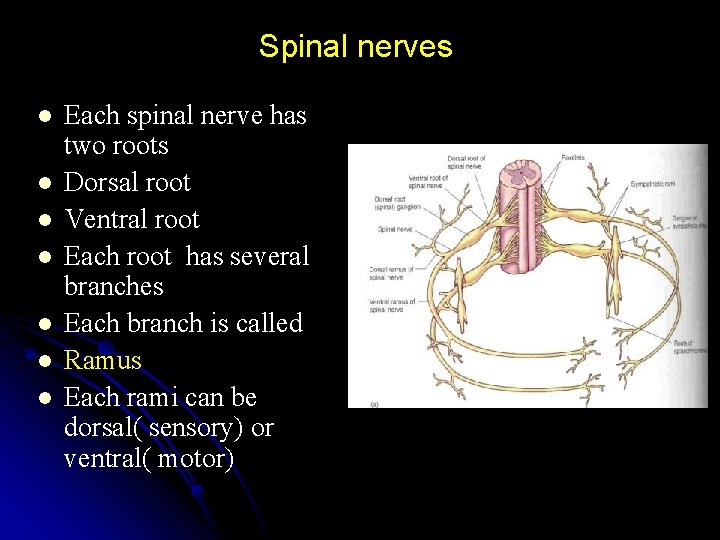
Spinal nerves l l l l Each spinal nerve has two roots Dorsal root Ventral root Each root has several branches Each branch is called Ramus Each rami can be dorsal( sensory) or ventral( motor)
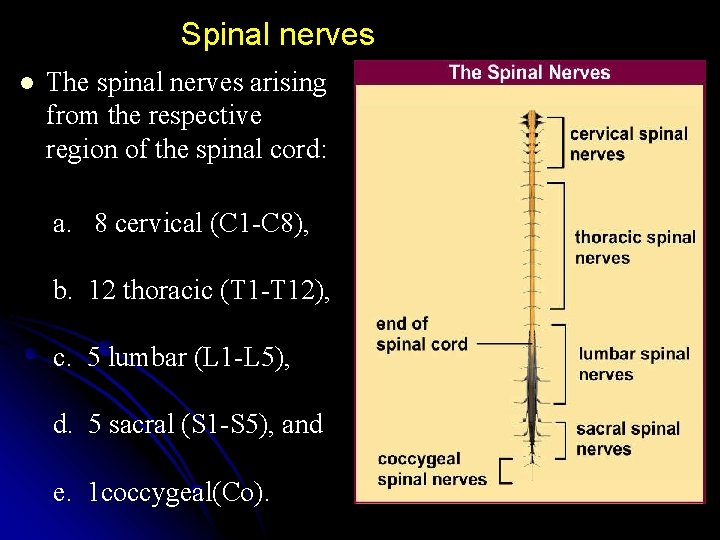
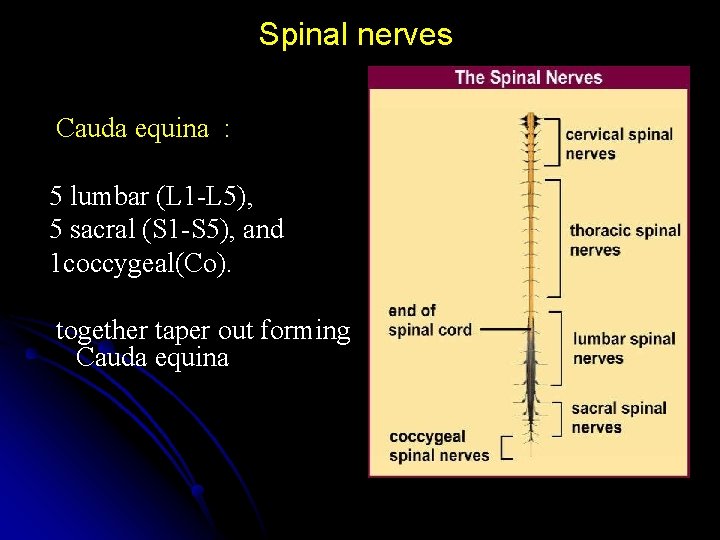
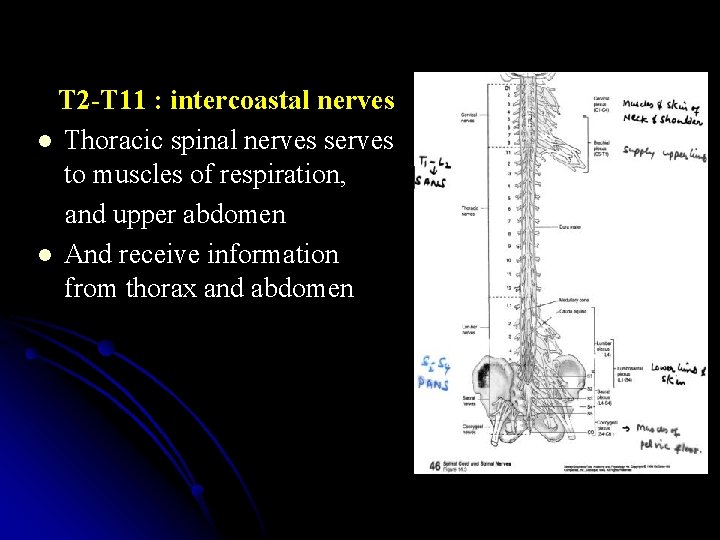
Spinal nerves l The spinal nerves arising from the respective region of the spinal cord: a. 8 cervical (C 1 -C 8), b. 12 thoracic (T 1 -T 12), c. 5 lumbar (L 1 -L 5), d. 5 sacral (S 1 -S 5), and e. 1 coccygeal(Co).
Spinal nerves Cauda equina : 5 lumbar (L 1 -L 5), 5 sacral (S 1 -S 5), and 1 coccygeal(Co). together taper out forming Cauda equina
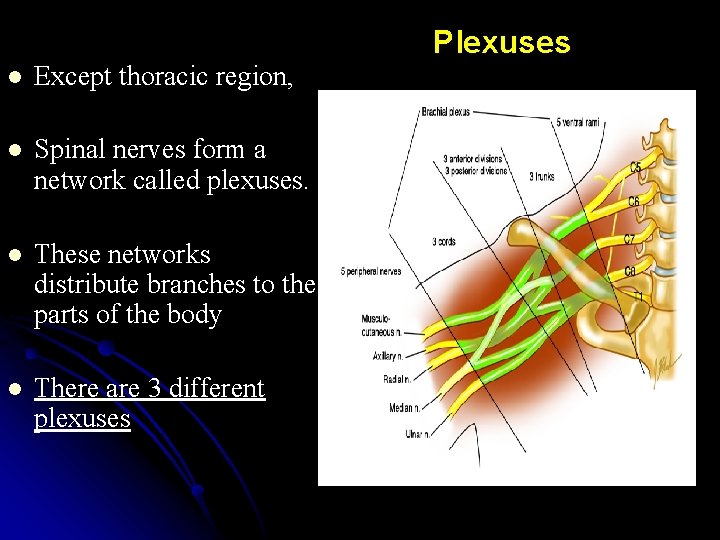
l Except thoracic region, l Spinal nerves form a network called plexuses. l These networks distribute branches to the parts of the body l There are 3 different plexuses Plexuses
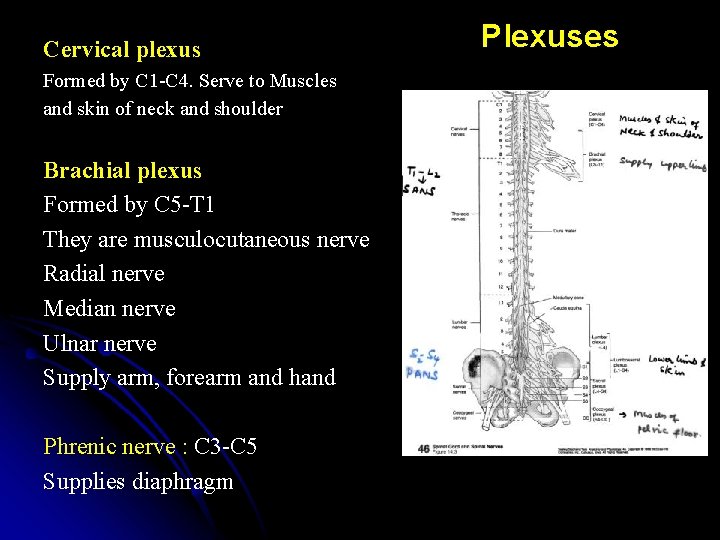
Cervical plexus Formed by C 1 -C 4. Serve to Muscles and skin of neck and shoulder Brachial plexus Formed by C 5 -T 1 They are musculocutaneous nerve Radial nerve Median nerve Ulnar nerve Supply arm, forearm and hand Phrenic nerve : C 3 -C 5 Supplies diaphragm Plexuses
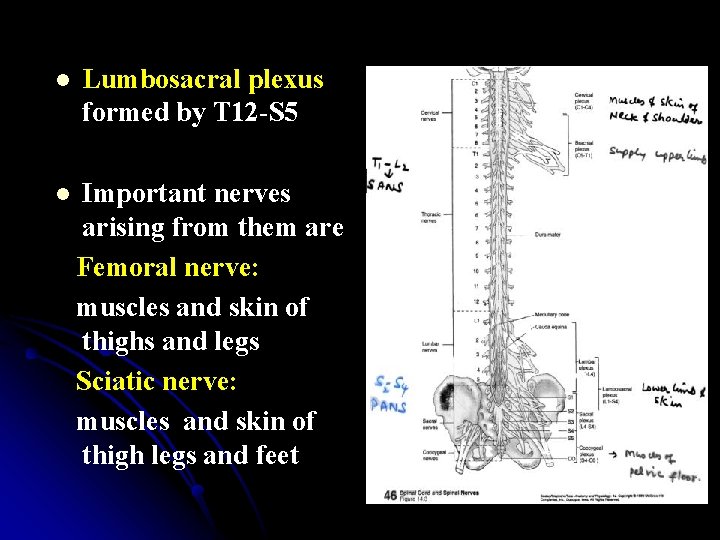
l Lumbosacral plexus formed by T 12 -S 5 l Important nerves arising from them are Femoral nerve: muscles and skin of thighs and legs Sciatic nerve: muscles and skin of thigh legs and feet
T 2 -T 11 : intercoastal nerves l Thoracic spinal nerves serves to muscles of respiration, and upper abdomen l And receive information from thorax and abdomen
Autonomous nervous system (ANS) l Motor subdivision of the PNS l Consists only of motor nerves l Also known as the Involuntary nervous system l Regulates activities of cardiac and smooth muscles and glands l Two subdivisions l Sympathetic division l Parasympathetic division
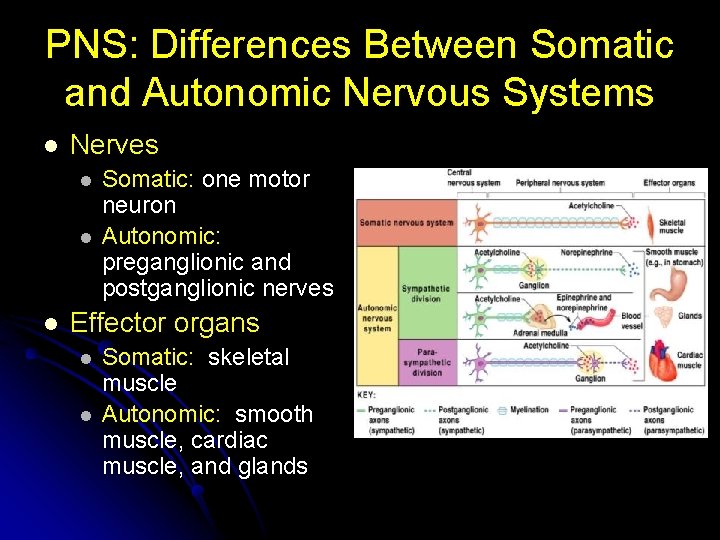
PNS: Differences Between Somatic and Autonomic Nervous Systems l Nerves l l l Somatic: one motor neuron Autonomic: preganglionic and postganglionic nerves Effector organs l l Somatic: skeletal muscle Autonomic: smooth muscle, cardiac muscle, and glands
PNS: Differences Between Somatic and Autonomic Nervous Systems l Neurotransmitters Somatic: always use acetylcholine l Autonomic: use acetylcholine, epinephrine, or norepinephrine l
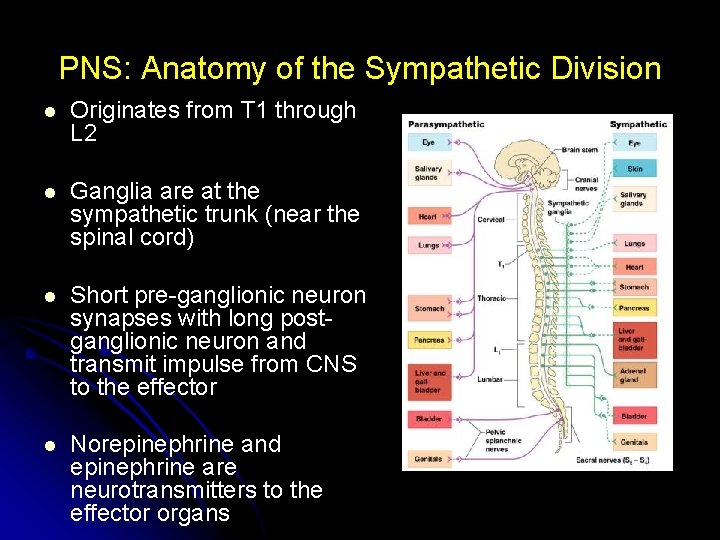
PNS: Anatomy of the Sympathetic Division l Originates from T 1 through L 2 l Ganglia are at the sympathetic trunk (near the spinal cord) l Short pre-ganglionic neuron synapses with long postganglionic neuron and transmit impulse from CNS to the effector l Norepinephrine and epinephrine are neurotransmitters to the effector organs
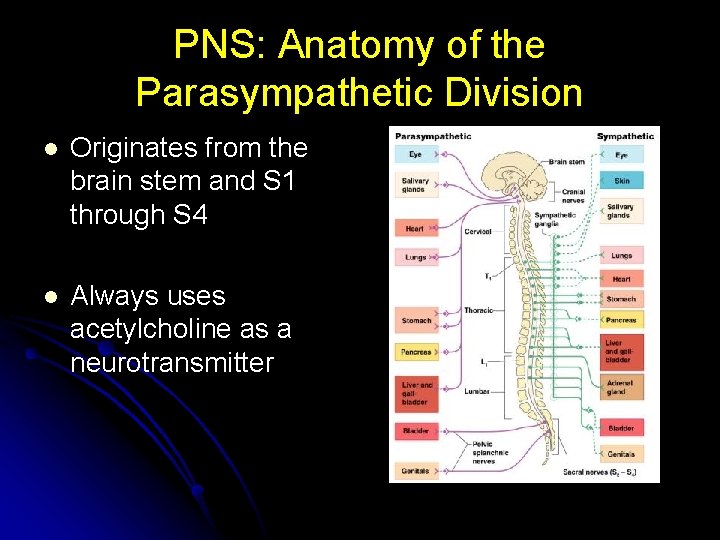
PNS: Anatomy of the Parasympathetic Division l Originates from the brain stem and S 1 through S 4 l Always uses acetylcholine as a neurotransmitter
PNS: Autonomic Functioning l Sympathetic — “fight or flight” Response to unusual stimulus l Takes over to increase activities l l Exercise, excitement, emergency, and embarrassment l Sympathetic nervous system increases heart rate, blood pressure, blood glucose levels
PNS: Autonomic Functioning l Parasympathetic—“housekeeping” activites Conserves energy l Maintains daily necessary body functions l l digestion, defecation, and diuresis (urination)
Development Aspects of the Nervous System l The nervous system is formed during the first month of embryonic development l Any maternal infection can have extremely harmful effects l The hypothalamus is one of the last areas of the brain to develop l No more neurons are formed after birth, but growth and maturation continues for several years l The brain reaches maximum weight in young adult