
The Nervous System By Muhammad Butt Colin Ciszewski
The Nervous System By: Muhammad Butt, Colin Ciszewski, Sharlynn. Parikh, Justine. Tumacder
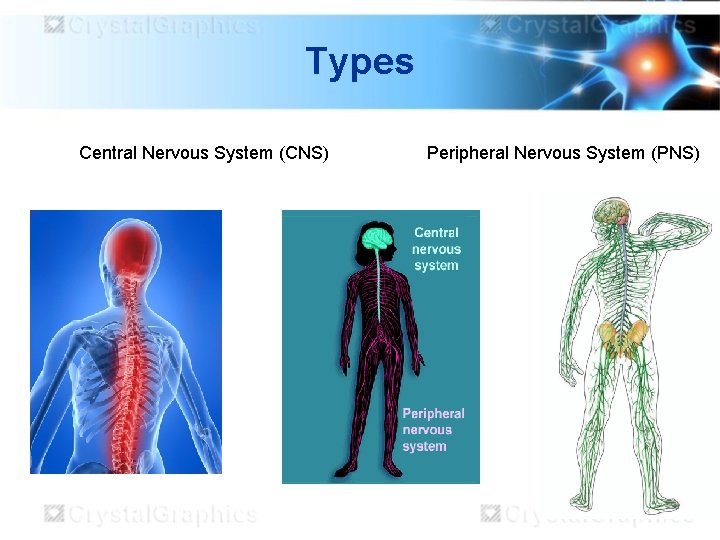
Types Central Nervous System (CNS) Peripheral Nervous System (PNS)
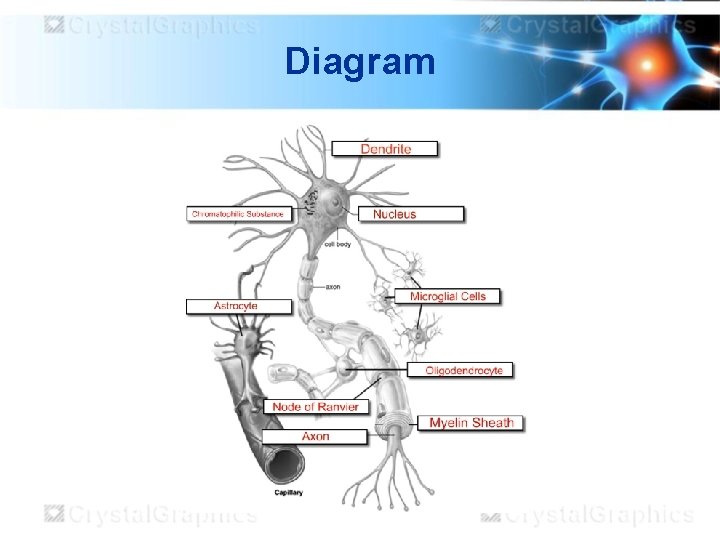
Diagram
Types of Neurons • Sensory neuron - nerve cells that carries impulses from a sense receptor to the brain or spinal cord. • Relay neuron- The nerve cell that connects sensory and motor neurons • Motor neuron- The nerve cell that transmits impulses from the brain or spinal cord to a muscle or gland Neuron video https: //www. youtube. com/watch? v=Jrda. EGw. Gu-w (start at 1: 10) Neurotransmissionhttps: //www. youtube. com/watch? v=p 5 z. Fg. T 4 aof. A
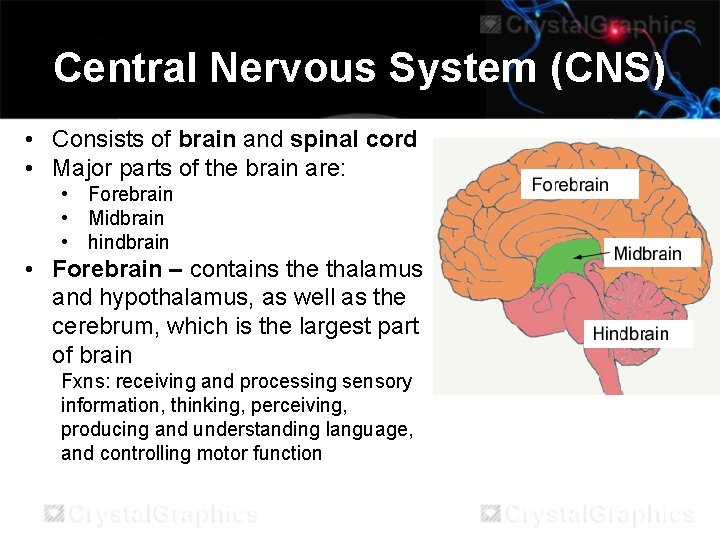
Central Nervous System (CNS) • Consists of brain and spinal cord • Major parts of the brain are: • Forebrain • Midbrain • hindbrain • Forebrain – contains the thalamus and hypothalamus, as well as the cerebrum, which is the largest part of brain Fxns: receiving and processing sensory information, thinking, perceiving, producing and understanding language, and controlling motor function
CNS Cont. • Midbrain – with the hindbrain, they make up the brainstem. Midbrain connects the hindbrain and forebrain through the brainstem • Fxns in auditory and visual response, and motor function • Hindbrain – extends from spinal cord. It contains the pons and cerebellum • Fxns: maintain balance, movement coordination, and involved in senses information • Spinal cord – transmits messages from the brain to areas of the body and vice versa. The nerves of the spinal cord are grouped into bundles, creating nerve fibers

Peripheral Nervous System (PNS) • PNS mainly connects CNS and environmental stimuli to allow body to respond properly. • PNS divided into 2 systems: • • Somatic Nervous System: governs voluntary actions and body reflexes Autonomic Nervous System: regulates involuntary actions such as breathing and digestion
Somatic Nervous System • Controls all voluntary movements • Consists of 3 parts: • Spinal Nerves: Peripheral nerves that carry sensory information into spinal cord and motor commands • Cranial Nerves: Nerve fibers that carry information from and to the brainstem. The information carried are related to smell, taste, vision, eye muscles, ears, etc • Association Nerves: integrate sensory input and motor output
Autonomic Nervous System (ANS) • Functions as a control system, mostly below the level of consciousness • Controls heart rate, digestion, respiratory rate, pupil dilation, perspiration, and sexual arousal • ANS is divided into 2 systems: • Parasympathetic Nervous System • Sympathetic Nervous System

Sympathetic Nervous System • “Fight-or-Flight” System • Main function is to prepare your body in emergencies and helps you in stressful situations • A person in a fight-or-flight mode may have increased blood pressure, breathing rate, and heart rate, dilated pupils, run faster, and have an adrenaline rush
Parasympathetic Nervous System • “Rest-and-digest” System • Its major function is to keep the body in its normal state by helping the body breath regularly, excrete hormones, and eat and digest food.
Diseases • • Multiple Sclerosis Huntington’s Disease Aphasia Amyotrophic Lateral Sclerosis (ALS)
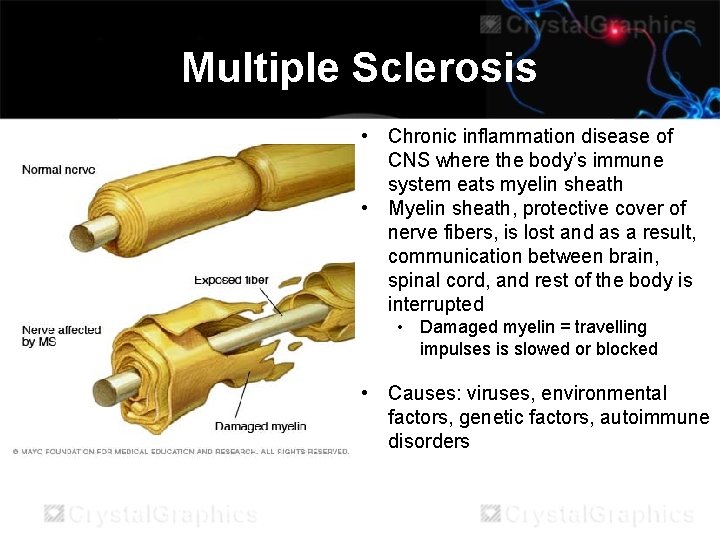
Multiple Sclerosis • Chronic inflammation disease of CNS where the body’s immune system eats myelin sheath • Myelin sheath, protective cover of nerve fibers, is lost and as a result, communication between brain, spinal cord, and rest of the body is interrupted • Damaged myelin = travelling impulses is slowed or blocked • Causes: viruses, environmental factors, genetic factors, autoimmune disorders
Multiple Sclerosis Cont. • Symptoms: • • • Loss of vision Weakness in limbs Fatigue Slurred speech Electric shock sensations from certain head movements • Treatments: • To slow progress: Beta interferon, type of drugs that reduces number and severity of attacks • To treat symptoms: physical therapy, muscle relaxants, and medication to reduce fatigue
Huntington’s Disease • Inherited disorder affecting people mostly in their 40’s and 50’s • Affects spinal cord and brain, where abnormal cells are found • Huntington is formed from an abnormal gene which prevents brain cells from protecting themselves against toxic chemicals. • This worsens when the amount of neurotransmitters in the brain decrease
Huntington’s Disease Cont. • Symptoms: • uncontrollable jerky movements • rapid eye movements • memory problems • change in mood • Death occurs 15 – 20 yrs after first symptoms • No cure • Medicine for treating symptoms: • Depression: Tricyclic antidepressants • Movement disorders: drugs that also treat parkinsonism and dystonia • Antisocial behavior: drugs such as Chlorpromazine
Aphasia • Neurological disorder due to damage on language parts of the brain from usually a stroke or brain damage • Inability to speak and/or understand written and spoken language • Affects mostly adults and those who experienced stroke • Causes: • usually stroke • brain injury • brain tumor • symptom of epilepsy
Aphasia Cont. • During stroke, the most common cause, brain tissues are damaged due to lack of oxygen and blood to the brain • Treatment: • Language therapy • Rehabilitation with speech pathologist • Patient practices how to read, write, follow directions, and repeat what they hear https: //www. youtube. com/watch? v=1 apl. Tv EQ 6 ew
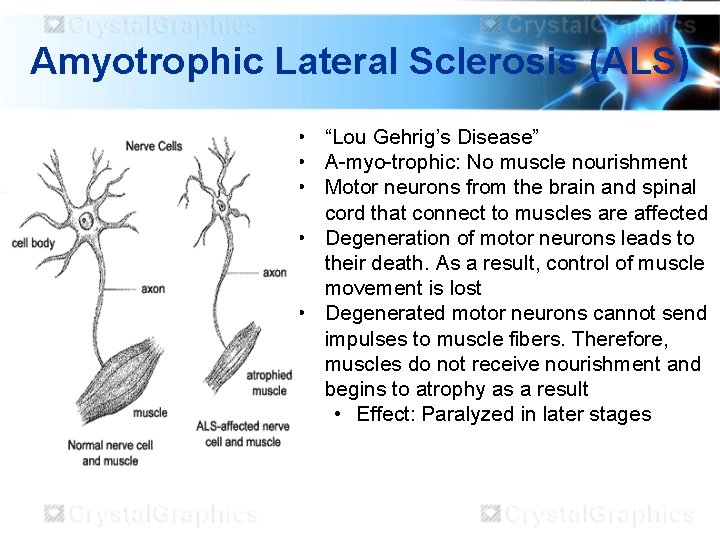
Amyotrophic Lateral Sclerosis (ALS) • “Lou Gehrig’s Disease” • A-myo-trophic: No muscle nourishment • Motor neurons from the brain and spinal cord that connect to muscles are affected • Degeneration of motor neurons leads to their death. As a result, control of muscle movement is lost • Degenerated motor neurons cannot send impulses to muscle fibers. Therefore, muscles do not receive nourishment and begins to atrophy as a result • Effect: Paralyzed in later stages
ALS Cont. • Symptoms: – Muscle weakness in arms, legs, muscles used in talking, breathing, swallowing – Difficulty breathing and swallowing – Muscle cramping • Currently no cure or treatment (death usually occurs 3 -5 years after diagnosis) • Certain drugs, such as riluzole, slows ALS progression
Links • https: //www. youtube. com/watch? v=x 4 PPZCL n. Vk. A- Crash course- nervous system • http: //www. livescience. com/22665 -nervoussystem. html
Works Cited • • • http: //biology. about. com/od/organsystems/ss/central-nervous-system. htm https: //www. boundless. com/physiology/autonomic-nervous-systemans/introduction-to-autonomic-nervous-system/somatic-compared-to-autonomicnervous-system/ https: //www. boundless. com/psychology/the-brain-and-behavior/the-nervoussystem/the-peripheral-nervous-system-pns/ http: //voices. yahoo. com/major-functions-sympathetic-parasympathetic 8876015. html? cat=4 http: //www. bbc. co. uk/science/humanbody/factfiles/peripheralnervoussystem/ peripheral_nervous_system. shtml http: //www. mayoclinic. org/diseases-conditions/multiplesclerosis/basics/definition/con-20026689 http: //www. netdoctor. co. uk/diseases/facts/huntingtons. htm http: //www. webmd. com/brain/aphasia-causes-symptoms-types-treatments http: //www. nhs. uk/Conditions/Aphasia/Pages/Causes. aspx http: //www. alsa. org/about-als/what-is-als. html
- Slides: 22