
The Nervous System By Aurora Gamboa Why is
The Nervous System By: Aurora Gamboa,
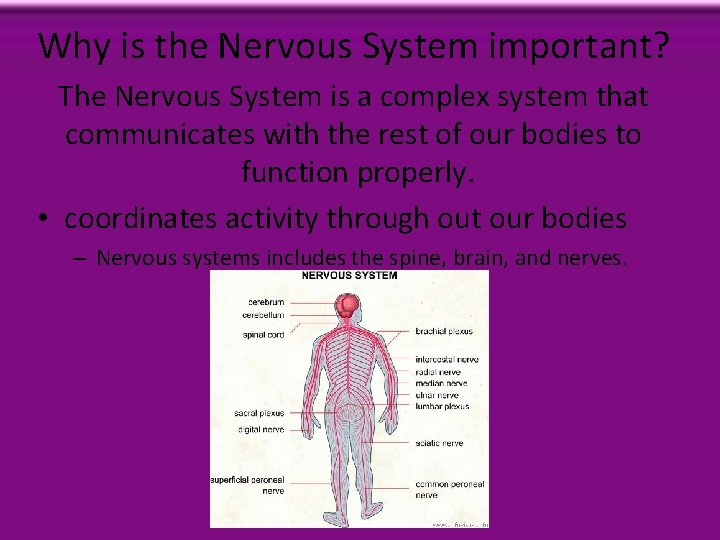
Why is the Nervous System important? The Nervous System is a complex system that communicates with the rest of our bodies to function properly. • coordinates activity through out our bodies – Nervous systems includes the spine, brain, and nerves.
What does it do? The Nervous System controls your emotions and pain. Your nerves send small impulses that transmit the feelings and thoughts that join together to create physical and motional pain, discomfort, or joy.
S N C Different Nervous Systems. • Peripheral (PNS): Contains all the nerves that are not (CNS) carried messages between (PNS) and (CNS) and the rest of the body. • Autonomic (ANS): controls involuntary things in our bodies such as digestion and heart rate. • Sympathetic (SNS): [Getting scared or fight or flight] Causing greater blood flow which allows your body to react quickly, also known as reflex. PNS ANS
Different Nervous Systems count. • Parasympathetic(PNS): During rest PNS slows your body functions. • Somatic(SNS): Relays messages from receptors in ears, eyes, nose, tongue, and skin to CNS. S N C PNS SNS
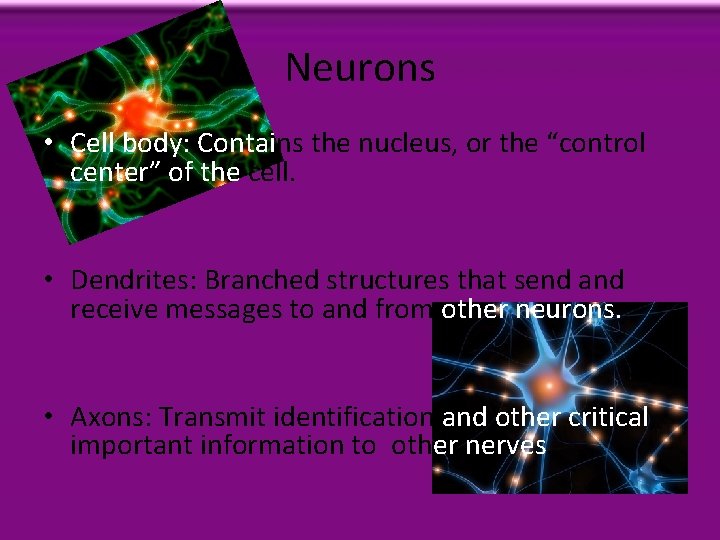
Neurons • Cell body: Contains the nucleus, or the “control center” of the cell. • Dendrites: Branched structures that send and receive messages to and from other neurons. • Axons: Transmit identification and other critical, important information to other nerves.
Care for Nervous System • Ways to care for your Nervous System – Eat a healthy diet – Get required hours of sleep – Exercise regularly
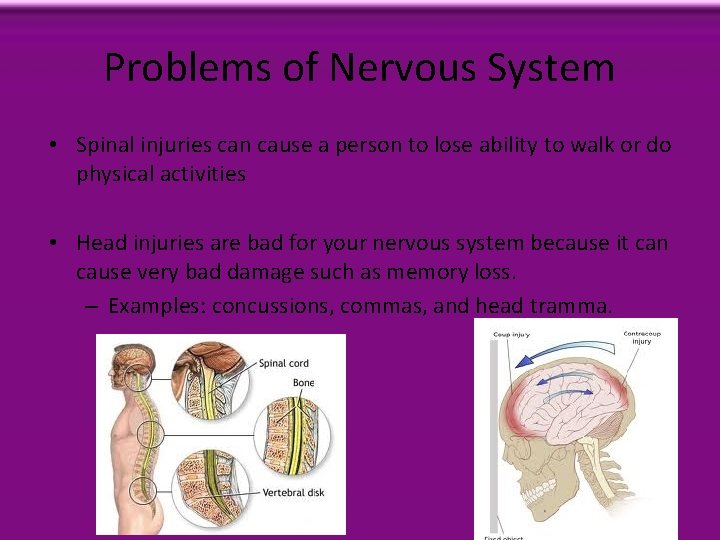
Problems of Nervous System • Spinal injuries can cause a person to lose ability to walk or do physical activities • Head injuries are bad for your nervous system because it can cause very bad damage such as memory loss. – Examples: concussions, commas, and head tramma.
Definitions • Neurons: Is a nerve cell (messages are transmitted) • Spinal cord: A long column of nerve tissue as thick as your index finger. • Cerebrum: Is the largest and most complex part of the brain. • Brain Stem: Three inch stalk of nerve cells • Reflex: Is an action that is performed as a response to a stimulus and without conscious thought. • Involuntary: Is a function done without will or conscious control.
- Slides: 9