
The Nervous System Brain and Endocrine System The
The Nervous System, Brain and Endocrine System
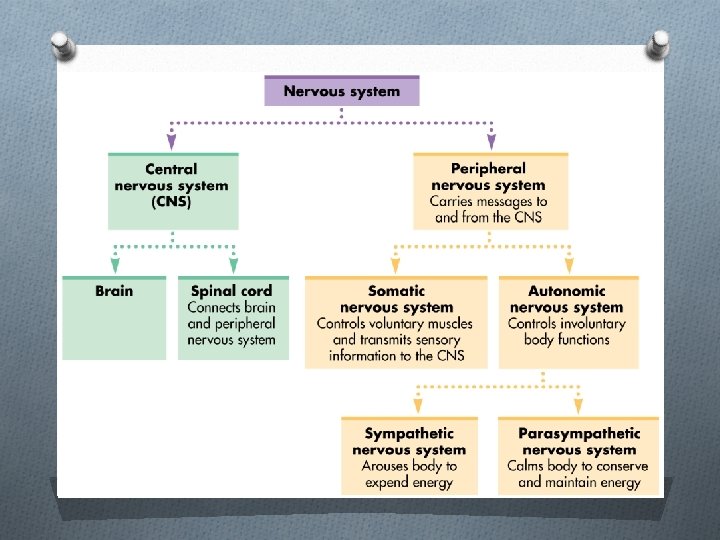
The Central Nervous System O Is composed of the brain and spinal cord O Spinal cord is the “cable” that is used to communicate to the rest of the body O Houses the axons that carry the brain’s commands to the other parts of the body/vice versa O Going up (send sensory info), going down (motor control info) O Think reflexes O The brain is the central “computer” of the nervous system
O Nerves are the bundles of neuron fibers (axons) that are routed together in the peripheral nervous system O Clustered into neural networks O Cerebrospinal fluid (CSF) nourishes the brain and provides a protective cushion for it O Cavities filled with this stuff in the brain are called ventricles
Peripheral Nervous System O All parts of the nervous system beyond the brain and spinal cord O Two Major Divisions O Somatic System- muscles and sense organs (voluntary behavior) O Autonomic System- the internal organs and glands (involuntary behavior)
Somatic Nervous System O Cables that carry information from receptors in the skin, muscles, and joints to the central nervous system (CNS) and carry commands from the CNS to the muscles O Afferent Nerve Fibers are axons that carry information outward to the nervous system from the periphery of the body O Efferent Nerve Fibers are the axons that carry information outward from the central nervous system to the periphery of the body
Autonomic Nervous System (ANS) O Nerves that connect to the heart, blood vessels, smooth muscles and glands O Controls the stuff we don’t think about (heart rate, digestion, and perspiration) O Arousal, emotion, sweating, etc O Fight or Flight- heart rate & breathing go up O Generally respond to threat by preparing physiologically for attacking (fight) or fleeing (flight) from an enemy or perceived threat
Sympathetic Division O Branch of the autonomic nervous system that mobilizes the body’s resources for emergencies O Fo. F response O Slows digestive processes, drains blood from the periphery to reduce bleeding in case of injury O Adrenal glands are signaled, triggering hormones that ready the body for exertion
Parasympathetic Division O Division that calms the body, conserving its energy O Produces the opposite effects of the sympathetic O Decreases heart rate, lowers blood sugar, etc O “PARAmedic” comes to help you
Endocrine System O Consists to the glands that secrete chemicals into the bloodstream that help control bodily functioning O Hormones- the chemical substances released by the endocrine system (messengers) O Like neurotransmitters! And also can act as neurotransmitters in the nervous system (norepinephrine) O Tend to be slower as they travel to distant cells at slower speeds and target a variety of cells
O The Hypothalamus controls most of the endocrine system O Adrenal Glands (epinephrine/norepinephrine) Fo. F O Pituitary Gland releases a variety of hormones that fan out around the body, stimulating actions in the other endocrine glands O “Master Gland” O Intermeshing with the nervous system as well (fight or flight-adrenal glands)
Physiological Development O Gonadotrophins affect the gonads, or sexual glands O Prior to birth, these direct the formation of the external sexual organs in the developing fetus O During puberty, there are features of secondary sexual characteristics, such as facial hair and breasts
How Do We Study the Brain?
Electrical Recordings O Electroencephalograph is a device that monitors the electrical activity of the brain over time by means of recording electrodes attached to the surface of the scalp O used in clinical diagnosis for brain damage, epilepsy, and other neurological disorders O Valuable especially when studying sleep

Lesioning O Lesioning involves destroying a piece of the brain O Typically done by inserting an electrode into a brain structure and passing a highfrequency electric current through it to burn the tissue and disable the structure O Anesthetics are used to minimize pain and discomfort for the animals (we don’t do this to people)
Electrical Stimulation of the Brain O Electrical Stimulation of the Brain- ESB involves sending a weak current into a brain structure to stimulate/activate it O current is delivered through and electrode, a close enough approximation to activate the brain structures O Mainly used with animals
The Brain
The Brain O Divided into three major regions O Hindbrain O Midbrain O Forebrain O We can find all of these areas in relation to the Brain Stem O Low end is attached to the spinal cord O High end is buried deep within the brain

Hindbrain O Includes the cerebellum and two structures found in the lower part of the brain stem- the medulla and the pons
O Medulla attaches to the spinal cord, controls largely unconscious but vital functions, including circulating blood, breathing, maintaining muscle tone, and regulating reflexes such as sneezing, coughing, and salivating. O Pons (literally bridge) includes a long bridge of fibers that connects the brainstem with the cerebellum, as well as several clusters of cell bodies involved with sleep and arousal
O Cerebellum (little brain) is a relatively large and deeply folded structure located adjacently to the back surface of the brain stem O Critical to the coordination of movement and to the sense of equilibrium/physical balance O Key role in organizing sensory information that guides these movements O First areas impacted by alcohol O Damage disrupts fine motor skills, such as those involved with typing, writing, or playing a musical instrument
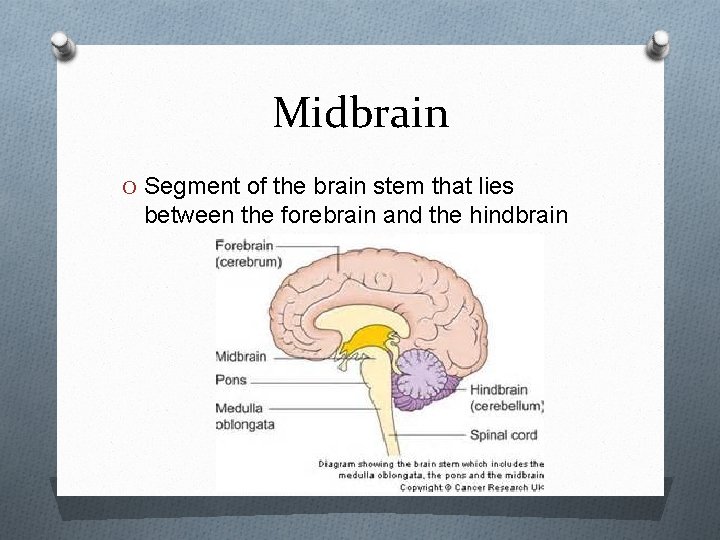
Midbrain O Segment of the brain stem that lies between the forebrain and the hindbrain
O Largely concerned with integrating sensory processes, such as vision and hearing O System of dopamine releasing neurons that projects into various higher brain centers O Dopamine is involved in the performance of voluntary movements O Reticular Formation contributes to the modulation of muscle reflexes, breathing, and pain perception, as well as sleep and arousal
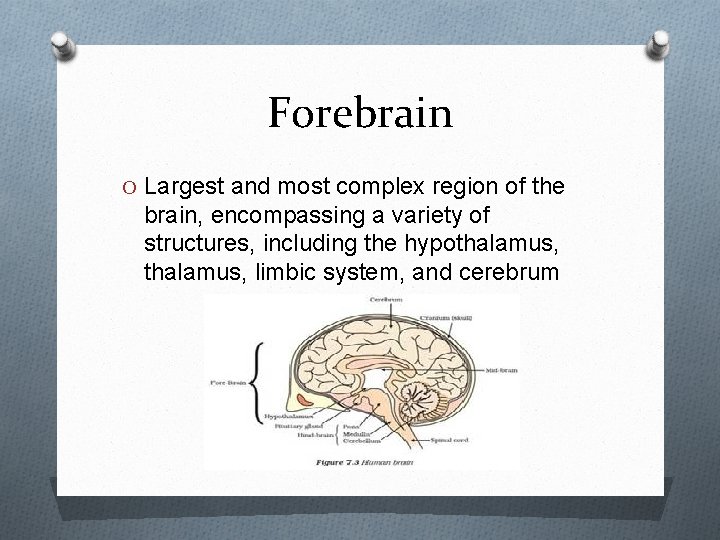
Forebrain O Largest and most complex region of the brain, encompassing a variety of structures, including the hypothalamus, limbic system, and cerebrum
Hypothalamus O Structure found near the base of the forebrain that is involved in the regulation of basic biological needs O (below the thalamus) O Controls autonomic nervous system O Link between the brain and the endocrine system O 4 F’s (fighting, fleeing, feeding, and mating O Hunger, thirst, sexual motivation, temperature regulation
Limbic System- the Seat of Emotion O Loosely connected network of structures located roughly along the border between the cerebral cortex and deeper subcortical areas (limbic means edge) O Not well defined with clear boundaries O Includes parts of the thalamus, hippocampus, amygdala, and other structures
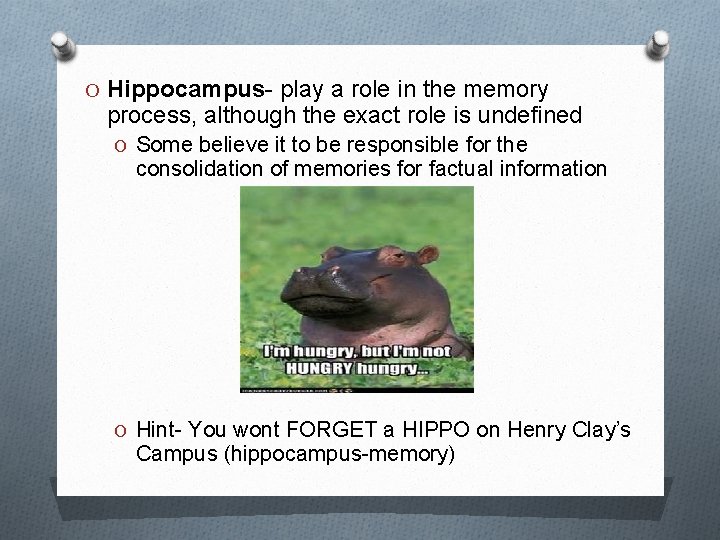
O Hippocampus- play a role in the memory process, although the exact role is undefined O Some believe it to be responsible for the consolidation of memories for factual information O Hint- You wont FORGET a HIPPO on Henry Clay’s Campus (hippocampus-memory)
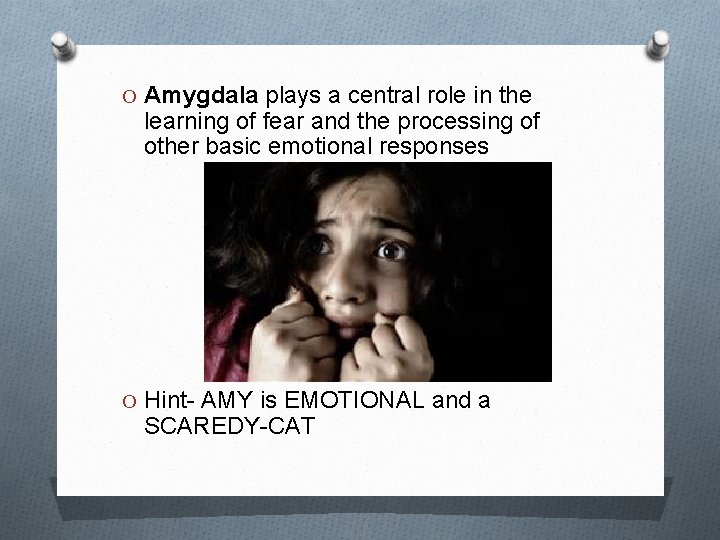
O Amygdala plays a central role in the learning of fear and the processing of other basic emotional responses O Hint- AMY is EMOTIONAL and a SCAREDY-CAT

O Medial Forebrain Bundle- bunch of axons that pass through the hypothalamus O rich in dopamine-releasing neurons O pleasure centers O Certain drugs, such as opiates, may rely on the stimulation of this area
Cerebrum Seat of Complex Thought O Largest and most complex part of the brain O Learning, remembering, thinking, and consciousness itself O Cerebral Cortex is the convoluted outer layer of the cerebrum, folded and bent, SA of about 1. 5 square feet

Division O The cerebrum is split into two halves, called the Cerebral Hemispheres (right and left) O The halves are separated in the middle by a longitudinal fissure that runs from the front to the back of the brain O Corpus Callosum is the structure that connects the two cerebral hemispheres (thick band of fibers)
The Lobes O Each of the two halves is further divided into four lobes (each of these is largely dedicated to specific tasks)
Occipital Lobe O Located at the back of the head, it includes the cortical area where most visual signals are sent and visual processing is begun O Now referred to as the primary visual cortex
Parietal Lobe O Forward of the occipital lobe and includes the area that registers the sense of touch, called the primary somatosensory cortex O Receives signals from the body about physical sensations O ESB
Temporal Lobe O Below the parietal lobe O Area devoted to auditory processing, called the primary auditory cortex O Damage here can impair the comprehension of speech and grammar
Frontal Lobe O Largest lobe in the human brain O Contains the principal areas that control the movement of muscles, called the primary motor cortex O The amount of motor cortex allotted to the control of a body part relies not on size but on diversity and precision of movement
Prefrontal Cortex O Portion of the frontal lobe to the front of the prefrontal cortex is a mystery O Contributes to higher-order functioning, such as memory for temporal sequences, working memory, reasoning relations between objects and events, some type of decision making O Possible executive control? O Injuries here may lead to deficits in planning, paying attention, and getting organized
Plasticity of the Brain O Surprise! The brain is more maleable than people used to think O Studies have shown that aspects of experience can sculpt features of brain structure O Somatosensory cortex that receives input from the sensory area is larger in string musicians
O Damage to incoming sensory pathways or the destruction of brain tissue can lead to neural reorganization O Amputation of fingers eventually led to the cortex changing its responsiveness O Neurons tend to compensate for the loss of nearby neurons in the case of brain damage
O Adult brains can generate new neurons O Originally thought that we couldn’t O The brain isn’t hard-wired like we originally thought O Neural wiring of the brain is flexible and constantly evolving
Phineas Gage O http: //vimeo. com/42123884
Cerebral Laterality A fancy way of saying Left Brain/Right Brain O Broca’s Area is in the left side of the frontal lobe, plays an important role speech production (1861) O Wernicke’s Area is in the temporal lobe in the left hemisphere plays an important role in language comprehension (1874) O Left Hemisphere became understood to process language/be smarter, Right Hemisphere is dumb, less important* * This is about to change……
Split Brain
Mike Gazzaniga, Roger Sperry, and their colleagues studies split brain patients-cerebral hemispheres had been surgically disconnected
Split-Brain Research O Split-Brain Surgery- the bundle of fibers that connects the cerebral hemispheres (corpus callosum) is cut to reduce the severity of epileptic seizures O Sensory and Motor Information are routed through to and from the two hemispheres O EACH HEMISPHERE’S PRIMARY CONNECTIONS ARE TO THE OPPOSITE SIDE OF THE BODY
O Vision and Hearing are more complex O Both eyes deliver information to both hemispheres, but there is still a separation of input O Stimuli in the right half of the visual field are registered by receptors on the left side of each eye, which send signals to the left hemisphere
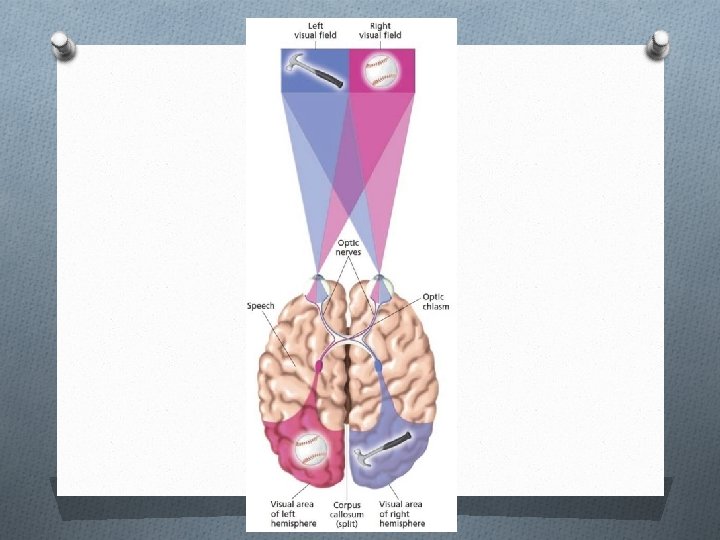

HE ART
O HE appears in the left visual field-> right hemisphere O ART is in the right visual field -> left hemisphere (usually involved in speech)
What happened? O People said they saw ART (left hemisphere) O People could point to HE (right hemisphere) O Each hemisphere is aware! But limited with expression
Split Brain Studies! O https: //www. youtube. com/watch? v=0 lmfx. Q -HK 7 Y
O Auditory Connections also go to both hemispheres, but the connections to the opposite hemispheres are more immediate and stronger
Hemispheric Specialization in the Intact Brain O Perceptual Asymmetries- left-right imbalances between the cerebral hemispheres in the speed of visual or auditory processing O Left hemisphere is quicker with verbal, right hemisphere is quicker with visual-spatial tasks O Left Hemisphere is usually better on tasks involving verbal processing, such as language, speech, reading, and writing O Right Hemisphere exhibits superiority on many tasks involving nonverbal processing, such as most spatial, musical and visual tasks, making inferences, modulate speech, orchestrates a sense of self
- Slides: 53