
The Nervous System AP Biology Unit 6 Branches

The Nervous System AP Biology Unit 6

Branches of the Nervous System • There are 2 main branches of the nervous system • Central Nervous System – Brain – Spinal Cord • Peripheral Nervous System – All nerves leading to rest of body

Anatomy of a Neuron • Dendrites = where a signal is received by the neuron • Cell body = contains the organelles, nucleus of the cell • Axon = signal travels down this to get to the other end of the neuron

Anatomy of a Neuron • Myelin = surrounds the axon to speed up the signal • Synaptic Terminal = end of the neuron • Synapse = gap/space between neurons

Question… • What is the general pathway of a signal through a neuron? – Dendrites cell body Axon Synaptic Terminals (then into the synapse to get to the next neuron or other cell)

Sending Signals • The “signal” sent through a neuron is an electrical signal • Based on the movement of ions into and out of the cell – Causes changes in the + and – charges inside the cell

A Neuron at Rest • A neuron at rest (unstimulated) has a difference in charge (voltage) across the plasma membrane = -70 m. V = resting potential – This means that it is more negative inside than outside • The resting potential is caused by the distribution of ions on either side of the membrane

A Neuron at Rest • Resting potential (-70 m. V) is maintained by the Sodium-Potassium Pump – Pumps Na+ out of cell – Pumps K+ into the cell – Active transport

Ion Concentrations at Rest Ion Inside neuron Outside neuron Na+ Lower Higher Cl- Lower Higher K+ Higher Lower • At rest, there also open K+ channels in the membrane Allows some K+ to escape • Leaves negatively charged molecules behind (Clions, etc. ) more negative on the inside than on the outside.

Sending a Signal: Action Potential • Na+ channels are embedded in the membrane of the neuron • Usually, these Na+ channels are closed, but can be triggered to open when the correct stimulus is received – Voltage gated channels = open in response to a particular change in voltage (charge) – Chemical gated channels = open in response to a chemical binding to them

Action Potential • STEP 1: To start an action potential, some kind of stimulus (light, pressure, chemical, etc. ) causes Na+ channels in the dendrite to open. • This causes Na+ to flood into the neuron from outside DEPOLARIZATION

Questions… • Why does Na+ diffuse in from the outside? – Higher concentration on the outside • When depolarization occurs, how is the charge inside the neuron affected? – Becomes more positively charged inside • What would happen if Cl- channels are also opened? – Cl- would also flow in– makes the inside more negative (cancels out the charge from Na+ coming in) -- HYPERPOLARIZED

Action Potential • STEP 2: The change in voltage triggers the next Na+ channel (voltage gated channel) to open. • STEP 3: As Na+ diffuses down the neuron, it continues to trigger voltage gated Na+ channels to open. – This is what sends a signal down the neuron towards the axon terminal.

Action Potential • STEP 4: Na+ voltage gated channels only open temporarily. After a short period of time, they close and an inactivation gate opens to prevent them from opening again for a little while REFRACTORY PERIOD

Action Potential • STEP 5: The neuron is “reset” (REPOLARIZED) by the opening of voltage gated K+ channels. • K+ flows out of the neuron, making the inside more negative again. – Why does K+ flow out? – Higher K+ concentrations inside neuron • The Na+/K+ pump also helps reestablish resting potential.

Saltatory Conduction • Depolarization & Repolarization happens over and over down the axon, so the nerve impulse travels. • Myelin sheaths insulate the axon, keeping ions from flowing out except at Nodes of Ranvier.
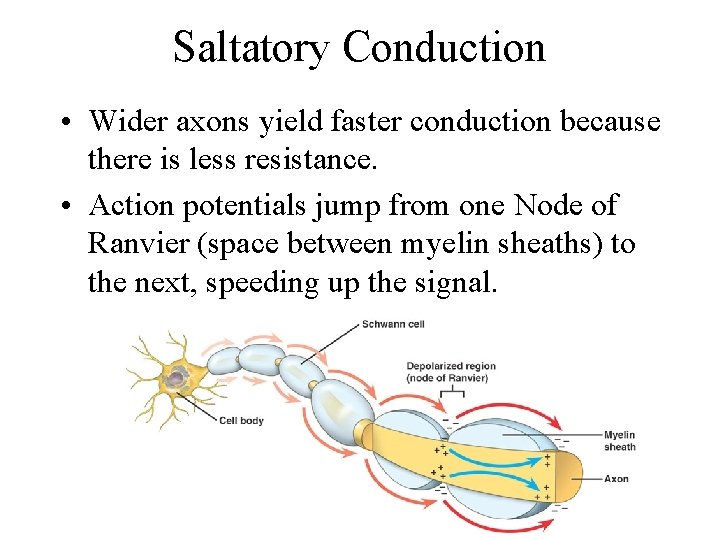
Saltatory Conduction • Wider axons yield faster conduction because there is less resistance. • Action potentials jump from one Node of Ranvier (space between myelin sheaths) to the next, speeding up the signal.

Communication between Neurons • When the signal reaches the axon terminal, it triggers voltage gated Ca 2+ channels to open. • This causes vesicles that contain neurotransmitter molecules to fuse with the plasma membrane and expel the neurotransmitters into the synaptic cleft (space between neurons)

Communication between Neurons • The neurotransmitters will diffuse across the cleft and bind to receptors on the next neuron (postsynaptic neuron). • This triggers a Na+ chemical gated channel to open on the postsynaptic neuron, triggering an action potential in that neuron.

Communication between Neurons • After the signal has been sent, neurotransmitters are eliminated from the synaptic cleft by – Diffusion = diffuse away – Reuptake – Enzyme degradation

Communication between Neurons • Reuptake – Neurotransmitters are actively transported back into the presynaptic neuron repackaged into vesicles to be released again – Recycling neurotransmitters • Enzyme degradation – Enzymes in the synaptic cleft break down the neurotransmitter

Question… • Why is it important that our bodies / medications control nerve communication? – So that signals are only sent to neurons when needed.

Control of Communication • How can nerve communication be varied? – Change conduction of impulse – Change synaptic cleft size – Change volume of neurotransmitters or vesicles – Change number of ligand-gated ion channels on post synaptic neuron – Add a chemical that binds to ligand-gated ion channels to block them or always keep them open – Add a chemical that binds to neurotransmitters, so they cannot bind to the ligand-gated ion channels
- Slides: 23