
The Needs Assessment Process Reasons or Pressure Points


- Slides: 31
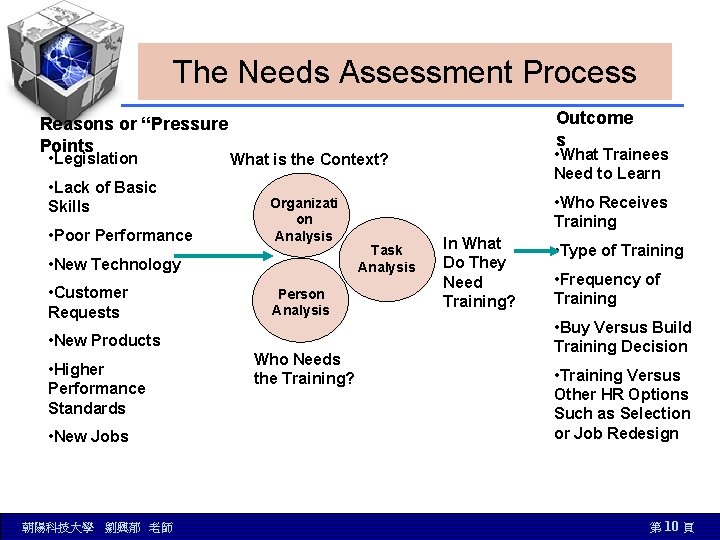
The Needs Assessment Process Reasons or “Pressure Points • Legislation • Lack of Basic Skills • Poor Performance Outcome s Organizati on Analysis • New Technology • Customer Requests Person Analysis • New Products • Higher Performance Standards • New Jobs 朝陽科技大學 劉興郁 老師 • What Trainees Need to Learn What is the Context? Who Needs the Training? • Who Receives Training Task Analysis In What Do They Need Training? • Type of Training • Frequency of Training • Buy Versus Build Training Decision • Training Versus Other HR Options Such as Selection or Job Redesign 第 10 頁
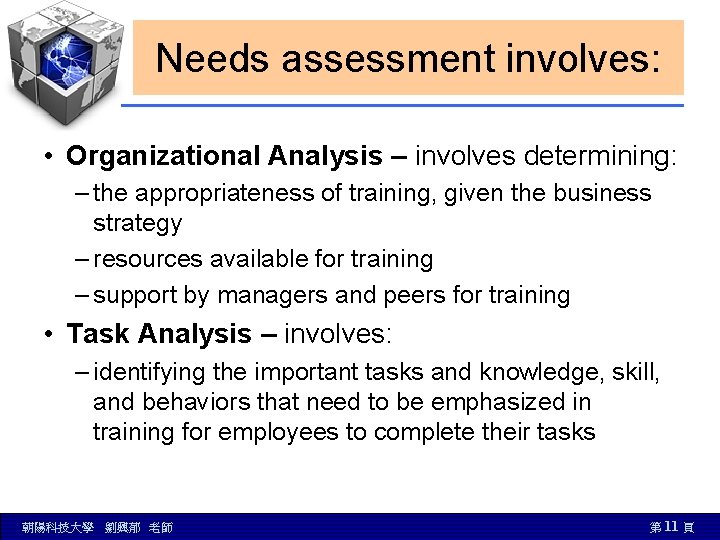
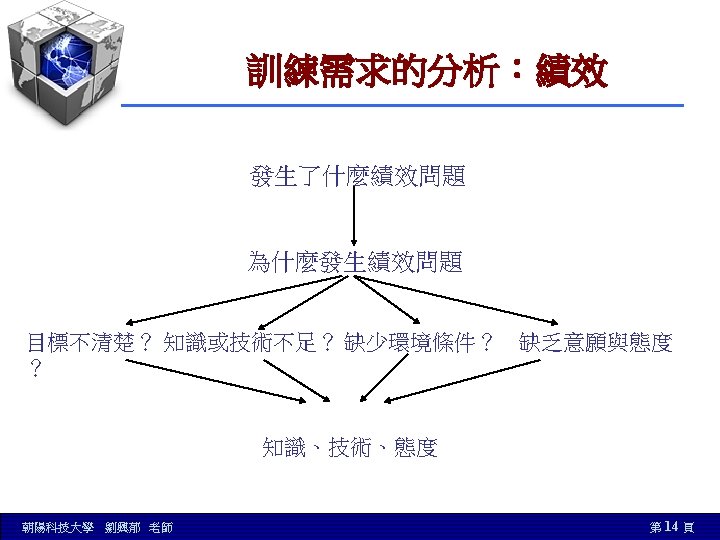
Needs assessment involves: • Organizational Analysis – involves determining: – the appropriateness of training, given the business strategy – resources available for training – support by managers and peers for training • Task Analysis – involves: – identifying the important tasks and knowledge, skill, and behaviors that need to be emphasized in training for employees to complete their tasks 朝陽科技大學 劉興郁 老師 第 11 頁
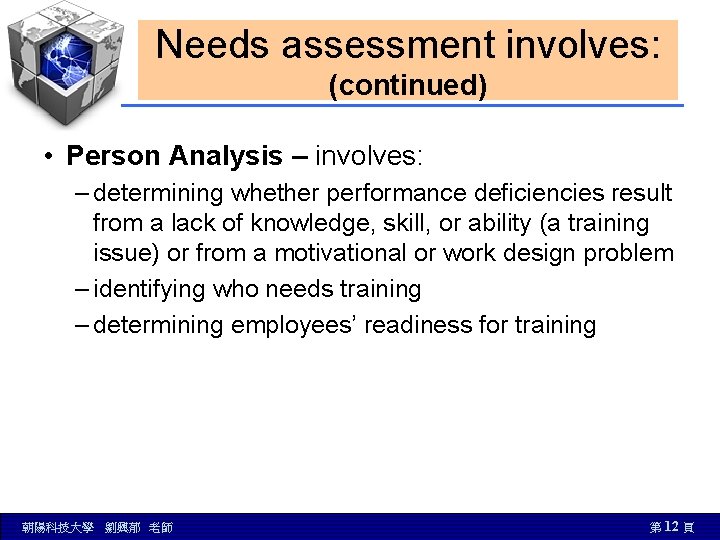
Needs assessment involves: (continued) • Person Analysis – involves: – determining whether performance deficiencies result from a lack of knowledge, skill, or ability (a training issue) or from a motivational or work design problem – identifying who needs training – determining employees’ readiness for training 朝陽科技大學 劉興郁 老師 第 12 頁
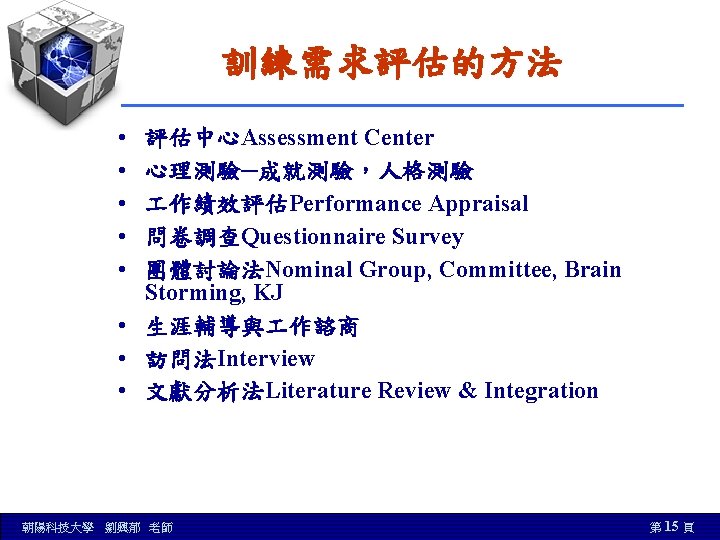
訓練需求評估的方法 • • • 評估中心Assessment Center 心理測驗─成就測驗,人格測驗 作績效評估Performance Appraisal 問卷調查Questionnaire Survey 團體討論法Nominal Group, Committee, Brain Storming, KJ • 生涯輔導與 作諮商 • 訪問法Interview • 文獻分析法Literature Review & Integration 朝陽科技大學 劉興郁 老師 第 15 頁
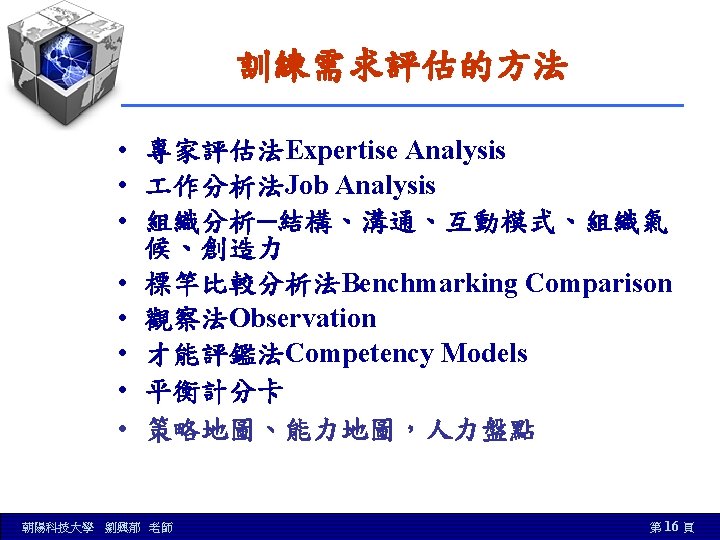
Competency Models • A competency refers to areas of personal capability that enable employees to successfully perform their jobs by achieving outcomes or successfully performing tasks. – A competency can be knowledge, skills, attitudes, values, or personal characteristics. • A competency model identifies the competencies necessary for each job as well as the knowledge, skills, behavior, and personality characteristics underlying each competency. 朝陽科技大學 劉興郁 老師 第 20 頁
Competency models • They identify behaviors needed for effective job performance. • They provide a tool for determining what skills are needed to meet today’s needs as well as the company’s future needs. • They help determine what skills are needed at different career points. • They provide a framework for ongoing coaching and feedback to develop employees for current and future roles. • They create a “roadmap” for identifying and developing employees who may be candidates for managerial positions. 朝陽科技大學 劉興郁 老師 第 21 頁
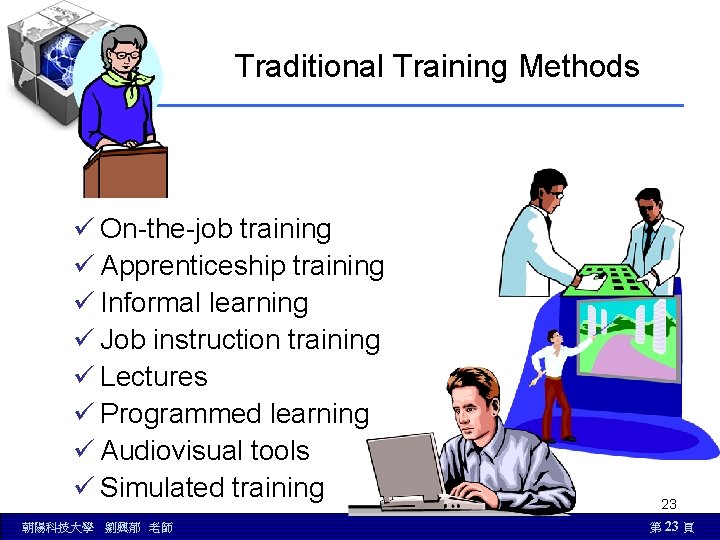
Traditional Training Methods ü On-the-job training ü Apprenticeship training ü Informal learning ü Job instruction training ü Lectures ü Programmed learning ü Audiovisual tools ü Simulated training 朝陽科技大學 劉興郁 老師 23 第 23 頁
Traditional Training Techniques ü Apprenticeship Training ü Informal learning or daily interaction ü Audiovisual tools ü Simulated training 朝陽科技大學 劉興郁 老師 第 24 頁
Lectures • • • Give listeners signals Keep conclusions short Maintain eye contact Control your hands Break long talk into shorter series • Practice makes perfect 朝陽科技大學 劉興郁 老師 • • Don’t begin on wrong foot Be alert to your audience Make sure all can hear Speak from notes not script 第 25 頁
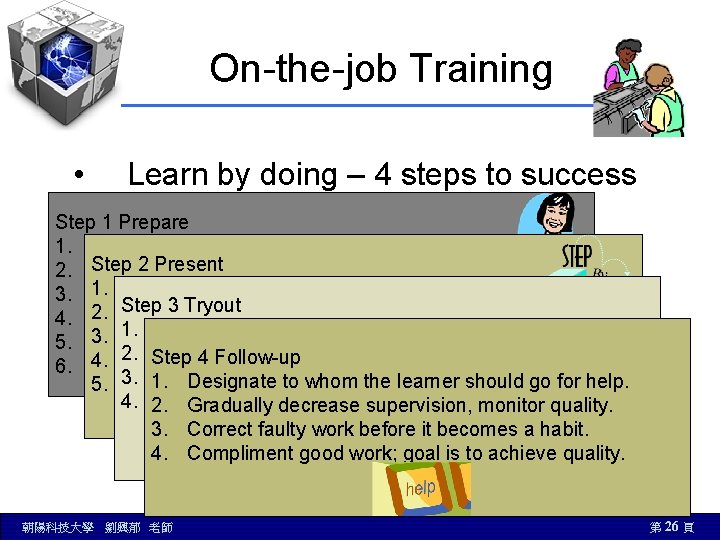
On-the-job Training • Learn by doing – 4 steps to success Step 1 Prepare 1. Put the learner at ease—relieve the tension. 2 Present 2. Step Explain why he or she is being taught. Explain quantity andwhat quality 3. 1. Create interest, find out therequirements. learner knows. Step 3 Tryout Go through thejob joband at the normal pace. 4. 2. Explain the whole relate it to awork known job. 1. Have the learner go through the job several times. Goclose through thenormal job several times, giving each step. 5. 3. Place to the working positions. 2. Run slowly jobagain. at the normal pace. Step 4 the Follow-up Repeat 6. 4. Familiarize with equipment, materials, & tools. Learner does explain the job, the building up and speed. 1. Designate to whom thesteps learner should go for help. 5. 3. Have the learner asskill you go through. 4. 2. Let Gradually the work begin – stick around formonitor a while. quality. decrease supervision, 3. Correct faulty work before it becomes a habit. 4. Compliment good work; goal is to achieve quality. 朝陽科技大學 劉興郁 老師 第 26 頁