
The Need for System Scale Studies in Polar
- Slides: 1
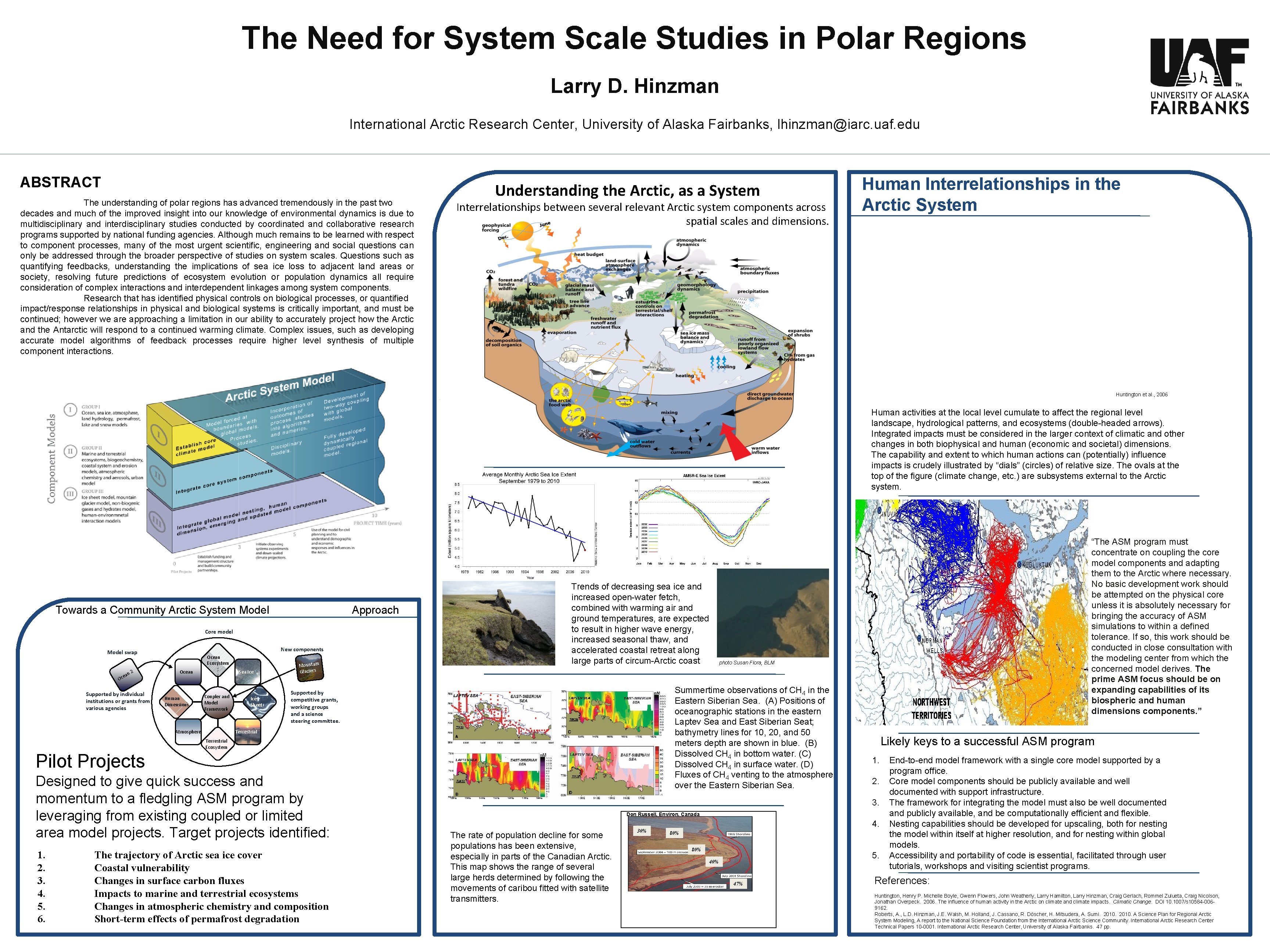
The Need for System Scale Studies in Polar Regions Larry D. Hinzman International Arctic Research Center, University of Alaska Fairbanks, lhinzman@iarc. uaf. edu ABSTRACT The understanding of polar regions has advanced tremendously in the past two decades and much of the improved insight into our knowledge of environmental dynamics is due to multidisciplinary and interdisciplinary studies conducted by coordinated and collaborative research programs supported by national funding agencies. Although much remains to be learned with respect to component processes, many of the most urgent scientific, engineering and social questions can only be addressed through the broader perspective of studies on system scales. Questions such as quantifying feedbacks, understanding the implications of sea ice loss to adjacent land areas or society, resolving future predictions of ecosystem evolution or population dynamics all require consideration of complex interactions and interdependent linkages among system components. Research that has identified physical controls on biological processes, or quantified impact/response relationships in physical and biological systems is critically important, and must be continued; however we are approaching a limitation in our ability to accurately project how the Arctic and the Antarctic will respond to a continued warming climate. Complex issues, such as developing accurate model algorithms of feedback processes require higher level synthesis of multiple component interactions. Understanding the Arctic, as a System Interrelationships between several relevant Arctic system components across spatial scales and dimensions. Human Interrelationships in the Arctic System Huntington et al. , 2006 Human activities at the local level cumulate to affect the regional level landscape, hydrological patterns, and ecosystems (double-headed arrows). Integrated impacts must be considered in the larger context of climatic and other changes in both biophysical and human (economic and societal) dimensions. The capability and extent to which human actions can (potentially) influence impacts is crudely illustrated by “dials” (circles) of relative size. The ovals at the top of the figure (climate change, etc. ) are subsystems external to the Arctic system. Towards a Community Arctic System Model Approach Core model New components Model swap n 2 cea O Supported by individual institutions or grants from various agencies Ocean Ecosystem Ocean Human Dimensions Sea Ice Coupler and Model Framework Atmosphere Ice Sheet Mountain Glaciers Trends of decreasing sea ice and increased open-water fetch, combined with warming air and ground temperatures, are expected to result in higher wave energy, increased seasonal thaw, and accelerated coastal retreat along large parts of circum-Arctic coast Terrestrial Ecosystem Pilot Projects Designed to give quick success and momentum to a fledgling ASM program by leveraging from existing coupled or limited area model projects. Target projects identified: 1. 2. 3. 4. 5. 6. The trajectory of Arctic sea ice cover Coastal vulnerability Changes in surface carbon fluxes Impacts to marine and terrestrial ecosystems Changes in atmospheric chemistry and composition Short-term effects of permafrost degradation photo Susan Flora, BLM Summertime observations of CH 4 in the Eastern Siberian Sea. (A) Positions of oceanographic stations in the eastern Laptev Sea and East Siberian Seat; bathymetry lines for 10, 20, and 50 meters depth are shown in blue. (B) Dissolved CH 4 in bottom water. (C) Dissolved CH 4 in surface water. (D) Fluxes of CH 4 venting to the atmosphere over the Eastern Siberian Sea. Supported by competitive grants, working groups and a science steering committee. “The ASM program must concentrate on coupling the core model components and adapting them to the Arctic where necessary. No basic development work should be attempted on the physical core unless it is absolutely necessary for bringing the accuracy of ASM simulations to within a defined tolerance. If so, this work should be conducted in close consultation with the modeling center from which the concerned model derives. The prime ASM focus should be on expanding capabilities of its biospheric and human dimensions components. ” Likely keys to a successful ASM program 1. 2. 3. Don Russell, Environ. Canada The rate of population decline for some populations has been extensive, especially in parts of the Canadian Arctic. This map shows the range of several large herds determined by following the movements of caribou fitted with satellite transmitters. 30% 4. 80% 5. 40% 47% End-to-end model framework with a single core model supported by a program office. Core model components should be publicly available and well documented with support infrastructure. The framework for integrating the model must also be well documented and publicly available, and be computationally efficient and flexible. Nesting capabilities should be developed for upscaling, both for nesting the model within itself at higher resolution, and for nesting within global models. Accessibility and portability of code is essential, facilitated through user tutorials, workshops and visiting scientist programs. References: Huntington, Henry P. Michelle Boyle, Gwenn Flowers, John Weatherly, Larry Hamilton, Larry Hinzman, Craig Gerlach, Rommel Zulueta, Craig Nicolson, Jonathan Overpeck. 2006. The influence of human activity in the Arctic on climate and climate impacts. Climatic Change. DOI 10. 1007/s 10584 -0069162. Roberts, A. , L. D. Hinzman, J. E. Walsh, M. Holland, J. Cassano, R. Döscher, H. Mitsudera, A. Sumi. 2010. A Science Plan for Regional Arctic System Modeling, A report to the National Science Foundation from the International Arctic Science Community. International Arctic Research Center Technical Papers 10 -0001. International Arctic Research Center, University of Alaska Fairbanks. 47 pp.