
the neck Overview Lateral Cervical Region Naomi Alexandra
- Slides: 56
the neck Overview, Lateral Cervical Region Naomi Alexandra Schmalz, MS November 13, 2017
Tips! • Listen for LANDMARKS. • Clavicle, hyoid bone, thyroid cartilage… • Listen for RELATIONSHIPS. • Orientation terms: anterior, posterior, superficial, deep. . . • Even if you cannot find the structure in the lab today, you may still be responsible for identifying it based on relationships presented in lecture… Neck I-HS_IN 2017 -Schmalz 1
Learning Objectives: Neck – Hour 1 1. (Pre-lecture objective) Describe the cranial nerves (and contrast with spinal nerves), their functional fiber types, their peripheral actions, and pathway of parasympathetic and sympathetic supply to target tissues. 2. Describe the cervical fasciae and compartmental organization of the neck. 3. Describe the superficial veins, cutaneous nerves, and lymphatic drainage of the neck. 4. Describe the boundaries and contents of the lateral cervical region (posterior triangle), including the cutaneous branches of the cervical plexus and the spinal accessory nerve (CN XI). Neck I-HS_IN 2017 -Schmalz 2
Session Summary: Neck – Hour 1 • Osteology • Cervical fasciae • Spread of Infection • Contents of the Neck • Blood Vessels and Lymphatics • Physical examination of cervical lymph nodes • Sentinel nodes of Virchow • Muscles • Nerves • Referred diaphragmatic pain • Viscera • Lateral cervical region (Posterior triangle of the Neck) • Interscalene nerve block Neck I-HS_IN 2017 -Schmalz 3
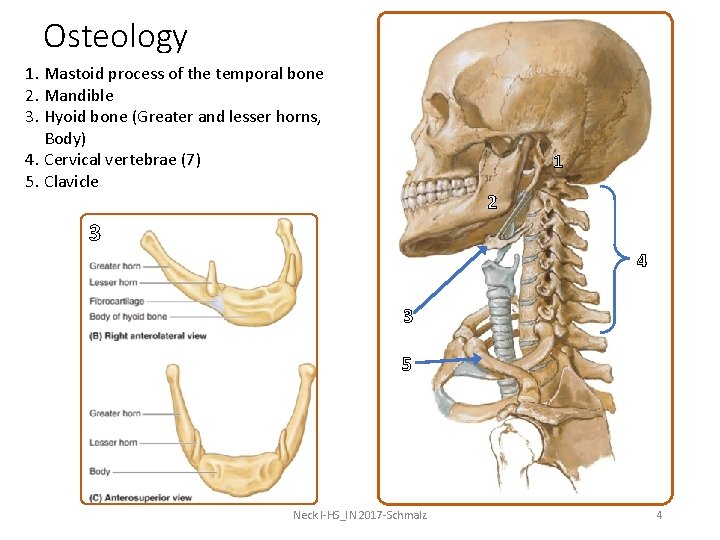
Osteology 1. Mastoid process of the temporal bone 2. Mandible 3. Hyoid bone (Greater and lesser horns, Body) 4. Cervical vertebrae (7) 5. Clavicle 1 2 3 4 3 5 Neck I-HS_IN 2017 -Schmalz 4
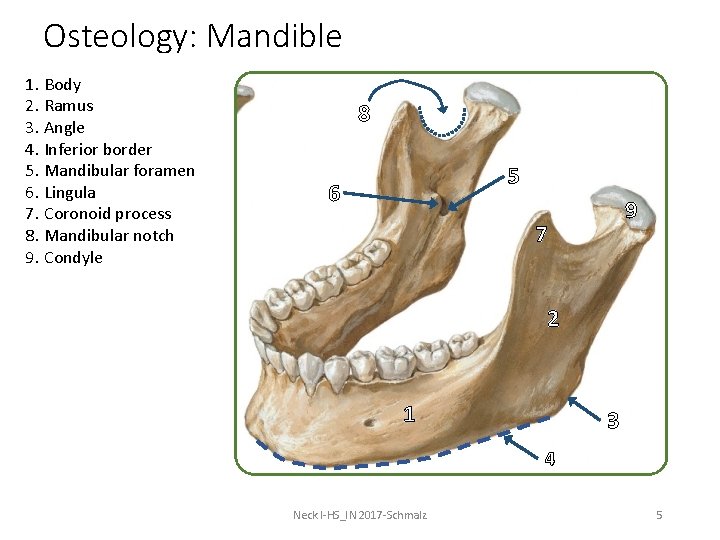
Osteology: Mandible 1. Body 2. Ramus 3. Angle 4. Inferior border 5. Mandibular foramen 6. Lingula 7. Coronoid process 8. Mandibular notch 9. Condyle 8 5 6 9 7 2 1 3 4 Neck I-HS_IN 2017 -Schmalz 5
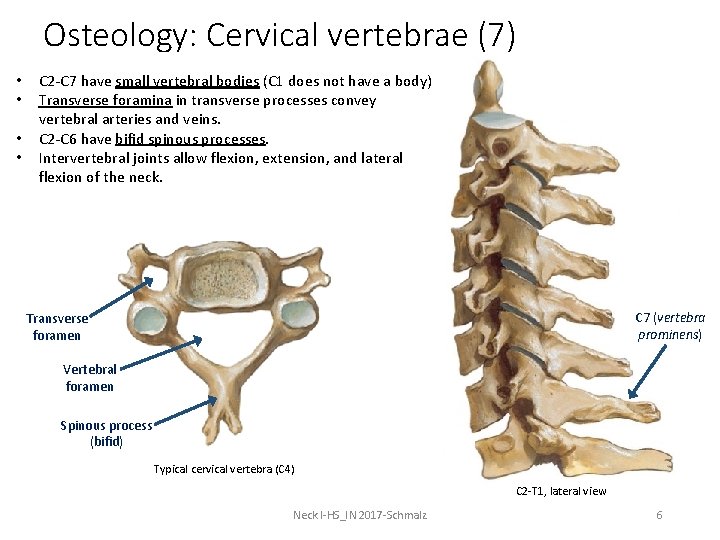
Osteology: Cervical vertebrae (7) • • C 2 -C 7 have small vertebral bodies (C 1 does not have a body) Transverse foramina in transverse processes convey vertebral arteries and veins. C 2 -C 6 have bifid spinous processes. Intervertebral joints allow flexion, extension, and lateral flexion of the neck. C 7 (vertebra prominens) Transverse foramen Vertebral foramen Spinous process (bifid) Typical cervical vertebra (C 4) C 2 -T 1, lateral view Neck I-HS_IN 2017 -Schmalz 6
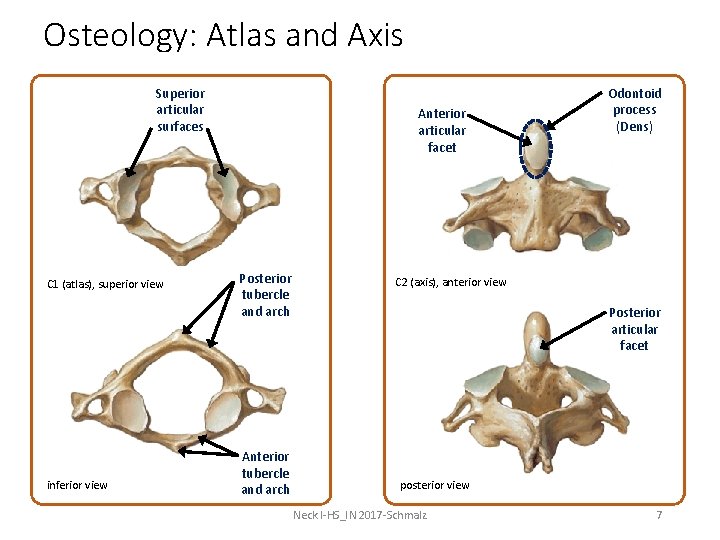
Osteology: Atlas and Axis Superior articular surfaces C 1 (atlas), superior view inferior view Anterior articular facet Posterior tubercle and arch Anterior tubercle and arch Odontoid process (Dens) C 2 (axis), anterior view Posterior articular facet posterior view Neck I-HS_IN 2017 -Schmalz 7
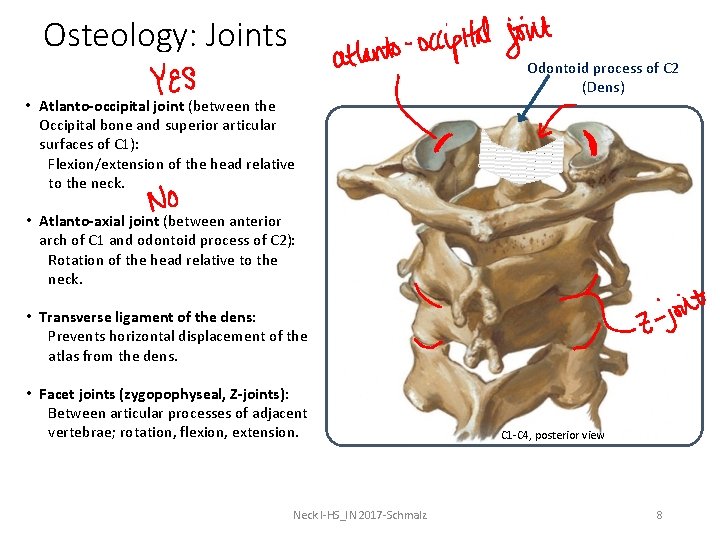
Osteology: Joints • Atlanto-occipital joint (between the Occipital bone and superior articular surfaces of C 1): Flexion/extension of the head relative to the neck. Odontoid process of C 2 (Dens) • Atlanto-axial joint (between anterior arch of C 1 and odontoid process of C 2): Rotation of the head relative to the neck. • Transverse ligament of the dens: Prevents horizontal displacement of the atlas from the dens. • Facet joints (zygopophyseal, Z-joints): Between articular processes of adjacent vertebrae; rotation, flexion, extension. Neck I-HS_IN 2017 -Schmalz C 1 -C 4, posterior view 8
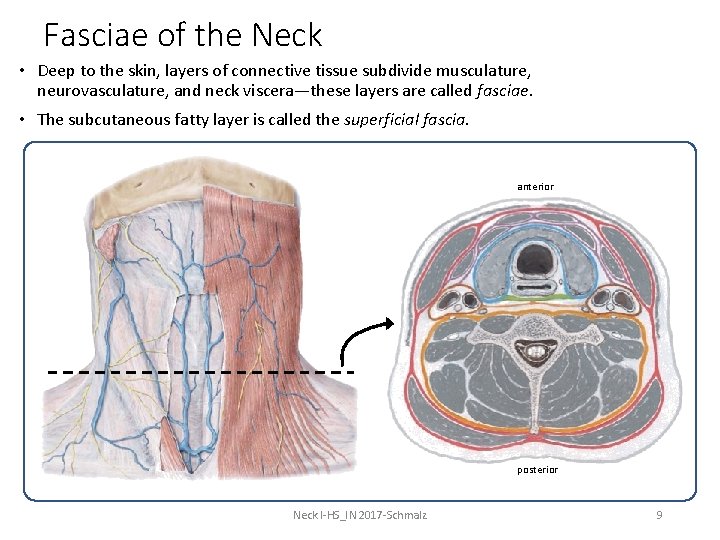
Fasciae of the Neck • Deep to the skin, layers of connective tissue subdivide musculature, neurovasculature, and neck viscera—these layers are called fasciae. • The subcutaneous fatty layer is called the superficial fascia. anterior posterior Neck I-HS_IN 2017 -Schmalz 9
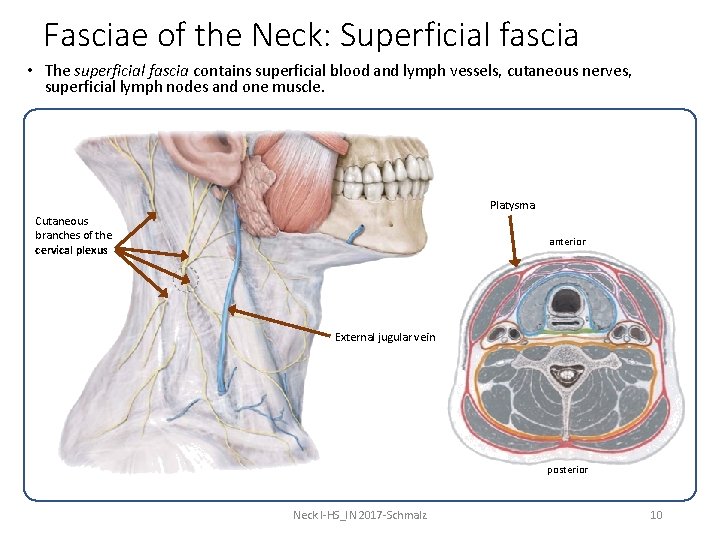
Fasciae of the Neck: Superficial fascia • The superficial fascia contains superficial blood and lymph vessels, cutaneous nerves, superficial lymph nodes and one muscle. Platysma Cutaneous branches of the cervical plexus anterior External jugular vein posterior Neck I-HS_IN 2017 -Schmalz 10
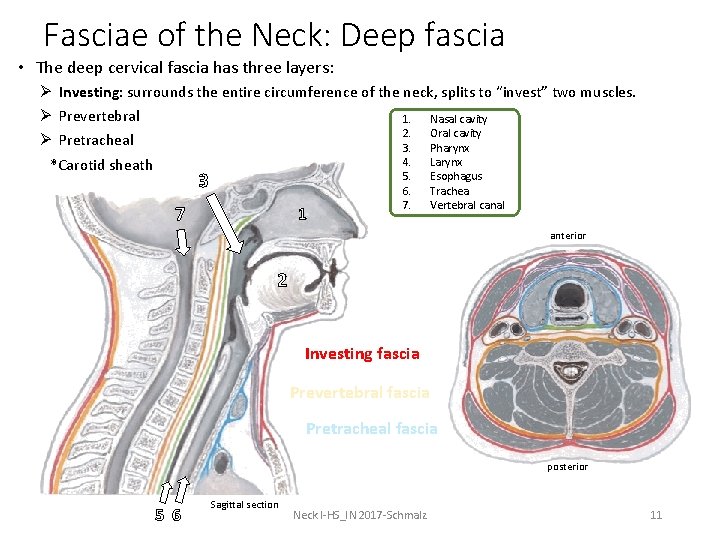
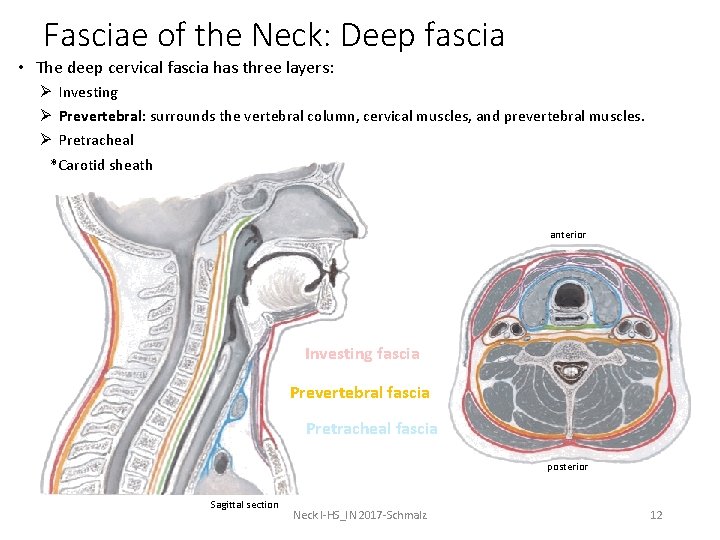
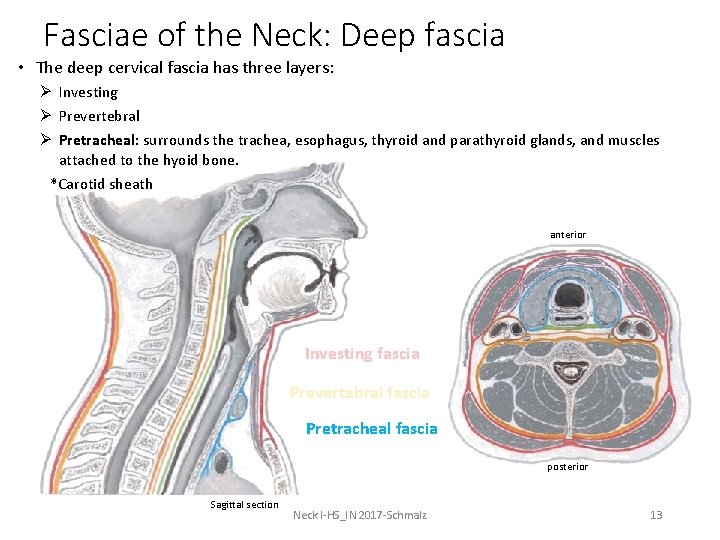
Fasciae of the Neck: Deep fascia • The deep cervical fascia has three layers: Ø Investing: surrounds the entire circumference of the neck, splits to “invest” two muscles. Ø Prevertebral 1. Nasal cavity 2. Oral cavity Ø Pretracheal 3. Pharynx 4. Larynx *Carotid sheath 3 7 1 5. 6. 7. Esophagus Trachea Vertebral canal anterior 2 Investing fascia Prevertebral fascia Pretracheal fascia posterior 5 6 Sagittal section Neck I-HS_IN 2017 -Schmalz 11
Fasciae of the Neck: Deep fascia • The deep cervical fascia has three layers: Ø Investing Ø Prevertebral: surrounds the vertebral column, cervical muscles, and prevertebral muscles. Ø Pretracheal *Carotid sheath anterior Investing fascia Prevertebral fascia Pretracheal fascia posterior Sagittal section Neck I-HS_IN 2017 -Schmalz 12
Fasciae of the Neck: Deep fascia • The deep cervical fascia has three layers: Ø Investing Ø Prevertebral Ø Pretracheal: surrounds the trachea, esophagus, thyroid and parathyroid glands, and muscles attached to the hyoid bone. *Carotid sheath anterior Investing fascia Prevertebral fascia Pretracheal fascia posterior Sagittal section Neck I-HS_IN 2017 -Schmalz 13
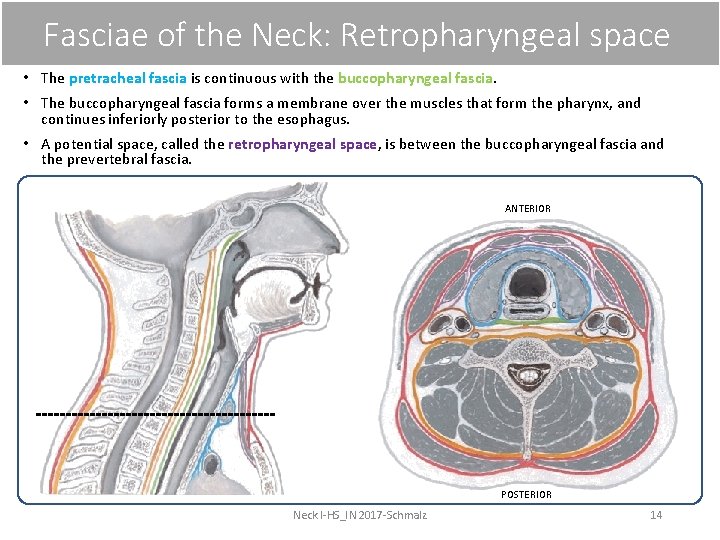
Fasciae of the Neck: Retropharyngeal space • The pretracheal fascia is continuous with the buccopharyngeal fascia. • The buccopharyngeal fascia forms a membrane over the muscles that form the pharynx, and continues inferiorly posterior to the esophagus. • A potential space, called the retropharyngeal space, is between the buccopharyngeal fascia and the prevertebral fascia. ANTERIOR POSTERIOR Neck I-HS_IN 2017 -Schmalz 14
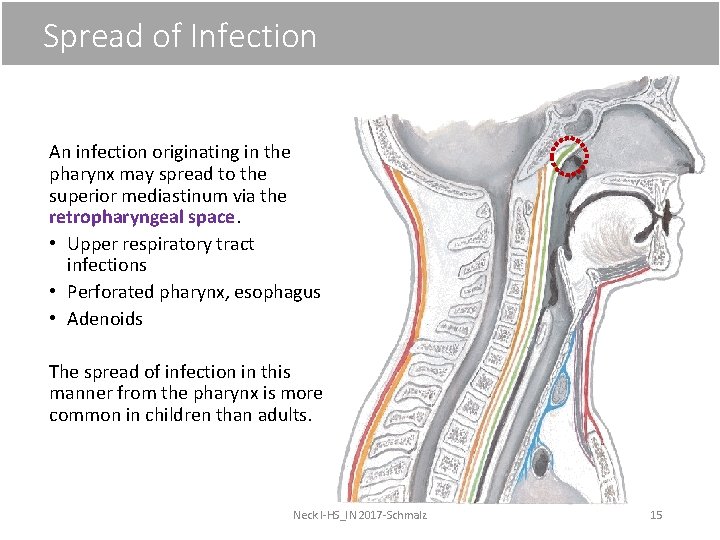
Spread of Infection An infection originating in the pharynx may spread to the superior mediastinum via the retropharyngeal space. • Upper respiratory tract infections • Perforated pharynx, esophagus • Adenoids The spread of infection in this manner from the pharynx is more common in children than adults. Neck I-HS_IN 2017 -Schmalz 15
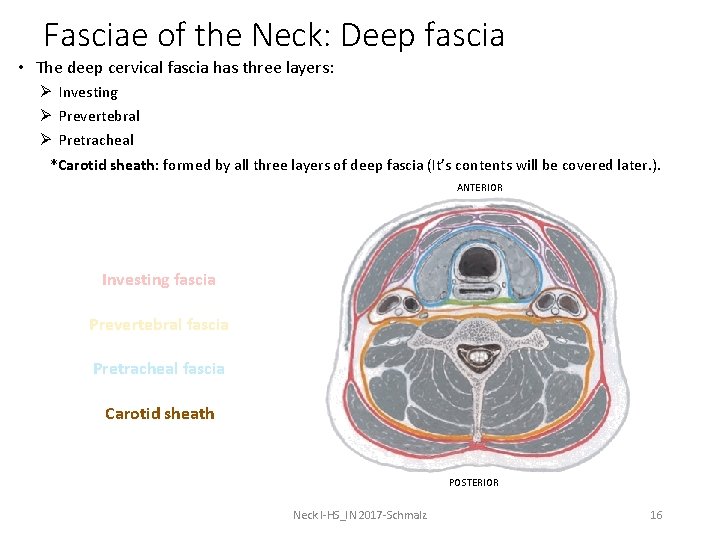
Fasciae of the Neck: Deep fascia • The deep cervical fascia has three layers: Ø Investing Ø Prevertebral Ø Pretracheal *Carotid sheath: formed by all three layers of deep fascia (It’s contents will be covered later. ). ANTERIOR Investing fascia Prevertebral fascia Pretracheal fascia Carotid sheath POSTERIOR Neck I-HS_IN 2017 -Schmalz 16
Time-out Topics Covered: Up Next: • Osteology • Fasciae of the Neck • Contents of the Neck • Posterior Triangle (Lateral cervical region) Neck I-HS_IN 2017 -Schmalz 17
The Big Picture • The neck serves as a conduit for structures travelling: • to/from the skull and thoracic/abdominal cavities • to/from the upper limb • The neck is the location of important viscera: thyroid and parathyroid glands, larynx… • The neck also contains musculature of the skull, cervical spine, mandible, and hyoid bone. • We dissect these contents by region, BUT we will introduce them by system. Neck I-HS_IN 2017 -Schmalz 18
blood vessels and lymphatics • Branches of the Common Carotid and Subclavian arteries • External and Internal jugular veins (and tributaries) • Superficial and Deep Cervical Lymph nodes Neck I-HS_IN 2017 -Schmalz 19
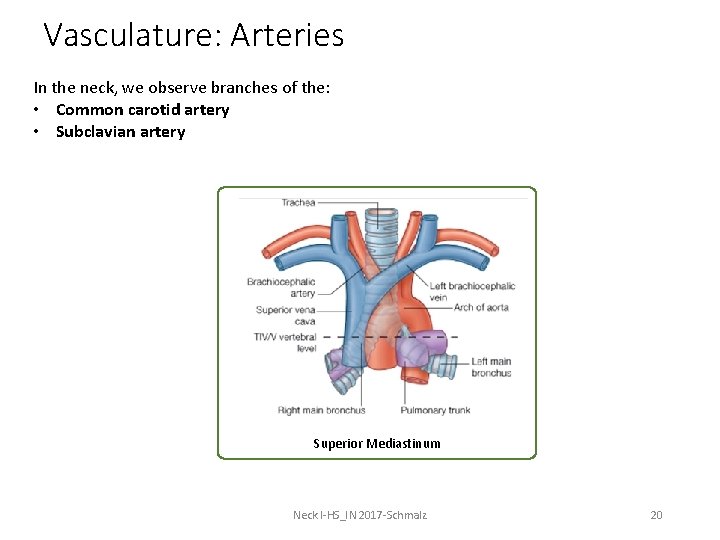
Vasculature: Arteries In the neck, we observe branches of the: • Common carotid artery • Subclavian artery Superior Mediastinum Neck I-HS_IN 2017 -Schmalz 20
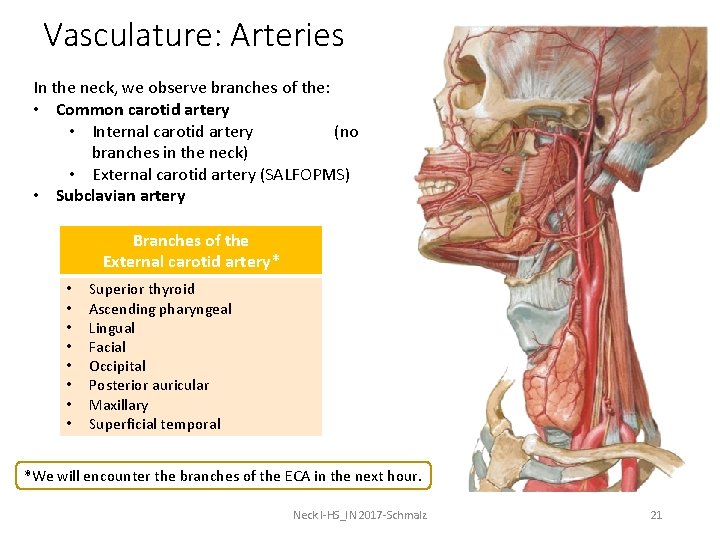
Vasculature: Arteries In the neck, we observe branches of the: • Common carotid artery • Internal carotid artery (no branches in the neck) • External carotid artery (SALFOPMS) • Subclavian artery Branches of the External carotid artery* • • Superior thyroid Ascending pharyngeal Lingual Facial Occipital Posterior auricular Maxillary Superficial temporal *We will encounter the branches of the ECA in the next hour. Neck I-HS_IN 2017 -Schmalz 21
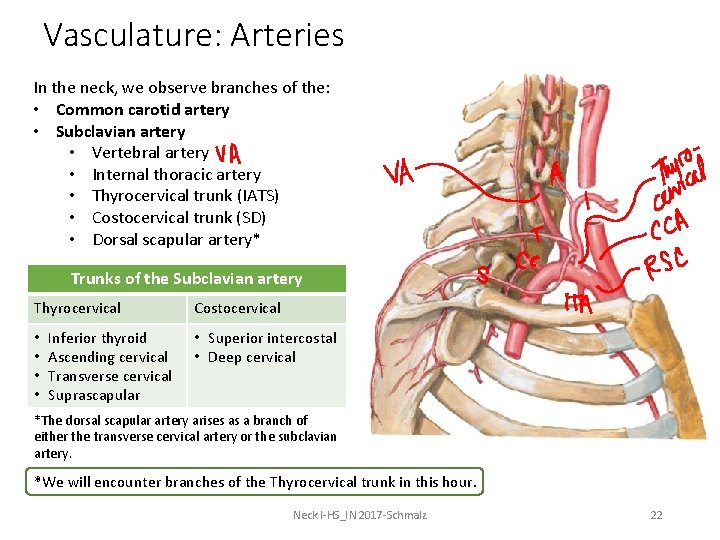
Vasculature: Arteries In the neck, we observe branches of the: • Common carotid artery • Subclavian artery • Vertebral artery • Internal thoracic artery • Thyrocervical trunk (IATS) • Costocervical trunk (SD) • Dorsal scapular artery* Trunks of the Subclavian artery Thyrocervical • • Inferior thyroid Ascending cervical Transverse cervical Suprascapular Costocervical • Superior intercostal • Deep cervical *The dorsal scapular artery arises as a branch of either the transverse cervical artery or the subclavian artery. *We will encounter branches of the Thyrocervical trunk in this hour. Neck I-HS_IN 2017 -Schmalz 22
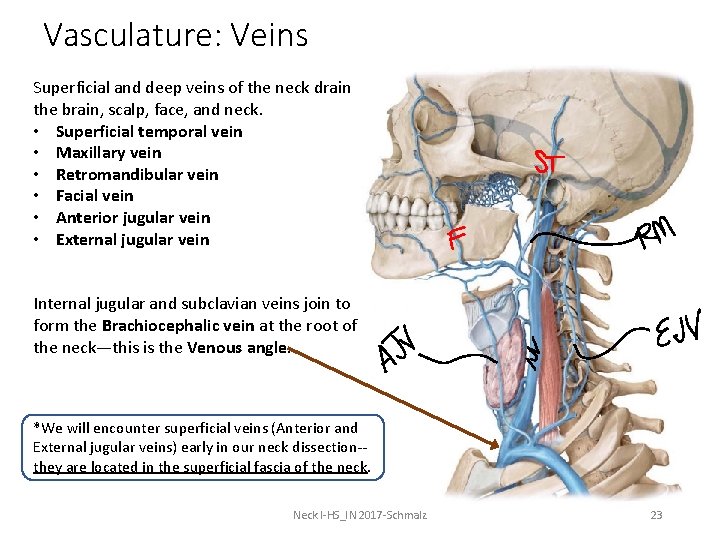
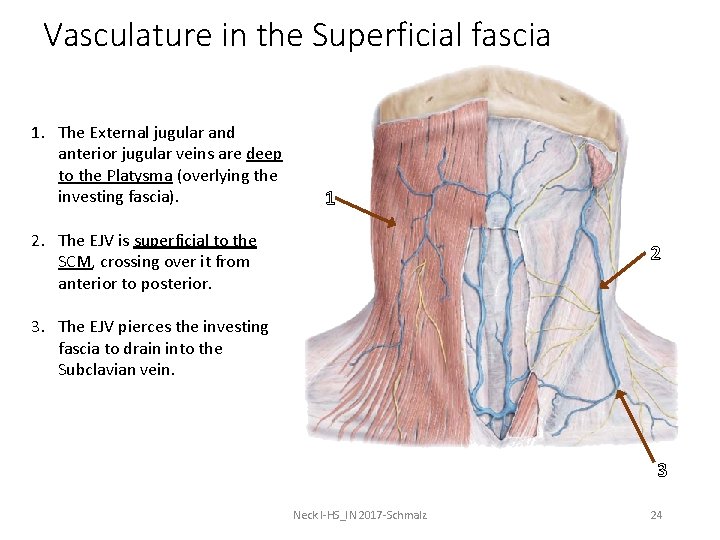
Vasculature: Veins Superficial and deep veins of the neck drain the brain, scalp, face, and neck. • Superficial temporal vein • Maxillary vein • Retromandibular vein • Facial vein • Anterior jugular vein • External jugular vein Internal jugular and subclavian veins join to form the Brachiocephalic vein at the root of the neck—this is the Venous angle. *We will encounter superficial veins (Anterior and External jugular veins) early in our neck dissection-they are located in the superficial fascia of the neck. Neck I-HS_IN 2017 -Schmalz 23
Vasculature in the Superficial fascia 1. The External jugular and anterior jugular veins are deep to the Platysma (overlying the investing fascia). 1 2. The EJV is superficial to the SCM, crossing over it from anterior to posterior. 2 3. The EJV pierces the investing fascia to drain into the Subclavian vein. 3 Neck I-HS_IN 2017 -Schmalz 24
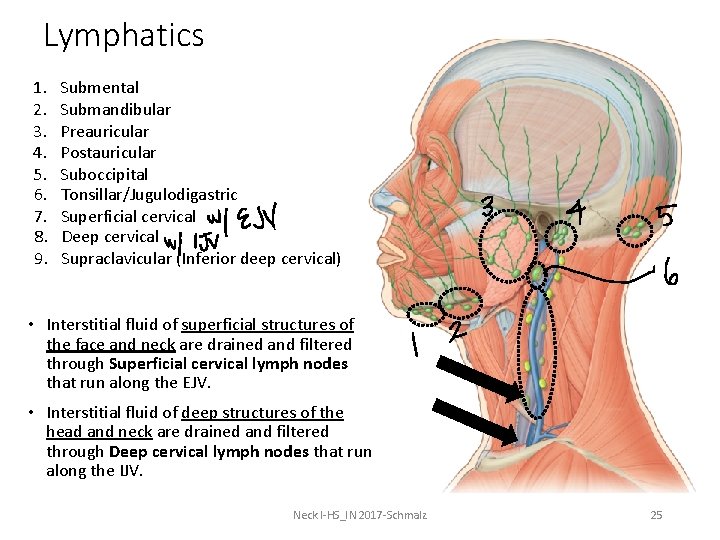
Lymphatics 1. 2. 3. 4. 5. 6. 7. 8. 9. Submental Submandibular Preauricular Postauricular Suboccipital Tonsillar/Jugulodigastric Superficial cervical Deep cervical Supraclavicular (Inferior deep cervical) • Interstitial fluid of superficial structures of the face and neck are drained and filtered through Superficial cervical lymph nodes that run along the EJV. • Interstitial fluid of deep structures of the head and neck are drained and filtered through Deep cervical lymph nodes that run along the IJV. Neck I-HS_IN 2017 -Schmalz 25
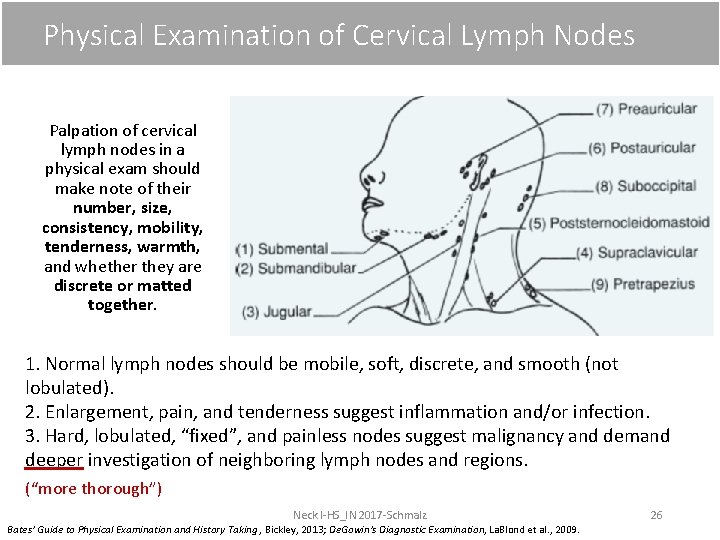
Physical Examination of Cervical Lymph Nodes Palpation of cervical lymph nodes in a physical exam should make note of their number, size, consistency, mobility, tenderness, warmth, and whether they are discrete or matted together. 1. Normal lymph nodes should be mobile, soft, discrete, and smooth (not lobulated). 2. Enlargement, pain, and tenderness suggest inflammation and/or infection. 3. Hard, lobulated, “fixed”, and painless nodes suggest malignancy and demand deeper investigation of neighboring lymph nodes and regions. (“more thorough”) Neck I-HS_IN 2017 -Schmalz Bates’ Guide to Physical Examination and History Taking , Bickley, 2013; De. Gowin’s Diagnostic Examination, La. Blond et al. , 2009. 26
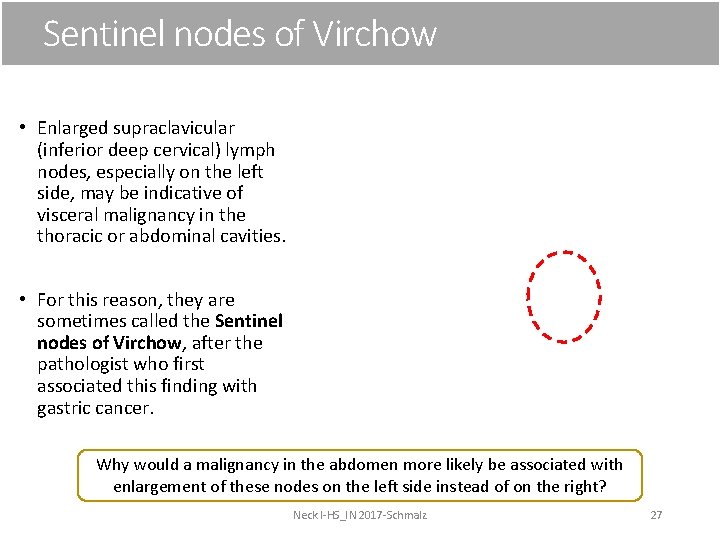
Sentinel nodes of Virchow • Enlarged supraclavicular (inferior deep cervical) lymph nodes, especially on the left side, may be indicative of visceral malignancy in the thoracic or abdominal cavities. • For this reason, they are sometimes called the Sentinel nodes of Virchow, after the pathologist who first associated this finding with gastric cancer. Why would a malignancy in the abdomen more likely be associated with enlargement of these nodes on the left side instead of on the right? Neck I-HS_IN 2017 -Schmalz 27
muscles • • • Platysma Sternocleidomastoid Trapezius Supra- and Infrahyoid muscles Prevertebral muscles Neck I-HS_IN 2017 -Schmalz 28
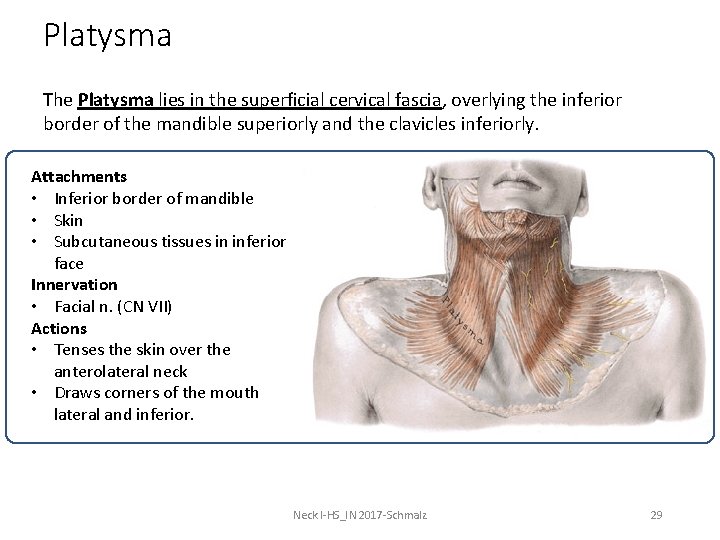
Platysma The Platysma lies in the superficial cervical fascia, overlying the inferior border of the mandible superiorly and the clavicles inferiorly. Attachments • Inferior border of mandible • Skin • Subcutaneous tissues in inferior face Innervation • Facial n. (CN VII) Actions • Tenses the skin over the anterolateral neck • Draws corners of the mouth lateral and inferior. Neck I-HS_IN 2017 -Schmalz 29
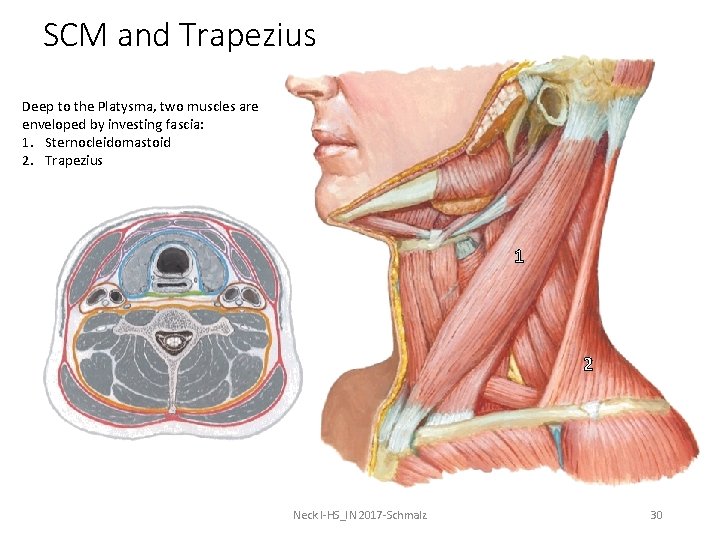
SCM and Trapezius Deep to the Platysma, two muscles are enveloped by investing fascia: 1. Sternocleidomastoid 2. Trapezius 1 2 Neck I-HS_IN 2017 -Schmalz 30
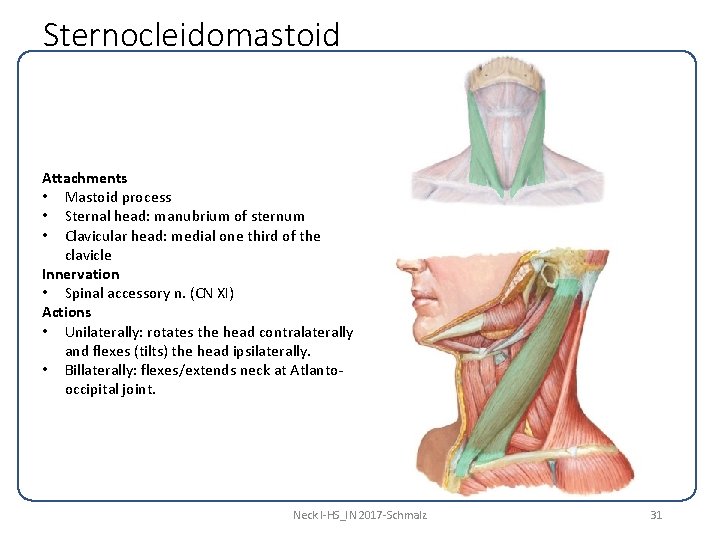
Sternocleidomastoid Attachments • Mastoid process • Sternal head: manubrium of sternum • Clavicular head: medial one third of the clavicle Innervation • Spinal accessory n. (CN XI) Actions • Unilaterally: rotates the head contralaterally and flexes (tilts) the head ipsilaterally. • Billaterally: flexes/extends neck at Atlantooccipital joint. Neck I-HS_IN 2017 -Schmalz 31
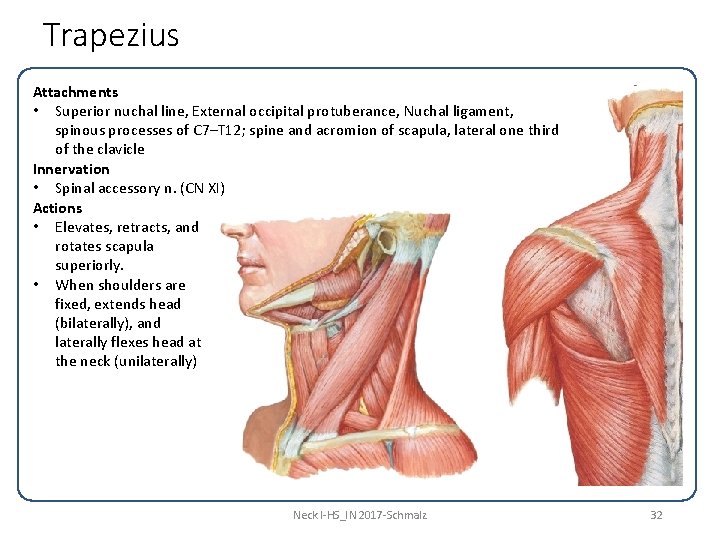
Trapezius Attachments • Superior nuchal line, External occipital protuberance, Nuchal ligament, spinous processes of C 7–T 12; spine and acromion of scapula, lateral one third of the clavicle Innervation • Spinal accessory n. (CN XI) Actions • Elevates, retracts, and rotates scapula superiorly. • When shoulders are fixed, extends head (bilaterally), and laterally flexes head at the neck (unilaterally) Neck I-HS_IN 2017 -Schmalz 32
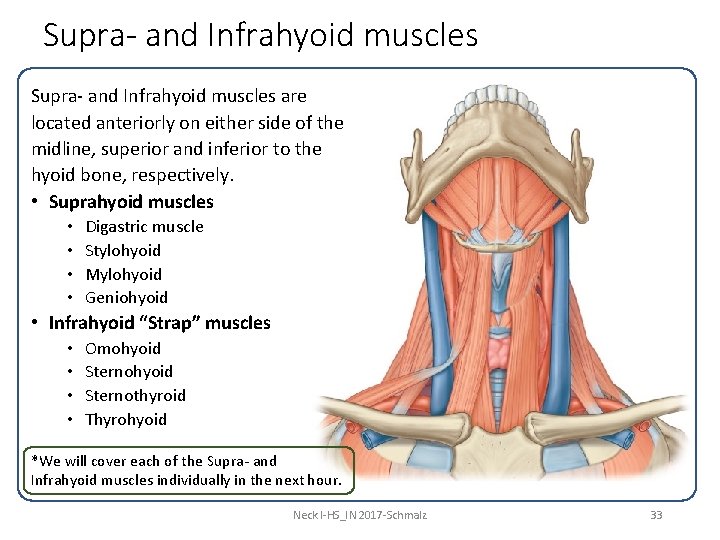
Supra- and Infrahyoid muscles are located anteriorly on either side of the midline, superior and inferior to the hyoid bone, respectively. • Suprahyoid muscles • • Digastric muscle Stylohyoid Mylohyoid Geniohyoid • Infrahyoid “Strap” muscles • • Omohyoid Sternothyroid Thyrohyoid *We will cover each of the Supra- and Infrahyoid muscles individually in the next hour. Neck I-HS_IN 2017 -Schmalz 33
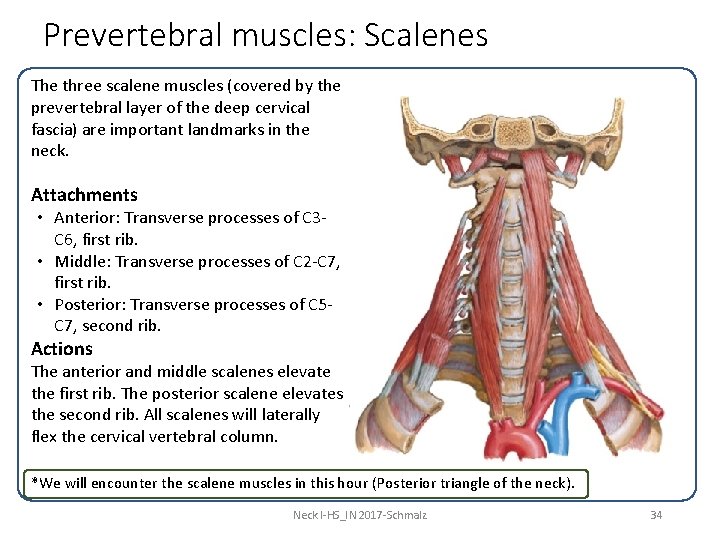
Prevertebral muscles: Scalenes The three scalene muscles (covered by the prevertebral layer of the deep cervical fascia) are important landmarks in the neck. Attachments • Anterior: Transverse processes of C 3 C 6, first rib. • Middle: Transverse processes of C 2 -C 7, first rib. • Posterior: Transverse processes of C 5 C 7, second rib. Actions The anterior and middle scalenes elevate the first rib. The posterior scalene elevates the second rib. All scalenes will laterally flex the cervical vertebral column. *We will encounter the scalene muscles in this hour (Posterior triangle of the neck). Neck I-HS_IN 2017 -Schmalz 34
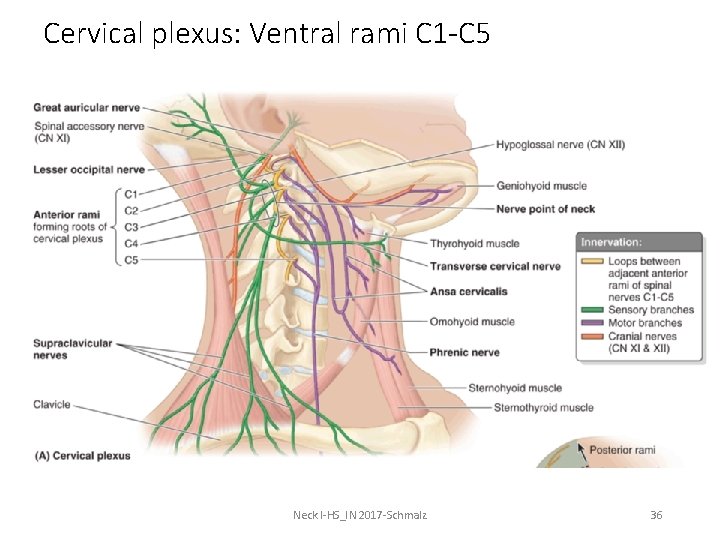
nerves • Cervical plexus (Ventral rami C 1 -C 5) • Cranial nerves X, XI, and XII • Sympathetics (Inferior, Middle, and Superior cervical ganglia) Neck I-HS_IN 2017 -Schmalz 35
Cervical plexus: Ventral rami C 1 -C 5 Neck I-HS_IN 2017 -Schmalz 36
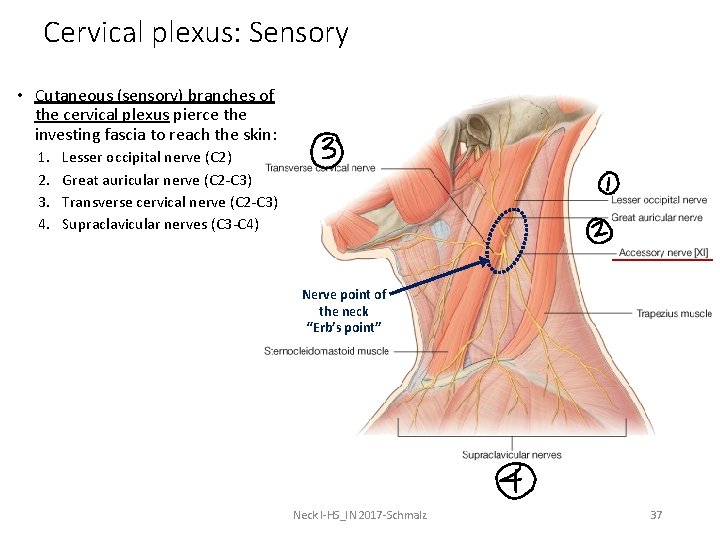
Cervical plexus: Sensory • Cutaneous (sensory) branches of the cervical plexus pierce the investing fascia to reach the skin: 1. 2. 3. 4. Lesser occipital nerve (C 2) Great auricular nerve (C 2 -C 3) Transverse cervical nerve (C 2 -C 3) Supraclavicular nerves (C 3 -C 4) Nerve point of the neck “Erb’s point” Neck I-HS_IN 2017 -Schmalz 37
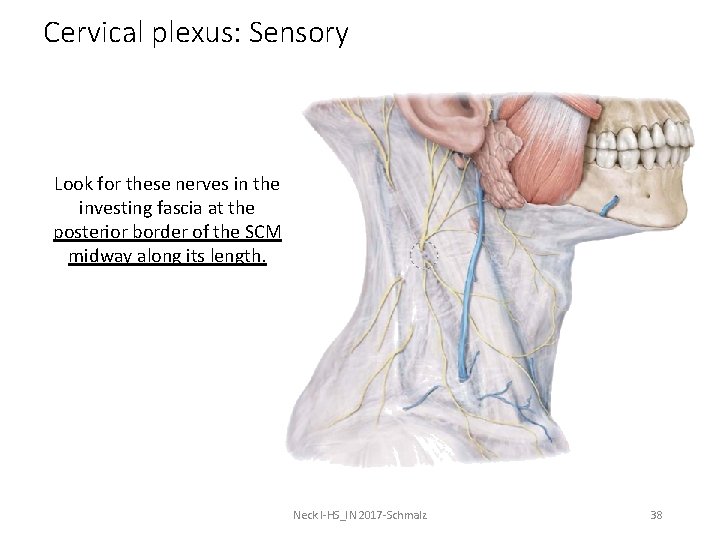
Cervical plexus: Sensory Look for these nerves in the investing fascia at the posterior border of the SCM midway along its length. Neck I-HS_IN 2017 -Schmalz 38
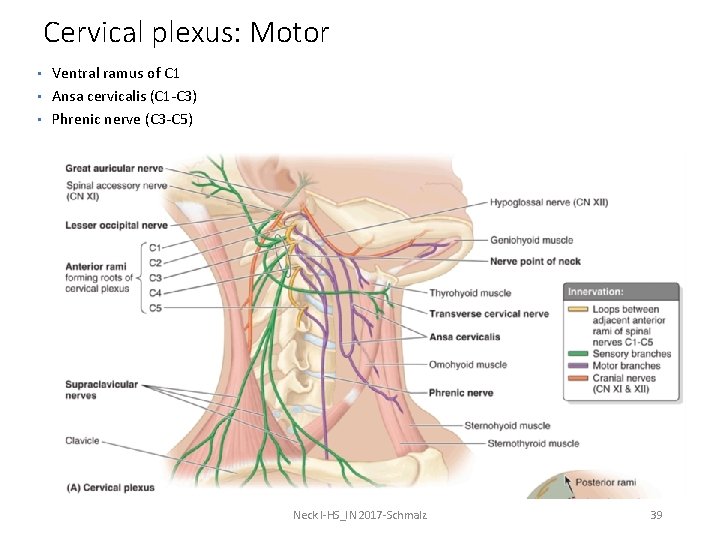
Cervical plexus: Motor • Ventral ramus of C 1 • Ansa cervicalis (C 1 -C 3) • Phrenic nerve (C 3 -C 5) Neck I-HS_IN 2017 -Schmalz 39
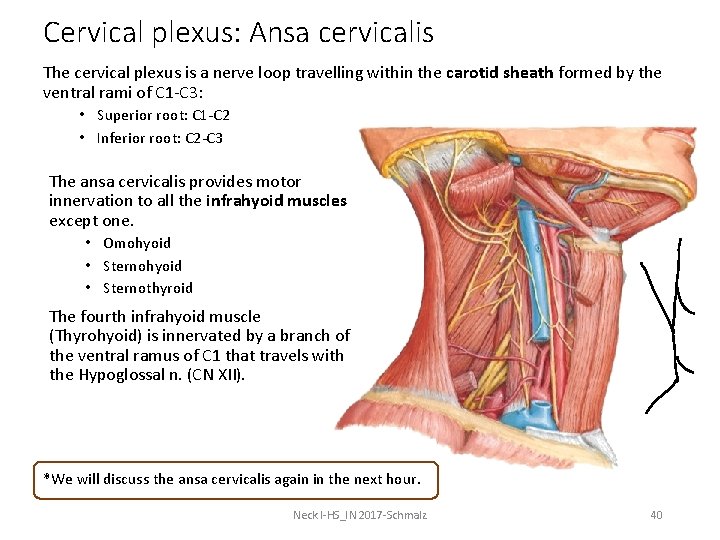
Cervical plexus: Ansa cervicalis The cervical plexus is a nerve loop travelling within the carotid sheath formed by the ventral rami of C 1 -C 3: • Superior root: C 1 -C 2 • Inferior root: C 2 -C 3 The ansa cervicalis provides motor innervation to all the infrahyoid muscles except one. • Omohyoid • Sternothyroid The fourth infrahyoid muscle (Thyrohyoid) is innervated by a branch of the ventral ramus of C 1 that travels with the Hypoglossal n. (CN XII). *We will discuss the ansa cervicalis again in the next hour. Neck I-HS_IN 2017 -Schmalz 40
Referred diaphragmatic pain • Irritation of the diaphragm on its peritoneal or pleural surfaces can cause pain on the top of the shoulder and clavicle. Why? • Innervation of the diaphragm? Phrenic nerve • Spinal cord levels? C 3 – C 5 • What types of fibers travel in this nerve? GSE, GVA The ventral rami of C 3 and C 4 contribute to the phrenic nerve and supraclavicular nerves (in the Cervical plexus), so a stimulus transmitted via GVA fibers in the Phrenic nerve is perceived as pain in the dermatome corresponding with spinal cord levels C 3 -C 5 (region supplied by supraclavicular nerves). Neck I-HS_IN 2017 -Schmalz 41
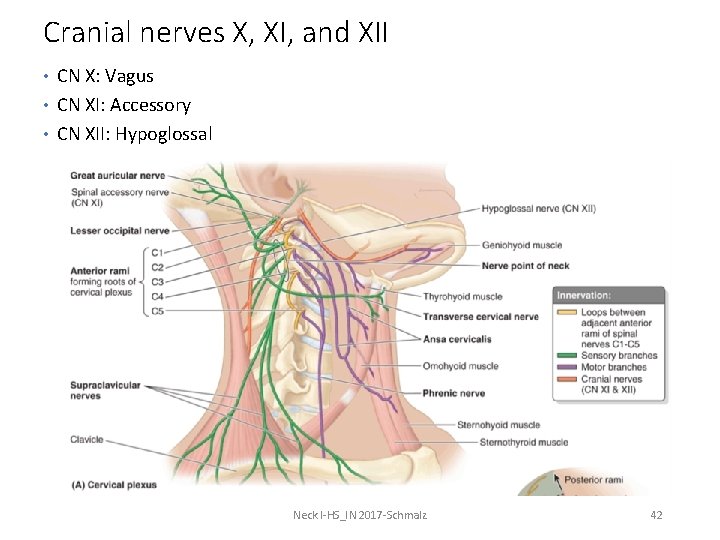
Cranial nerves X, XI, and XII • CN X: Vagus • CN XI: Accessory • CN XII: Hypoglossal Neck I-HS_IN 2017 -Schmalz 42
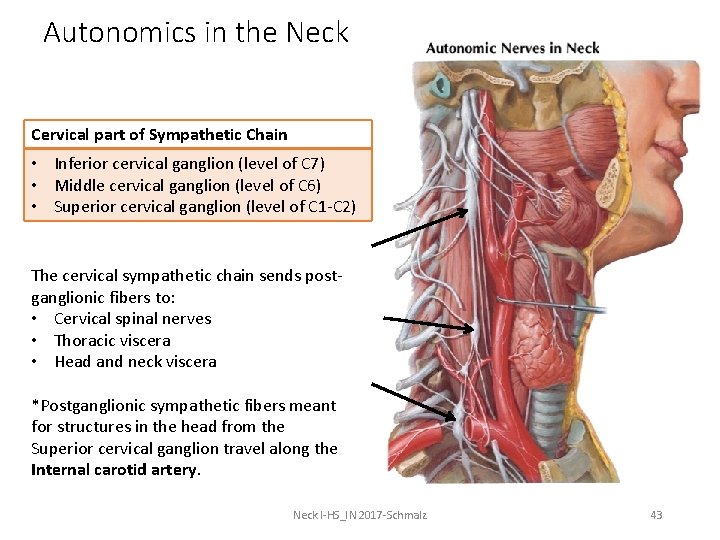
Autonomics in the Neck Cervical part of Sympathetic Chain • Inferior cervical ganglion (level of C 7) • Middle cervical ganglion (level of C 6) • Superior cervical ganglion (level of C 1 -C 2) The cervical sympathetic chain sends postganglionic fibers to: • Cervical spinal nerves • Thoracic viscera • Head and neck viscera *Postganglionic sympathetic fibers meant for structures in the head from the Superior cervical ganglion travel along the Internal carotid artery. Neck I-HS_IN 2017 -Schmalz 43
viscera • Larynx • Thyroid gland • Parathyroid glands Neck I-HS_IN 2017 -Schmalz 44
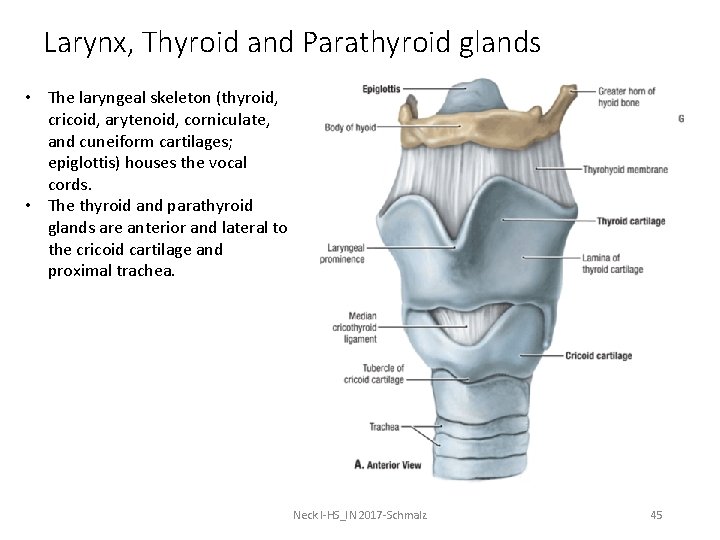
Larynx, Thyroid and Parathyroid glands • The laryngeal skeleton (thyroid, cricoid, arytenoid, corniculate, and cuneiform cartilages; epiglottis) houses the vocal cords. • The thyroid and parathyroid glands are anterior and lateral to the cricoid cartilage and proximal trachea. Neck I-HS_IN 2017 -Schmalz 45
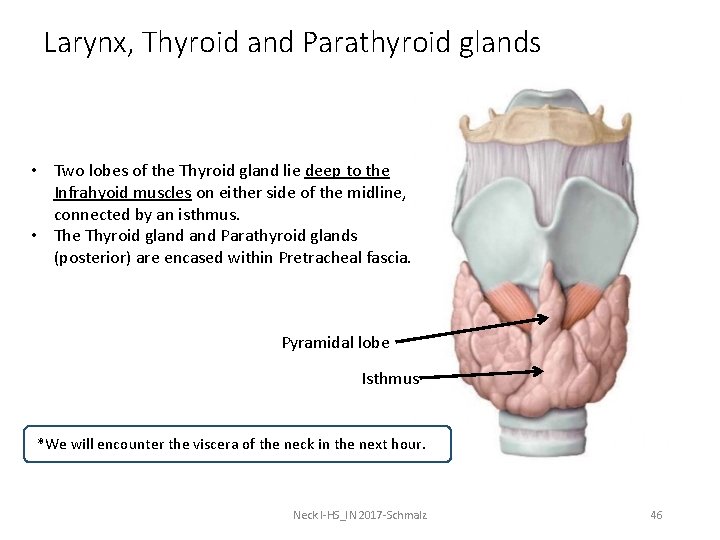
Larynx, Thyroid and Parathyroid glands • Two lobes of the Thyroid gland lie deep to the Infrahyoid muscles on either side of the midline, connected by an isthmus. • The Thyroid gland Parathyroid glands (posterior) are encased within Pretracheal fascia. Pyramidal lobe Isthmus *We will encounter the viscera of the neck in the next hour. Neck I-HS_IN 2017 -Schmalz 46
Time-out Topics Covered: Up Next: • Osteology • Fasciae of the Neck • Contents of the Neck • Posterior Triangle (Lateral cervical region) Neck I-HS_IN 2017 -Schmalz 47
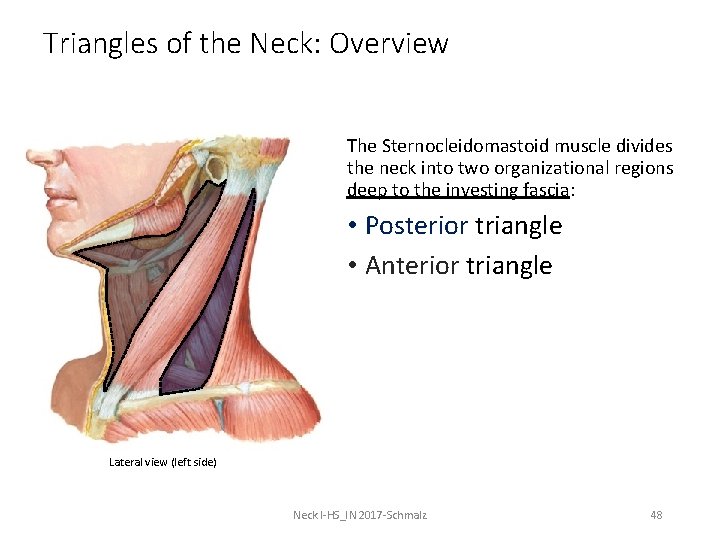
Triangles of the Neck: Overview The Sternocleidomastoid muscle divides the neck into two organizational regions deep to the investing fascia: • Posterior triangle • Anterior triangle Lateral view (left side) Neck I-HS_IN 2017 -Schmalz 48
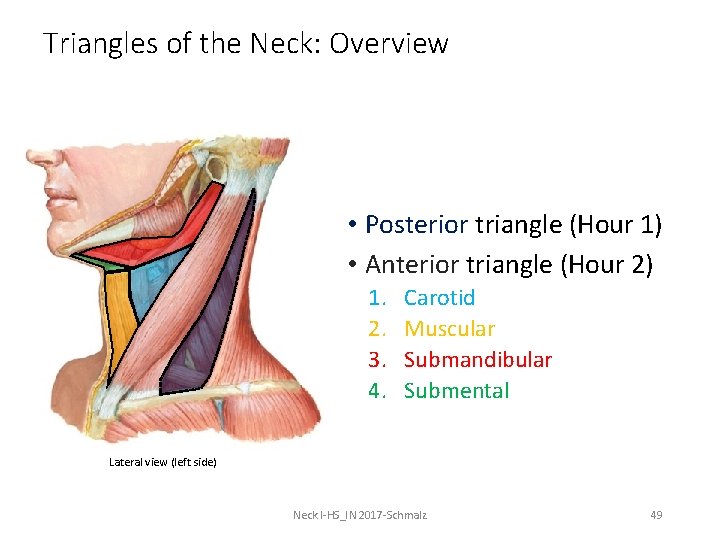
Triangles of the Neck: Overview • Posterior triangle (Hour 1) • Anterior triangle (Hour 2) 1. 2. 3. 4. Carotid Muscular Submandibular Submental Lateral view (left side) Neck I-HS_IN 2017 -Schmalz 49
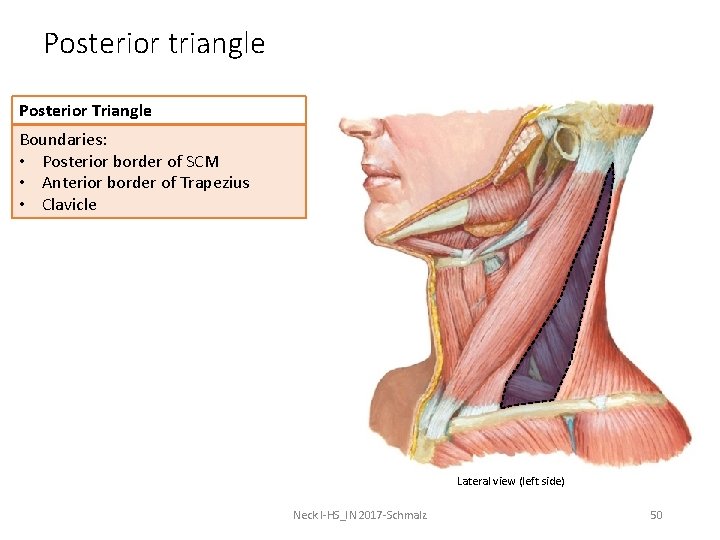
Posterior triangle Posterior Triangle Boundaries: • Posterior border of SCM • Anterior border of Trapezius • Clavicle Lateral view (left side) Neck I-HS_IN 2017 -Schmalz 50
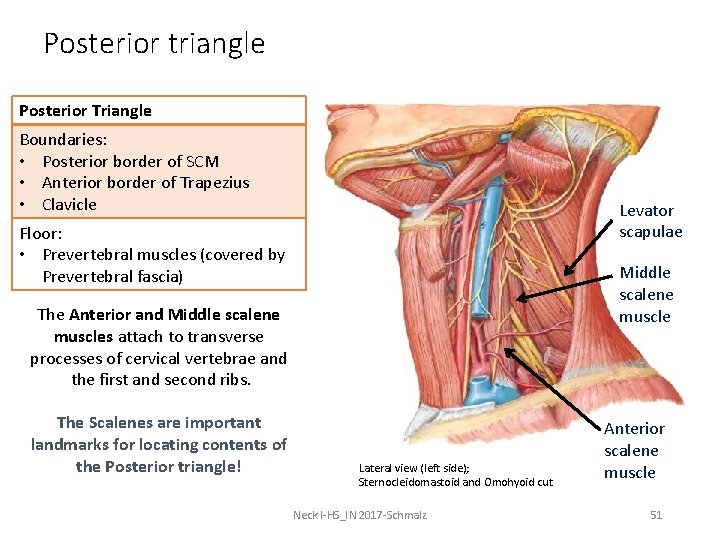
Posterior triangle Posterior Triangle Boundaries: • Posterior border of SCM • Anterior border of Trapezius • Clavicle Levator scapulae Floor: • Prevertebral muscles (covered by Prevertebral fascia) Middle scalene muscle The Anterior and Middle scalene muscles attach to transverse processes of cervical vertebrae and the first and second ribs. The Scalenes are important landmarks for locating contents of the Posterior triangle! Lateral view (left side); Sternocleidomastoid and Omohyoid cut Neck I-HS_IN 2017 -Schmalz Anterior scalene muscle 51
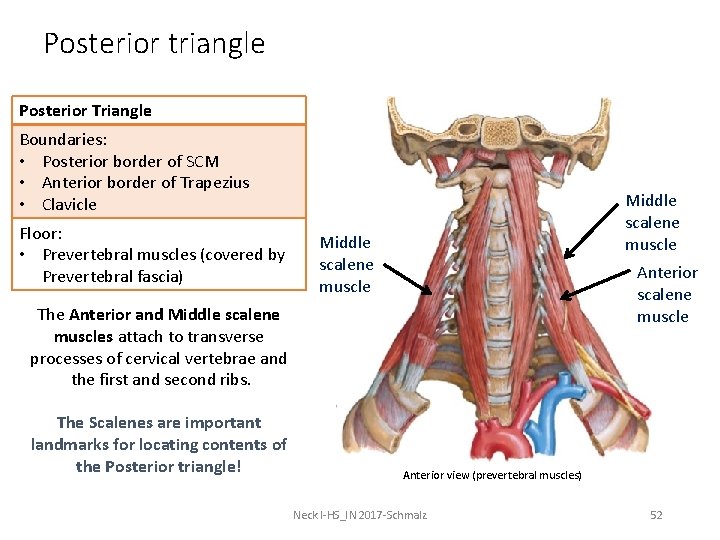
Posterior triangle Posterior Triangle Boundaries: • Posterior border of SCM • Anterior border of Trapezius • Clavicle Floor: • Prevertebral muscles (covered by Prevertebral fascia) Middle scalene muscle Anterior scalene muscle The Anterior and Middle scalene muscles attach to transverse processes of cervical vertebrae and the first and second ribs. The Scalenes are important landmarks for locating contents of the Posterior triangle! Anterior view (prevertebral muscles) Neck I-HS_IN 2017 -Schmalz 52
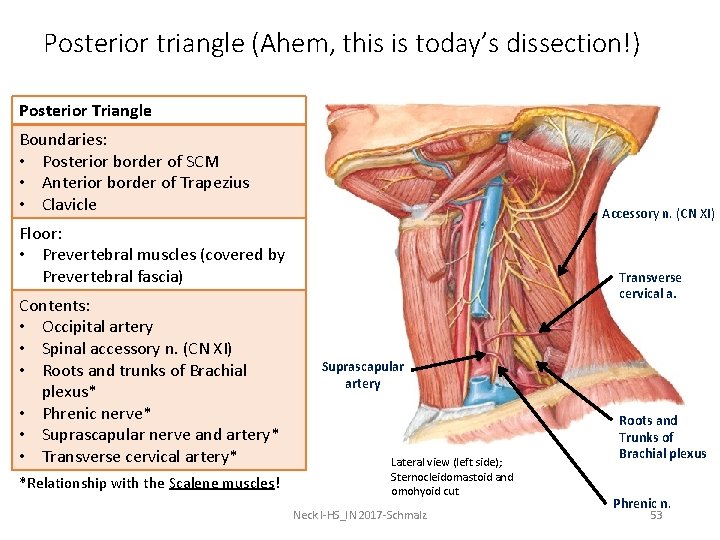
Posterior triangle (Ahem, this is today’s dissection!) Posterior Triangle Boundaries: • Posterior border of SCM • Anterior border of Trapezius • Clavicle Accessory n. (CN XI) Floor: • Prevertebral muscles (covered by Prevertebral fascia) Contents: • Occipital artery • Spinal accessory n. (CN XI) • Roots and trunks of Brachial plexus* • Phrenic nerve* • Suprascapular nerve and artery* • Transverse cervical artery* *Relationship with the Scalene muscles! Transverse cervical a. Suprascapular artery Lateral view (left side); Sternocleidomastoid and omohyoid cut Neck I-HS_IN 2017 -Schmalz Roots and Trunks of Brachial plexus Phrenic n. 53
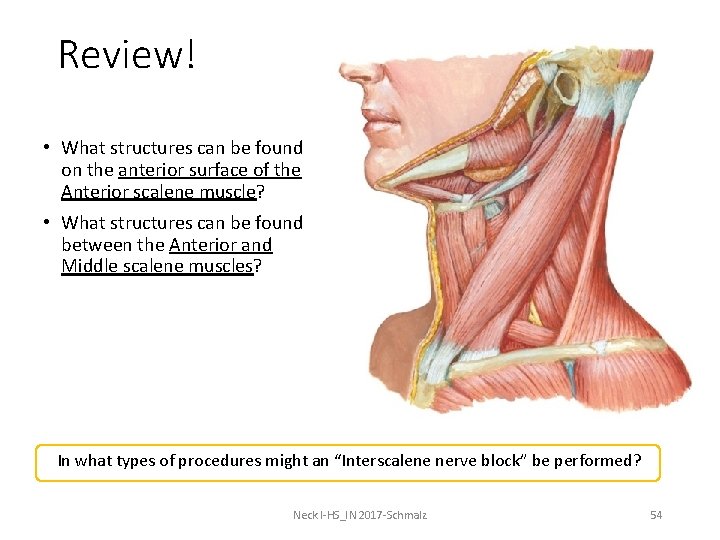
Review! • What structures can be found on the anterior surface of the Anterior scalene muscle? • What structures can be found between the Anterior and Middle scalene muscles? In what types of procedures might an “Interscalene nerve block” be performed? Neck I-HS_IN 2017 -Schmalz 54
Session Summary: Neck – Hour 1 • Osteology • Cervical fasciae • Spread of Infection • Contents of the Neck • Blood Vessels and Lymphatics • Physical examination of cervical lymph nodes • Sentinel nodes of Virchow • Muscles • Nerves • Referred diaphragmatic pain • Viscera • Lateral cervical region (Posterior triangle of the Neck) • Interscalene nerve block Neck I-HS_IN 2017 -Schmalz 55