
The Nature of the Wind Talk Outline A




- Slides: 21
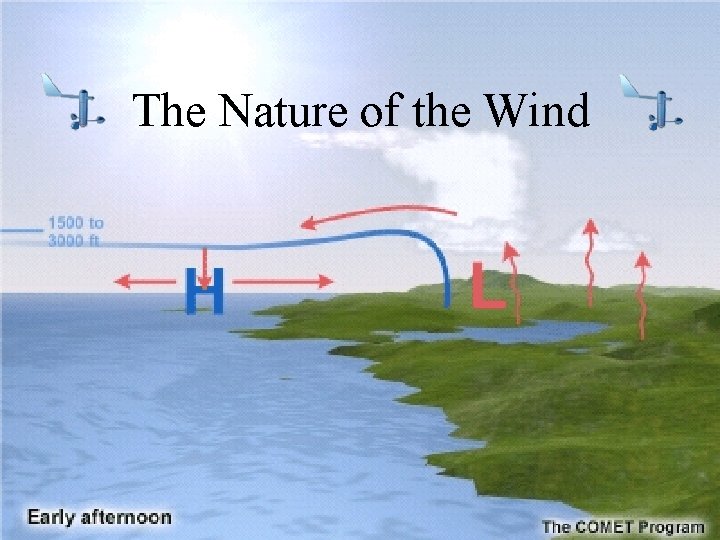
The Nature of the Wind
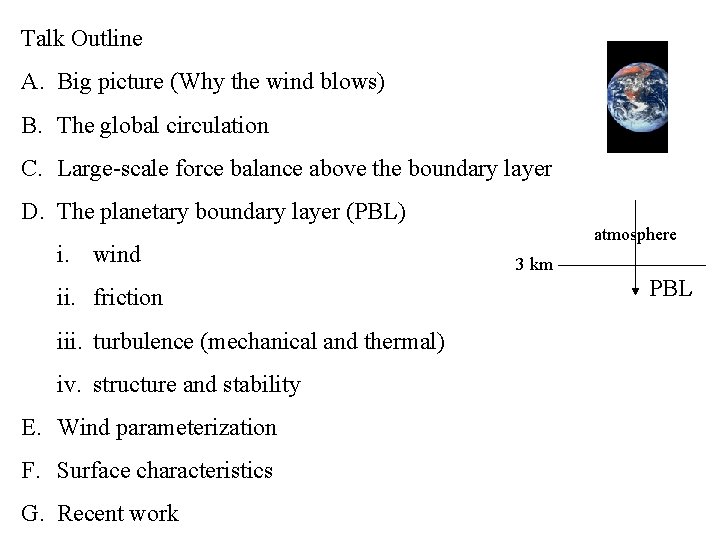
Talk Outline A. Big picture (Why the wind blows) B. The global circulation C. Large-scale force balance above the boundary layer D. The planetary boundary layer (PBL) i. wind ii. friction iii. turbulence (mechanical and thermal) iv. structure and stability E. Wind parameterization F. Surface characteristics G. Recent work atmosphere 3 km PBL
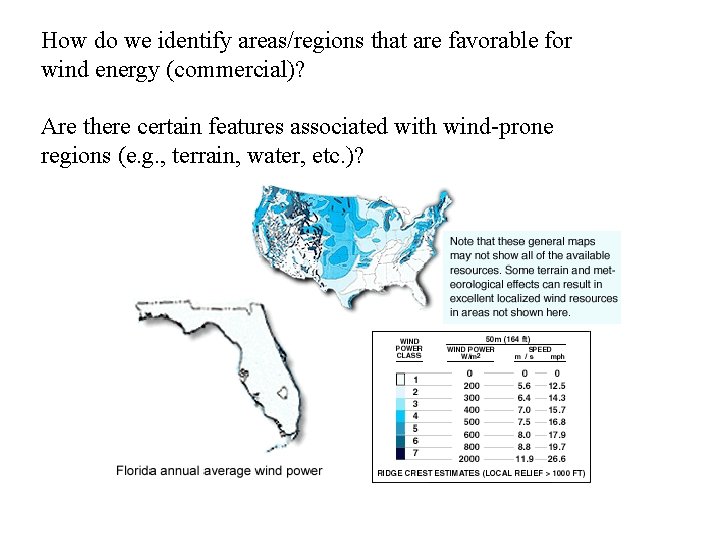
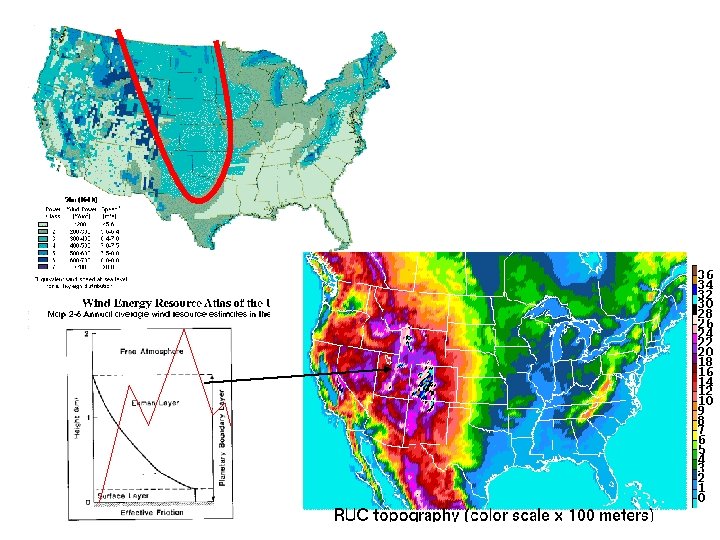
How do we identify areas/regions that are favorable for wind energy (commercial)? Are there certain features associated with wind-prone regions (e. g. , terrain, water, etc. )?
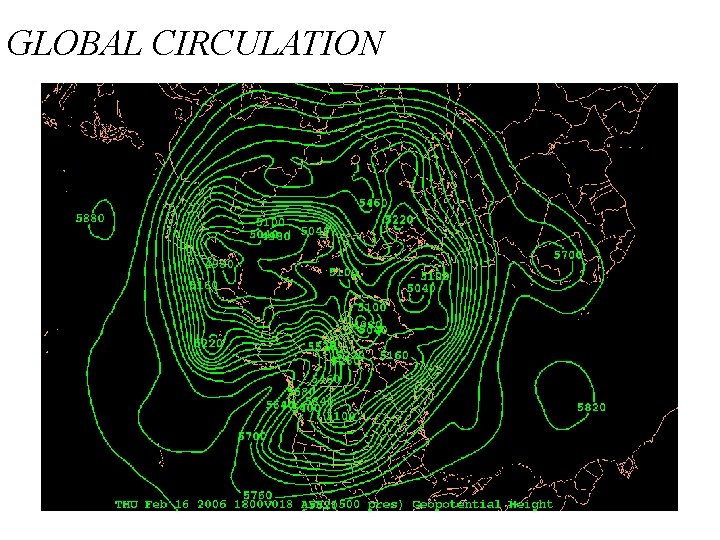
GLOBAL CIRCULATION
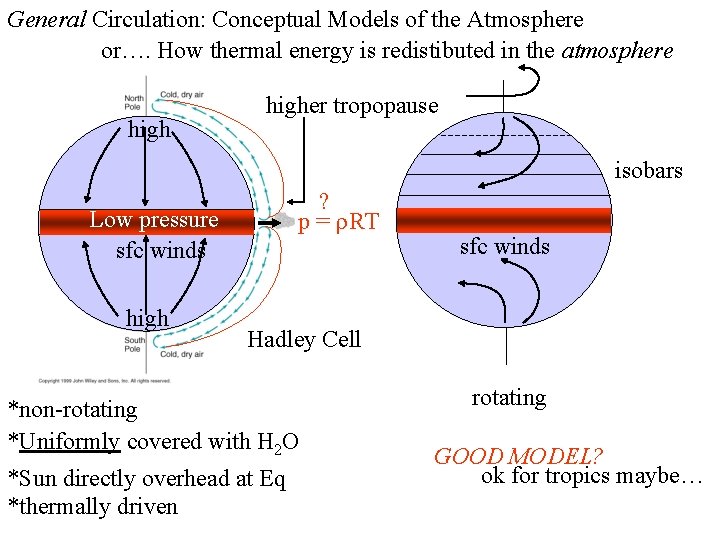
General Circulation: Conceptual Models of the Atmosphere or…. How thermal energy is redistibuted in the atmosphere higher tropopause isobars ? p = r. RT Low pressure sfc winds high sfc winds Hadley Cell *non-rotating *Uniformly covered with H 2 O *Sun directly overhead at Eq *thermally driven rotating GOOD MODEL? ok for tropics maybe…
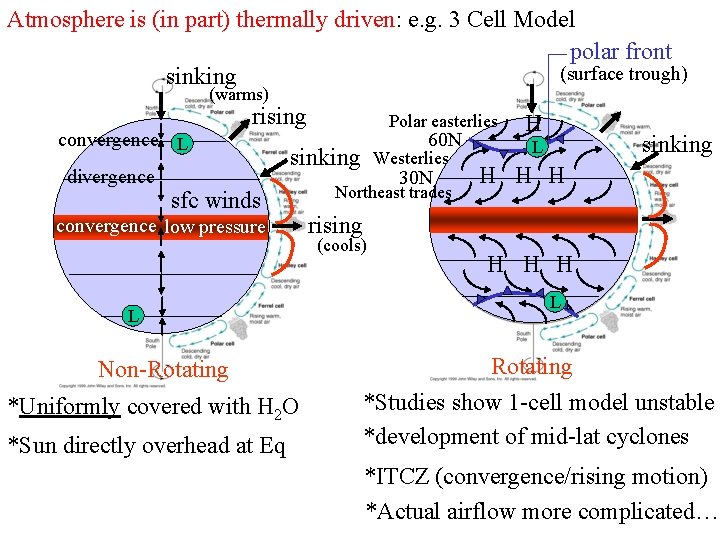
Atmosphere is (in part) thermally driven: e. g. 3 Cell Model polar front (surface trough) sinking (warms) convergence L divergence rising 60 N sinking sfc winds convergence low pressure L Non-Rotating *Uniformly covered with H 2 O *Sun directly overhead at Eq Polar easterlies Westerlies 30 N Northeast trades H sinking L H H H rising (cools) H H H sfc winds L Rotating *Studies show 1 -cell model unstable *development of mid-lat cyclones *ITCZ (convergence/rising motion) *Actual airflow more complicated….
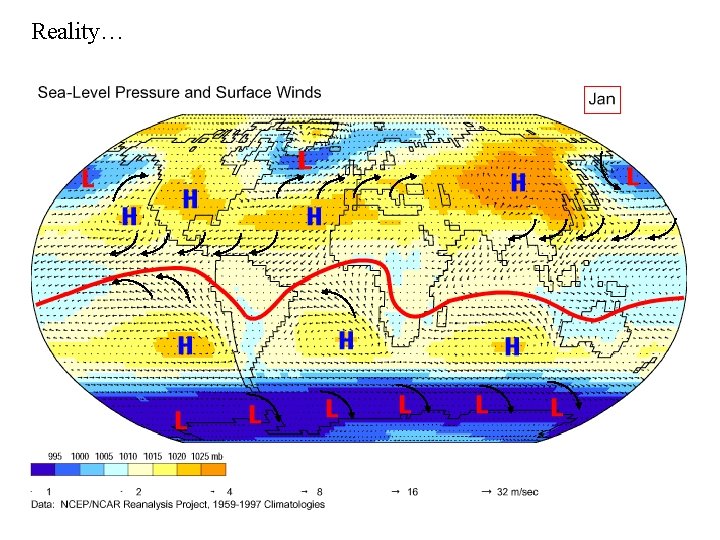
Reality…
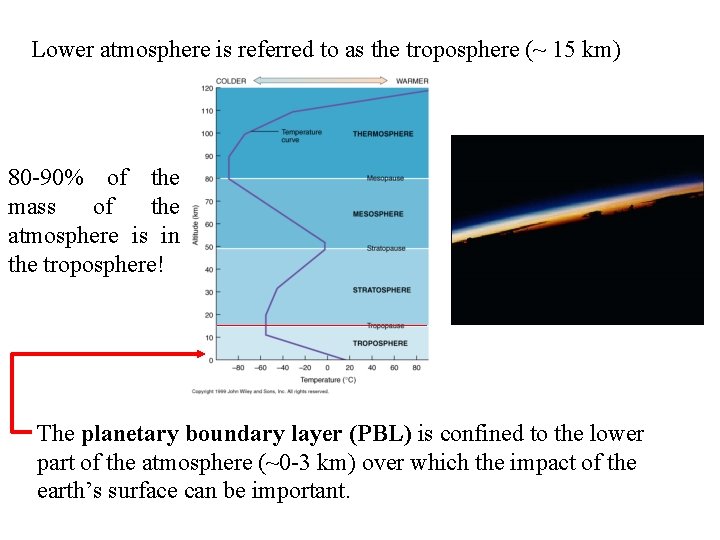
Lower atmosphere is referred to as the troposphere (~ 15 km) 80 -90% of the mass of the atmosphere is in the troposphere! The planetary boundary layer (PBL) is confined to the lower part of the atmosphere (~0 -3 km) over which the impact of the earth’s surface can be important.
Looking at the lowest 2 km… increasing friction winds ~ geostrophic planetary boundary layer wind turbine from Doswell
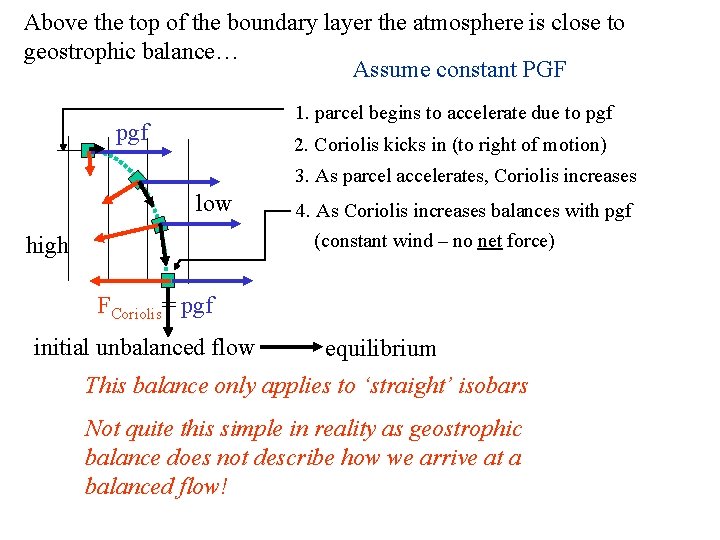
Above the top of the boundary layer the atmosphere is close to geostrophic balance… Assume constant PGF 1. parcel begins to accelerate due to pgf 2. Coriolis kicks in (to right of motion) 3. As parcel accelerates, Coriolis increases low high 4. As Coriolis increases balances with pgf (constant wind – no net force) FCoriolis= pgf initial unbalanced flow equilibrium This balance only applies to ‘straight’ isobars Not quite this simple in reality as geostrophic balance does not describe how we arrive at a balanced flow!
What influences the wind in the PBL? ØDriven by large-scale horizontal pressure/temperature gradients ØImpacted by surface roughness characteristics ØEarth’s rotation (Coriolis) ØDiurnal temperature cycle at the surface (PBL stratification) ØEntrainment of air above the PBL ØHorizontal advection of momentum & heat ØLarge-scale convergence/divergence ØClouds and precipitation ØTopography w
Near the sfc (above sfc layer up to 1 km or so) Ekman Spiral Ffr Assume constant PGF FCoriolis= pgf 1. Parcel in geostrophic balance. apply friction 2. Apply friction (disrupt balance). 3. Winds decelerate, Coriolis weakens. high 4. PGF causes flow to deflect toward low pressure. 5. New force balance established low new equilibrium no net force This balance only applies to ‘straight’ isobars geostrophic z y x-isobaric toward low pressure x isobars
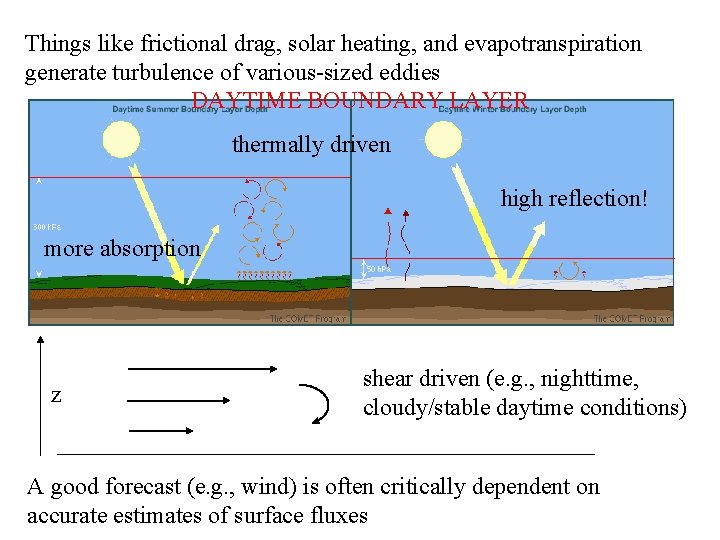
Things like frictional drag, solar heating, and evapotranspiration generate turbulence of various-sized eddies DAYTIME BOUNDARY LAYER thermally driven high reflection! more absorption z shear driven (e. g. , nighttime, cloudy/stable daytime conditions) A good forecast (e. g. , wind) is often critically dependent on accurate estimates of surface fluxes
Residual layer The residual layer is the part of the atmosphere where mixing still takes place as a result of air flow (mechanical), although heat fluxes from the surface of the Earth are small. The surface layer (~lowest 10% of PBL) is the area most influenced by surface properties like heat fluxes etc. . much of what I’ll be talking about coming up is relevant to this layer only. 10 km Free Atmosphere winds are ~ geostrophic 1 km similar characteristics Convective Mixed Layer Residual Layer Mixed Layer stable boundary layer radiational cooling Noon Sunset peak heating Midnight surface layer Sunrise Noon
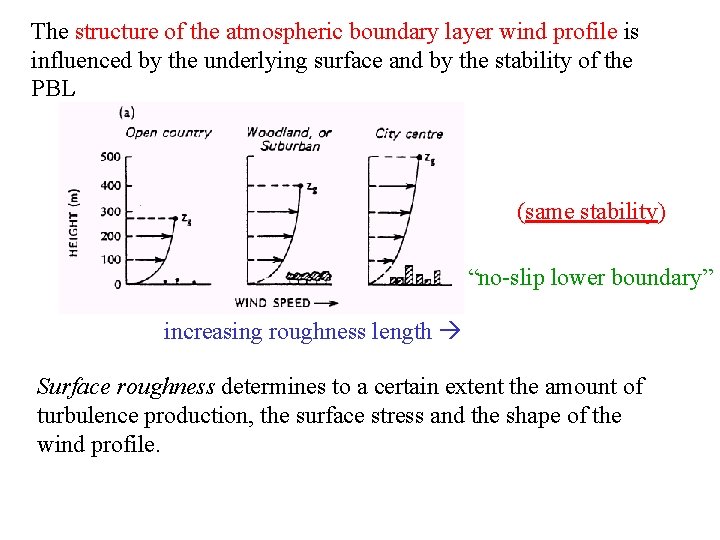
The structure of the atmospheric boundary layer wind profile is influenced by the underlying surface and by the stability of the PBL (same stability) “no-slip lower boundary” increasing roughness length Surface roughness determines to a certain extent the amount of turbulence production, the surface stress and the shape of the wind profile.
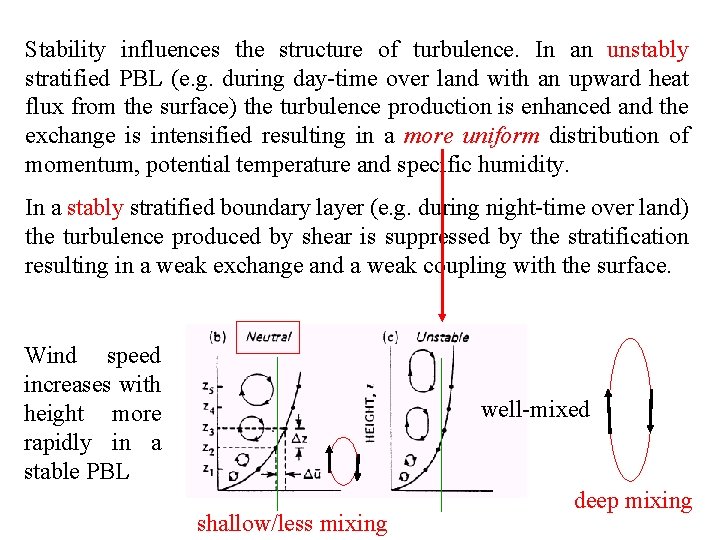
Stability influences the structure of turbulence. In an unstably stratified PBL (e. g. during day-time over land with an upward heat flux from the surface) the turbulence production is enhanced and the exchange is intensified resulting in a more uniform distribution of momentum, potential temperature and specific humidity. In a stably stratified boundary layer (e. g. during night-time over land) the turbulence produced by shear is suppressed by the stratification resulting in a weak exchange and a weak coupling with the surface. Wind speed increases with height more rapidly in a stable PBL well-mixed shallow/less mixing deep mixing
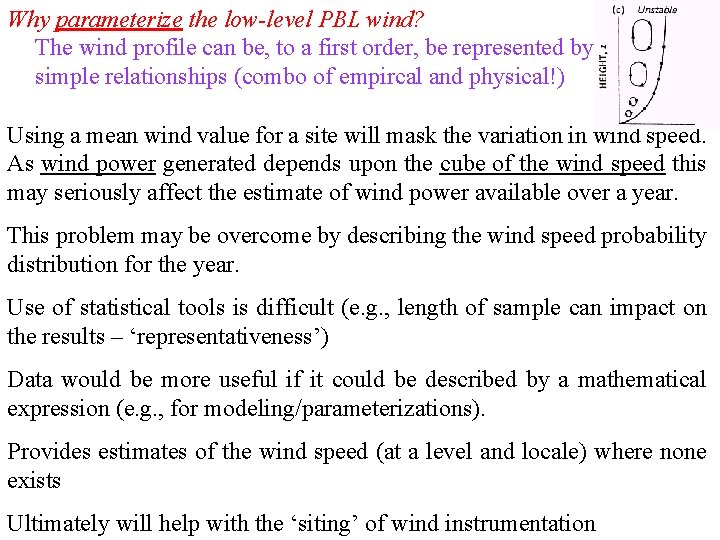
Why parameterize the low-level PBL wind? The wind profile can be, to a first order, be represented by simple relationships (combo of empircal and physical!) Using a mean wind value for a site will mask the variation in wind speed. As wind power generated depends upon the cube of the wind speed this may seriously affect the estimate of wind power available over a year. This problem may be overcome by describing the wind speed probability distribution for the year. Use of statistical tools is difficult (e. g. , length of sample can impact on the results – ‘representativeness’) Data would be more useful if it could be described by a mathematical expression (e. g. , for modeling/parameterizations). Provides estimates of the wind speed (at a level and locale) where none exists Ultimately will help with the ‘siting’ of wind instrumentation
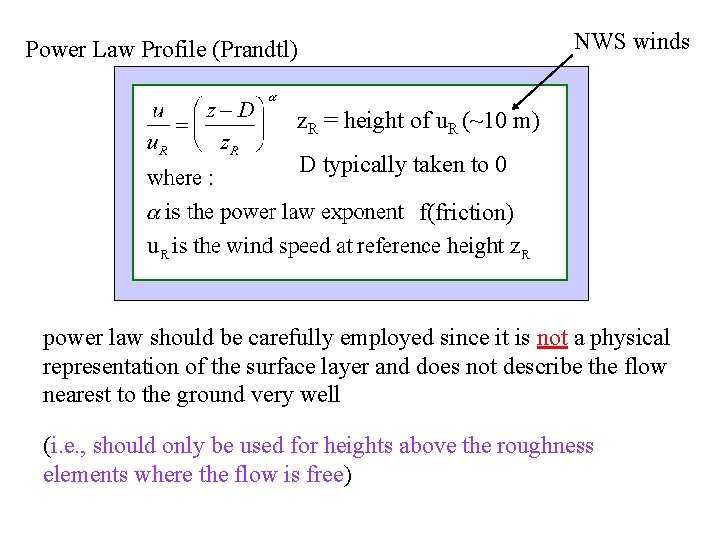
NWS winds Power Law Profile (Prandtl) z. R = height of u. R (~10 m) D typically taken to 0 f(friction) power law should be carefully employed since it is not a physical representation of the surface layer and does not describe the flow nearest to the ground very well (i. e. , should only be used for heights above the roughness elements where the flow is free)
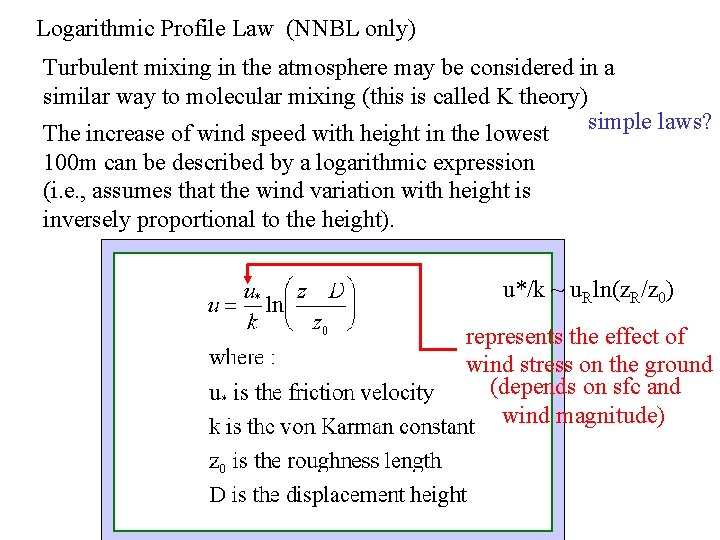
Logarithmic Profile Law (NNBL only) Turbulent mixing in the atmosphere may be considered in a similar way to molecular mixing (this is called K theory) simple laws? The increase of wind speed with height in the lowest 100 m can be described by a logarithmic expression (i. e. , assumes that the wind variation with height is inversely proportional to the height). u*/k ~ u. Rln(z. R/z 0) represents the effect of wind stress on the ground (depends on sfc and wind magnitude)
Both the log law and the power law are simplified expressions of the actual wind profile. They are valid in flat homogeneous terrain. They do not include the effects of topography, obstacles or changes in roughness or stability. When either of these 2 simple laws do apply, they are intended for the lower part of boundary layer called the surface layer (i. e. lowest ~50 -100 m or so, but above the canopy and in flat homogeneous terrain). • Wind direction is assumed to change little with height • Effects of earth rotation are assumed to be minimal • Wind structure is determined by surface friction and the vertical temperature gradient.