
THE NATURE OF SCIENCE THE BIG IDEA How

THE NATURE OF SCIENCE THE BIG IDEA: How can science provide answers to your questions about the world around you?
Understanding Science: What is science? • What is scientific inquiry? • What are the results of scientific investigations? • How can scientist minimize bias in a scientific investigation?

BRANCHES OF SCIENCE: • Life Science—the study of living things—or biology • Earth Science—the study of Earth—landforms, rocks, soil and forces that shapes Earth’s surface • Physical Science—the study of Physics and CHemistry
SCIENTIFIC INQUIRY • Ask questions—make observations, state a problem, research , infer • Hypothesize • Predict • Test your Hypothesis • Analyze Results • Draw Conclusions • Communicate Results
RESULTS OF SCIENTIFIC INQUIRY • Technology—the practical use of scientific knowledge—television, MP 3 players, computers, artificial limbs • New Materials—bone bioceramic • Possible Explanations—who, when, what, where or how

SCIENTIFIC THEORY AND SCIENTIFIC LAWS THEORY LAWS OBSERVATIONS STATES THAT SOMETHING WILL OCCUR WELL SUPPORTED HYPOTHESIS
EVALUATING SCIENTIFIC EVIDENCE • Critical thinking is an important skill in scientific inquiry: • Sampling • Bias • Blind Study • Repetition

SAFETY IN SCIENCE • Use of safety procedures: includes the following recognize safety equipment, safety instructions, • Recognize potential hazards • ETHICS: potential risks and benefits of experimentations
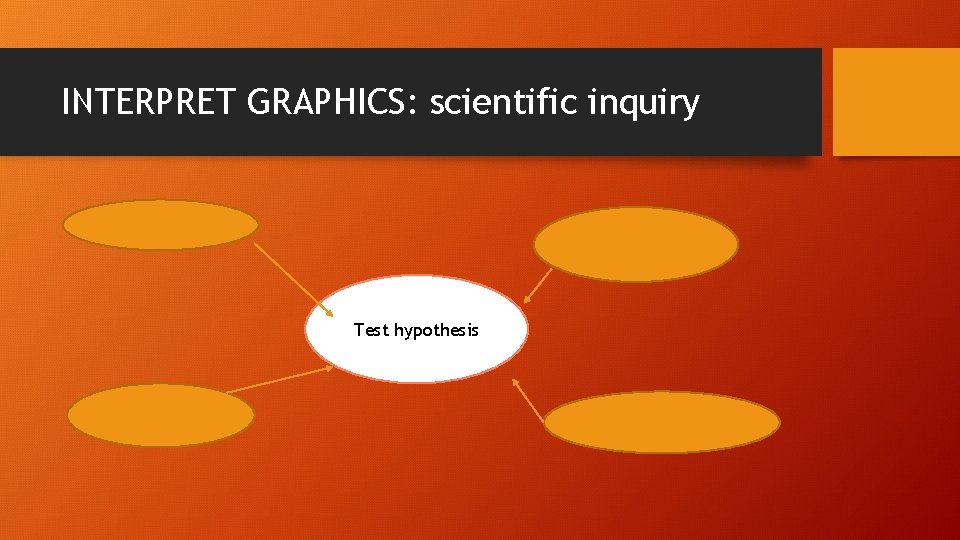
INTERPRET GRAPHICS: scientific inquiry Test hypothesis

USE VOCABULARY • COMPARE AND CONTRAST: • Inference and Prediction • Critical thinking and Inference
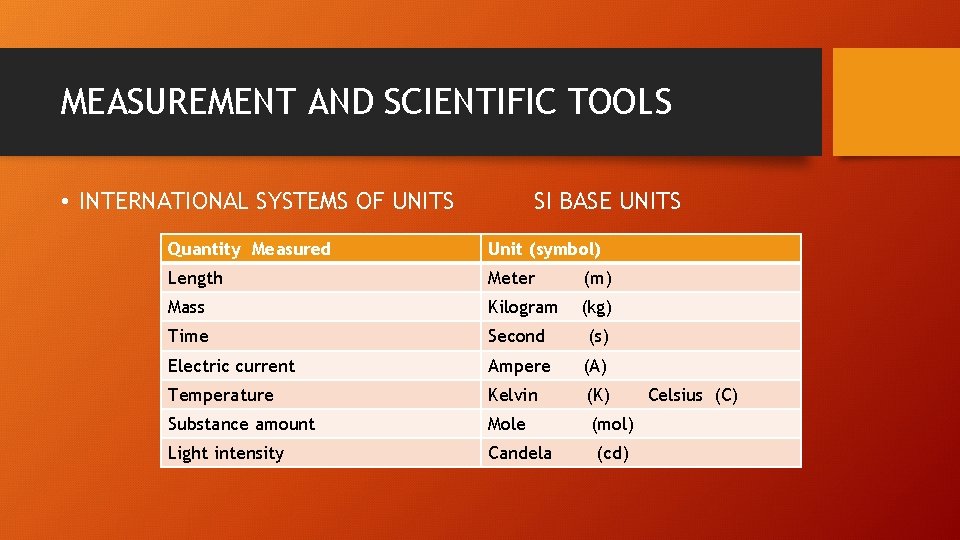
MEASUREMENT AND SCIENTIFIC TOOLS • INTERNATIONAL SYSTEMS OF UNITS SI BASE UNITS Quantity Measured Unit (symbol) Length Meter (m) Mass Kilogram (kg) Time Second (s) Electric current Ampere (A) Temperature Kelvin (K) Substance amount Mole (mol) Light intensity Candela (cd) Celsius (C)
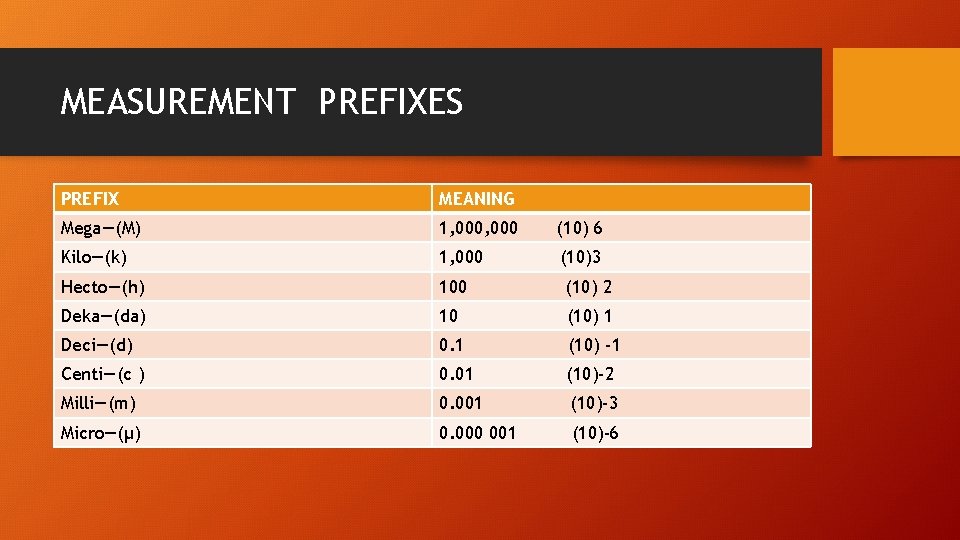
MEASUREMENT PREFIXES PREFIX MEANING Mega—(M) 1, 000 (10) 6 Kilo—(k) 1, 000 (10)3 Hecto—(h) 100 (10) 2 Deka—(da) 10 (10) 1 Deci—(d) 0. 1 (10) -1 Centi—(c ) 0. 01 (10)-2 Milli—(m) 0. 001 (10)-3 Micro—(µ) 0. 000 001 (10)-6
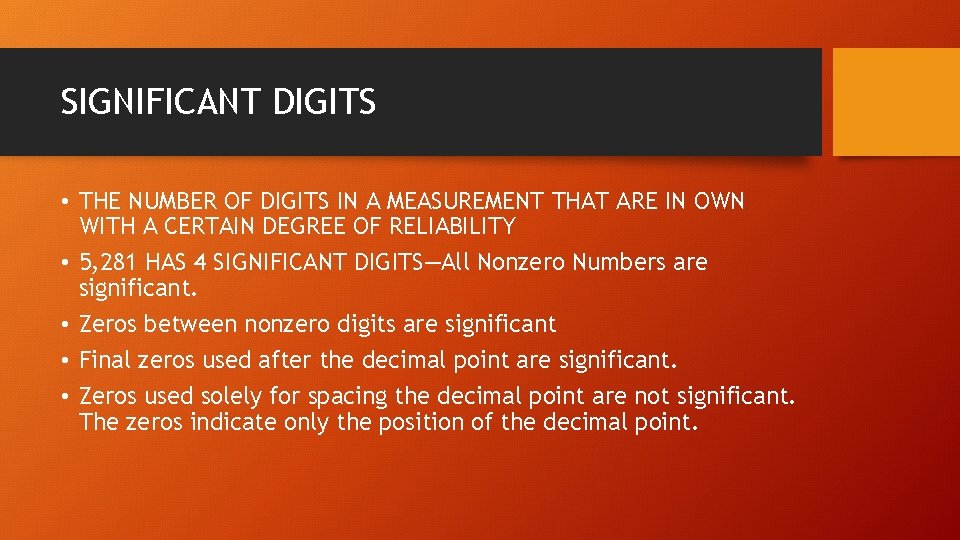
SIGNIFICANT DIGITS • THE NUMBER OF DIGITS IN A MEASUREMENT THAT ARE IN OWN WITH A CERTAIN DEGREE OF RELIABILITY • 5, 281 HAS 4 SIGNIFICANT DIGITS—All Nonzero Numbers are significant. • Zeros between nonzero digits are significant • Final zeros used after the decimal point are significant. • Zeros used solely for spacing the decimal point are not significant. The zeros indicate only the position of the decimal point.

SCIENTIFIC TOOLS • • Science Journal Balances Thermometers Glassware Compound Microscope Computers Magnifying lens Slides, pipettes, dissecting tools
- Slides: 14