
the nature of science chapter 1 What is
- Slides: 21
the nature of science chapter 1
What is Science? • a process that uses observation and investigation to gain knowledge about events in nature • Science studies natural patterns. • Scientists ask questions to learn about the natural world.
Categories of Science • Life Science – studies living things • Earth Science – studies earth and space • Physical Science – studies matter and energy
Science Explains Nature • Sometimes these explanations evolve over time as new information or technology arises.
Investigations • Scientists perform investigations to learn about the world. – observations – experimentations – modeling
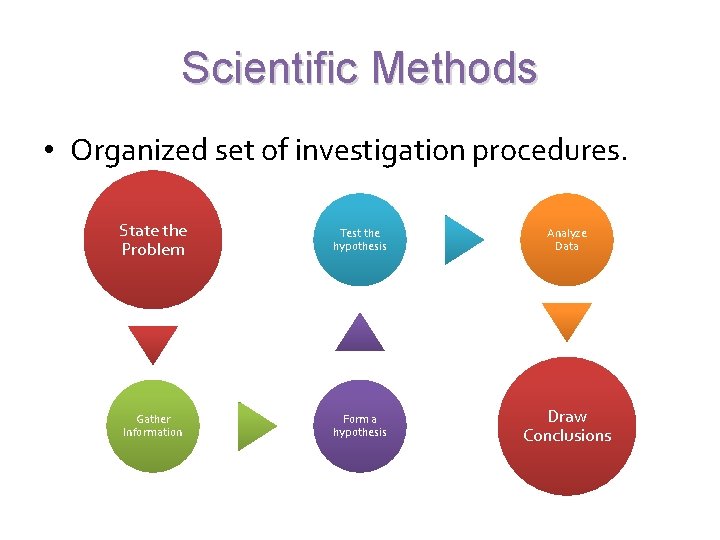
Scientific Methods • Organized set of investigation procedures. State the Problem Test the hypothesis Analyze Data Gather Information Form a hypothesis Draw Conclusions
Steps of the Scientific Method • State the Problem • Gather Information • Form a hypothesis – an educated guess – a possible explanation for what is happening based on what you know and observe • Test the hypothesis – Experiment
Experiments • Test the effect of one thing on another using controlled conditions • Variables – Things that have the potential to change in an experiment • Constants – Things that don’t change in an experiment • Control – A standard that you can use to compare your results
Variables • Independent Variable – the variable that YOU change on purpose • Dependent Variable – the variable that changes because of what you did – the variable you are going to measure • DRY MIX
Steps of the scientific Method • Analyze the Data – make graphs/charts – do calculations • Draw Conclusions – must be based on evidence – must match your original problem – must not contain BIAS • keep records, measure, repeat the experiment
Models • Represents an idea, event or object • Physical • Technological – simulations
Theories and Laws • Scientific Law – a statement about what happens in nature that seems to be true all the time – Answers the question “What happens? ” • Theory – an explanation of what is happening based on many observations and tests – Answers the question “Why is that happening? ”
Technology • Science applied to help people
Limitations of Science • Science can only answer questions about the physical world. • Science is not perfect and is never final. • Science should be considered as the best thoughts we have on the natural world right now. It is not truth. • God’s word is truth.
Units and Standards • Standard – exact quantity that people agree to use to compare measurements • All measurements must have a number and a unit
International System of Units (SI) • English • Metric • Based on multiples of ten • Uses prefixes to tell “how many” • King Henry Died by drinking chocolate milk Length = meter Mass = kilogram Time = second Current = ampere Temperature = kelvin
Common Measurements • Length – distance between two points • Volume – amount of space an object occupies • Mass – amount of matter in an object • Density – mass per unit volume (D = m/V)
Temperature • Measured on the Kelvin scale • K = Celsius + 273
Graphs • Visual display of information or data • Line graphs show relationships between variables • Choose the scale so your graph can be readable. • DRY MIX • Units of measurement must be the same
Bar Graphs • Used for comparing information you have counted.
Circle Graphs • Used to show a “whole” can be broken into its individual parts.