
The Nature of Science Chapter 1 Biology A

The Nature of Science Chapter 1 Biology A

Observations include information recorded by scientists regarding something they see, hear, taste, smell, or touch

Inferences Logical hypotheses regarding the information gained through observation


Observation/Inference Activity Go to the lab tables with your lab groups from the marshmallow challenge activity. Make and record as many observations and inferences as you can in 5 minutes. Be prepared to share your observations and inferences with the class.

The Scientific Method: Asking Questions Scientists often begin experiments by asking a question Example What is the optimal (best) concentration of fertilizer for the fastest germination time for kale seeds?
The Scientific Method: Asking Questions What factors might affect the time it takes for a seed to germinate? Temperature Light Water Humidity What question could you ask about one of these factors that affect the germination time of a particular type of seed?

The Scientific Method: Forming a Hypothesis A hypothesis is a testable explanation Hypotheses are generally in the form of If…. . , then…. . , because…. . Example If the concentration of fertilizer increases, the germination time for kale seeds will decrease because increasing the amount of fertilizer will provide more nutrients for the germinating seeds.

The Scientific Method: Forming a Hypothesis What is your hypothesis for the variable that you are testing? Remember that is must be in the following form: If…. . , then…. , because…

The Scientific Method: Designing an Experiments are used to test the questions and hypotheses that are proposed by scientists Experiments must always test only one variable In the kale experiment, the only variable being tested is the concentration of fertilizer What variable are you testing?

The Scientific Method: Independent and Dependent Variables When designing an experiment, you must first identify the independent and dependent variables The independent variable is the variable that you are testing the effect of In my experiment, I am testing the effect of fertilizer concentration on seed germination time This means that fertilizer concentration is my independent variable
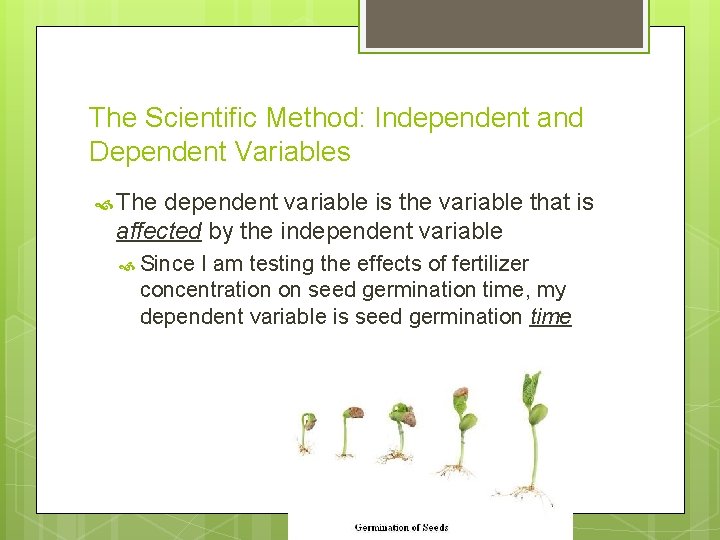
The Scientific Method: Independent and Dependent Variables The dependent variable is the variable that is affected by the independent variable Since I am testing the effects of fertilizer concentration on seed germination time, my dependent variable is seed germination time

The Scientific Method: Independent and Dependent Variables What are your independent and dependent variables?

The Scientific Method: Control and Experimental Groups Every experiment needs a control group and at least one experimental group The control group is used to compare the results of the experimental group The control group can either not get treated with the independent variable or can be as close to normal conditions as possible

The Scientific Method: Control and Experimental Groups The control group in my experiment is the group that will get only water and no fertilizer The concentration of fertilizer would be 0%
The Scientific Method: Control and Experimental Groups The experimental group(s) is/are used to test the effects of the independent variable You can have more than one experimental group

The Scientific Method: Control and Experimental Groups The experimental groups in the example experiment are those that receive different concentrations of fertilizer There will be two experimental groups in this experiment 1% fertilizer 3% fertilizer Why do you think I have low concentrations of fertilizer?
The Scientific Method: Control and Experimental Groups What will the control and experimental groups be in your experiment? You must have at least two different experimental groups

The Scientific Method: Experimental Constants Since you must test only one variable, other variables in your experiment must be the same for both the experimental and control groups These variables that remain the same are called experimental constants
The Scientific Method: Experimental Constants In the example experiment and in your experiment, what variables must remain constant for both the control and experimental groups?

The Scientific Method: Sample Size Scientific experiments must also have a large enough sample size so that your results are accurate How many seeds should we test in each of the control and experimental groups?
The Scientific Method: Writing a Procedure The procedures for your experiment should be written so they could be followed by someone who did not participate in designing the experiment Procedures should be written as a set of instructions and should not include the words I, you, we, etc.
The Scientific Method: Writing a Procedure 1. 2. 3. Obtain the materials needed for this lab: seeds, seed trays, soil, and fertilizer. Fill each of the three seed trays to the top with soil moistened with water, 1% fertilizer solution, or 3% fertilizer solution. Label each of the seed trays. Place holes in the soil at the depth indicated on the seed packet and plant one seed in each hole. Cover the seeds with soil.

The Scientific Method: Writing a Procedure 4. 5. 6. 7. Place the seed trays under the grow light stations. Observe the trays each day to determine if germination has occurred. If germination has occurred, record the number of days to germination in the data table on the lab report. Continue recording data for 7 -10 days or until all seeds have germinated.
The Scientific Method: Writing a Procedure Write the procedure for your lab with your lab group. Remember to use the example as a guide and to change the procedure for the variables you are testing.

The Scientific Method: Collecting Data There are two types of data that can be collected in a scientific experiment Quantitative data is data that is collected as numbers Examples of quantitative data include: time, #, length, mass, etc.
The Scientific Method: Collecting Data Qualitative data is collected by describing things you see, hear, taste, smell or touch and does not involve numerical data Examples of qualitative data include: odors, sounds, textures, etc. Quantitative data is preferred by scientists because it leaves little room for interpretation
The Scientific Method: Collecting Data In our lab, we are going to collect quantitative data The data we are collecting is the number of days it takes for seeds to germinate

The Scientific Method: Collecting Data should be recorded in some form of table The table for the example experiment looks like this: # of days 0% 1% 3% # of days Avg. # of days
The Scientific Method: Collecting Data Make the data table for your experiment with your group. The number of columns will vary with the number of seeds you are using for your control and experimental groups.
The Scientific Method: Analyzing Data One way to analyze data is to put it a graph A good graph should always have the following characteristics: Title The Effect of _______ on _____ Labeled Axes X-axis: independent variable Y-axis: dependent variable Evenly spaced numbers Key If there is more than one set of data on the graph
The Scientific Method: Analyzing Data Most of the time in this class, we will use line graphs Other graphs used in this class include: pie charts and bar graphs
- Slides: 33