
The Nature of Motivation Motivation The psychological forces
- Slides: 18
The Nature of Motivation • Motivation ØThe psychological forces acting on an individual that determine: • Direction—possible behaviors the individual could engage in • Effort—how hard the individual will work • Persistence—whether the individual will keep trying or give up ØThis is one of the factors that explains why people behave the way they do in organizations. • What are some other factors? © Copyright Mc. Graw-Hill. All rights reserved. 1
The Nature of Motivation (cont’d) • Extrinsic Motivation ØBehavior that is performed to acquire material or social rewards or to avoid punishment. • Examples? – What motivate you? – What motivates others you know? • Intrinsic Motivation ØBehavior that is performed for its own sake. • Examples? – What motivates you? – What motivates others you know? © Copyright Mc. Graw-Hill. All rights reserved. 2
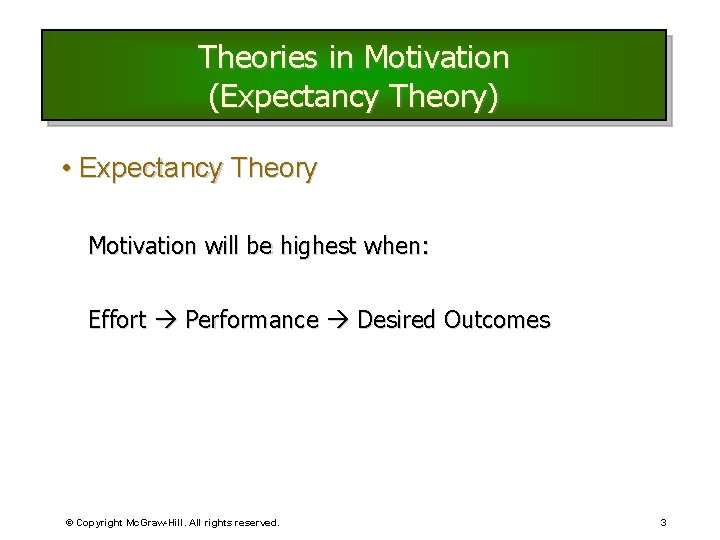
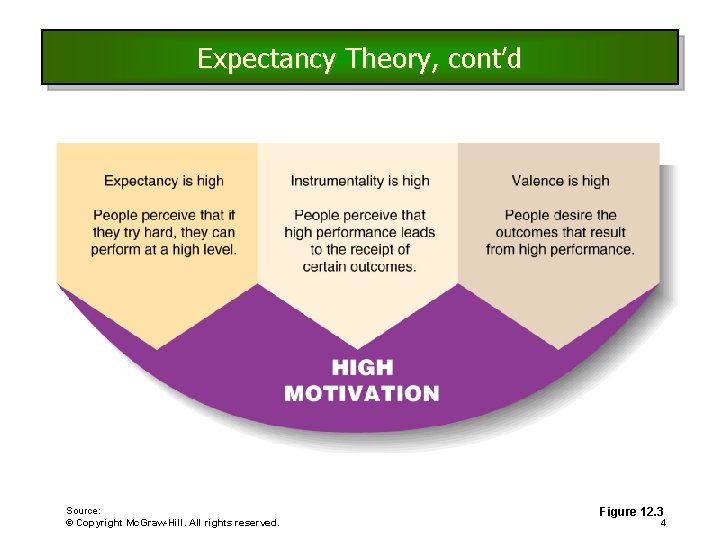
Theories in Motivation (Expectancy Theory) • Expectancy Theory Motivation will be highest when: Effort Performance Desired Outcomes © Copyright Mc. Graw-Hill. All rights reserved. 3
Expectancy Theory, cont’d Source: © Copyright Mc. Graw-Hill. All rights reserved. Figure 12. 3 4
Theories in Motivation (Needs Theories) • Maslow’s Hierarchy of Needs ØFive basic needs ØLowest level of unmet need is the primary motivator © Copyright Mc. Graw-Hill. All rights reserved. 5
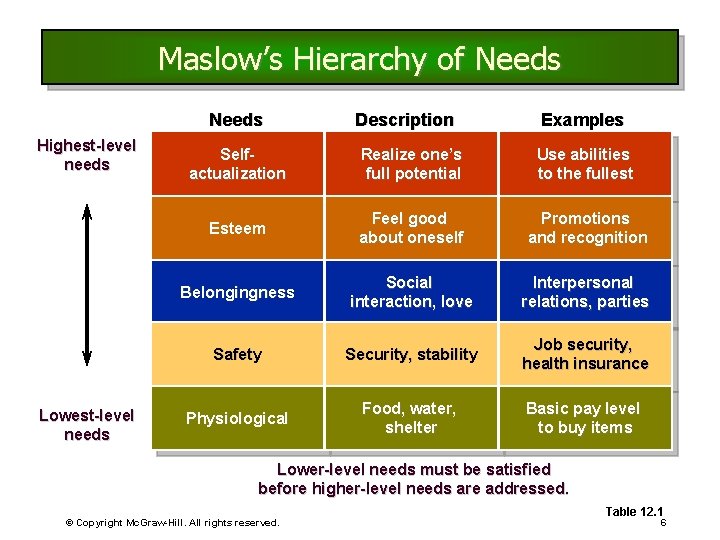
Maslow’s Hierarchy of Needs Highest-level needs Lowest-level needs Description Examples Selfactualization Realize one’s full potential Use abilities to the fullest Esteem Feel good about oneself Promotions and recognition Belongingness Social interaction, love Interpersonal relations, parties Safety Security, stability Job security, health insurance Physiological Food, water, shelter Basic pay level to buy items Lower-level needs must be satisfied before higher-level needs are addressed. © Copyright Mc. Graw-Hill. All rights reserved. Table 12. 1 6
Theories in Motivation (Needs Theories, cont’d) • Alderfer’s ERG Theory ØThree needs categories ØNeeds at more than one level can be the motivator at any time © Copyright Mc. Graw-Hill. All rights reserved. 7
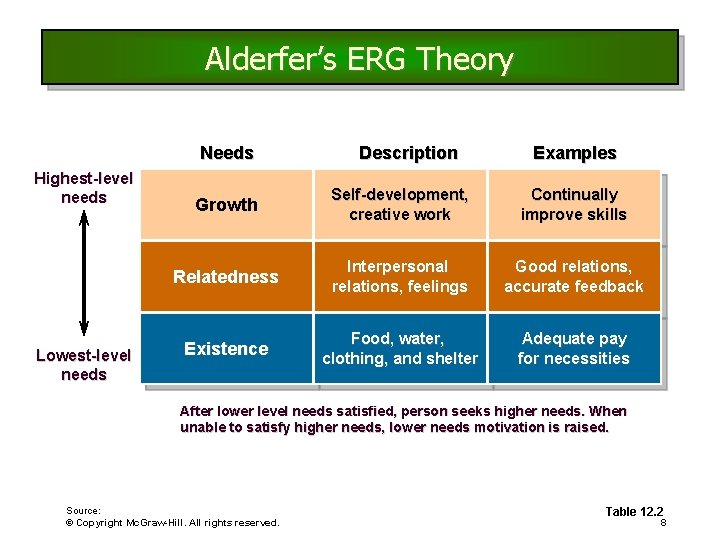
Alderfer’s ERG Theory Needs Highest-level needs Lowest-level needs Description Examples Growth Self-development, creative work Continually improve skills Relatedness Interpersonal relations, feelings Good relations, accurate feedback Existence Food, water, clothing, and shelter Adequate pay for necessities After lower level needs satisfied, person seeks higher needs. When unable to satisfy higher needs, lower needs motivation is raised. Source: © Copyright Mc. Graw-Hill. All rights reserved. Table 12. 2 8
Theories in Motivation (Needs Theories) Let’s stop for a minute … Why should a manager care about all these “needs theories”? © Copyright Mc. Graw-Hill. All rights reserved. 9
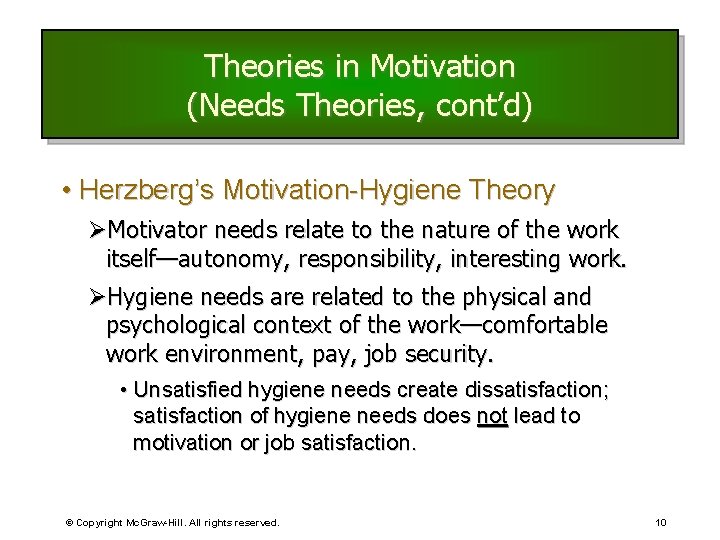
Theories in Motivation (Needs Theories, cont’d) • Herzberg’s Motivation-Hygiene Theory ØMotivator needs relate to the nature of the work itself—autonomy, responsibility, interesting work. ØHygiene needs are related to the physical and psychological context of the work—comfortable work environment, pay, job security. • Unsatisfied hygiene needs create dissatisfaction; satisfaction of hygiene needs does not lead to motivation or job satisfaction. © Copyright Mc. Graw-Hill. All rights reserved. 10
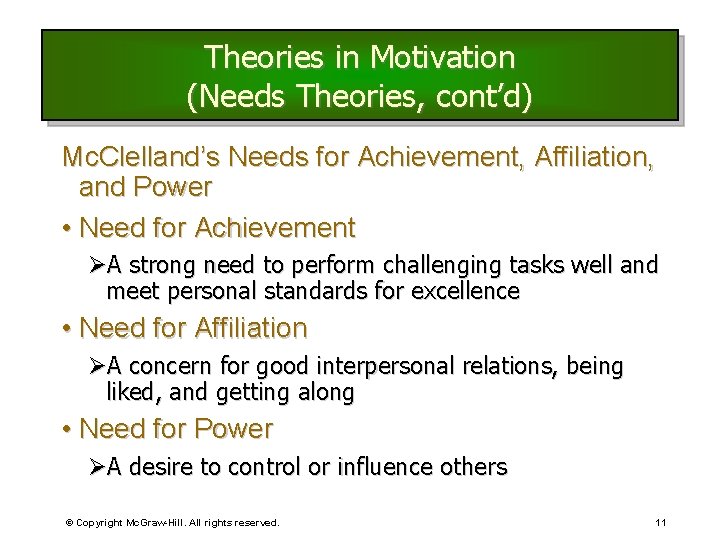
Theories in Motivation (Needs Theories, cont’d) Mc. Clelland’s Needs for Achievement, Affiliation, and Power • Need for Achievement ØA strong need to perform challenging tasks well and meet personal standards for excellence • Need for Affiliation ØA concern for good interpersonal relations, being liked, and getting along • Need for Power ØA desire to control or influence others © Copyright Mc. Graw-Hill. All rights reserved. 11
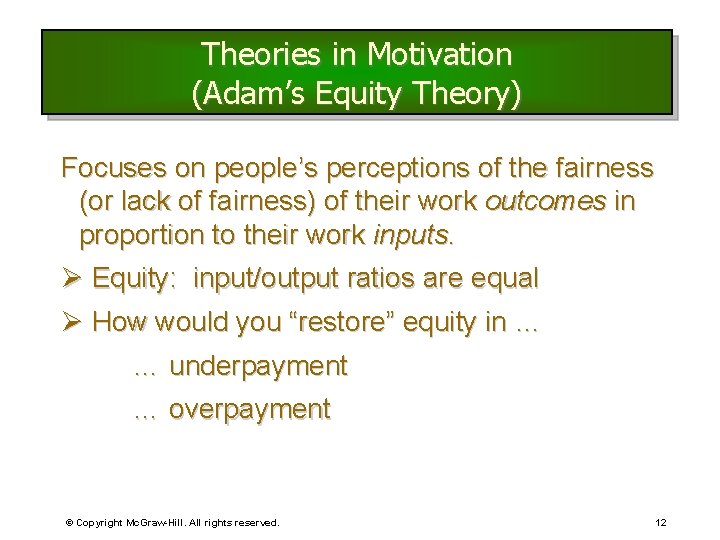
Theories in Motivation (Adam’s Equity Theory) Focuses on people’s perceptions of the fairness (or lack of fairness) of their work outcomes in proportion to their work inputs. Ø Equity: input/output ratios are equal Ø How would you “restore” equity in … … underpayment … overpayment © Copyright Mc. Graw-Hill. All rights reserved. 12
Theories in Motivation (Goal Setting Theory) • Focuses on identifying the types of goals that are effective in producing high levels of motivation and explaining why goals have these effects. • Goals must be: ØSpecific ØDifficult ØInclude feedback © Copyright Mc. Graw-Hill. All rights reserved. 13
Theories in Motivation (Learning Theories) • Theories that focus on increasing motivation and performance by linking outcomes to performance and the attainment of goals. • Learning ØA relatively permanent change in person’s knowledge or behavior that results from practice or experience. © Copyright Mc. Graw-Hill. All rights reserved. 14
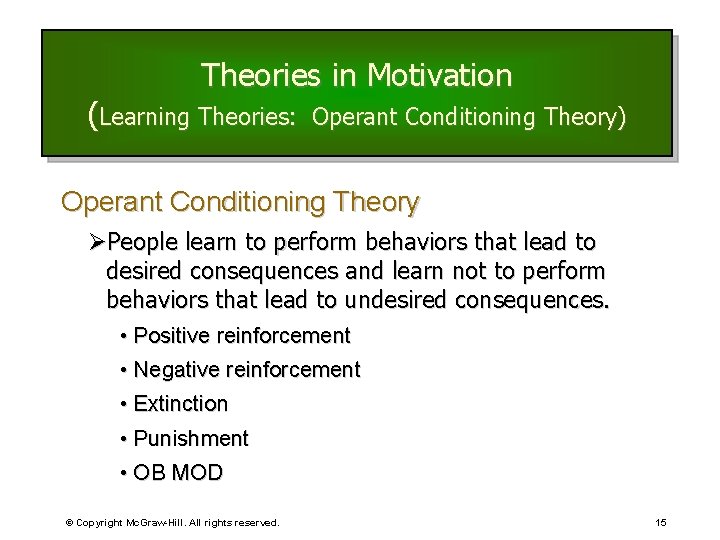
Theories in Motivation (Learning Theories: Operant Conditioning Theory) Operant Conditioning Theory ØPeople learn to perform behaviors that lead to desired consequences and learn not to perform behaviors that lead to undesired consequences. • Positive reinforcement • Negative reinforcement • Extinction • Punishment • OB MOD © Copyright Mc. Graw-Hill. All rights reserved. 15
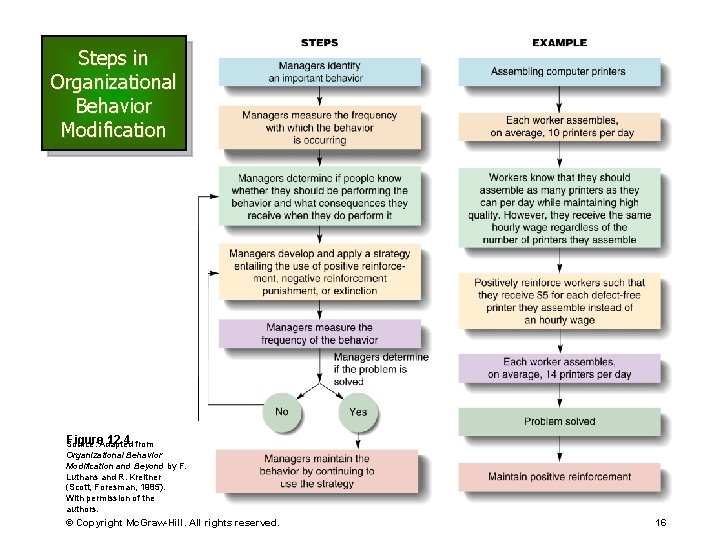
Steps in Organizational Behavior Modification Figure. Adapted 12. 4 from Source: Organizational Behavior Modification and Beyond by F. Luthans and R. Kreitner (Scott, Foresman, 1985). With permission of the authors. © Copyright Mc. Graw-Hill. All rights reserved. 16
Theories in Motivation (Learning Theories: Social Learning Theory) • A theory that takes into account how learning and motivation are influenced by people’s thoughts and beliefs and their observations of other people’s behavior. • Vicarious Learning (Observational Learning) ØLearning that occurs when a learner is motivated to perform a behavior by watching another person perform and be rewarded. • People are motivated to imitate models who are highly competent, expert, receive attractive reinforcers, and are friendly or approachable. © Copyright Mc. Graw-Hill. All rights reserved. 17
Theories in Motivation (Where does pay fit in? ) • Pay as a Motivator? ? ØExpectancy: pay is an instrumentality (and outcome), must be high for motivation to be high. ØNeed Theory: pay is used to satisfy many needs. ØEquity Theory: pay is given in relation to inputs. ØGoal Setting Theory: pay is linked to attainment of goals. ØLearning Theory: outcomes (pay), is distributed upon performance of functional behaviors. © Copyright Mc. Graw-Hill. All rights reserved. 18