
The Nature of Modern Corporate Finance and the


















- Slides: 46
The Nature of Modern Corporate Finance and the Objective of the Firm
Learning Objectives On completion of this topic you should be able to: • overview the history of modern finance • explain the contribution of theory to financial decision-making • discuss general principles of finance • identify the focus of finance and explain the differences and similarities between finance and accounting • describe the framework for financial decision-making • explain why firm’s exist and how this relates to the goal of the firm
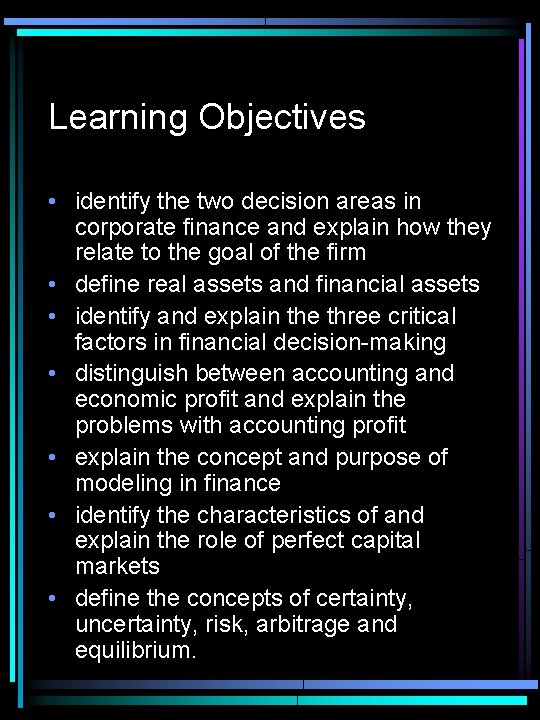
Learning Objectives • identify the two decision areas in corporate finance and explain how they relate to the goal of the firm • define real assets and financial assets • identify and explain the three critical factors in financial decision-making • distinguish between accounting and economic profit and explain the problems with accounting profit • explain the concept and purpose of modeling in finance • identify the characteristics of and explain the role of perfect capital markets • define the concepts of certainty, uncertainty, risk, arbitrage and equilibrium.
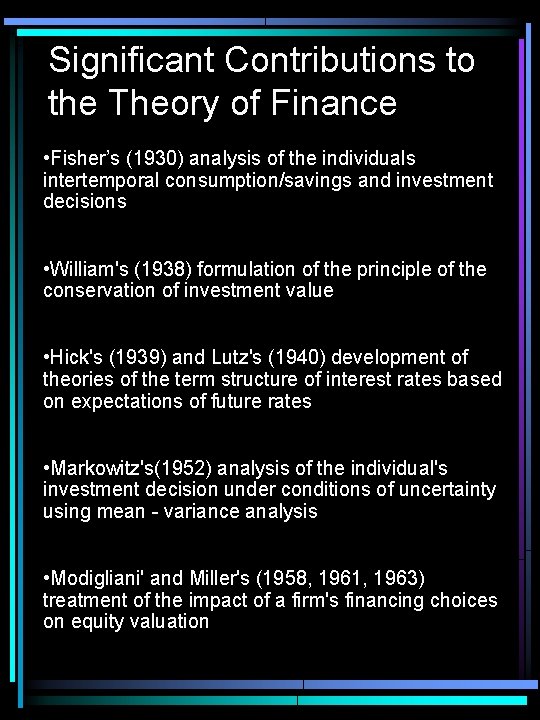
Significant Contributions to the Theory of Finance • Fisher’s (1930) analysis of the individuals intertemporal consumption/savings and investment decisions • William's (1938) formulation of the principle of the conservation of investment value • Hick's (1939) and Lutz's (1940) development of theories of the term structure of interest rates based on expectations of future rates • Markowitz's(1952) analysis of the individual's investment decision under conditions of uncertainty using mean - variance analysis • Modigliani' and Miller's (1958, 1961, 1963) treatment of the impact of a firm's financing choices on equity valuation
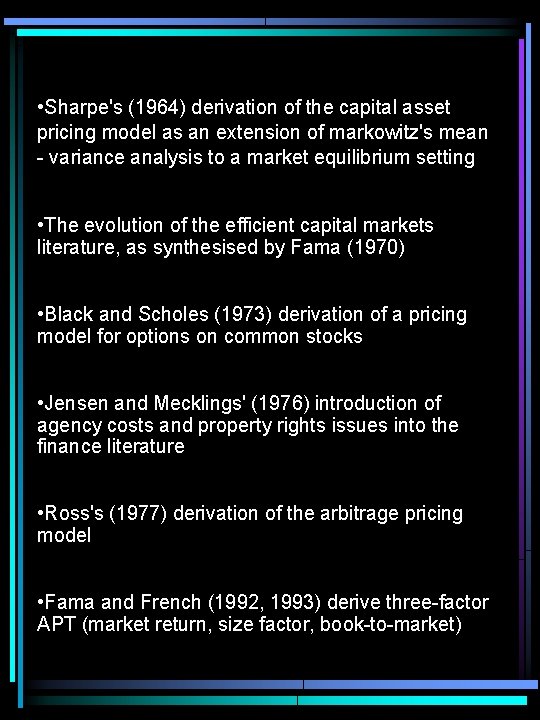
• Sharpe's (1964) derivation of the capital asset pricing model as an extension of markowitz's mean - variance analysis to a market equilibrium setting • The evolution of the efficient capital markets literature, as synthesised by Fama (1970) • Black and Scholes (1973) derivation of a pricing model for options on common stocks • Jensen and Mecklings' (1976) introduction of agency costs and property rights issues into the finance literature • Ross's (1977) derivation of the arbitrage pricing model • Fama and French (1992, 1993) derive three-factor APT (market return, size factor, book-to-market)
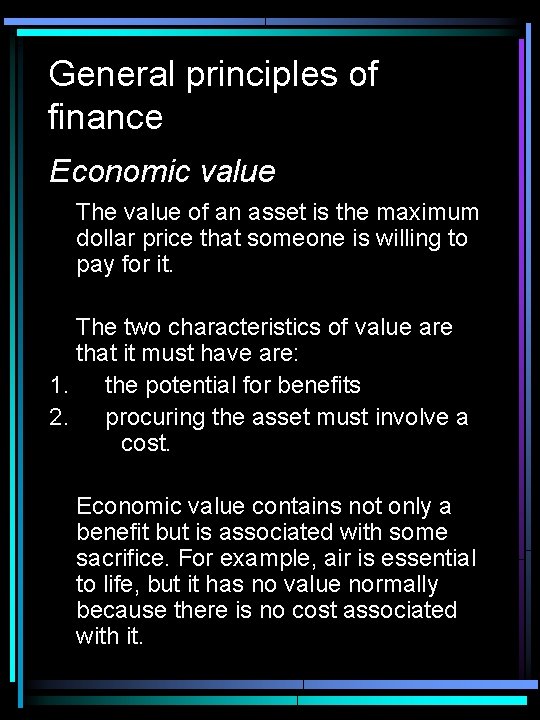
General principles of finance Economic value The value of an asset is the maximum dollar price that someone is willing to pay for it. The two characteristics of value are that it must have are: 1. the potential for benefits 2. procuring the asset must involve a cost. Economic value contains not only a benefit but is associated with some sacrifice. For example, air is essential to life, but it has no value normally because there is no cost associated with it.
Benefits are either tangible or intangible. Tangible benefits – • physical, easily quantifiable and therefore relatively easy to identify. • relevant in finding the value of an asset in finance and usually consist of the cash flow streams arising from the ownership of the asset eg working for an organisation provides a salary, or investment in stocks providing dividends and capital gains. Intangible benefits • not always quantifiable and is not always taken into account. • However, to the extent that impacts on demand for the asset, some assessment may have to be made. For example, prestige associated with working for a particular organisation.
Opportunity cost The true cost of anything is the most valuable alternative given up. The cost is termed opportunity cost. Example A • If we choose between A and B and we choose A, then we forego or sacrifice the alternative B. The incurred opportunity cost is the cost of the next best alternative.
Example B • If you buy a 12 -month Treasury bond to receive $1, 000 in 1 year, how is this valued? The government security is risk free, so the question might be, what is the best risk-free investment we can make over this time. If we assume that the best 12 month rate from a bank is 6%, then the value of the bond is: V 0 = 1, 000/1. 06 = $943. 40 If you pay more than $943. 40 you will lose money value because that value represents the best alternative investment in the same risk class. Note that the opportunity cost identifies the relevant discount rate in obtaining the value of the asset.
Price of bond Wealth at end of year Increase in wealth 900. 00 100. 00 943. 40 1000 56. 60 950. 00 1000 50. 00 Wealth at end of year if money is invested at 6% Price of bond Wealth at end of year Economic profit 900. 00 1000 954. 00 $46. 00 943. 40 1000. 00 - 950. 00 1007. 00 $ (7. 00) Thus accounting profit is made in all three cases but in only one case do you profit economically.
Economic profit is the excess profit that is gained from an investment over and above the profit that could be obtained from the best alternative foregone. That is: Economic profit = wealth increase refinanced wealth increase
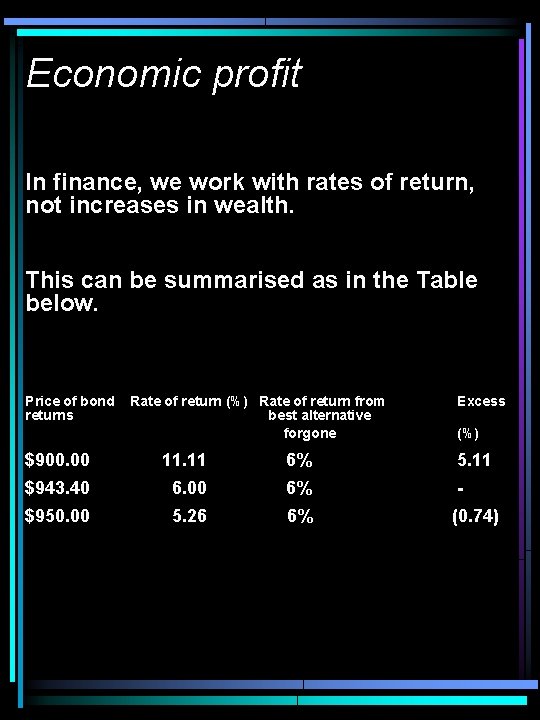
Economic profit In finance, we work with rates of return, not increases in wealth. This can be summarised as in the Table below. Price of bond returns Rate of return (%) Rate of return from best alternative forgone Excess (%) $900. 00 11. 11 6% 5. 11 $943. 40 6. 00 6% - $950. 00 5. 26 6% (0. 74)
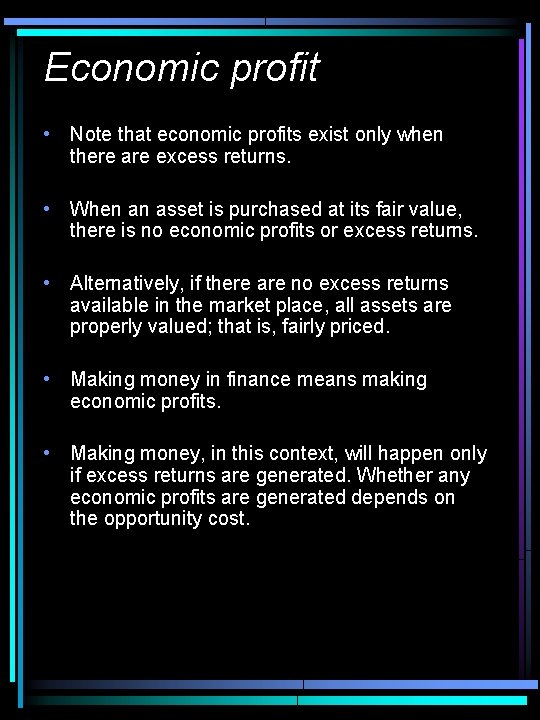
Economic profit • Note that economic profits exist only when there are excess returns. • When an asset is purchased at its fair value, there is no economic profits or excess returns. • Alternatively, if there are no excess returns available in the market place, all assets are properly valued; that is, fairly priced. • Making money in finance means making economic profits. • Making money, in this context, will happen only if excess returns are generated. Whether any economic profits are generated depends on the opportunity cost.
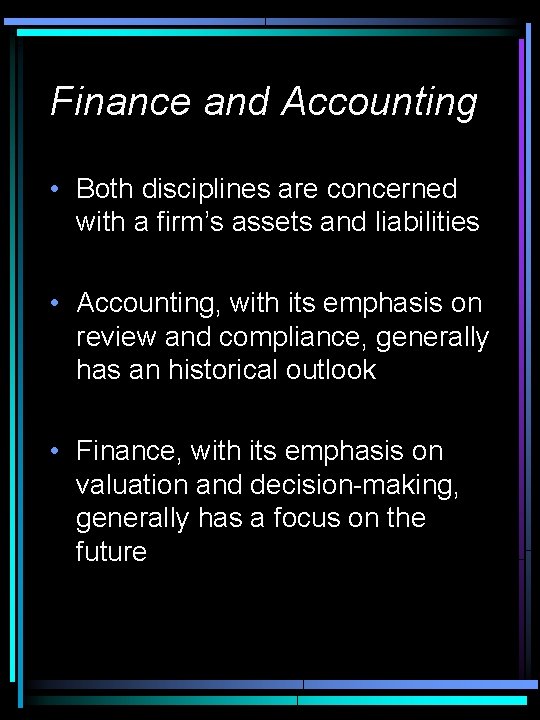
Finance and Accounting • Both disciplines are concerned with a firm’s assets and liabilities • Accounting, with its emphasis on review and compliance, generally has an historical outlook • Finance, with its emphasis on valuation and decision-making, generally has a focus on the future
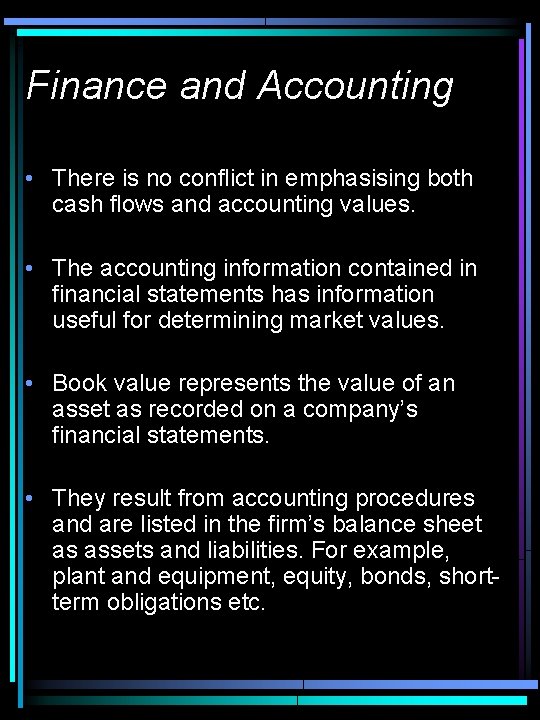
Finance and Accounting • There is no conflict in emphasising both cash flows and accounting values. • The accounting information contained in financial statements has information useful for determining market values. • Book value represents the value of an asset as recorded on a company’s financial statements. • They result from accounting procedures and are listed in the firm’s balance sheet as assets and liabilities. For example, plant and equipment, equity, bonds, shortterm obligations etc.
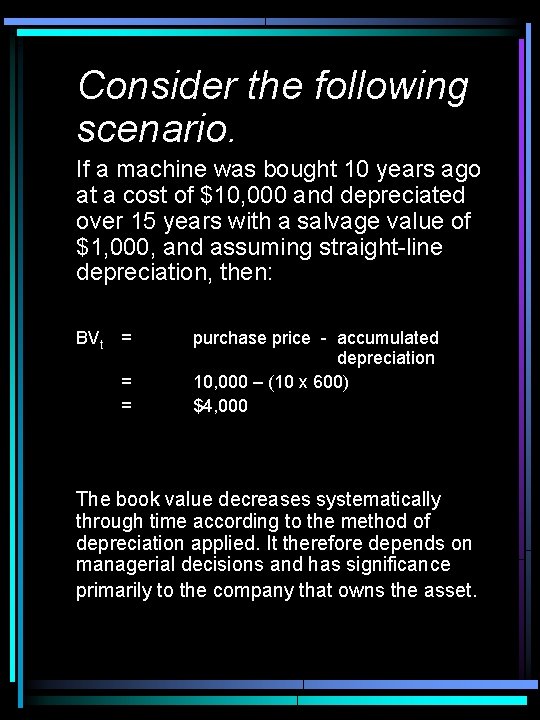
Consider the following scenario. If a machine was bought 10 years ago at a cost of $10, 000 and depreciated over 15 years with a salvage value of $1, 000, and assuming straight-line depreciation, then: BVt = = = purchase price - accumulated depreciation 10, 000 – (10 x 600) $4, 000 The book value decreases systematically through time according to the method of depreciation applied. It therefore depends on managerial decisions and has significance primarily to the company that owns the asset.
Now consider. Given the total net worth (shareholder’s equity) is $88 million and there are 5 million shares outstanding, then BV/share = 88, 000, 00 5, 000 = $17. 60
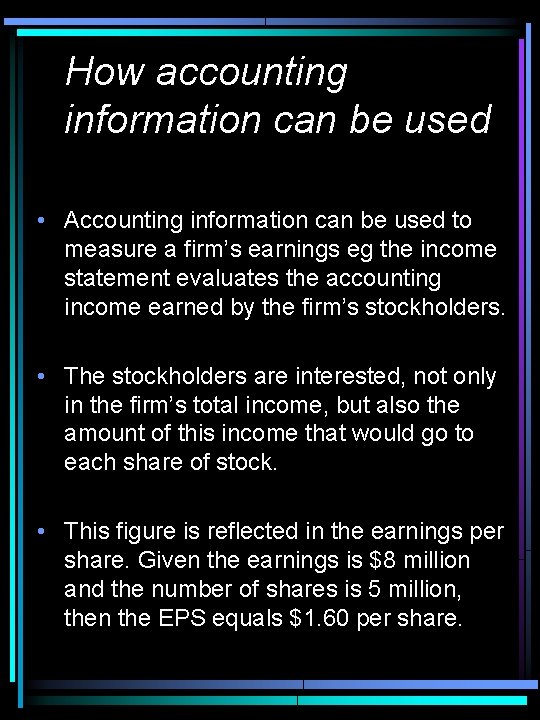
How accounting information can be used • Accounting information can be used to measure a firm’s earnings eg the income statement evaluates the accounting income earned by the firm’s stockholders. • The stockholders are interested, not only in the firm’s total income, but also the amount of this income that would go to each share of stock. • This figure is reflected in the earnings per share. Given the earnings is $8 million and the number of shares is 5 million, then the EPS equals $1. 60 per share.
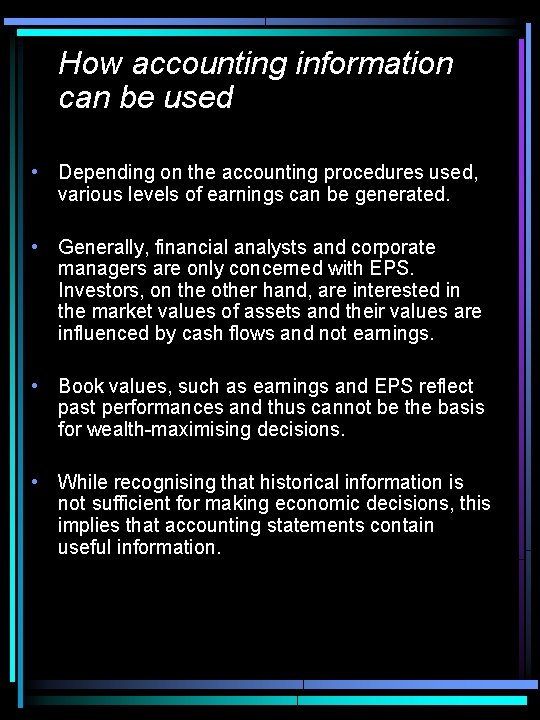
How accounting information can be used • Depending on the accounting procedures used, various levels of earnings can be generated. • Generally, financial analysts and corporate managers are only concerned with EPS. Investors, on the other hand, are interested in the market values of assets and their values are influenced by cash flows and not earnings. • Book values, such as earnings and EPS reflect past performances and thus cannot be the basis for wealth-maximising decisions. • While recognising that historical information is not sufficient for making economic decisions, this implies that accounting statements contain useful information.
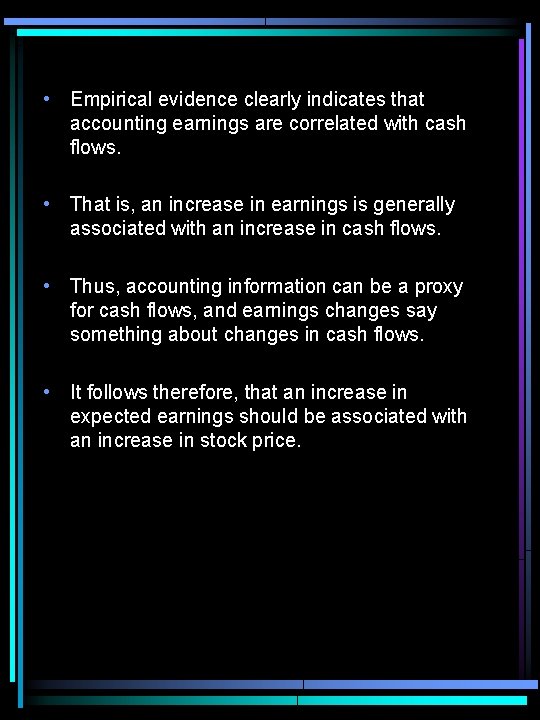
• Empirical evidence clearly indicates that accounting earnings are correlated with cash flows. • That is, an increase in earnings is generally associated with an increase in cash flows. • Thus, accounting information can be a proxy for cash flows, and earnings changes say something about changes in cash flows. • It follows therefore, that an increase in expected earnings should be associated with an increase in stock price.
• To extend this argument, if managers are given various incentives for boosting earnings then this should increase stock prices. • There is no doubt that accounting manipulation can misrepresent earnings and the market might increase stock prices based on incorrect estimates of cash flows. • Studies have shown that the market is not generally misled by market manipulations. • Market participants look to a firm’s fundamental economic performance as reflected in its cash flows and risk and they appear to be good at examining accounting data and extracting the relevant information about cash flows.
• The balance sheet provides a statement of the firm’s assets and liabilities at a particular time. • An income statement summarises the outcome of the firm’s operation as they affect its net income, and the statement of retained earnings shows the increase in book value during a given period. • The latter allows an analysis of how management’s decisions have affected the firm’s cash flows. • This statement cites the cash inflows and cash outflows based on operational, financial and investment decisions.
• It is true however, that the bulk of accounting information is that of compliance with statutory regulations as well as planning from a corporate sense. • The transactions data is real, tangible and recorded or past data. • The financial analyst uses this data to project and estimate future cash flow in order to make current financial decisions.
The focus of financial decisions • Organisations need capital, both physical and human capital, to produce goods and services. • Physical capital includes financial assets and real assets and these may be converted from one form to another. For example, cash may be converted into plant and equipment, pay salaries, purchase raw materials etc. • Human capital is an intangible and includes the company’s productive human resources. • The intellectual and entrepreneurial skills of management and the enthusiasm of the employees are examples of human capital.
The focus of financial decisions • A firm needs to invest in real assets in order to produce goods and services. • The firm’s managers must decide what assets to own, and what mix of fixed assets and what mix of current assets will best facilitate the firm’s production of goods and services—the investment decision.
The focus of financial decisions • The company needs to finance its assets by acquiring cash from the financial markets. Should they be debt, should they be equity, should they be long-term or short-term? These are the financial decisions. • The broad decisions of investment and finance are the responsibility of the finance manager and the art and science of making the right decisions for the firm is called financial management.
Valuation in finance • Valuation in finance is determining the benefits (cash flow stream) from the asset and discounting this cash flow stream at the opportunity cost of capital. • This opportunity cost is known as the required rate of return (RRR). • That is, valuation is the process of capitalising a cash flow stream at the appropriate RRR.
Modelling in finance • Modelling conjures in the mind physical images , such as ships, planes, cars, and mathematical images, such as precise relationships under certain assumptions. • In finance a model is a simplification and an abstraction of reality • The purpose of a model is to explain and predict - not describe • The usefulness of a model is judged by how well it explains and predicts i. e. by its accuracy
Modelling in finance 1. Mathematical models 2. Relatively simple 3. Basis in economic theory 4. General models adaptable 5. Involve use of statistics 6. Tested with empirical data
Perfect capital markets Perfect markets is an idealised version of capital markets. Characteristics: • No Taxes • • No Transaction Costs Information is costless and accessible to all market participants No Price-makers All participants can borrow and lend at the same interest rate
Equilibrium and Arbitrage • Arbitrage simply means finding two things that are essentially the same and buying the cheaper and selling the more expensive. • The arbitrage pricing theory states that the price of an asset depends on multiple factors. The theory (developed by Stephen Ross) says that in competitive financial markets, arbitrage will assure equilibrium pricing according to risk and return.
• Applied to the valuation of securities, two securities deemed to have the same risk characteristics should provide the same expected return. • If this is not the case, investors rush to buy the security with the higher expected return and sell the security with the lower expected return. • Price adjustments occur whilst arbitrageurs think that the securities are mis-priced. • Rational market participants will exhaust all arbitrage opportunities until all securities bear a linear relationship between the risk and return characteristics so that the market is continually moving towards an equilibrium position.
Uncertainty, risk, and the risk/return relationship • In finance, uncertainty involves the realisation of all the possible outcomes of a certain act. • Risk, on the other hand, is the applying probabilities to the possible outcomes. Thus, risk is quantifiable uncertainty. • The analysis of the risk of stock, capital investment etc. , must be incorporated into the valuation process to provide a more realistic assessment of value.
Framework for financial decisions The goal of the firm • The goal of the firm is to make decisions that will serve the best interest of its owners. • The firm must attempt to maximise the welfare of its residual claimants (shareholders). • This approach must take into account the existence of multiple stakeholders employees, customers, government, surrounding community etc. , because of the capacity of stakeholders to withhold resources critical to the firm’s activities.
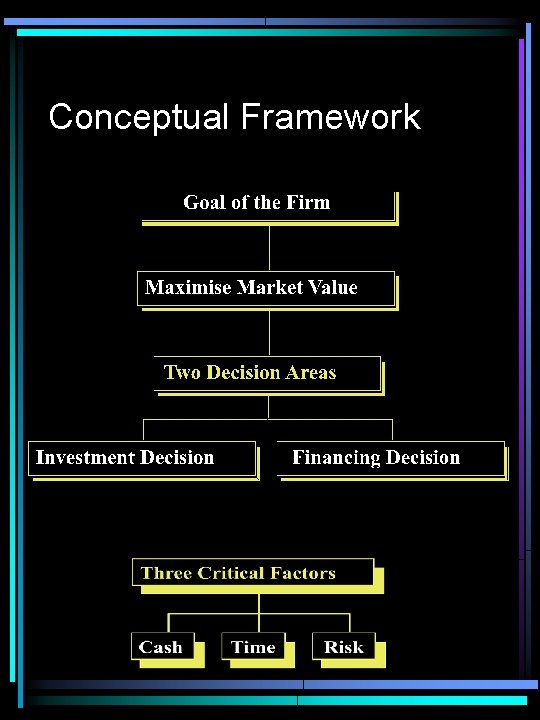
Framework for financial decisions Goal of the firm is to maximise its market value
Conceptual Framework
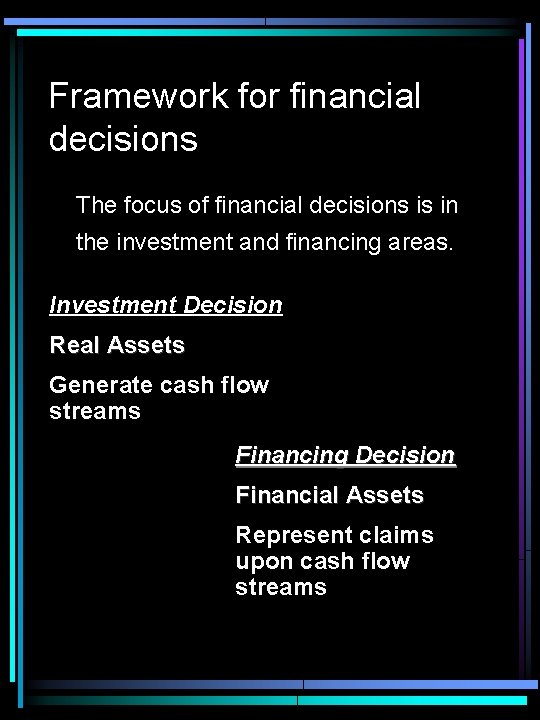
Framework for financial decisions The focus of financial decisions is in the investment and financing areas. Investment Decision Real Assets Generate cash flow streams Financing Decision Financial Assets Represent claims upon cash flow streams
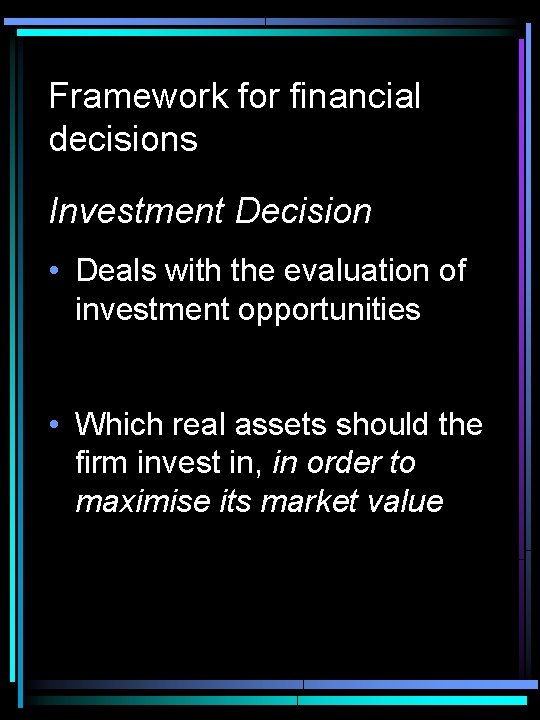
Framework for financial decisions Investment Decision • Deals with the evaluation of investment opportunities • Which real assets should the firm invest in, in order to maximise its market value
Framework for financial decisions Financing Decision • Deals with determination of the firm's capital structure • How should the firm finance the investment in real assets, in order to maximise its market value. • Involves the Dividend Decision
Critical factors in decisionmaking There are three critical factors in decision-making: 1. 2. 3. Cash Time Risk. The valuation process relies on estimates of the income stream provided by the asset, the risk inherent in the asset and the discount rate adopted in any assessment of value and the timing related to any cash flow stream.
Framework for financial decisions Cash: Focus is always on cash flows, not accounting earnings. Time: Money has a time value. Decision making in finance must take account of the timing of the cash flows. Risk: Risk refers to variability of a cash flow stream. Adjustments must be made to take account of differing degrees of variability The risk-return relationship must always be kept in mind
Rationale for Maximisation of the Market Value Goal • The maximisation of the market price per share is the cumulative judgement of all market participants as to the value of the firm taking into account prospective future earnings per share, the timing duration and risk of these earnings, the dividend policy of the company and other factors that impact on its value. • The market price serves as a barometer for business performance. • It provides the best indicator due to the influence of factors both within and outside of management’s control.
Agency problems • Maximising shareholder’s wealth is the only meaningful goal when the firm’s manager is both the owner and stockholder. A problem arises when this is not so. • Conflict of interest can and does occur. Managers are paid salaries and given other benefits by the company to make decisions on behalf of the firm’s owners. • The manager is really the agent acting on behalf of the principal (equity holder).
Agency problems • Managers tend to pursue their own self interest. If managers make decisions that are not in the best interest of shareholders but reflect self interest, then such actions will lower the wealth of the firm. The loss in value is the agency cost. • Although the pecuniary benefits (salary, retirement benefits, bonuses, etc. ) that managers can expect are stipulated in their employment contract, there are many non-pecuniary benefits that managers can give themselves. • They may choose to work less, take extended lunch breaks, extend travel arrangements beyond what is necessary, spend additional funds on offices and cars etc.
Agency problems • As a result resources are diverted from production and the overall value of the firm diminishes. • There is informational asymmetry in that managers are insiders and privy to future plans which for competitive reasons may need to be shrouded in secrecy. • Managers may hide behind this veil and not necessarily act in the best interest of shareholders.
Recap • General Concepts/Principles of Finance – Economic Value/Profit (Opportunity Cost) – Finance and Accounting – The Focus of Financial Decision Making – Valuation in Finance – Modelling in Finance – Perfect Capital Markets – Equilibrium and Arbitrage – Certainty, Uncertainty and Risk • Framework for Financial Decision Making– The Goal of the Firm – Two Decision Areas – Three Critical Factors in Financial Decision Making • Rationale for Maximization of Market Value • Agency Problems