
The Nature of Light Chapter Five Partially Complete

- Slides: 35
The Nature of Light Chapter Five Partially Complete as of Sep. 24, 2007
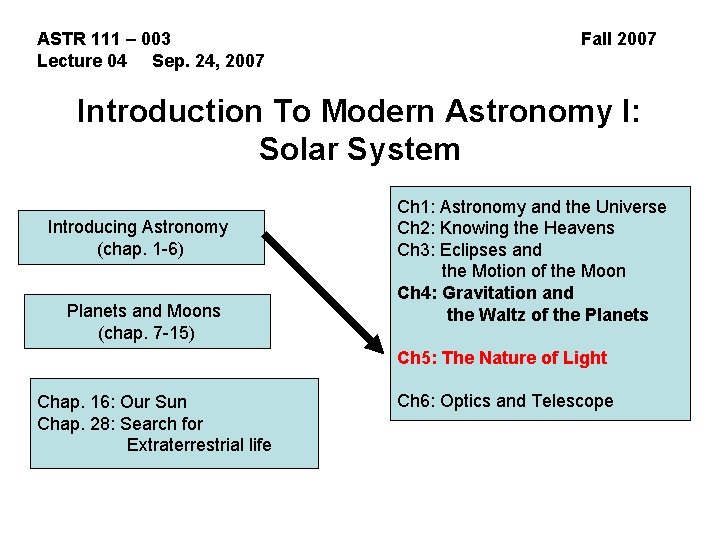
ASTR 111 – 003 Lecture 04 Sep. 24, 2007 Fall 2007 Introduction To Modern Astronomy I: Solar System Introducing Astronomy (chap. 1 -6) Planets and Moons (chap. 7 -15) Ch 1: Astronomy and the Universe Ch 2: Knowing the Heavens Ch 3: Eclipses and the Motion of the Moon Ch 4: Gravitation and the Waltz of the Planets Ch 5: The Nature of Light Chap. 16: Our Sun Chap. 28: Search for Extraterrestrial life Ch 6: Optics and Telescope
Speed of Light • The speed of light in the vacuum – C = 299, 792. 458 km/s, or – C = 3. 00 X 105 km/s = 3. 00 X 108 m/s • It takes the light 500 seconds traveling 1 AU.
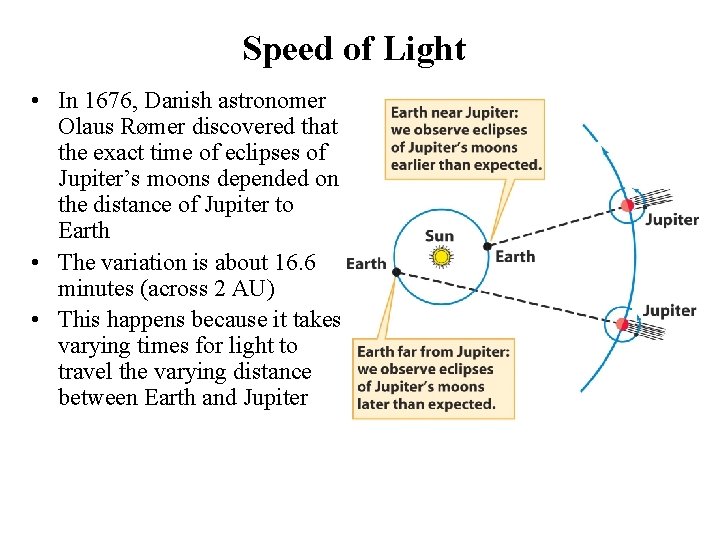
Speed of Light • In 1676, Danish astronomer Olaus Rømer discovered that the exact time of eclipses of Jupiter’s moons depended on the distance of Jupiter to Earth • The variation is about 16. 6 minutes (across 2 AU) • This happens because it takes varying times for light to travel the varying distance between Earth and Jupiter
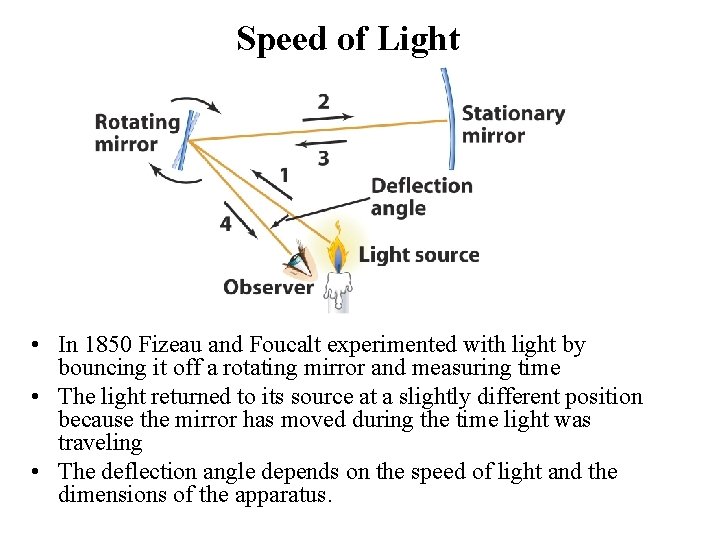
Speed of Light • In 1850 Fizeau and Foucalt experimented with light by bouncing it off a rotating mirror and measuring time • The light returned to its source at a slightly different position because the mirror has moved during the time light was traveling • The deflection angle depends on the speed of light and the dimensions of the apparatus.
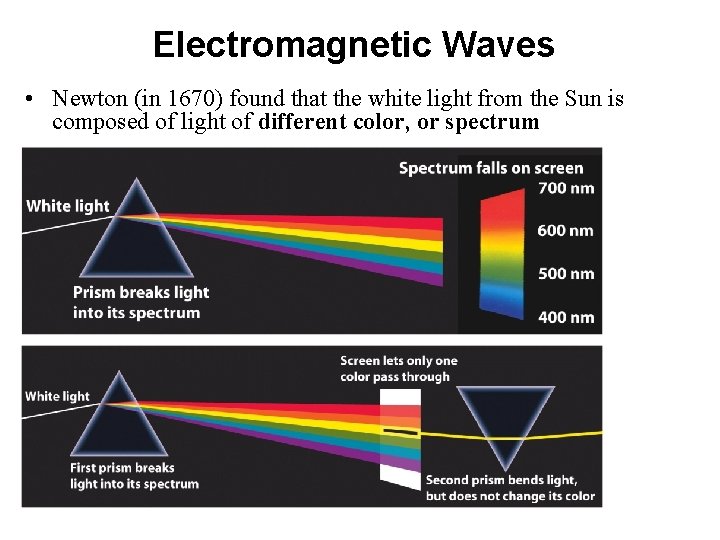
Electromagnetic Waves • Newton (in 1670) found that the white light from the Sun is composed of light of different color, or spectrum
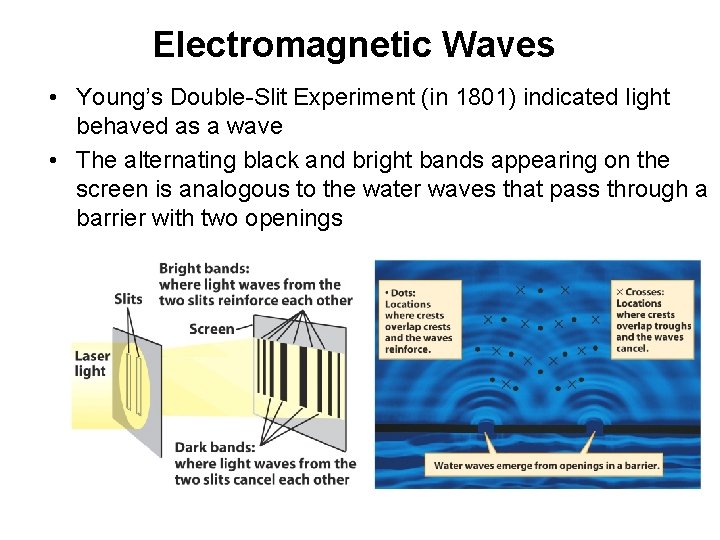
Electromagnetic Waves • Young’s Double-Slit Experiment (in 1801) indicated light behaved as a wave • The alternating black and bright bands appearing on the screen is analogous to the water waves that pass through a barrier with two openings
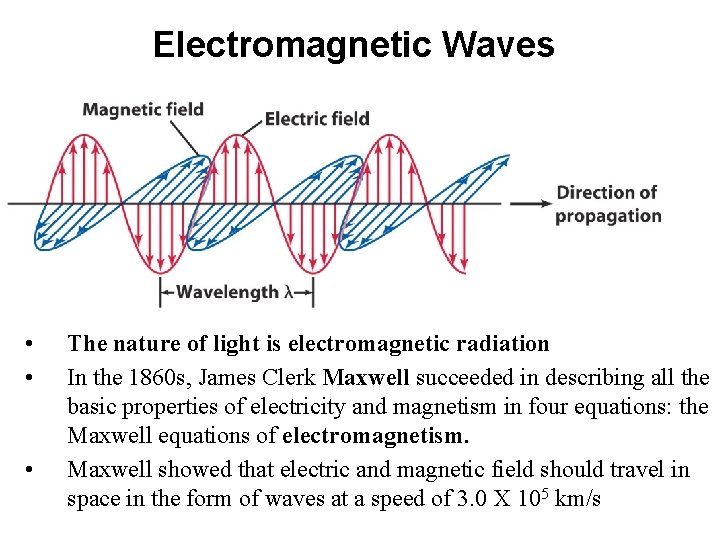
Electromagnetic Waves • • • The nature of light is electromagnetic radiation In the 1860 s, James Clerk Maxwell succeeded in describing all the basic properties of electricity and magnetism in four equations: the Maxwell equations of electromagnetism. Maxwell showed that electric and magnetic field should travel in space in the form of waves at a speed of 3. 0 X 105 km/s
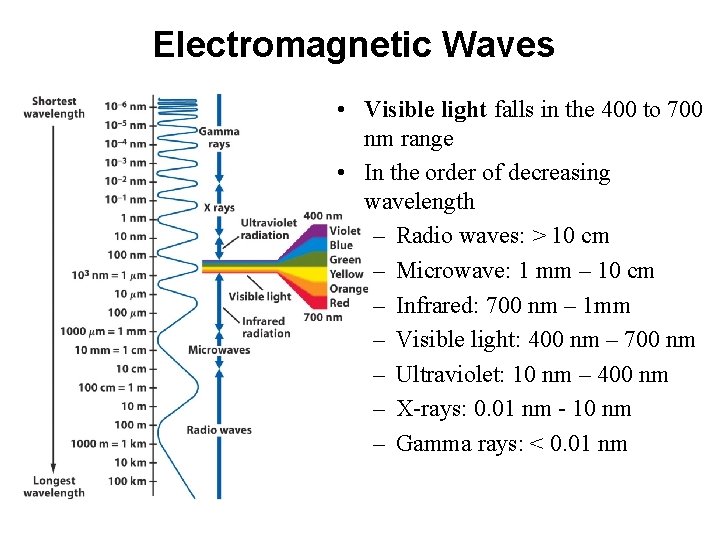
Electromagnetic Waves • Visible light falls in the 400 to 700 nm range • In the order of decreasing wavelength – Radio waves: > 10 cm – Microwave: 1 mm – 10 cm – Infrared: 700 nm – 1 mm – Visible light: 400 nm – 700 nm – Ultraviolet: 10 nm – 400 nm – X-rays: 0. 01 nm - 10 nm – Gamma rays: < 0. 01 nm
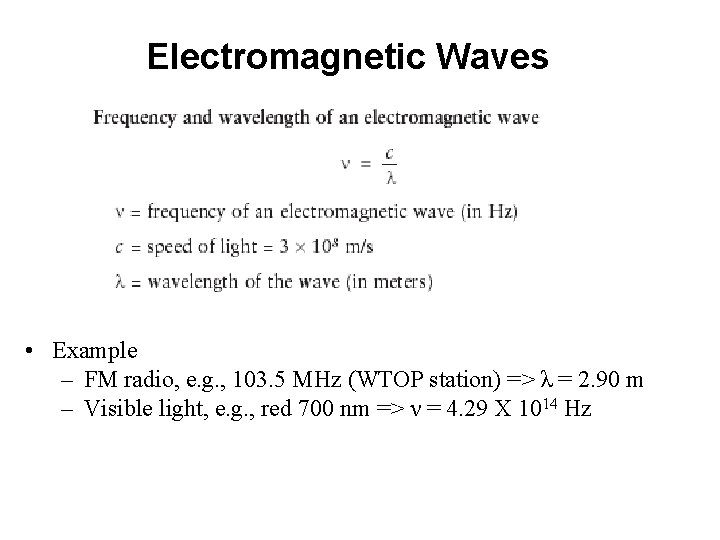
Electromagnetic Waves • Example – FM radio, e. g. , 103. 5 MHz (WTOP station) => λ = 2. 90 m – Visible light, e. g. , red 700 nm => ν = 4. 29 X 1014 Hz
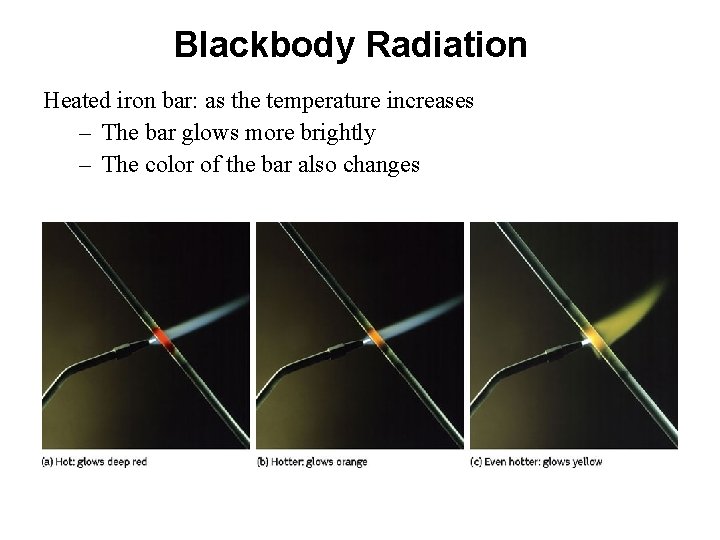
Blackbody Radiation Heated iron bar: as the temperature increases – The bar glows more brightly – The color of the bar also changes
Blackbody Radiation • A blackbody is a hypothetical object that is a perfect absorber of electromagnetic radiation at all wavelengths – The radiation of a blackbody is entirely the result of its temperature – A blackbody does not reflect any light at all
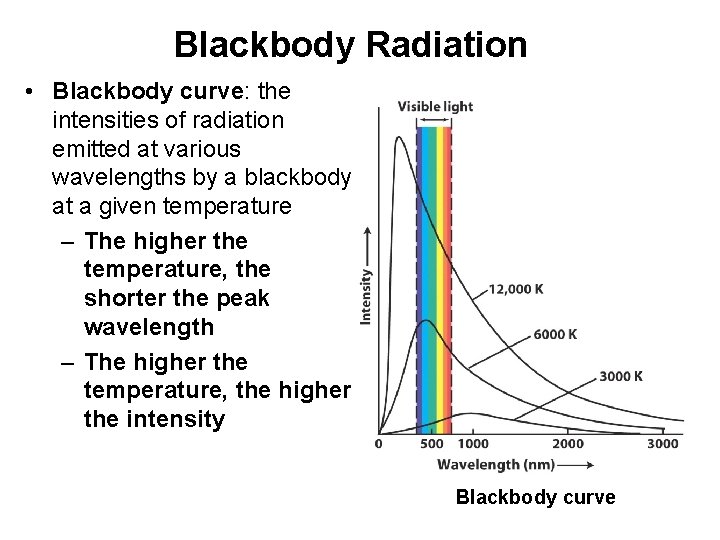
Blackbody Radiation • Blackbody curve: the intensities of radiation emitted at various wavelengths by a blackbody at a given temperature – The higher the temperature, the shorter the peak wavelength – The higher the temperature, the higher the intensity Blackbody curve
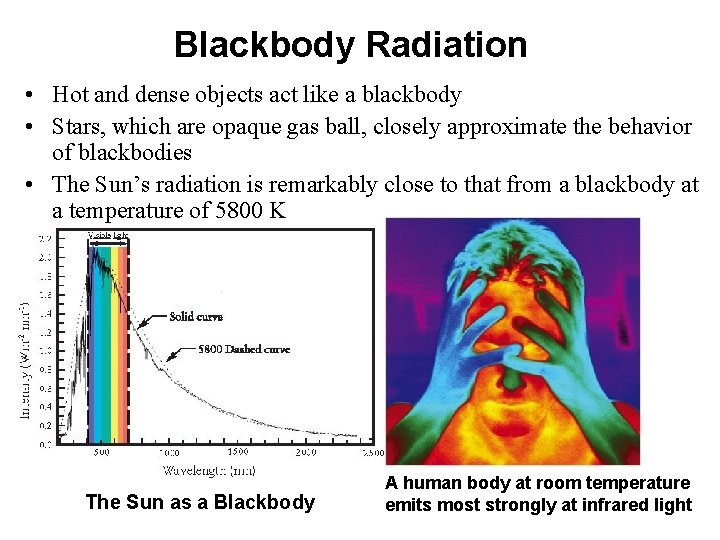
Blackbody Radiation • Hot and dense objects act like a blackbody • Stars, which are opaque gas ball, closely approximate the behavior of blackbodies • The Sun’s radiation is remarkably close to that from a blackbody at a temperature of 5800 K The Sun as a Blackbody A human body at room temperature emits most strongly at infrared light
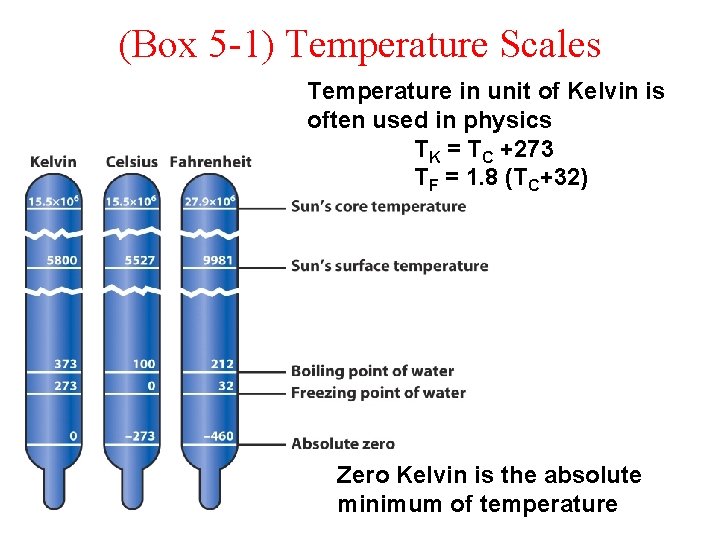
(Box 5 -1) Temperature Scales Temperature in unit of Kelvin is often used in physics TK = TC +273 TF = 1. 8 (TC+32) Zero Kelvin is the absolute minimum of temperature
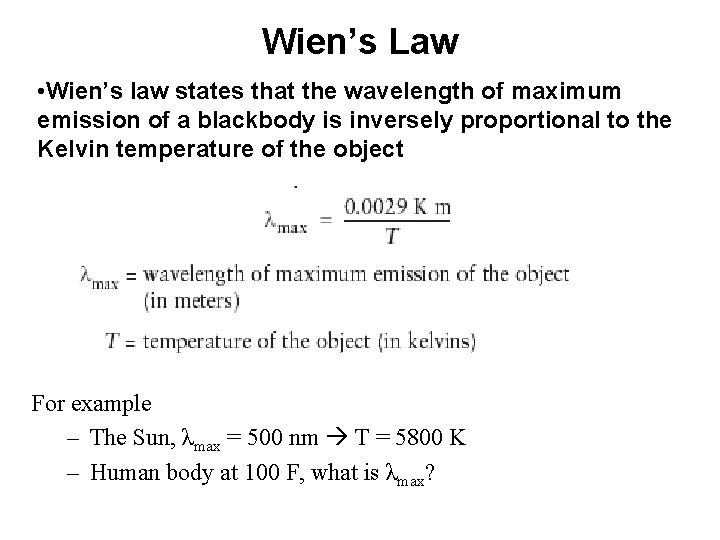
Wien’s Law • Wien’s law states that the wavelength of maximum emission of a blackbody is inversely proportional to the Kelvin temperature of the object For example – The Sun, λmax = 500 nm T = 5800 K – Human body at 100 F, what is λmax?
(Box 5 -2) Wien’s Law Sirius, the brightest star (also called dog star, in Canis Major) in the night sky, has a surface temperature of 10, 000 K. Find the wavelength at which Sirius emits most intensely?
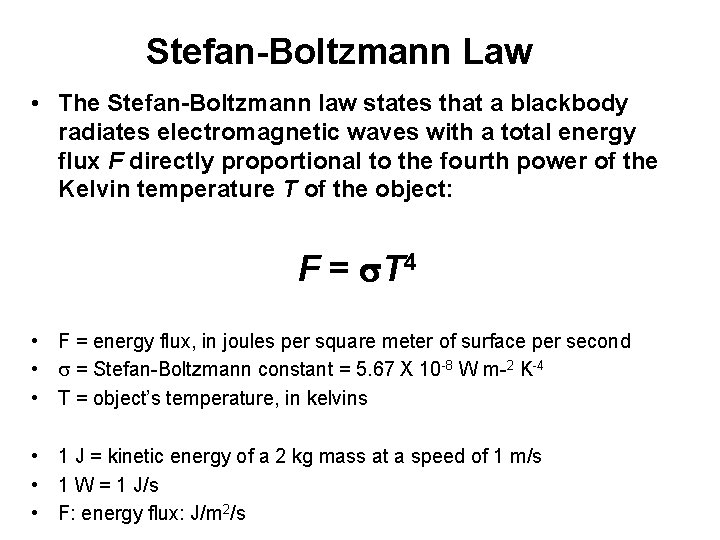
Stefan-Boltzmann Law • The Stefan-Boltzmann law states that a blackbody radiates electromagnetic waves with a total energy flux F directly proportional to the fourth power of the Kelvin temperature T of the object: F = T 4 • F = energy flux, in joules per square meter of surface per second • = Stefan-Boltzmann constant = 5. 67 X 10 -8 W m-2 K-4 • T = object’s temperature, in kelvins • 1 J = kinetic energy of a 2 kg mass at a speed of 1 m/s • 1 W = 1 J/s • F: energy flux: J/m 2/s
(Box 5 -2) Stefan-Boltzmann Law Sirius, the brightest star (also called dog star, in Canis Major) in the night sky, has a surface temperature of 10, 000 K. How does the energy flux from Sirius compare to the Sun’s energy flux?
Dual properties of Light: (1) waves and (2) particles • Light is an electromagnetic radiation wave, e. g, Young’s double slit experiment • Light is also a particle-like packet of energy – Light packet is called photon – The energy of phone is related to the wavelength of light • Light has a dual personality; it behaves as a stream of particle like photons, but each photon has wavelike properties
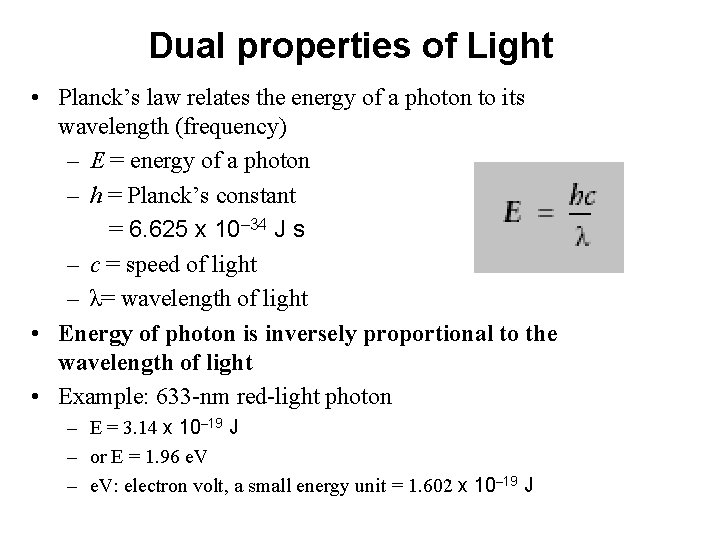
Dual properties of Light • Planck’s law relates the energy of a photon to its wavelength (frequency) – E = energy of a photon – h = Planck’s constant = 6. 625 x 10– 34 J s – c = speed of light – λ= wavelength of light • Energy of photon is inversely proportional to the wavelength of light • Example: 633 -nm red-light photon – E = 3. 14 x 10– 19 J – or E = 1. 96 e. V – e. V: electron volt, a small energy unit = 1. 602 x 10– 19 J
(Box 5 -3) Planck’s Law The bar-code scanners used at supermarket emit orange-red light of wavelength 633 nm and consume a power 1 m. W. Calculate how many photons are emitted by second
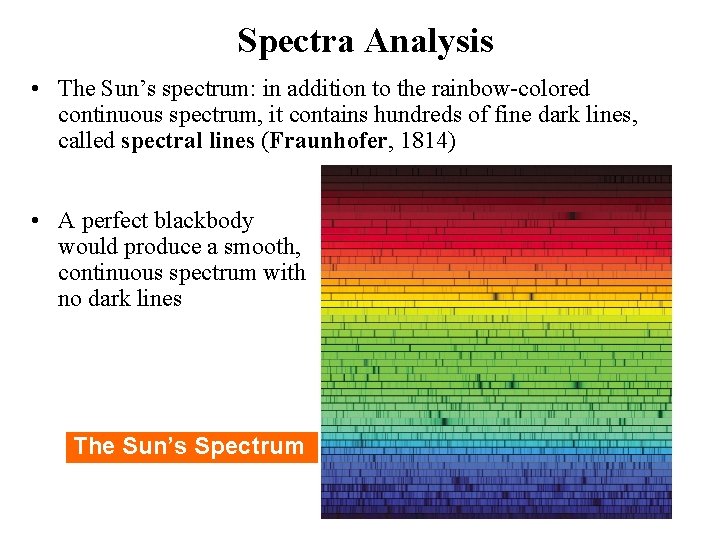
Spectra Analysis • The Sun’s spectrum: in addition to the rainbow-colored continuous spectrum, it contains hundreds of fine dark lines, called spectral lines (Fraunhofer, 1814) • A perfect blackbody would produce a smooth, continuous spectrum with no dark lines The Sun’s Spectrum
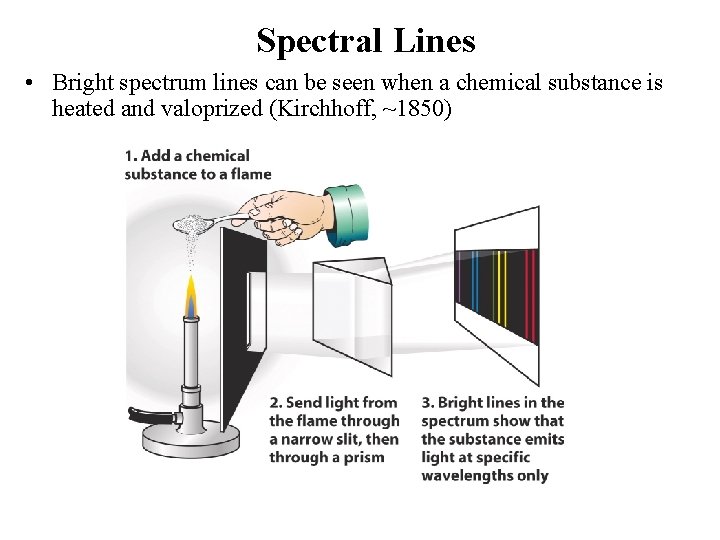
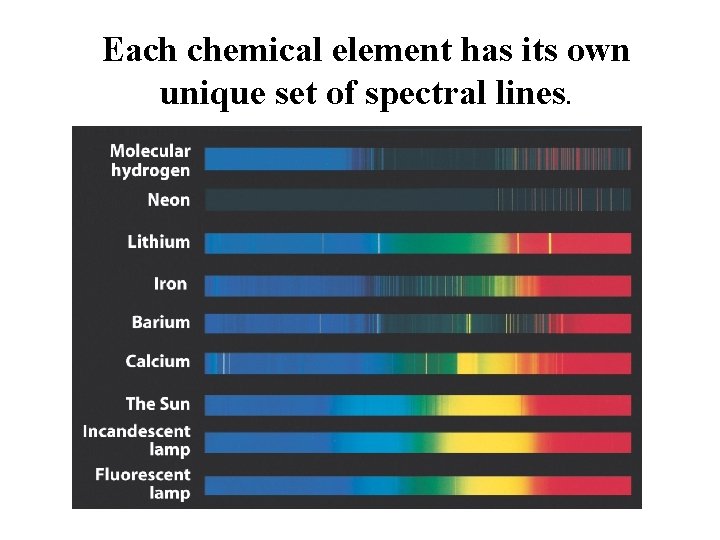
Spectral Lines • Bright spectrum lines can be seen when a chemical substance is heated and valoprized (Kirchhoff, ~1850)
Each chemical element has its own unique set of spectral lines.
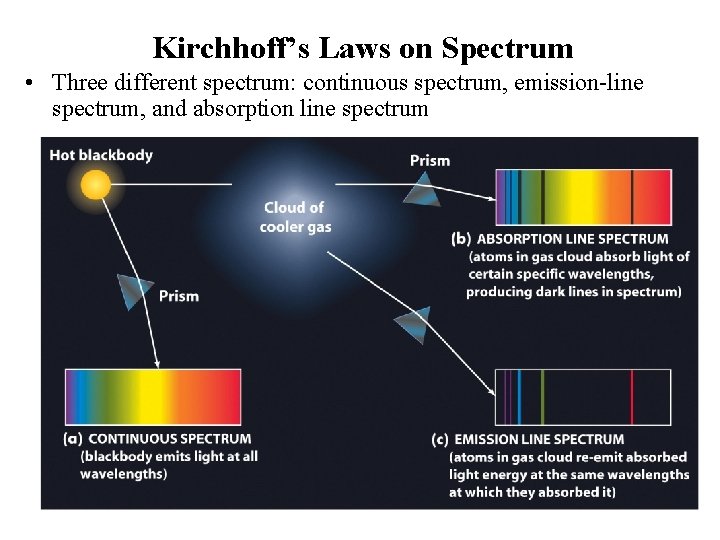
Kirchhoff’s Laws on Spectrum • Three different spectrum: continuous spectrum, emission-line spectrum, and absorption line spectrum
Kirchhoff’s Laws on Spectrum • Law 1 - Continuous spectrum: a hot opaque body, such as a perfect blackbody, produce a continuous spectrum – a complete rainbow of colors without any spectral line • Law 2 – emission line spectrum: a hot, transparent gas produces an emission line spectrum – a series of bright spectral lines against a dark background • Law 3 – absorption line spectrum: a relatively cool, transparent gas in front of a source of a continuous spectrum produces an absorption line spectrum – a series of dark spectral lines amongst the colors of the continuous spectrum. Further, the dark lines of a particular gas occur at exactly the same wavelength as the bright lines of that same gas.
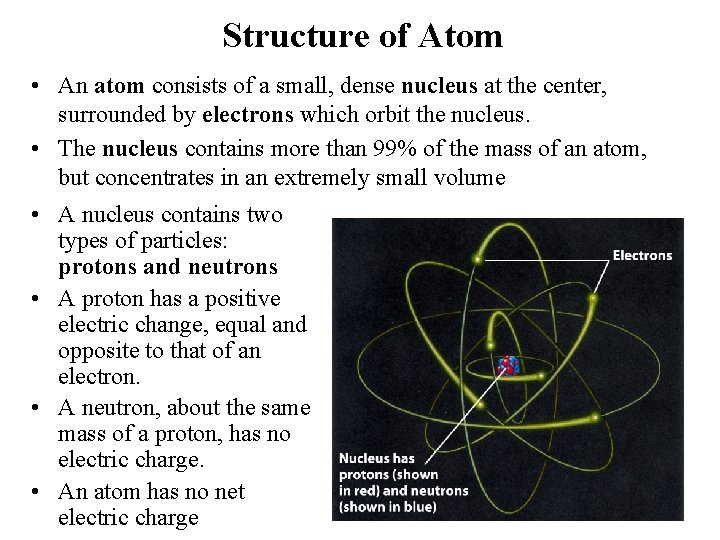
Structure of Atom • An atom consists of a small, dense nucleus at the center, surrounded by electrons which orbit the nucleus. • The nucleus contains more than 99% of the mass of an atom, but concentrates in an extremely small volume • A nucleus contains two types of particles: protons and neutrons • A proton has a positive electric change, equal and opposite to that of an electron. • A neutron, about the same mass of a proton, has no electric charge. • An atom has no net electric charge
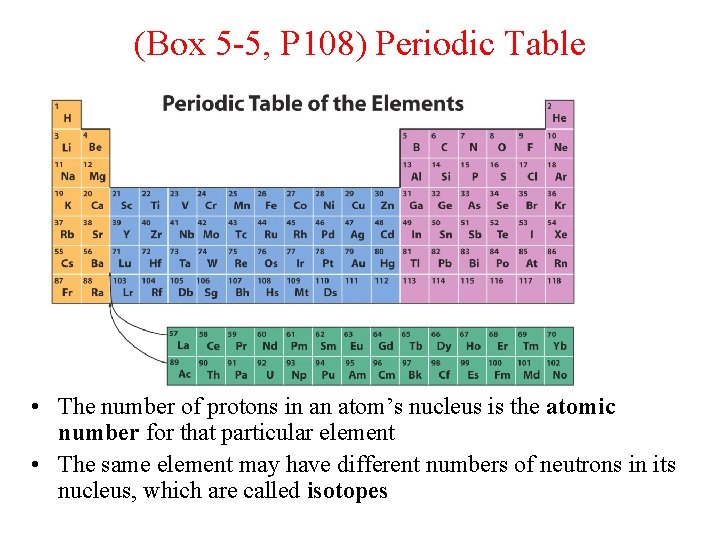
(Box 5 -5, P 108) Periodic Table • The number of protons in an atom’s nucleus is the atomic number for that particular element • The same element may have different numbers of neutrons in its nucleus, which are called isotopes
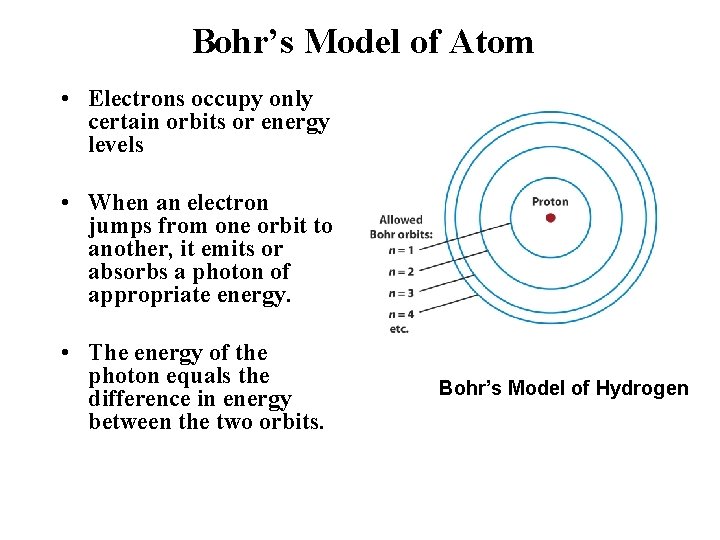
Bohr’s Model of Atom • Electrons occupy only certain orbits or energy levels • When an electron jumps from one orbit to another, it emits or absorbs a photon of appropriate energy. • The energy of the photon equals the difference in energy between the two orbits. Bohr’s Model of Hydrogen
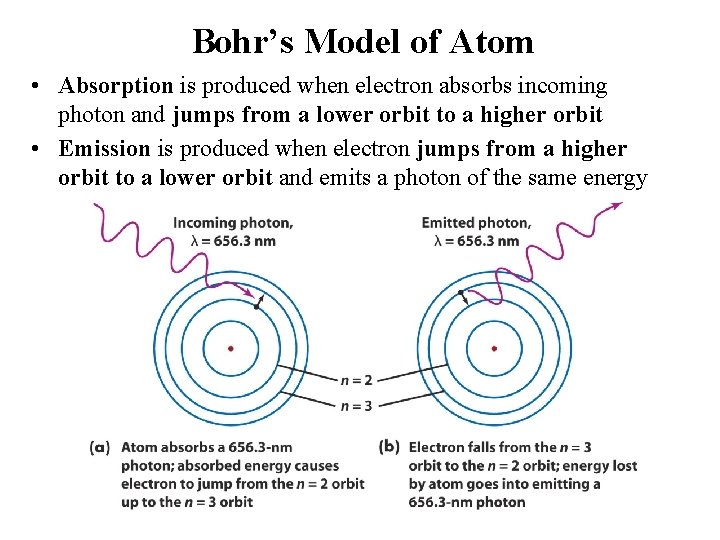
Bohr’s Model of Atom • Absorption is produced when electron absorbs incoming photon and jumps from a lower orbit to a higher orbit • Emission is produced when electron jumps from a higher orbit to a lower orbit and emits a photon of the same energy
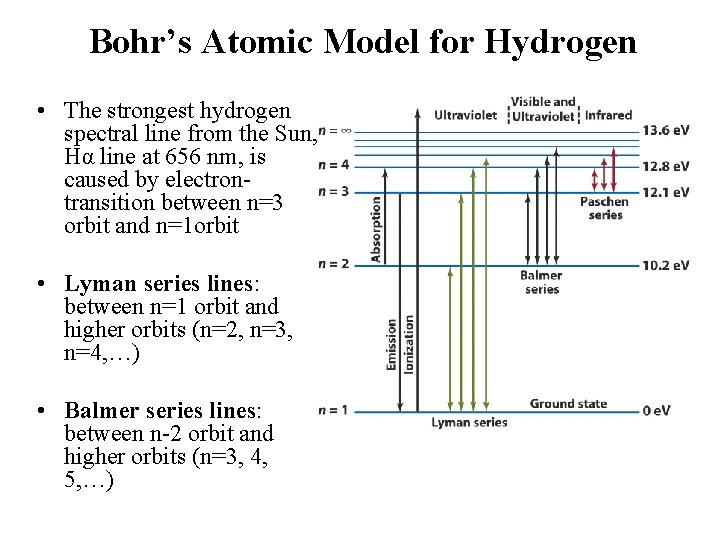
Bohr’s Atomic Model for Hydrogen • The strongest hydrogen spectral line from the Sun, Hα line at 656 nm, is caused by electrontransition between n=3 orbit and n=1 orbit • Lyman series lines: between n=1 orbit and higher orbits (n=2, n=3, n=4, …) • Balmer series lines: between n-2 orbit and higher orbits (n=3, 4, 5, …)
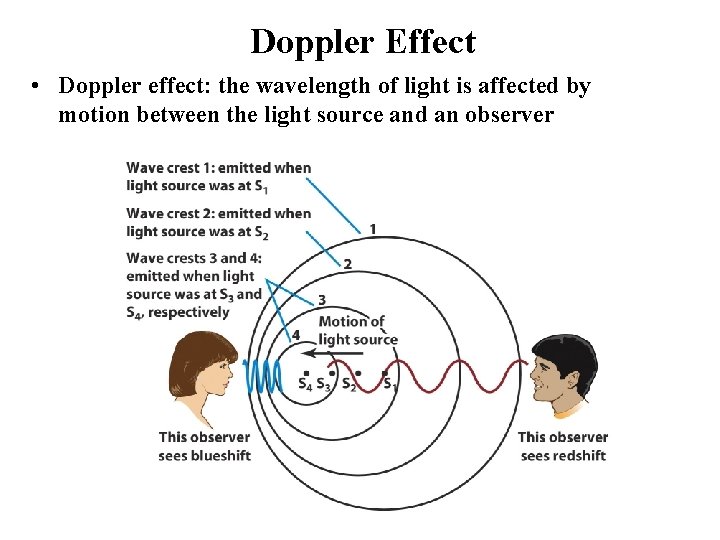
Doppler Effect • Doppler effect: the wavelength of light is affected by motion between the light source and an observer
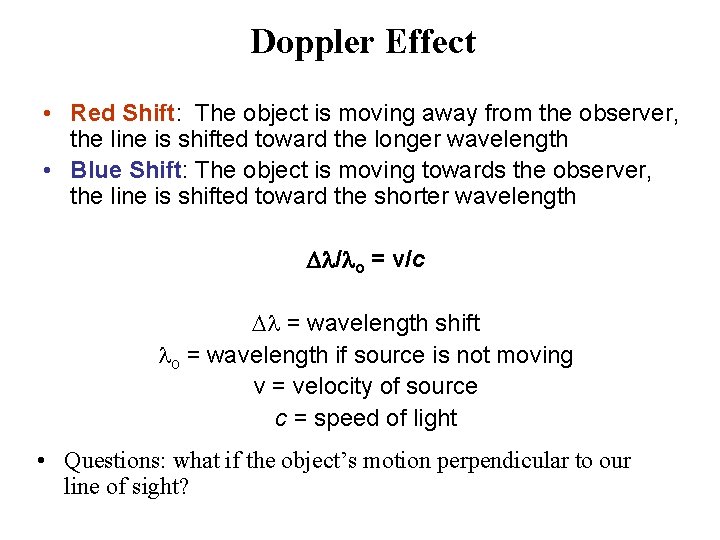
Doppler Effect • Red Shift: The object is moving away from the observer, the line is shifted toward the longer wavelength • Blue Shift: The object is moving towards the observer, the line is shifted toward the shorter wavelength Dl/lo = v/c Dl = wavelength shift lo = wavelength if source is not moving v = velocity of source c = speed of light • Questions: what if the object’s motion perpendicular to our line of sight?
Final Notes on Chap. 5 • There are 9 sections. All section are covered