
The Nature of Leadership Leadership v A social
- Slides: 26
The Nature of Leadership • Leadership v A social (interpersonal) influence between two or more persons who depend on each other to attain certain mutual goals in a group situation. • Leader versus manager v Leadership and management are not interchangeable. v Leadership is the accepted use of organizationally-derived and/or personal power to influence and motivate subordinates. v Management is process-oriented (planning, organizing, directing, and controlling) Copyright © 2015 11– 1
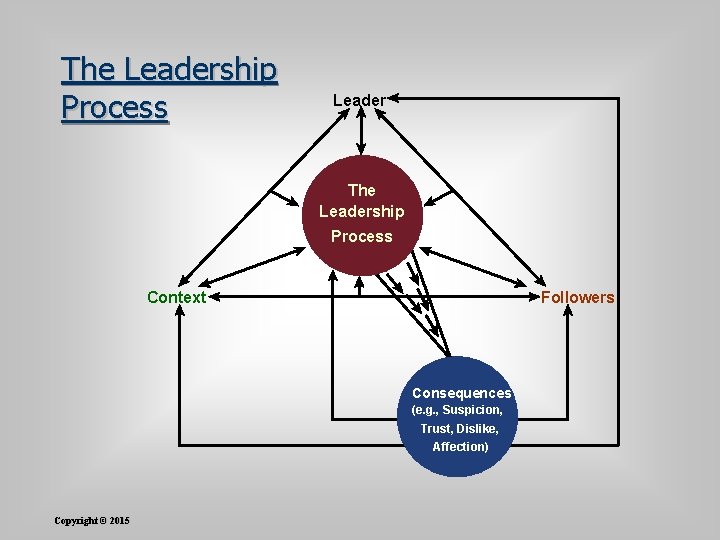
The Leadership Process Leader The Leadership Process Context Followers Consequences (e. g. , Suspicion, Trust, Dislike, Affection) Copyright © 2015
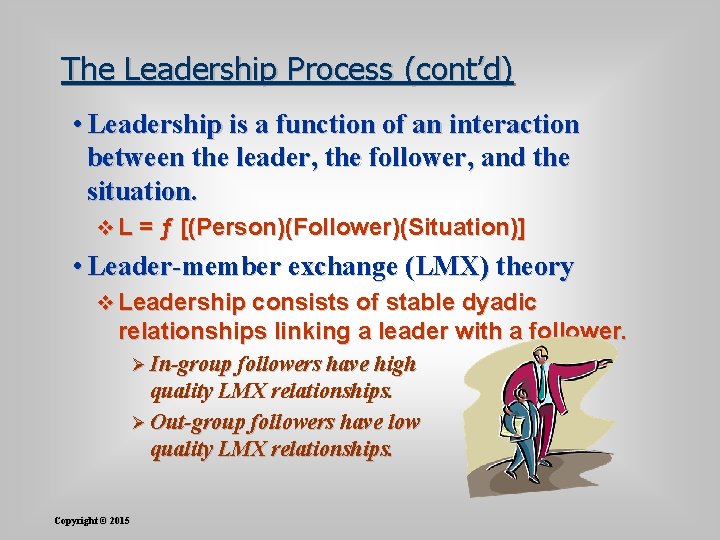
The Leadership Process (cont’d) • Leadership is a function of an interaction between the leader, the follower, and the situation. v L = ƒ [(Person)(Follower)(Situation)] • Leader-member exchange (LMX) theory v Leadership consists of stable dyadic relationships linking a leader with a follower. Ø In-group followers have high quality LMX relationships. Ø Out-group followers have low quality LMX relationships. Copyright © 2015
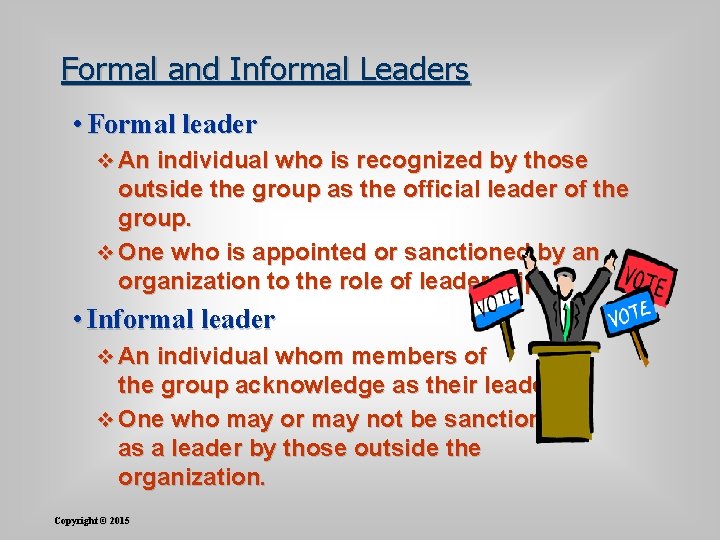
Formal and Informal Leaders • Formal leader v An individual who is recognized by those outside the group as the official leader of the group. v One who is appointed or sanctioned by an organization to the role of leadership. • Informal leader v An individual whom members of the group acknowledge as their leader. v One who may or may not be sanctioned as a leader by those outside the organization. Copyright © 2015
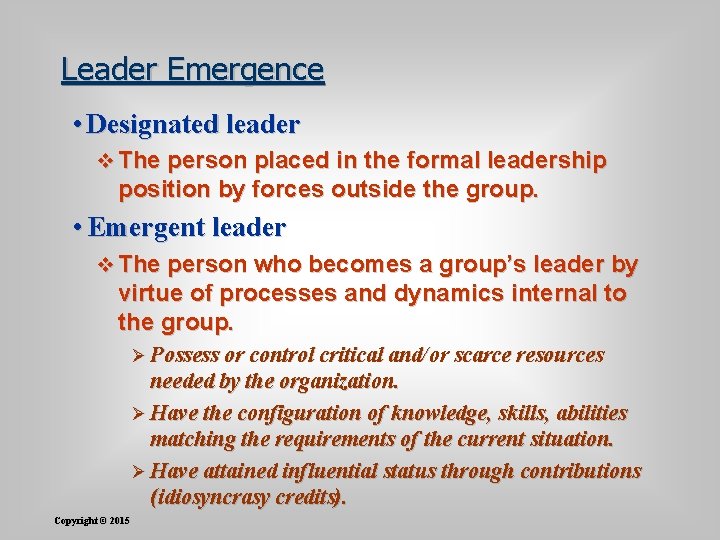
Leader Emergence • Designated leader v The person placed in the formal leadership position by forces outside the group. • Emergent leader v The person who becomes a group’s leader by virtue of processes and dynamics internal to the group. Ø Possess or control critical and/or scarce resources needed by the organization. Ø Have the configuration of knowledge, skills, abilities matching the requirements of the current situation. Ø Have attained influential status through contributions (idiosyncrasy credits). Copyright © 2015
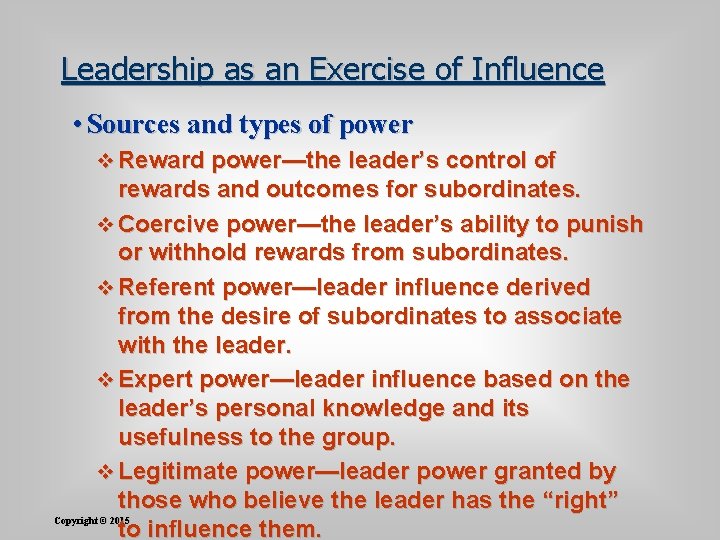
Leadership as an Exercise of Influence • Sources and types of power v Reward power—the leader’s control of rewards and outcomes for subordinates. v Coercive power—the leader’s ability to punish or withhold rewards from subordinates. v Referent power—leader influence derived from the desire of subordinates to associate with the leader. v Expert power—leader influence based on the leader’s personal knowledge and its usefulness to the group. v Legitimate power—leader power granted by those who believe the leader has the “right” Copyright © 2015 to influence them.
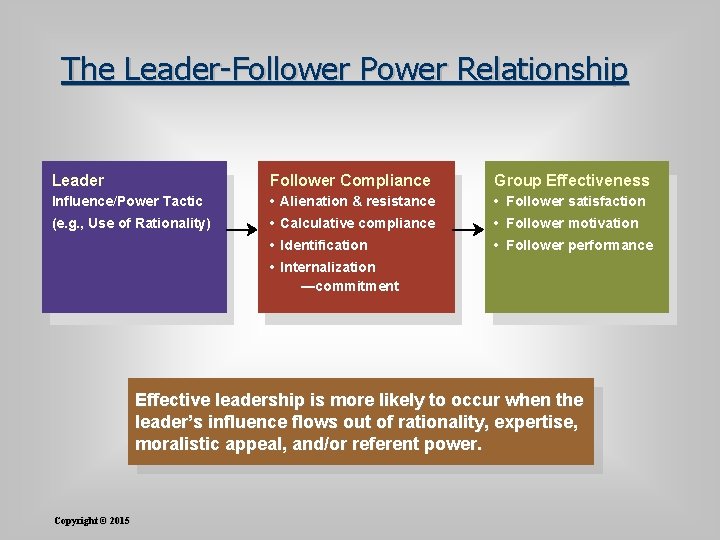
The Leader-Follower Power Relationship Leader Follower Compliance Group Effectiveness Influence/Power Tactic • Alienation & resistance • Follower satisfaction (e. g. , Use of Rationality) • Calculative compliance • Follower motivation • Identification • Follower performance • Internalization —commitment Effective leadership is more likely to occur when the leader’s influence flows out of rationality, expertise, moralistic appeal, and/or referent power. Copyright © 2015
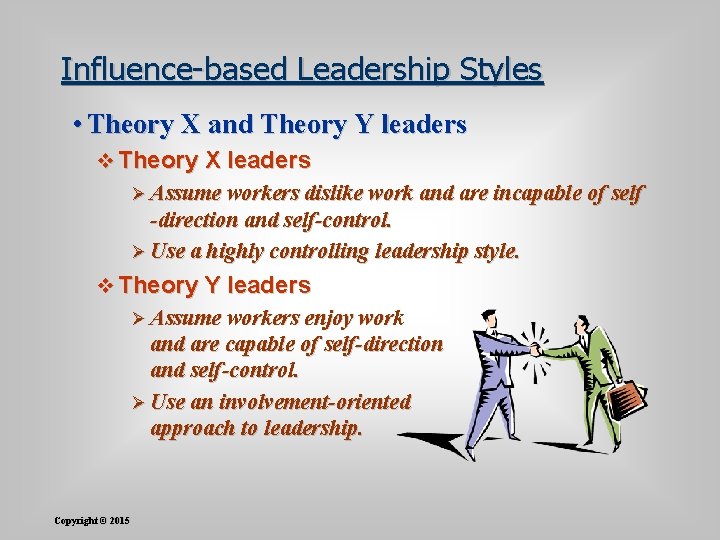
Influence-based Leadership Styles • Theory X and Theory Y leaders v Theory X leaders Ø Assume workers dislike work and are incapable of self -direction and self-control. Ø Use a highly controlling leadership style. v Theory Y leaders Ø Assume workers enjoy work and are capable of self-direction and self-control. Ø Use an involvement-oriented approach to leadership. Copyright © 2015
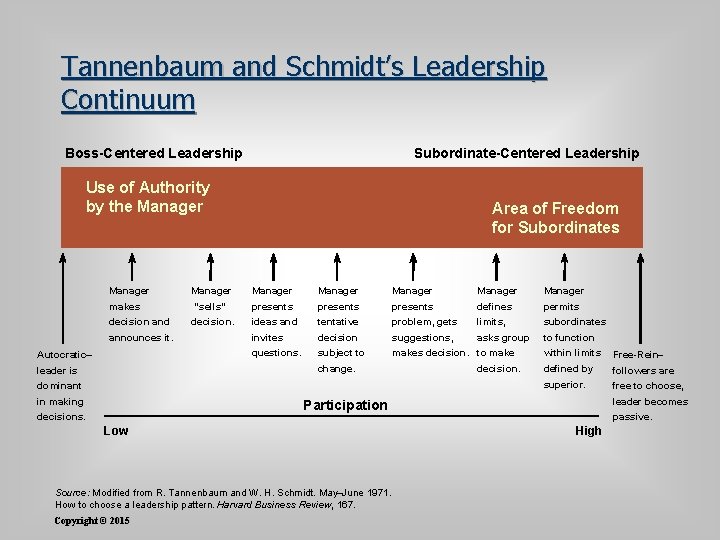
Tannenbaum and Schmidt’s Leadership Continuum Boss-Centered Leadership Subordinate-Centered Leadership Use of Authority by the Manager Area of Freedom for Subordinates Manager Manager makes “sells” presents defines permits decision and decision. ideas and tentative problem, gets limits, subordinates invites decision suggestions, asks group to function questions. subject to makes decision. to make announces it. Autocratic– change. leader is dominant in making decision. within limits Free-Rein– defined by followers are superior. free to choose, leader becomes Participation decisions. Low Source: Modified from R. Tannenbaum and W. H. Schmidt. May–June 1971. How to choose a leadership pattern. Harvard Business Review, 167. Copyright © 2015 passive. High
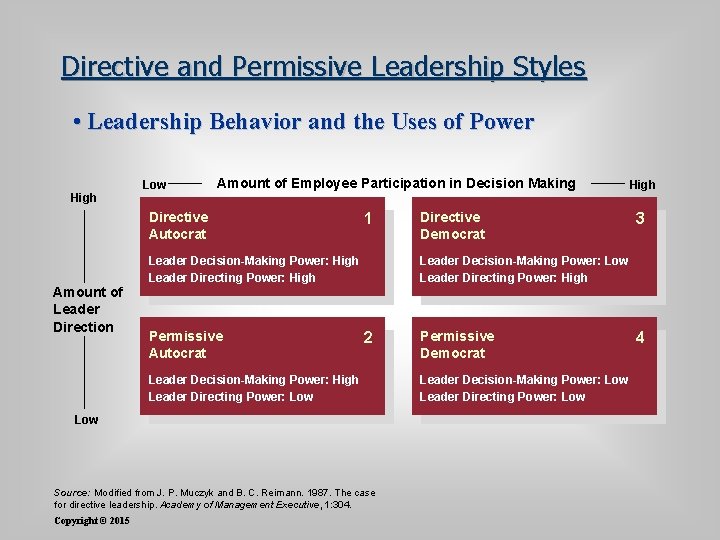
Directive and Permissive Leadership Styles • Leadership Behavior and the Uses of Power High Low Amount of Employee Participation in Decision Making Directive Autocrat 1 Leader Decision-Making Power: High Leader Directing Power: High Amount of Leader Direction Permissive Autocrat 3 Leader Decision-Making Power: Low Leader Directing Power: High 2 Leader Decision-Making Power: High Leader Directing Power: Low Source: Modified from J. P. Muczyk and B. C. Reimann. 1987. The case for directive leadership. Academy of Management Executive, 1: 304. Copyright © 2015 Directive Democrat High Permissive Democrat Leader Decision-Making Power: Low Leader Directing Power: Low 4
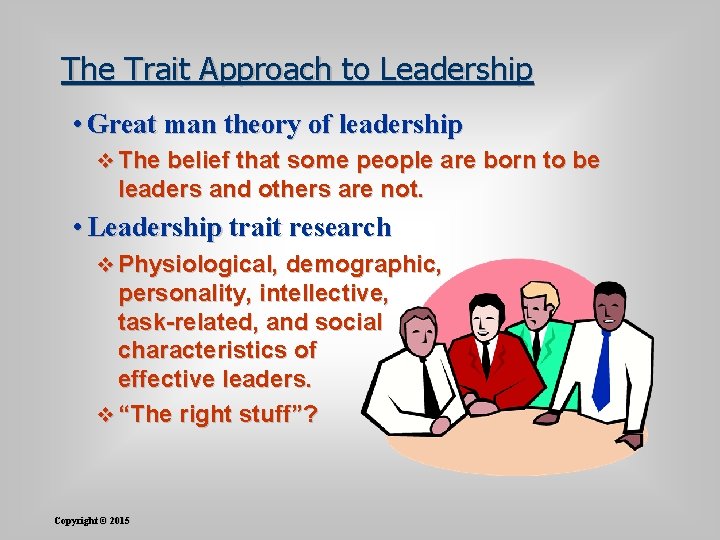
The Trait Approach to Leadership • Great man theory of leadership v The belief that some people are born to be leaders and others are not. • Leadership trait research v Physiological, demographic, personality, intellective, task-related, and social characteristics of effective leaders. v “The right stuff”? Copyright © 2015
Leadership Trait Research (cont’d) • Core characteristics of leaders (Locke) v Drive—high level of effort and desire for achievement v Leadership motivation—intense desire to lead others v Honesty and integrity—commitment to the truth v Self-confidence—assurance in self, ideas, and ability v Cognitive ability—conceptually skilled and possessing good judgment v Knowledge of business—high degree of understanding about the company, industry, Copyright © 2015
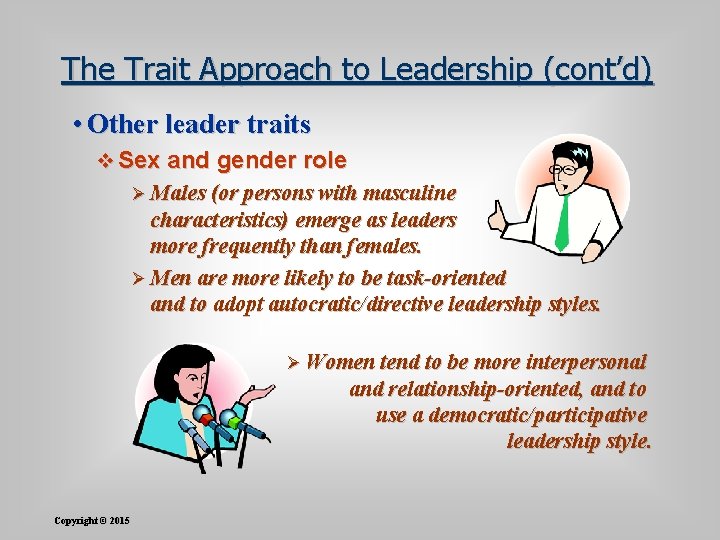
The Trait Approach to Leadership (cont’d) • Other leader traits v Sex and gender role Ø Males (or persons with masculine characteristics) emerge as leaders more frequently than females. Ø Men are more likely to be task-oriented and to adopt autocratic/directive leadership styles. Ø Women tend to be more interpersonal and relationship-oriented, and to use a democratic/participative leadership style. Copyright © 2015
Behavioral Approaches to Leadership • The Ohio State studies identified two major sets of leader behaviors: v Consideration—a “relationship-oriented” leader behavior that is supportive, friendly, and focused on personal needs and interpersonal relationships. v Initiating structure—a “task-oriented” leader behavior that is focused on goal attainment, organizing and scheduling work, solving problems, and maintaining work processes. Copyright © 2015
Behavioral Approaches to Leadership (cont’d) • The University of Michigan studies identified the behavioral characteristics of effective leaders: v Job-centered behaviors— supervisory activities such as planning, scheduling, and coordinating work activities. v Employee member-centered behaviors— consideration and support for organizational members. Copyright © 2015
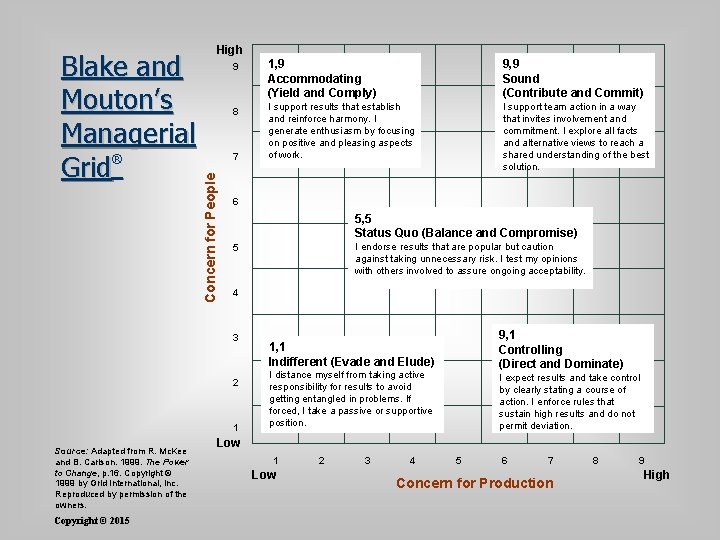
9 8 7 Concern for People Blake and Mouton’s Managerial ® Grid High I support results that establish and reinforce harmony. I generate enthusiasm by focusing on positive and pleasing aspects of work. I support team action in a way that invites involvement and commitment. I explore all facts and alternative views to reach a shared understanding of the best solution. 5, 5 Status Quo (Balance and Compromise) I endorse results that are popular but caution against taking unnecessary risk. I test my opinions with others involved to assure ongoing acceptability. 5 4 2 1 Copyright © 2015 9, 9 Sound (Contribute and Commit) 6 3 Source: Adapted from R. Mc. Kee and B. Carlson. 1999. The Power to Change, p. 16. Copyright © 1999 by Grid International, Inc. Reproduced by permission of the owners. 1, 9 Accommodating (Yield and Comply) 9, 1 Controlling (Direct and Dominate) 1, 1 Indifferent (Evade and Elude) I distance myself from taking active responsibility for results to avoid getting entangled in problems. If forced, I take a passive or supportive position. I expect results and take control by clearly stating a course of action. I enforce rules that sustain high results and do not permit deviation. Low 1 Low 2 3 4 5 6 7 Concern for Production 8 9 High
Situational (Contingency) Approaches to Leadership • Contingency theory of leadership v Different leadership styles are effective as a function of the favorableness of the leadership situation. v Creating a match of leadership style and situation: Ø Assessing the leader’s disposition toward others by using their least preferred co-worker (LPC) score. Ø Assessing situational favorableness Copyright © 2015
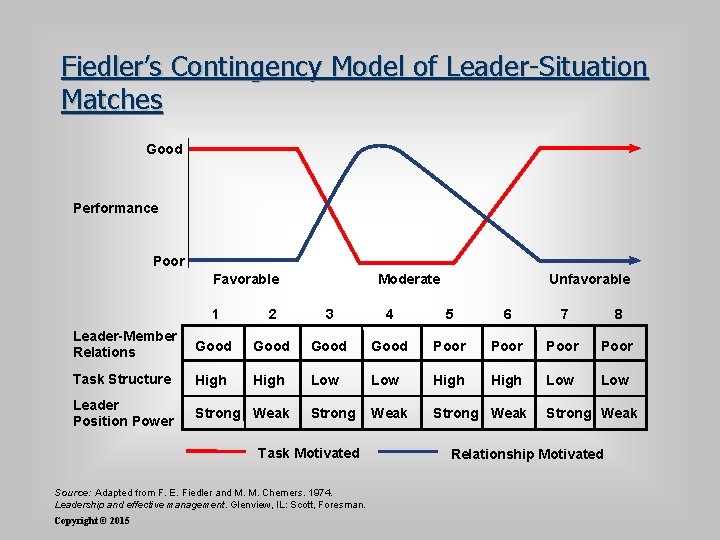
Situational (Contingency) Approaches to Leadership (cont’d) • Contingency theory of leadership (cont’d) v Least preferred co-worker (LPC) score Ø High LPC scores = relationship-oriented leaders. Ø Low LPC scores = task-oriented leaders. v Situational favorableness Ø Favorable situations allow leaders more control/ influence over the group process. – Leader member relations, task structure, leader position power Copyright © 2015
Fiedler’s Contingency Model of Leader-Situation Matches Good Performance Poor Favorable Moderate Unfavorable 1 2 3 4 5 6 7 8 Leader-Member Relations Good Poor Task Structure High Low Low Leader Position Power Strong Weak Task Motivated Source: Adapted from F. E. Fiedler and M. M. Chemers. 1974. Leadership and effective management. Glenview, IL: Scott, Foresman. Copyright © 2015 Strong Weak Relationship Motivated
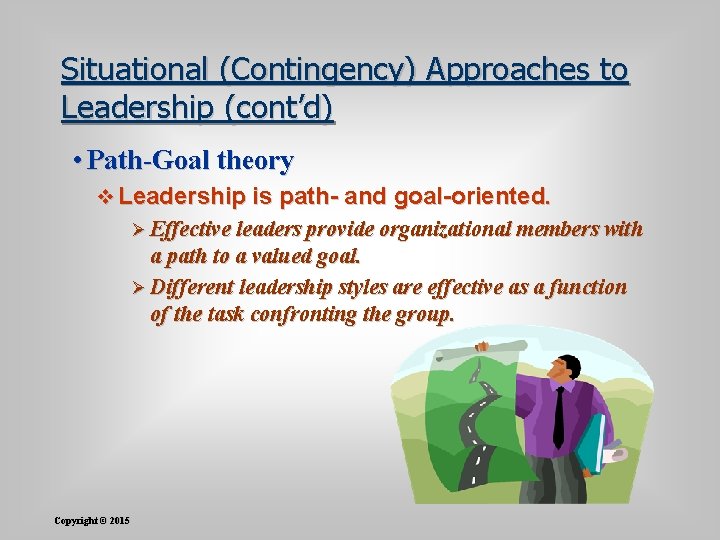
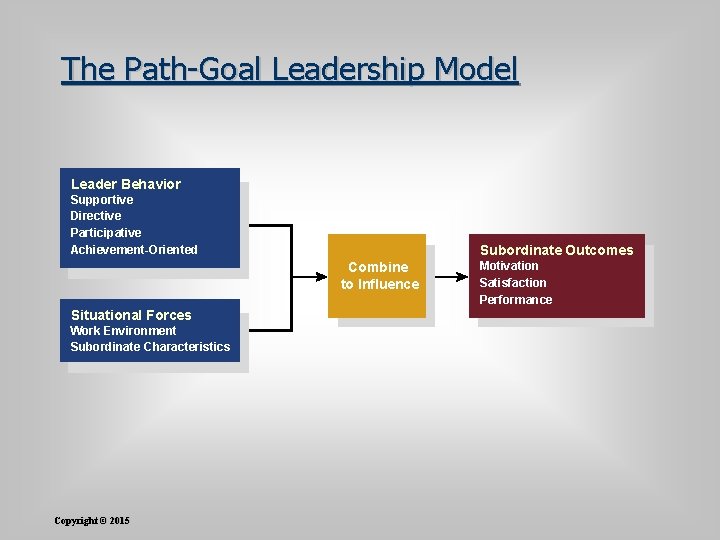
Situational (Contingency) Approaches to Leadership (cont’d) • Path-Goal theory v Leadership is path- and goal-oriented. Ø Effective leaders provide organizational members with a path to a valued goal. Ø Different leadership styles are effective as a function of the task confronting the group. Copyright © 2015
The Path-Goal Leadership Model Leader Behavior Supportive Directive Participative Achievement-Oriented Subordinate Outcomes Combine to Influence Situational Forces Work Environment Subordinate Characteristics Copyright © 2015 Motivation Satisfaction Performance
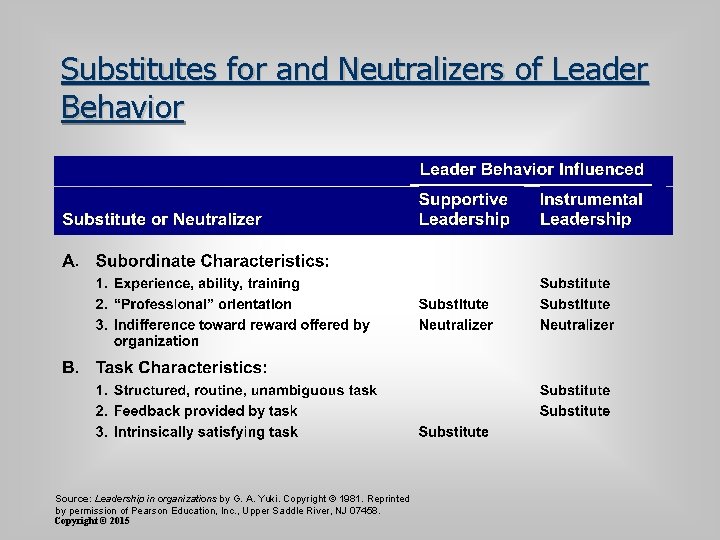
Substitutes for and Neutralizers of Leader Behavior Source: Leadership in organizations by G. A. Yuki. Copyright © 1981. Reprinted by permission of Pearson Education, Inc. , Upper Saddle River, NJ 07458. Copyright © 2015
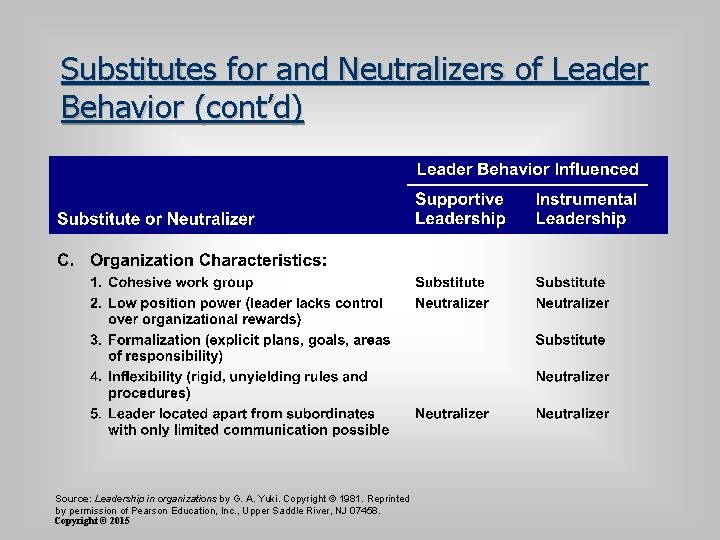
Substitutes for and Neutralizers of Leader Behavior (cont’d) Source: Leadership in organizations by G. A. Yuki. Copyright © 1981. Reprinted by permission of Pearson Education, Inc. , Upper Saddle River, NJ 07458. Copyright © 2015
Transformational, Visionary, and Charismatic Leadership • Transformational leader v A leader who moves and changes things “in a big way” by inspiring others to perform the extraordinary. Ø Charisma, individualized consideration, intellectual stimulation, inspirational motivation • Visionary leader v An individual who is capable of influencing others through an emotional and/or intellectual attraction to the leader’s dream for that which “can be. ” Copyright © 2015
Transformational, Visionary, and Charismatic Leadership (cont’d) • Charismatic leadership v Charisma—a special personal magnetic charm or appeal that arouses loyalty and enthusiasm in a leader-follower relationship. v Charismatic leader—a person who possess legitimate power that arises from “exceptional sanctity, heroism, or exemplary character. ” Copyright © 2015
Leadership Needs in the 21 st Century • The magnitude of change will demand: v More leadership v Newer forms of leadership • Tomorrow’s leaders v Strategic opportunists v Global/cultural/diversity awareness v Decentralized managers v Interpersonally competent v Builders of organizational communities Copyright © 2015