
The Nature of Force Newtons Laws What is
- Slides: 11
The Nature of Force Newton’s Laws
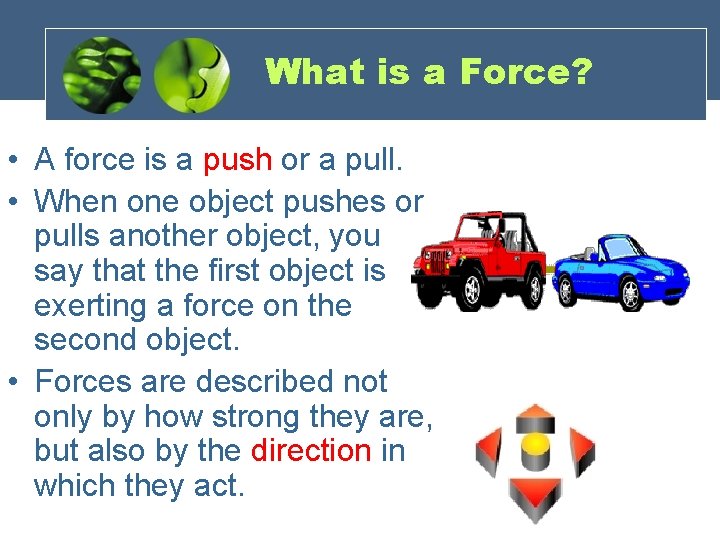
What is a Force? • A force is a push or a pull. • When one object pushes or pulls another object, you say that the first object is exerting a force on the second object. • Forces are described not only by how strong they are, but also by the direction in which they act.
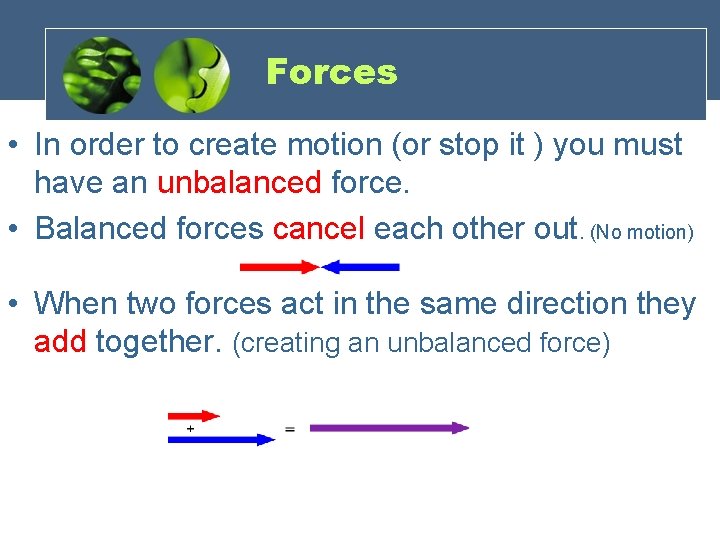
Forces • In order to create motion (or stop it ) you must have an unbalanced force. • Balanced forces cancel each other out. (No motion) • When two forces act in the same direction they add together. (creating an unbalanced force)
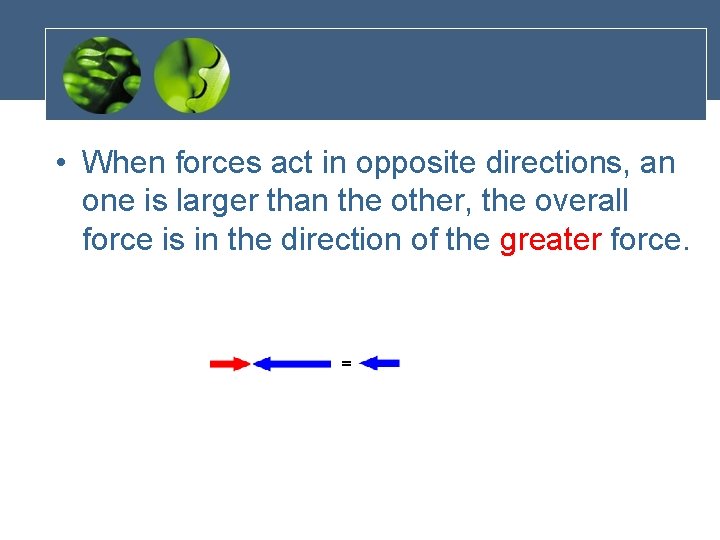
• When forces act in opposite directions, an one is larger than the other, the overall force is in the direction of the greater force.
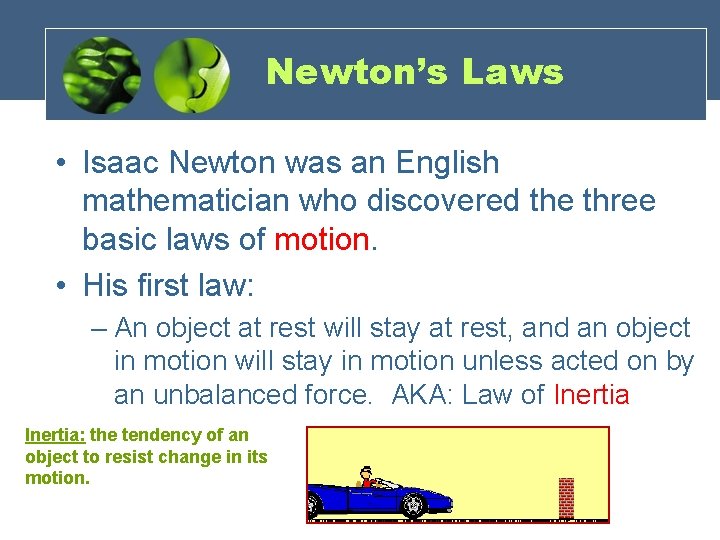
Newton’s Laws • Isaac Newton was an English mathematician who discovered the three basic laws of motion. • His first law: – An object at rest will stay at rest, and an object in motion will stay in motion unless acted on by an unbalanced force. AKA: Law of Inertia: the tendency of an object to resist change in its motion.
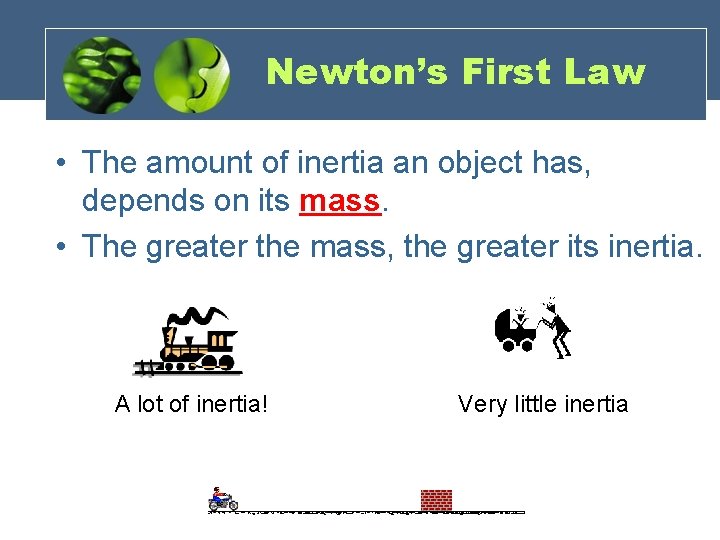
Newton’s First Law • The amount of inertia an object has, depends on its mass. • The greater the mass, the greater its inertia. A lot of inertia! Very little inertia
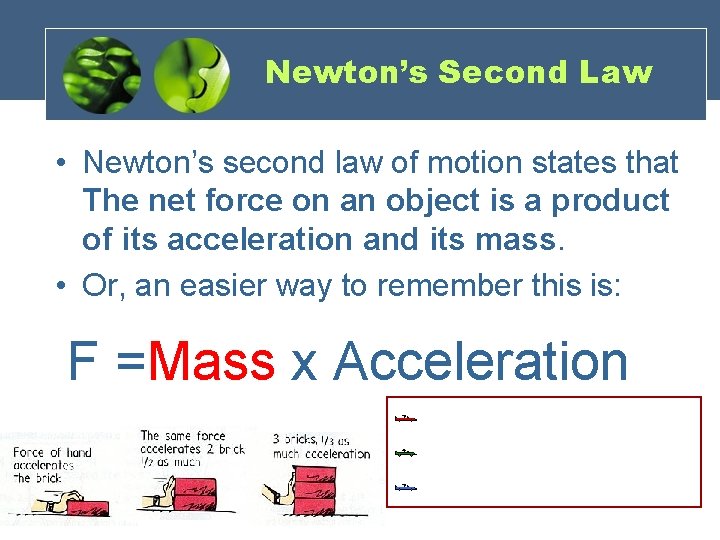
Newton’s Second Law • Newton’s second law of motion states that The net force on an object is a product of its acceleration and its mass. • Or, an easier way to remember this is: F =Mass x Acceleration
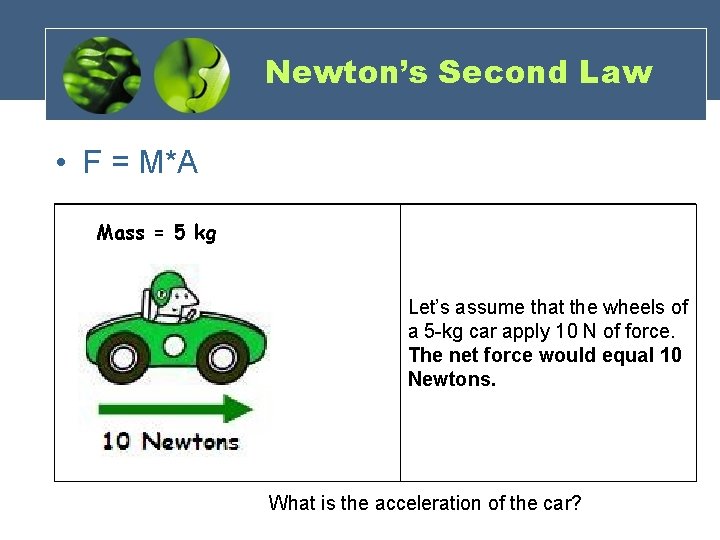
Newton’s Second Law • F = M*A Mass = 5 kg Let’s assume that the wheels of a 5 -kg car apply 10 N of force. The net force would equal 10 Newtons. What is the acceleration of the car?
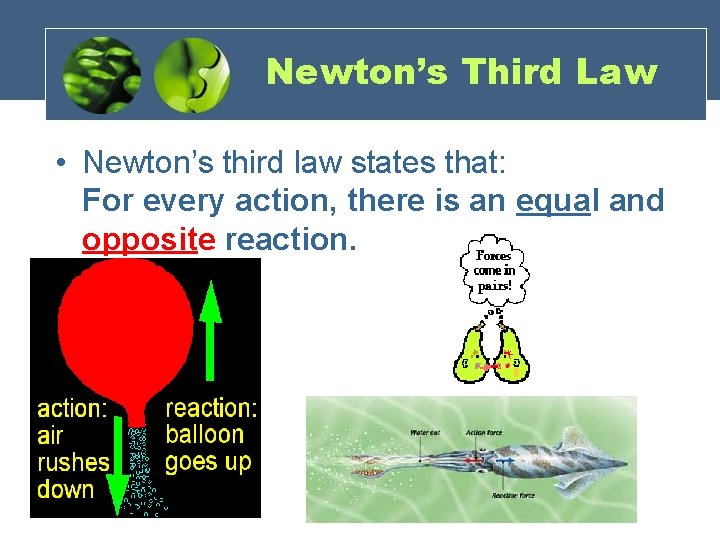
Newton’s Third Law • Newton’s third law states that: For every action, there is an equal and opposite reaction.
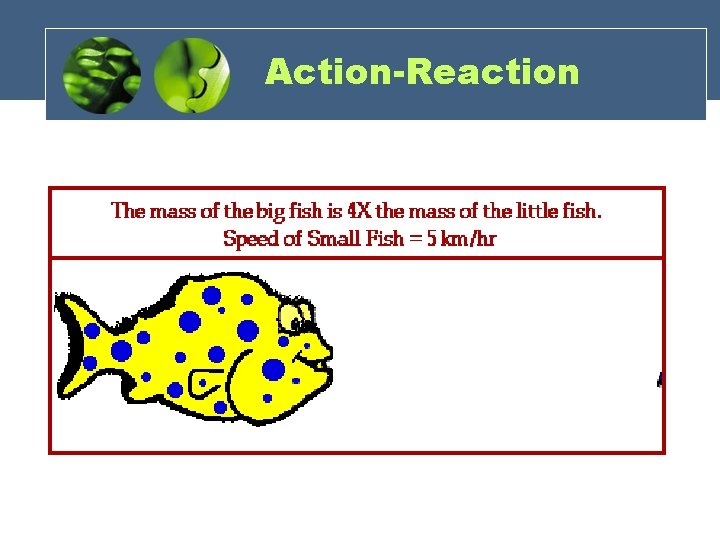
Action-Reaction
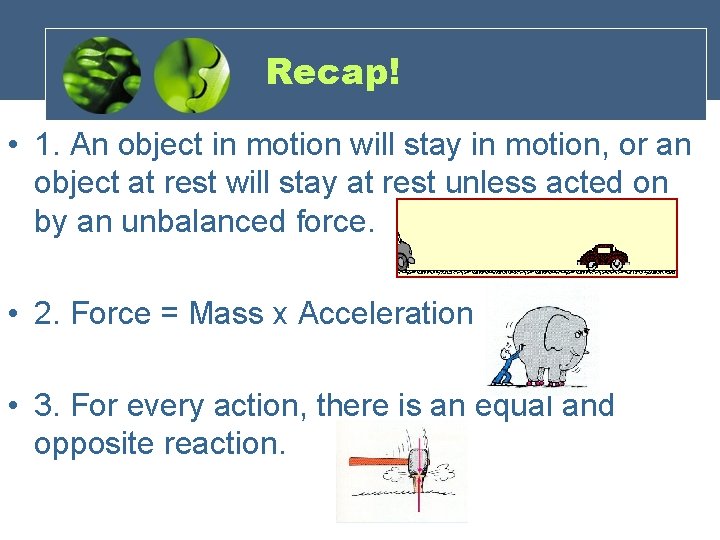
Recap! • 1. An object in motion will stay in motion, or an object at rest will stay at rest unless acted on by an unbalanced force. • 2. Force = Mass x Acceleration • 3. For every action, there is an equal and opposite reaction.