
The Nature Nurture Debate Introduction to the debates
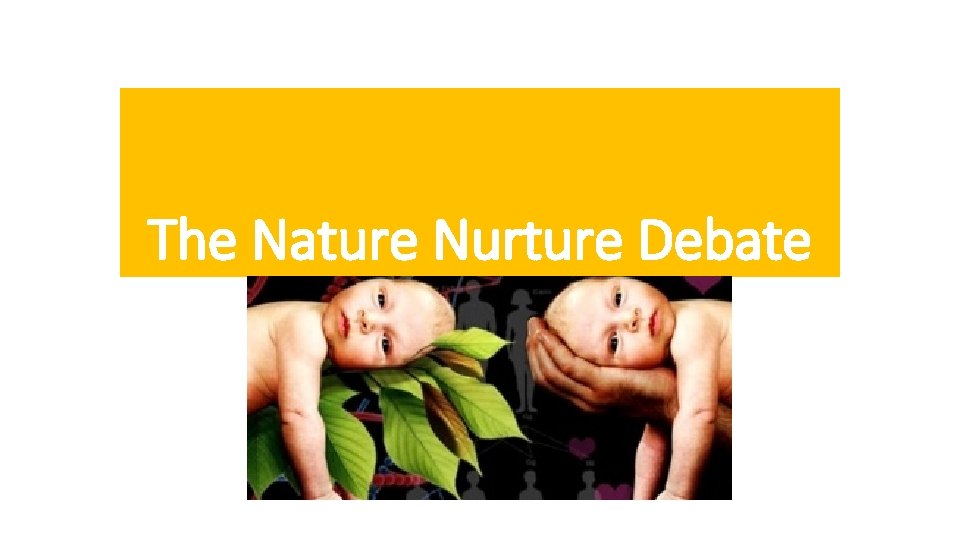
The Nature Nurture Debate
Introduction to the debates We will be looking at 4 debates in Psychology: • The nature nurture debate • Determinism vs free will • Reductionism vs holism • Nomothetic vs idiographic Can you guess which of the debates each of these statements relate to, and which side of the argument it supports? In your groups, write your choices down on a MWB 1. “The only way to effectively treat mental disorders is to deal with the chemical imbalance that they result from” 2. “I’ve always been very lazy, it runs in my family. My mother was a very lazy woman who spent a lot of her time in bed completing crossword puzzles. I’ve got that from her, but my brother didn’t get it, he’s much more motivated” 3. “There’s no point trying to categorise people because every case will be different. People’s individual motivations will be different” 4. “I was destined to end up in jail. My mother was a heroin addict, my father left before I was born and I was taken into care and passed around different foster families before left to fend for myself at the age of 16”
Introduction to the debates Answers: 1. “The only way to effectively treat mental disorders is to deal with the chemical imbalance that they result from” Reductionism vs holism 2. “I’ve always been very lazy, it runs in my family. My mother was a very lazy woman who spent a lot of her time in bed completing crossword puzzles. I’ve got that from her, but my brother didn’t get it, he’s much more motivated” nature vs nurture 3. “There’s no point trying to categorise people because every case will be different. People’s individual motivations will be different” idiographic vs nomothetic 4. “I was destined to end up in jail. My mother was a heroin addict, my father left before I was born and I was taken into care and passed around different foster families before left to fend for myself at the age of 16” free will vs determinism
The Nature Nurture Debate On MWBs, in pairs, define what is meant by the nature nurture debate • Your answers should have included some reference to the debate otherwise they will receive no credit in the exam • E. g. , if you wrote ‘Nature refers to the belief that behaviour is inherited, and nurture refers the belief that behaviour is learnt’ this will receive no credit because it does not make reference to the debate! • Therefore, you must say ‘the extent to which behaviour is a product of gentic and/or environmental influences’ • Another common error is to mistake biology for heredity. They are not the same thing! The nature nurture debate is focused on heredity, not biology in general
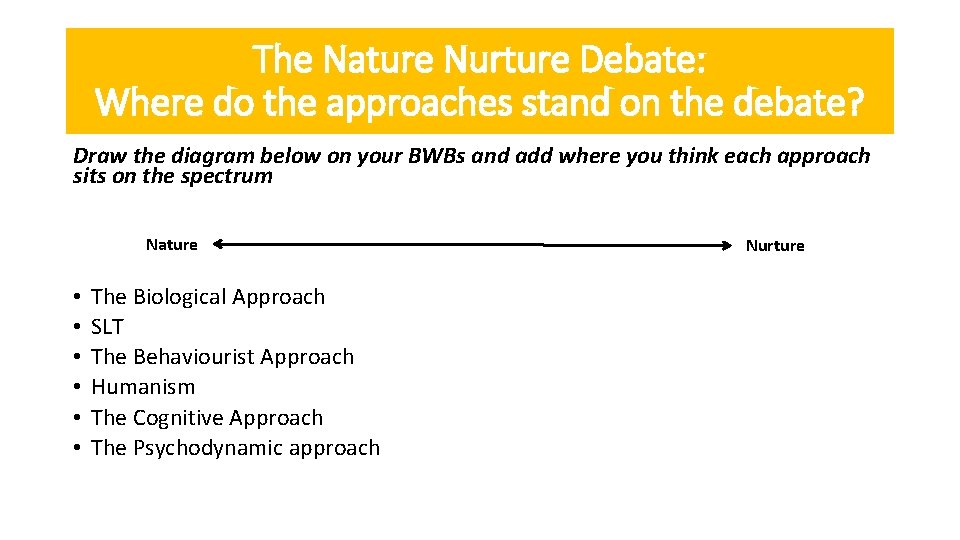
The Nature Nurture Debate: Where do the approaches stand on the debate? Draw the diagram below on your BWBs and add where you think each approach sits on the spectrum Nature • • • The Biological Approach SLT The Behaviourist Approach Humanism The Cognitive Approach The Psychodynamic approach Nurture
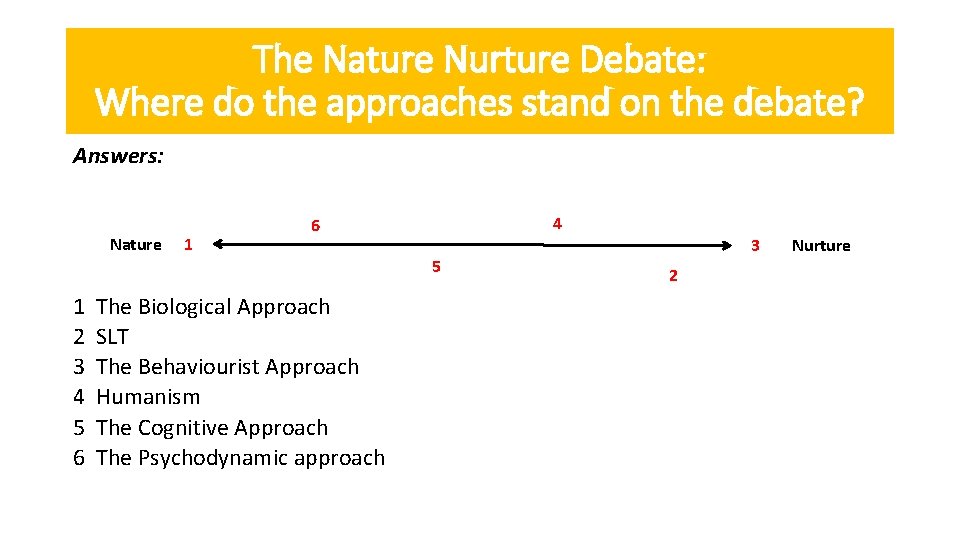
The Nature Nurture Debate: Where do the approaches stand on the debate? Answers: Nature 1 4 6 5 1 2 3 4 5 6 The Biological Approach SLT The Behaviourist Approach Humanism The Cognitive Approach The Psychodynamic approach 3 2 Nurture
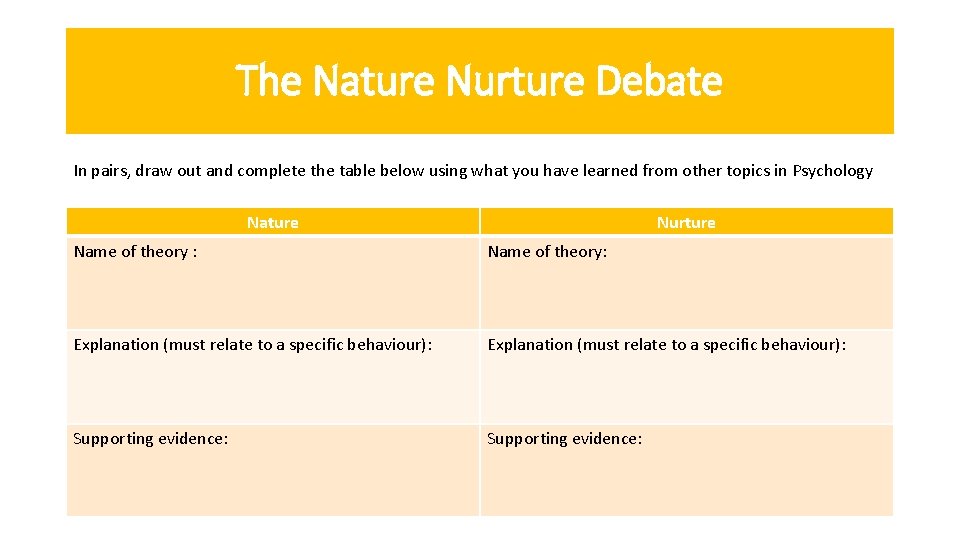
The Nature Nurture Debate In pairs, draw out and complete the table below using what you have learned from other topics in Psychology Nature Nurture Name of theory : Name of theory: Explanation (must relate to a specific behaviour): Supporting evidence:
The Interactionist Approach What do you remember about the interactionist approach? Answer the following questions on mini-whiteboards • What does the interactionist approach believe about the causes of behaviour? • The diathesis-stress model is part of the interactionist approach. What does the ‘diathesis’ part refer to, and what does the ‘stress’ part refer to? • You have covered the stress-diathesis model in the Psychopathology topic. Give details of that particular theory
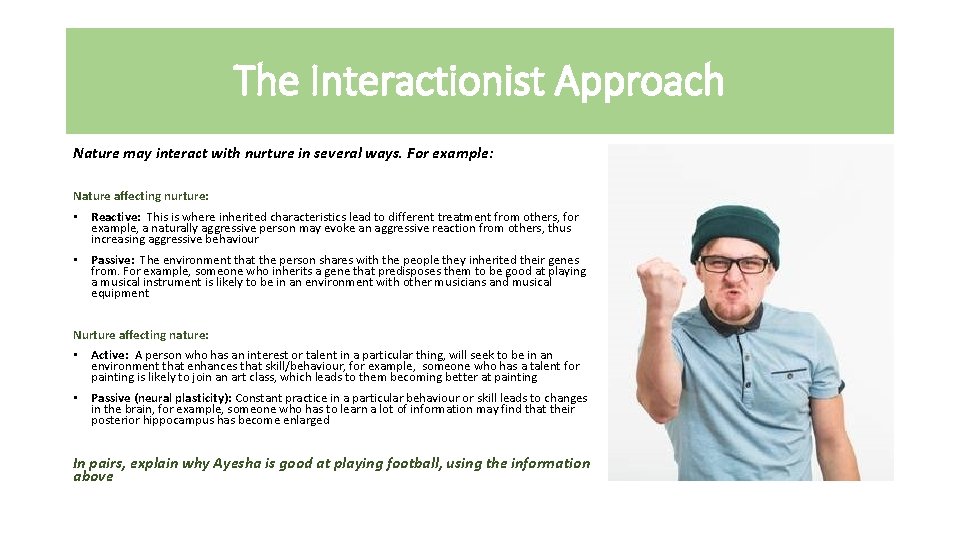
The Interactionist Approach Nature may interact with nurture in several ways. For example: Nature affecting nurture: • Reactive: This is where inherited characteristics lead to different treatment from others, for example, a naturally aggressive person may evoke an aggressive reaction from others, thus increasing aggressive behaviour • Passive: The environment that the person shares with the people they inherited their genes from. For example, someone who inherits a gene that predisposes them to be good at playing a musical instrument is likely to be in an environment with other musicians and musical equipment Nurture affecting nature: • Active: A person who has an interest or talent in a particular thing, will seek to be in an environment that enhances that skill/behaviour, for example, someone who has a talent for painting is likely to join an art class, which leads to them becoming better at painting • Passive (neural plasticity): Constant practice in a particular behaviour or skill leads to changes in the brain, for example, someone who has to learn a lot of information may find that their posterior hippocampus has become enlarged In pairs, explain why Ayesha is good at playing football, using the information above
The Interactionist Approach Why is Ayesha good at playing football? Nature affecting nurture • Reactive: parents notice her talent for kicking a ball so take her to football coaching • Passive: she inherits the ability to play football from her parents. As such, her environment involves playing football a lot with her parents and watching football matches Nurture affecting nature • Active: She notices she is good at football so chooses friends at school who she can play football with and this improves her technique • Passive (Neural plasticity): playing football a lot at school and at home strengthens the neural connections and pathways involved in the motor activity required to kick a ball accurately so she becomes skilled at football
Putting it all together As part of your preparation homework, you spent sometime analysing a model essay You will have noticed that the discussion part of the essay doesn’t quite follow the same formula as other essays. The emphasis in this part of the specification is to draw on information from other topics Here are some suggestions for discussion content, taken from a mark scheme: • Use of evidence to support the influence of nature eg twin studies showing higher concordance for MZ pairs than DZ pairs • Use of evidence to support the influence of nurture eg studies of social learning • The need to take an interactionist approach rather than a dichotomous view Remember, the paragraphs must link together as a debate. If there is no debate, you are unlikely to score very highly
Putting it all together: The Essay You will now get some of the information from the essay. In your groups, on MWBs, you task is to finish the paragraph, from what you remember of the essay, or using your own examples that you have discussed today. No looking at the essay though!
Putting it all together: The Essay AO 1 The nature-nurture debate centres on the relative contributions of genetic inheritance (nature) and environmental influences (nurture) to human behaviour. The nature side of the debate refers to how human characteristics are innate as a result of heredity (genes being passed on from one generation to the next). For example… Your turn: Complete the paragraph
Putting it all together: The Essay AO 1 In contrast, the nurture side of the debate refers to environmental influences or “experience” acquired through interactions with your physical and social world. For example… Your turn: Complete the paragraph
Putting it all together: The Essay AO 3 One of the complexities of the debate is that nature can affect nurture and vica versa. For example… Your turn: Complete the paragraph using what you remember about Mc. Guire’s taxi driver study
Putting it all together: The Essay AO 3 Furthermore, genes may exert an indirect influence in a number of ways. For example… Your turn: Complete the paragraph using what you know about how a person’s nature can affect their environment Don’t forget to say how this relates back to Their behaviour
Putting it all together: The Essay AO 3 Despite the issues with the complexity of the nature-nurture debate it has led to the formation of the interactionist approach, which has implications for how we understand mental disorders, for instance… Your turn: Complete the paragraph using what You know about the interactionist view of Mental disorders Don’t forget to say why this information may Be useful What do all of these points mean about the nature Nurture debate?
- Slides: 17