
THE NATURE AND SOURCES OF COMPETITIVE ADVANTAGE FOUNDATIONS
- Slides: 9
THE NATURE AND SOURCES OF COMPETITIVE ADVANTAGE FOUNDATIONS OF STRATEGY John Beddington Scott Bearden Patrick Lewis Lauren Frick Trevor Mc. Donald
THE EMERGENCE OF COMPETITIVE ADVANTAGE Competitive Advantage: when two or more firms compete within the same market, one firm posses a competitive advantage over its rivals when it earns a persistently higher rate of profit Creating a competitive advantage External sources of change: change must have differential effects on companies because of their different resources and capabilities or strategic positioning � Internal sources of change: some firms have greater creative and innovative capability � Responsiveness to change: firms must respond rapidly to changes to maximize profits or opportunity � From innovation: � New industries New customer segments New sources of competitive advantage
SUSTAINING COMPETITIVE ADVANTAGE Obscuring Superior Performance: mask success so that other firms can’t identify success until it’s too late Deterrence of competition: � Proliferation � Large investments in production capacity � Patents Diagnosing competitive advantage � Causal ambiguity and uncertain imitability Acquiring resources and capabilities � First mover advantage
TYPES OF COMPETITIVE ADVANTAGE: COST AND DIFFERENTIATION Cost: Similar product at a lower cost � Wal-Mart Differentiation: Price premium from unique product � Luxury car companies
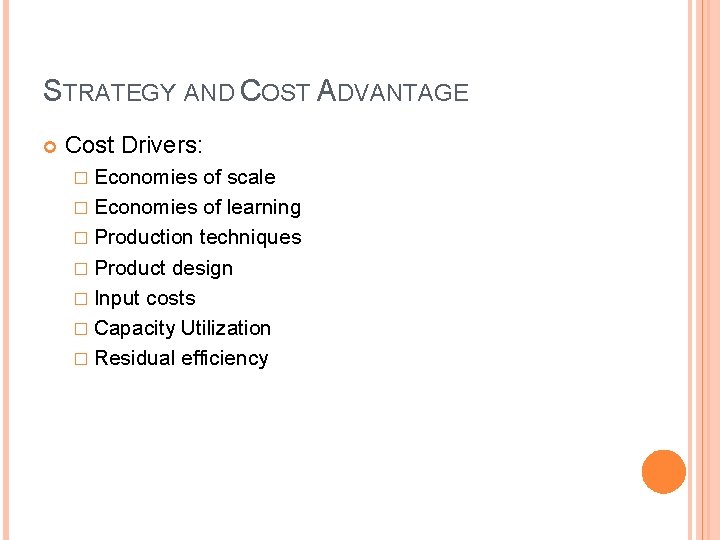
STRATEGY AND COST ADVANTAGE Cost Drivers: � Economies of scale � Economies of learning � Production techniques � Product design � Input costs � Capacity Utilization � Residual efficiency
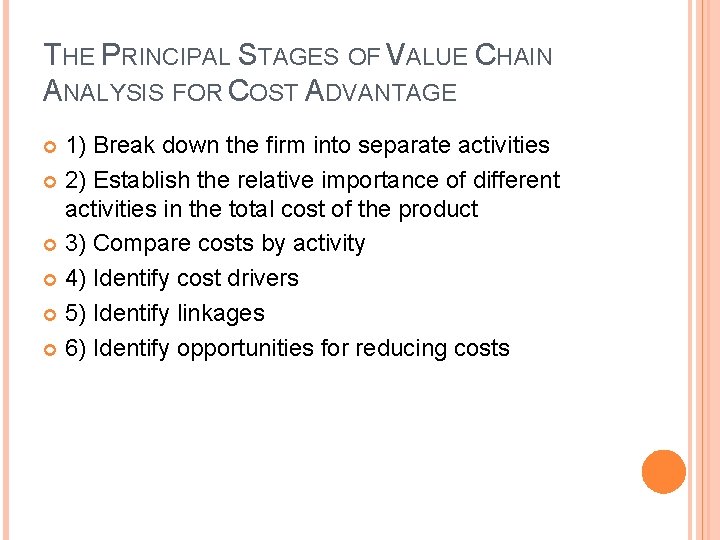
THE PRINCIPAL STAGES OF VALUE CHAIN ANALYSIS FOR COST ADVANTAGE 1) Break down the firm into separate activities 2) Establish the relative importance of different activities in the total cost of the product 3) Compare costs by activity 4) Identify cost drivers 5) Identify linkages 6) Identify opportunities for reducing costs
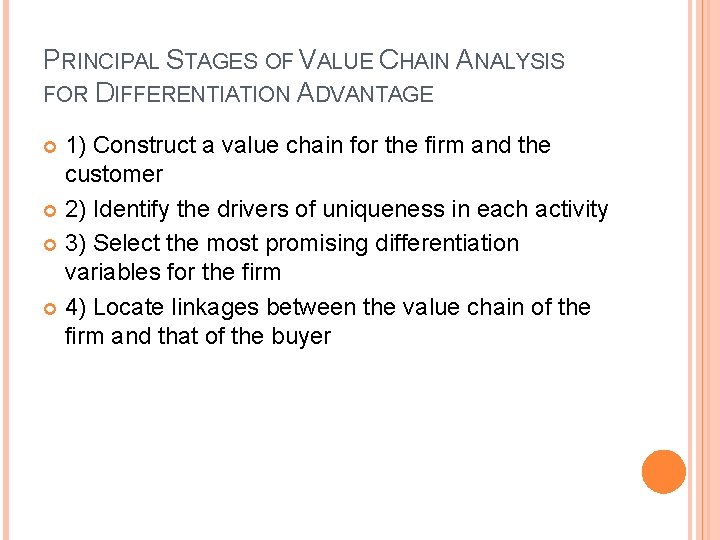
PRINCIPAL STAGES OF VALUE CHAIN ANALYSIS FOR DIFFERENTIATION ADVANTAGE 1) Construct a value chain for the firm and the customer 2) Identify the drivers of uniqueness in each activity 3) Select the most promising differentiation variables for the firm 4) Locate linkages between the value chain of the firm and that of the buyer
AMAZON AND COMPETITIVE ADVANTAGE Amazon gained competitive advantage by implementing value-added services � Best-seller lists � Reviews of books � Customized recommendations based on past purchases Created new customer segment with same products (books) by appealing to technology era customers � Able to purchase books online
TAKEAWAYS Competitive advantage Recognize how resources can offer opportunities for competitive advantage Distinguish between cost advantage and differentiation advantage Value chain analysis for cost and differentiation advantage opportunities Understand the dangers of being ‘stuck in the middle’ of the competition