
The Nature and Purpose of Financial Regulation Douglas
- Slides: 21
The Nature and Purpose of Financial Regulation Douglas W. Arner Professor & Head, Department of Law University of Hong Kong
Overview • • Finance Evolution of financial regulation Financial stability and economic growth East Asia
The Global Economy • 2011 Global GDP (current prices – real exchange rates): US$ 70. 16 trillion • 2011 Global GDP (purchasing power parity – PPP): US$ 78. 95 trillion • Source: IMF / CIA
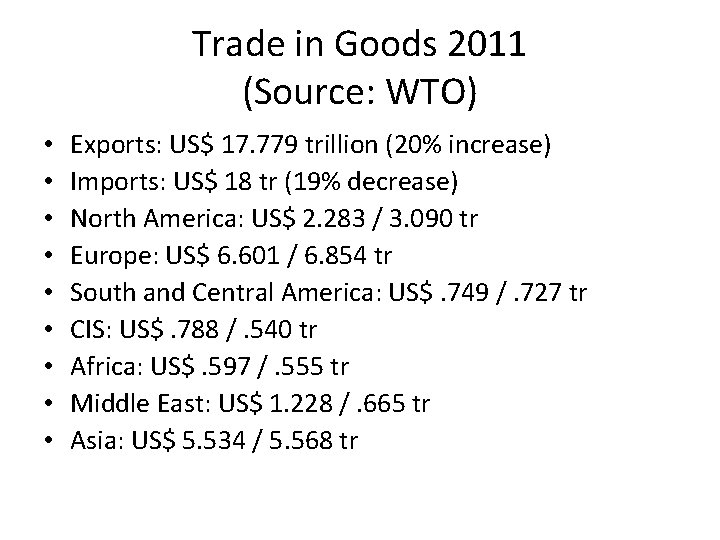
Trade in Goods 2011 (Source: WTO) • • • Exports: US$ 17. 779 trillion (20% increase) Imports: US$ 18 tr (19% decrease) North America: US$ 2. 283 / 3. 090 tr Europe: US$ 6. 601 / 6. 854 tr South and Central America: US$. 749 /. 727 tr CIS: US$. 788 /. 540 tr Africa: US$. 597 /. 555 tr Middle East: US$ 1. 228 /. 665 tr Asia: US$ 5. 534 / 5. 568 tr
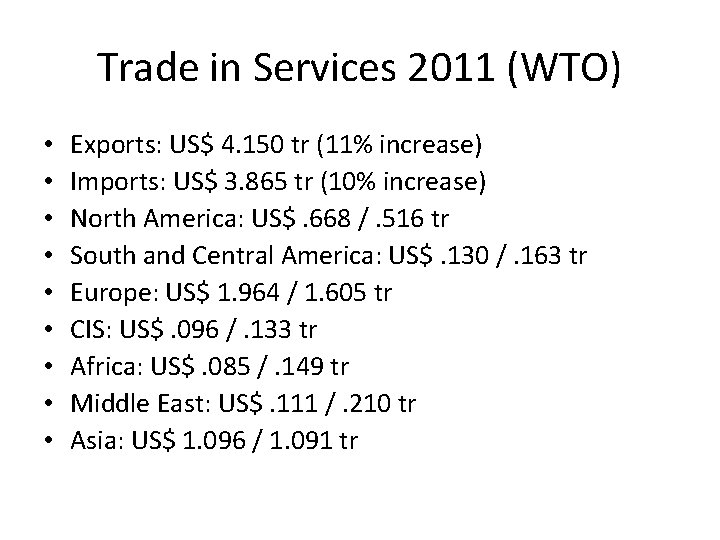
Trade in Services 2011 (WTO) • • • Exports: US$ 4. 150 tr (11% increase) Imports: US$ 3. 865 tr (10% increase) North America: US$. 668 /. 516 tr South and Central America: US$. 130 /. 163 tr Europe: US$ 1. 964 / 1. 605 tr CIS: US$. 096 /. 133 tr Africa: US$. 085 /. 149 tr Middle East: US$. 111 /. 210 tr Asia: US$ 1. 096 / 1. 091 tr
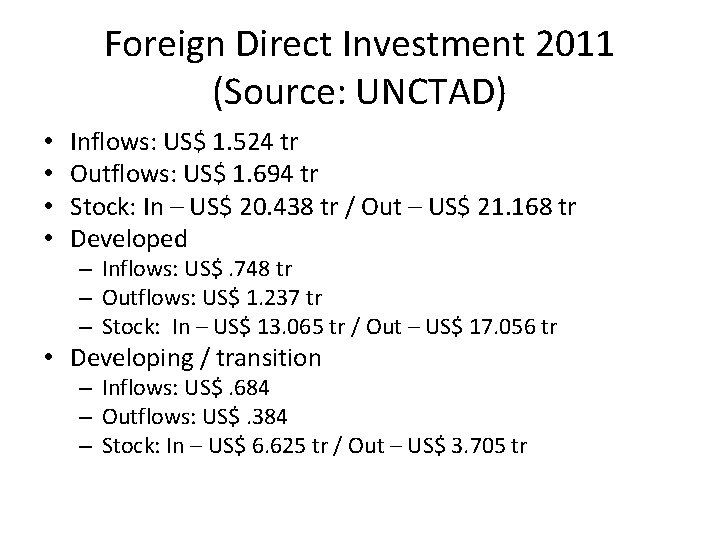
Foreign Direct Investment 2011 (Source: UNCTAD) • • Inflows: US$ 1. 524 tr Outflows: US$ 1. 694 tr Stock: In – US$ 20. 438 tr / Out – US$ 21. 168 tr Developed – Inflows: US$. 748 tr – Outflows: US$ 1. 237 tr – Stock: In – US$ 13. 065 tr / Out – US$ 17. 056 tr • Developing / transition – Inflows: US$. 684 – Outflows: US$. 384 – Stock: In – US$ 6. 625 tr / Out – US$ 3. 705 tr
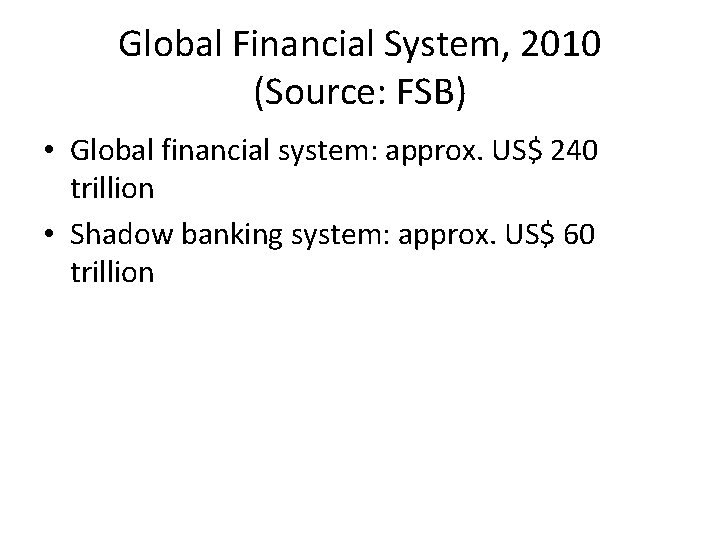
Global Financial System, 2010 (Source: FSB) • Global financial system: approx. US$ 240 trillion • Shadow banking system: approx. US$ 60 trillion
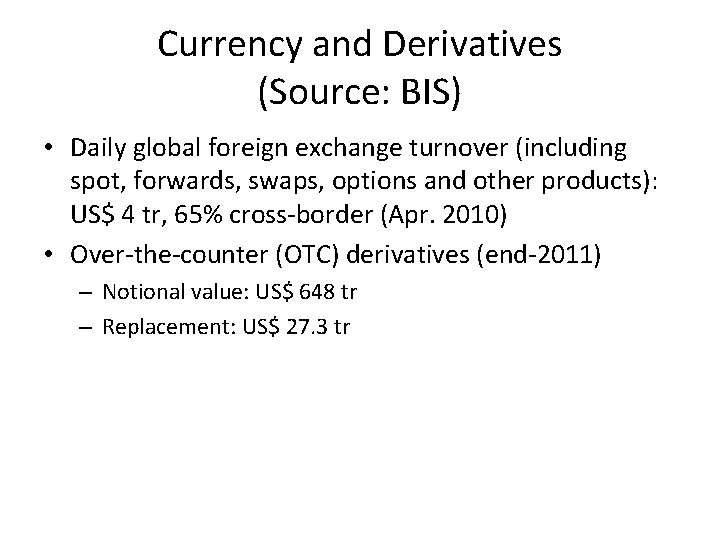
Currency and Derivatives (Source: BIS) • Daily global foreign exchange turnover (including spot, forwards, swaps, options and other products): US$ 4 tr, 65% cross-border (Apr. 2010) • Over-the-counter (OTC) derivatives (end-2011) – Notional value: US$ 648 tr – Replacement: US$ 27. 3 tr
Purpose of Financial Markets • • Pricing / allocation of financial resources Efficient pricing / allocation = financial development Financial development = economic growth Economic growth = development • But: financial crisis = high costs • Overall: confidence – key
Globalisation of Finance 1870 -1914 “Golden Age” 1914 -1944 Interwar 1944 -1973 Bretton Woods 1973 -1982 Oil Crises 1982 -1993 Internationalisation 1993 -2007 Globalisation 2007 to present Global financial crises
Market failures, Intermediation and Indirect Finance • • Irrational behaviour Imperfect competition Transaction costs Asymmetric information – Adverse selection – Moral hazard • Externalities: systemic risk
“Infrastructure”: Law, Regulation, Institutions • Market functioning / efficiency / development – Systems: exchange, payment, clearance, settlement, custody – Rules: competition, behaviour, transactions costs, information – Information: data, research, ratings, compliance • • Fairness Macroeconomic / monetary policy / development Systemic risk / financial stability Overall: Confidence – key
Elements: Prevention • Financial infrastructure: payment / settlement – plumbing (OTC derivatives) • Well-managed financial institutions: licensing, risk management, corporate governance, market discipline • Information • Financial institution safety and soundness: prudential regulation
Elements: Addressing crises • Liquidity provider of last resort: central bank • Financial institution resolution mechanisms, including insolvency • Consumer protection: deposit insurance etc
Systemic Risk and Financial Stability • Systemic risk: – The risk that an event will trigger a loss of economic value or confidence in, and attendant increases in uncertainty about, a substantial portion of the financial system that is serious enough to quite probably have significant adverse effect on the economy. – The adverse real economic effect are generally seen as arising from disruptions to the payment systems, to credit flows, and from the destruction of asset values. • Financial stability – Positive – Negative
Global finance and crises: Analytical framework • Crises – Currency – Banking / financial – Debt • Liquidity / solvency • Private / sovereign
East Asia: Development models • Competitive experimentation • Japanese developmental state model: exports + administrative direction of finance • Financial liberalization • AFC: limitations
AFC to GFC • • Export-led growth Reserve accumulation Financial reform Regional cooperation
Asian regional financial integration: Rationale • Crisis imperative • Economic imperative: trade / investment / integration • Development imperative: Asian resources • Political imperative: counterbalance to EU/euro, US/US$ • Context and approaches – Domestic / regional / external – Supply / demand
Asian finance post-GFC • • Trade Investment Capital Financial services – Post-crisis regulatory agenda – Liberalization? • The role of China
Financial reform • Post-GFC debate: what model? • Crisis lessons – Financial stability – Domestic / regional economic / financial conditions • Access to finance: underdeveloped rural / urban areas • Risk management tools: derivatives • Innovation: Shadow banking