
THE NATURE AND ORIGIN OF QUANTUM MECHANICS Luis
- Slides: 51
THE NATURE AND ORIGIN OF QUANTUM MECHANICS Luis Gonzalez-Mestres Cosmology Laboratory, John Naisbitt University Belgrade and Paris Abstract – An updated discussion is presented of the various approaches to the deep nature and ultimate origin of Quantum Mechanics, with particular emphasis on the possible role of space-time beyond standard relativity and of the physical vacuum beyond standard Quantum Field Theory. Uncertainties on the cosmological history of the generation of Quantum Mechanics are also dealt with. Experimental tests and possible modifications of standard quantum mechanics are equally considered. 1
THIS CONTRIBUTION IS DEDICATED TO PROFESSOR YAKIR AHARONOV th FOR HIS 85 BIRTHDAY 2
AND TO THE CHESS PLAYER YAKIR AHARONOV BY LUIS GONZALEZ MESTRES, MASTER OF THE INTERNATIONAL CHESS FEDERATION (FIDE) 3
SOME OPEN QUESTIONS FROM MY ICNFP 2016 LECTURE : What is the origin of Quantum Mechanics (QM)? Is it an ultimate principle of Physics or a property of standard particles generated at a more fundamental level? In the last case, a spinorial space-time with two complex coordinates instead of the standard four real ones can play an important role in the foundations of QM. Similarly, if the vacuum is made of preons and the vacuum preons are superluminal just as the speed of light is much larger than that of sound, quantum entanglement appears as a natural property for standard particles and Bell's theorem does not apply to this new situation. 4
A vacuum made of superluminal preons can also influence black hole dynamics, including new quantum effects and new forms of radiation. LIGO and VIRGO data can potentially be sensitive to such an interaction. Can the Gödel-Cohen incompleteness be avoided for a suitable formulation of the Quantum Physics of standard particles, if these particles are actually excitations of a preonic vacuum? After reviewing the present situation for conventional Quantum Mechanics, we attempt to answer this question considering implications for both Particle Physics and Cosmology. (end of quote) THE DYNAMICAL ORIGIN OF ENTANGLEMENT REMAINS A FUNDAMENTAL INTERROGATION AND REQUIRES FURTHER RESEARCH 5
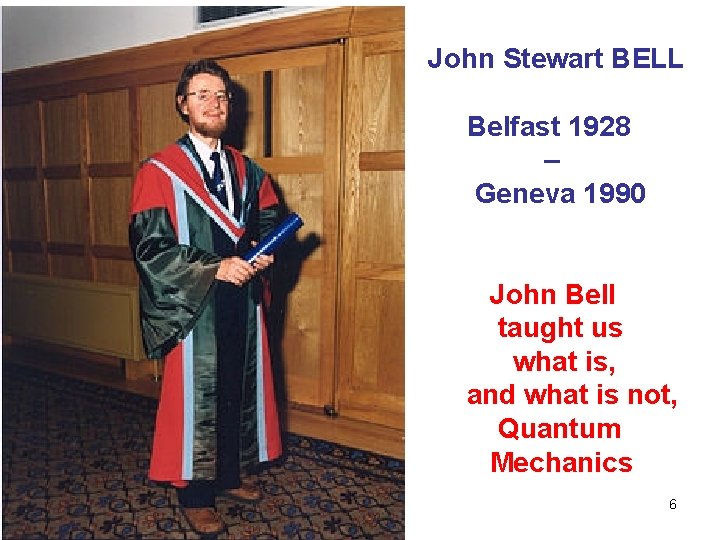
John Stewart BELL Belfast 1928 – Geneva 1990 John Bell taught us what is, and what is not, Quantum Mechanics 6
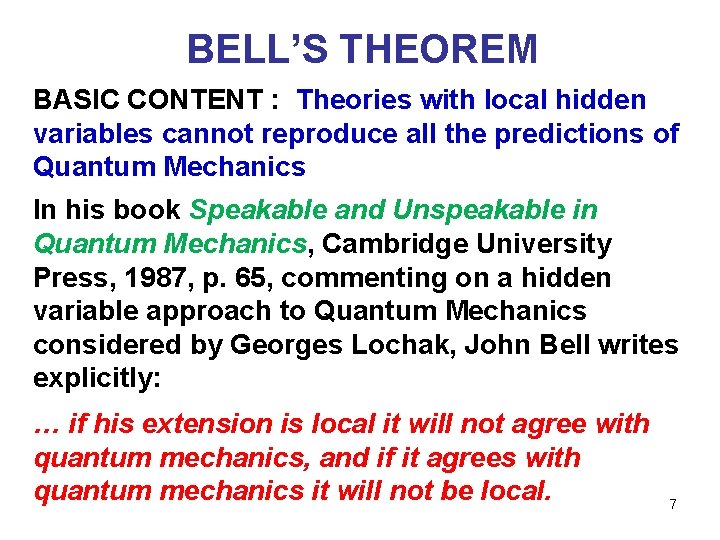
BELL’S THEOREM BASIC CONTENT : Theories with local hidden variables cannot reproduce all the predictions of Quantum Mechanics In his book Speakable and Unspeakable in Quantum Mechanics, Cambridge University Press, 1987, p. 65, commenting on a hidden variable approach to Quantum Mechanics considered by Georges Lochak, John Bell writes explicitly: … if his extension is local it will not agree with quantum mechanics, and if it agrees with quantum mechanics it will not be local. 7
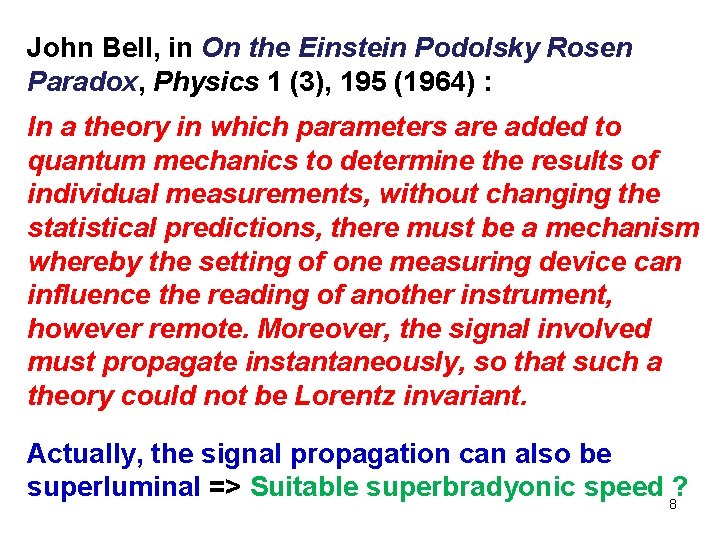
John Bell, in On the Einstein Podolsky Rosen Paradox, Physics 1 (3), 195 (1964) : In a theory in which parameters are added to quantum mechanics to determine the results of individual measurements, without changing the statistical predictions, there must be a mechanism whereby the setting of one measuring device can influence the reading of another instrument, however remote. Moreover, the signal involved must propagate instantaneously, so that such a theory could not be Lorentz invariant. Actually, the signal propagation can also be superluminal => Suitable superbradyonic speed 8?
TWO BASIC KINDS OF APPROACHES TO QUANTUM MECHANICS AND QUANTUM FIELD THEORY : 1 - START FROM A SITUATION WHERE, ROUGHLY SPEAKING, “THERE IS INITIALLY NOTHING INSIDE THE ORIGINAL VACUUM”. BUT WHAT, THEN, ABOUT THE COSMOLOGICAL CONSTANT GENERATED FROM SCALAR FIELDS ? (See, f. i. , S. WEINBERG, Rev. Mod. Phys. 61 , 1989, 1 -23). SEVERAL KINDS OF ATTEMPTS TO SOLVE THE COSMOLOGICAL CONSTANT PROBLEM EXIST (see, f. i. , A. ASHTEKAR, Implications of a positive cosmological constant for general relativity, ar. Xiv: 1706. 07482 ; C. WETTERICH ar. Xiv: 1704. 08040, 9
2 - VACUUM IS ACTUALLY “FULL” AND CAN EVEN LEAD THE FUNDAMENTAL DYNAMICS OF PARTICLE PHYSICS AND COSMOLOGY => PARTICLES ARE VACUUM EXCITATIONS => STANDARD QUANTUM MECHANICS AND QUANTUM FIELD THEORY CAN THEN BE LOWENERGY LIMITS OF THE BASIC PARTICLE PHYSICS GENERATED BY VACUUM => SOME OF THEIR PROPERTIES, WITH SUITABLE IMPROVEMENTS, MAY BE PRESERVED AT DISTANCE SCALES MUCH LARGER THAN THE SIZE OF QUARKS AND LEPTONS => WHAT IS THE ACTUAL SIZE OF AN ELECTRON ? WHAT ABOUT ITS INTERACTION WITH VACUUM ? 10
MORE GENERALLY, ALL THE LAWS OF PHYSICS (RELATIVITY, QUANTUM MECHANICS, VALIDITY OF LAGRANGIAN AND HAMILTONIAN FORMALISM, ENERGY AND MOMENTUM CONSERVATION, EFFECTIVE SPACE-TIME DIMENSIONS… ) SUCH AS FORMULATED AT LOW ENERGY, CAN BE DEFORMED AS THE ENERGY SCALE INCREASES AND NEW ELEMENTS OF THE BASIC DYNAMICS MANIFEST THEMSELVES => 11
“CLASSICAL” APPROACH : PREONS WOULD BE THE ULTIMATE CONSTITUENTS OF THE STANDARD PARTICLES SEE, f. i. , ABDUS SALAM, NOBEL LECTURE (DECEMBER 1979) AND REFERENCES THEREIN : “… the notions of quarks (and possibly leptons) as being composite of some more basic entities (PREQUARKS or PREENS), which each carry but one basic charge …” 12
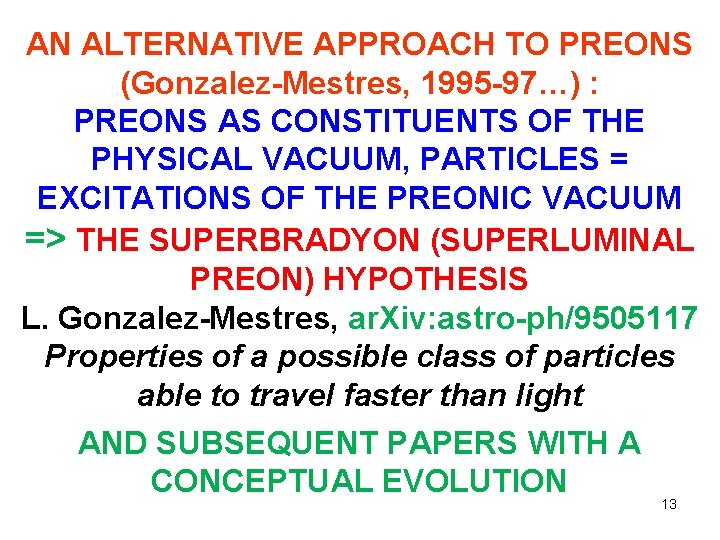
AN ALTERNATIVE APPROACH TO PREONS (Gonzalez-Mestres, 1995 -97…) : PREONS AS CONSTITUENTS OF THE PHYSICAL VACUUM, PARTICLES = EXCITATIONS OF THE PREONIC VACUUM => THE SUPERBRADYON (SUPERLUMINAL PREON) HYPOTHESIS L. Gonzalez-Mestres, ar. Xiv: astro-ph/9505117 Properties of a possible class of particles able to travel faster than light AND SUBSEQUENT PAPERS WITH A CONCEPTUAL EVOLUTION 13
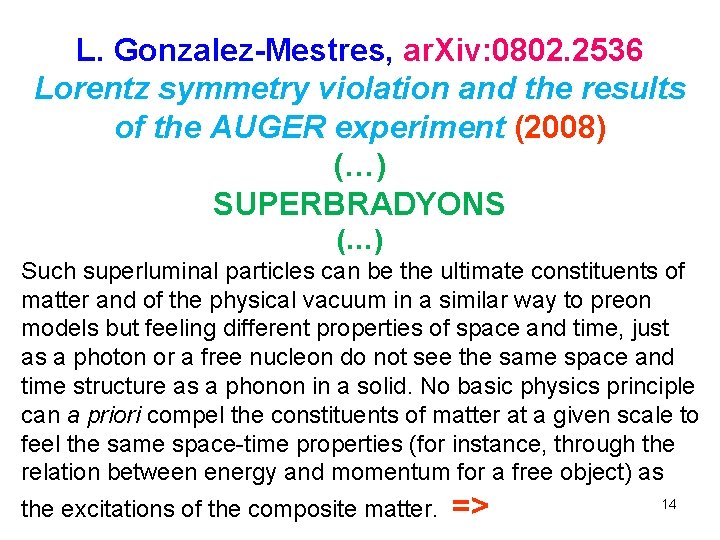
L. Gonzalez-Mestres, ar. Xiv: 0802. 2536 Lorentz symmetry violation and the results of the AUGER experiment (2008) (…) SUPERBRADYONS (…) Such superluminal particles can be the ultimate constituents of matter and of the physical vacuum in a similar way to preon models but feeling different properties of space and time, just as a photon or a free nucleon do not see the same space and time structure as a phonon in a solid. No basic physics principle can a priori compel the constituents of matter at a given scale to feel the same space-time properties (for instance, through the relation between energy and momentum for a free object) as the excitations of the composite matter. => 14
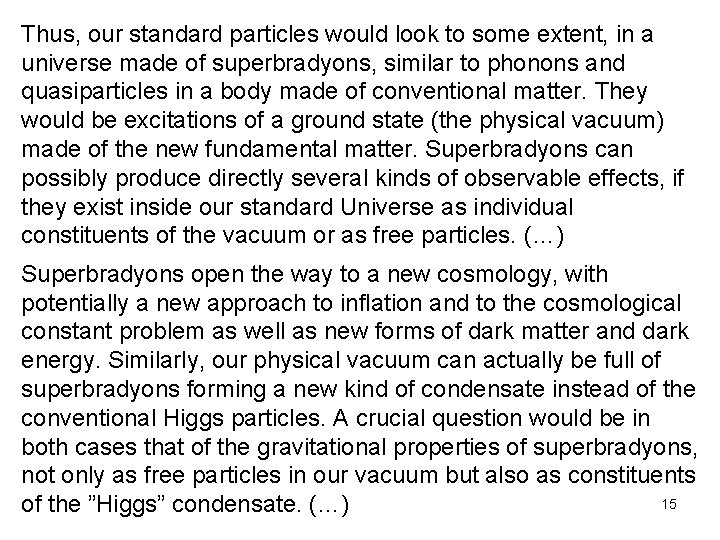
Thus, our standard particles would look to some extent, in a universe made of superbradyons, similar to phonons and quasiparticles in a body made of conventional matter. They would be excitations of a ground state (the physical vacuum) made of the new fundamental matter. Superbradyons can possibly produce directly several kinds of observable effects, if they exist inside our standard Universe as individual constituents of the vacuum or as free particles. (…) Superbradyons open the way to a new cosmology, with potentially a new approach to inflation and to the cosmological constant problem as well as new forms of dark matter and dark energy. Similarly, our physical vacuum can actually be full of superbradyons forming a new kind of condensate instead of the conventional Higgs particles. A crucial question would be in both cases that of the gravitational properties of superbradyons, not only as free particles in our vacuum but also as constituents 15 of the ”Higgs” condensate. (…)
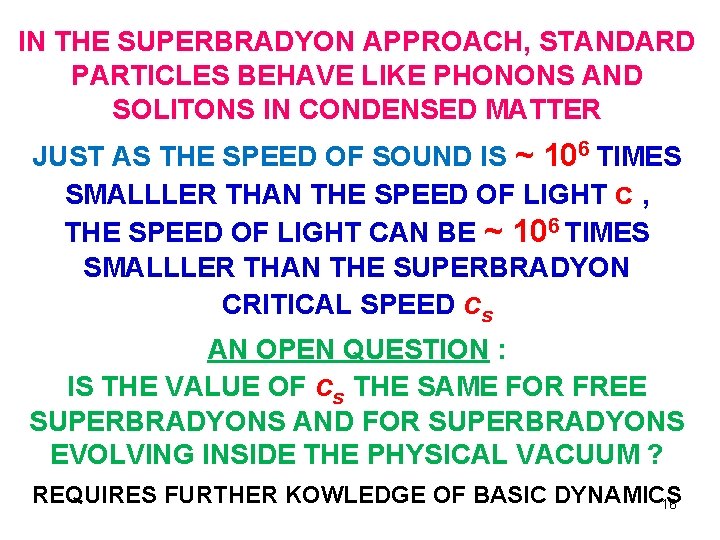
IN THE SUPERBRADYON APPROACH, STANDARD PARTICLES BEHAVE LIKE PHONONS AND SOLITONS IN CONDENSED MATTER JUST AS THE SPEED OF SOUND IS ~ 106 TIMES SMALLLER THAN THE SPEED OF LIGHT c , THE SPEED OF LIGHT CAN BE ~ 106 TIMES SMALLLER THAN THE SUPERBRADYON CRITICAL SPEED cs AN OPEN QUESTION : IS THE VALUE OF cs THE SAME FOR FREE SUPERBRADYONS AND FOR SUPERBRADYONS EVOLVING INSIDE THE PHYSICAL VACUUM ? REQUIRES FURTHER KOWLEDGE OF BASIC DYNAMICS 16
THE UNPRECEDENTED RESULTS OF A SATELLITE EXPERIMENT ENTANGLEMENT CHECKED AT ~ 1200 KM WHAT ARE THE POTENTIAL IMPLICATIONS ? 17
https: //arxiv. org/abs/1707. 01339 Satellite-Based Entanglement Distribution Over 1200 kilometer Juan Yin, Yuan Cao, Yu-Huai Li, Sheng-Kai Liao, Liang Zhang, Ji-Gang Ren, Wen. Qi Cai, Wei-Yue Liu, Bo Li, Hui Dai, Guang-Bing Li, Qi-Ming Lu, Yun-Hong Gong, Yu Xu, Shuang-Lin Li, Feng-Zhi Li, Ya-Yun Yin, Zi-Qing Jiang, Ming Li, Jian-Jun Jia, Ge Ren, Dong He, Yi-Lin Zhou, Xiao-Xiang Zhang, Na Wang, Xiang Chang, Zhen-Cai Zhu, Nai-Le Liu, Yu-Ao Chen, Chao-Yang Lu, Rong Shu, Cheng-Zhi Peng, Jian-Yu Wang, Jian-Wei Pan (Submitted on 5 Jul 2017) Long-distance entanglement distribution is essential both for foundational tests of quantum physics and scalable quantum networks. Owing to channel loss, however, the previously achieved distance was limited to ~100 km. Here, we demonstrate satellite-based distribution of entangled photon pairs to two locations separated by 1203 km on the Earth, through satellite-toground two-downlink with a sum of length varies from 1600 km to 2400 km. => 18
We observe a survival of two-photon entanglement and a violation of Bell inequality by 2. 37+/-0. 09 under strict Einstein locality conditions. The obtained effective link efficiency at 1200 km in this work is over 12 orders of magnitude higher than the direct bidirectional transmission of the two photons through the best commercial telecommunication fibers with a loss of 0. 16 d. B/km. (end of the abstract) (…) A synchronization jitter of 0. 77 ns is obtained, which is used to tag the received signals and perform coincidence detection within a 2. 5 – ns time window (end of quote) CAN BE COMPATIBLE WITH SUPERLUMINAL SIGNAL PROPAGATION AT A SPEED cs ~ 106 c GENERATING ENTANGLEMENT 19
THE SUPERLUMINAL SIGNAL PROPAGATION JUST CONSIDERED WOULD BE SPECIFIC TO THE TWO ENTANGLED PARTICLES IF “ELEMENTARY” PARTICLES ARE ACTUALLY VACUUM EXCITATIONS, SUCH A SIGNAL WOULD PROPAGATE INSIDE THE PHYSICAL VACUUM AND GENERATE A PERMANENT LINK (ENTANGLEMENT) BETWEEN THE TWO PARTICLES => THEN, OTHER SUPERLUMINAL OBJECTS WOULD ALSO EXIST AND PROPAGATE INSIDE VACUUM (PREONS, PREONIC WAVES…) 20
AS SUPERBRADYONS WOULD NOT BE STANDARD PARTICLES, WE EXPECT THE DIRECT COUPLING OF A SINGLE SUPERBRADYON TO STANDARD INTERACTIONS TO BE WEAKER THAN THAT OF STANDARD MATTER BUT IF THE PHYSICAL VACUUM IS MADE OF SUPERBRADYONS, THE TRANSMISSION OF SIGNALS AND INFORMATION FROM STANDARD MATTER WILL BE A COLLECTIVE EFFECT AND CAN BE AMPLIFIED AS SUCH 21
SUPERLUMINAL SIGNALS PROPAGATING IN A SUPERBRADYONIC VACUUM AS A NATURAL EXPLANATION FOR QUANTUM ENTANGLEMENT DATA Assume, as previously, that the critical speed of superbradyons inside vacuum is cs ~ 106 c just as c is ~ 106 times larger than the speed of sound => can explain data from Bernien, Hensen et al. 1. 3 Km / cs ~ 4 x 10 -12 s Future experiments on entanglement can lead to bounds on cs and even, possibly, determine it. 22
http: //arxiv. org/abs/1508. 05949 Experimental loophole-free violation of a Bell inequality using entangled electron spins separated by 1. 3 km B. Hensen, H. Bernien, A. E. Dréau, A. Reiserer, N. Kalb, M. S. Blok, J. Ruitenberg, R. F. L. Vermeulen, R. N. Schouten, C. Abellán, W. Amaya, V. Pruneri, M. W. Mitchell, M. Markham, D. J. Twitchen, D. Elkouss, S. Wehner, T. H. Taminiau, R. Hanson (Submitted on 24 Aug 2015) For more than 80 years, the counterintuitive predictions of quantum theory have stimulated debate about the nature of reality. In his seminal work, John Bell proved that no theory of nature that obeys locality and realism can reproduce all the predictions of quantum theory. Bell showed that in any local realist theory the correlations between distant measurements satisfy an inequality and, moreover, that this inequality can be violated according to quantum theory. 23
This provided a recipe for experimental tests of the fundamental principles underlying the laws of nature. In the past decades, numerous ingenious Bell inequality tests have been reported. However, because of experimental limitations, all experiments to date required additional assumptions to obtain a contradiction with local realism, resulting in loopholes. Here we report on a Bell experiment that is free of any such additional assumption and thus directly tests the principles underlying Bell's inequality. We employ an event-ready scheme that enables the generation of high-fidelity entanglement between distant electron spins. Efficient spin readout avoids the fair sampling assumption (detection loophole), while the use of fast random basis selection and readout combined with a spatial separation of 1. 3 km ensure the required locality conditions. We perform 245 trials testing the CHSH-Bell inequality S ≤ 2 and find S = 2. 42 ± 0. 20. A null hypothesis test yields a probability of p = 0. 0039 that a local-realist model for space-like separated sites produces data with a violation at least as large as observed, even when allowing for memory in the devices. This result rules out large classes of local realist theories, and paves the way for implementing device-independent quantum-secure communication and randomness certification. 24
II – QUANTUM MECHANICS AND SPACE -TIME STRUCTURE SPACE-TIME, THE UNIVERSE AND PARTICLE PROPERTIES => THE SPINORIAL SPACE-TIME FIRST INGREDIENT OF A NEW FORMULATION OF QUANTUM MECHANICS : SUPERLUMINAL SIGNALS IN THE SUPERBRADYONIC VACUUM BUT WHAT ABOUT SPACE-TIME ? IS THERE A LINK BETWEEN QUANTUM MECHANICS AND THE SPACE-TIME STRUCTURE ? 25
IS THERE A RELATION BETWEEN COMPLEX QUANTUM WAVE FUNCTIONS AND POSSIBLE COMPLEX SPACE-TIME COORDINATES ? ARE COMPLEX QUANTUM WAVE FUNCTIONS NATURAL EXPRESSIONS OF A COMPLEX SPACE-TIME WHERE VACUUM DYNAMICS IS GENERATED AND OPERATES ? HOW ARE FERMIONIC SPINORS GENERATED FROM THE ULTIMATE DYNAMICAL STRUCTURE ? FERMIONIC WAVE FUNCTIONS ARE NOT DIRECT REPRESENTATIONS OF THE SO(3) SPACE ROTATION GROUP => WHAT CAN BE A SUITABLE SPACE-TIME ? 26
AN POSSIBLE NEW SPACE-TIME : THE SPINORIAL SPACE-TIME (SST) L. Gonzalez-Mestres, 1996 -97 FERMIONS ARE NOT ACTUAL REPRESENTATIONS OF THE CONVENTIONAL SPACE ROTATION GROUP SO(3) BUT OF ITS COVERING GROUP SU(2) => Replace the standard four-dimensional spacetime by a SU(2) spinorial one, so that spin-1/2 particles become representations of the actual group of space transformations. => Associate to each point of space-time in our Universe a cosmic spinor ξ (two components, two complex numbers) with a SU(2) group that contains 27 the space rotations group SO(3).
SEE, FOR INSTANCE, MY PREVIOUS ICNFP PAPERS => Extracting from a cosmic spinor ξ the scalar |ξ|2 = ξ†ξ where the dagger stands for hermitic conjugate, a positive cosmic time t = |ξ| can be defined which leads in particular to a naturally expanding universe, with an arrow of time. => The conventional space at cosmic time t 0 corresponds to the |ξ| = t 0 S 3 hypersphere from the four real numbers contained in the two SU(2) spinor components PURELY GEOMETRIC EFFECTS UNTIL NOW => No matter, no critical speed, involved yet. 28
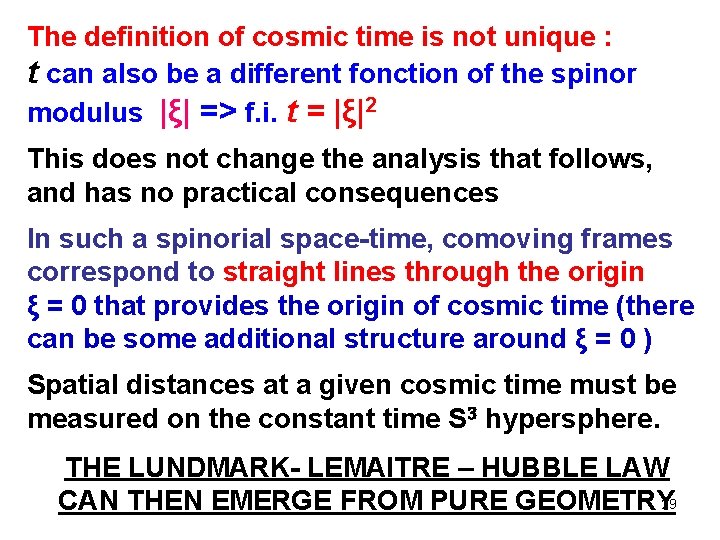
The definition of cosmic time is not unique : t can also be a different fonction of the spinor modulus |ξ| => f. i. t = |ξ|2 This does not change the analysis that follows, and has no practical consequences In such a spinorial space-time, comoving frames correspond to straight lines through the origin ξ = 0 that provides the origin of cosmic time (there can be some additional structure around ξ = 0 ) Spatial distances at a given cosmic time must be measured on the constant time S 3 hypersphere. THE LUNDMARK- LEMAITRE – HUBBLE LAW 29 CAN THEN EMERGE FROM PURE GEOMETRY
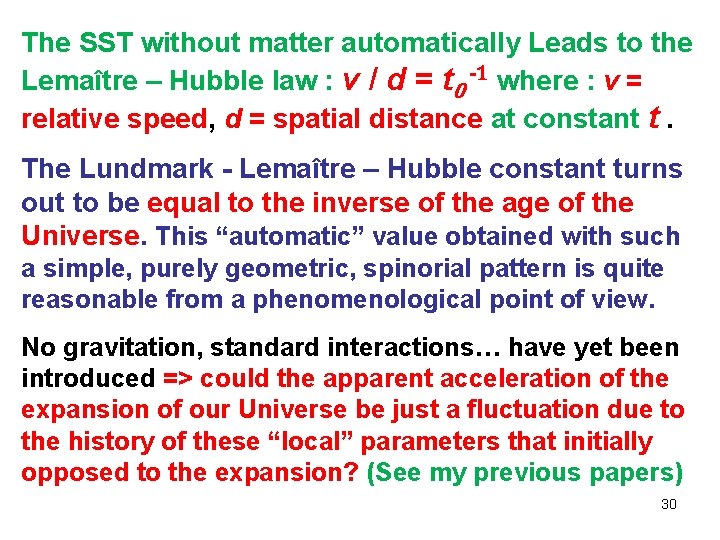
The SST without matter automatically Leads to the Lemaître – Hubble law : v / d = t 0 -1 where : v = relative speed, d = spatial distance at constant t. The Lundmark - Lemaître – Hubble constant turns out to be equal to the inverse of the age of the Universe. This “automatic” value obtained with such a simple, purely geometric, spinorial pattern is quite reasonable from a phenomenological point of view. No gravitation, standard interactions… have yet been introduced => could the apparent acceleration of the expansion of our Universe be just a fluctuation due to the history of these “local” parameters that initially opposed to the expansion? (See my previous papers) 30
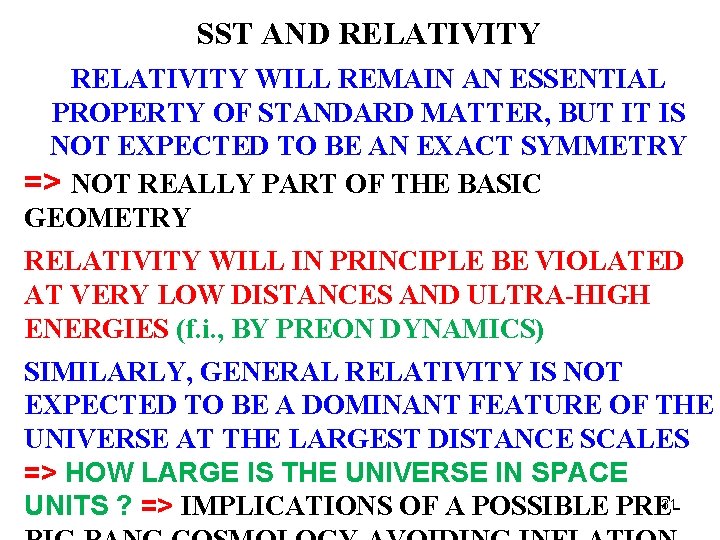
SST AND RELATIVITY WILL REMAIN AN ESSENTIAL PROPERTY OF STANDARD MATTER, BUT IT IS NOT EXPECTED TO BE AN EXACT SYMMETRY => NOT REALLY PART OF THE BASIC GEOMETRY RELATIVITY WILL IN PRINCIPLE BE VIOLATED AT VERY LOW DISTANCES AND ULTRA-HIGH ENERGIES (f. i. , BY PREON DYNAMICS) SIMILARLY, GENERAL RELATIVITY IS NOT EXPECTED TO BE A DOMINANT FEATURE OF THE UNIVERSE AT THE LARGEST DISTANCE SCALES => HOW LARGE IS THE UNIVERSE IN SPACE 31 UNITS ? => IMPLICATIONS OF A POSSIBLE PRE-
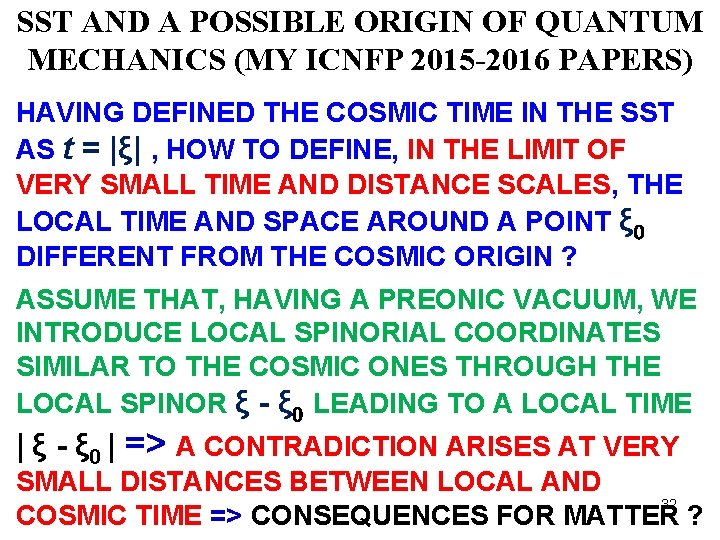
SST AND A POSSIBLE ORIGIN OF QUANTUM MECHANICS (MY ICNFP 2015 -2016 PAPERS) HAVING DEFINED THE COSMIC TIME IN THE SST AS t = |ξ| , HOW TO DEFINE, IN THE LIMIT OF VERY SMALL TIME AND DISTANCE SCALES, THE LOCAL TIME AND SPACE AROUND A POINT ξ 0 DIFFERENT FROM THE COSMIC ORIGIN ? ASSUME THAT, HAVING A PREONIC VACUUM, WE INTRODUCE LOCAL SPINORIAL COORDINATES SIMILAR TO THE COSMIC ONES THROUGH THE LOCAL SPINOR ξ - ξ 0 LEADING TO A LOCAL TIME | ξ - ξ 0 | => A CONTRADICTION ARISES AT VERY SMALL DISTANCES BETWEEN LOCAL AND 32 COSMIC TIME => CONSEQUENCES FOR MATTER ?
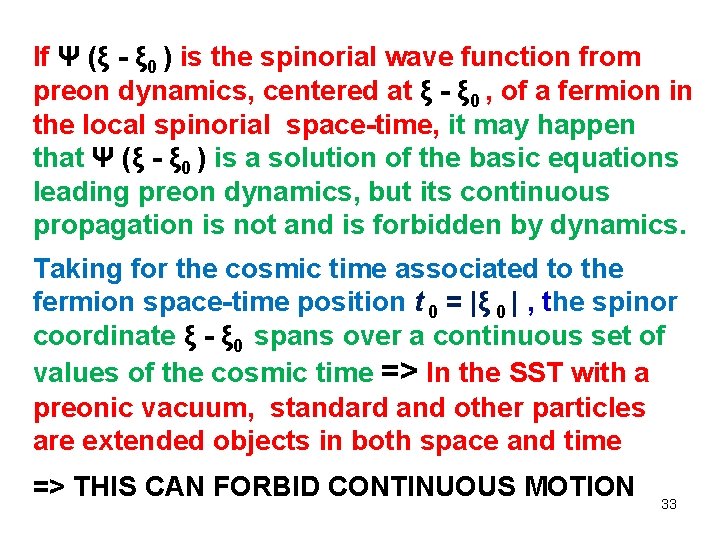
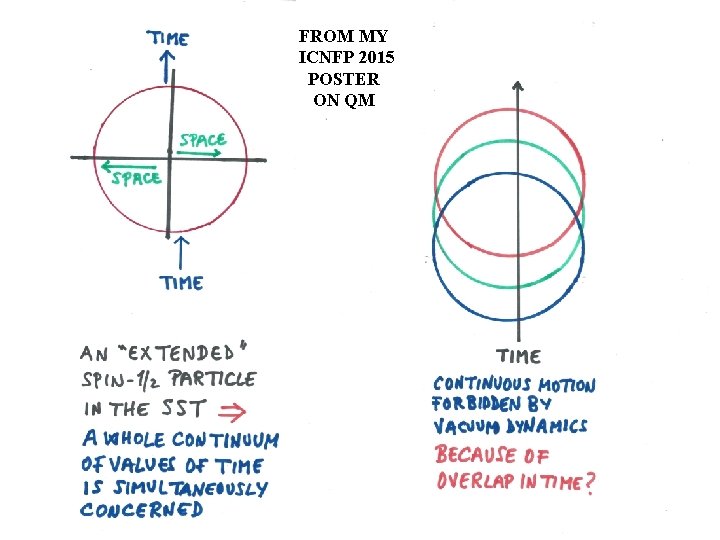
If Ψ (ξ - ξ 0 ) is the spinorial wave function from preon dynamics, centered at ξ - ξ 0 , of a fermion in the local spinorial space-time, it may happen that Ψ (ξ - ξ 0 ) is a solution of the basic equations leading preon dynamics, but its continuous propagation is not and is forbidden by dynamics. Taking for the cosmic time associated to the fermion space-time position t 0 = |ξ 0 | , the spinor coordinate ξ - ξ 0 spans over a continuous set of values of the cosmic time => In the SST with a preonic vacuum, standard and other particles are extended objects in both space and time => THIS CAN FORBID CONTINUOUS MOTION 33
FROM MY ICNFP 2015 POSTER ON QM 34
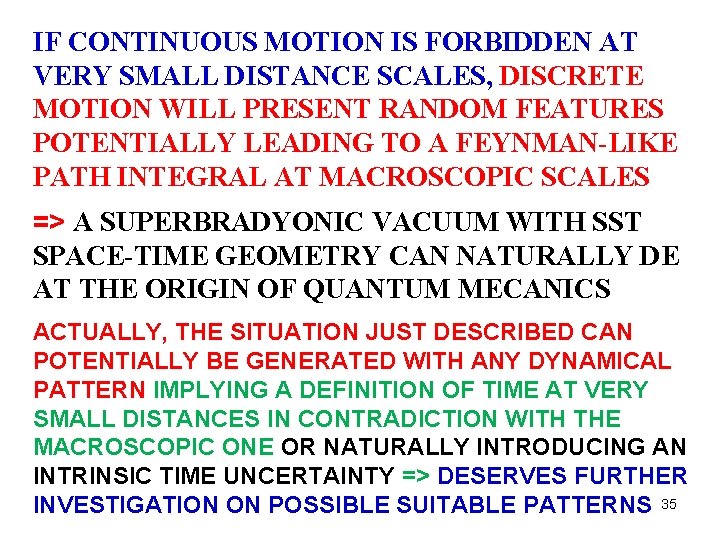
IF CONTINUOUS MOTION IS FORBIDDEN AT VERY SMALL DISTANCE SCALES, DISCRETE MOTION WILL PRESENT RANDOM FEATURES POTENTIALLY LEADING TO A FEYNMAN-LIKE PATH INTEGRAL AT MACROSCOPIC SCALES => A SUPERBRADYONIC VACUUM WITH SST SPACE-TIME GEOMETRY CAN NATURALLY DE AT THE ORIGIN OF QUANTUM MECANICS ACTUALLY, THE SITUATION JUST DESCRIBED CAN POTENTIALLY BE GENERATED WITH ANY DYNAMICAL PATTERN IMPLYING A DEFINITION OF TIME AT VERY SMALL DISTANCES IN CONTRADICTION WITH THE MACROSCOPIC ONE OR NATURALLY INTRODUCING AN INTRINSIC TIME UNCERTAINTY => DESERVES FURTHER INVESTIGATION ON POSSIBLE SUITABLE PATTERNS 35
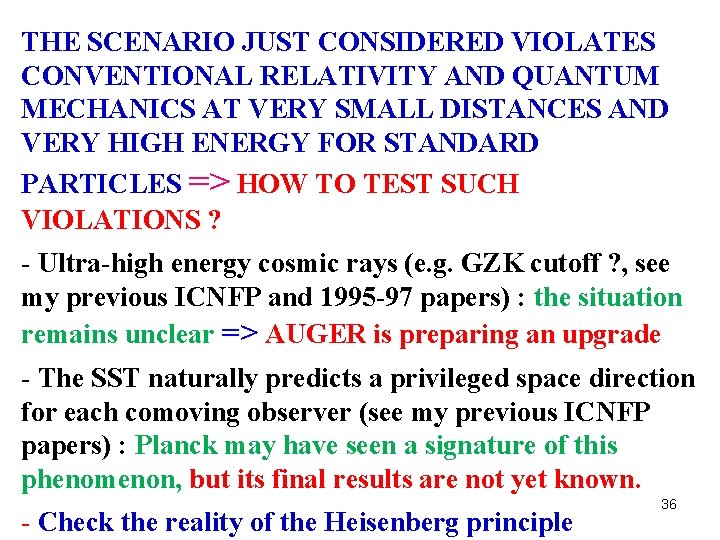
THE SCENARIO JUST CONSIDERED VIOLATES CONVENTIONAL RELATIVITY AND QUANTUM MECHANICS AT VERY SMALL DISTANCES AND VERY HIGH ENERGY FOR STANDARD PARTICLES => HOW TO TEST SUCH VIOLATIONS ? - Ultra-high energy cosmic rays (e. g. GZK cutoff ? , see my previous ICNFP and 1995 -97 papers) : the situation remains unclear => AUGER is preparing an upgrade - The SST naturally predicts a privileged space direction for each comoving observer (see my previous ICNFP papers) : Planck may have seen a signature of this phenomenon, but its final results are not yet known. - Check the reality of the Heisenberg principle 36
Recent precision experiments do not seem to confirm the "measurementdisturbance relationship" suggested by Werner Heisenberg in 1927 (W. Heisenberg, Über den anschaulichen Inhalt der quantentheoretischen Kinematik und Mechanik, Zeitschfrift für Physik 43, 172 (1927). Werner Heisenberg wrote in particular [51]: "At the instant of time when the position is determined, that is, at the instant when the photon is scattered by the electron, the electron undergoes a discontinuous change in momentum. This change is the greater the smaller the wavelength of the light employed, i. e. , the more exact the determination of the position". (English translation from W. Heisenbeg, The Physical Content of Quantum Kinematics and Mechanics, in Quantum Theory and Measurement, Edited by J. A. Wheeler and W. H. Zurek, Princeton Univ. Press, 1984. ) But L. A. Rozema et al. , Violation of Heisenberg’s Measurement. Disturbance Relationship by Weak Measurements, Phys. Rev. Lett. 109, 100404 (2012), ar. Xiv: 1208. 0034, conclude on the grounds of experimental results that "although correct for uncertainties in states, the form of Heisenberg’s precision limit is incorrect if naively applied to measurement". 37
http: //arxiv. org/abs/1604. 03637 The Pierre Auger Observatory Upgrade Preliminary Design Report The Pierre Auger Collaboration: (Submitted on 13 Apr 2016) The Pierre Auger Observatory has begun a major Upgrade of its already impressive capabilities, with an emphasis on improved mass composition determination using the surface detectors of the Observatory. Known as Auger. Prime, the upgrade will include new 4 m 2 plastic scintillator detectors on top of all 1660 water-Cherenkov detectors, updated and more flexible surface detector electronics, a large array of buried muon detectors, and an extended duty cycle for operations of the fluorescence detectors. This Preliminary Design Report was produced by the Collaboration in April 2015 as an internal document and information for funding agencies. It outlines the scientific and technical case for Auger. Prime. (…) 38
III – HOW TO TEST THE SUPERBRADYONIC VACUUM ? (INCLUDING QUANTUM-MECHANICAL EFFECTS IN THIS CONTEXT) A POSSIBLE NEW WAY AFTER LIGO – VIRGO RESULTS : BLACK HOLES, GRAVITATIONAL WAVES, OTHER POSSIBLE WAVES… 39
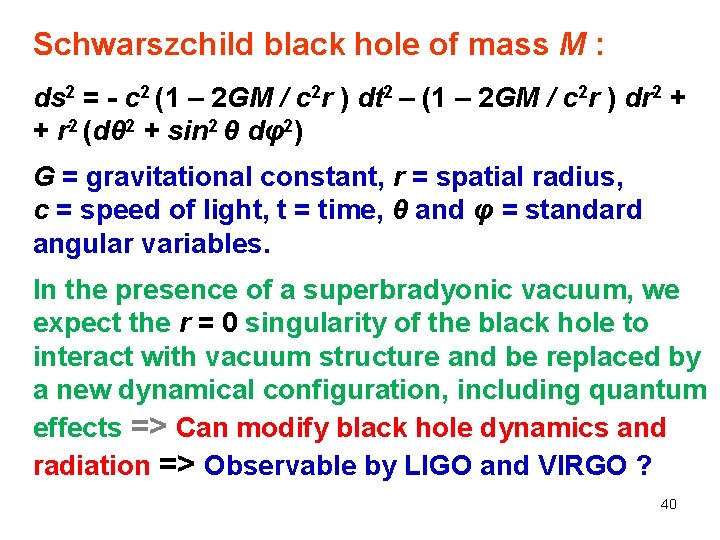
Schwarszchild black hole of mass M : ds 2 = - c 2 (1 – 2 GM / c 2 r ) dt 2 – (1 – 2 GM / c 2 r ) dr 2 + + r 2 (dθ 2 + sin 2 θ dφ2) G = gravitational constant, r = spatial radius, c = speed of light, t = time, θ and φ = standard angular variables. In the presence of a superbradyonic vacuum, we expect the r = 0 singularity of the black hole to interact with vacuum structure and be replaced by a new dynamical configuration, including quantum effects => Can modify black hole dynamics and radiation => Observable by LIGO and VIRGO ? 40
ar. Xiv: 1706. 01812 GW 170104: Observation of a 50 -Solar-Mass Binary Black Hole Coalescence at Redshift 0. 2 The LIGO Scientific Collaboration, the Virgo Collaboration We describe the observation of GW 170104, a gravitational-wave signal produced by the coalescence of a pair of stellar-mass black holes. The signal was measured on January 4, 2017 at 10: 11: 58. 6 UTC by the twin advanced detectors of the Laser Interferometer Gravitational-Wave Observatory during their second observing run, with a network signal-tonoise ratio of 13 and a false alarm rate less than 1 in 70, 000 years. The inferred component black hole masses are 31. 2 +8. 4 − 6. 0 M⊙ and 19. 4 +5. 3 − 5. 9 M ⊙ (at the 90% credible level). The black hole spins are best constrained through measurement of the effective inspiral spin parameter, a mass-weighted combination of the spin components perpendicular to the orbital plane, χeff=− 0. 12 +0. 21 − 0. 30. This result implies that spin configurations with both component spins positively aligned with the orbital angular momentum are disfavored. 41
The source luminosity distance is 880 +450 − 390 Mpc corresponding to a redshift of z = 0. 18 +0. 08 − 0. 07. We constrain the magnitude of modifications to the gravitational-wave dispersion relation and perform null tests of general relativity. Assuming that gravitons are dispersed in vacuum like massive particles, we bound the graviton mass to mg ≤ 7. 7 × 10− 23 e. V/c 2. In all cases, we find that GW 170104 is consistent with general relativity. NEW PHYSICS, AND IN PARTICULAR THE PHYSICAL VACUUM STRUCTURE, CAN INDEED MODIFY BLACK HOLE DYNAMICS AND PRODUCE OBSERVABLE EFFECTS THE EFFECT CAN BE EVEN STRONGER FOR A BLACK HOLE MERGER STANDARD QUANTUM EFFECTS ARE ALREADY KNOWN TO PRODUCE HAWKING RADIATION, BUT WHAT CAN HAPPEN IN THE PRESENCE 42 OF A SUPERBRADYONIC VACUUM?
EPJ Web of Conferences will be set by the publisher DOI: will be set by the publisher c Owned by the authors, published by EDP Sciences, 2017 ICNFP 2016 Quantum Mechanics, vacuum, particles, Gödel-Cohen incompleteness and the Universe Luis Gonzalez-Mestres, Cosmology Laboratory, John Naisbitt University, Belgrade and Paris Goce Delceva 8, 11070 Novi Beograd, Serbia Abstract. Are the standard laws of Physics really fundamental principles? Does the physical vacuum have a more primordial internal structure? Are quarks, leptons, gauge bosons. . . ultimate elementary objects? These three basic questions are actually closely related. If the deep vacuum structure and dynamics turn out to be less trivial than usually depicted, the conventional "elementary" particles will most likely be excitations of such a vacuum dynamics that remains by now unknown. We then expect relativity and quantum mechanics to be low-energy limits of a more fundamental dynamical pattern that generates them at a deeper level. It may even happen that vacuum drives the expansion of the Universe from 43 its own inner dynamics. =>
Inside such a vacuum structure, the speed of light would not be the critical speed for vacuum constituents and propagating signals. The natural scenario would be the superbradyon (superluminal preon) pattern we postulated in 1995, with a new critical speed cs much larger than the speed of light c just as c is much larger than the speed of sound. Superbradyons are assumed to be the bradyons of a super-relativity associated to cs (a Lorentz invariance with cs as the critical speed). Similarly, the standard relativistic space-time with four real coordinates would not necessarily hold beyond low-energy and comparatively local distance scales. Instead, the spinorial space-time (SST) with two complex coordinates we introduced in 1996 -97 may be the suitable one to describe the internal structure of vacuum and standard "elementary" particles and, simultaneously, Cosmology at very large distance scales. If the constituents of the preonic vacuum are superluminal, quantum entanglement appears as a natural property provided cs >> c. The value of cs can even be possibly found experimentally by studying entanglement at large distances. It is not excluded that preonic constituents of vacuum can exist in our Universe as free particles ("free" superbradyons), in which case we expect them to be weakly coupled to 44 standard matter. =>
If a preonic vacuum is actually leading the basic dynamics of Particle Physics and Cosmology, and standard particles are vacuum excitations, the Gödel-Cohen incompleteness will apply to vacuum dynamics whereas the conventional laws of physics will actually be approximate and have error bars. We discuss here the possible role of the superbradyonic vacuum and of the SST in generating Quantum Mechanics, as well as the implications of such a dynamical origin of the conventional laws of Physics and possible evidences in experiments and observations. Black holes, gravitational waves, possible "free" superbradyons or preonic waves, unconventional vacuum radiation. . . are considered from this point of view paying particular attention to LIGO, VIRGO and CERN experiments. EPJ Web of Conferences will be set by the publisher ICNFP 2016 DOI: will be set by the publisher c Owned by the authors, published by EDP Sciences, 2017 Value of H, space-time patterns, vacuum, matter, expansion of the Universe, alternative cosmologies Luis Gonzalez-Mestres (…) 45
ar. Xiv: 1708. 01789 Nature Astronomy 1 (2017) 0065 Planck stars: new sources in radio and gamma astronomy? Carlo Rovelli A new phenomenon, recently studied in theoretical physics, may have considerable interest for astronomers: the explosive decay of old primordial black holes via quantum tunnelling. Models predict radio and gamma bursts with a characteristic frequency-distance relation making them identifiable. Their detection would be of major theoretical importance. MORE GENERALLY, VACUUM INTERACTIONS WITH BLACK HOLES (IN PARTICULAR, SUPERBRADYONS) AND QUANTUM EFFECTS 46
A SIMPLE EXAMPLE OF A POSSIBLE SIGNATURE Assume that, as a result of the interaction between the superbradyonic vacuum and the black hole (or black hole merger), some superbradyons can penetrate inside the black hole (or black hole merger) and leave it as free particles => a new form of black hole radiation The Schwarszchild radius R = 2 GMc-2 associated to the observed black holes and black hole mergers is in all cases less than 200 Km => A superbradyon with speed ~ 106 c would possibly be able to leave the black hole in less than 1 ns => No time to interact gravitationally ? => AND 47 POSSIBLE PERMANENT INTERACTIONS ?
Then, assuming Cherenkov decay in vacuum, superbradyons emitted by the observed black hole mergers should be able to reach Earth with a speed close to c Energy ? Interaction with detectors ? PREONIC WAVES emitted together with gravitational waves ? => Can one detect such superbradyons and preonic waves ? Can gravitational waves propagating on very large distances directly interact with the preonic vacuum ? => FURTHER WORK AND DATA ARE NEEDED 48
CONCLUSION A REAL UNDERSTANDING OF QUANTUM MECHANICS REQUIRES, IN PARTICULAR, UNDERSTANDING THE PHYSICAL VACUUM => THIS IS NOT A SIMPLE TASK AND CAN TAKE A LONG TIME IF THE VACUUM HAS A NONTRIVIAL INTERNAL STRUCTURE, ITS CONSTITUENTS WILL NATURALLY BE SUPERLUMINAL => NATURAL QUANTUM ENTANGLEMENT 49
THE SST CAN BE AT THE ORIGIN OF THE COMPLEX WAVE FUNCTIONS AND CAN EVEN GENERATE A SPACE-TIME CONTRADICTION LEADING TO THE FEYNMAN PATH INTEGRAL BLACK HOLES, GRAVITATIONAL WAVES, LIGO, VIRGO… CAN CONTRIBUTE TO UNVEIL THE VACUUM STRUCTURE INCLUDING SUPERBRADYONS AND PREONIC WAVES IF QUANTUM MECHANICS IS THE RESULT OF A SPACE-TIME CONTRADICTION, ITS GENERATION AS A PHYSICAL LAW FOR STANDARD MATTER HAS FOLLOWED THE EVOLUTION OF THE EARLY UNIVERSE => A REAL PRE-BIG BANG PATTERN, INSTEAD OF LEMAÎTRE’S FIRST QUANTUM 50
CAN ULTRA-HIGH ENERGY COSMIC RAYS PROVIDE A SIGNATURE OF DEFORMATIONS OF RELATIVITY AND QUANTUM MECHANICS ? (Gonzalez-Mestres, 1996…) THE EXPERIMENTAL SITUATION IS NOT YET CLEAR => AUGER UPGRADE A FUNDAMENTAL INTERROGATION : DOES THE PLANCK SCALE MAKE SENSE? SEE MY PREVIOUS CONTRIBUTIONS TO THE ICNFP CONFERENCES 51