
The Natural Logarithmic Function Differentiation Integration Properties of
- Slides: 35
The Natural Logarithmic Function Differentiation Integration
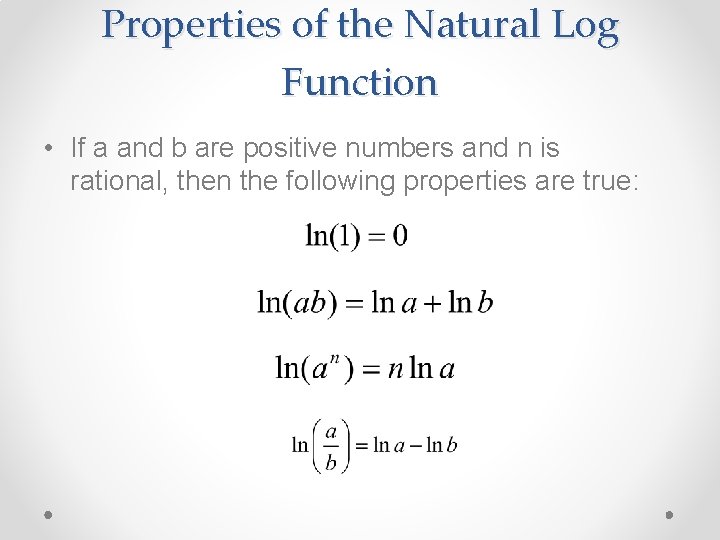
Properties of the Natural Log Function • If a and b are positive numbers and n is rational, then the following properties are true:
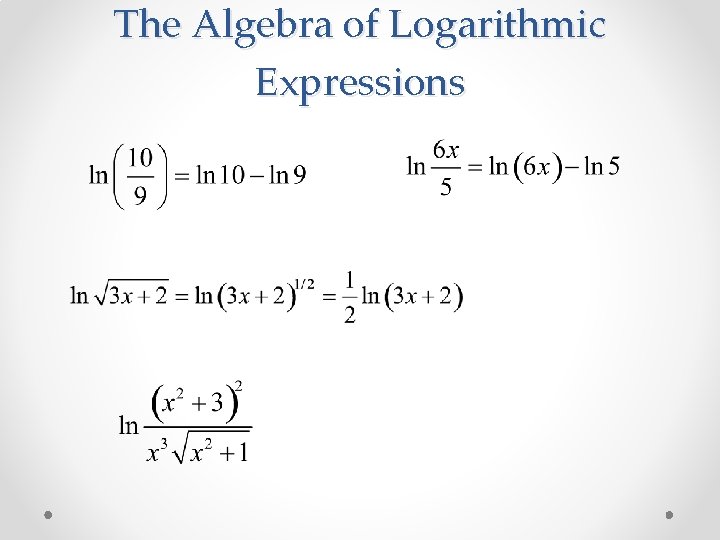
The Algebra of Logarithmic Expressions
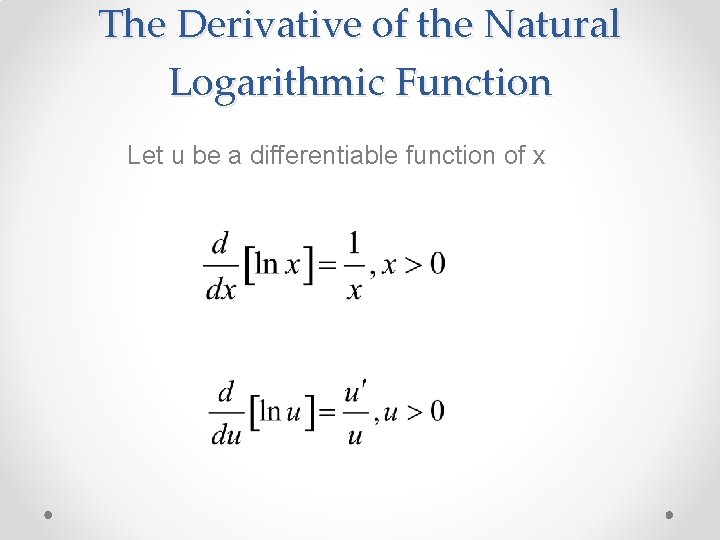
The Derivative of the Natural Logarithmic Function Let u be a differentiable function of x
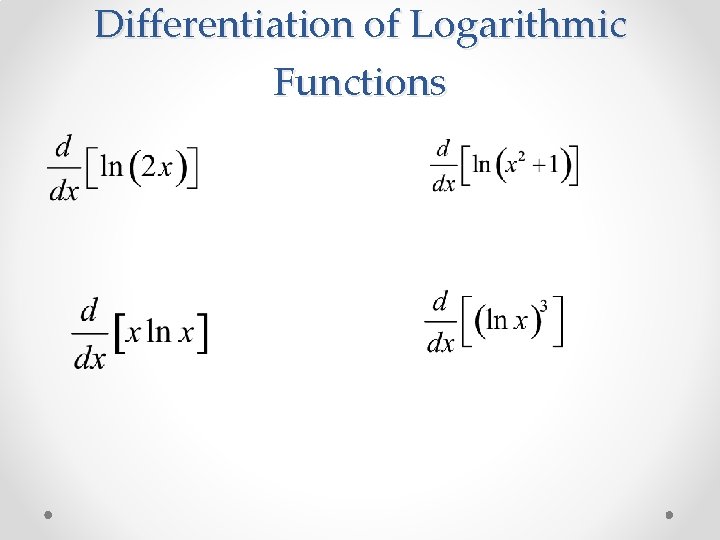
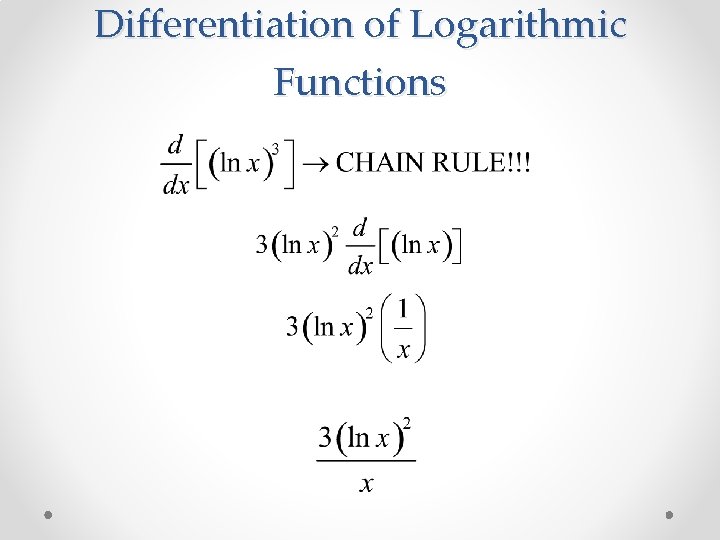
Differentiation of Logarithmic Functions
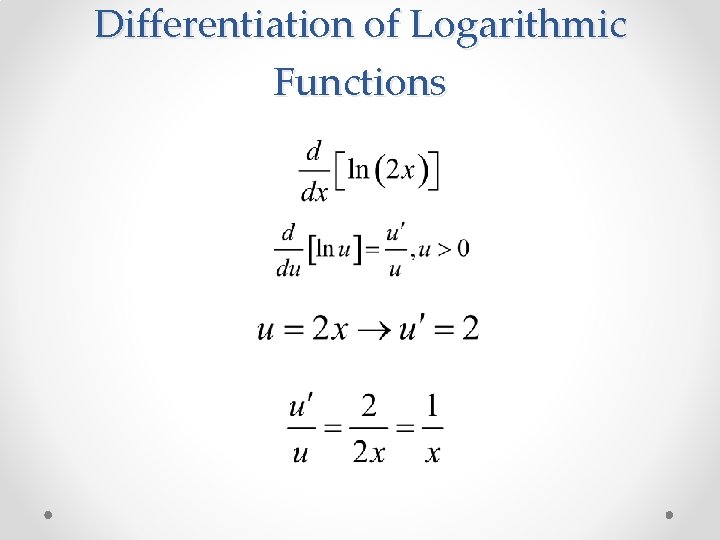
Differentiation of Logarithmic Functions
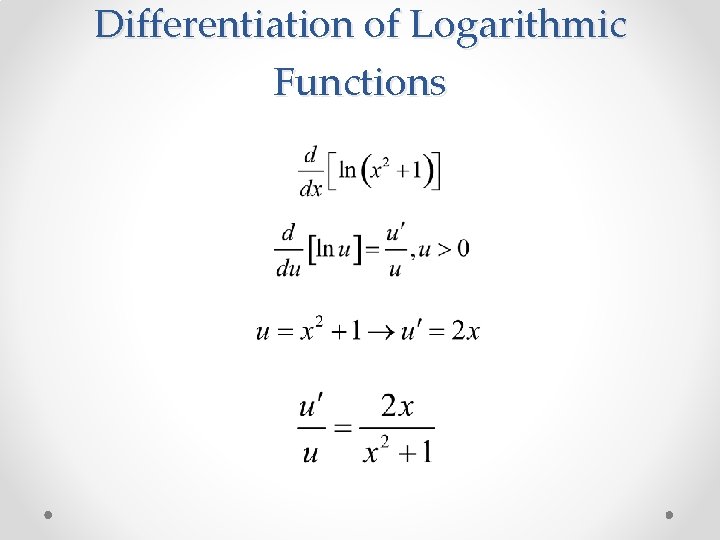
Differentiation of Logarithmic Functions
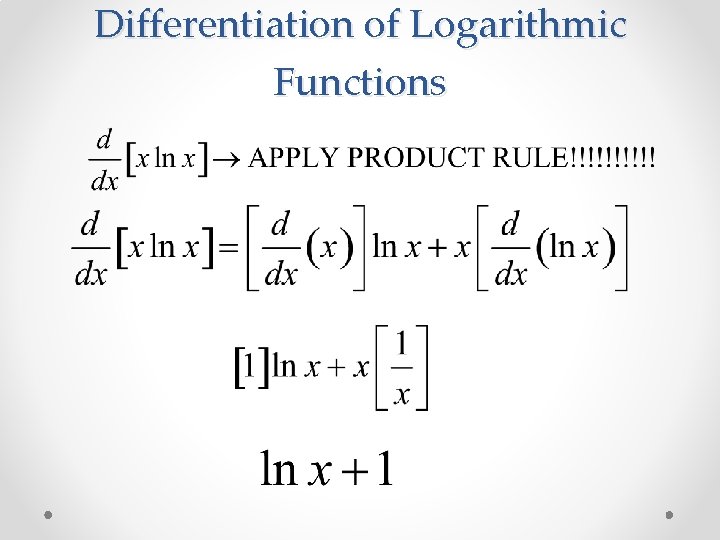
Differentiation of Logarithmic Functions
Differentiation of Logarithmic Functions
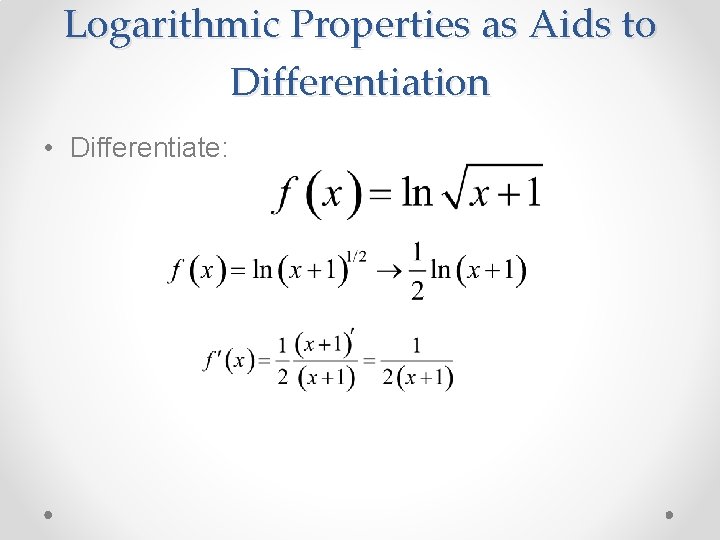
Logarithmic Properties as Aids to Differentiation • Differentiate:
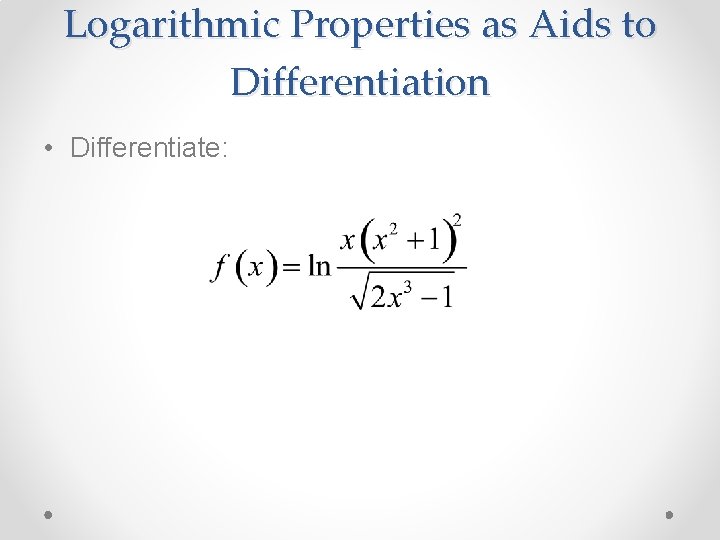
Logarithmic Properties as Aids to Differentiation • Differentiate:
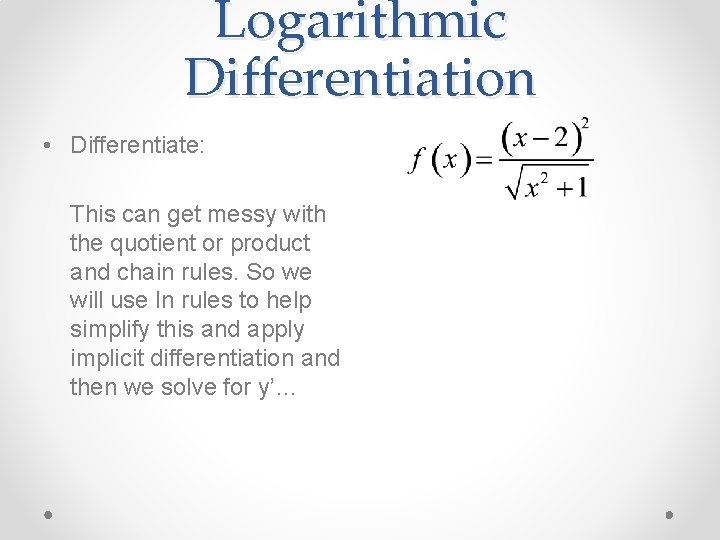
Logarithmic Differentiation • Differentiate: This can get messy with the quotient or product and chain rules. So we will use ln rules to help simplify this and apply implicit differentiation and then we solve for y’…
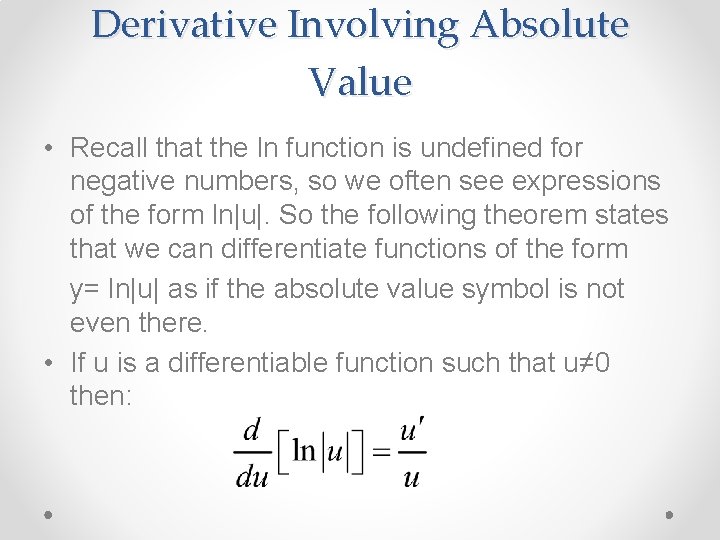
Derivative Involving Absolute Value • Recall that the ln function is undefined for negative numbers, so we often see expressions of the form ln|u|. So the following theorem states that we can differentiate functions of the form y= ln|u| as if the absolute value symbol is not even there. • If u is a differentiable function such that u≠ 0 then:
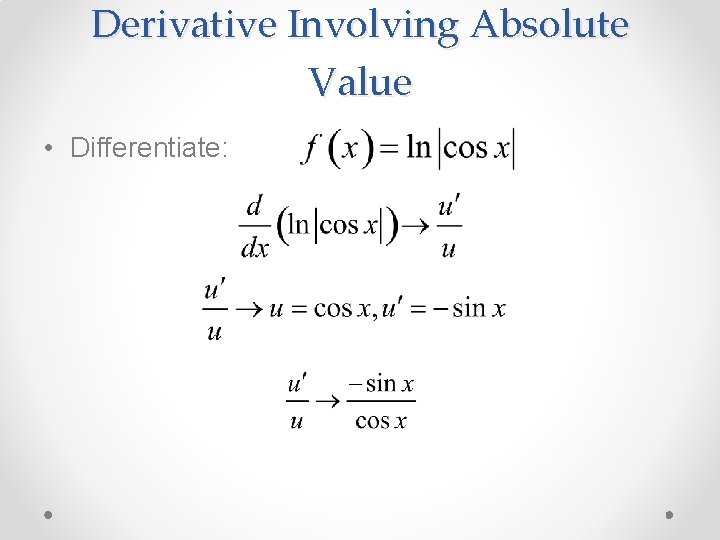
Derivative Involving Absolute Value • Differentiate:
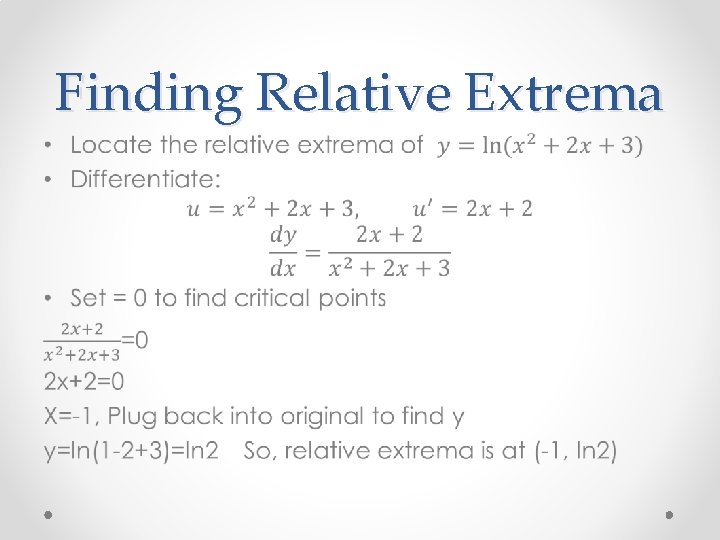
Finding Relative Extrema •
Homework • 5. 1 Natural Logarithmic Functions and the Number e Derivative #19 -35, 47 -65, 71, 79, 93 -96
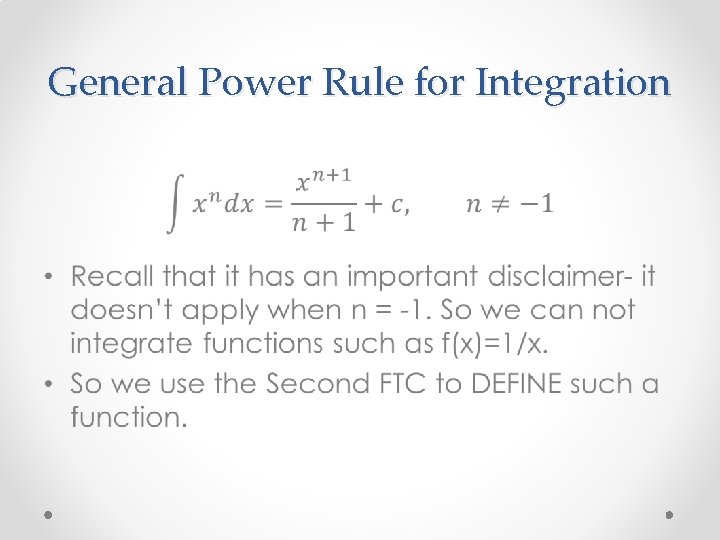
General Power Rule for Integration •
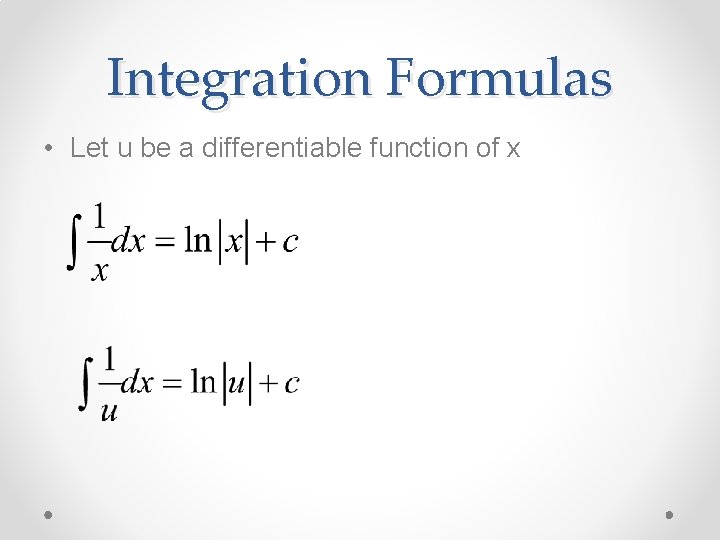
Integration Formulas • Let u be a differentiable function of x
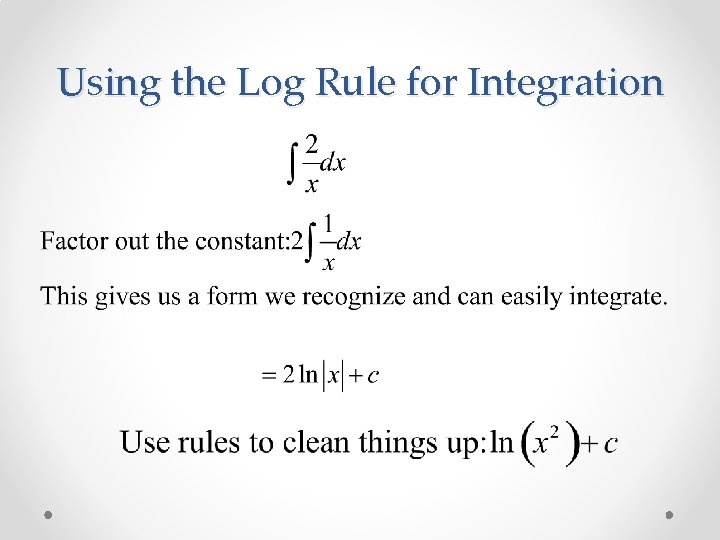
Using the Log Rule for Integration
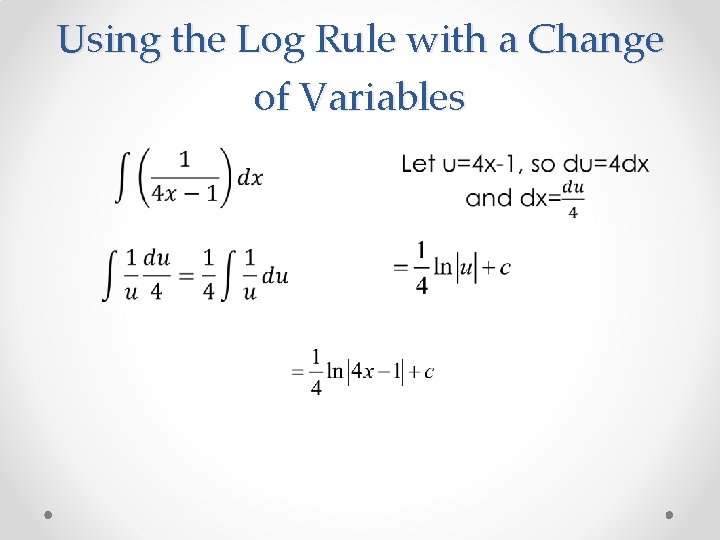
Using the Log Rule with a Change of Variables •
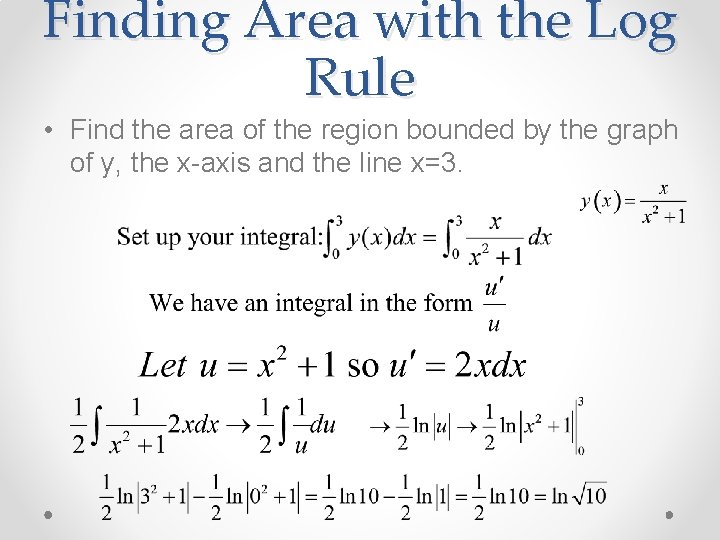
Finding Area with the Log Rule • Find the area of the region bounded by the graph of y, the x-axis and the line x=3.
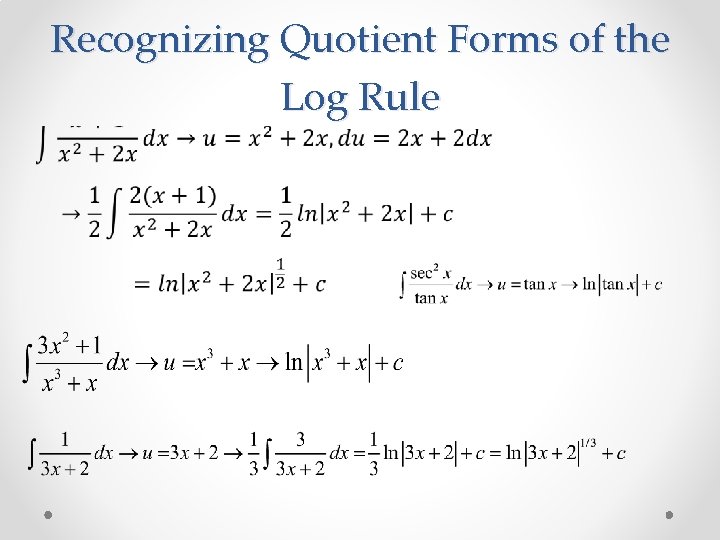
Recognizing Quotient Forms of the Log Rule
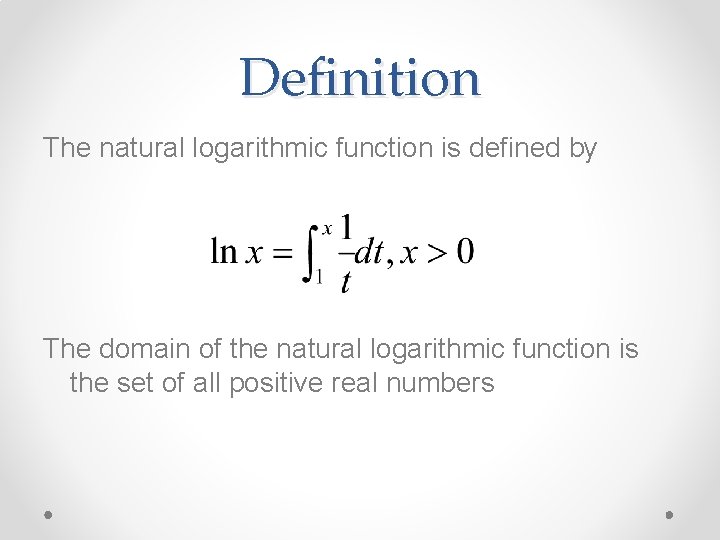
Definition The natural logarithmic function is defined by The domain of the natural logarithmic function is the set of all positive real numbers
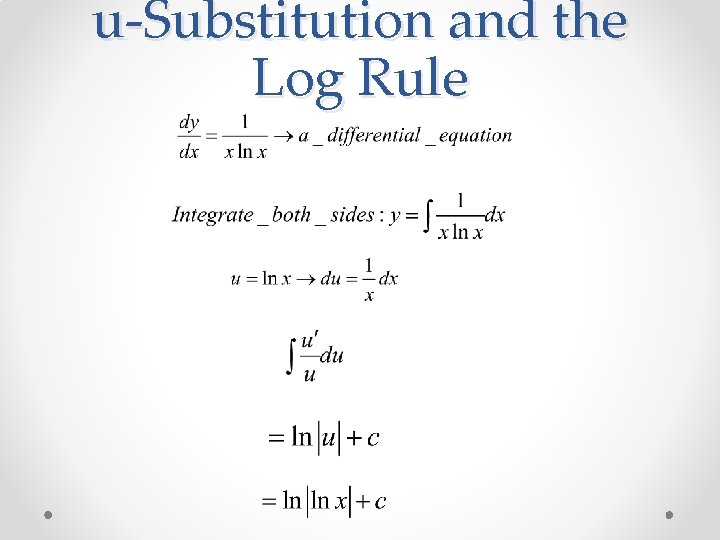
u-Substitution and the Log Rule
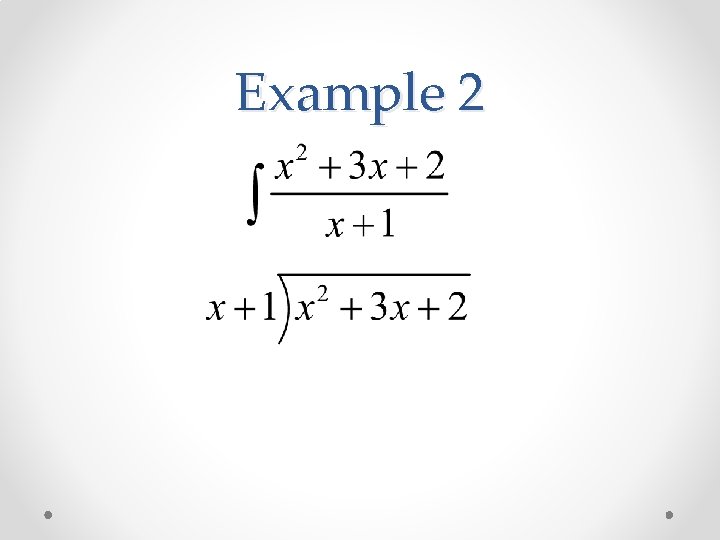
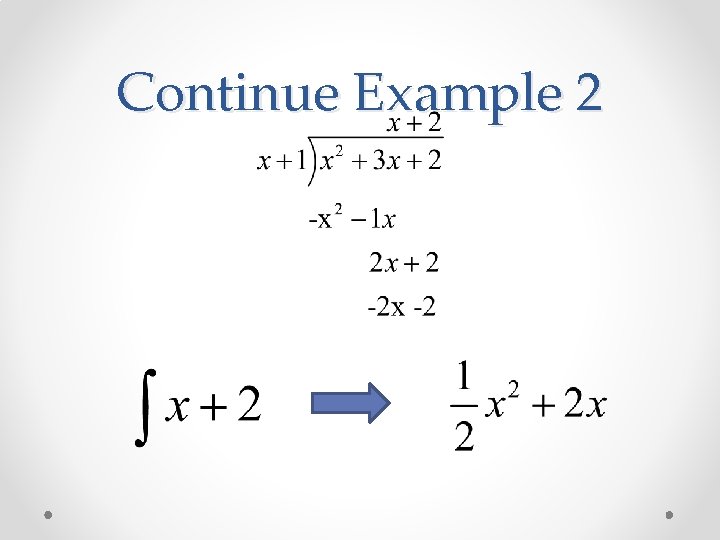
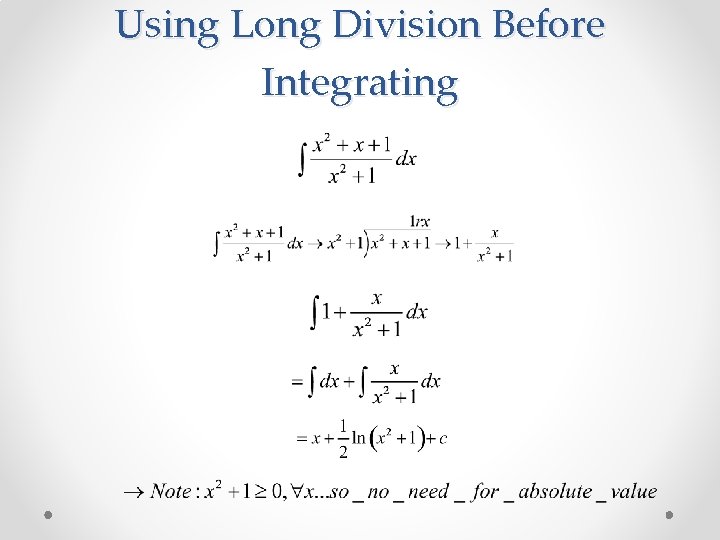
Long Division With Integrals
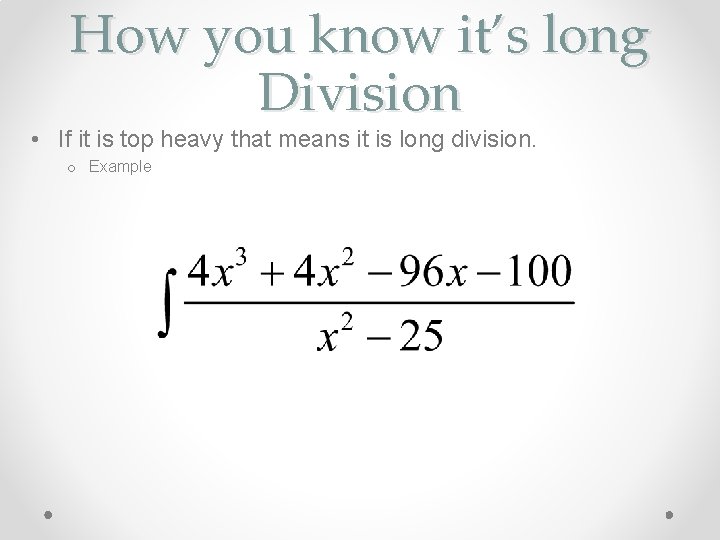
How you know it’s long Division • If it is top heavy that means it is long division. o Example
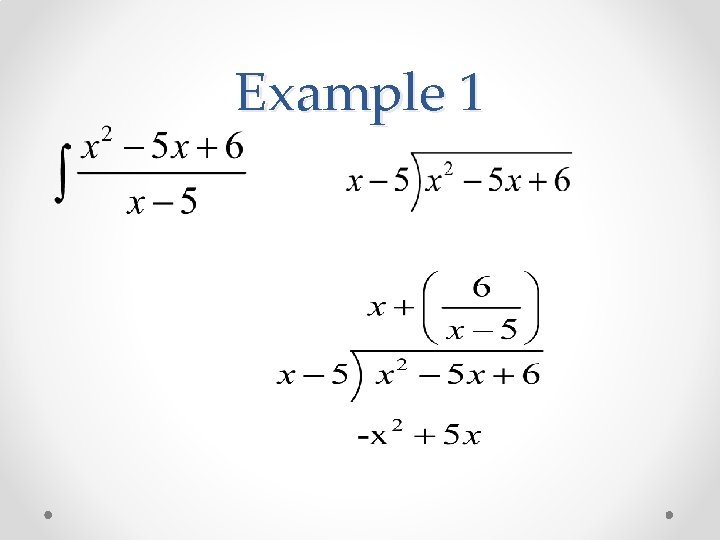
Example 1
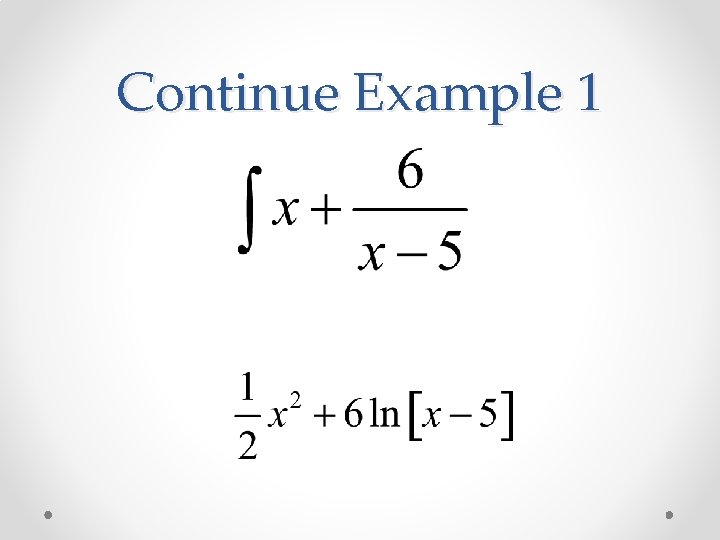
Continue Example 1
Example 2
Continue Example 2
Using Long Division Before Integrating
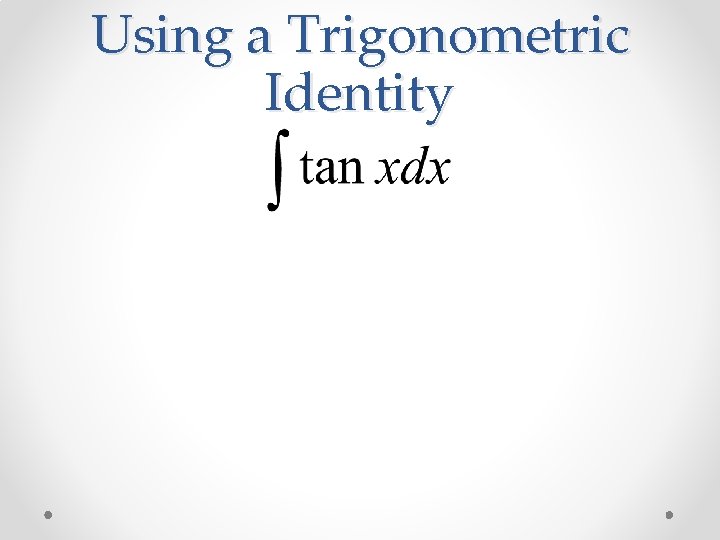
Using a Trigonometric Identity
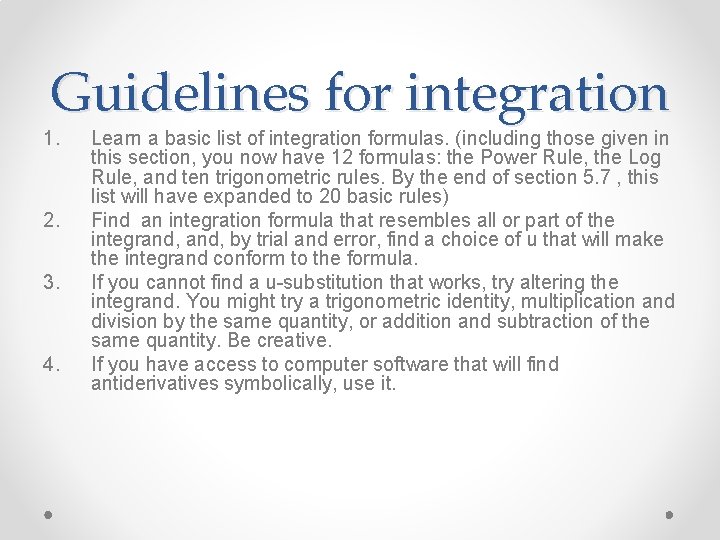
Guidelines for integration 1. 2. 3. 4. Learn a basic list of integration formulas. (including those given in this section, you now have 12 formulas: the Power Rule, the Log Rule, and ten trigonometric rules. By the end of section 5. 7 , this list will have expanded to 20 basic rules) Find an integration formula that resembles all or part of the integrand, by trial and error, find a choice of u that will make the integrand conform to the formula. If you cannot find a u-substitution that works, try altering the integrand. You might try a trigonometric identity, multiplication and division by the same quantity, or addition and subtraction of the same quantity. Be creative. If you have access to computer software that will find antiderivatives symbolically, use it.
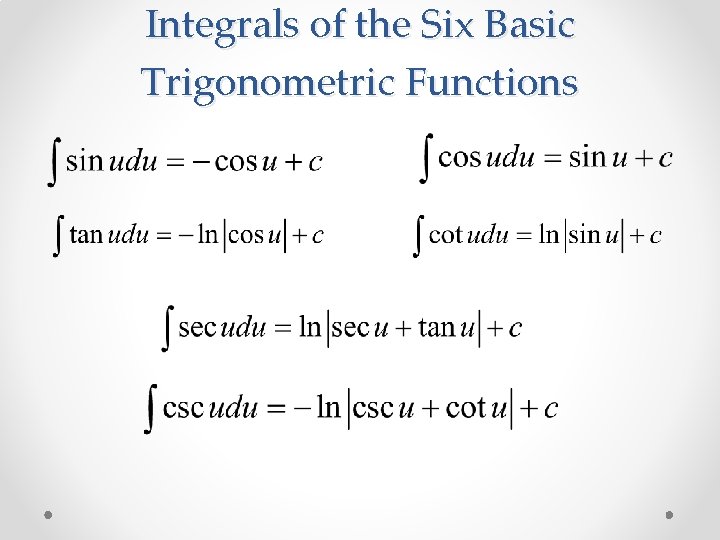
Integrals of the Six Basic Trigonometric Functions
Homework • 5. 2 Log Rule for Integration and Integrals for Trig Functions (substitution) #1 -39, 47 -53, 67