
The Natural History of Epithelial Ingrowth Following Lift
- Slides: 10
The Natural History of Epithelial Ingrowth Following Lift Flap Enhancements for LASIK Description of Methodology George O. Waring IV, MD Daniel S. Durrie, MD Miranda Bishara, MD University of Kansas Medical Center Department of Ophthalmology
Disclosure • Dr. Waring and Dr. Bishara have no financial interest in the material presented. • Dr. Durrie is a clinical investigator for: – – – – Alcon Allergan Wavefront Science Neuro. Vision High Performance Optics Ocu. Sense Quest. Vision Visiometrics Tracey Technologies Bausch and Lomb Intra. Lase Refractec Acu. Focus Wave. Tec
Purpose To describe a novel method of prospectively correlating intraoperative factors in lift flap LASIK enhancements that may lead to epithelial ingrowth
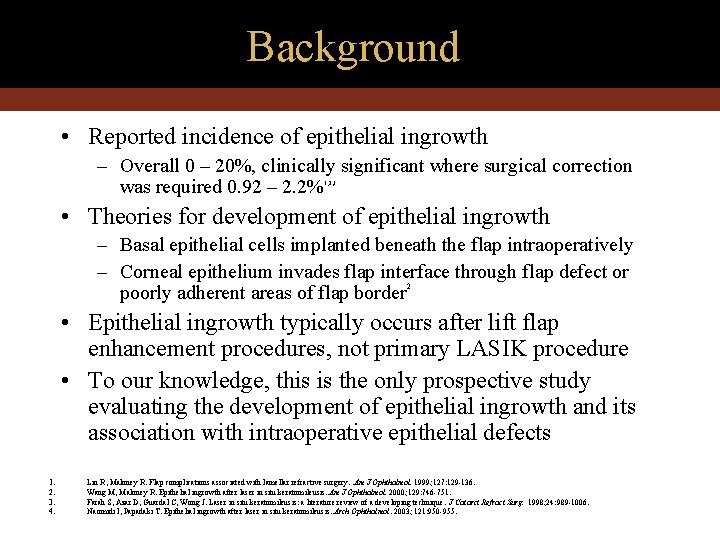
Background • Reported incidence of epithelial ingrowth – Overall 0 – 20%, clinically significant where surgical correction was required 0. 92 – 2. 2% 1, 2, 3 • Theories for development of epithelial ingrowth – Basal epithelial cells implanted beneath the flap intraoperatively – Corneal epithelium invades flap interface through flap defect or poorly adherent areas of flap border 2 • Epithelial ingrowth typically occurs after lift flap enhancement procedures, not primary LASIK procedure • To our knowledge, this is the only prospective study evaluating the development of epithelial ingrowth and its association with intraoperative epithelial defects 1. 2. 3. 4. Lin R, Maloney R. Flap complications associated with lamellar refractive surgery. Am J Ophthalmol. 1999; 127: 129 -136. Wang M, Maloney R. Epithelial ingrowth after laser in situ keratomileusis. Am J Ophthalmol. 2000; 129: 746 -751. Farah S, Azar D, Guardal C, Wong J. Laser in situ keratomileusis: a literature review of a developing technique. J Catarct Refract Surg. 1998; 24: 989 -1006. Naomidi I, Papadaki T. Epithelial ingrowth after laser in situ keratomileusis. Arch Ophthalmol. 2003; 121: 950 -955.
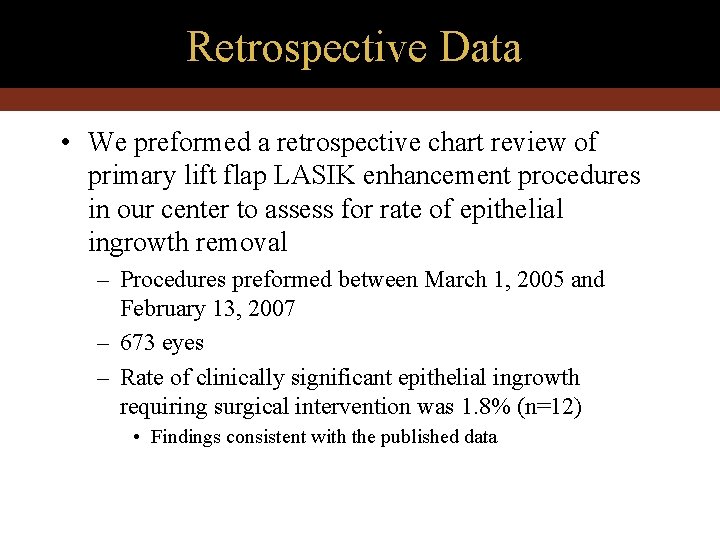
Retrospective Data • We preformed a retrospective chart review of primary lift flap LASIK enhancement procedures in our center to assess for rate of epithelial ingrowth removal – Procedures preformed between March 1, 2005 and February 13, 2007 – 673 eyes – Rate of clinically significant epithelial ingrowth requiring surgical intervention was 1. 8% (n=12) • Findings consistent with the published data
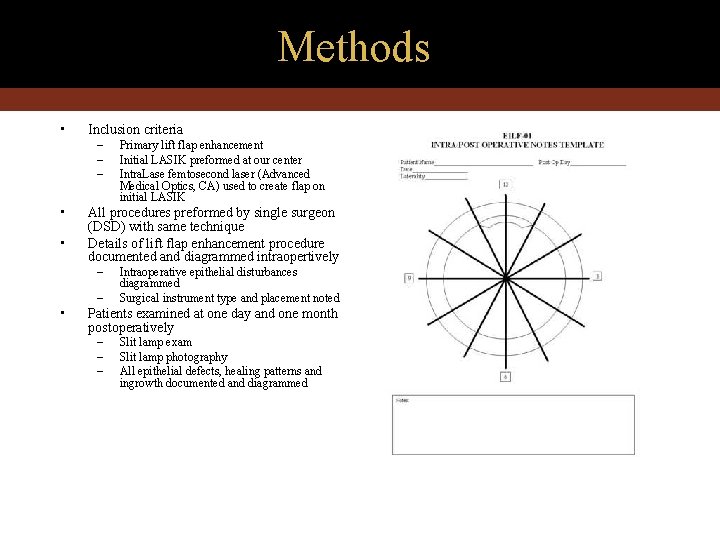
Methods • Inclusion criteria – – – • • All procedures preformed by single surgeon (DSD) with same technique Details of lift flap enhancement procedure documented and diagrammed intraopertively – – • Primary lift flap enhancement Initial LASIK preformed at our center Intra. Lase femtosecond laser (Advanced Medical Optics, CA) used to create flap on initial LASIK Intraoperative epithelial disturbances diagrammed Surgical instrument type and placement noted Patients examined at one day and one month postoperatively – – – Slit lamp exam Slit lamp photography All epithelial defects, healing patterns and ingrowth documented and diagrammed
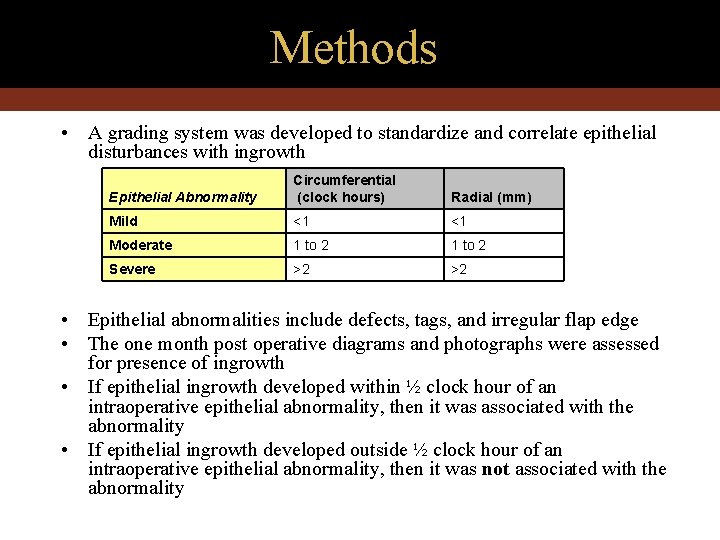
Methods • A grading system was developed to standardize and correlate epithelial disturbances with ingrowth Epithelial Abnormality Circumferential (clock hours) Radial (mm) Mild <1 <1 Moderate 1 to 2 Severe >2 >2 • Epithelial abnormalities include defects, tags, and irregular flap edge • The one month post operative diagrams and photographs were assessed for presence of ingrowth • If epithelial ingrowth developed within ½ clock hour of an intraoperative epithelial abnormality, then it was associated with the abnormality • If epithelial ingrowth developed outside ½ clock hour of an intraoperative epithelial abnormality, then it was not associated with the abnormality
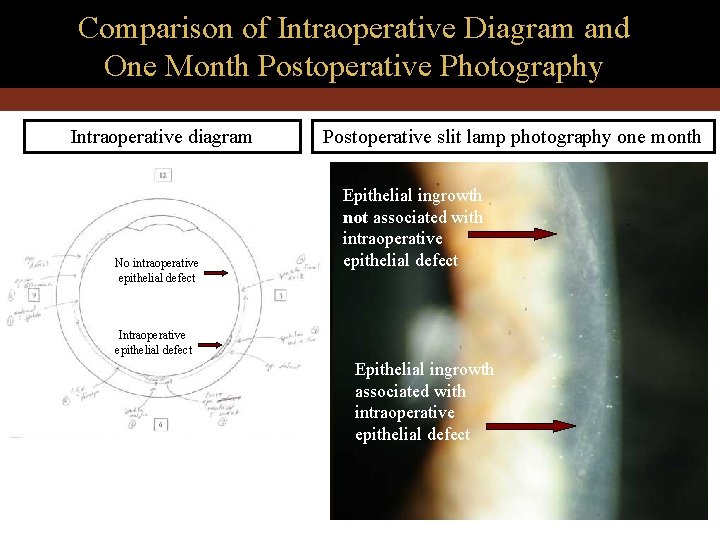
Comparison of Intraoperative Diagram and One Month Postoperative Photography Intraoperative diagram No intraoperative epithelial defect Postoperative slit lamp photography one month Epithelial ingrowth not associated with intraoperative epithelial defect Intraoperative epithelial defect Epithelial ingrowth associated with intraoperative epithelial defect
Discussion • • This is an ongoing study A total of 200 eyes will be enrolled Results will be reported once enrollment has been completed Future analysis will include relationship between – Intraoperative epithelial disturbances and postoperative epithelial ingrowth – Surgical instrumentation and epithelial ingrowth – Severity of intraoperative epithelial disturbances and postoperative epithelial ingrowth • The next phase of the study will include techniques that effect or prevent epithelial ingrowth – Bandage contact lens use – Intraoperative epithelial recession
Conclusions • We have described a novel method to prospectively assess for intraoperative factors in lift flap LASIK enhancements that may lead to epithelial ingrowth • We hope this study will allow us to better understand the relationship between intraoperative epithelial abnormalities and epithelial ingrowth