
The Natural Base e e How do we
The Natural Base, e e • How do we use the number e to write and graph exponential functions representing real-world situations? Holt. Mc. Dougal Algebra 2 Holt
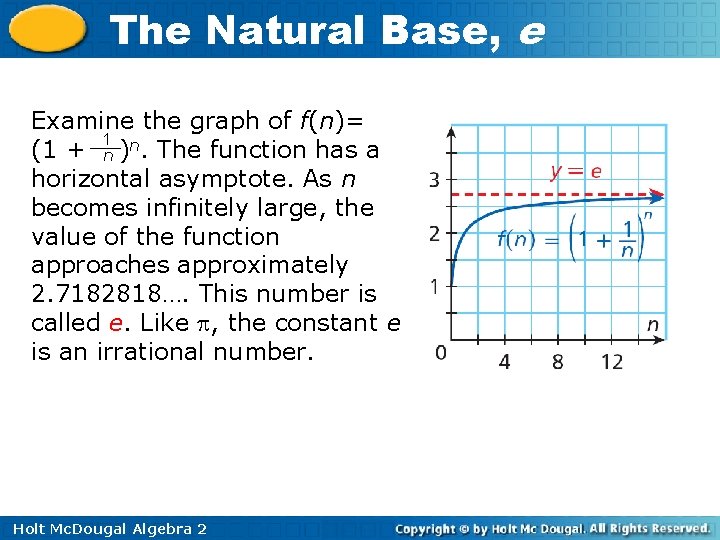
The Natural Base, e Examine the graph of f(n)= 1 (1 + n )n. The function has a horizontal asymptote. As n becomes infinitely large, the value of the function approaches approximately 2. 7182818…. This number is called e. Like , the constant e is an irrational number. Holt Mc. Dougal Algebra 2
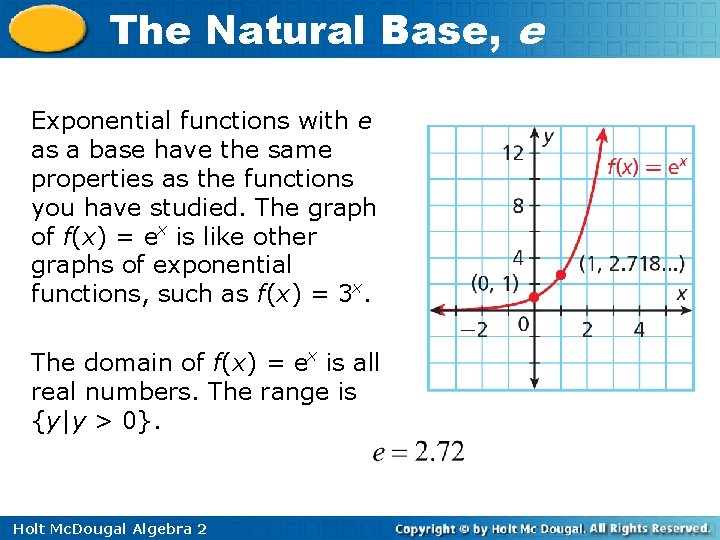
The Natural Base, e Exponential functions with e as a base have the same properties as the functions you have studied. The graph of f(x) = ex is like other graphs of exponential functions, such as f(x) = 3 x. The domain of f(x) = ex is all real numbers. The range is {y|y > 0}. Holt Mc. Dougal Algebra 2
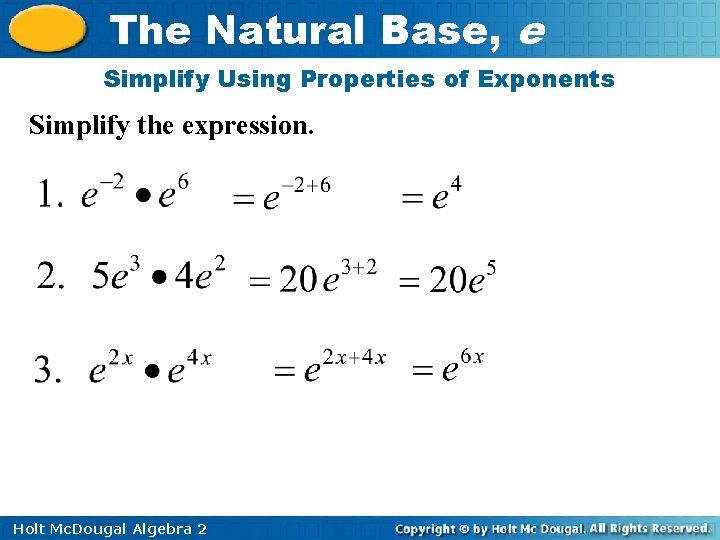
The Natural Base, e Simplify Using Properties of Exponents Simplify the expression. Holt Mc. Dougal Algebra 2

The Natural Base, e Simplify Using Properties of Exponents Simplify the expression. Holt Mc. Dougal Algebra 2

The Natural Base, e Evaluating Natural Base Expressions Use a calculator to evaluate the expression. Round the result to three decimal places. Holt Mc. Dougal Algebra 2
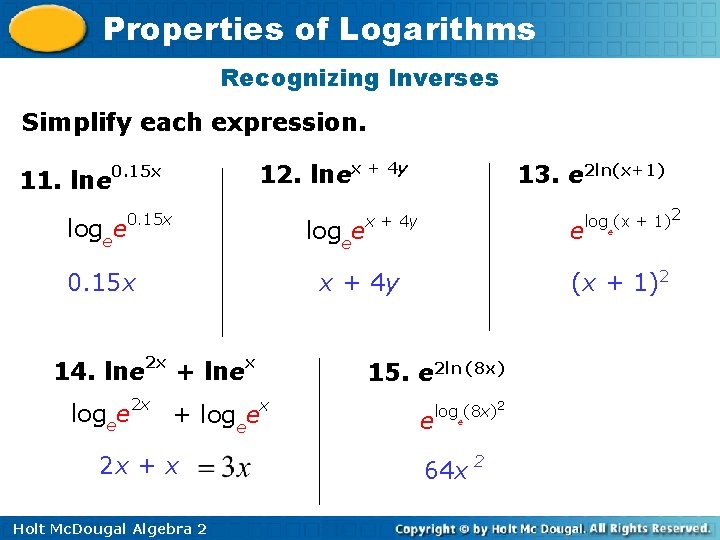
Properties of Logarithms Recognizing Inverses Simplify each expression. 11. lne 0. 15 x logee 12. lnex + 4 y 0. 15 x 14. lne 2 x + lnex logee 2 x + logeex 2 x + x Holt Mc. Dougal Algebra 2 logee 13. e 2 ln(x+1) x + 4 y e loge(x + 1)2 x + 4 y 15. e 2 ln (8 x) e loge(8 x)2 64 x 2
Properties of Logarithms Lesson 9. 3 Practice A Holt Mc. Dougal Algebra 2
- Slides: 8