
THE NATIONAL POVERTY OBSERVATORY MAURITIUS COUNTRY PAPER PRESENTATION
THE NATIONAL POVERTY OBSERVATORY MAURITIUS COUNTRY PAPER PRESENTATION BY DANA CHENGAN, MACOSS 25 TH NOVEMBER 2016 MR. THINK TANK MEETING ON THE SADC REGIONAL POVERTY OBSERVATORY AND NATIONAL >> POVERTY OBSERVATORIES
CONTENT • Poverty in Mauritius • Overview and Report • Poverty Observatory • Contribution of CSOs to fight Poverty. • Institutional Support and Funding Agencies • Government Policies and support • Conclusion • Recommendations
POVERTY IN MAURITIUS Ø No extreme poverty in Mauritius • the proportion of the population living below the poverty line as defined by the World Bank, namely below $1. 25 (PPP) per day, is non-existent in Mauritius Ø Yet - relative poverty is growing slowly and the income gaps are widening as a result of diversification and structural changes in the economy Ø Government has put in place poverty abatement programs • However, the substantial financial resources invested in these programs are yet to show measurable results • Absence of monitoring mechanisms
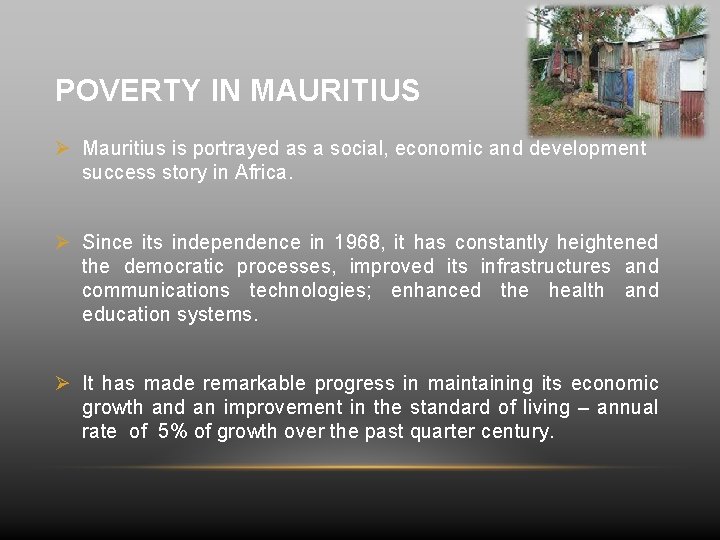
POVERTY IN MAURITIUS Ø Mauritius is portrayed as a social, economic and development success story in Africa. Ø Since its independence in 1968, it has constantly heightened the democratic processes, improved its infrastructures and communications technologies; enhanced the health and education systems. Ø It has made remarkable progress in maintaining its economic growth and an improvement in the standard of living – annual rate of 5% of growth over the past quarter century.
POVERTY IN MAURITIUS Ø This evident growth is the result of extensive social programs and safety nets financed by the welfare state which include • • free health services and free education, universal old-age pension, free transport for the elderly and full time students, and various social services which have contributed to better the life of individual. Ø Side by side there has been significant social progress which is validated by higher life expectancy at birth, universal primary and secondary education and higher level of adult literacy
POVERTY IN MAURITIUS Ø Statistics Mauritius – 2012 Household Budget Survey • Definition of poor family - “a family consisting of 2 adults and 2 children and receiving less than Rs 13, 310 (370 USD) as monthly revenues” • However, more than 9% of Mauritian families fall into this category (33, 600 families out of 335, 000) • Children were more prone to poverty. Estimated 42, 100 children in relative poverty out of a total of 285, 900 children • In 2008 the National Empowerment Foundation (NEF) carried out a survey and identified 229 pockets of poverty hosting about 7, 200 households living the lowest level of relative poverty.
WORLD BANK REPORT ( 2014) Ø Mauritius has been doing well in terms of the twin goals of reducing extreme poverty and improving the well-being of the bottom line - 40% of the population. Ø They indicate that extreme poverty is negligible Ø In absolute terms, poverty has declined from 8. 5 percent in 2006 -2007 to 6. 9 percent in 2012, associated mainly with the stable and strong economic growth experienced Ø In relative terms poverty has increased from 8. 5% in 2006 -2007 to 9. 8% in 2012 associated with an increase in income disparity between the medium household and those below the medium.
ROOT CAUSES OF POVERTY Ø The most vulnerable one are most particularly those who: • Are uneducated or has a low level of education • Are poorly empowered to adapt to changing economy and technical improvements • Have household headed by women with great risk of social exclusion • Have family head addicted to drugs and alcohol • Are unemployed and facing difficulty to accede to employment opportunities • Are facing hunger with one meal or a poor diet per day • Have no convenient shelter and Hygiene • Are marginalised and are subject to social ills such as prostitution and drugs
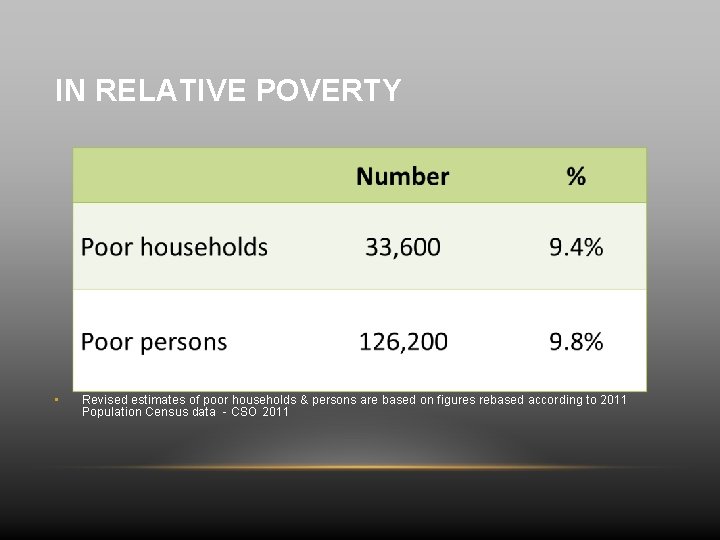
IN RELATIVE POVERTY • Revised estimates of poor households & persons are based on figures rebased according to 2011 Population Census data - CSO 2011
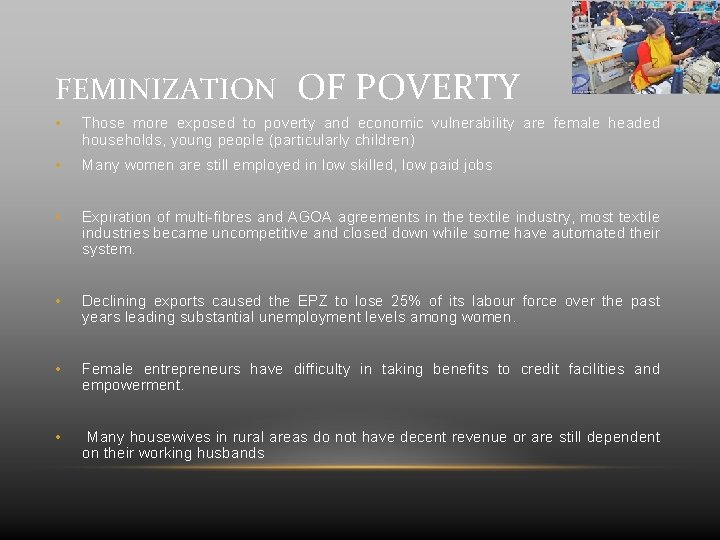
FEMINIZATION OF POVERTY • Those more exposed to poverty and economic vulnerability are female headed households, young people (particularly children) • Many women are still employed in low skilled, low paid jobs • Expiration of multi-fibres and AGOA agreements in the textile industry, most textile industries became uncompetitive and closed down while some have automated their system. • Declining exports caused the EPZ to lose 25% of its labour force over the past years leading substantial unemployment levels among women. • Female entrepreneurs have difficulty in taking benefits to credit facilities and empowerment. • Many housewives in rural areas do not have decent revenue or are still dependent on their working husbands
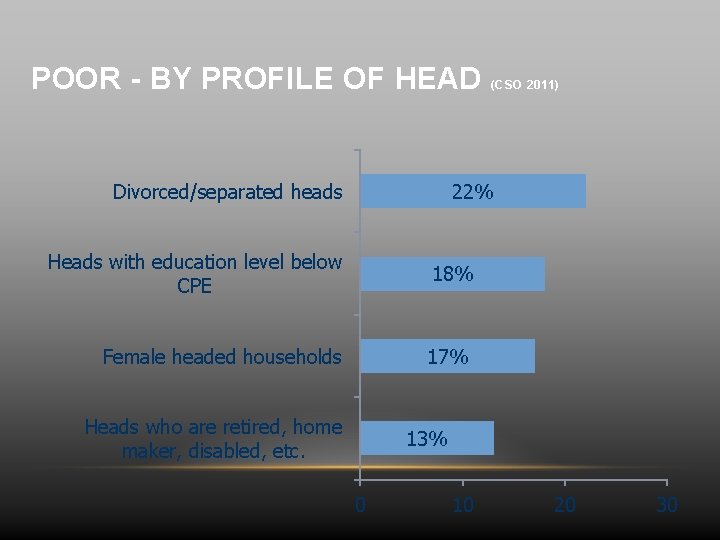
POOR - BY PROFILE OF HEAD Divorced/separated heads (CSO 2011) 22% Heads with education level below CPE 18% Female headed households 17% Heads who are retired, home maker, disabled, etc. 13% 0 10 20 30
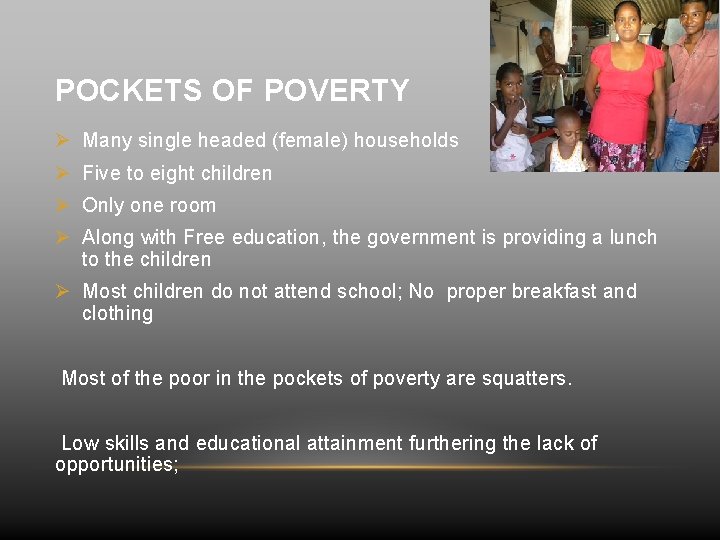
POCKETS OF POVERTY Ø Many single headed (female) households Ø Five to eight children Ø Only one room Ø Along with Free education, the government is providing a lunch to the children Ø Most children do not attend school; No proper breakfast and clothing Most of the poor in the pockets of poverty are squatters. Low skills and educational attainment furthering the lack of opportunities;
POVERTY OBSERVATORY IN MAURITIUS Ø 2009 – Mauritius Poverty Observatory launched by the Minister of Industry Science and Research • The Observatory aimed to analyze the impact of policies and projects on the population and to assess what works and what did not • It would study poverty with the participation of the poor • It would adopt a qualitative methodology to (make it possible to) understand poverty • It would operate as an independent observer of the on-theground situation Ø MRC (Mauritius Research Council) conferred the responsibility of the NPO
POVERTY OBSERVATORY IN MAURITIUS Ø However, the poverty observatory did not last long. Ø Reasons for failure • Studies not detailed enough • Findings vague without proposed solutions • Inappropriate and different to local conditions.
POVERTY OBSERVATORY IN MAURITIUS Ø 2015 - the Cabinet has agreed to the setting up of a Poverty Observatory under the aegis of the Ministry of Social Integration and Economic Empowerment Ø The Observatory would, among others: • Act as a repository for Information on poverty. • Commission research and studies on poverty and social development • Coordinate the process of monitoring and evaluation of the implementation of a Marshall Plan on the eradication of poverty • Advise the Minister of Social Integration and Economic Empowerment on policies that reflect the changing parameters of poverty and its impact on vulnerable groups.
CONTRIBUTION OF CIVIL SOCIETY IN THE FIGHT AGAINST POVERTY Ø MACOSS is an umbrella organisation for NGOs with currently 370 members Ø It promotes social and community development with the participation of its Member Organisations and volunteers Ø MACOSS acts as a facilitator for NGOs and develop capacity building Ø MACOSS , in collaboration with UNDP, launched the PEN (Poverty Eradication Network) in 12 Poverty-driven areas in Mauritius since 2015. This initiative will also support the Marshall plan.
CONTRIBUTION OF CIVIL SOCIETY IN THE FIGHT AGAINST POVERTY Ø Support to Non-State Actors • The underlying goal of the Cotonou Agreement governing the European Union’s cooperation with the African. Caribbean-Pacific (ACP) group of nations is to reduce and eventually eradicate poverty, in line with the objectives of sustainable development and the gradual integration of the ACP countries into the world economy • Within this context, Cotonou recognises the complementary role of Non-State-Actors (NSAs) in the development process • Decentralised Cooperation Programme – a joint effort between the Government of Mauritius and the EU
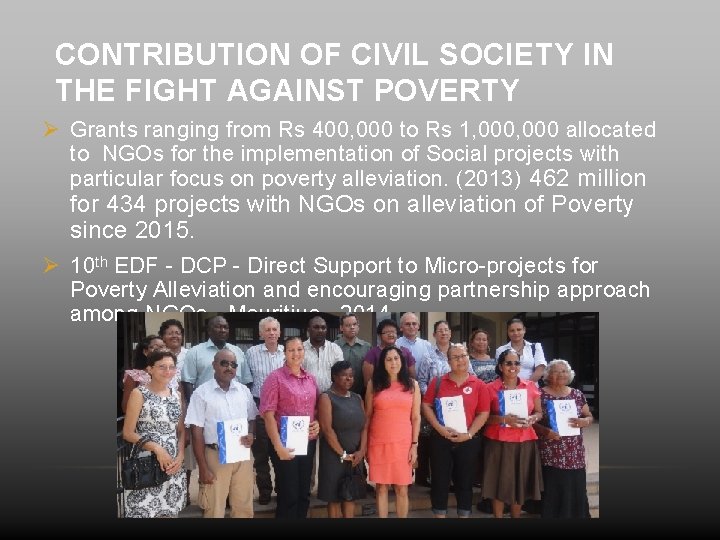
CONTRIBUTION OF CIVIL SOCIETY IN THE FIGHT AGAINST POVERTY Ø Grants ranging from Rs 400, 000 to Rs 1, 000 allocated to NGOs for the implementation of Social projects with particular focus on poverty alleviation. (2013) 462 million for 434 projects with NGOs on alleviation of Poverty since 2015. Ø 10 th EDF - DCP - Direct Support to Micro-projects for Poverty Alleviation and encouraging partnership approach among NGOs - Mauritius - 2014
CONTRIBUTION OF CIVIL SOCIETY IN THE FIGHT AGAINST POVERTY Ø The PEN project • Creating Ownership - The fundamental approach is to strengthen the local/community based system, develop local economic sector and empower the people in their living environment. • Assist in empowerment. • Capacity Building to lead, to analyse, to take decision according to their needs and requirements. Develop local solutions (for adaptation) • Collaborative approach with Private Sector, NGOs, Public Institutions, Technical Institution • Facilities - Education, sports, infrastructure, equipment and technology • Develop a ‘feel good Factor’ • Sharing of best practices.
SUPPORT TO NGOS Ø CSR Policy • Private sector contribution – 2% of profits with new Strategies and policies in view. Ø NGO Trust Fund financing micro projects Ø Love Bridge Project • a community and humanitarian program which aims to be part of a long-term vision to foster nation building and to promote positive human values and support. Ø Special collaborative programme for support to women and children in distress Ø International funding (US, Australia, etc. )
THE NATIONAL EMPOWERMENT FOUNDATION (NEF) Ø A government owned Institution Ø It implements programmes and projects to support vulnerable persons and families to move out of poverty and empower them with a view to integrating them into mainstream society Ø The main objective of the NEF is to provide a range of programmes and services : • adults follow a training and employment programme and as a result engage in activities leading to a decent income • children go to school and succeed in their studies • families enjoy an improved living environment • communities lead a demand-driven development process resulting in an improved quality of life for community residents • marginalized groups become successfully integrated into the society
NEF – EXECUTIVE ARM OF THE MINISTRY Ø Between 2009 – 2012 trained and reskilled 13, 875 unemployed person under the training and placement program out of which 7, 447 were successfully retained for employment Ø 16, 573 school children from vulnerable families in Mauritius and around 5, 000 in Rodrigues benefitted from school materials Ø 3, 000 children of pre-primary and primary schools are benefiting from the package of services that includes among other things free meals, transport, free schooling and school materials Ø Literacy& Life skills training are delivered to people of deprived regions to help rebuild the human and social capital. Ø Micro enterprises( cattle rearing in Panchavati – community based programme) Ø Support to improve academic performance and reduce dropouts Ø Aids prevention and support Ø Assistance to women and children in need or abused
THE NATIONAL EMPOWERMENT FOUNDATION (NEF) Ø NEF activities are implemented district wise with the support of NGOs under the following broad pillars: • Placement and Training • Housing and Community Empowerment • Child and Family Development Programme
THE GOVERNMENT GLOBAL POLICIES Ø In September 2000, the government of Mauritius took an important step ahead in the quest to eradicating poverty by committing to the United Nations Millennium Declaration along 188 member states of the United Nations. Ø Accordingly, the Government introduced several targeted empowerment and poverty alleviation programmes to empower the disadvantaged and improve accessibility to social services which are implemented through various Ministries and other institutions Ø Mauritius being a welfare state injects billion of rupees yearly for social development Ø Widening the circle of opportunities to target the most vulnerable groups holds a significant position in the Government of Mauritius policies as indicated by its ten year economic reform programme (2006 -2015).
GOVERNMENT PROGRAMMES Ø Accordingly, the Government introduced several targeted empowerment and poverty alleviation programmes to empower the disadvantaged and improve accessibility to social services which are implemented through various Ministries and institutions • The Cabinet has also agreed to the introduction of the Social Integration and Empowerment Bill in the National Assembly soon. The object of the Bill is to promote social integration and empowerment of persons living in absolute poverty within the philosophy of enhancing social justice and national unity to: • (a) combat absolute poverty; • (b) provide support and other services to persons living in absolute poverty; and • (c) support persons living in absolute poverty to integrate the mainstream society.
POVERTY ALLEVIATION PROGRAMMES • 1995: Trust Fund for “La lutte contre L’exclusion”- restyled as TFSIVG below now NEF • 1997: Committee on Poverty set up by the President of the Republic (this is only advisory) • 1999: Trust Fund for the Social Integration of Vulnerable Groups (TFSIVG) - restyled to EAP then to NEF • 1999: Lévé Debouté (Self-help Project) in Rodrigues-completed • 1999: A Nou Diboute Ensam- A poverty alleviation programme funded by EU-ongoing • 2000: International Fund for Agricultural Development (IFAD)-Phases I, II & III-ongoing” • 2005: Decentralised Co-operation Programme (DCP) funded by the EU and which is ongoing • 2006: National Empowerment Foundation (NEF); formerly, the Empowerment Programme- fully operational • 2008: Eradication of Absolute Poverty (EAP)- absorbed by National Empowerment foundation
SOCIAL AIDS/PENSION TO NEEDY PEOPLE Ø Basic Retirement Pension (BRP) Ø Basic Widow’s Pension (BWP) Ø Basic Invalid’s Pension (BIP) Ø Basic Orphan’s Pension (BOP) Ø Guardian’s Allowance Ø Child Allowance Ø Inmate Allowance Ø Other social aids
GOVERNMENT MEASURES Ø Budget 2016/2017 • Measures to combat poverty • Marshall Plan against poverty • New CSR Framework • A Social Integration and Empowerment Bill will be presented soon by the Minister. The object of the Bill is to promote social integration and empowerment of persons living in absolute poverty. The Bill will provide for the setting up of such empowerment programmes or schemes as may be necessary to - (a) combat absolute poverty; • (b) provide support and other services to persons living in absolute poverty to integrate the mainstream society.
UNITED NATION DEVELOPMENT PROGRAMME Ø UNDP in partnership with the government developed the Social Register in Mauritius tools. Ø The main purpose of the SRM project is to improve the targeting efficiency of social programmes so that limited programme resources primarily reach the poor (i. e. minimizing leakage to non-poor) and the poor are not excluded (i. e. minimizing under-coverage of the poor). Ø The SRM initiative was introduced to modernize public resources management and improve the efficiency and effectiveness of government spending.
SOCIAL REGISTER IN MAURITIUS Ø It was designed to become an exhaustive and centralized database of social programme beneficiaries with the following objectives: • Better target beneficiaries. • Manage social programmes in an integrated way. • Better harmonize the criteria for the different social programmes run by different ministries. • Analyse cyclical and structural poverty reduction policies
MARSHALL PLAN AGAINST POVERTY 1. Minimum guaranteed monthly income 2. Cash award for successful completion of studies at different levels for students coming from less fortunate families 3. Increase in monthly grant under crèche voucher scheme 4. Pilot project for integrated academic teaching and community engagement in 5 ZEP schools 5. Increase in meal allowance for students attending ZEP 6. Decent housing a) Construction of 2700 housing units over the next 3 years b) Rehabilitation programme of NHDC housing c) Exemption of Land Transfer Tax on the Provision of Social Housing to Employees
MARSHALL PLAN AGAINST POVERTY 7. Special needs children • Removal of age limit for Basic Invalidity pension will be removed • Scholarship scheme for 5 students to pursue tertiary studies locally with a monthly stipend • Grant in aid to NGOs will increase by more than 50% 8. Monthly rental allowance for victims of accidental fire 9. Increase in Funeral grant 10. National Empowerment Foundation will be restructured 11. Setting up of a National CSR Foundation managed jointly by public and private sector
NEW NATIONAL CSR FRAMEWORK Ø National CSR Foundation • Contribution of private sector (1% of profits in 2016/2017 and 1. 5% of profits as from 2017/2018) Ø Priority areas • Poverty alleviation • Educational support • Social housing • Supporting persons with severe disabilities • Health problems (substance abuse and poor sanitation) Ø New guidelines for funding • Projects by NGOs • Projects by private sector/ foundations
CONCLUSION Ø Poverty alleviation has seen a proponent of actions all around the world. Ø In some parts of the world it has shown good results while at other instances it is stagnant. Ø People's initiatives and voluntary action have helped in identifying the key elements in programme design. Ø There is an urgent need for continuous innovation and willingness to break away from the routine and conventional way of doing things. Ø The elements identified by this study may be critical for the design of poverty alleviation programmes. It provides a sound basis for bold experimentation in this vital area of the development process of a nation state.
CONCLUSION Ø A holistic approach adopted to alleviate and eradicate poverty. Ø The involvement of some local NGOs intensively engaged in poverty reduction appear to have performed reasonably well and has changed the life of the poor to some extent through community action and participation strategies Ø In Mauritius, NGO contributions in poverty reduction are reasonably limited. Their works are relatively appreciable in the context of the very slow progress in alleviating poverty. Ø In order to address the limitations and to enhance their performance, there is need for strengthening local institutions and linking with development agencies, scaling up innovative development program, building synergy with the government and the private sector, and engaging in advocacy for pro-poor development policy Ø The NGO capacity in dealing with these challenges will determine NGO contributions in alleviating poverty.
RECOMMENDATIONS Ø Definitional Issues: A determination and setting up of a factual and representative measure of poverty in Mauritius would be the first factor. Ø Relevance of Policies All the policies administered have to be followed in terms of their effects, influences and implications. Ø Setting up of an “Observatoire de la Pauvreté”; with a system of tripartite forum should be set up involving the government organizations, NGO representatives and business organizations/ donor agencies to assess the situation every three months. Ø The Social Register tools to be made operationalized by the Ministry of Social Security, National Solidarity and Reforms Institutions and the NPO. Ø A social Audit report on Poverty alleviation projects (with
RECOMMENDATIONS Ø National Minimum Wage: Implementation of a national minimum wage to reduce the worsening economic and income inequality to avoid shocks such as inflation which quickly push people into poverty. Ø Social Entrepreneurship: One potentially promising strategy for improvement in poverty alleviation programmes is to encourage and support social entrepreneurship Ø Re-skilling Programme for women need to be innovative, with extensive support and marketing strategies. More outreach and onsite programmes must be developed for low literate women.
RECOMMENDATIONS Ø Focused Youth Employment Programme: Government need to conduct periodical audit in the economic and social sectors and forecast the human resources that will be needed for a period of 5 years. Ø Youth Career Initiatives/ Life Skills: Innovative and high-impact approach need to be adopted to deal with youth unemployment and ensure career opportunities. Ø Women Empowerment and microfinance schemes: The most vulnerable to poverty are women and children; therefore women should not only be involved as the main target but also as the main agency of program interventions.
RECOMMENDATIONS Ø Building Synergy among Agencies: Government need to engage into more serious dialogue with the civil society to build resilient partnership to deal with poverty to avoid duplication of programs and wastage of resource. Ø Strengthening local institutions and building linkages with development agencies: there is an imperative need for NGOs in ‘moving from development as delivery to development as leverage’ (Edwards et al. , 1999). Ø Specialized Training and Professionalization of NGOs: It is widely confirmed by many studies that strengthening capacity is the best way for NGOs to make a lasting impact on poverty (Edwards, 1999).
RECOMMENDATIONS Ø Scaling up the program intervention: Without scaling-up the program intervention, the successful performance of NGOs remain little in a wider economic and institutional environment which is detrimental to the poor (Uvin et al. , 2000). NGOs need to become larger, more professionally managed, and more efficiently programmatic institutions. Ø Engaging in policy advocacy: Advocacy in the area where NGOs lack proficiency. NGOs need to combine their delivery of services with advocacy activities. Ø Checks and balances: Checks and balances, transparency, accountability, good governance are words that are increasingly used in democratic countries. Therefore, the need of checks and balances, transparency and accountability is highly crucial to ensure an equitable and sound development. Ø Periodical meetings with Stakeholders to review progress.
“Overcoming poverty is not a task of Charity, it is an act of justice” Nelson Mandela Thank You!
- Slides: 41