
The NATIONAL GRID BUTTONS Click us Clicking here
The NATIONAL GRID BUTTONS Click us: Clicking here will allow you to. SI hear some information on on the Clicking on me take you to multipliers table. Clicking on me will take you to a list of equations, clicking Clicking here will reveal some information. Clicking here will reveal an answer. Clicking here will move you back a page. Clicking here will bring back to this page. Clicking here will move youstop toyou the page. topic. Clicking here again thenext sound. on me again return youwill to previous page. me again will take you back toyour the previous page. TOPICS … Sankey diagrams (4 pages). … efficiency (3 pages). … the National Grid and transformers. … power losses (higher). … the demand for electricity. … practice questions (4 pages) …exam questions (3 pages).
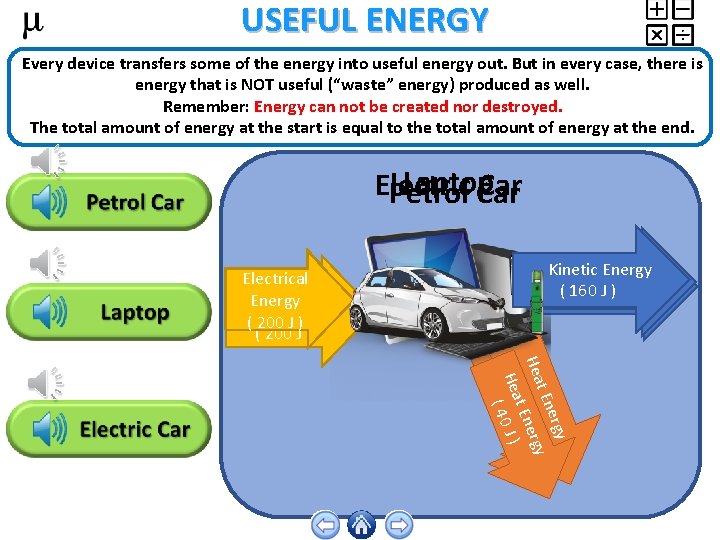
USEFUL ENERGY Every device transfers some of the energy into useful energy out. But in every case, there is energy that is NOT useful (“waste” energy) produced as well. Remember: Energy can not be created nor destroyed. The total amount of energy at the start is equal to the total amount of energy at the end. Laptop Electric Car Petrol Car Chemical Electrical Energy ( 200 J) ( 200 J ) Kinetic Energy Light and. Energy Sound Kinetic ( 160 Energy ( 40 J(J)80 ) J) ergy t En y Hea 2 E 0 n. Een. J re)grgy 1 t t He(aea 0 JJ)) H ( 1(640
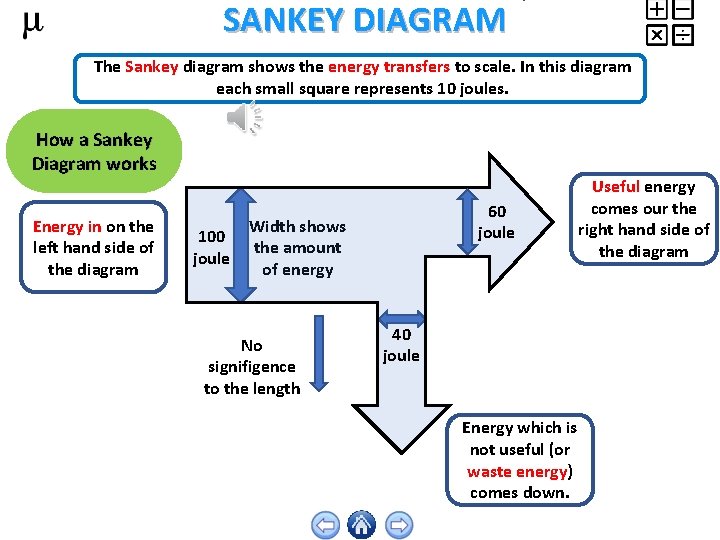
SANKEY DIAGRAM The Sankey diagram shows the energy transfers to scale. In this diagram each small square represents 10 joules. How a Sankey Diagram works Energy in on the left hand side of the diagram 100 joule 60 joule Width shows the amount of energy No signifigence to the length 40 joule Energy which is not useful (or waste energy) comes down. Useful energy comes our the right hand side of the diagram
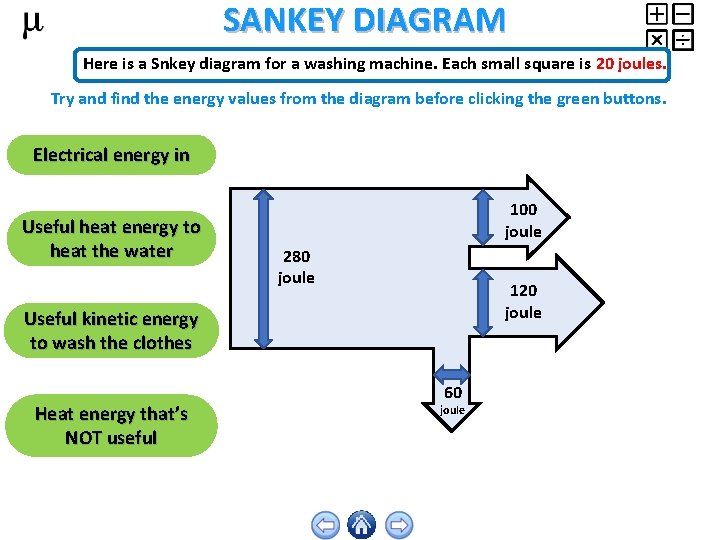
SANKEY DIAGRAM Here is a Snkey diagram for a washing machine. Each small square is 20 joules. Try and find the energy values from the diagram before clicking the green buttons. Electrical energy in Useful heat energy to heat the water 100 joule 280 joule 120 joule Useful kinetic energy to wash the clothes Heat energy that’s NOT useful 60 joule
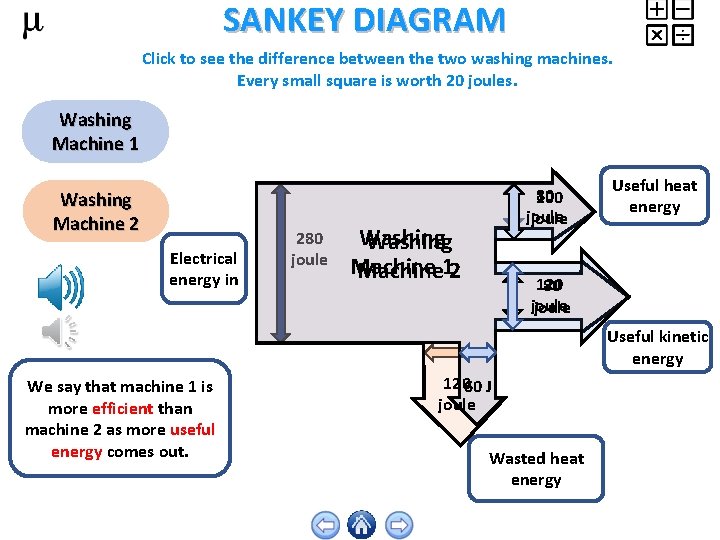
SANKEY DIAGRAM Click to see the difference between the two washing machines. Every small square is worth 20 joules. Washing Machine 1 Washing Machine 2 Electrical energy in 280 joule 80 100 joule Washing Machine 12 Useful heat energy 120 80 joule Useful kinetic energy We say that machine 1 is more efficient than machine 2 as more useful energy comes out. 12060 J joule Wasted heat energy
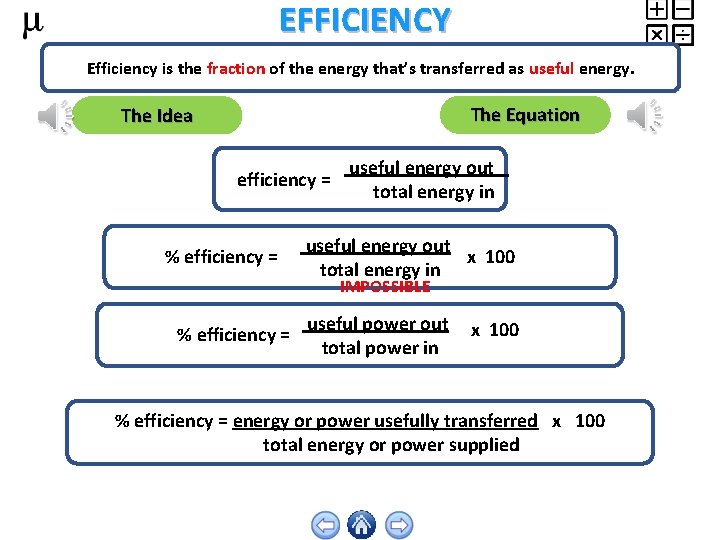
EFFICIENCY Efficiency is the fraction of the energy that’s transferred as useful energy. The Equation The Idea Click on the circle to change the efficiency = 40% Total energy in 20% = 1000 joules% efficiency = 0% useful energy out 60% total energy in Useful Energy 0 J 200 J 400 J 600 J 800 J 1000 J 80% out useful energy x 100 Total Energy out = total energy in IMPOSSIBLE 100% useful power out Efficiency total power in % efficiency = 1000 joule x 100 Wasted Energy It is not possible for any machine or device to be 0 J 200 J 400 J 600 J 800 J 1000 J % efficiency = energy or power usefully transferred x 100% efficient. Some of the energy is always wasted usually astotal heat. energy or power supplied
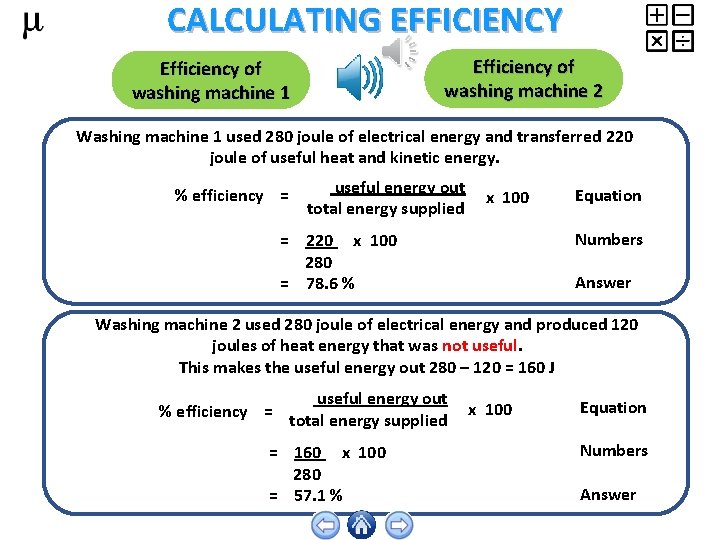
CALCULATING EFFICIENCY Efficiency of washing machine 2 Efficiency of washing machine 1 Washing machine 1 used 280 joule of electrical energy and transferred 220 joule of useful heat and kinetic energy. % efficiency = useful energy out total energy supplied x 100 Equation Numbers = 220 x 100 280 = 78. 6 % Answer Washing machine 2 used 280 joule of electrical energy and produced 120 joules of heat energy that was not useful. This makes the useful energy out 280 – 120 = 160 J useful energy out % efficiency = total energy supplied = 160 x 100 280 = 57. 1 % x 100 Equation Numbers Answer
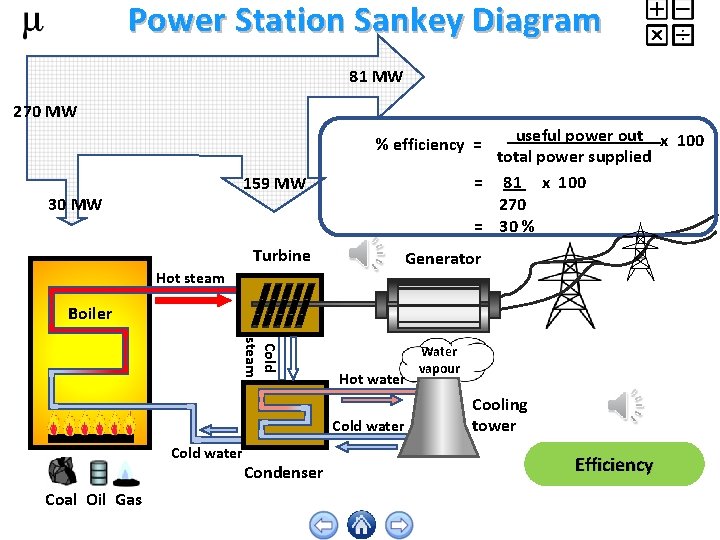
Power Station Sankey Diagram 81 MW 270 MW useful power out_ x 100 total power supplied = 81 x 100 270 = 30 % % efficiency = 159 MW 30 MW Turbine Hot steam Generator Boiler Cold steam Hot water Cold water Coal Oil Gas Condenser Water vapour Cooling tower Efficiency
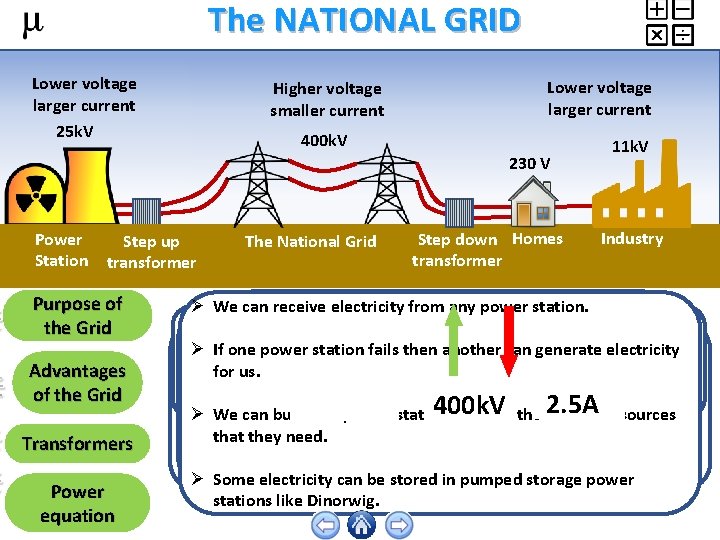
The NATIONAL GRID Lower voltage larger current 25 k. V Higher voltage smaller current Lower voltage larger current 400 k. V 230 V Power Station Step up transformer Purpose of the Grid Advantages of the Grid Transformers Power equation The National Grid Step down Homes transformer 11 k. V Industry Ø We can receive electricity from any power station. The istransformers change thecables voltage The National Grid the system of pylons, and sub-stations If one power station fails then AØ step up transformer increases theanother voltagecan andgenerate decreaseselectricity the which transfers electrical energy from the power stations to our for. Afor us. = V x I current theup same power, P toproduces reduceheat losses. (Remember step transformer a higher voltage and a it’s the homes, schools, hospitals and factories. current that heatslower the cables) current for the same power. 2. 5 A resources 1000 k. W = 400 k. V 25 k. V Ø We can build the power stations near to x the 40 A natural that theytransformer need. transformer A step decreases the voltage and increases Adown step down produces a lower voltage and the a current, for the same power, to make safe for the user. higher current for theitsame power. Ø Some electricity can be stored in pumped storage power stations like Dinorwig.
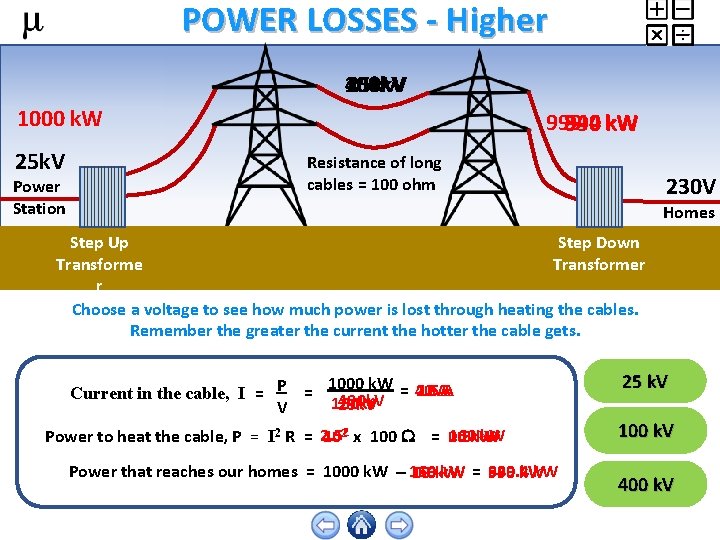
POWER LOSSES - Higher 25 k. V 100 k. V 400 k. V 1000 k. W 25 k. V Power Station 840 999. 4 990 k. W Resistance of long cables = 100 ohm 230 V Homes Step Up Step Down Transformer r Choose a voltage to see how much power is lost through heating the cables. Remember the greater the current the hotter the cable gets. 1000 k. W 2. 5 10 AAA Current in the cable, I = P = 400 k. V = 40 100 k. V 25 k. V V 160 k. W Power to heat the cable, P = I 2 R = 2. 5 0. 6 k. W 4022 x 100 = 10 10 Power that reaches our homes = 1000 k. W 160 k. W 840 k. W 990 0. 6 k. W = 999. 4 10 25 k. V 100 k. V 400 k. V
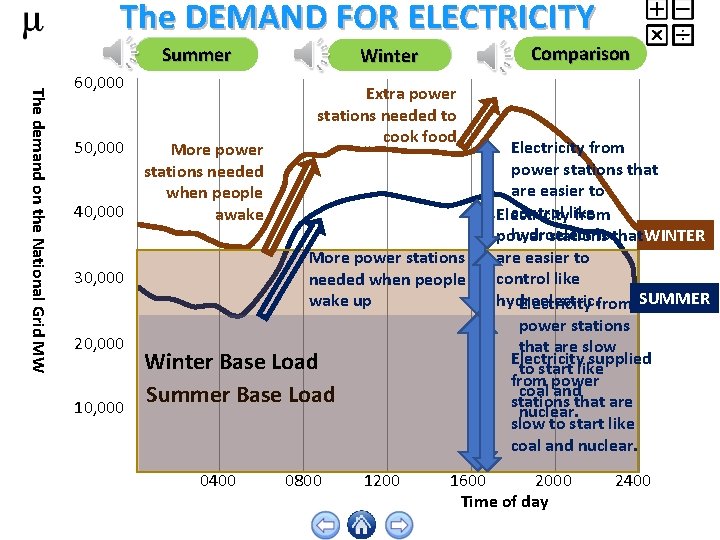
The DEMAND FOR ELECTRICITY Summer The demand on the National Grid MW 60, 000 50, 000 40, 000 More power stations needed when people awake 10, 000 Extra power stations needed to cook food More power stations needed when people wake up 30, 000 20, 000 Comparison Winter Base Load Summer Base Load 0400 0800 1200 Electricity from power stations that are easier to control like Electricity from hydroelectric. power stations that WINTER are easier to control like hydroelectric. Electricity from SUMMER power stations that are slow Electricity supplied to start like from power coal and stations that are nuclear. slow to start like coal and nuclear. 1600 2000 Time of day 2400
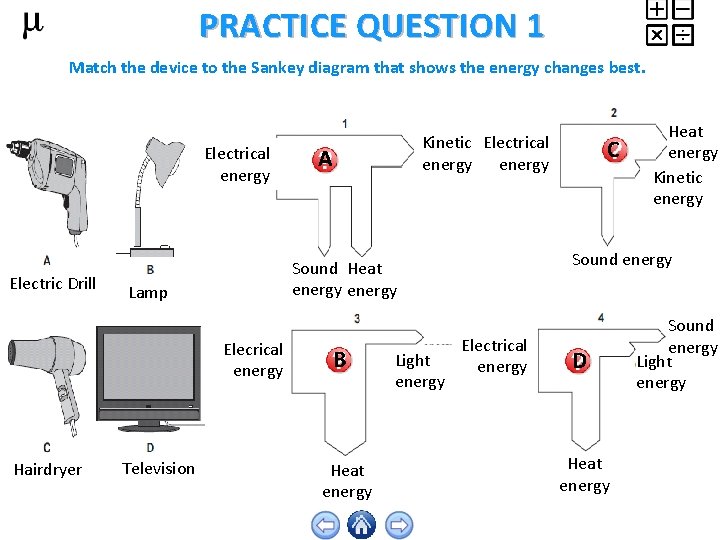
PRACTICE QUESTION 1 Match the device to the Sankey diagram that shows the energy changes best. Electrical energy Electric Drill Lamp Television A B Heat energy Light energy C Heat energy Kinetic energy Sound Heat energy Elecrical energy Hairdryer Kinetic Electrical energy D Heat energy Sound energy Light energy
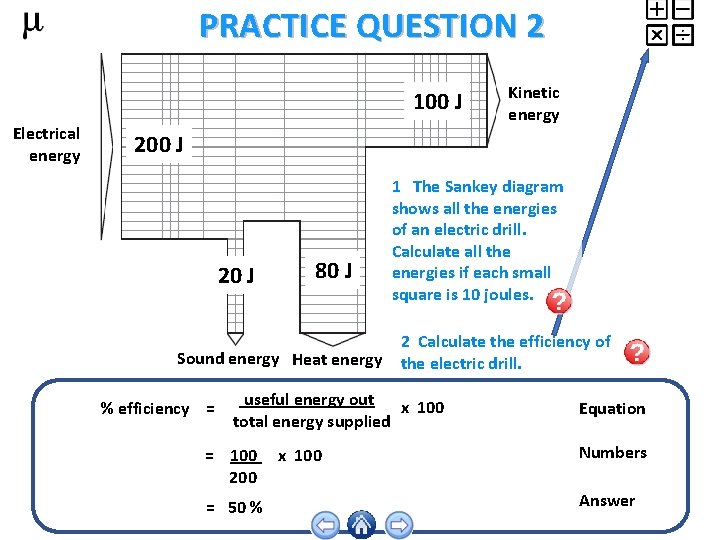
PRACTICE QUESTION 2 100 J Electrical energy Kinetic energy 200 J 20 J 80 J Sound energy Heat energy % efficiency = 1 The Sankey diagram shows all the energies of an electric drill. Calculate all the energies if each small square is 10 joules. 2 Calculate the efficiency of the electric drill. useful energy out x 100 total energy supplied = 100 200 = 50 % x 100 Equation Numbers Answer
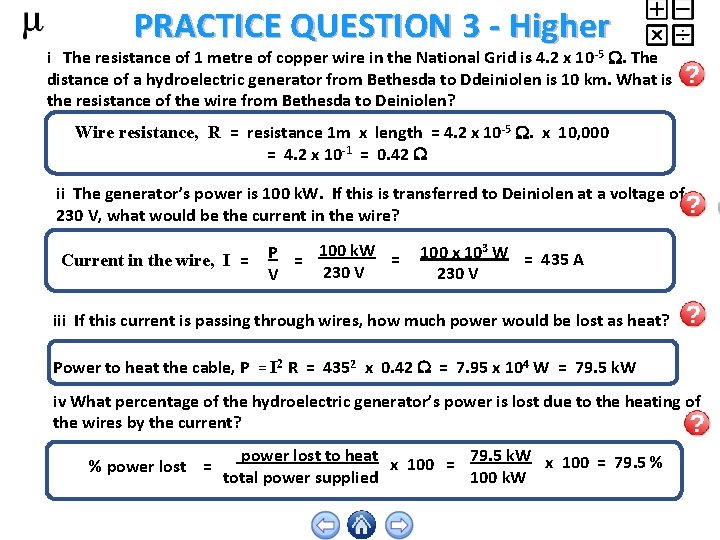
PRACTICE QUESTION 3 - Higher i The resistance of 1 metre of copper wire in the National Grid is 4. 2 x 10 -5 . The distance of a hydroelectric generator from Bethesda to Ddeiniolen is 10 km. What is the resistance of the wire from Bethesda to Deiniolen? Wire resistance, R = resistance 1 m x length = 4. 2 x 10 -5 . x 10, 000 = 4. 2 x 10 -1 = 0. 42 ii The generator’s power is 100 k. W. If this is transferred to Deiniolen at a voltage of 230 V, what would be the current in the wire? Current in the wire, I = P = 100 k. W = 230 V V 100 x 103 W = 435 A 230 V iii If this current is passing through wires, how much power would be lost as heat? Power to heat the cable, P = I 2 R = 4352 x 0. 42 = 7. 95 x 104 W = 79. 5 k. W iv What percentage of the hydroelectric generator’s power is lost due to the heating of the wires by the current? % power lost = 79. 5 k. W x 100 = 79. 5 % power lost to heat x 100 = 100 k. W total power supplied
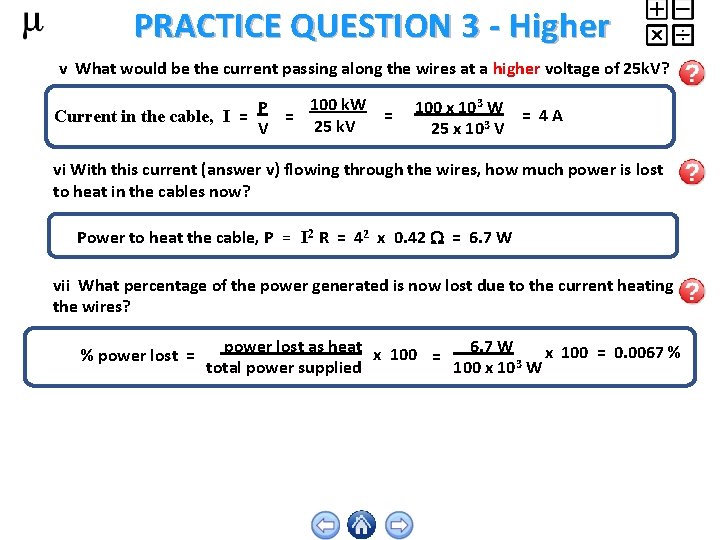
PRACTICE QUESTION 3 - Higher v What would be the current passing along the wires at a higher voltage of 25 k. V? 100 k. W P Current in the cable, I = = 25 k. V V = 100 x 103 W = 4 A 25 x 103 V vi With this current (answer v) flowing through the wires, how much power is lost to heat in the cables now? Power to heat the cable, P = I 2 R = 42 x 0. 42 = 6. 7 W vii What percentage of the power generated is now lost due to the current heating the wires? % power lost = 6. 7 W power lost as heat x 100 = 0. 0067 % = 3 100 x 10 W total power supplied
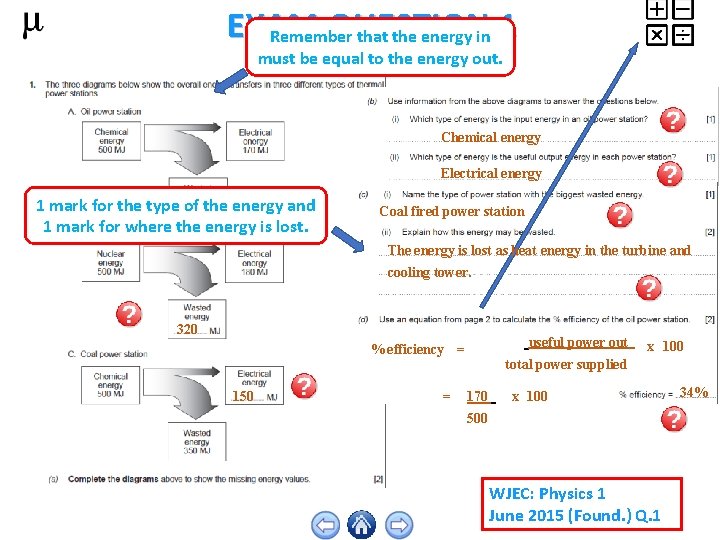
EXAM QUESTION Remember that the energy in 1 must be equal to the energy out. Chemical energy Electrical energy 1 mark for the type of the energy and 1 mark for where the energy is lost. Coal fired power station The energy is lost as heat energy in the turbine and cooling tower. 320 useful power out % efficiency = 150 = x 100 total power supplied 170 x 100 34 % 34% 500 WJEC: Physics 1 June 2015 (Found. ) Q. 1
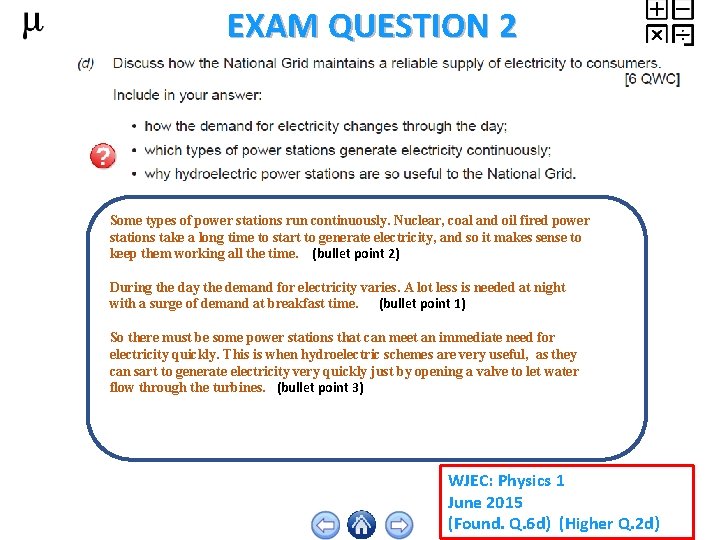
EXAM QUESTION 2 Some types of power stations run continuously. Nuclear, coal and oil fired power stations take a long time to start to generate electricity, and so it makes sense to keep them working all the time. (bullet point 2) During the day the demand for electricity varies. A lot less is needed at night with a surge of demand at breakfast time. (bullet point 1) So there must be some power stations that can meet an immediate need for electricity quickly. This is when hydroelectric schemes are very useful, as they can sart to generate electricity very quickly just by opening a valve to let water flow through the turbines. (bullet point 3) WJEC: Physics 1 June 2015 (Found. Q. 6 d) (Higher Q. 2 d)
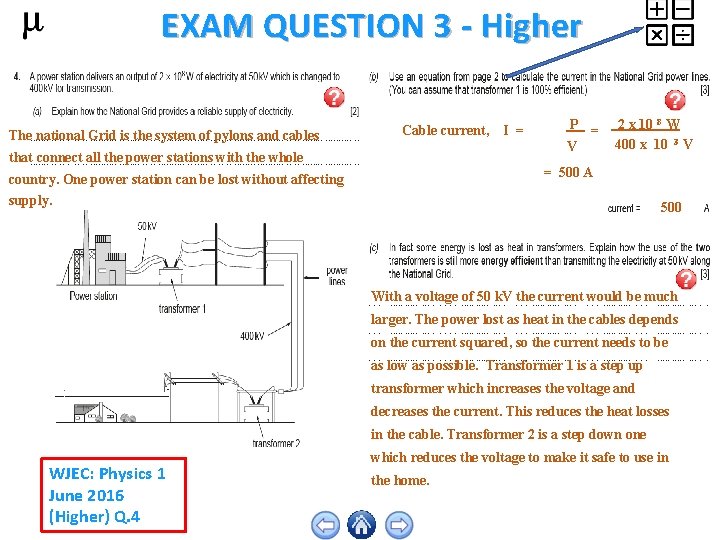
EXAM QUESTION 3 - Higher The national Grid is the system of pylons and cables Cable current, I = that connect all the power stations with the whole P = V 2 x 10 8 W 400 x 10 3 V = 500 A country. One power station can be lost without affecting supply. 500 With a voltage of 50 k. V the current would be much larger. The power lost as heat in the cables depends on the current squared, so the current needs to be as low as possible. Transformer 1 is a step up transformer which increases the voltage and decreases the current. This reduces the heat losses in the cable. Transformer 2 is a step down one WJEC: Physics 1 June 2016 (Higher) Q. 4 which reduces the voltage to make it safe to use in the home.
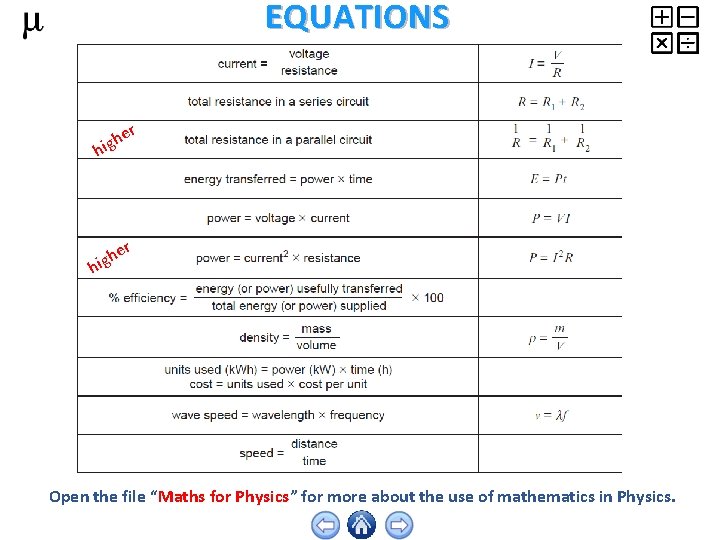
EQUATIONS r e igh h er h hig Open the file “Maths for Physics” for more about the use of mathematics in Physics.
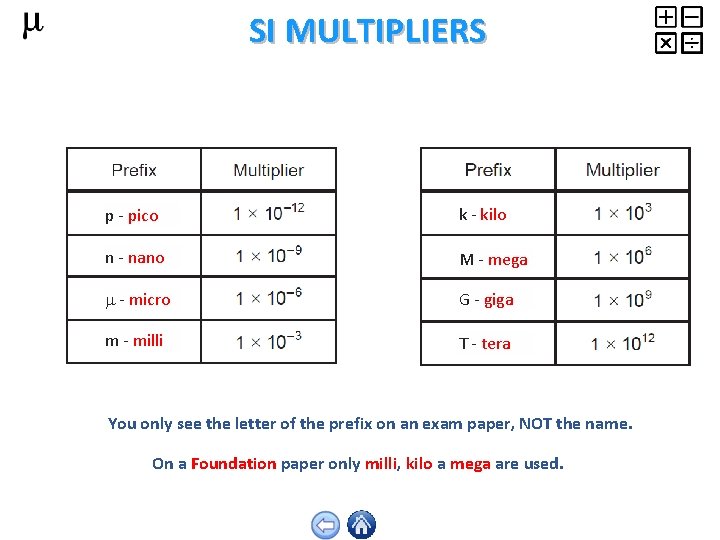
SI MULTIPLIERS p - pico k - kilo n - nano M - mega - micro G - giga m - milli T - tera You only see the letter of the prefix on an exam paper, NOT the name. On a Foundation paper only milli, kilo a mega are used.
- Slides: 20