
The National Curriculum Pupils should spell words as
- Slides: 8
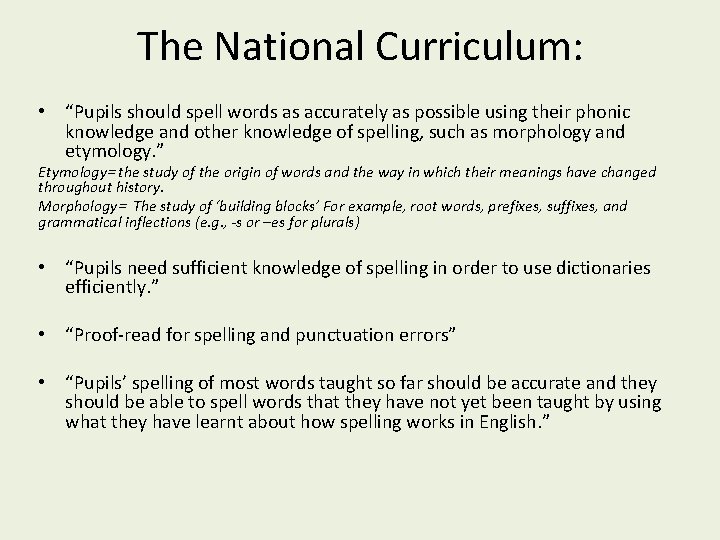
The National Curriculum: • “Pupils should spell words as accurately as possible using their phonic knowledge and other knowledge of spelling, such as morphology and etymology. ” Etymology= the study of the origin of words and the way in which their meanings have changed throughout history. Morphology= The study of ‘building blocks’ For example, root words, prefixes, suffixes, and grammatical inflections (e. g. , -s or –es for plurals) • “Pupils need sufficient knowledge of spelling in order to use dictionaries efficiently. ” • “Proof-read for spelling and punctuation errors” • “Pupils’ spelling of most words taught so far should be accurate and they should be able to spell words that they have not yet been taught by using what they have learnt about how spelling works in English. ”
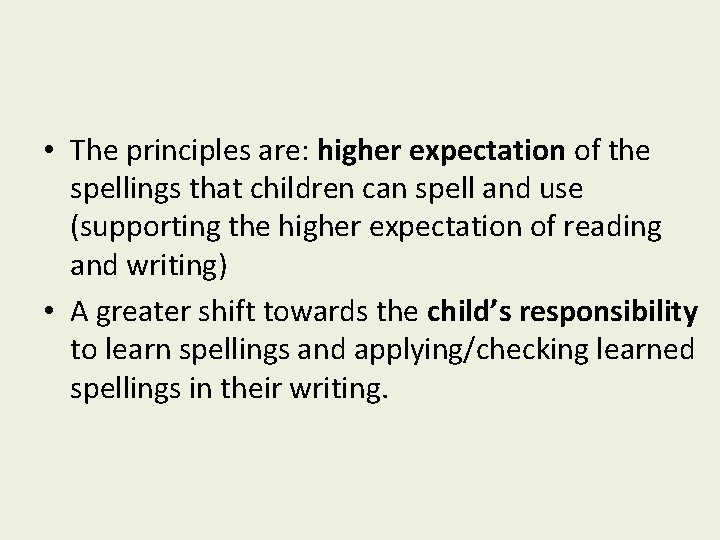
• The principles are: higher expectation of the spellings that children can spell and use (supporting the higher expectation of reading and writing) • A greater shift towards the child’s responsibility to learn spellings and applying/checking learned spellings in their writing.
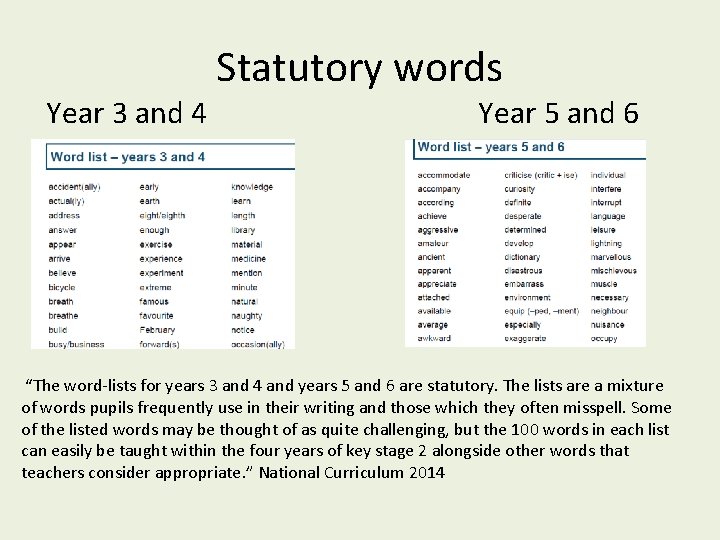
Year 3 and 4 Statutory words Year 5 and 6 “The word-lists for years 3 and 4 and years 5 and 6 are statutory. The lists are a mixture of words pupils frequently use in their writing and those which they often misspell. Some of the listed words may be thought of as quite challenging, but the 100 words in each list can easily be taught within the four years of key stage 2 alongside other words that teachers consider appropriate. ” National Curriculum 2014
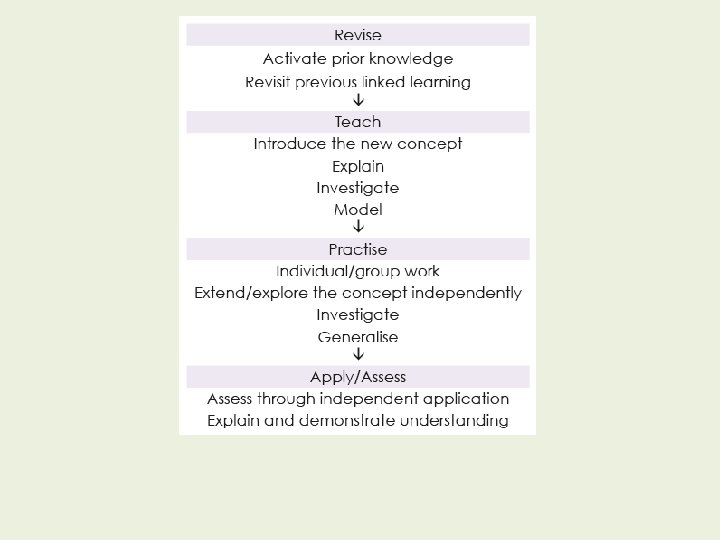
Assessment Pupils’ learning is assessed throughout the programme. The ‘Apply’ part of the sequence regularly includes assessment activities to identify if pupils have learnt the key concept taught. These activities include: • Testing – by teacher and peers • Dictation • Explaining • Independent application in writing • Frequent learning and testing of statutory and personal words.
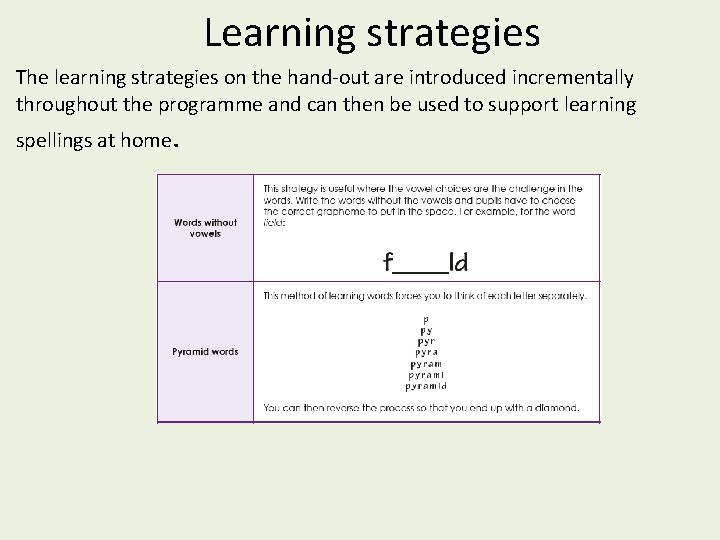
Learning strategies The learning strategies on the hand-out are introduced incrementally throughout the programme and can then be used to support learning spellings at home.
A note on reading stamina and comprehension • Skilled word reading involves both the speedy working out of the pronunciation of unfamiliar printed words (decoding) and the speedy recognition of familiar printed words. • Good comprehension draws from linguistic knowledge (in particular of vocabulary and grammar). For the KS 1 tests, children are expected to read 90 words per minute. For the KS 2 tests, children are expected to read 1500 -2300 words and answer questions in 60 minutes.
Comprehension The ‘goal’ of reading is to make meaning and gain understanding from the text. The children should expect texts to make sense and they should expect to have a response from what they have read. If they don’t, it’s likely that they have not understood.