
The National Board of Certification for Medical Interpreters
The National Board of Certification for Medical Interpreters Yes we can, and we will, in 2009! May 1 st 2009 1
FOUNDERS International Medical Interpreter Association (IMIA) n Founded in 1986, with 1, 900 members, is the oldest & largest medical interpreter association in the world. IMIA is revered by medical interpreters as the ultimate experts in the medical interpreting field. Language Line® University (LLU) n Is the globally recognized interpreter testing, training and certification division of Language Line Services, the worlds founder and largest over the phone, video and on-site interpreter provider. Both organizations partnered with PSI n For over 60 years PSI have offered comprehensive solutions from test development to delivery to results processing, including licensing & certification tests for corporations, professional associations and government agencies. Copyright © 2009 NBCMI 2
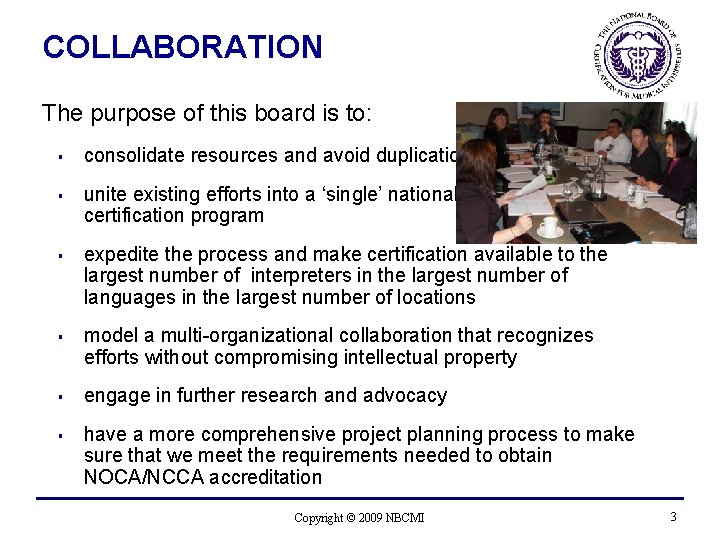
COLLABORATION The purpose of this board is to: § § § consolidate resources and avoid duplication unite existing efforts into a ‘single’ national certification program expedite the process and make certification available to the largest number of interpreters in the largest number of languages in the largest number of locations model a multi-organizational collaboration that recognizes efforts without compromising intellectual property engage in further research and advocacy have a more comprehensive project planning process to make sure that we meet the requirements needed to obtain NOCA/NCCA accreditation Copyright © 2009 NBCMI 2 3
NOCA ACCREDITATION National Organization for Competency Assurance (NOCA) § National Commission for Certifying Agencies (NCCA) is the body of NOCA that regulates and accredits certification programs nationwide promoting excellence and quality certification process. Why are we seeking NOCA accreditation? § § To ensure the quality of the certification process To gain state, federal and national recognition Note: NOCA current standards exceeds the requirements of the American Psychological Association and the US Equal Employment Opportunity Commission. Organizations that are accredited by NOCA: American Academy of Nurse Practitioners, Board of Pharmaceutical Specialties, Commission for Case Managers, many others (100+) Copyright © 2009 NBCMI 4
GOVERNANCE NATIONAL BOARD OF CERTIFICATION FOR MEDICAL INTEPRETERS n The Board of Certification for Medical Interpreters is a group of organizations who will be appointed to implement policy related to certification program operation. Several stakeholder groups (e. g. , the public and other consumers, trainers, employers, regulators, and certificants) will be represented. This constitutes the certifying entity and will have authority over all essential certification decisions. n Policies and procedures will be established to protect against undue influence that could compromise the integrity of the certification process. n To avoid conflicts of interest between certification and education functions, the National Board of Certification for Medical Interpreters will not be responsible for accreditation of educational or training programs or courses of study leading to the certification. Copyright © 2009 NBCMI 5
PROCESS n Interpreters’ Ownership of Process - The certification program is for interpreters and therefore it is interpreters that own the process. The board was created to guarantee and ensure that the best interests of medical interpreters are protected. Copyright © 2009 NBCMI 6
INCLUSIVENESS n Annual National Medical Interpreter Certification convening’s to discuss the important topic of national medical certification. Informative updates from national and international speakers and subject matter experts. The forum also consists of round table sessions and an expert panel. Past attendees have included interpreters, providers, associations, state officials, advocates, policy makers, language service providers, educators, trainers and international representatives. This is an open collaboration that crosses state lines and industry sectors to enable a broader perspective n Interpreters and other stakeholders have been sending us their opinions and reactions directly by email and we continue to incorporate their feedback through the FAQ Guide n This process is inclusive to national testing companies and others that want to participate, without having to release their legal rights to their intellectual property n The National Board is committed to having an inclusive selection process of its members. n Open Calls & Webex – Made available to all organizations and Copyright © 2009 NBCMI 7
TRANSPARENCY n Presentations about the process have been made over the last ten years to multiple conferences and venues. The number of presentations grew in the last two years, and were presented extensively in conferences in the US and internationally. In addition, press releases about certification have been published since 2001. Last, we have maintained several groups apprised of the latest developments, including: q Consortium of Interpreter Associations (COIA), Since October 11, 2006 q q q n Annual National Medical Interpreter Certification Forums (NMICF) since 2007 Forum of Coordinators of Interpreter Services (FOCIS) presentations since 2001 Global Advisory Council (GAC), since May 2008 National Coalition of Certification (NCC) since May 2008 National presentations, most recently at CHIA and TAHIT Copyright © 2009 NBCMI Dissemination – Information has been regularly distributed to 8
CREDIBILITY n An updated National Job Analysis took place in February 2009 in which over 1500 interpreters participated n Existing written and performance exams were updated to ensure that content was in concordance with the results of the 2009 job analyses n Current instruments will be review by SMEs and psychometricians to ensure the validity and reliability of the instruments. n Qualification exams will be reviewed by SME to ensure their validity. n Focus groups, surveys and SME reviews have also taken place in this very complex and enormous undertaking Copyright © 2009 NBCMI 9
PRIMARY BENEFITS Patients and Providers § § Ensures effective communication between providers and patients Prevents adverse effects due to use of unqualified interpreters Interpreters § § § Provides a professional credentialing that crosses state lines Gives one credential for all interpreters (in-person & remote) Provides the ability of being tested once and not by every health care facility they apply to Healthcare Industry § § Prevents liability issues due to incompetent interpreting Reduces length of time it takes to validate candidates qualifications and prevents administrative testing costs of recruitment of interpreters Government § § Provides national credential that crosses state lines in case of national disasters State health departments. Copyright don’t©need to spend to develop state certification 10 2009 NBCMI
PATIENT SAFETY n One of the root cause for Healthcare Disparities is lack of effective communication and failure to address this hinders patient from receiving quality of care and exposes the healthcare industry to many liabilities n IOM report Crossing the Quality Chasm suggests there are six elements tied to quality of care and out of those six elements there are three that are directly linked to communication; effectiveness, safety & equity n Research has shown that LEP patients are more likely to suffer from adverse events due to communication errors and these events tend to have a greater clinical consequence n Also research has shown that in the presence of communication difficulties healthcare providers may tend to order unnecessary tests for conditions that could have been diagnosed through a simple basic history taken with a qualified interpreter Copyright © 2009 NBCMI 11
CREDENTIALING Offers 3 credentials to cover all languages: CERTIFIED MEDICAL INTERPRTER (CMI) 1. § Successful completion of process with written & performance exam ü Initially available in 22 languages, expanding to 30 by 2010 QUALIFIED MEDICAL INTERPRETER (QMI) 2. § Successful completion of process with written & qualification exam ü For minority languages done in partnership with other national testing providers SCREENED MEDICAL INTEPRETER (SMI) 3. § Successful completion of process with written & review of portfolio (similar to Canadian & Australian recognition Copyright © 2009 NBCMI processes) 12
PROCESS FOR CERTIFICATION Step 1. Register for certification -Meet basic eligibility prerequisites (knowledge, education & skills training) Step 2. Take the National Board Written Exam -Demonstrate competency in knowledge areas (proctored/administered by PSI) Step 3. Depending on the non-English working language -Take the National Performance Exam -Take the Qualification Exam -Undergo the Portfolio Review Step 4. Re-certification Copyright 2009 NBCMI required 3. 0 CEUs, 5 year period, no© 3 retesting 13
RECERTIFICATION Requirements: ü 3. 0 Continuing Education Units (30 hours within 5 years) ü No retesting required Why do you need to be recertified? ü ü ü Protect patient’s safety Honor patient’s right to obtain services of a competent interpreter to ensure good outcomes Prevent interpreters once certified to lag on field experience for many years Copyright © 2009 NBCMI 14
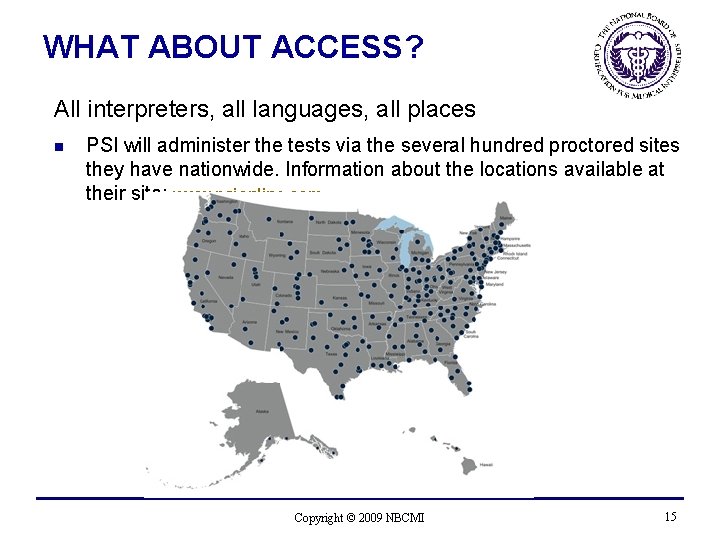
WHAT ABOUT ACCESS? All interpreters, all languages, all places n PSI will administer the tests via the several hundred proctored sites they have nationwide. Information about the locations available at their site: www. psionline. com Copyright © 2009 NBCMI 6 15
WHAT ABOUT ACCESS? Interpreters with disabilities Blind or Visually Impaired n The written test is designed in a platform that is compatible with screen reading programs like JAWS and Windoweyes. Physically Challenged or Mobility Impaired n Candidates will be able to request special accommodations to access testing centers Copyright © 2009 NBCMI 16
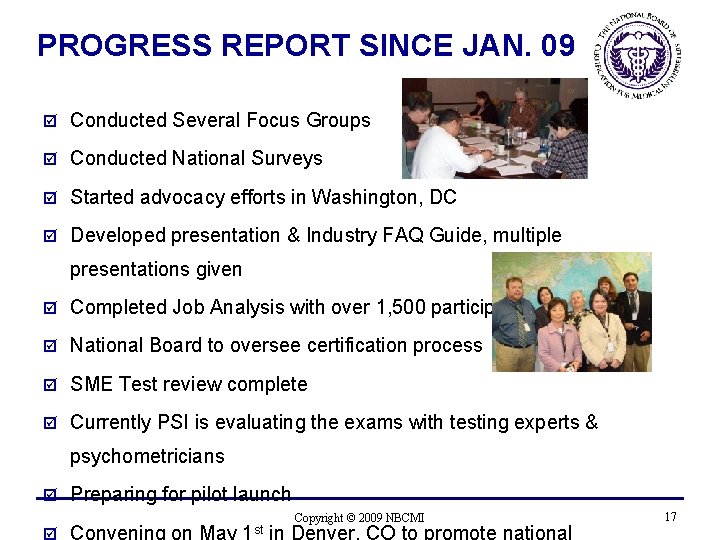
PROGRESS REPORT SINCE JAN. 09 þ Conducted Several Focus Groups þ Conducted National Surveys þ Started advocacy efforts in Washington, DC þ Developed presentation & Industry FAQ Guide, multiple presentations given þ Completed Job Analysis with over 1, 500 participants þ National Board to oversee certification process þ SME Test review complete þ Currently PSI is evaluating the exams with testing experts & psychometricians þ Preparing for pilot launch þ Convening on May 1 st Copyright © 2009 NBCMI in Denver, CO to promote national 17
What’s Next? n Continue to promote national certification for medical interpreters with other organizations, coalitions, and government entities n Continue advocating for the reimbursement of medical interpreter services because: ü ü Unfunded mandate – Title VI, ADA, Executive Order 13166, State Laws Hospitals capped by administrative budgets Cost of interpreter is minimal compared to cost of delays or additional tests/visits/ hospitalizations It is time we provide assurance of safety communication to patients and providers alike to eliminate healthcare disparities due to language access! Copyright © 2009 NBCMI START THE PROCESS TO BRING ORGANIZATIONS/ 7 18
NATIONAL BOARD NOCA Requirements Standard 2 -The certification program must be structured and governed in ways that are appropriate for the profession, occupation, role, or skill, and that ensure autonomy in decision making over essential certification activities. Standard 3 -The certification board of the certification program must include individuals from the certified population, as well as voting representation from at least one consumer or public member. To ensure autonomy it should be an independent entity. n Board member should represent: n n n The public member requirement-someone that has been or is a potential a consumer of the certificants’ skills or services and has experience with public advocacy Trainers Employers Regulators Certificants
CURRENT BOARD UPDATE Inaugural Board members n Founding Members (IMIA, LLU) n Jordan Coriza, MDPH n 2 others pending finalization Inaugural Board Members will develop: n Transparent guidelines and procedures for selection of additional members
WHAT WILL BE EXPECTED FROM BOARD MEMBERS? n Development of: q q q n Mission statement Articles of incorporation By-laws Business plan Policies and procedures related to the implementation certification program Organizational chart Make all decisions related to process of the certification q q q Eligibility standards Development Administration Scoring of the assessment instruments Selection of personnel Operational processes
PROPOSED PROCESS n RFA (Request for Applications) q q will be posted on the National Board website will be distributed nationwide through list-serve n Establish a deadline to submit applications n Candidates/organizations submit application with: q q Information about organization or a CV if it is an individual application Statement about the stakeholder group representing Applications will be submitted via e-mail to: info@certifiedmedicalinterpreters. org Subject on the e-mail: National Board Application
Center for Updates & Information n A website dedicated to National Medical Certification for Interpreters is now active and in development with basic information now, and additional information being posted regularly. It also includes a link to send your questions and feedback www. imiaweb. org Copyright © 2009 NBCMI 8 23
- Slides: 23