
The National Animal Identification System Basics Blueprint Timelines
The National Animal Identification System: Basics, Blueprint, Timelines, and Processes Prepared by: C. Wilson Gray District Extension Economist, Agricultural Economics and Rural Sociology Twin Falls Research and Extension Center University of Idaho Email: wgray@uidaho. edu Western Extension Marketing Committee Western Center for Risk Management Education
The National Animal Identification System • What is the National Animal Identification System? – A system capable of tracing an animal or group of animals back to the herd that is the most logical source of a disease of concern • Can trace potentially exposed animals that have moved from the subject premises. • trace back to all of the locations a suspect animal has been within 48 hours • provide information on all other animals that came in contact with the subject animal

The National Animal Identification System • Why is it Important to Track Animals? – national plan will enhance disease preparedness • provides the ability to quickly trace animals exposed to disease • permits rapid detection, containment, and elimination of disease threats – This is essential to preserving the domestic and international marketability of our nation’s animals and animal products
The National Animal Identification System • Are Only U. S. Animals Affected by the NAIS? – Animals entering the United States from other countries will be subject to the same ID procedures • The ID devices on animals entering the United States would remain on the animals as official devices – The Canadian ID program is compatible with NAIS. • Are the NAIS and Traceability Connected? – NAIS is designed to quickly trace live animal movements in the event of a disease outbreak • Traceability can be established in a two-step process – “farm to slaughter” and “plant to retail” – Tracking throughout the system is possible, but only at higher cost
How Does the Recent BSE Discovery Impact the NAIS? • USDA accelerated implementation of a nationwide animal ID plan – Mad-Cow Disease is a disease of the central nervous system (CNS) in cattle • BSE has never been found in meat or muscle cuts • non-ambulatory animals are banned from entering the food system – important to be able to quickly trace an animal’s premises history • NAIS should allow for this to occur within 48 hours
Who is Supporting the NAIS? • dairy, cattle, sheep, and swine industries have developed preliminary implementation plans • All other livestock are becoming engaged in the plan – goats, cervids, equine, aquaculture – poultry, llamas, and bison
How Will Implementation Occur? • NAIS defines the standards and framework for a national animal ID system including: – a premise numbering system – an individual and group/lot animal number system – standards for data and data handling • When Will Implementation of the NAIS Happen? – 29 state and tribal pilot projects were funded on August 29, 2004 – USDA planned to begin issuing premises ID numbers by the fall of 2004 • farms, ranches, feed lots, packing plants, and other livestock locations

NAIS Timeline
What Will the NAIS Cost? • Federal government may pay $165 million, or onethird of the cost, over five years – partners in bearing the cost • USDA • state governments • the livestock industry – Costs of the plan are • ID device(s) • retrofitting facilities to utilize the ID devices • upgrades to software to handle the database requirements – Volume requirements and technology advances will lower costs
How Will the NAIS Work? • NAIS currently supports the following species and/or industries: – bison, beef cattle, dairy cattle – swine, sheep, goats, camelids (alpacas and llamas) – horses, cervids (deer and elk), poultry (eight species including game birds) – aquaculture (eleven species)
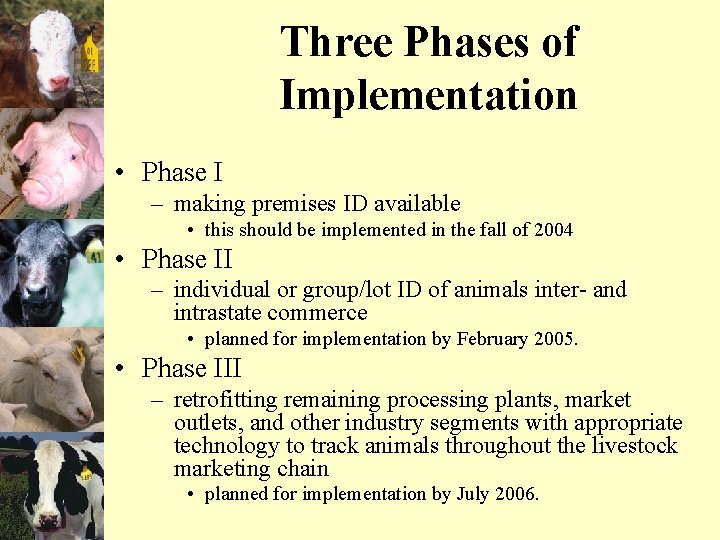
Three Phases of Implementation • Phase I – making premises ID available • this should be implemented in the fall of 2004 • Phase II – individual or group/lot ID of animals inter- and intrastate commerce • planned for implementation by February 2005. • Phase III – retrofitting remaining processing plants, market outlets, and other industry segments with appropriate technology to track animals throughout the livestock marketing chain • planned for implementation by July 2006.
Implementation • Initial focus on the cattle, swine, and small ruminant industries. – standards apply to all animals within the represented industries regardless of their intended use as seed stock, commercial, pets, or other personal uses – Animal ID work began with the cattle industry due to concerns about Mad-Cow Disease – ID work will also begin with other major food animals such as hogs, sheep, and poultry
For More Information • The U. S. Animal Identification Program is at – www. usaip. info • USDA/APHIS also has information at – http: //www. aphis. usda. gov/vs/highlights/sectio n 3/section 3 -10. html
Publications In This Series • C. Wilson Gray: The National Animal Identification System: Basics, Blueprint, Timelines, and Processes • Dee. Von Bailey: Benefits and Costs of Animal Identification • Michael Roberts: Product Liability Types (negligence vs. strict liability) • Michael Roberts: Information Management Confidentiality • Wendy Umberger: Cool vs. Animal ID • Darrell Mark: Structural Issues - Feedlot/Stockers/Cow. Calf/Purebred • Ruby Ward: Value of Production Information • Kynda Curtis: Consumer Driven Forces • Jim Robb: Technical and Pricing Issues Related to Traceability • Russell Tronstad: Challenges of Adoption in Western Production Systems • Michael Coe: Working with Technology Providers • Dillon Feuz and Jim Robb: Implications for the future
Our Sponsors
- Slides: 15