
The Narrow Line Region Current Models and Future
- Slides: 32
The Narrow Line Region Current Models and Future Questions Brent Groves Max Planck Institute for Astrophysics Invited Talk The Central Engine in AGN
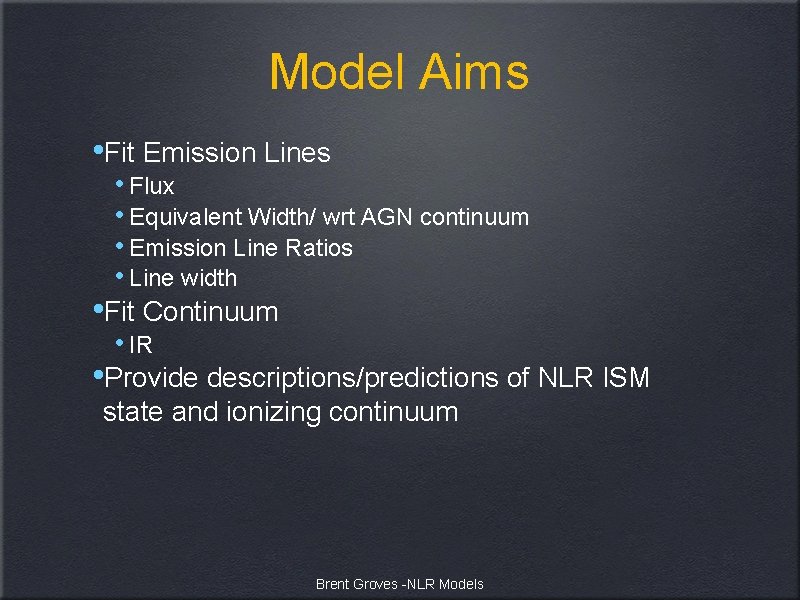
Model Aims • Fit Emission Lines • Flux • Equivalent Width/ wrt AGN continuum • Emission Line Ratios • Line width • Fit Continuum • IR • Provide descriptions/predictions of NLR ISM state and ionizing continuum Brent Groves -NLR Models
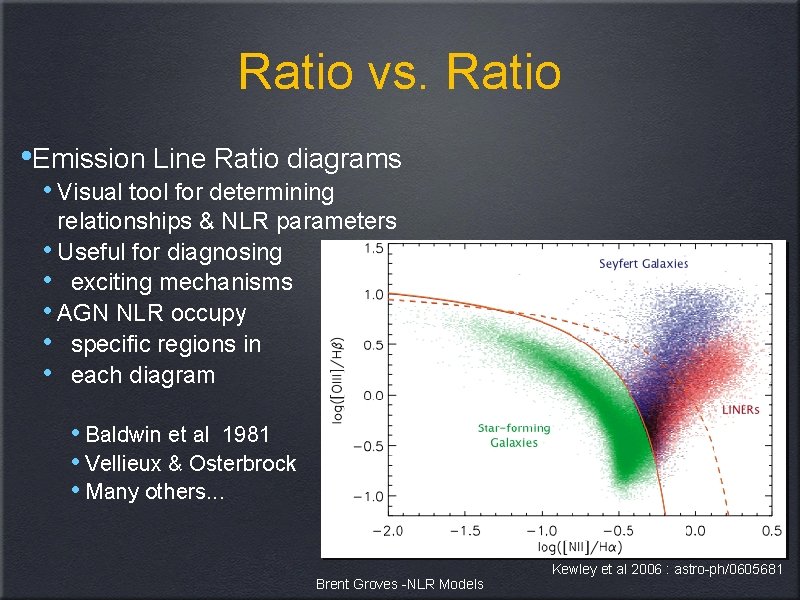
Ratio vs. Ratio • Emission Line Ratio diagrams • Visual tool for determining relationships & NLR parameters • Useful for diagnosing • exciting mechanisms • AGN NLR occupy • specific regions in • each diagram • Baldwin et al 1981 • Vellieux & Osterbrock • Many others. . . Brent Groves -NLR Models Kewley et al 2006 : astro-ph/0605681
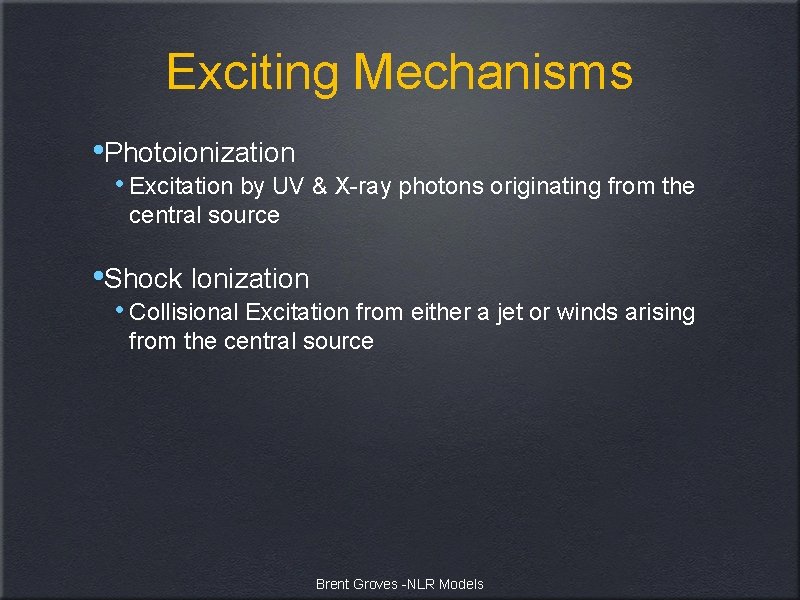
Exciting Mechanisms • Photoionization • Excitation by UV & X-ray photons originating from the central source • Shock Ionization • Collisional Excitation from either a jet or winds arising from the central source Brent Groves -NLR Models
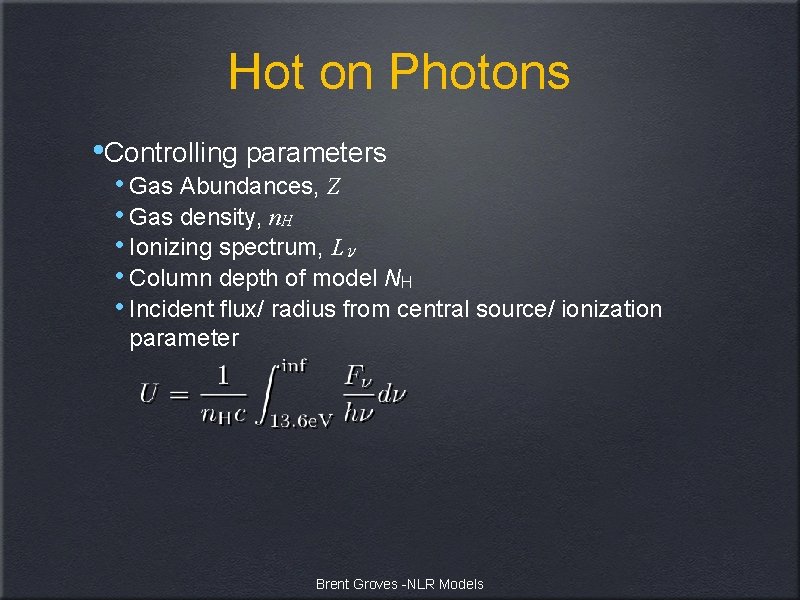
Hot on Photons • Controlling parameters • Gas Abundances, Z • Gas density, n. H • Ionizing spectrum, Lν • Column depth of model NH • Incident flux/ radius from central source/ ionization parameter Brent Groves -NLR Models
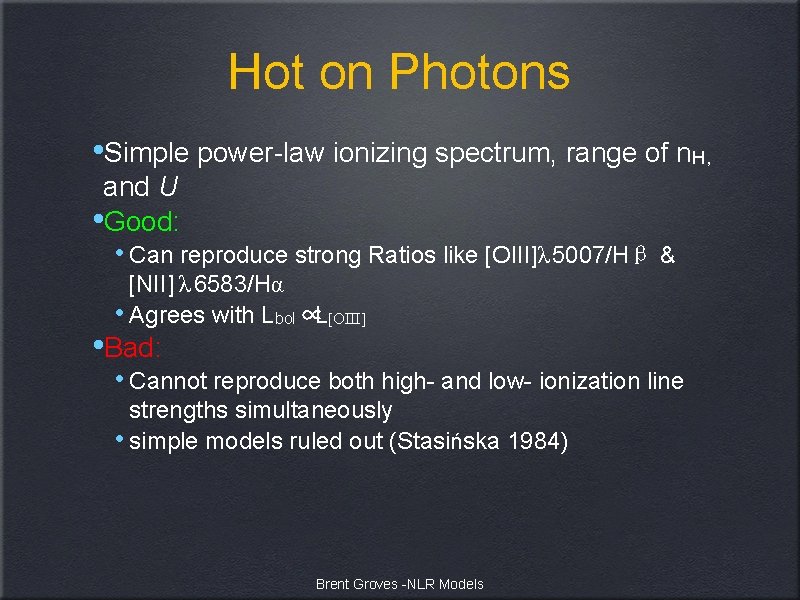
Hot on Photons • Simple power-law ionizing spectrum, range of n. H, and U • Good: • Can reproduce strong Ratios like [OIII]λ 5007/Hβ & [NII] λ 6583/Hα • Agrees with Lbol ∝L[OIII] • Bad: • Cannot reproduce both high- and low- ionization line strengths simultaneously • simple models ruled out (Stasińska 1984) Brent Groves -NLR Models
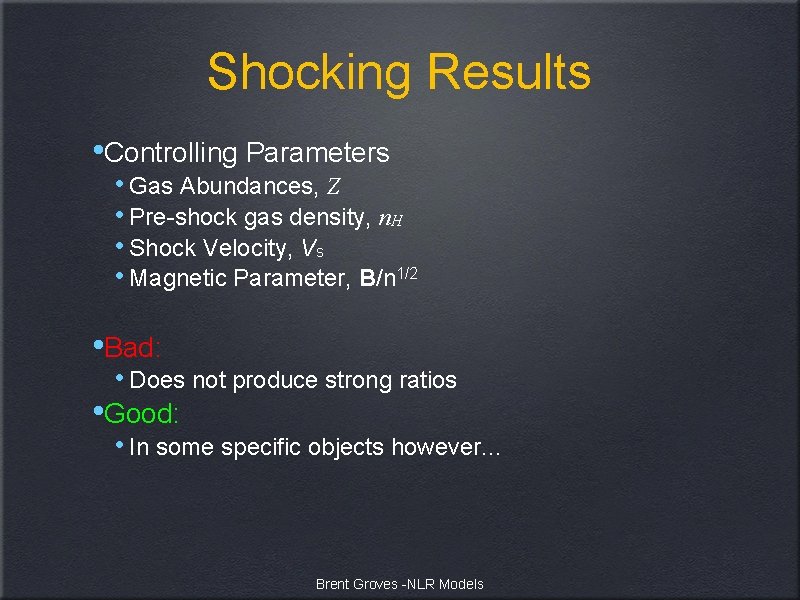
Shocking Results • Controlling Parameters • Gas Abundances, Z • Pre-shock gas density, n. H • Shock Velocity, Vs • Magnetic Parameter, B/n 1/2 • Bad: • Does not produce strong ratios • Good: • In some specific objects however. . . Brent Groves -NLR Models
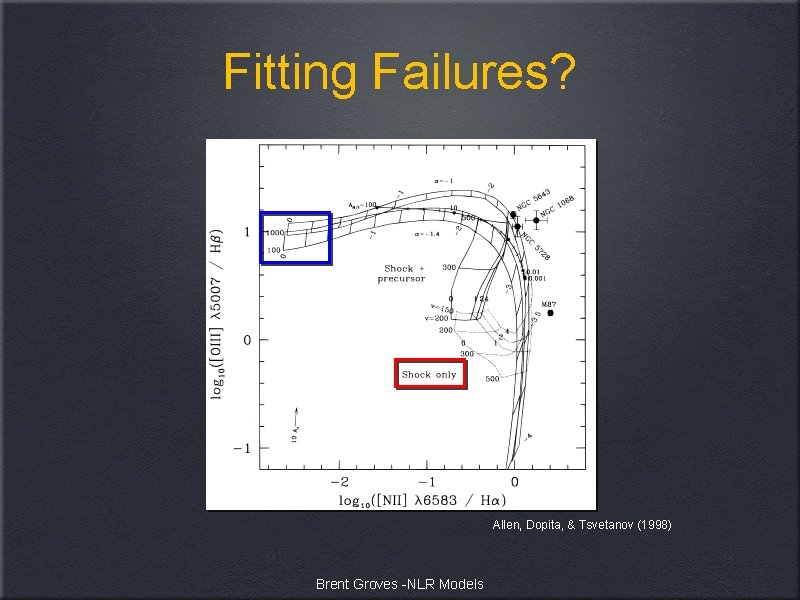
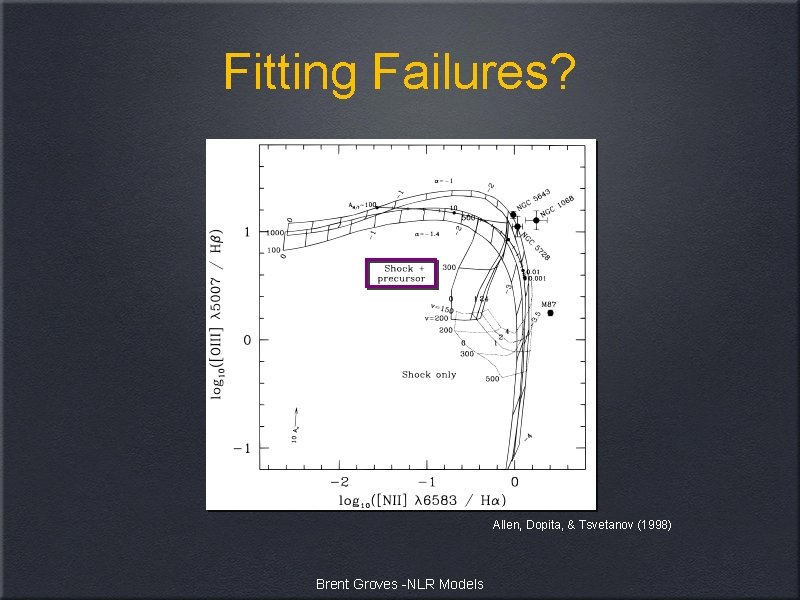
Fitting Failures? Allen, Dopita, & Tsvetanov (1998) Brent Groves -NLR Models
Shockingly Fast? • Fast shocks (Vs > 150 km s-1) produce ionizing photons (Dopita & Sutherland 1995, 96) • Post shock gas cools producing photons which diffuse upstream & downstream • Upstream ionizes pre-shock gas • Combination of collisional & photoionization • Good: Correct Ratios • Bad: Velocity signatures Brent Groves -NLR Models
Fitting Failures? Allen, Dopita, & Tsvetanov (1998) Brent Groves -NLR Models
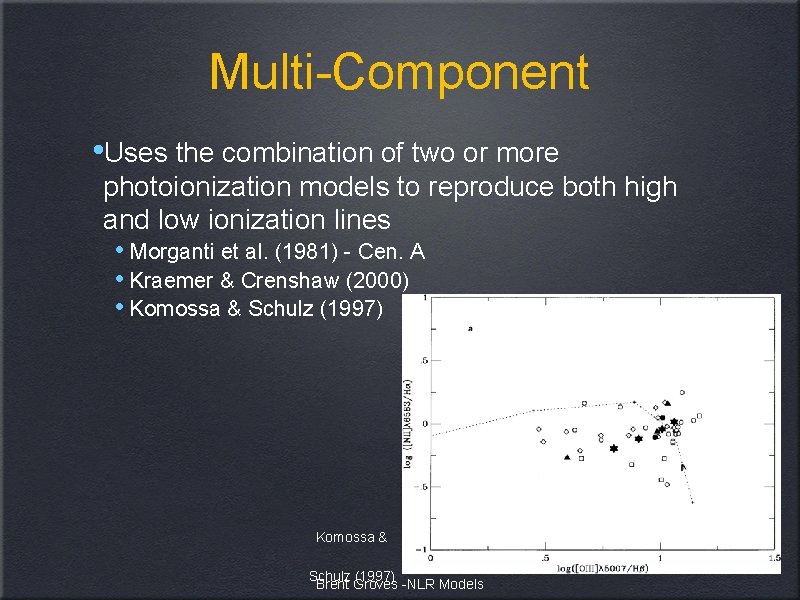
Multi-Component • Uses the combination of two or more photoionization models to reproduce both high and low ionization lines • Morganti et al. (1981) - Cen. A • Kraemer & Crenshaw (2000) • Komossa & Schulz (1997) Brent Groves -NLR Models
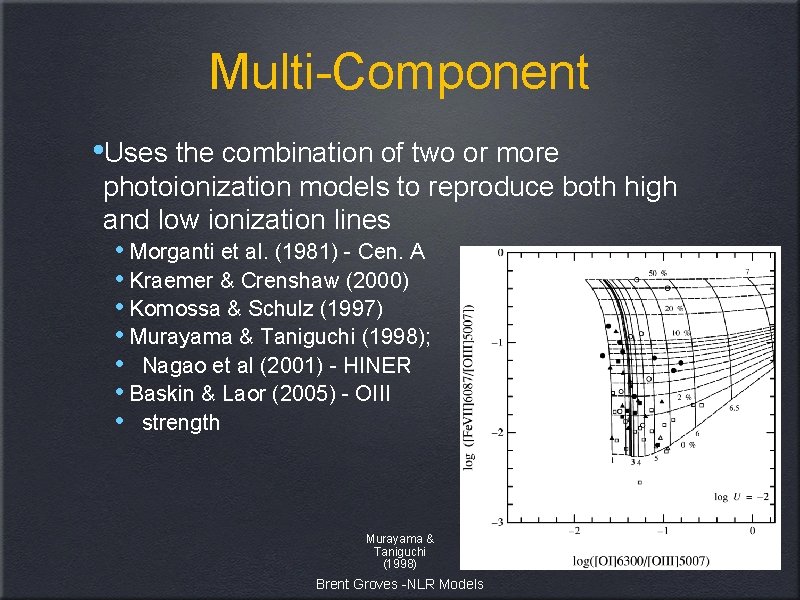
Multi-Component • Uses the combination of two or more photoionization models to reproduce both high and low ionization lines • Morganti et al. (1981) - Cen. A • Kraemer & Crenshaw (2000) • Komossa & Schulz (1997) • Murayama & Taniguchi (1998); • Nagao et al (2001) - HINER • Baskin & Laor (2005) - OIII • strength Murayama & Taniguchi (1998) Brent Groves -NLR Models
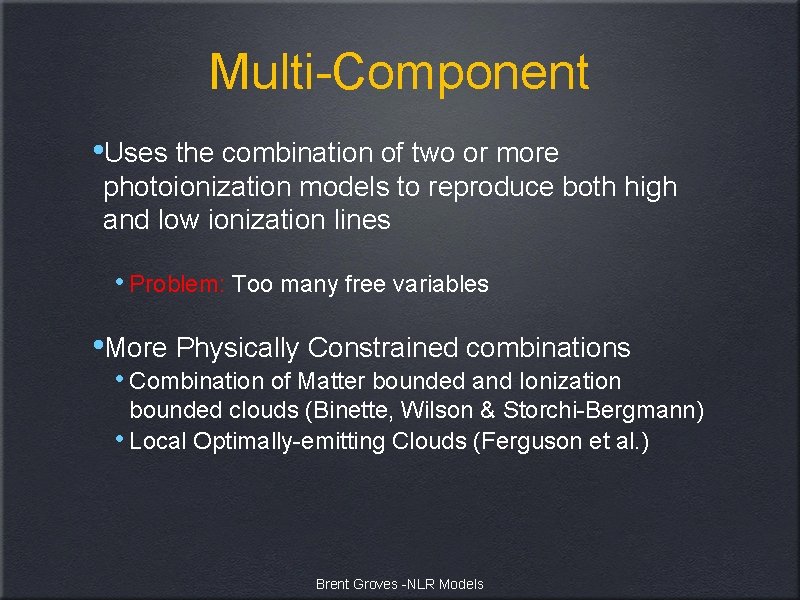
Multi-Component • Uses the combination of two or more photoionization models to reproduce both high and low ionization lines • Problem: Too many free variables • More Physically Constrained combinations • Combination of Matter bounded and Ionization bounded clouds (Binette, Wilson & Storchi-Bergmann) • Local Optimally-emitting Clouds (Ferguson et al. ) Brent Groves -NLR Models
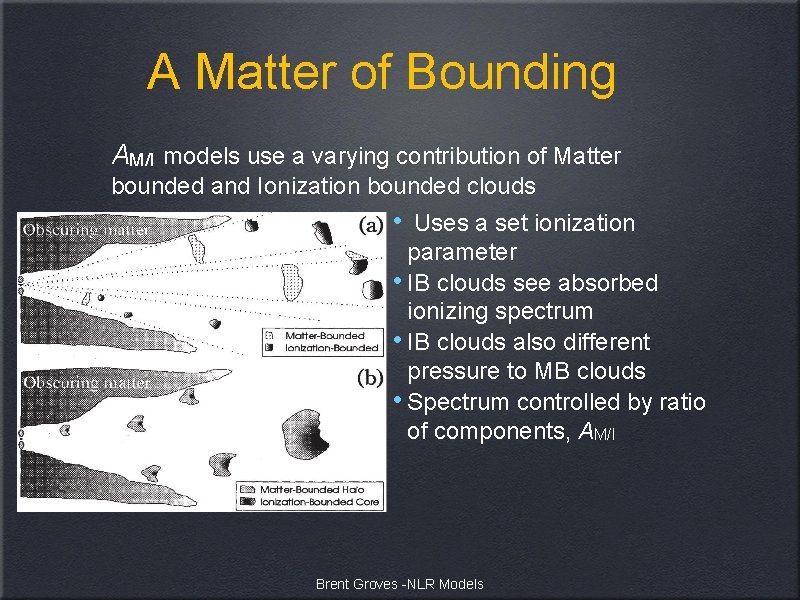
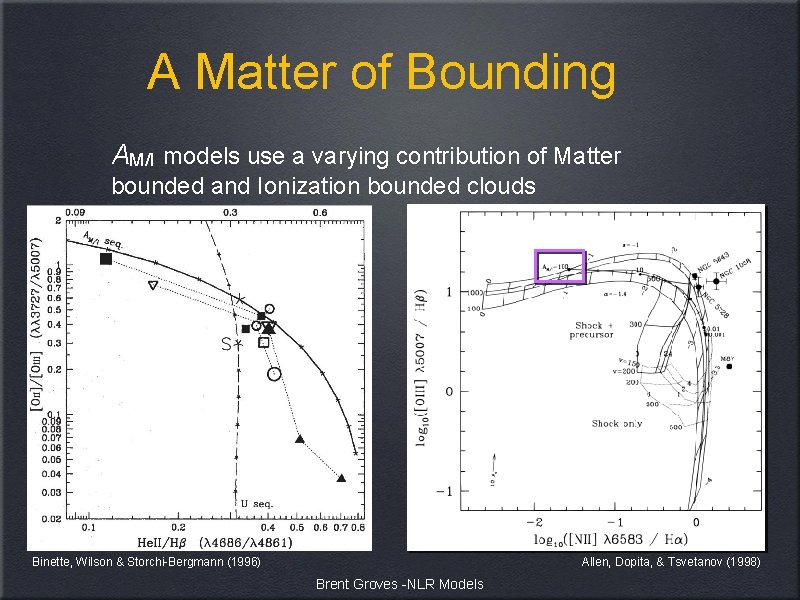
A Matter of Bounding AM/I models use a varying contribution of Matter bounded and Ionization bounded clouds • Uses a set ionization parameter • IB clouds see absorbed ionizing spectrum • IB clouds also different pressure to MB clouds • Spectrum controlled by ratio of components, AM/I Brent Groves -NLR Models
A Matter of Bounding AM/I models use a varying contribution of Matter bounded and Ionization bounded clouds Binette, Wilson & Storchi-Bergmann (1996) Allen, Dopita, & Tsvetanov (1998) Brent Groves -NLR Models
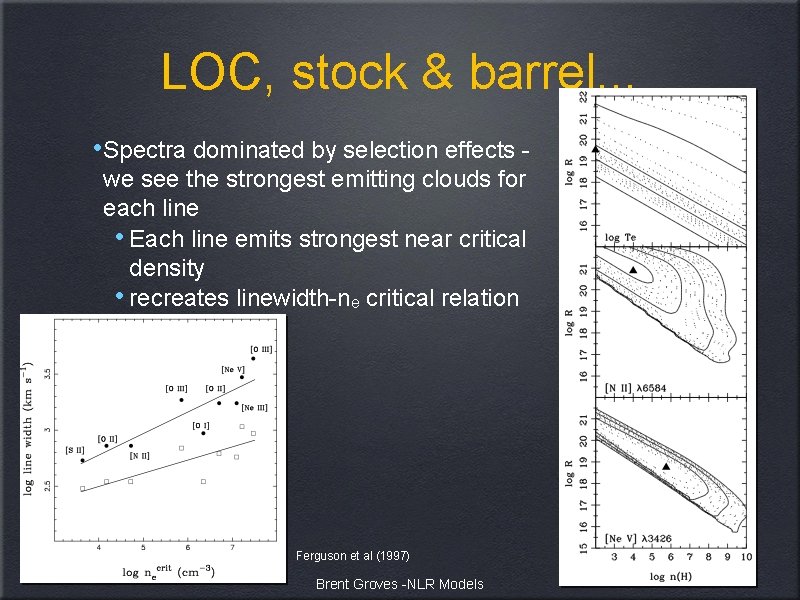
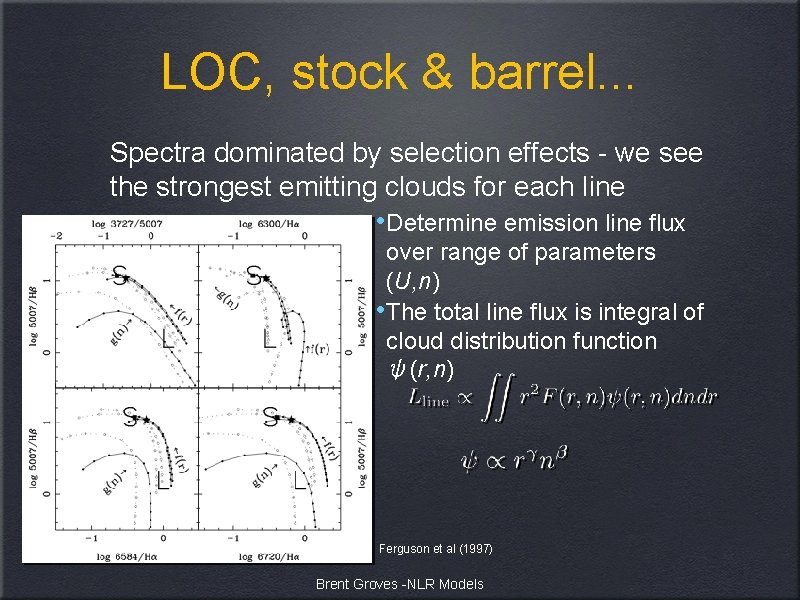
LOC, stock & barrel. . . • Spectra dominated by selection effects we see the strongest emitting clouds for each line • Each line emits strongest near critical density • recreates linewidth-ne critical relation Ferguson et al (1997) Brent Groves -NLR Models
LOC, stock & barrel. . . Spectra dominated by selection effects - we see the strongest emitting clouds for each line • Determine emission line flux over range of parameters (U, n) • The total line flux is integral of cloud distribution function ψ(r, n) Ferguson et al (1997) Brent Groves -NLR Models
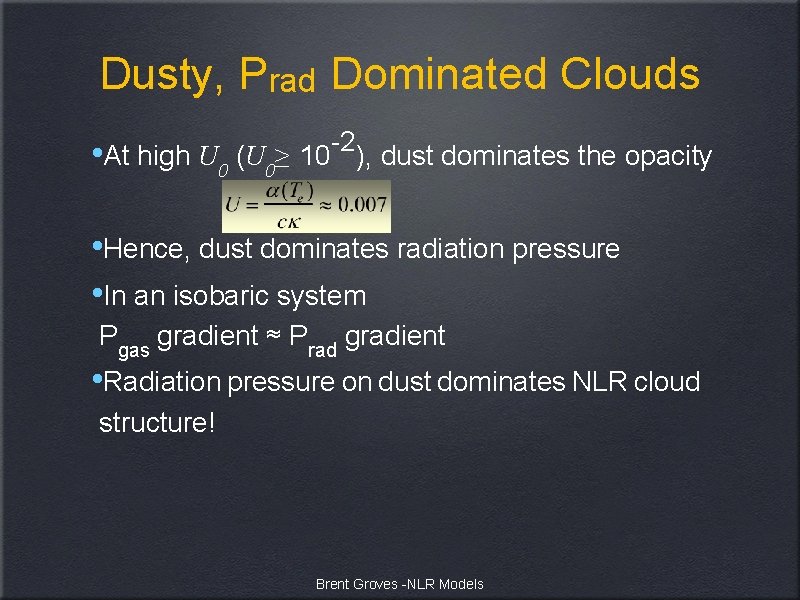
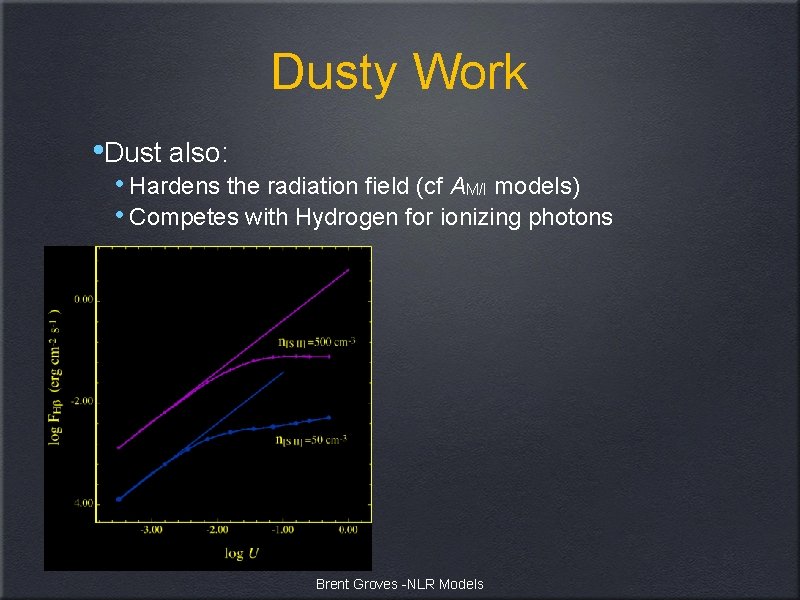
Dusty, Prad Dominated Clouds • At high U 0 (U 0≥ 10 -2 ), dust dominates the opacity • Hence, dust dominates radiation pressure • In an isobaric system Pgas gradient ≈ Prad gradient • Radiation pressure on dust dominates NLR cloud structure! Brent Groves -NLR Models
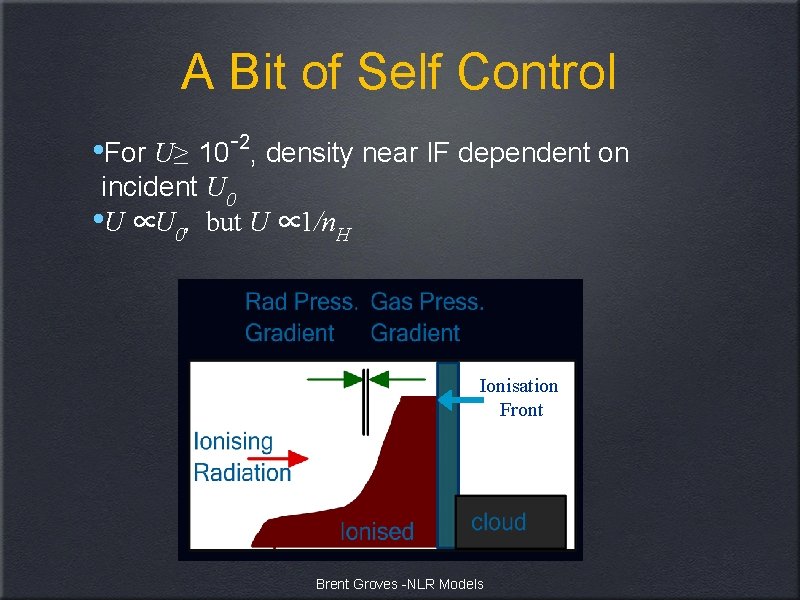
A Bit of Self Control • For U≥ 10 -2, density near IF dependent on incident U 0 • U ∝U 0, but U ∝ 1/n. H Ionisation Front Brent Groves -NLR Models
A Bit of Self Control • For U≥ 10 -2, density near IF dependent on incident U 0 • U ∝U 0, but U ∝ 1/n. H • Local U becomes independent of U 0!! • Self regulatory mechanism for constant emission lines!! Brent Groves -NLR Models
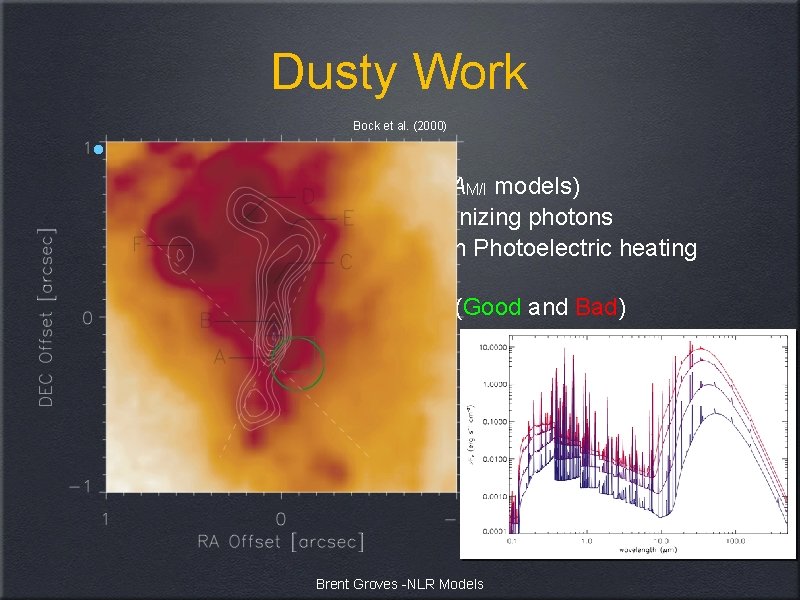
Dusty Work • Dust also: • Hardens the radiation field (cf AM/I models) • Competes with Hydrogen for ionizing photons Brent Groves -NLR Models
Dusty Work • Dust also: Bock et al. (2000) • Hardens the radiation field (cf AM/I models) • Competes with Hydrogen for ionizing photons • Increased Temperature through Photoelectric heating (ie ROIII increased) • Depletes Refractory Elements (Good and Bad) • Corresponding IR emission Brent Groves -NLR Models
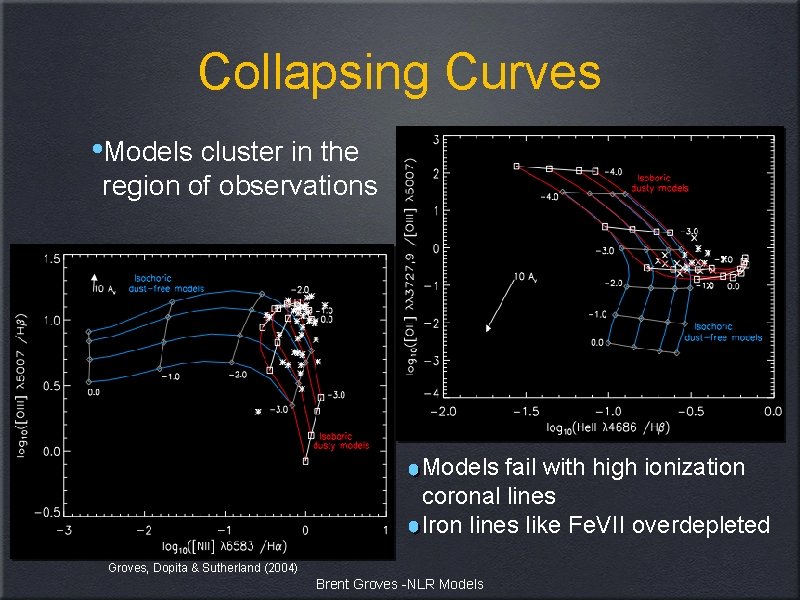
Collapsing Curves • Models cluster in the region of observations Models fail with high ionization coronal lines Iron lines like Fe. VII overdepleted Groves, Dopita & Sutherland (2004) Brent Groves -NLR Models
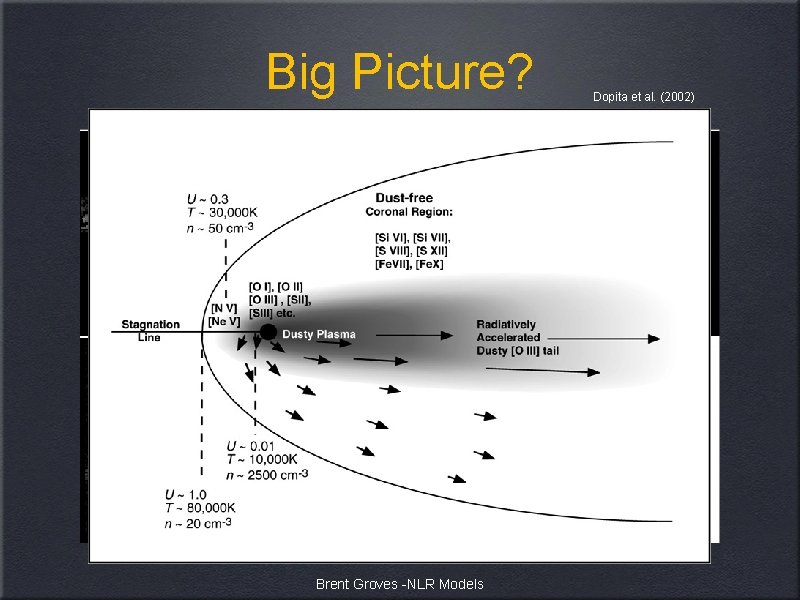
Big Picture? Cecil et al. (2002) Brent Groves -NLR Models Dopita et al. (2002)
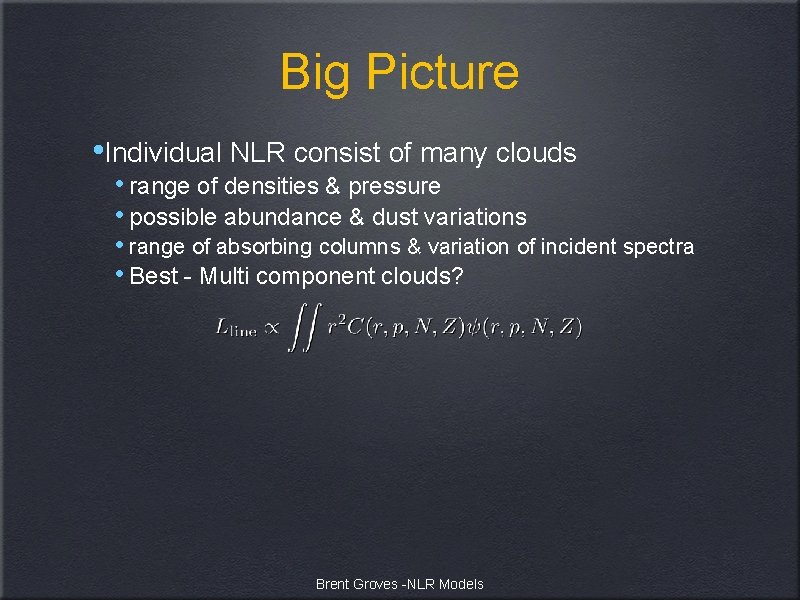
Big Picture • Individual NLR consist of many clouds • range of densities & pressure • possible abundance & dust variations • range of absorbing columns & variation of incident spectra • Best - Multi component clouds? Brent Groves -NLR Models
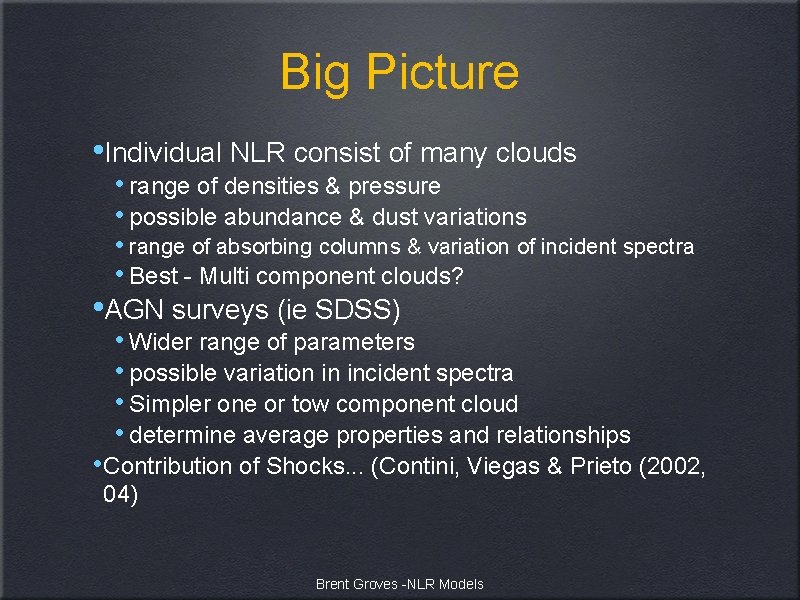
Big Picture • Individual NLR consist of many clouds • range of densities & pressure • possible abundance & dust variations • range of absorbing columns & variation of incident spectra • Best - Multi component clouds? • AGN surveys (ie SDSS) • Wider range of parameters • possible variation in incident spectra • Simpler one or tow component cloud • determine average properties and relationships • Contribution of Shocks. . . (Contini, Viegas & Prieto (2002, 04) Brent Groves -NLR Models
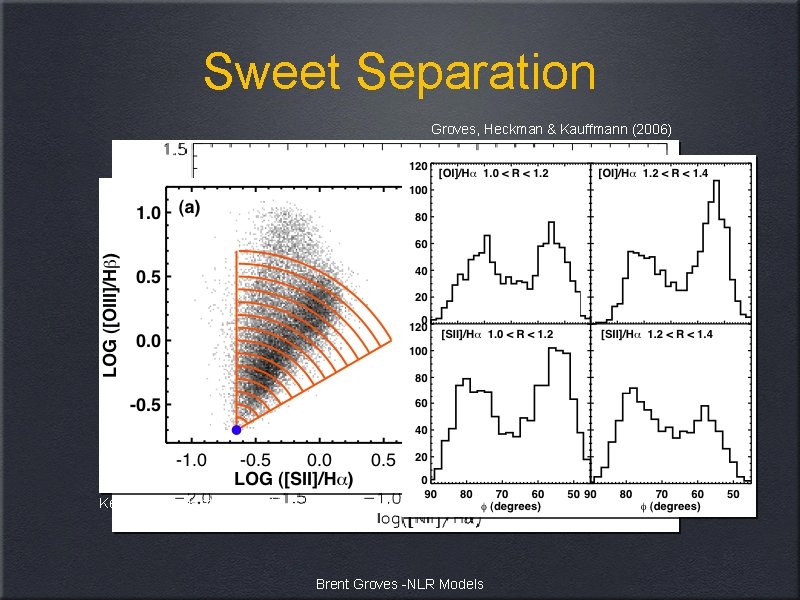
Sweet Separation Groves, Heckman & Kauffmann (2006) Kewley, Groves et al. (2006) Brent Groves -NLR Models
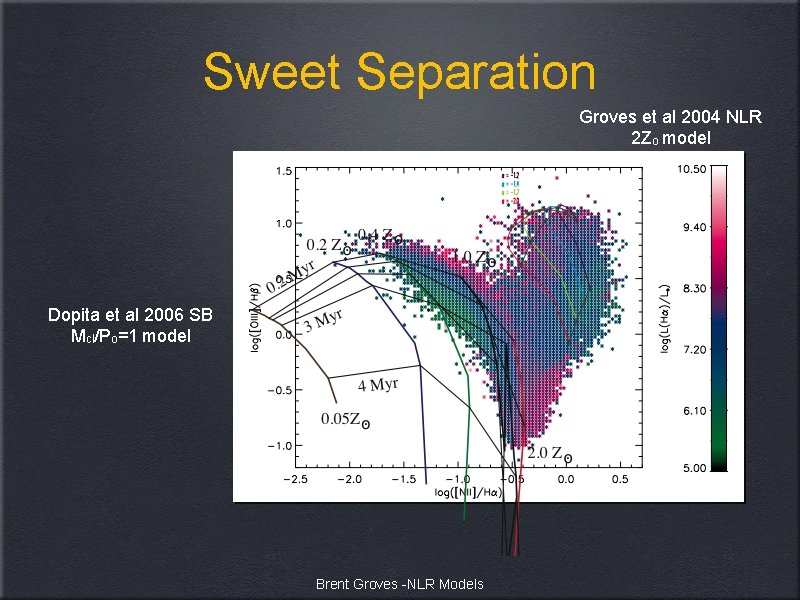
Sweet Separation Groves et al 2004 NLR 2 Zo model Dopita et al 2006 SB Mcl/Po=1 model Brent Groves -NLR Models
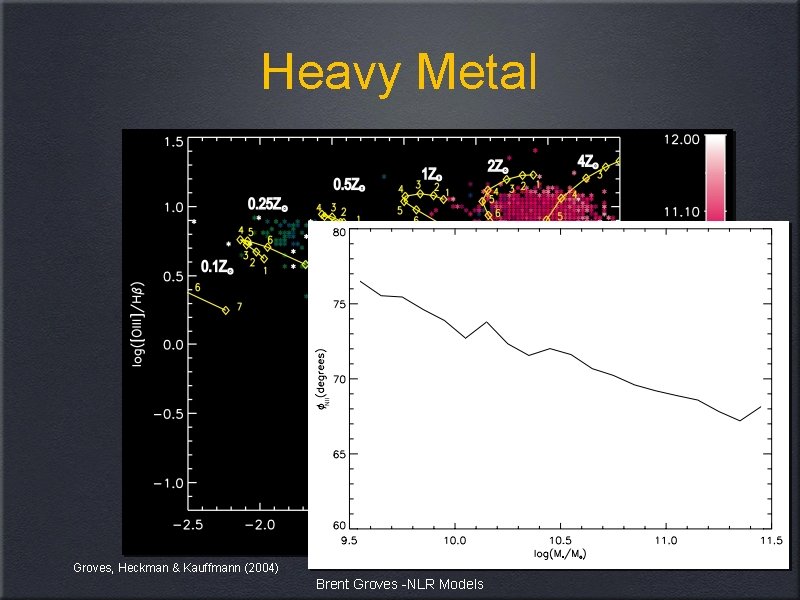
Heavy Metal Groves, Heckman & Kauffmann (2004) Brent Groves -NLR Models
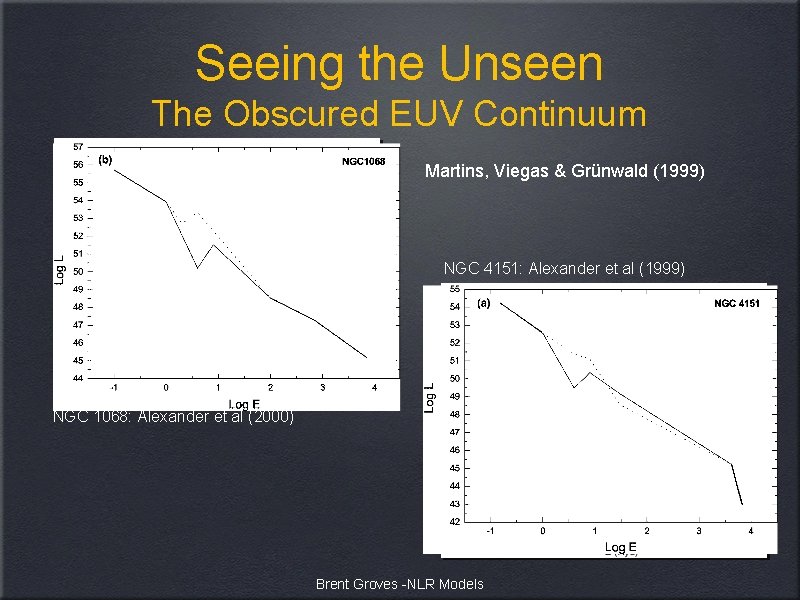
Seeing the Unseen The Obscured EUV Continuum Martins, Viegas & Grünwald (1999) NGC 4151: Alexander et al (1999) NGC 1068: Alexander et al (2000) Brent Groves -NLR Models
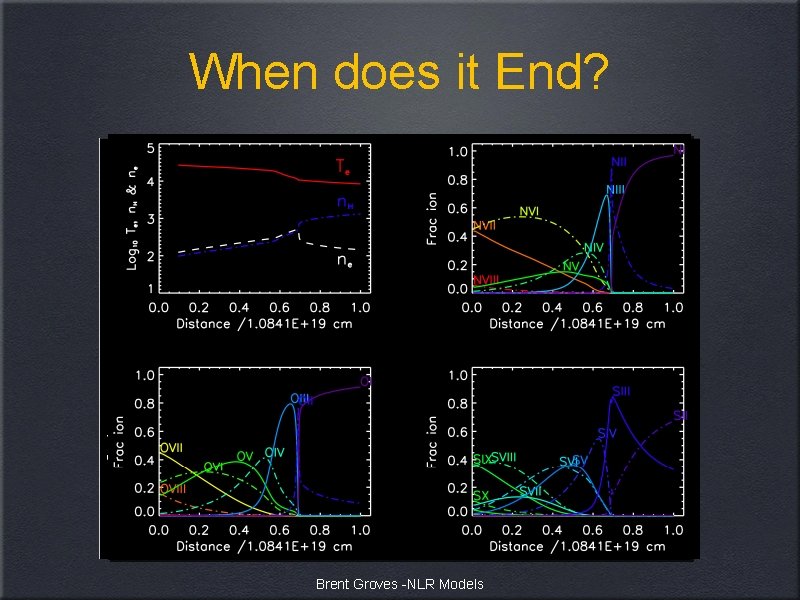
When does it End? Brent Groves -NLR Models
A Model Ending • With the current NLR models we have a good physical Understanding of NLR and its appearance & emission lines • The models can be used to determine properties of the NLR and AGN (but Caution needed!) • Models are still limited. . . • but heading towards a full 3 D, dynamical picture of the NLR. . . • One step at a time! Brent Groves -NLR Models