
THE NARRATIVE INTERVIEW AS A RESEARCH METHOD Murray
- Slides: 20
THE NARRATIVE INTERVIEW AS A RESEARCH METHOD
Murray, M. (2008). Chapter 6: Narrative Psychology. In Smith, J. A. (2008). Qualitative Psychology: A practical guide to research methods. Second Edition. Sage.
Byatt (2000): narrative lies at the heart of being human “it is as much a part of human nature as breathe and the circulation of the blood” Story-telling is our way of “making sense of an ever changing world” Helps to. . . achieve a sense of order is a seemingly disordered world define ourselves; provides continuity and shows how we are distinct from others
Ontology: Sarbin (1986) narrative for humans is like the ocean for fishes: we actively construct the world through narratives and we also live through the stories told by others and by ourselves” A shared means of making sense of the world A narrative is an organised interpretation of a sequence of events We decide who caused various things to happen for example (attributing agency) We infer causal links between events Beginning, middle and end; it has closure; a conclusion Sometimes we finish stories we are confronted with using our existing knowledge of other stories Key term; emplotment; creating a plot; creating connectedness between elements
When we tell stories from our past, we use the term recollection Re- refers to evoking memories of something that happened long ago Collection however seems to evoke the idea that fragmented dispersed elements some of which may have been lost are gathered together, organised and presented as a new story which makes sense. Some elements may lost and new ones confabulated to help the stories make sense. A fascinating process to study! New pieces of evidence may be added to the a story as a person interacts with others; ; ink to focus groups
A unique sequence of events, mental states, and happenings involving human beings as characters of actors Real or imaginary Forging of links between the exceptional and the ordinary Through this we can bring sense to something obscure or unusual Psychologists are often interested in analysing narratives as a away in which people find meaning for disruptions in their lives; financial, emotional, health wise etc.
“We are all tellers of tales. We each seek to provide our scattered and often confusing experiences with a sense of coherence by arranging the episodes of our lives into stories” Components to a narrative. . . Tone; optimism/pessimism Imagery; “ a treasure trove of personalised symbols and fantasised objects” Themes; “ recurrent patterns of intentions” Ideology; values and beliefs underpinning the story
The stories we tell are shaped by the sociocultural niche in which we find ourselves; regulated by the stories we have learnt throughout our lives Link with social representations theory Stories are also influenced by the audience and may be altered to suit Analysis of the stories allows understanding of the narrator and of their relationship with their own social world
Groups, communities and societies also have their own stories passed on from generation to help understand the past; histories and aspirations Personal narratives help with creating an integrated self concept at an individual level whilst collective stories help groups to identify themselves to themselves (the quest for positive distinctiveness) and understand their place within time and social space.
“We may narrate our own (life) stories even if we are not the authors of our lives” Discuss!
Are used to gather the narratives Unlike semi-structured interview, Pp is allowed the chance to tell their story in their own words and in detail without being interrupted Life story interviews (aim to learn about the person's life), e. g. Gerontologists have researched the ageing process using this method Pps may be wary and uncommunicative at the start! Rapport is everything!
Narratives interviews may not tell a whole life story rather specific bits relating to experiences of disruptions for example – the episodic interview (Flick, 2002)
Show interest to the interviewee whilst maintaining a neutral stance; you do not wish to lead or bas what is presented, thus shaping the course of the narrative You have to acknowledge when using this approach that you become part of the process; as an audience to the construction of the story (recollection), your presence will alter the story that is told; try to be as neutral and objective as possible Think! Reflexivity You may encourage your Pp to keep a journal or use photos, video etc as prompts to assist in the story telling
“The interviewer’s presence and form of involvement, how he or she listens, attends, encouragers, , interrupts, digresses, initiates topics, and terminates responses is integral to a respondent’s account. It is in this specific sense that a story is a joint production” Mishler (1986)
Initial contact; interview schedule shared, informed consent gained; sort out time and setting (home, office etc) Make sure all recording equipment functioning as expected (respect to Pps as much as anything!) Make sure you have researched appropriate support services should a Pp become upset during the interview Be prepared to stop the interview if necessary
Researchers should keep detailed logs of interviews: Demographic details of pp When and where interview happened After tape player turned off, Pps often make comments which can influence the interpretation; these need careful logging in the notes (create a commentary as soon as possible after the interview) Transcription methods vary; can also be done professionally but need to check for errors etc against the tapes; should include emphases, pauses, exclamations etc (post modern style)
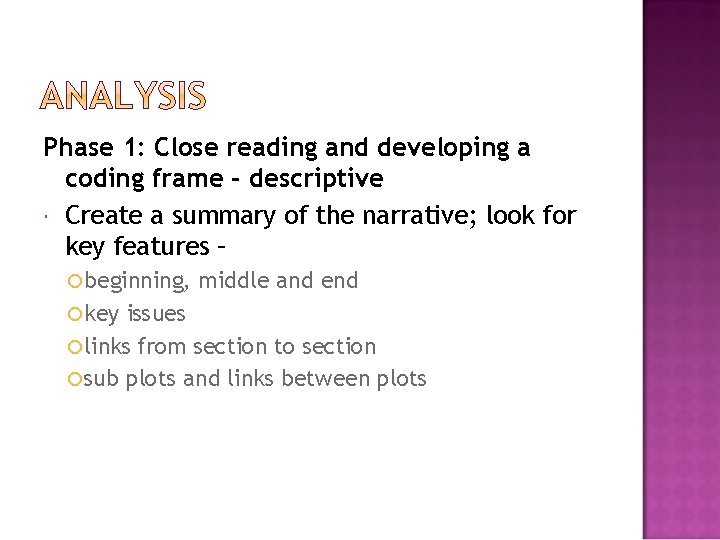
Phase 1: Close reading and developing a coding frame - descriptive Create a summary of the narrative; look for key features – beginning, key middle and end issues links from section to section sub plots and links between plots
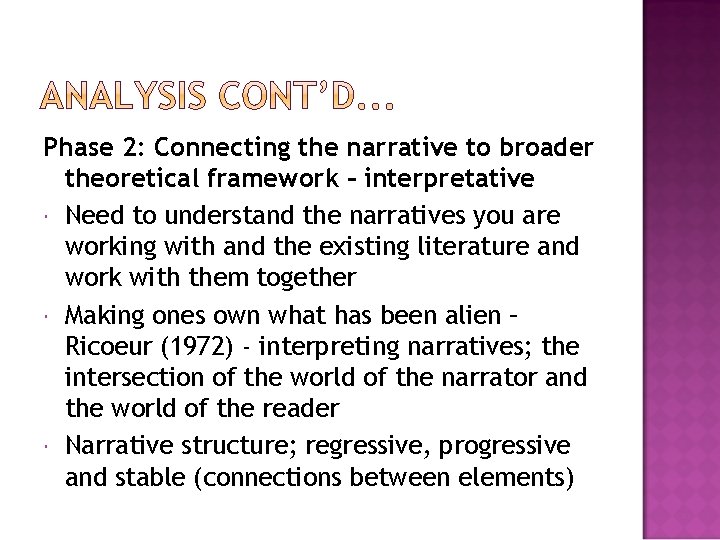
Phase 2: Connecting the narrative to broader theoretical framework – interpretative Need to understand the narratives you are working with and the existing literature and work with them together Making ones own what has been alien – Ricoeur (1972) - interpreting narratives; the intersection of the world of the narrator and the world of the reader Narrative structure; regressive, progressive and stable (connections between elements)
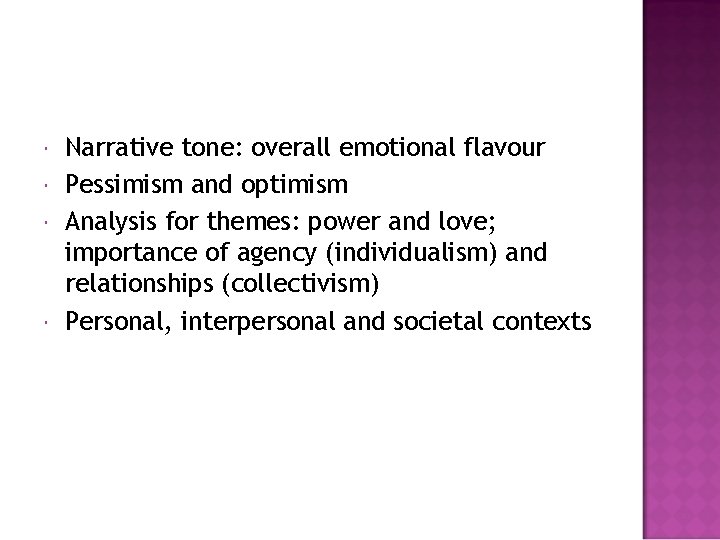
Narrative tone: overall emotional flavour Pessimism and optimism Analysis for themes: power and love; importance of agency (individualism) and relationships (collectivism) Personal, interpersonal and societal contexts
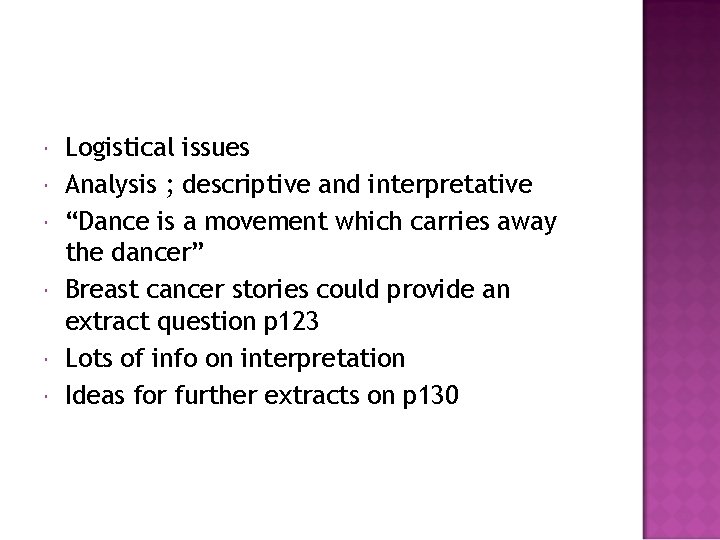
Logistical issues Analysis ; descriptive and interpretative “Dance is a movement which carries away the dancer” Breast cancer stories could provide an extract question p 123 Lots of info on interpretation Ideas for further extracts on p 130