
The Napoleonic Era 1799 1815 http www history
- Slides: 24
The Napoleonic Era 1799 -1815 http: //www. history. com/topics/napoleon/videos/napoleon Napoleon Cartoon – The History Channel
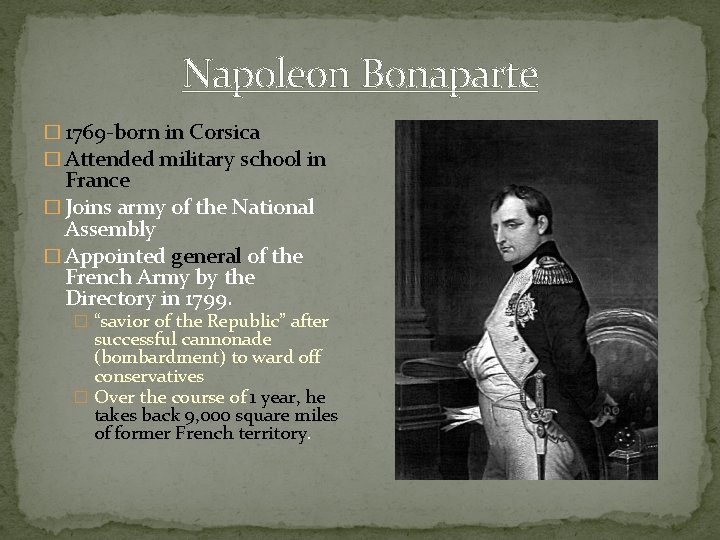
Napoleon Bonaparte � 1769 -born in Corsica � Attended military school in France � Joins army of the National Assembly � Appointed general of the French Army by the Directory in 1799. � “savior of the Republic” after successful cannonade (bombardment) to ward off conservatives � Over the course of 1 year, he takes back 9, 000 square miles of former French territory.
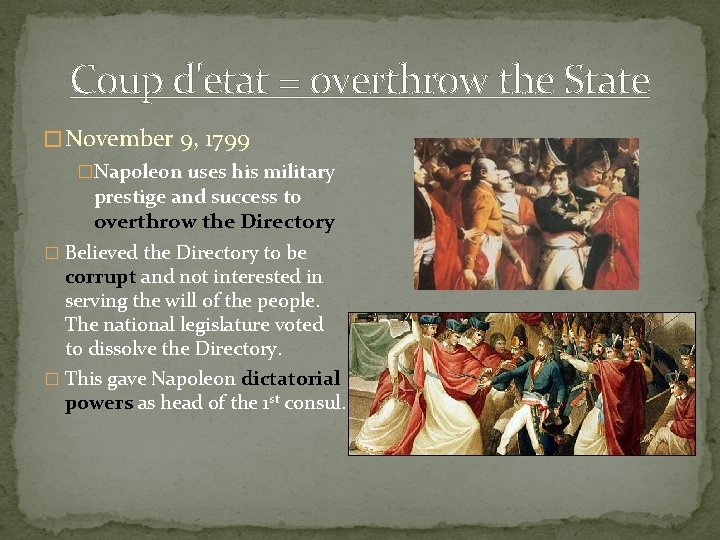
Coup d'etat = overthrow the State � November 9, 1799 �Napoleon uses his military prestige and success to overthrow the Directory � Believed the Directory to be corrupt and not interested in serving the will of the people. The national legislature voted to dissolve the Directory. � This gave Napoleon dictatorial powers as head of the 1 st consul.
French Consulate �November 10, 1799 - French Consulate in place � 3 leaders called Consuls � 1 st Consul- Napoleon Bonaparte � 2 nd and 3 rd Consul – Jean Jacques Regis de Cambaceres and Charles-Francois Lebrun 1804 - In a sudden turn of events……. Napoleon drafts a new constitution (4 th in 8 years) naming him as 1 st consul of France for life…unbeknownst to the other consuls. This is the true beginning of the Napoleonic Era!
Napoleon becomes Emperor �Plebiscite= by the people a vote of YES or NO on specific question (similar to a referendum in California today) � 1800 - plebiscite votes YES- 1 st Consul of France � 1802 -plebiscite votes YES- 1 st Consul of France for life � 1804 -plebiscite votes YES- EMPEROR OF FRANCE
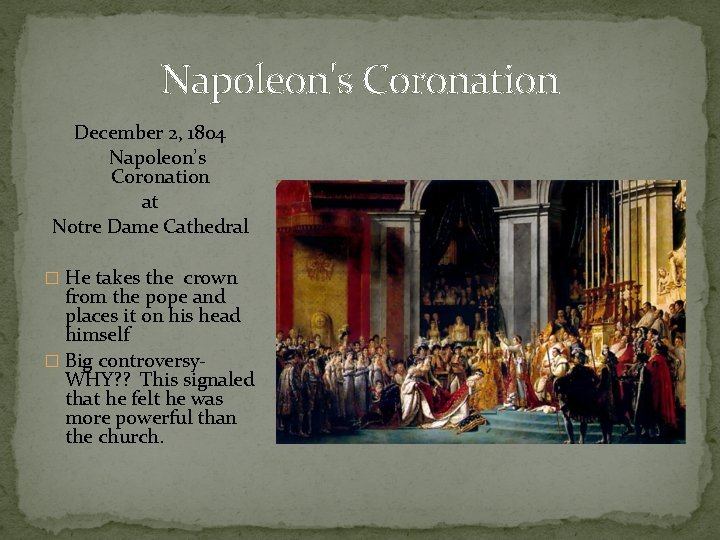
Napoleon's Coronation December 2, 1804 Napoleon’s Coronation at Notre Dame Cathedral � He takes the crown from the pope and places it on his head himself � Big controversy. WHY? ? This signaled that he felt he was more powerful than the church.
Napoleon's Reforms � He was Enlightened but did limit some rights as well. � Reforms focused on four areas: � Economic reform � Social reform � Religious reform � Legal reform Other improvements: ü Brought order to France after the instability of the Revolution ü Turned Paris into a beautiful city (parks, fountains, boulevards, etc…)
Economic Reform � Slowed inflation and equaled taxation = stable economy �Balanced budget �Set up a National Bank �Controlled circulation of money �Paid off debt � Sold Louisiana Territory to President Jefferson (3 rd pres) � For $15 Mill (3 cents/acre), we made the Louisiana Purchase � Napoleon saw this as a way to finance his plans in Europe and give the British more headaches
Social Reform �Welcomed émigrés (nobles) back into govt positions on good behavior �Promoted officials by merit nobility �Set up Lycees (public schools, which consisted of ordinary and wealthy children) �He would introduced the metric system to France
Religious Reform �Establish CONCORDAT (agreement) with the pope � New relationship b/w church and state � Allowed freedom of religion � However, he promoted Catholicism as “great majority” and “true” religion of France � Eliminated any political control of Pope � He emancipated Jews from laws that restricted them to ghettos.
Legal Reform �Established the Napoleonic Code of Laws (1 st post king modern day laws) � Set of 101 new laws establishing strong sense of law and order , but simultaneously many of the laws placed big limitations on individual freedoms. �Equality under the law �Freedom of speech and press were limited �Censured newspapers �Reduced women’s rights (right to sell property) �Restored slavery in French Colonies of the Caribbean
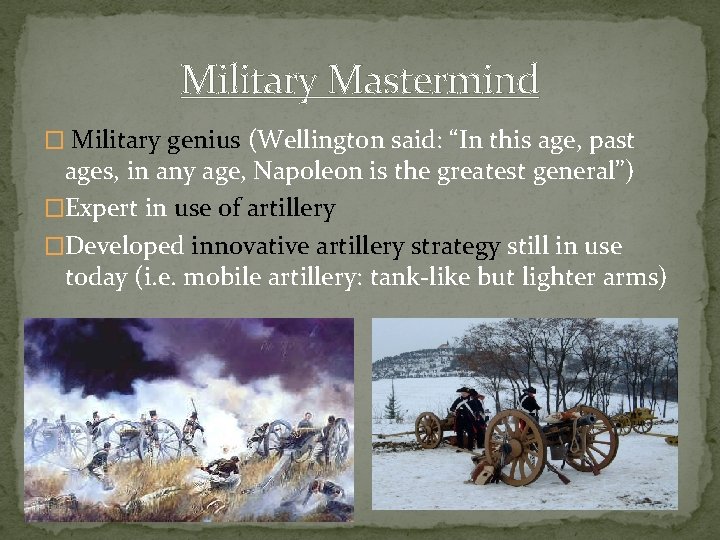
Military Mastermind � Military genius (Wellington said: “In this age, past ages, in any age, Napoleon is the greatest general”) �Expert in use of artillery �Developed innovative artillery strategy still in use today (i. e. mobile artillery: tank-like but lighter arms)
Napoleon: The Conquerer �Napoleon quickly forced his power across Europe �Battle of Austerlitz -December 1805 (see p. 207 - Voices from the Past) � Invades Austria � Forces emperor to make peace and forms alliance �Battle of Jena -October 1806 � Invades Prussia � Forces King to make peace and forms alliance
Napoleon: The Conqueror �Battle of Friedland: June 1807 � Fought in Poland � Against Russians � Forces Czar Alex I to the bargaining table �PEACE OF TILSIT Napoleon can have western ½ of Poland all of Europe Alex I can have eastern ½ of Poland all Ottoman Empire Peaceful coexistence Non-aggression Pact
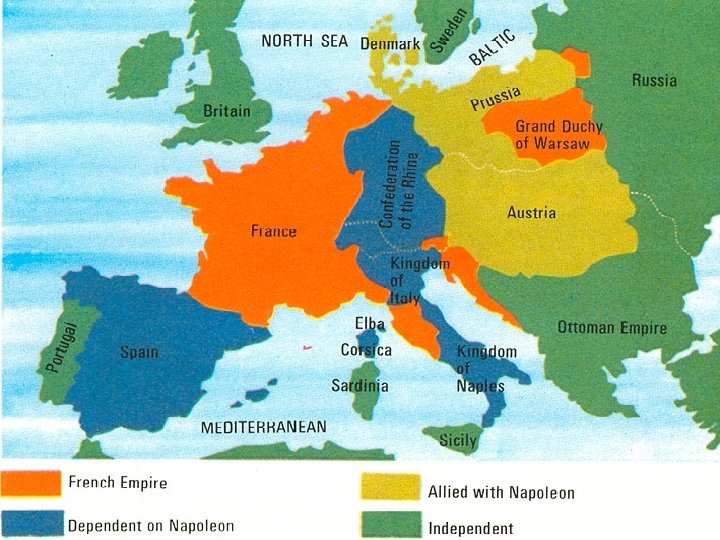
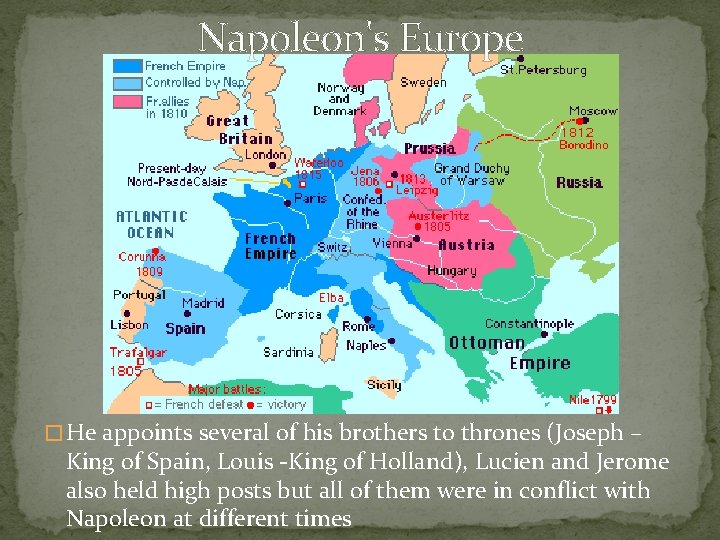
Napoleon's Europe � He appoints several of his brothers to thrones (Joseph – King of Spain, Louis -King of Holland), Lucien and Jerome also held high posts but all of them were in conflict with Napoleon at different times
Napoleon's ego gets in his way… �he becomes blinded by success and makes three fatal mistakes… � 1. Continental System (attempted blockade of GB) � 2. The Peninsular War (a result of non-compliance with the Continental System) � 3. Invasion of Russia (a result of non-compliance with the Continental System)
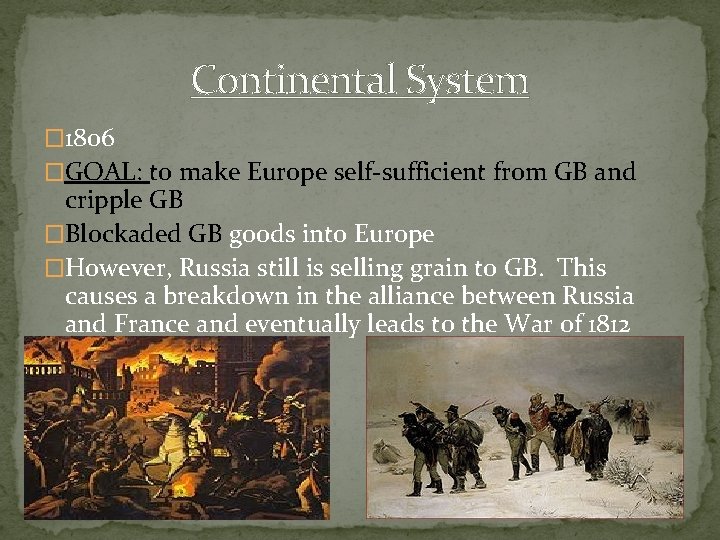
Continental System � 1806 �GOAL: to make Europe self-sufficient from GB and cripple GB �Blockaded GB goods into Europe �However, Russia still is selling grain to GB. This causes a breakdown in the alliance between Russia and France and eventually leads to the War of 1812
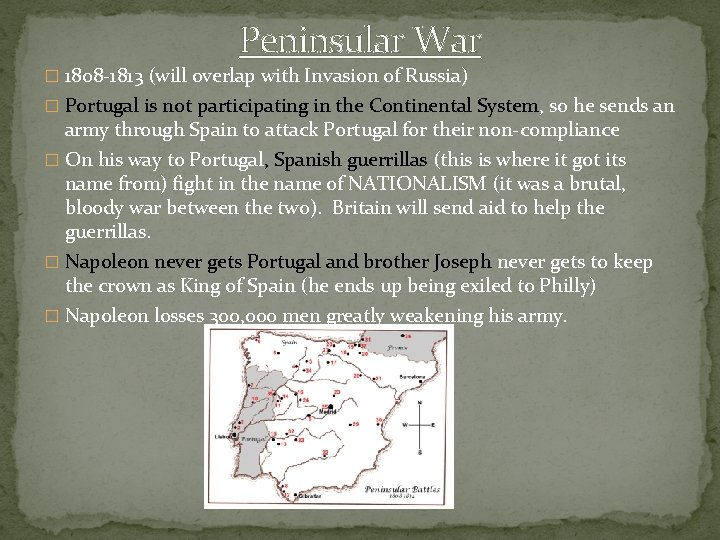
Peninsular War � 1808 -1813 (will overlap with Invasion of Russia) � Portugal is not participating in the Continental System, so he sends an army through Spain to attack Portugal for their non-compliance � On his way to Portugal, Spanish guerrillas (this is where it got its name from) fight in the name of NATIONALISM (it was a brutal, bloody war between the two). Britain will send aid to help the guerrillas. � Napoleon never gets Portugal and brother Joseph never gets to keep the crown as King of Spain (he ends up being exiled to Philly) � Napoleon losses 300, 000 men greatly weakening his army.
Invasion of Russia � June, 1812 � GOAL: quickly (Napoleon predicted a 20 day campaign) take Russia as punishment for breaking Continental System (selling grain to GB) � Invades with Grand Army of 600, 000 men (many of these men were not from France and didn’t have high loyalty toward Napoleon to begin with) � Scorched-earth policy sucks him in (no food, water , shelter) � Wins at Moscow, but Czar won’t surrender. Winter sets in and he never gets Russia � December, 1812 -Returns with 10, 000 men � Beginning of the end for Napoleon
Kick him when he's down? ? ? � Europe has Napoleon at his weakest and decide to attack � Grand Alliance of Europe takes him on and wins � Exiled to Elba, but returns; Last 100 days � Finally defeated at the Battle of Waterloo (Belgium) by General Wellington of GB � Exiled again…but much further away—St. Helena (South Atlantic) under guard of GB. There are other inhabitants of the island, but none of them are family. � Dies on the island in 1821 (age 51). Cause of death never determined…. some speculate stomach cancer, arsenic poisoning, neglect…. . �Why don’t they (France or GB) just kill him?
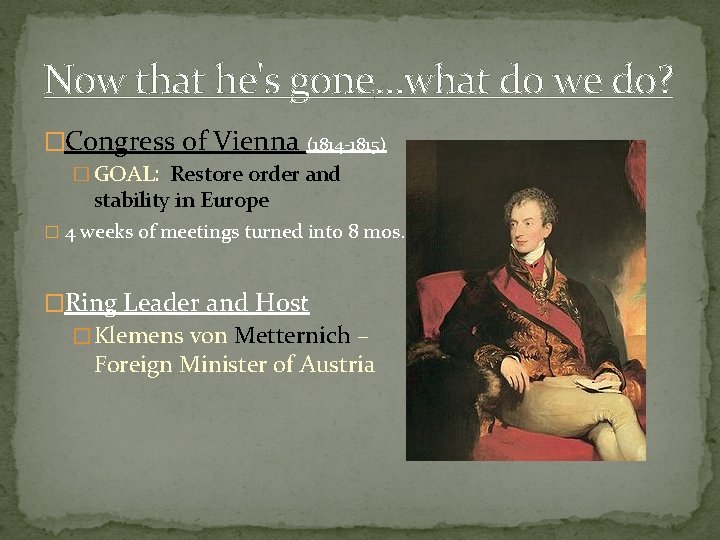
Now that he's gone…what do we do? �Congress of Vienna (1814 -1815) � GOAL: Restore order and stability in Europe � 4 weeks of meetings turned into 8 mos. �Ring Leader and Host � Klemens von Metternich – Foreign Minister of Austria
Metternich's Agenda Action Plan: Encirclement of France � Strengthen countries around France � Prevent French aggression 2. Balance of Power � Restore balance so no country would be a threat to others in Europe 3. Legitimacy � Restore the monarchies deposed by Napoleon � Uphold conservative political ideals 1.
Great Powers of Europe 1. 2. 3. 4. 5. Great Britain Austrian Empire Prussia Russia France Was it right to keep France a great power? Yes. A strong France is a strong Europe