
THE NADD COMPETENCYBASED DUAL DIAGNOSIS SPECIALTY CERTIFICATION PROGRAM
THE NADD COMPETENCY-BASED DUAL DIAGNOSIS SPECIALTY CERTIFICATION PROGRAM EMERGING BEST PRACTICES Robin Van. Eerden, MS, LPC, NCC, NADD-CC Astrid Berry, BA, QIDP, NADD-DDS March, 2015 1
Standard 2: Emerging Best Practices Benchmarks: 2 a - The NADD DD Certified Specialist demonstrates understanding of assessments, their purpose, when they may be needed and how to obtain them. 2 b - The NADD DD Certified Specialist understands the connection between assessment and service delivery. 2
Standard 2: Emerging Best Practices COMPETENCY 2 a Specialist demonstrates an understanding of assessments, their purpose, when they may be needed and how to obtain them 3
Assessment � � Evaluative process to determine plan of treatment Multi-faceted in approach � Medical/health � Social/emotional � Etiology � Psychiatric � Behavioral 4
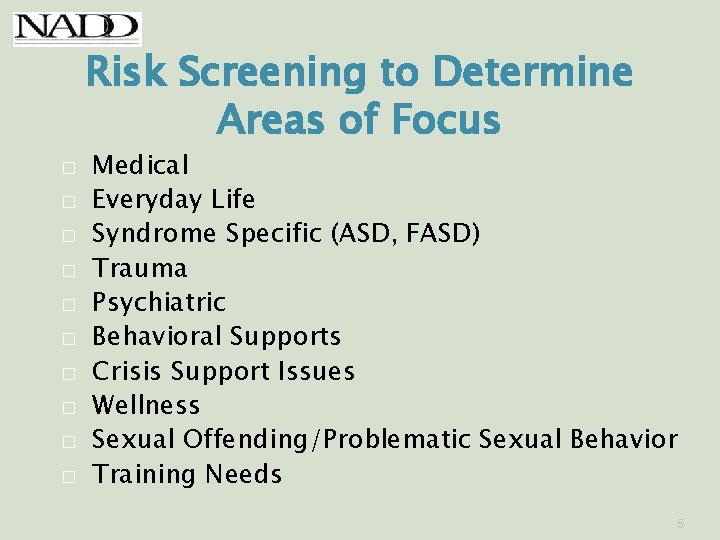
Risk Screening to Determine Areas of Focus � � � � � Medical Everyday Life Syndrome Specific (ASD, FASD) Trauma Psychiatric Behavioral Supports Crisis Support Issues Wellness Sexual Offending/Problematic Sexual Behavior Training Needs 5
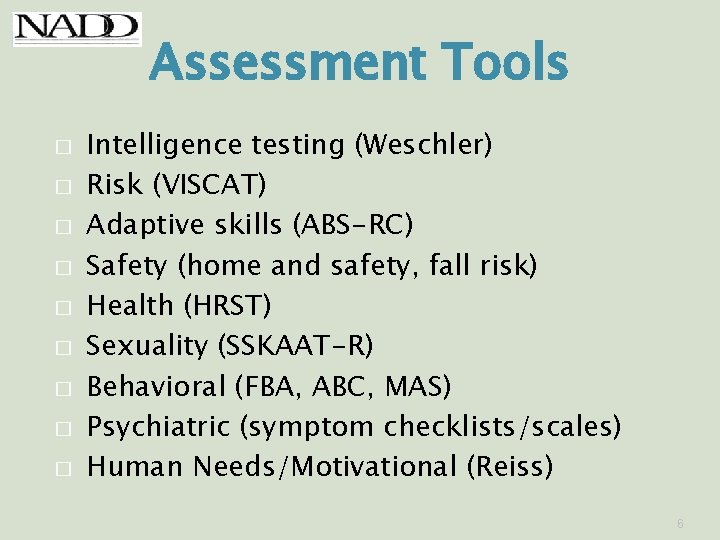
Assessment Tools � � � � � Intelligence testing (Weschler) Risk (VISCAT) Adaptive skills (ABS-RC) Safety (home and safety, fall risk) Health (HRST) Sexuality (SSKAAT-R) Behavioral (FBA, ABC, MAS) Psychiatric (symptom checklists/scales) Human Needs/Motivational (Reiss) 6
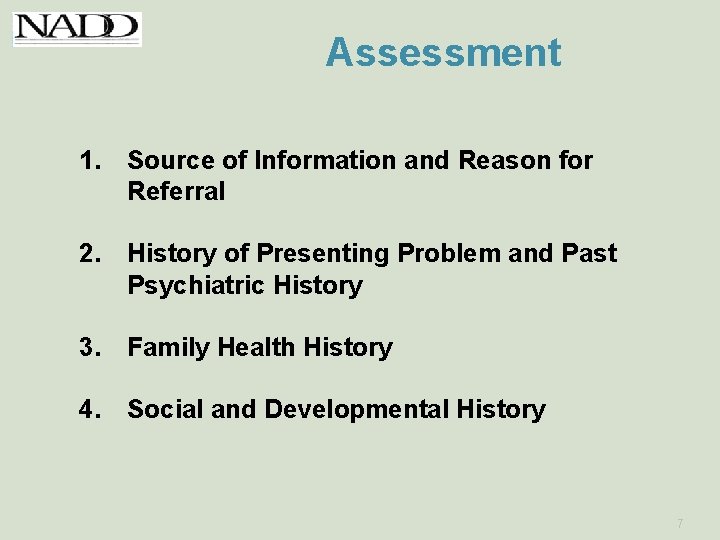
Assessment 1. Source of Information and Reason for Referral 2. History of Presenting Problem and Past Psychiatric History 3. Family Health History 4. Social and Developmental History 7
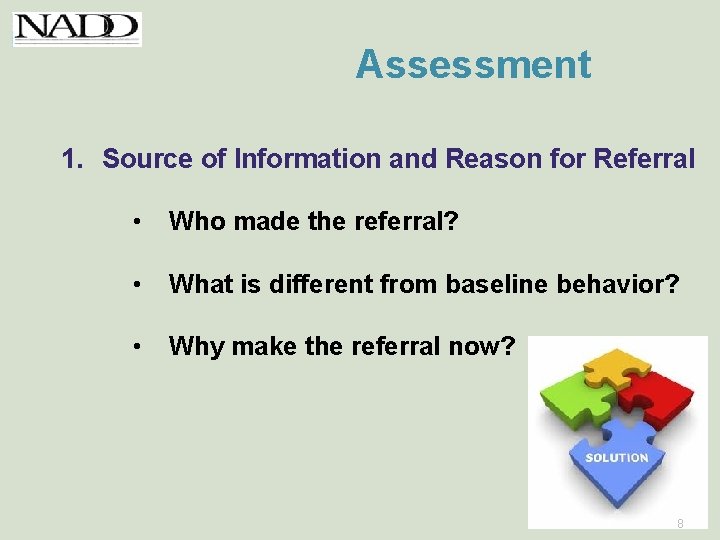
Assessment 1. Source of Information and Reason for Referral • Who made the referral? • What is different from baseline behavior? • Why make the referral now? 8
Assessment 2. History of Presenting Problem and Past Psychiatric History • How long has the problem occurred? • History of mental health treatment 9
Assessment 3. Personal and Family Health History • Medical, psychiatric, and substance abuse history • Psychotropic medications • Side effects/reactions • Efficacy – therapeutic trial • Medical conditions • Genetic disorders • Hypo/hyper thyroid condition • Constipation • Epilepsy • Diabetes • Gastrointestinal problem 10
Assessment 4. Social/Developmental History • Developmental milestones • Relevant school history • Work/vocational history • Current work/vocational status • Legal issues • Relevant family relationships • Drug/alcohol history • Abuse history (emotional/physical/sexual) 11
Assessment Behavioral Status A. Recent Changes (what changed, when and what were circumstances) B. Challenge (defined objectively) C. Quality of Life Issues 12
Etiology Determining Root Cause 13
Genetics & IDD 283 Causes of ID identified in 1994 Prenatal causes dominated diagnosis 1200 + Genetic causes of ID in 2014 14
Phenotype and Genotypes Definition of Genotype A complete inheritable genetic identity – the set of genes an individual carries Definition of Phenotype: The phenotype of a genetic syndrome is the set of physical characteristics produced by a genetic abnormality or genotype. (DM-ID, 2009) Definition of Behavioral Phenotype: The specific and characteristic repertoire exhibited by people with a genetic disorder (Flint & Yale, 1994) Fletcher, 2013 15
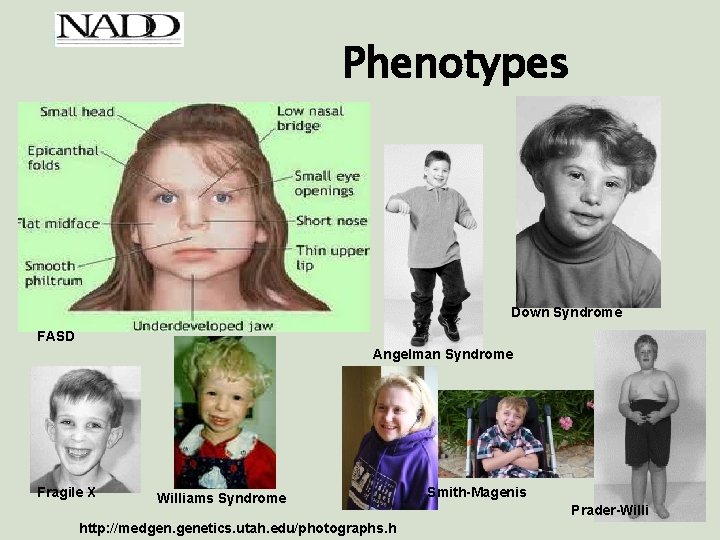
Phenotypes Down Syndrome FASD Angelman Syndrome Fragile X Williams Syndrome http: //medgen. genetics. utah. edu/photographs. h Smith-Magenis Prader-Willi
Sensory Integration and Dysfunction Sensory Integration - is defined as the neurological process that organizes sensation from one’s own body and the environment, thus making it possible to use the body effectively within the environment. Specifically, it deals with how the brain processes multiple sensory modality outputs into usable functional outputs. Sensory Integration Dysfunction - the term is used informally in the medical literature to describe any such difficulty. 17
Data Collection • Physical Health • 24 Hours Sleep Data (month cycle) • Medication Changes • Eating Patterns • Environmental Changes • Mood Charting • Symptoms and Behavioral Manifestations 18
Psychosocial approaches � � � � � Anger management therapies Social skills training Coping skills training Self-management skills training Trauma informed therapies Cognitive restructuring therapies Other cognitive behavioral therapies Contingency management/token programs Behavior support/positive behavior support approaches 19
Person Centered Planning NON-NEGOTIABLES items that a person cannot live without to maintain their health and safety within a community setting. STRONG PREFERENCES Such things as music, sports, parties, crafts, movies, and church activities may be listed here. HIGHLY DESIRABLES These are the hopes and dreams of the individual. Anything from a vacation in Hawaii to a new winter coat may be listed here depending on the individual’s immediate needs and dreams for the future. WHAT DO YOU NEED TO KNOW? Issues as eating habits, personal care, and safety issues may be covered here. There may be certain things that upset an individual such as loud noises. These are listed here also. SUPPORTS/BARRIERS An example for an individual who is fearful of or cannot negotiate stairs, a one-floor home is recommended. This area may also include financial supports, behavioral supports, therapeutic supports, and medical supports if needed. 20
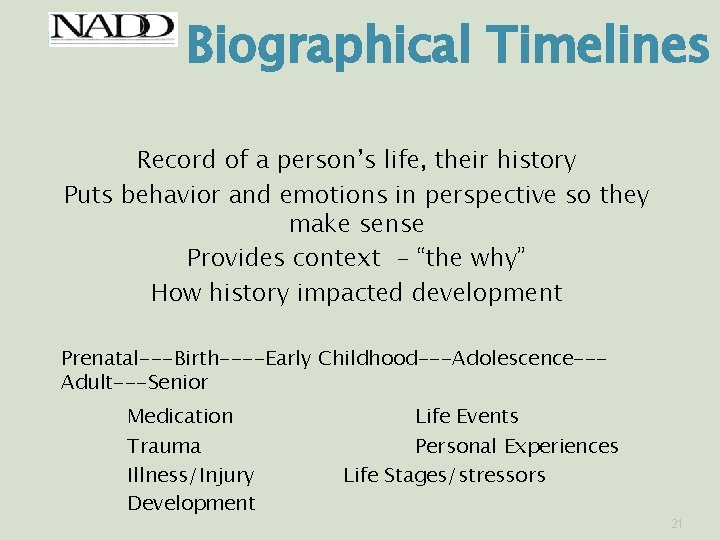
Biographical Timelines Record of a person’s life, their history Puts behavior and emotions in perspective so they make sense Provides context - “the why” How history impacted development Prenatal---Birth----Early Childhood---Adolescence--Adult---Senior Medication Trauma Illness/Injury Development Life Events Personal Experiences Life Stages/stressors 21
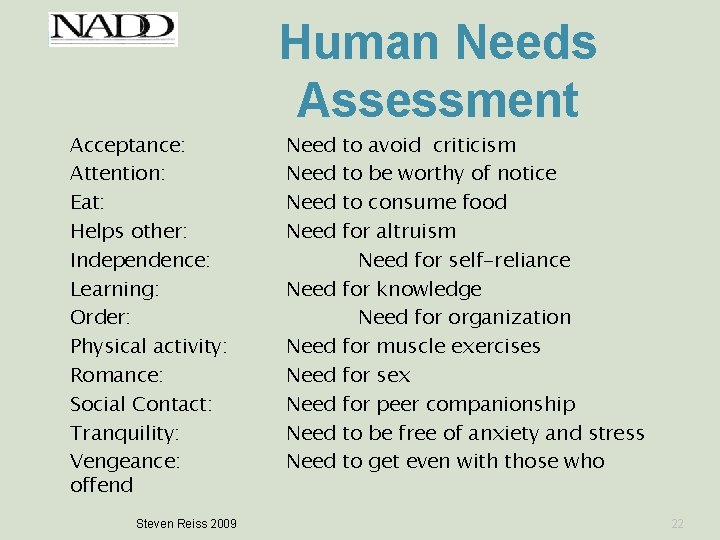
Human Needs Assessment Acceptance: Attention: Eat: Helps other: Independence: Learning: Order: Physical activity: Romance: Social Contact: Tranquility: Vengeance: offend Steven Reiss 2009 Need Need Need to avoid criticism to be worthy of notice to consume food for altruism Need for self-reliance for knowledge Need for organization for muscle exercises for sex for peer companionship to be free of anxiety and stress to get even with those who 22
Standard 2: Emerging Best Practices COMPETENCY 2 b Specialist understands connection between assessment and service delivery 23
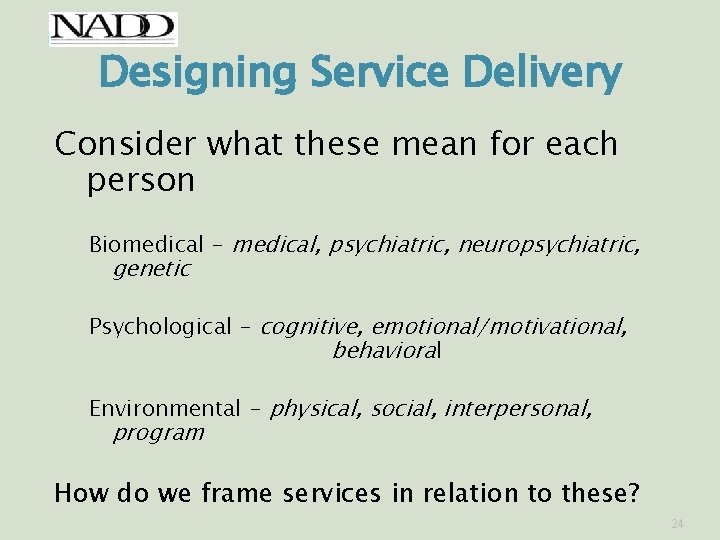
Designing Service Delivery Consider what these mean for each person Biomedical - medical, psychiatric, neuropsychiatric, genetic Psychological - cognitive, emotional/motivational, behavioral Environmental - physical, social, interpersonal, program How do we frame services in relation to these? 24
Designing Service Delivery � Coordination of care � Physical services � Stakeholder engagement � Person � directed Support networks � Natural � and behavioral health care, long term resources Financial alignment � Integration � Resource allocation � Person � of funding streams centered life plans Life long planning � Every life stage 25
Recovery Tools Wellness Recovery Action Plan (WRAP) Certified Peer Specialists Personal Medicine Tools 26
“WRAPs© ” WRAPs© are developed by the person Includes: • • • person’s symptoms of mental health challenges in their own words triggers that might cause recurrence of symptoms coping strategies that work and those that do not strategies to employ in a crisis what to do if all else fails MH Advance Directives o o who to contact in a MH emergency preferred hospital current medications do’s and don’ts during a psychiatric crisis WRAPs© for people with learning distinctions Copeland Center for Wellness and Recovery http: //copelandcenter. com 27
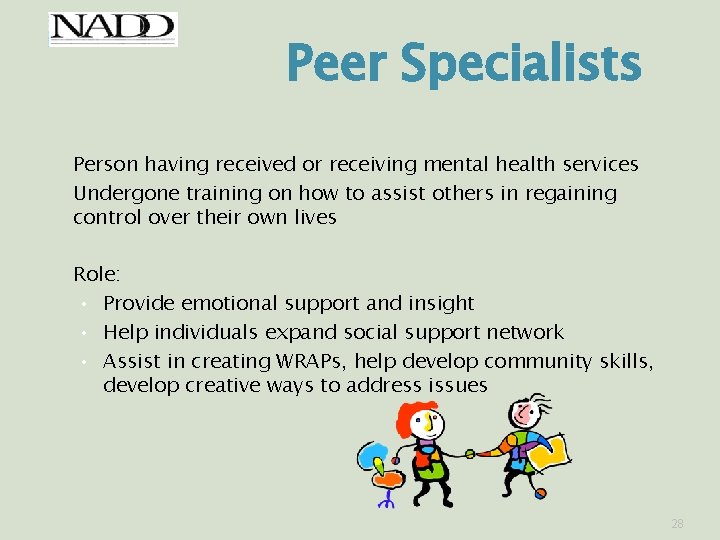
Peer Specialists Person having received or receiving mental health services Undergone training on how to assist others in regaining control over their own lives Role: • Provide emotional support and insight • Help individuals expand social support network • Assist in creating WRAPs, help develop community skills, develop creative ways to address issues 28
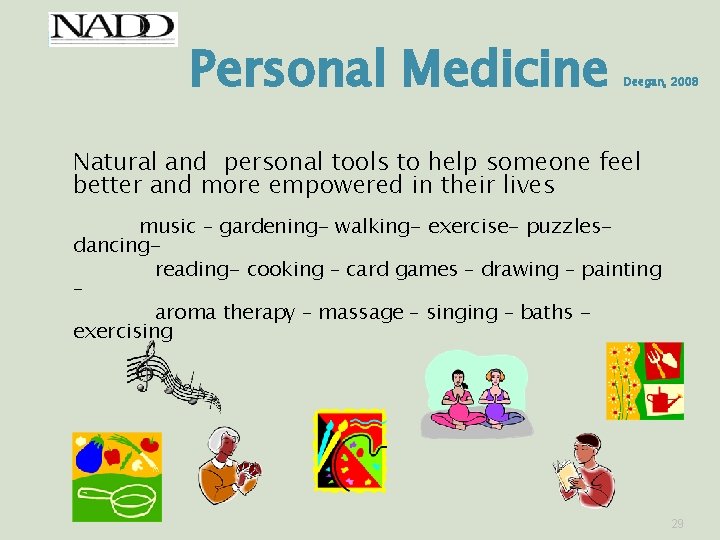
Personal Medicine Deegan, 2008 Natural and personal tools to help someone feel better and more empowered in their lives music – gardening- walking- exercise- puzzlesdancingreading- cooking – card games – drawing – painting – aroma therapy – massage – singing – baths exercising 29
Use of Model in Planning for Mr. De. Diminico Consider. . . How would this model guide service planning? Assessment Process – what tools are available and useful in this case? � � � Medical/health Social/emotional Etiology Psychiatric Behavioral Is service delivery? � � � Person centered Based on human needs Takes into consideration the life span Utilizes recovery tools like peer specialists, WRAPs, Personal Medicine Based in Positive Behavioral Support What are the � � � Staffing/Network issues to be considered Teaching/instructional milieus Resources needed 30
Thank You For more information, please contact Dr. Robert J. Fletcher NADD 132 Fair Street, Kingston, NY 12401 Telephone 845 331 -4336 E-mail rfletcher@thenadd. org www. thenadd. org 31
- Slides: 31