
The NA 62 rare kaon decay experiment Photon
![Lead+Sc. Fibers Test Beam Energy Resolution Time Resolution Beam Energy[Me. V] Tagged Events Event](https://slidetodoc.com/presentation_image/c760f5eda854ba6c2692c4ecaae44e53/image-9.jpg "Lead+Sc. Fibers Test Beam Energy Resolution Time Resolution Beam Energy[Me. V] Tagged Events Event")
![Lead+Sc. Tiles Test Beam Results (Preliminary) Beam Energy[Me. V] Tagged Events Event with E<50](https://slidetodoc.com/presentation_image/c760f5eda854ba6c2692c4ecaae44e53/image-10.jpg "Lead+Sc. Tiles Test Beam Results (Preliminary) Beam Energy[Me. V] Tagged Events Event with E<50")
![Lead Glass Results (Preliminary) First test Beam Energy[Me. V] Tagged Events Event with E<50](https://slidetodoc.com/presentation_image/c760f5eda854ba6c2692c4ecaae44e53/image-12.jpg "Lead Glass Results (Preliminary) First test Beam Energy[Me. V] Tagged Events Event with E<50")

- Slides: 24
The NA 62 rare kaon decay experiment Photon Veto System Vito Palladino for NA 62 Coll.
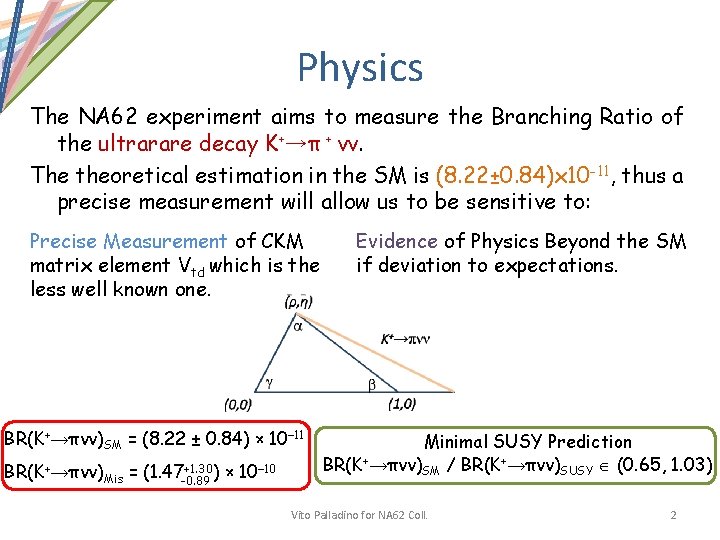
Physics The NA 62 experiment aims to measure the Branching Ratio of the ultrarare decay K+→π + νν. The theoretical estimation in the SM is (8. 22± 0. 84)x 10 -11, thus a precise measurement will allow us to be sensitive to: Precise Measurement of CKM matrix element Vtd which is the less well known one. BR(K+→πνν)SM = (8. 22 ± 0. 84) × 10− 11 +1. 30) × 10− 10 BR(K+→πνν)Mis = (1. 47 -0. 89 Evidence of Physics Beyond the SM if deviation to expectations. Minimal SUSY Prediction BR(K+→πνν)SM / BR(K+→πνν)SUSY (0. 65, 1. 03) Vito Palladino for NA 62 Coll. 2
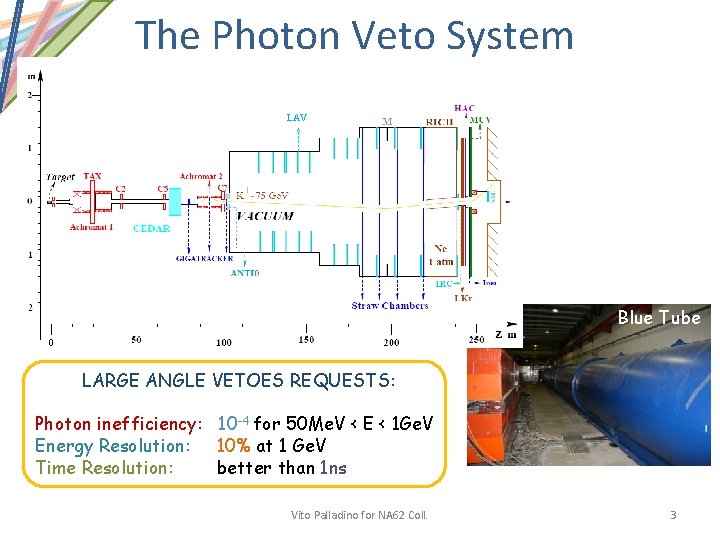
The Photon Veto System LAV Blue Tube LARGE ANGLE VETOES REQUESTS: Photon inefficiency: 10 -4 for 50 Me. V < E < 1 Ge. V Energy Resolution: 10% at 1 Ge. V Time Resolution: better than 1 ns Vito Palladino for NA 62 Coll. 3
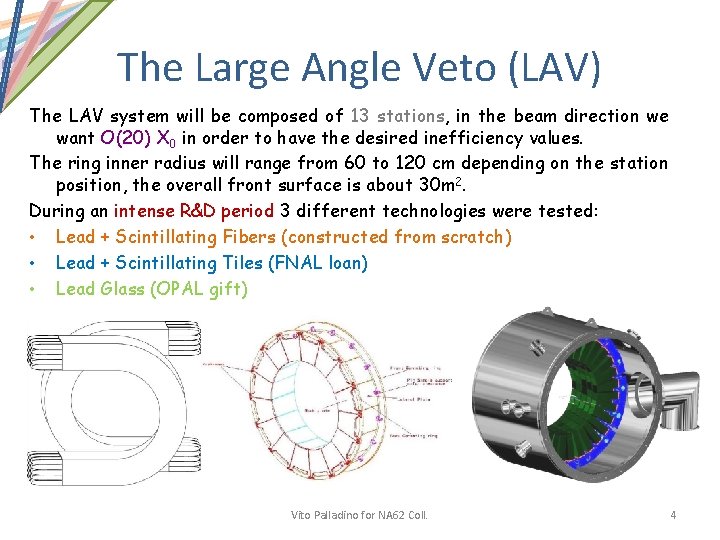
The Large Angle Veto (LAV) The LAV system will be composed of 13 stations, in the beam direction we want O(20) X 0 in order to have the desired inefficiency values. The ring inner radius will range from 60 to 120 cm depending on the station position, the overall front surface is about 30 m 2. During an intense R&D period 3 different technologies were tested: • Lead + Scintillating Fibers (constructed from scratch) • Lead + Scintillating Tiles (FNAL loan) • Lead Glass (OPAL gift) Vito Palladino for NA 62 Coll. 4
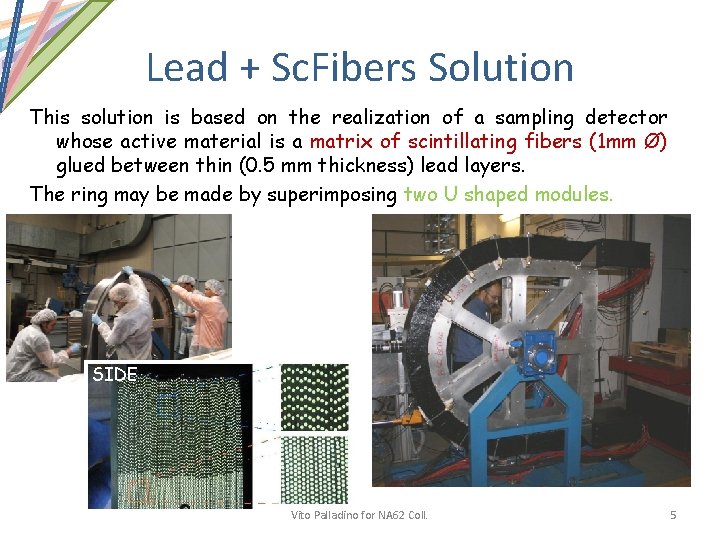
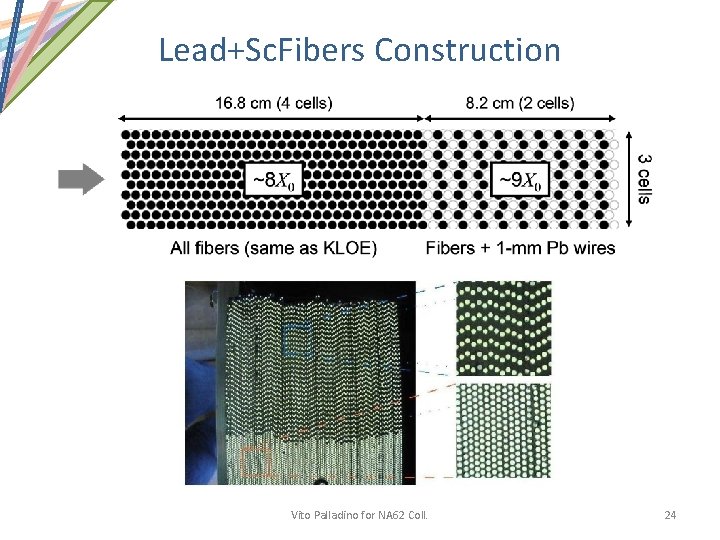
Lead + Sc. Fibers Solution This solution is based on the realization of a sampling detector whose active material is a matrix of scintillating fibers (1 mm Ø) glued between thin (0. 5 mm thickness) lead layers. The ring may be made by superimposing two U shaped modules. SIDE Vito Palladino for NA 62 Coll. 5
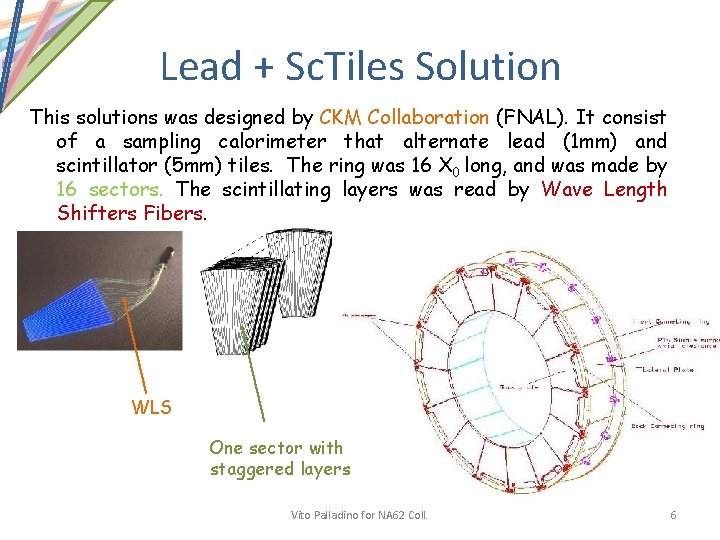
Lead + Sc. Tiles Solution This solutions was designed by CKM Collaboration (FNAL). It consist of a sampling calorimeter that alternate lead (1 mm) and scintillator (5 mm) tiles. The ring was 16 X 0 long, and was made by 16 sectors. The scintillating layers was read by Wave Length Shifters Fibers. WLS One sector with staggered layers Vito Palladino for NA 62 Coll. 6
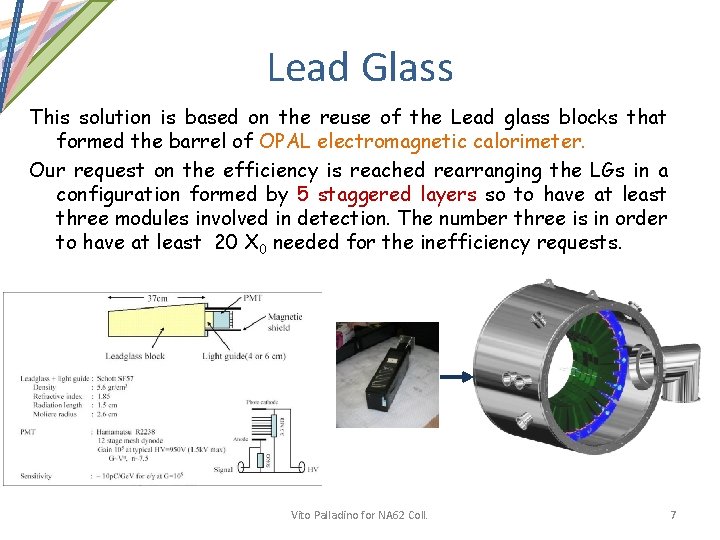
Lead Glass This solution is based on the reuse of the Lead glass blocks that formed the barrel of OPAL electromagnetic calorimeter. Our request on the efficiency is reached rearranging the LGs in a configuration formed by 5 staggered layers so to have at least three modules involved in detection. The number three is in order to have at least 20 X 0 needed for the inefficiency requests. Vito Palladino for NA 62 Coll. 7
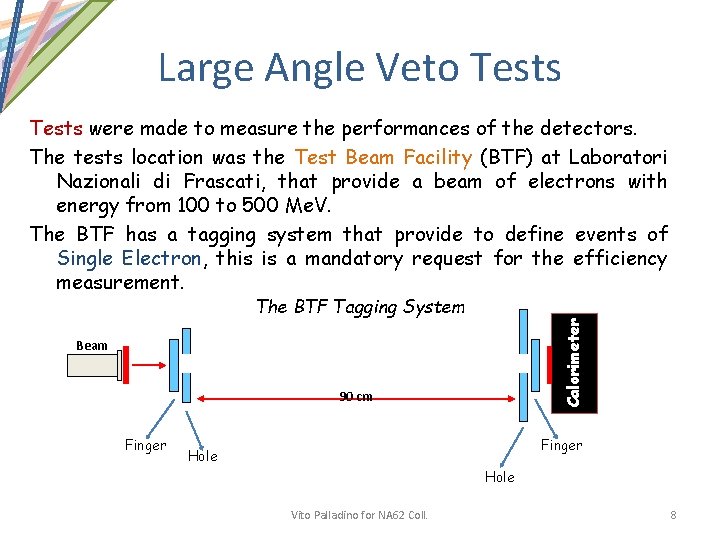
Large Angle Veto Tests were made to measure the performances of the detectors. The tests location was the Test Beam Facility (BTF) at Laboratori Nazionali di Frascati, that provide a beam of electrons with energy from 100 to 500 Me. V. The BTF has a tagging system that provide to define events of Single Electron, this is a mandatory request for the efficiency measurement. Calorimeter The BTF Tagging System Beam 90 cm Finger Hole Vito Palladino for NA 62 Coll. 8
Lead+Sc. Fibers Test Beam Energy Resolution Time Resolution Beam Energy[Me. V] Tagged Events Event with E<50 Me. V 1 -e(Inefficiency) 203 68 829 5 +4. 1 x 10 -5 7. 3 -3. 3 350 207 385 3 +1. 1 x 10 -5 1. 4 -0. 9 483 371 633 1 +4. 7 x 10 -6 2. 7 -1. 7 Vito Palladino for NA 62 Coll. 9
Lead+Sc. Tiles Test Beam Results (Preliminary) Beam Energy[Me. V] Tagged Events Event with E<50 Me. V 1 -e(Inefficiency) 203 65 165 2 -5 3. 1+3. 5 -1. 9 x 10 350 221 162 3 -5 1. 4+1. 0 -0. 9 x 10 483 192 412 1 +9. 1 x 10 -6 5. 2 -3. 3 Vito Palladino for NA 62 Coll. 10
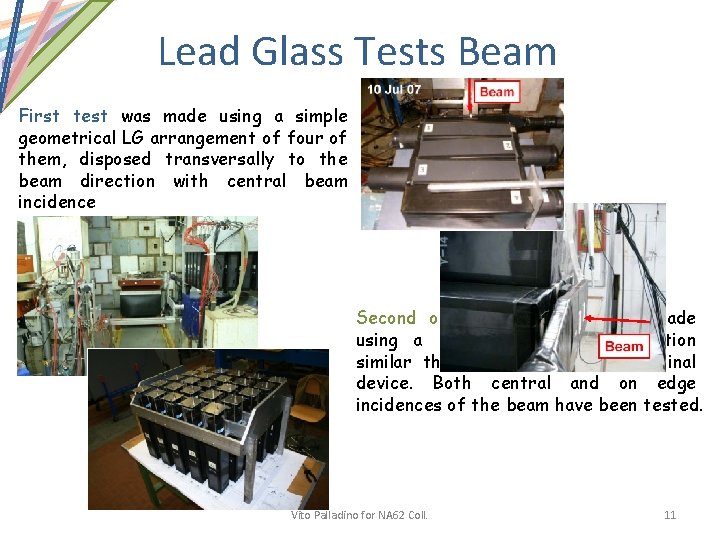
Lead Glass Tests Beam First test was made using a simple geometrical LG arrangement of four of them, disposed transversally to the beam direction with central beam incidence Second one (February 2008) is made using a LGs staggered configuration similar that will be used in the final device. Both central and on edge incidences of the beam have been tested. Vito Palladino for NA 62 Coll. 11
Lead Glass Results (Preliminary) First test Beam Energy[Me. V] Tagged Events Event with E<50 Me. V 1 -e(Inefficiency) 203 65 069 3 +0. 9 x 10 -4 1. 2 -0. 8 483 91 511 1 -5 1. 1+1. 9 -0. 7 x 10 Event with E<50 Me. V 1 -e(Inefficiency) 1 +7. 6 x 10 -5 4. 4 -2. 8 Central Incidence Beam Energy[Me. V] Tagged Events 471 22 703 Second Test On edge Incidence Beam Energy[Me. V] Tagged Events Event with E<50 Me. V 1 -e(Inefficiency) 471 9 711 1 -4 1. 03+1. 75 -0. 65 x 10 Vito Palladino for NA 62 Coll. 12
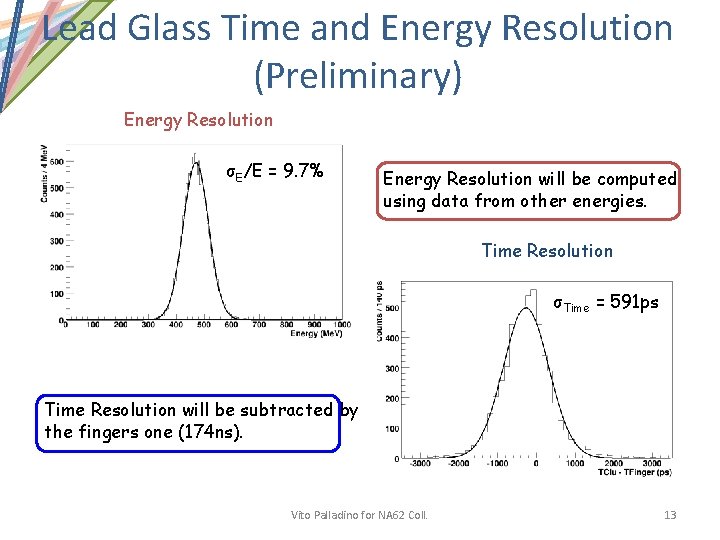
Lead Glass Time and Energy Resolution (Preliminary) Energy Resolution σE/E = 9. 7% Energy Resolution will be computed using data from other energies. Time Resolution σTime = 591 ps Time Resolution will be subtracted by the fingers one (174 ns). Vito Palladino for NA 62 Coll. 13
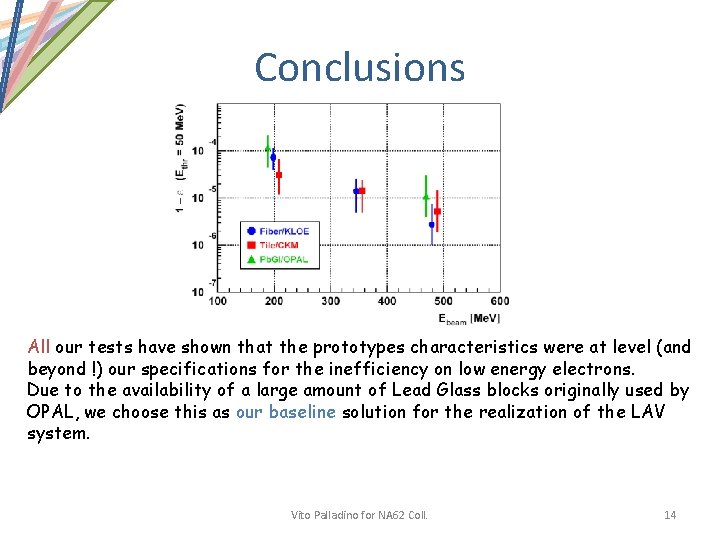
Conclusions All our tests have shown that the prototypes characteristics were at level (and beyond !) our specifications for the inefficiency on low energy electrons. Due to the availability of a large amount of Lead Glass blocks originally used by OPAL, we choose this as our baseline solution for the realization of the LAV system. Vito Palladino for NA 62 Coll. 14
Future Plans Next months will be full of events: • After some problems with the storage of the LGs (the storage area has been flooded), we are working for defining a procedure for cleaning and test half of the LGs needed for the whole project (~1000). • Starting from September is scheduled a test of a sector of a ring at CERN on a K+ beam to evaluate the performance of the device for photons and investigate the effects of the muon halo. • In the same period of the test we will start the realization of the first prototype (Module 0) of the whole ring. This prototype will be used as one of the LAV station of the apparatus. Vito Palladino for NA 62 Coll. 15
Thanks Vito Palladino for NA 62 Coll. 16
Spares Vito Palladino for NA 62 Coll. 17
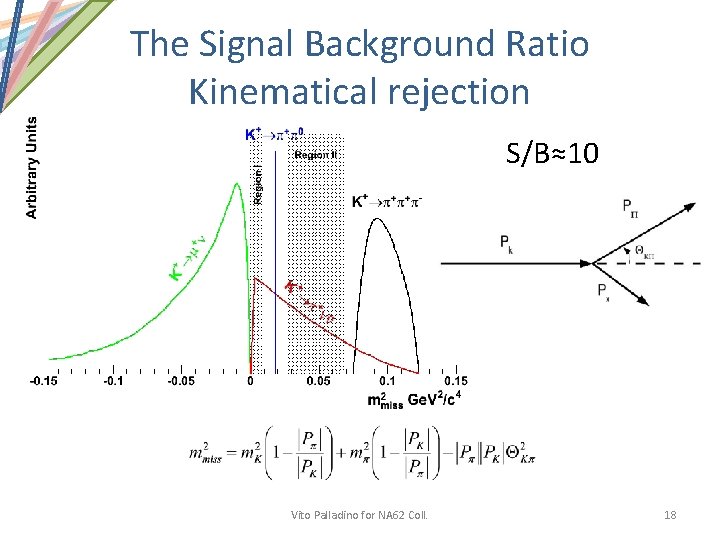
The Signal Background Ratio Kinematical rejection S/B≈10 Vito Palladino for NA 62 Coll. 18
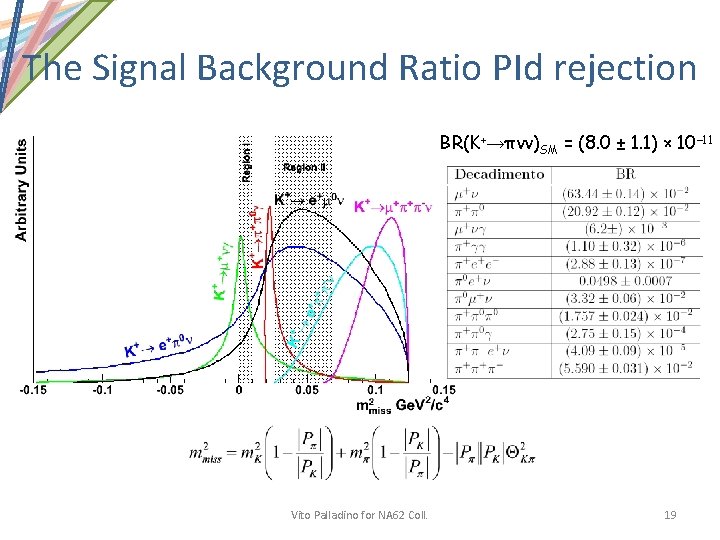
The Signal Background Ratio PId rejection BR(K+→πνν)SM = (8. 0 ± 1. 1) × 10− 11 Vito Palladino for NA 62 Coll. 19
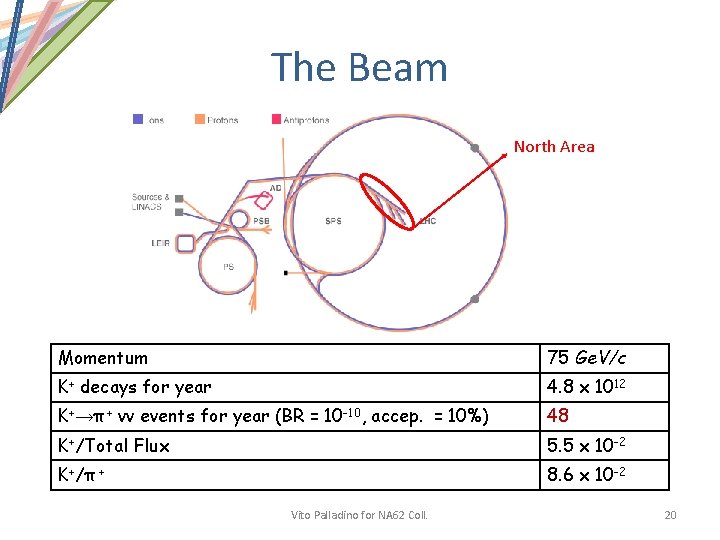
The Beam North Area Momentum 75 Ge. V/c K+ decays for year 4. 8 x 10¹² K+→π + νν events for year (BR = 10 -10, accep. = 10%) 48 K+/Total Flux 5. 5 x 10 -2 K+/π + 8. 6 x 10 -2 Vito Palladino for NA 62 Coll. 20
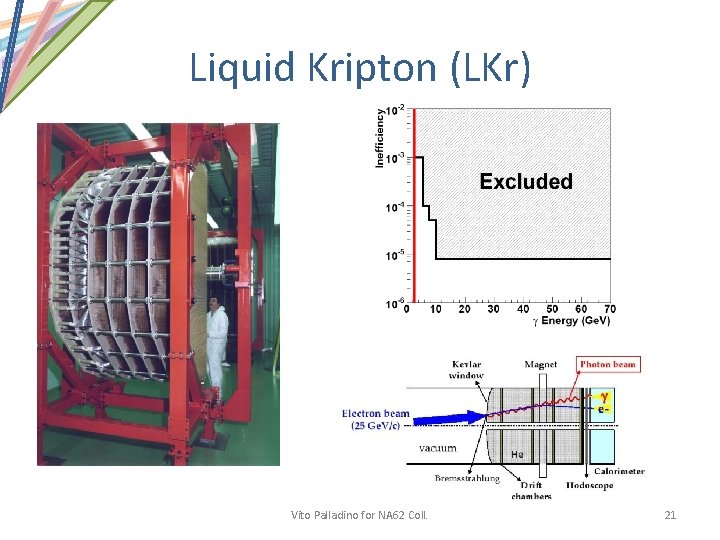
Liquid Kripton (LKr) Vito Palladino for NA 62 Coll. 21
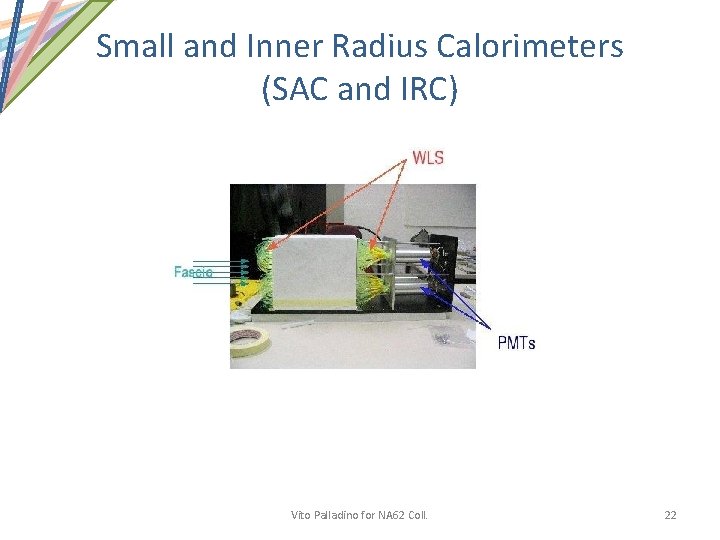
Small and Inner Radius Calorimeters (SAC and IRC) Vito Palladino for NA 62 Coll. 22
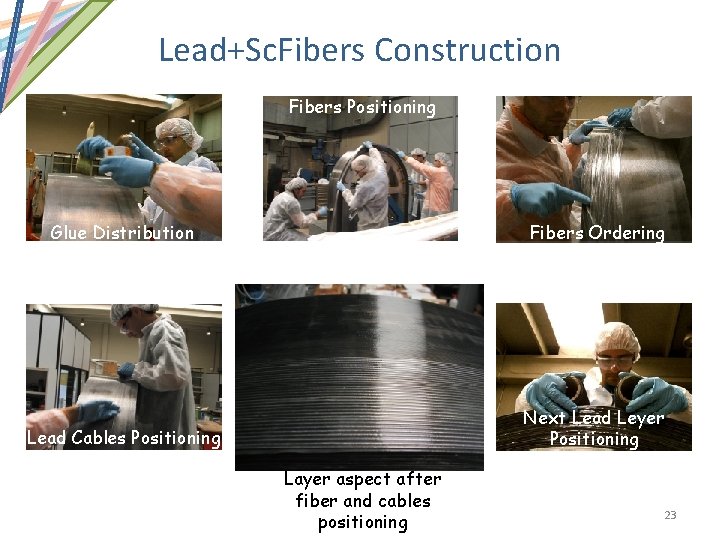
Lead+Sc. Fibers Construction Fibers Positioning Glue Distribution Fibers Ordering Lead Cables Positioning Next Lead Leyer Positioning Layer aspect after fiber and cables positioning 23
Lead+Sc. Fibers Construction Vito Palladino for NA 62 Coll. 24