
The MUTCD the Role of the NCUTCD INSERT

- Slides: 62
The MUTCD & the Role of the NCUTCD INSERT NAME? INSERT COMPANY? National Committee on Uniform Traffic Control Devices INSERT DATE?
Agenda The NCUTCD – History & Role n Basics of the MUTCD n Existing Resources related to MUTCD n ¨ Frequently Asked Questions ¨ Official Interpretations ¨ Interim Approvals ¨ Official Experiments/Rulings n The Next Edition of the MUTCD? 2
NCUTCD (www. ncutcd. org) • National Committee on Uniform Traffic Control Devices, formed 1980 • Predecessor committees formed in 1931; wrote the 1935 - 1971 MUTCD editions • Since 1971, committees have advised FHWA on MUTCD – initiating recommended changes, reviewing proposals, submitting comments on rulemakings 3
NCUTCD • Focuses on standards and guidelines for traffic control devices • Recommends proposed revisions to the MUTCD to FHWA (organization responsible for the Manual) • Provides forum for professionals with diverse backgrounds to exchange information 4
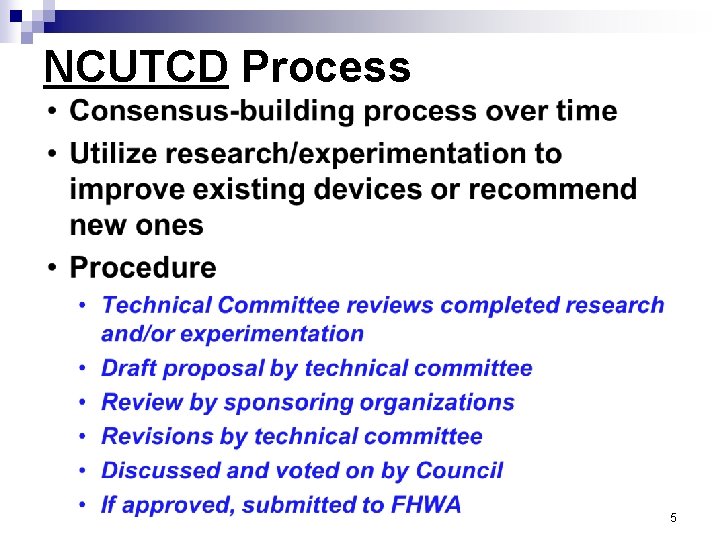
NCUTCD Process 5
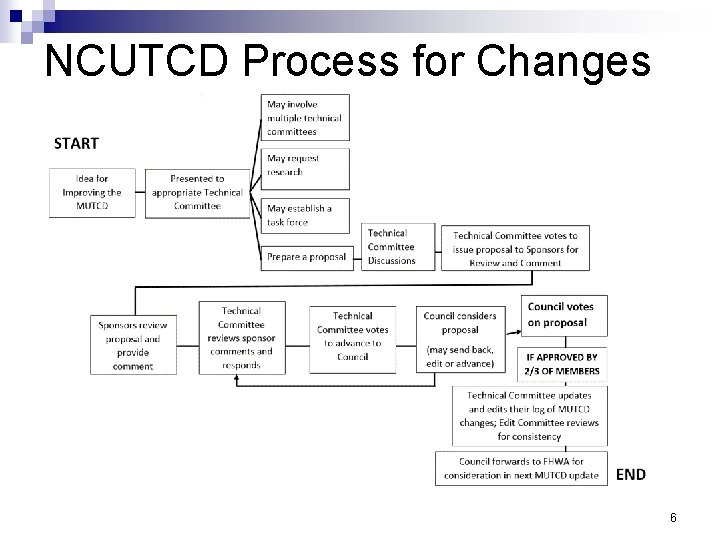
NCUTCD Process for Changes 6
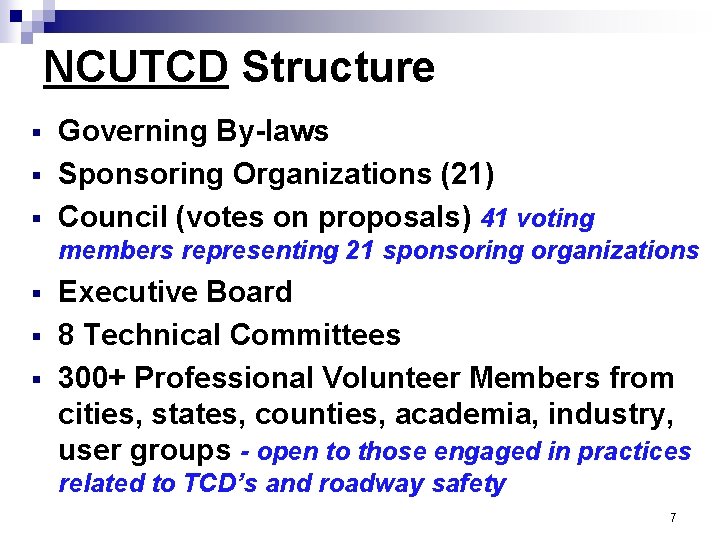
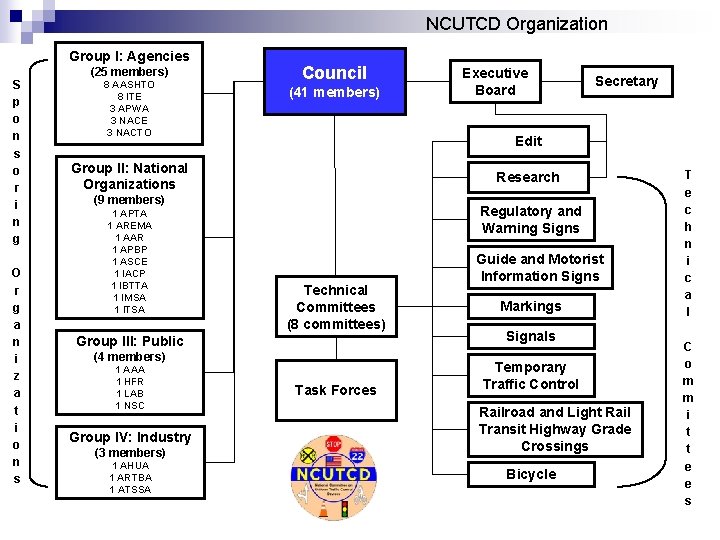
NCUTCD Structure § § § Governing By-laws Sponsoring Organizations (21) Council (votes on proposals) 41 voting members representing 21 sponsoring organizations § § § Executive Board 8 Technical Committees 300+ Professional Volunteer Members from cities, states, counties, academia, industry, user groups - open to those engaged in practices related to TCD’s and roadway safety 7
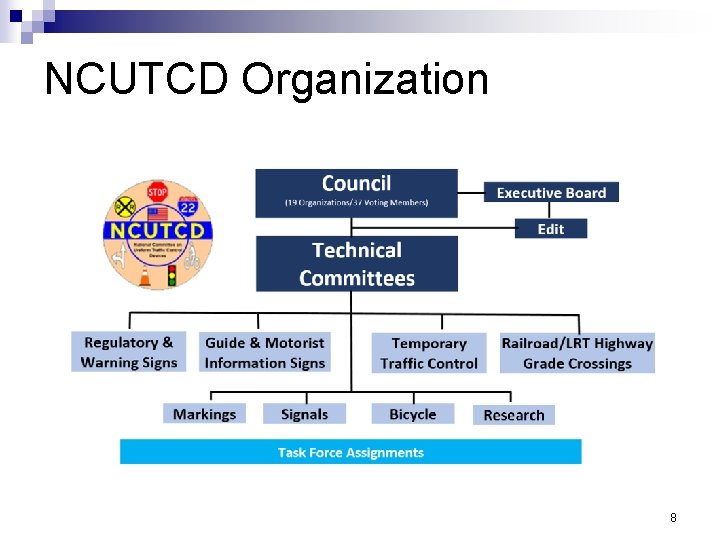
NCUTCD Organization n Document 1 - _Hlk 492649867 8
NCUTCD Organization Group I: Agencies S p o n s o r i n g O r g a n i z a t i o n s (25 members) 8 AASHTO 8 ITE 3 APWA 3 NACE 3 NACTO Council (41 members) Research (9 members) Regulatory and Warning Signs Technical Committees (8 committees) Group III: Public (4 members) 1 AAA 1 HFR 1 LAB 1 NSC Group IV: Industry (3 members) 1 AHUA 1 ARTBA 1 ATSSA Secretary Edit Group II: National Organizations 1 APTA 1 AREMA 1 AAR 1 APBP 1 ASCE 1 IACP 1 IBTTA 1 IMSA 1 ITSA Executive Board Task Forces Guide and Motorist Information Signs Markings Signals Temporary Traffic Control Railroad and Light Rail Transit Highway Grade Crossings Bicycle T e c h n i c a l C o m m i t t e e s
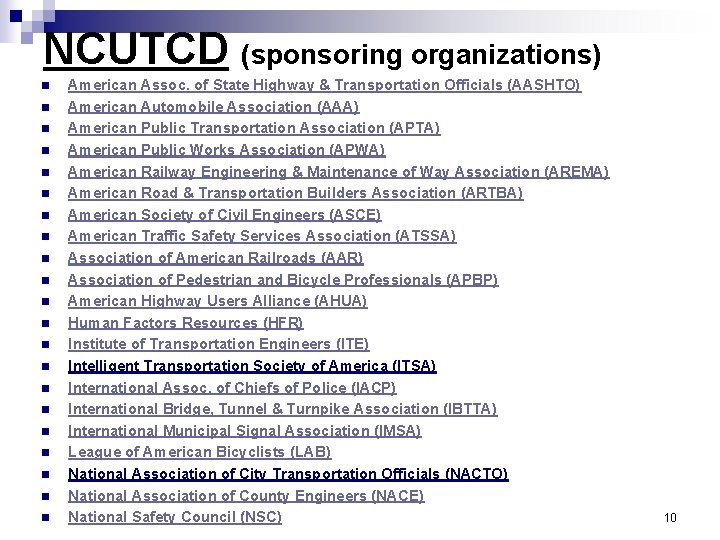
NCUTCD (sponsoring organizations) n n n n n n American Assoc. of State Highway & Transportation Officials (AASHTO) American Automobile Association (AAA) American Public Transportation Association (APTA) American Public Works Association (APWA) American Railway Engineering & Maintenance of Way Association (AREMA) American Road & Transportation Builders Association (ARTBA) American Society of Civil Engineers (ASCE) American Traffic Safety Services Association (ATSSA) Association of American Railroads (AAR) Association of Pedestrian and Bicycle Professionals (APBP) American Highway Users Alliance (AHUA) Human Factors Resources (HFR) Institute of Transportation Engineers (ITE) Intelligent Transportation Society of America (ITSA) International Assoc. of Chiefs of Police (IACP) International Bridge, Tunnel & Turnpike Association (IBTTA) International Municipal Signal Association (IMSA) League of American Bicyclists (LAB) National Association of City Transportation Officials (NACTO) National Association of County Engineers (NACE) National Safety Council (NSC) 10
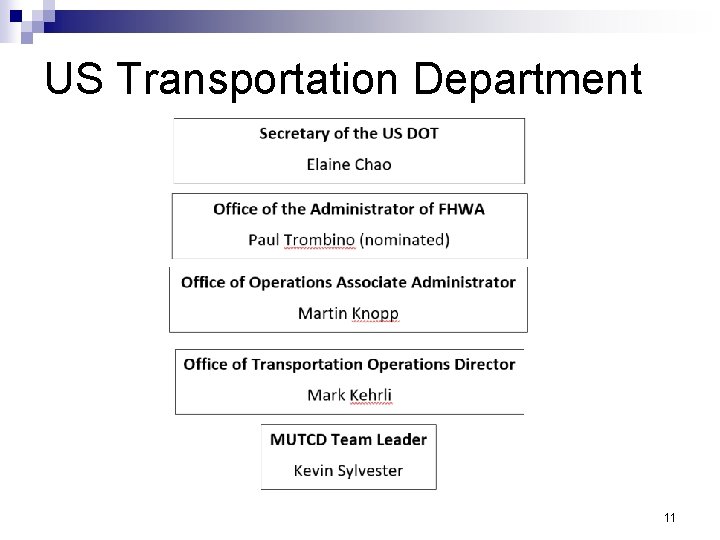
US Transportation Department 11
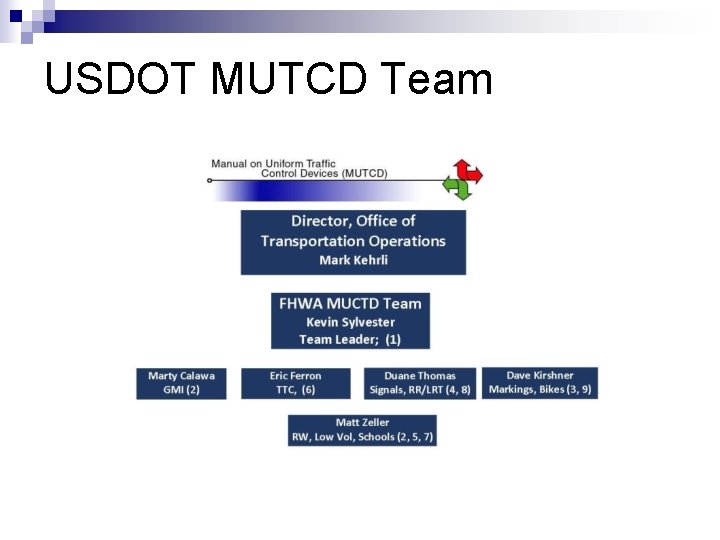
USDOT MUTCD Team
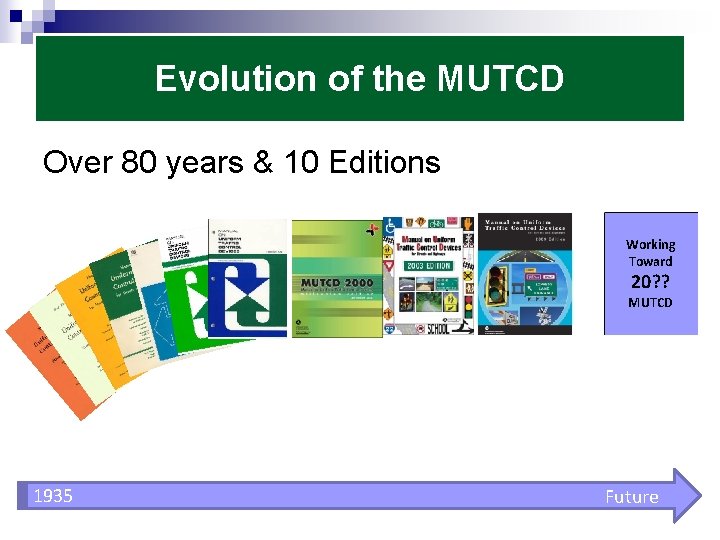
Evolution of the MUTCD Over 80 years & 10 Editions Working Toward 20? ? MUTCD 1935 Future
2009 MUTCD Important dates for the 2009 MUTCD: • 1/2/2008 – Notice of Proposed Amendments to the 2003 MUTCD • 12/16/2009 – Final Rule and publishing of 2009 MUTCD; 23 CFR 655 • 1/15/2010 – Effective date of 2009 MUTCD • 1/15/2012 – Date by which all States & US jurisdictions were required by Federal law to adopt the MUTCD 14
2009 MUTCD State and US jurisdiction MUTCDs (and supplements) shall be in “substantial conformance” with the Federal MUTCD, as determined by the FHWA’s Division Administrator in each State 15
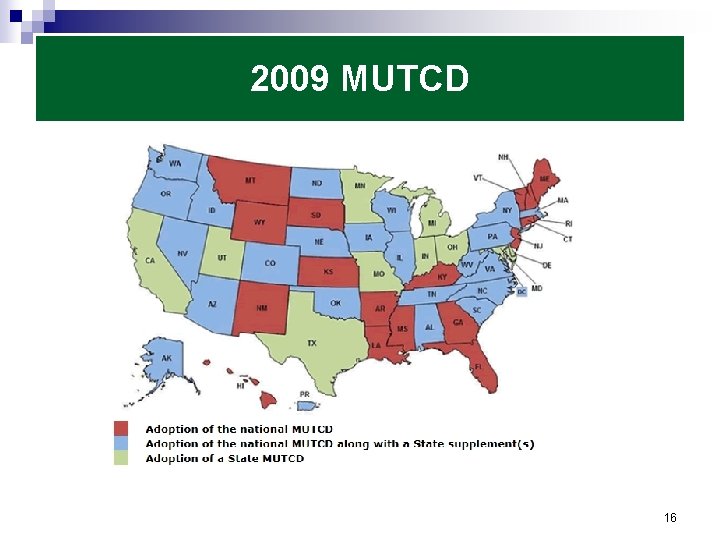
2009 MUTCD 16
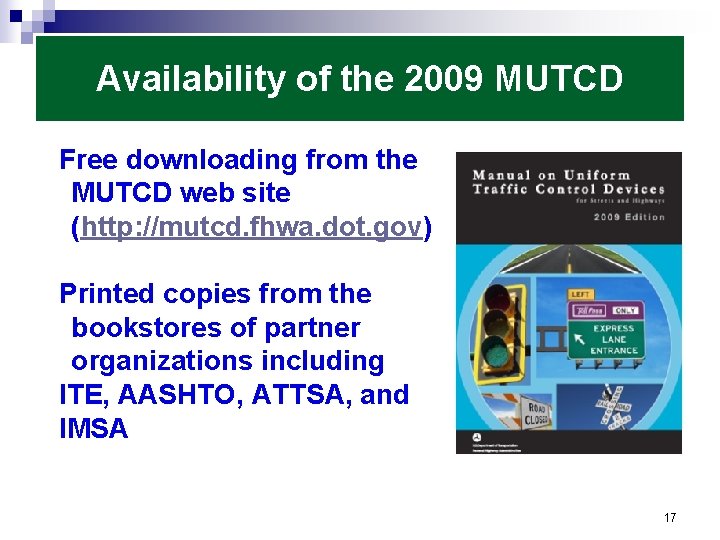
Availability of the 2009 MUTCD Free downloading from the MUTCD web site (http: //mutcd. fhwa. dot. gov) Printed copies from the bookstores of partner organizations including ITE, AASHTO, ATTSA, and IMSA 17
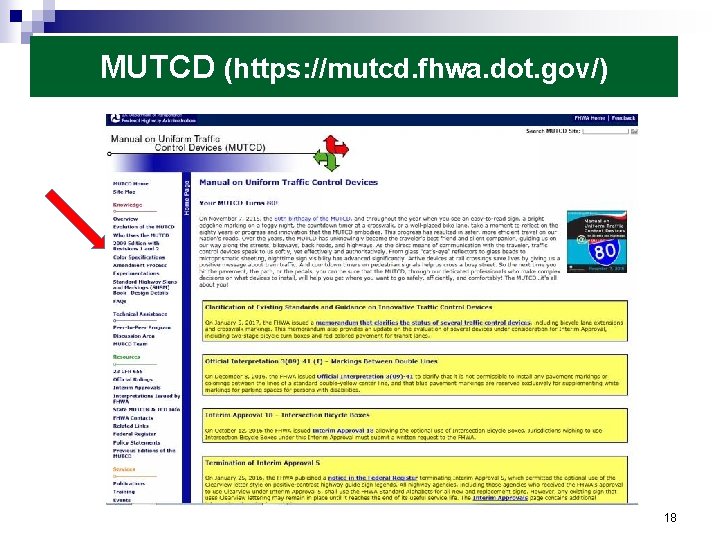
MUTCD (https: //mutcd. fhwa. dot. gov/) 18
Existing Revisions to the 2009 MUTCD The 2009 MUTCD has been officially revised two times, with both revisions being published on the same day in May 2012: • Revision 1 – Application of engineering judgment in the selection and use of traffic control devices • Revision 2 – Revisions to compliance dates, including the elimination of 46 of the original 58 compliance dates 19
Key Elements of MUTCD Website • • • Frequently Asked Questions (FAQ’s) Official Interpretations Issued by FHWA Interim Approvals Experimentations Official Rulings 20
Frequently Asked Questions (FAQ’s) The FHWA's MUTCD Team receives questions daily about a wide variety of issues involving traffic control devices and the MUTCD As a resource to practitioners, some of the most frequently-asked questions, along with the answers to those questions, are posted on the FAQs web page of the MUTCD web site All of the FAQs are relevant to the 2009 MUTCD 21
Official Interpretations Official interpretations began being issued upon request when FHWA took over responsibility for the MUTCD in 1971 Their purpose is to allow the FHWA to provide additional clarity to practitioners when a provision in the MUTCD is difficult to understand or when situations arise where complying with a particular provision would be challenging or impractical 22
Official Interpretations An Official Interpretation is not a revision to the MUTCD and should be considered as FHWA policy guidance or FHWA's recommendation of appropriate or best practice Agencies are encouraged to comply with the information provided in an official interpretation, but there is no legal obligation to do so 23
Official Interpretations Some interpretations clarify that a particular device or application meets the intent of the MUTCD or is in compliance with the MUTCD, even though the MUTCD text does not specifically say so An official interpretation of this type provides agencies the ability to use or continue using that particular device or application, at their option, but only in the manner specified in the interpretation 24
Official Interpretations The official interpretation process is described in Paragraphs 6 and 7 of Section 1 A. 10 of the 2009 MUTCD The requester should write a letter to the FHWA requesting an official interpretation. The letter should fully describe the interpretation being sought and the reasons why the MUTCD provisions are unclear or why compliance is unattainable. 25
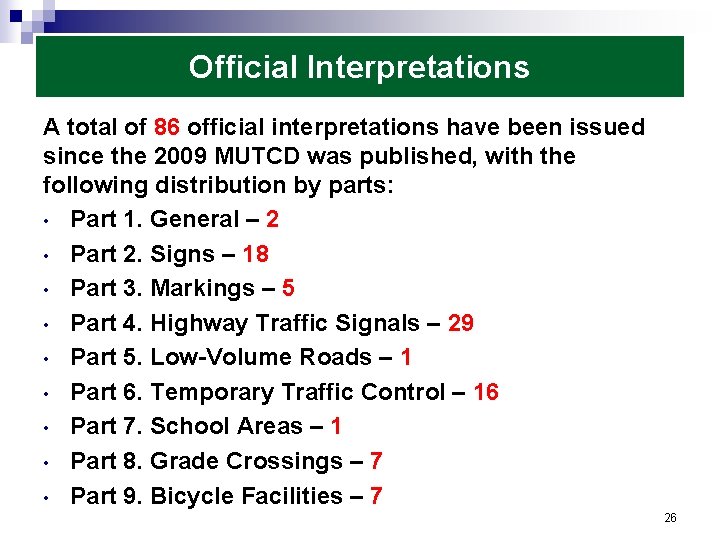
Official Interpretations A total of 86 official interpretations have been issued since the 2009 MUTCD was published, with the following distribution by parts: • Part 1. General – 2 • Part 2. Signs – 18 • Part 3. Markings – 5 • Part 4. Highway Traffic Signals – 29 • Part 5. Low-Volume Roads – 1 • Part 6. Temporary Traffic Control – 16 • Part 7. School Areas – 1 • Part 8. Grade Crossings – 7 • Part 9. Bicycle Facilities – 7 26
Interim Approvals Section 1 A. 10 of the MUTCD contains a provision authorizing the Federal Highway Administration to issue Interim Approvals. Such approvals allow the interim use, pending official rulemaking, of a new traffic control device, a revision to the application or manner of use of an existing traffic control device, or a provision not specifically described in the MUTCD. Any jurisdiction that wishes to use a device or application that has received Interim Approval must submit a written request to the FHWA, Director of the Office of Transportation Operations. 27
Interim Approvals The interim approval process was first introduced in the 2003 MUTCD Its purpose is to allow the interim use, pending official rulemaking, of a proven successful new traffic control device, a revision to the application or manner of use of an existing traffic control device, or a provision not specifically described in this Manual It is issued by official memorandum and includes technical conditions for use (design, placement, etc. ) 28
Interim Approvals Criteria for a new device to be considered for FHWA issuance of an Interim Approval: • Successful experimentation and/or research in diverse geographic regions or conditions (not just a single jurisdiction) • Assessment of relative risks, benefits, costs, impacts, and other factors • FHWA’s intention to propose the device for the next edition of MUTCD and a high likelihood of its adoption in the Final Rule 29
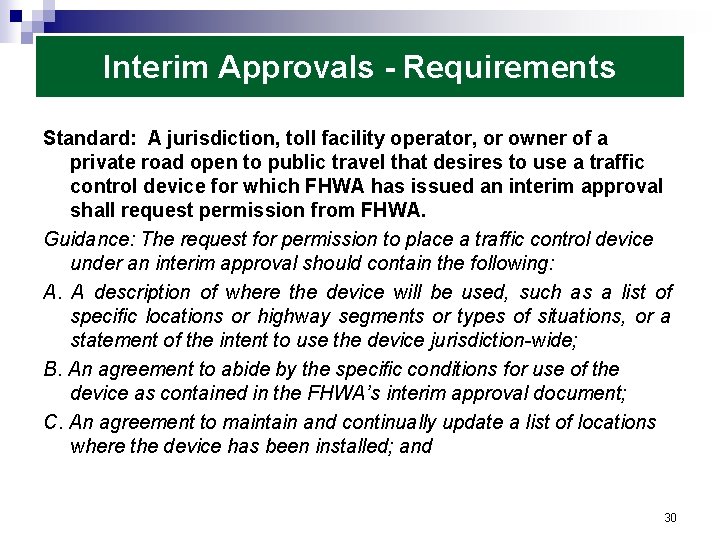
Interim Approvals - Requirements Standard: A jurisdiction, toll facility operator, or owner of a private road open to public travel that desires to use a traffic control device for which FHWA has issued an interim approval shall request permission from FHWA. Guidance: The request for permission to place a traffic control device under an interim approval should contain the following: A. A description of where the device will be used, such as a list of specific locations or highway segments or types of situations, or a statement of the intent to use the device jurisdiction-wide; B. An agreement to abide by the specific conditions for use of the device as contained in the FHWA’s interim approval document; C. An agreement to maintain and continually update a list of locations where the device has been installed; and 30
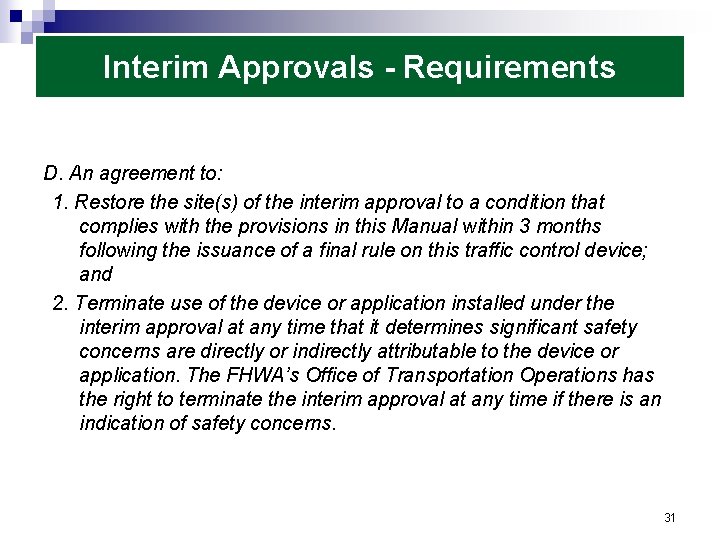
Interim Approvals - Requirements D. An agreement to: 1. Restore the site(s) of the interim approval to a condition that complies with the provisions in this Manual within 3 months following the issuance of a final rule on this traffic control device; and 2. Terminate use of the device or application installed under the interim approval at any time that it determines significant safety concerns are directly or indirectly attributable to the device or application. The FHWA’s Office of Transportation Operations has the right to terminate the interim approval at any time if there is an indication of safety concerns. 31
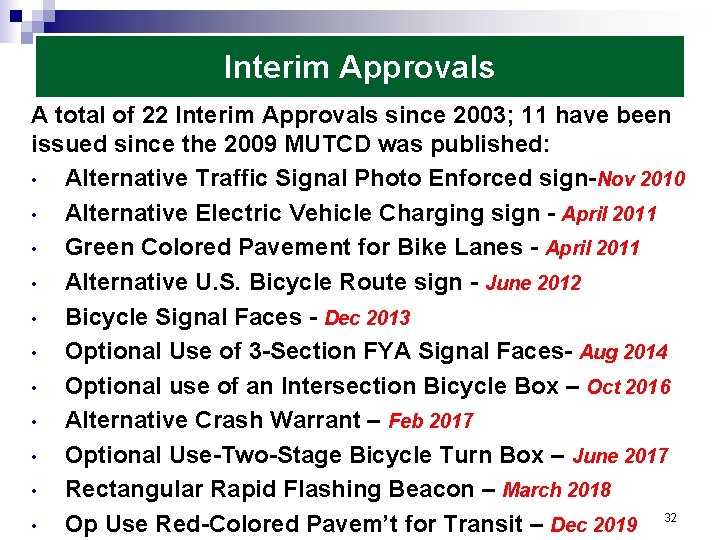
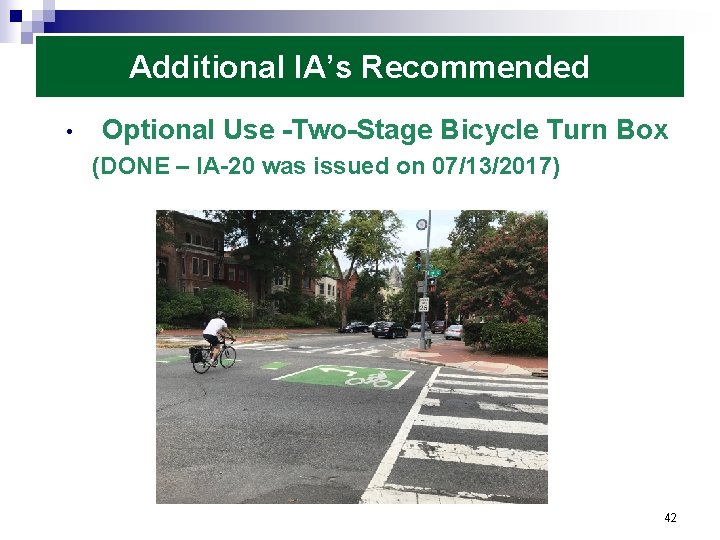
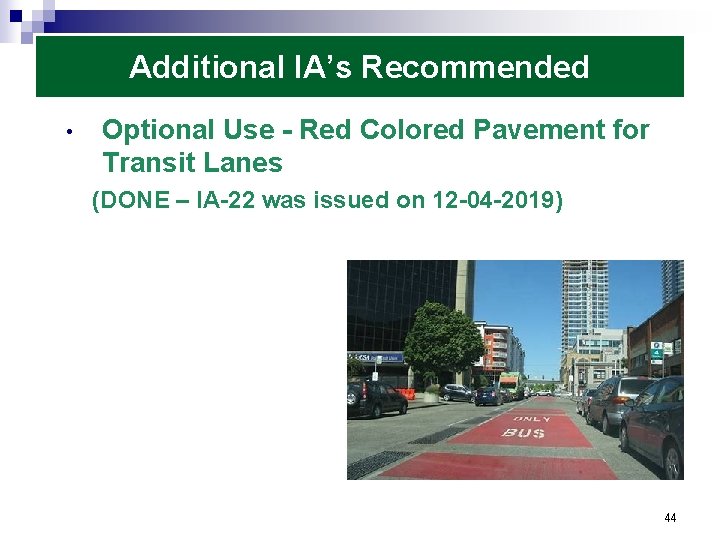
Interim Approvals A total of 22 Interim Approvals since 2003; 11 have been issued since the 2009 MUTCD was published: • Alternative Traffic Signal Photo Enforced sign- Nov 2010 • Alternative Electric Vehicle Charging sign - April 2011 • Green Colored Pavement for Bike Lanes - April 2011 • Alternative U. S. Bicycle Route sign - June 2012 • Bicycle Signal Faces - Dec 2013 • Optional Use of 3 -Section FYA Signal Faces- Aug 2014 • Optional use of an Intersection Bicycle Box – Oct 2016 • Alternative Crash Warrant – Feb 2017 • Optional Use-Two-Stage Bicycle Turn Box – June 2017 • Rectangular Rapid Flashing Beacon – March 2018 32 • Op Use Red-Colored Pavem’t for Transit – Dec 2019
Interim Approvals Two interim approvals issued prior to the 2009 MUTCD that were in effect until recently, have been reinstated: 33
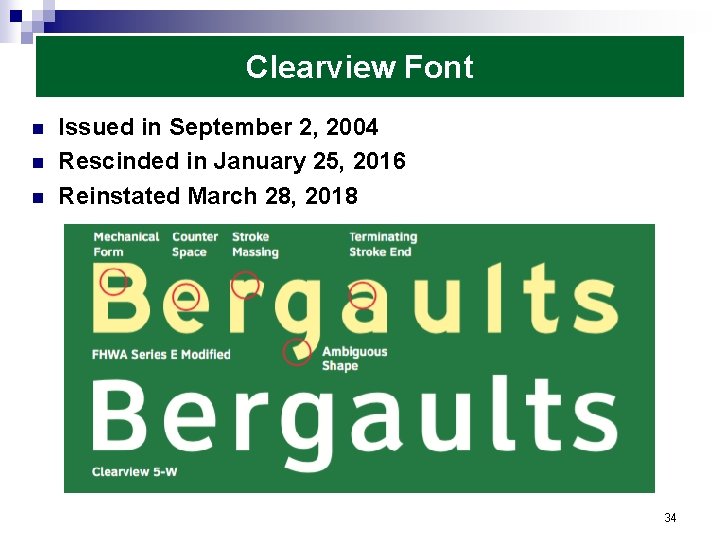
Clearview Font n n n Issued in September 2, 2004 Rescinded in January 25, 2016 Reinstated March 28, 2018 34
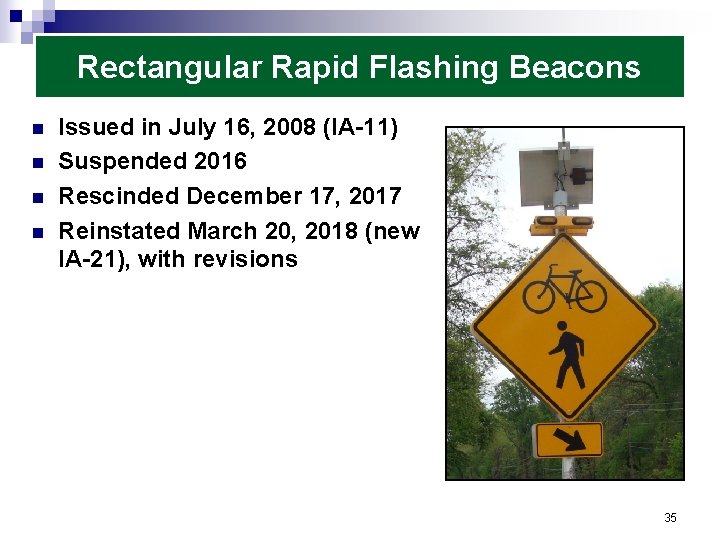
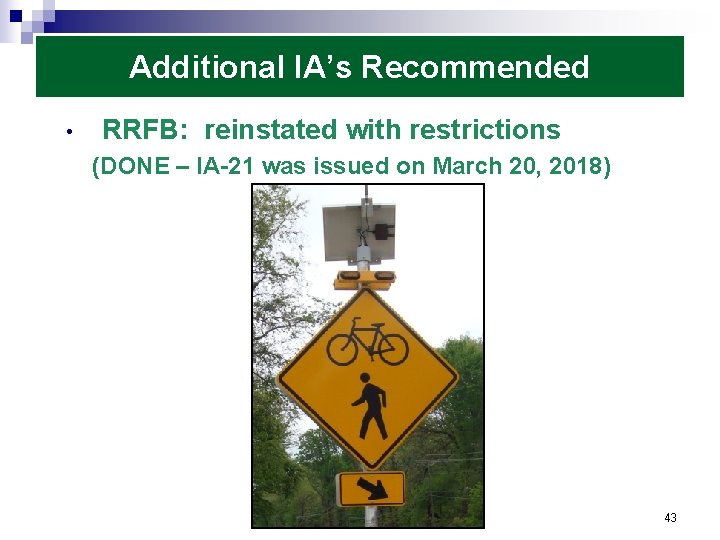
Rectangular Rapid Flashing Beacons n n Issued in July 16, 2008 (IA-11) Suspended 2016 Rescinded December 17, 2017 Reinstated March 20, 2018 (new IA-21), with revisions 35
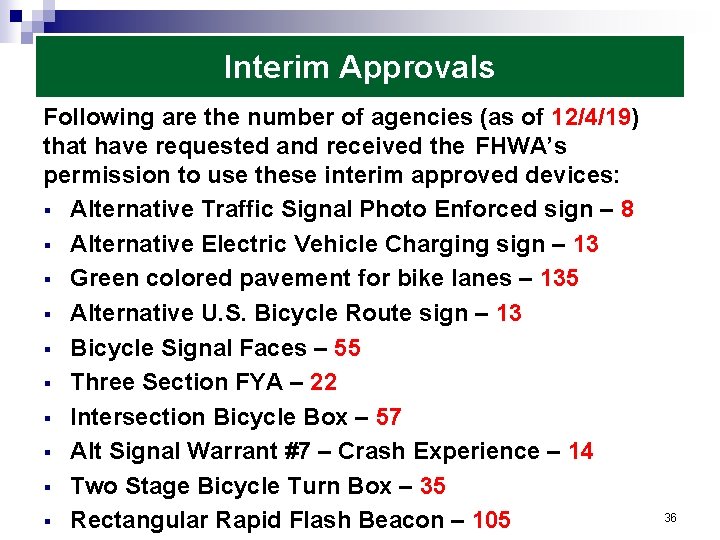
Interim Approvals Following are the number of agencies (as of 12/4/19) that have requested and received the FHWA’s permission to use these interim approved devices: § Alternative Traffic Signal Photo Enforced sign – 8 § Alternative Electric Vehicle Charging sign – 13 § Green colored pavement for bike lanes – 135 § Alternative U. S. Bicycle Route sign – 13 § Bicycle Signal Faces – 55 § Three Section FYA – 22 § Intersection Bicycle Box – 57 § Alt Signal Warrant #7 – Crash Experience – 14 § Two Stage Bicycle Turn Box – 35 § Rectangular Rapid Flash Beacon – 105 36
Interim Approvals Dilemma – Considering how to deal with the backlog, get proven new devices into use to improve safety and mobility, and keep MUTCD current and relevant? June 2016 – At the request of ITE, NCUTCD reviewed all of the recommendations it sent to FHWA since 2008 and identified many items for FHWA to consider for issuance of new Interim Approvals. 37
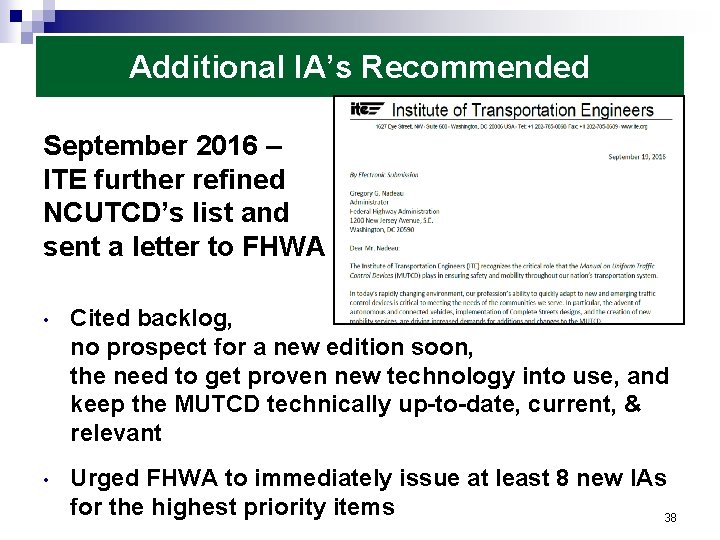
Additional IA’s Recommended September 2016 – ITE further refined NCUTCD’s list and sent a letter to FHWA • Cited backlog, no prospect for a new edition soon, the need to get proven new technology into use, and keep the MUTCD technically up-to-date, current, & relevant • Urged FHWA to immediately issue at least 8 new IAs for the highest priority items 38
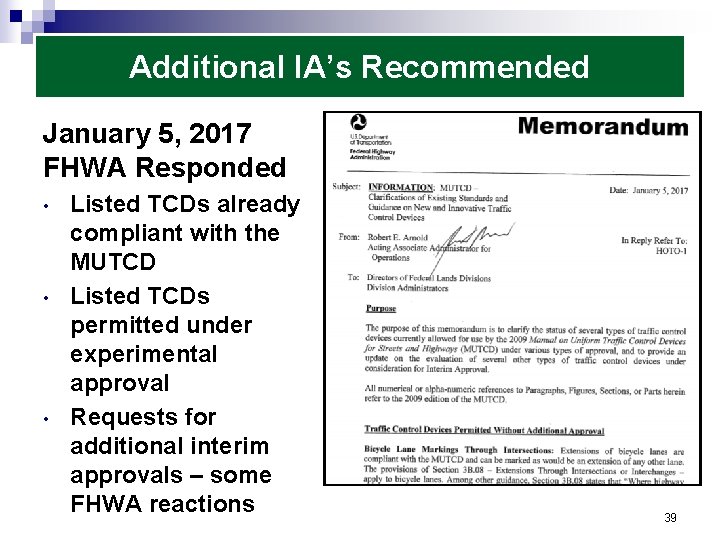
Additional IA’s Recommended January 5, 2017 FHWA Responded • • • Listed TCDs already compliant with the MUTCD Listed TCDs permitted under experimental approval Requests for additional interim approvals – some FHWA reactions 39
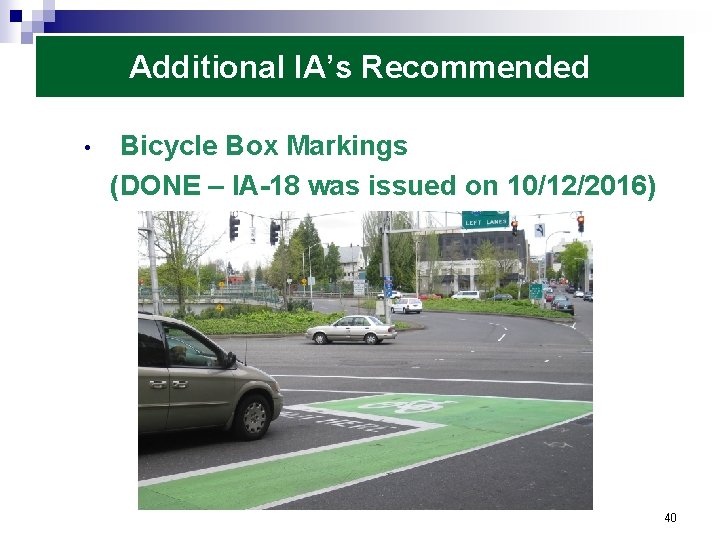
Additional IA’s Recommended • Bicycle Box Markings (DONE – IA-18 was issued on 10/12/2016) 40
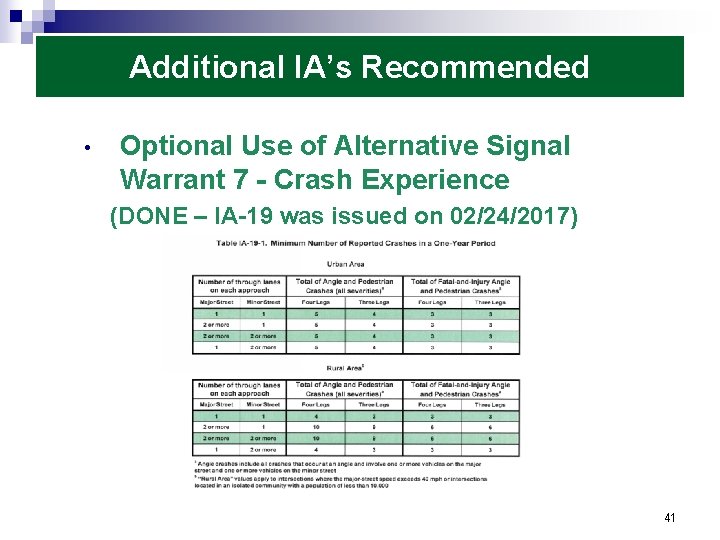
Additional IA’s Recommended • Optional Use of Alternative Signal Warrant 7 - Crash Experience (DONE – IA-19 was issued on 02/24/2017) 41
Additional IA’s Recommended • Optional Use -Two-Stage Bicycle Turn Box (DONE – IA-20 was issued on 07/13/2017) 42
Additional IA’s Recommended • RRFB: reinstated with restrictions (DONE – IA-21 was issued on March 20, 2018) 43
Additional IA’s Recommended • Optional Use - Red Colored Pavement for Transit Lanes (DONE – IA-22 was issued on 12 -04 -2019) 44
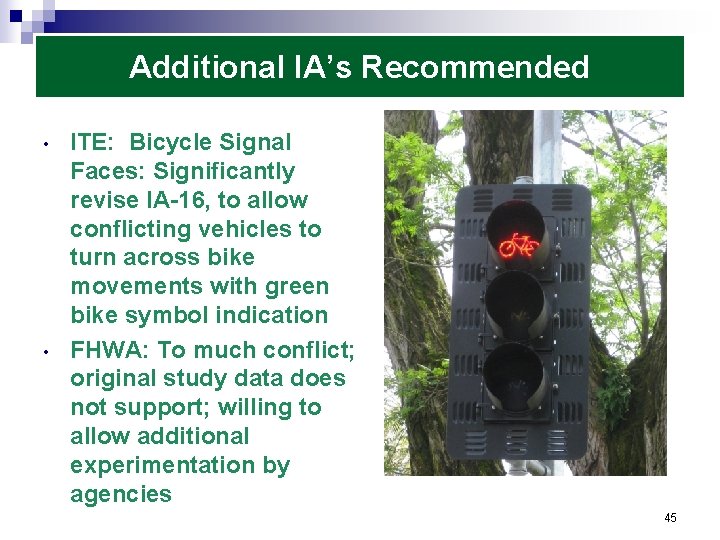
Additional IA’s Recommended • • ITE: Bicycle Signal Faces: Significantly revise IA-16, to allow conflicting vehicles to turn across bike movements with green bike symbol indication FHWA: To much conflict; original study data does not support; willing to allow additional experimentation by agencies 45
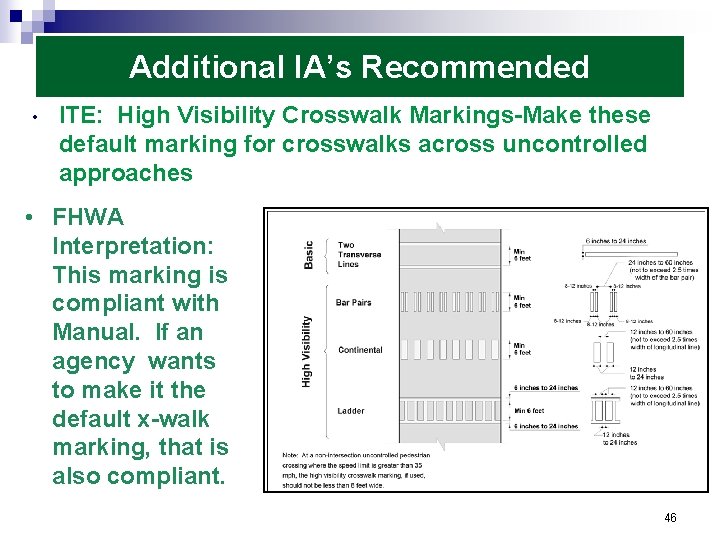
Additional IA’s Recommended • ITE: High Visibility Crosswalk Markings-Make these default marking for crosswalks across uncontrolled approaches • FHWA Interpretation: This marking is compliant with Manual. If an agency wants to make it the default x-walk marking, that is also compliant. 46
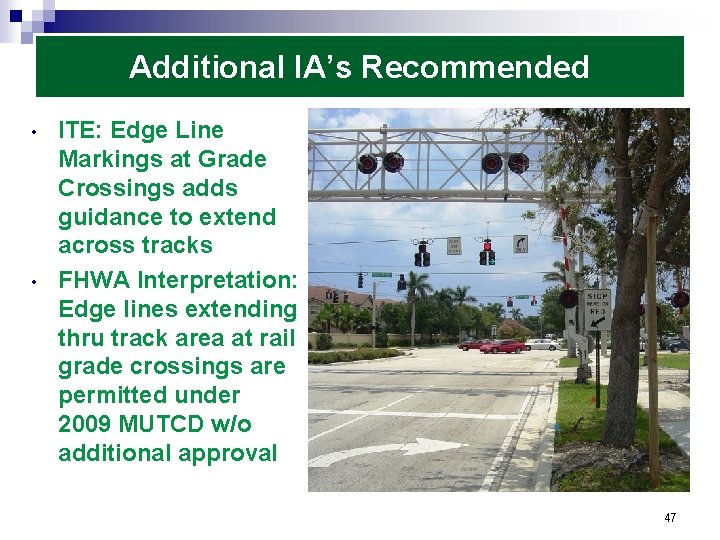
Additional IA’s Recommended • • ITE: Edge Line Markings at Grade Crossings adds guidance to extend across tracks FHWA Interpretation: Edge lines extending thru track area at rail grade crossings are permitted under 2009 MUTCD w/o additional approval 47
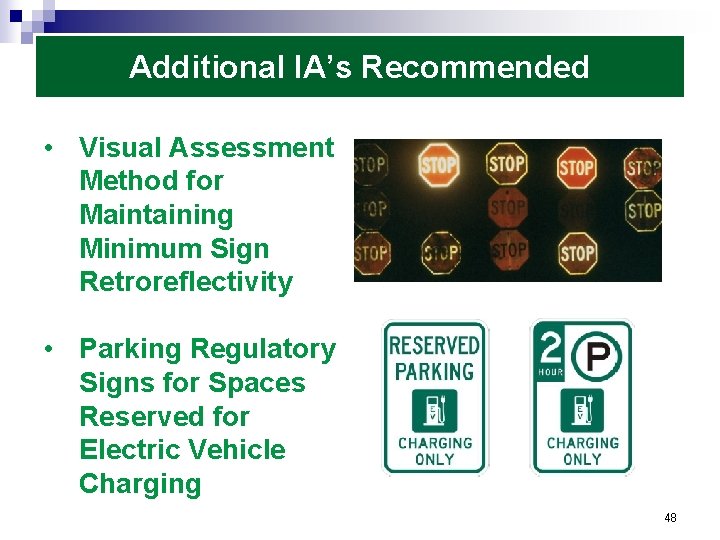
Additional IA’s Recommended • Visual Assessment Method for Maintaining Minimum Sign Retroreflectivity • Parking Regulatory Signs for Spaces Reserved for Electric Vehicle Charging 48
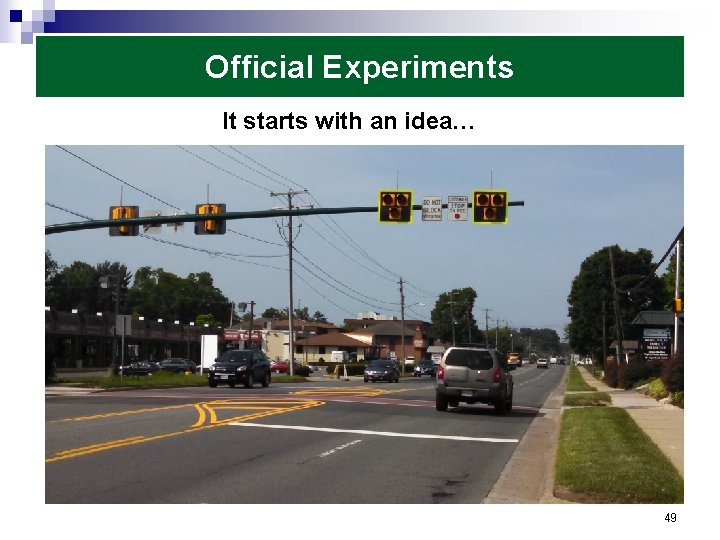
Official Experiments It starts with an idea… 49
Official Experiments/Rulings Goal- to seek the best traffic control devices Purpose – to allow practitioners to test new or innovative traffic control devices or applications: • To see if they perform more effectively than the devices in the MUTCD; or • Because there is no device in the MUTCD that addresses the situation being studied 50
Official Experiments The official experimentation process is described in Section 1 A. 10 of the 2009 MUTCD, Paragraphs 8 - 11 A State DOT or a local agency must write a letter to the FHWA requesting to conduct an experiment Request must include a research plan describing what data will be collected, how it will be collected, and how it will be analyzed Key is for experimental plan to produce data for objective (not subjective) results Experiment may begin only after written approval from the FHWA Successful experimentation is utilized by NCUTCD & FHWA to recommend updates to the Manual 51
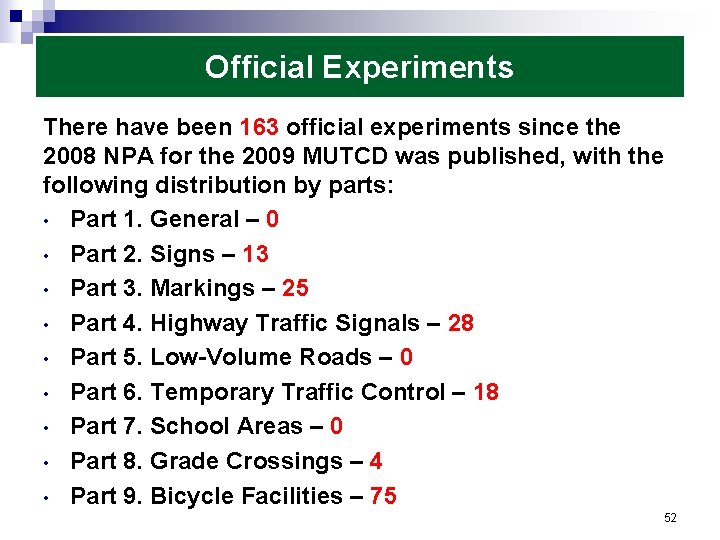
Official Experiments There have been 163 official experiments since the 2008 NPA for the 2009 MUTCD was published, with the following distribution by parts: • Part 1. General – 0 • Part 2. Signs – 13 • Part 3. Markings – 25 • Part 4. Highway Traffic Signals – 28 • Part 5. Low-Volume Roads – 0 • Part 6. Temporary Traffic Control – 18 • Part 7. School Areas – 0 • Part 8. Grade Crossings – 4 • Part 9. Bicycle Facilities – 75 52
Official Experiments-Why Important A jurisdiction that installs a device or application that is not in the MUTCD, that violates MUTCD requirements, or that has not received Interim Approval status, without first obtaining FHWA experimentation approval, faces these risks: • Potential legal liability if a crash occurs • Potential loss of Federal-Aid funding 53
Official Experiments-Why Important Data from experiments is critical to objective, scientific evaluation of new devices Experimental results are also critical in the FHWA’s consideration of a new device for possible Interim Approval or adoption into the MUTCD 54
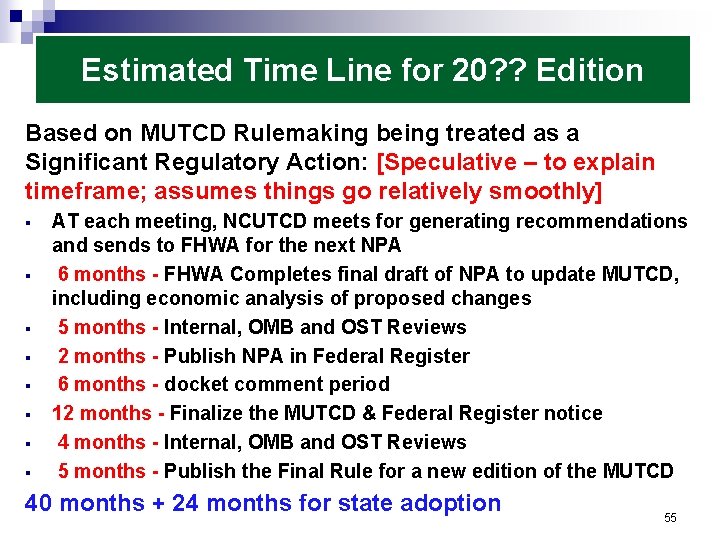
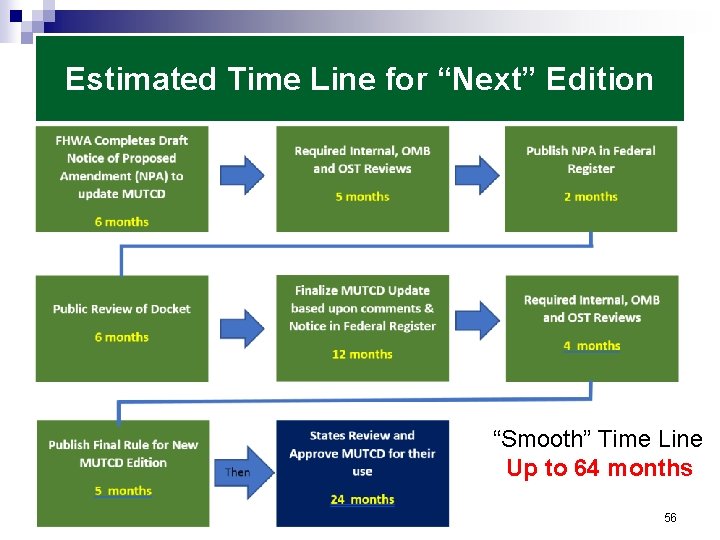
Estimated Time Line for 20? ? Edition Based on MUTCD Rulemaking being treated as a Significant Regulatory Action: [Speculative – to explain timeframe; assumes things go relatively smoothly] § § § § AT each meeting, NCUTCD meets for generating recommendations and sends to FHWA for the next NPA 6 months - FHWA Completes final draft of NPA to update MUTCD, including economic analysis of proposed changes 5 months - Internal, OMB and OST Reviews 2 months - Publish NPA in Federal Register 6 months - docket comment period 12 months - Finalize the MUTCD & Federal Register notice 4 months - Internal, OMB and OST Reviews 5 months - Publish the Final Rule for a new edition of the MUTCD 40 months + 24 months for state adoption 55
Estimated Time Line for “Next” Edition “Smooth” Time Line Up to 64 months 56
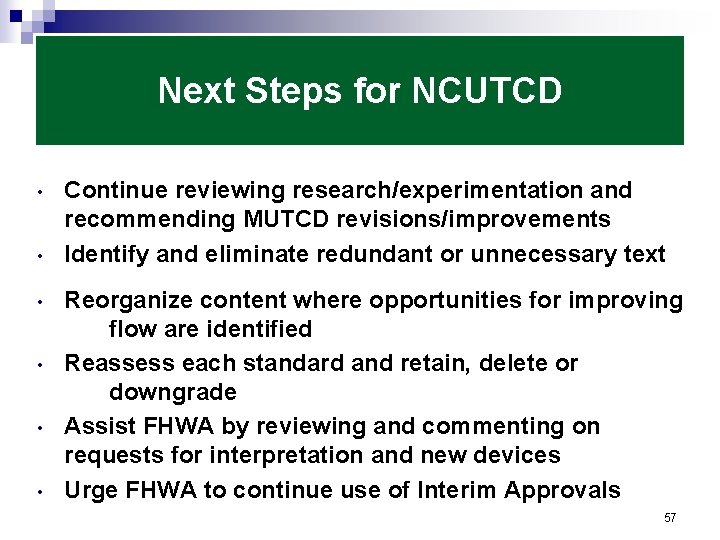
Next Steps for NCUTCD • • • Continue reviewing research/experimentation and recommending MUTCD revisions/improvements Identify and eliminate redundant or unnecessary text Reorganize content where opportunities for improving flow are identified Reassess each standard and retain, delete or downgrade Assist FHWA by reviewing and commenting on requests for interpretation and new devices Urge FHWA to continue use of Interim Approvals 57
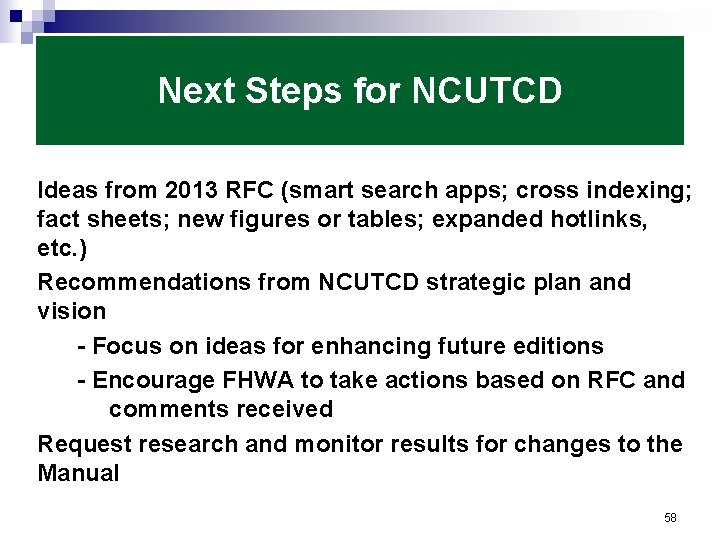
Next Steps for NCUTCD Ideas from 2013 RFC (smart search apps; cross indexing; fact sheets; new figures or tables; expanded hotlinks, etc. ) Recommendations from NCUTCD strategic plan and vision - Focus on ideas for enhancing future editions - Encourage FHWA to take actions based on RFC and comments received Request research and monitor results for changes to the Manual 58
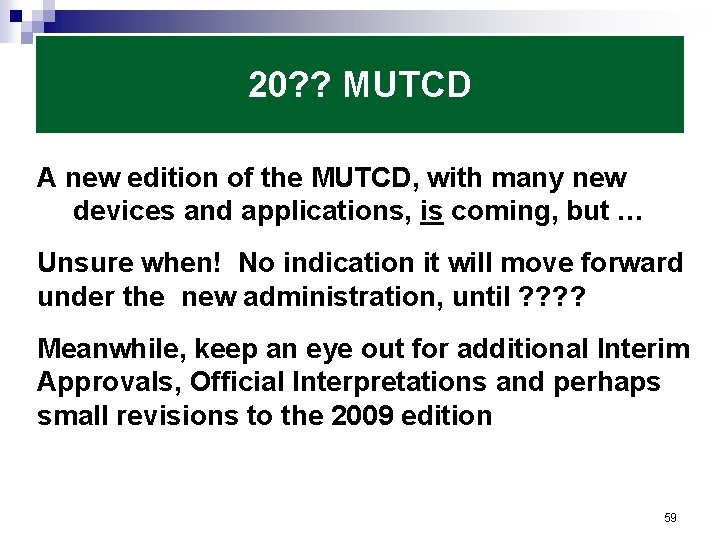
20? ? MUTCD A new edition of the MUTCD, with many new devices and applications, is coming, but … Unsure when! No indication it will move forward under the new administration, until ? ? Meanwhile, keep an eye out for additional Interim Approvals, Official Interpretations and perhaps small revisions to the 2009 edition 59
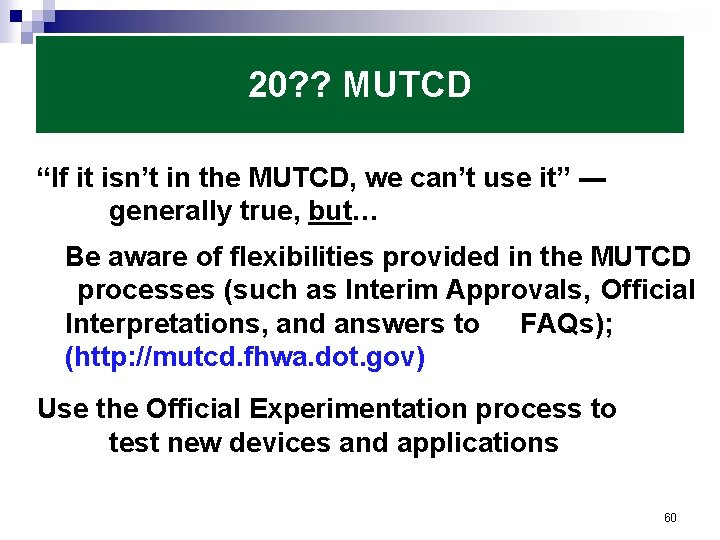
20? ? MUTCD “If it isn’t in the MUTCD, we can’t use it” --generally true, but… Be aware of flexibilities provided in the MUTCD processes (such as Interim Approvals, Official Interpretations, and answers to FAQs); (http: //mutcd. fhwa. dot. gov) Use the Official Experimentation process to test new devices and applications 60
Thank you! INSERT NAME? INSERT TITLE? INSERT COMPANY NAME? INSERT PHONE NAME? INSERT EMAIL ADDRESS? Acknowledgements to ITE Professional Development & FHWA for some of content. 61
Thank you! If interested in getting involved or becoming a member (www. ncutcd. org) Questions? 62