
The Muscular System Part 2 Support Movement Muscle
- Slides: 25
The Muscular System Part 2: Support & Movement
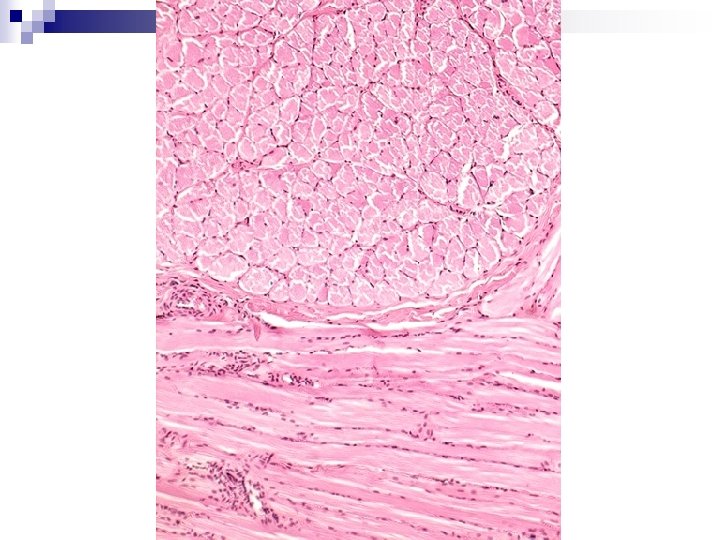
Muscle Tissue n Muscle: One of the 4 basic human tissues ¨ Defined by its ability to contract & provide movement Composition of muscle tissue will be discussed in next chapter n Current chapter will cover location, function, & classification n
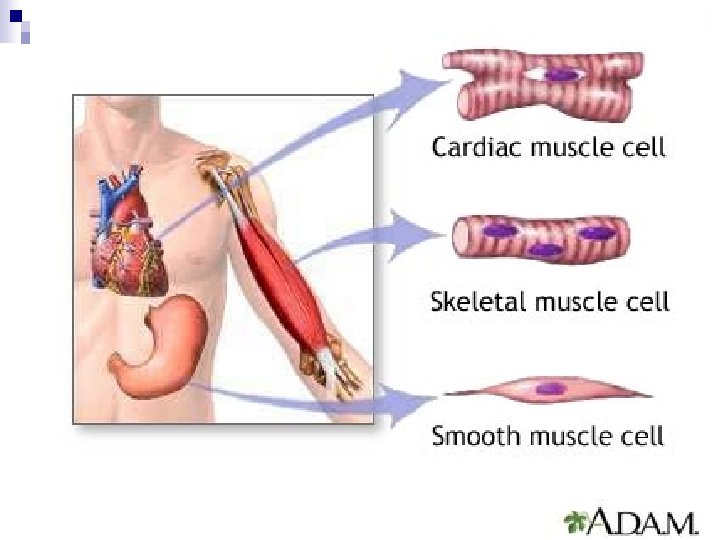
3 Types of Muscle Tissue n Skeletal Muscle: Striated - associated with unstriated muscle ¨ Voluntary ¨ Attaches to the bones of the skeleton Multinucleated ¨ n Smooth Muscle: Involuntary ¨ Found in digestive system, blood vessel walls, urinary & reproductive systems ¨ n Cardiac Muscle: Involuntary ¨ Only found in the heart ¨ Has rhythmicity – will beat without outside stimulation ¨ Sources of energy that moves blood through the blood vessels ¨ n Smooth & Cardiac Muscle are controlled by the autonomic nervous system.
Common Traits n Proteins Needed: ¨ ¨ n Four Essential Ions Needed: ¨ ¨ n Actin Myosin Calcium Sodium Chloride Potassium Common Characteristics: ¨ ¨ ¨ Excitability Conductivity Contractility Extensibility Elasticity
Skeletal Muscles: Function n Functions: ¨ Movement ¨ Stability ¨ Communication n Expressions, Speech ¨ Provides n n primary source of body heat Through muscle contractions – thermogenesis Roughly 600 skeletal muscles in the human body
Skeletal Muscles: Properties n n Contractility: Ability to forcefully contract when stimulated Extensibility: Ability of the tissue to stretch without damage Elasticity: Ability to return to its original shape after contraction or extension Excitability: Ability to respond to stimuli ¨ Action Potentials: Electrical signals prompted by neurotransmitters or by autorhythmic signals arising within the muscle tissue
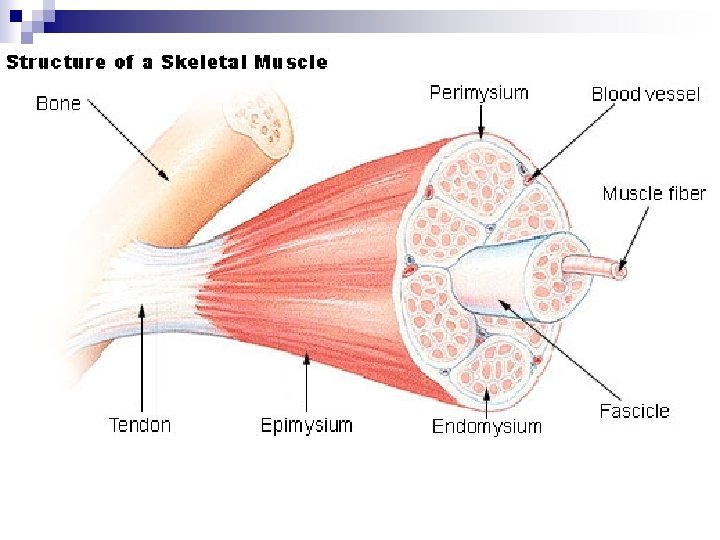
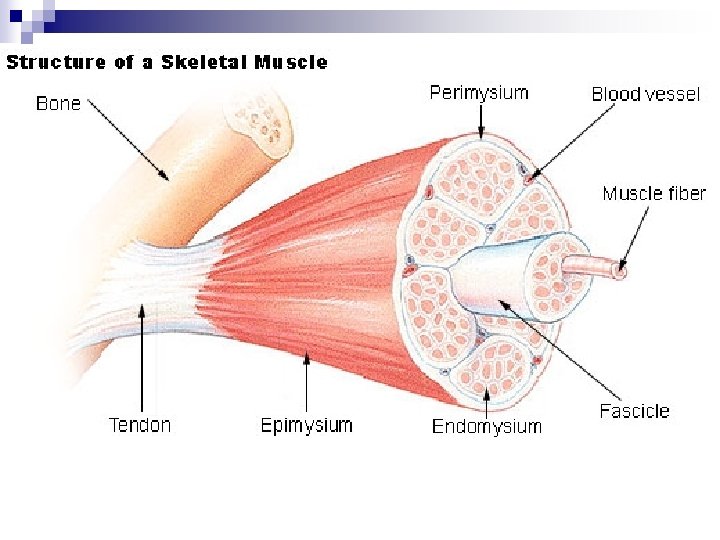
Skeletal Muscles: Connective Tissue Components n Fascicles: Bundles of muscle fiber that make up skeletal muscles ¨ Enveloped n by connective tissue Fascia: Thin fibrous sheet of connective tissue that surrounds muscles & provides protection ¨ Superficial Fascia: Separates the skin from muscle; subcutaneous layer ¨ Deep Fascia: Holds individual muscles together
Skeletal Muscles: Connective Tissue n 3 Types of Connective Tissue protecting muscles: ¨ Endomysium: Layer of areolar tissue surrounding individual muscle fibers ¨ Perimysium: Sheath of connective tissue surrounding the fascicles ¨ Epimysium: Outer layer of connective tissue covering the entire muscle & blending into the fascia
Skeletal Muscles: Attachment n Collagen Fibers: Connects muscle directly to bone ¨ Attaches n using epimysium & periosteum Tendons: Extensions of connective tissue, primarily from the deep fascia ¨ Attaches to the periosteum of the bone
Skeletal Muscles: General Anatomy n Points of Attachment: ¨ Origin: Point of attachment at the stationary end of an individual muscle. n Usually medial ¨ Insertion: Point of attachment at the more mobile end of the muscle. ¨ Belly: Middle region of the muscle; very thick.
Skeletal Muscles: Classification Intrinsic Muscles: Entirely contained within a particular region, e. g. the tongue. n Extrinsic Muscles: Act upon a certain region, but their origin is elsewhere. n
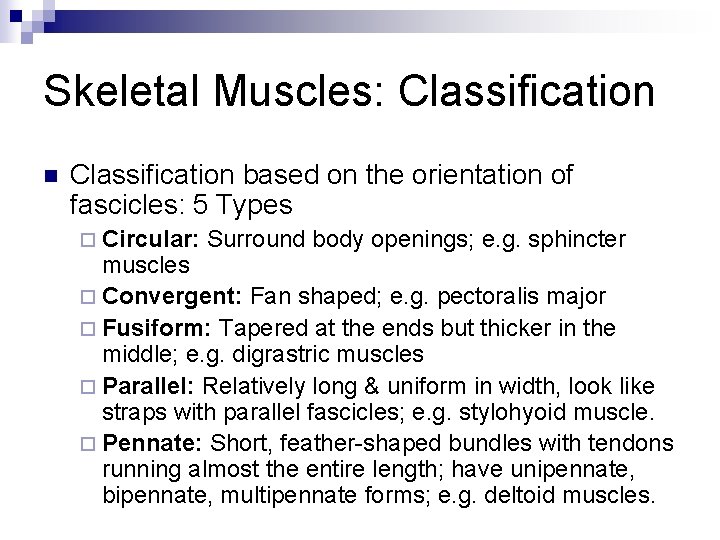
Skeletal Muscles: Classification n Classification based on the orientation of fascicles: 5 Types ¨ Circular: Surround body openings; e. g. sphincter muscles ¨ Convergent: Fan shaped; e. g. pectoralis major ¨ Fusiform: Tapered at the ends but thicker in the middle; e. g. digrastric muscles ¨ Parallel: Relatively long & uniform in width, look like straps with parallel fascicles; e. g. stylohyoid muscle. ¨ Pennate: Short, feather-shaped bundles with tendons running almost the entire length; have unipennate, bipennate, multipennate forms; e. g. deltoid muscles.
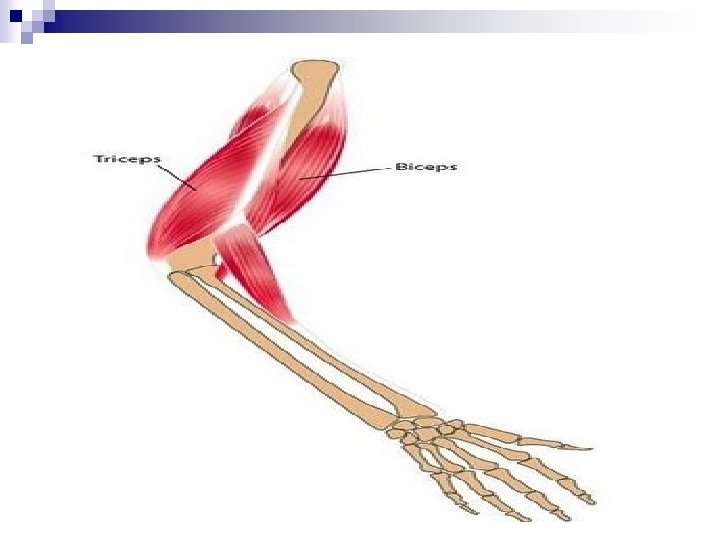
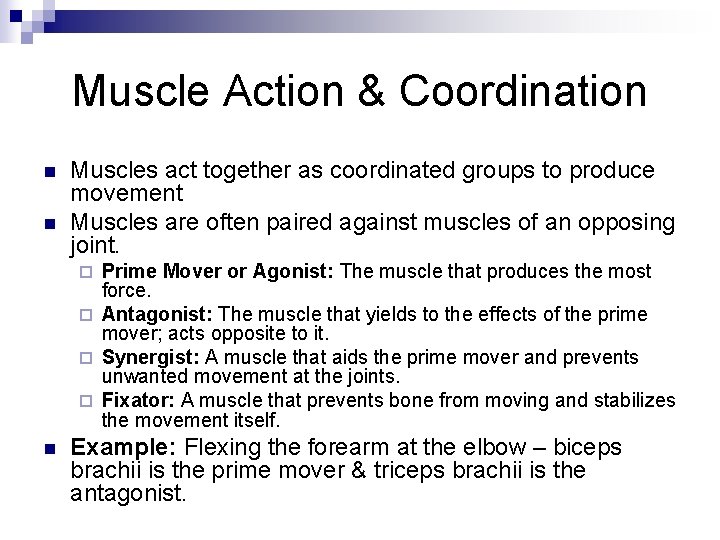
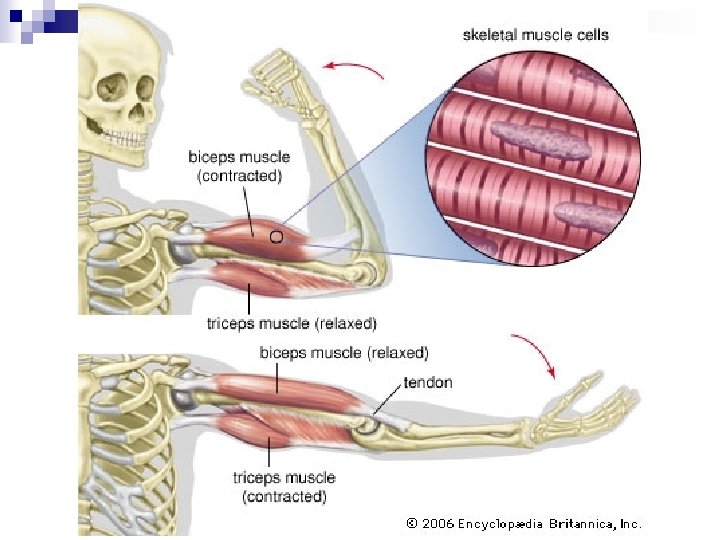
Muscle Action & Coordination n n Muscles act together as coordinated groups to produce movement Muscles are often paired against muscles of an opposing joint. Prime Mover or Agonist: The muscle that produces the most force. ¨ Antagonist: The muscle that yields to the effects of the prime mover; acts opposite to it. ¨ Synergist: A muscle that aids the prime mover and prevents unwanted movement at the joints. ¨ Fixator: A muscle that prevents bone from moving and stabilizes the movement itself. ¨ n Example: Flexing the forearm at the elbow – biceps brachii is the prime mover & triceps brachii is the antagonist.
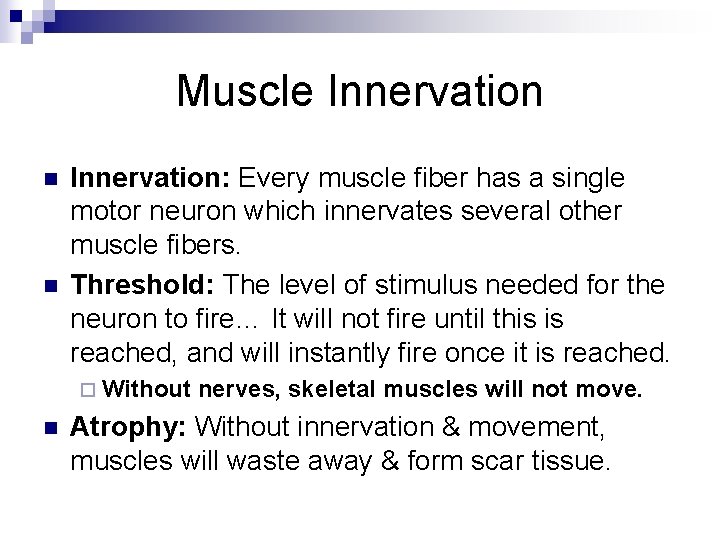
Muscle Innervation n n Innervation: Every muscle fiber has a single motor neuron which innervates several other muscle fibers. Threshold: The level of stimulus needed for the neuron to fire… It will not fire until this is reached, and will instantly fire once it is reached. ¨ Without n nerves, skeletal muscles will not move. Atrophy: Without innervation & movement, muscles will waste away & form scar tissue.
Skeletal Muscle Names Skeletal muscles are named according to their distinctive features! n Named for size, shape, action, & number of origins. n
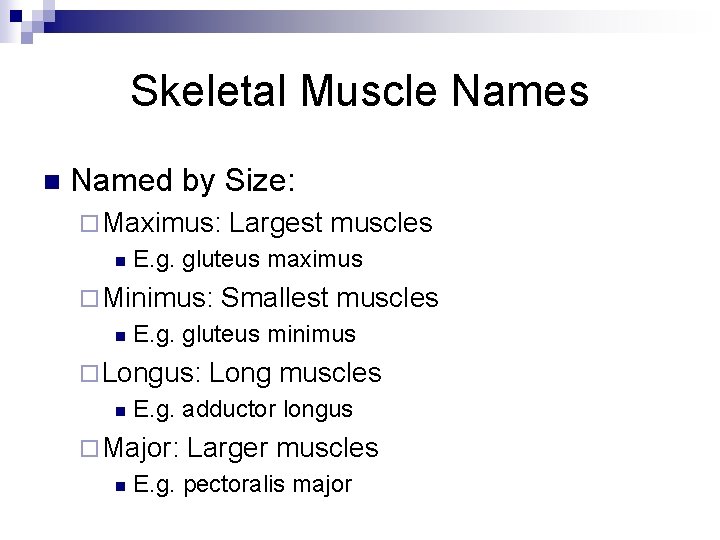
Skeletal Muscle Names n Named by Size: ¨ Maximus: n E. g. gluteus maximus ¨ Minimus: n Long muscles E. g. adductor longus ¨ Major: n Smallest muscles E. g. gluteus minimus ¨ Longus: n Largest muscles Larger muscles E. g. pectoralis major
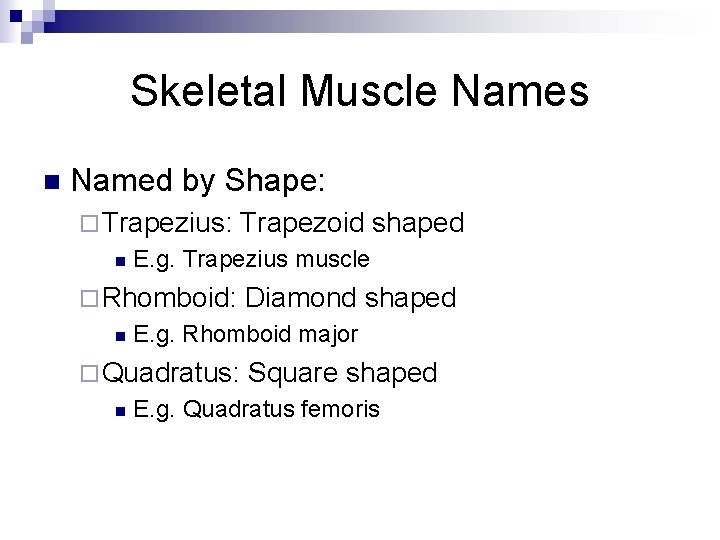
Skeletal Muscle Names n Named by Shape: ¨ Trapezius: n Trapezoid shaped E. g. Trapezius muscle ¨ Rhomboid: n E. g. Rhomboid major ¨ Quadratus: n Diamond shaped Square shaped E. g. Quadratus femoris
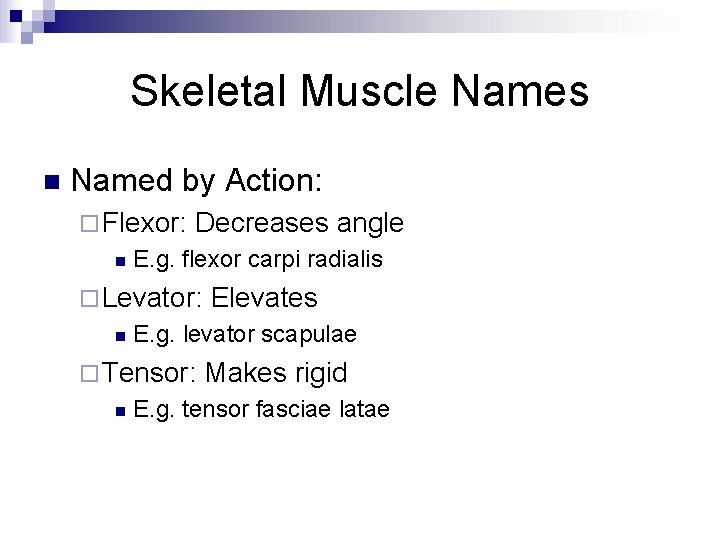
Skeletal Muscle Names n Named by Action: ¨ Flexor: n Decreases angle E. g. flexor carpi radialis ¨ Levator: n E. g. levator scapulae ¨ Tensor: n Elevates Makes rigid E. g. tensor fasciae latae
Skeletal Muscle Names n Named by Number of Origins: ¨ Biceps: n Two origins E. g. biceps brachii ¨ Triceps: n Three origins E. g. triceps brachii ¨ Quadriceps: n Four origins E. g. quadriceps femori