
The Muscular System Muscle Innervation Structure of a
- Slides: 16
The Muscular System Muscle Innervation
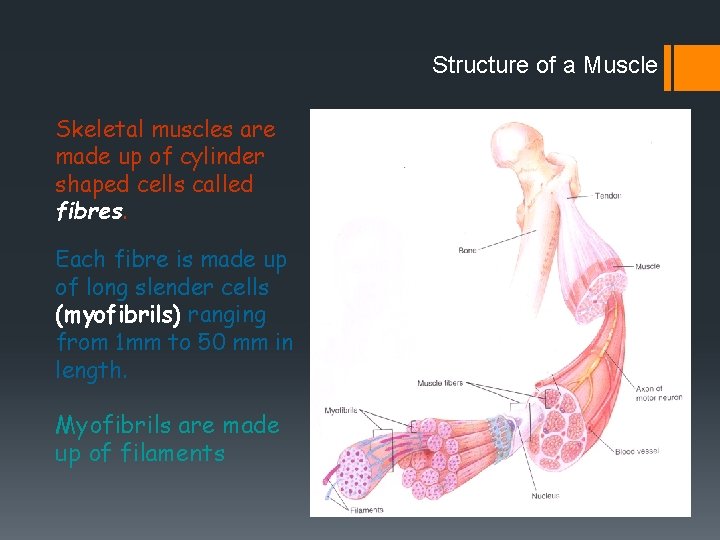
Structure of a Muscle Skeletal muscles are made up of cylinder shaped cells called fibres. Each fibre is made up of long slender cells (myofibrils) ranging from 1 mm to 50 mm in length. Myofibrils are made up of filaments
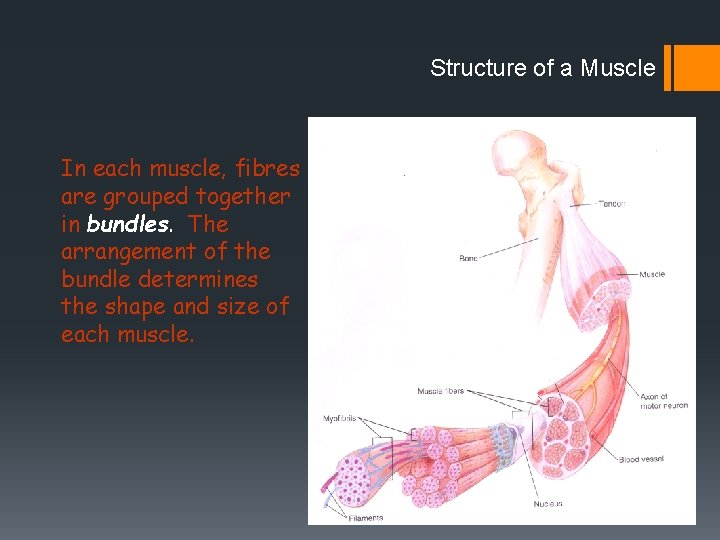
Structure of a Muscle In each muscle, fibres are grouped together in bundles. The arrangement of the bundle determines the shape and size of each muscle.
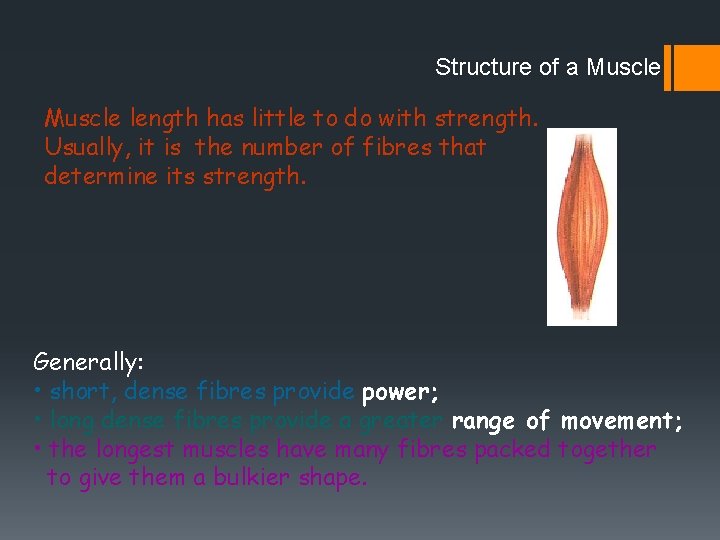
Structure of a Muscle length has little to do with strength. Usually, it is the number of fibres that determine its strength. Generally: • short, dense fibres provide power; • long dense fibres provide a greater range of movement; • the longest muscles have many fibres packed together to give them a bulkier shape.
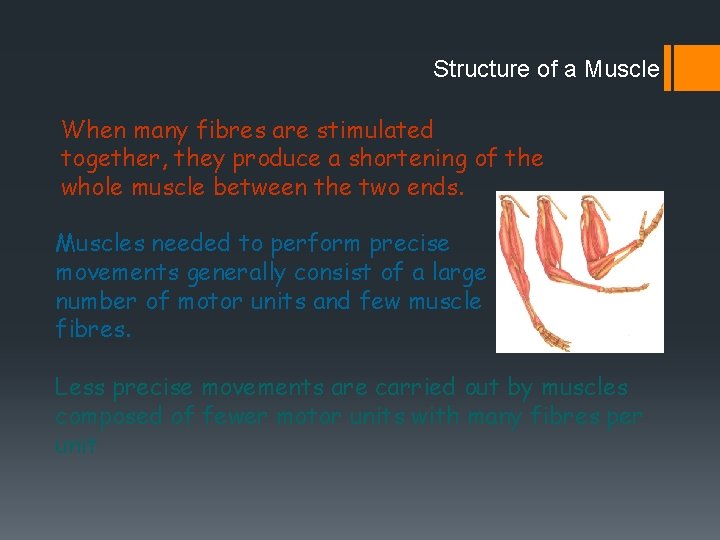
Structure of a Muscle When many fibres are stimulated together, they produce a shortening of the whole muscle between the two ends. Muscles needed to perform precise movements generally consist of a large number of motor units and few muscle fibres. Less precise movements are carried out by muscles composed of fewer motor units with many fibres per unit
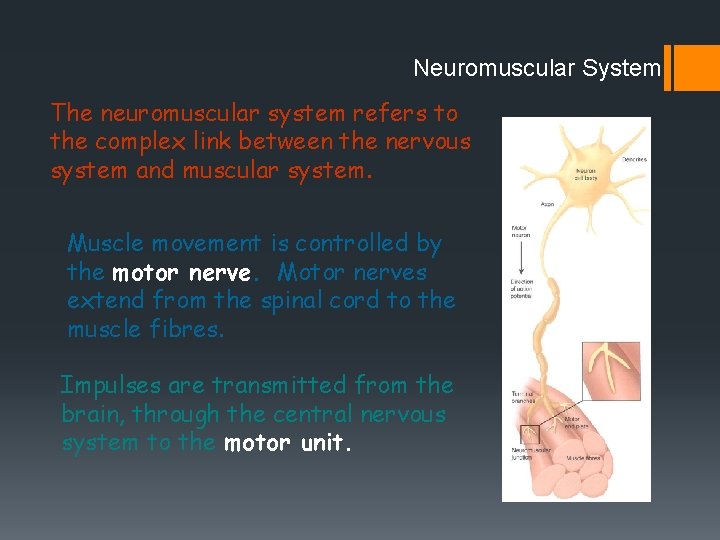
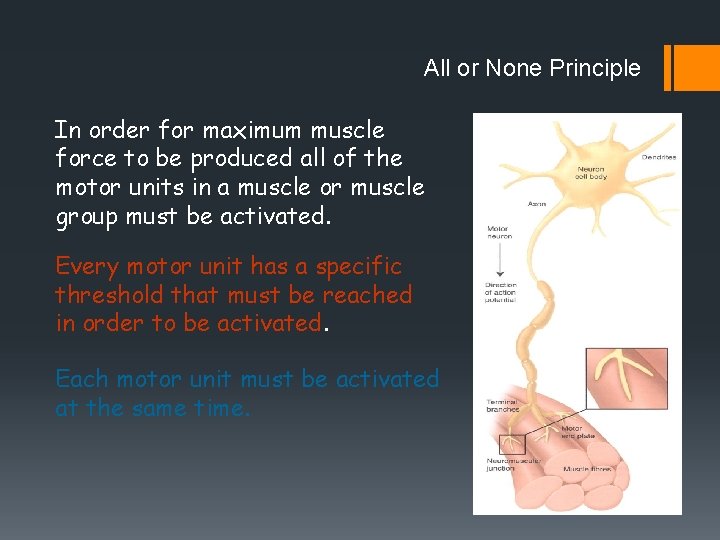
Neuromuscular System The neuromuscular system refers to the complex link between the nervous system and muscular system. Muscle movement is controlled by the motor nerve. Motor nerves extend from the spinal cord to the muscle fibres. Impulses are transmitted from the brain, through the central nervous system to the motor unit.
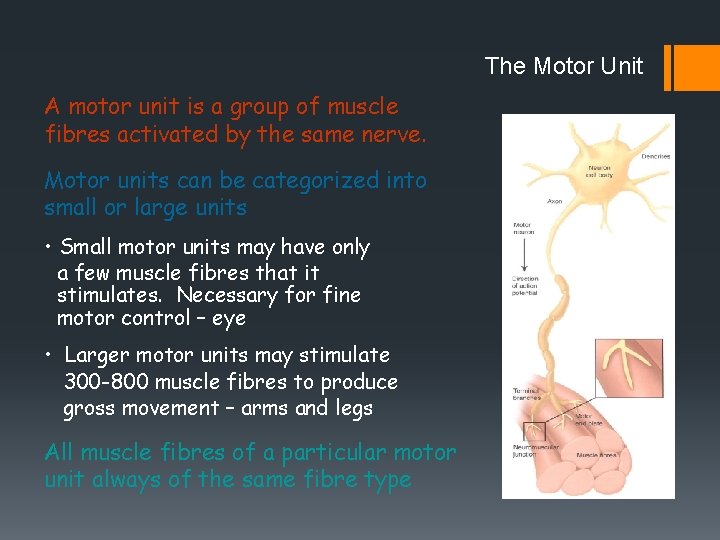
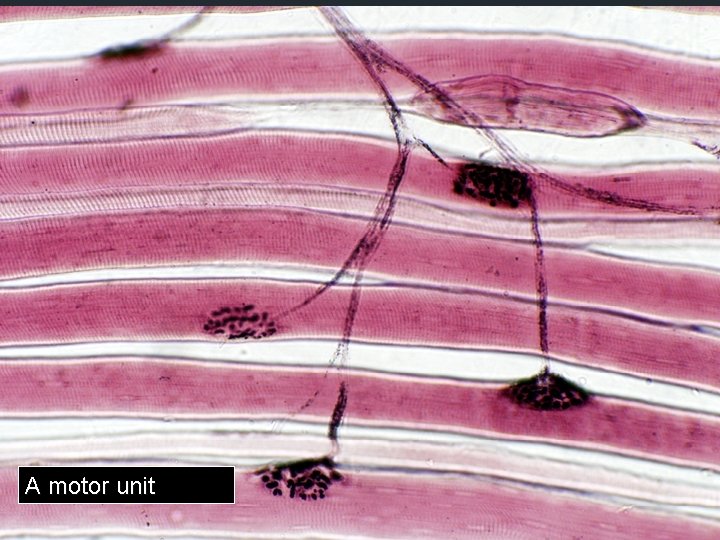
The Motor Unit A motor unit is a group of muscle fibres activated by the same nerve. Motor units can be categorized into small or large units • Small motor units may have only a few muscle fibres that it stimulates. Necessary for fine motor control – eye • Larger motor units may stimulate 300 -800 muscle fibres to produce gross movement – arms and legs All muscle fibres of a particular motor unit always of the same fibre type
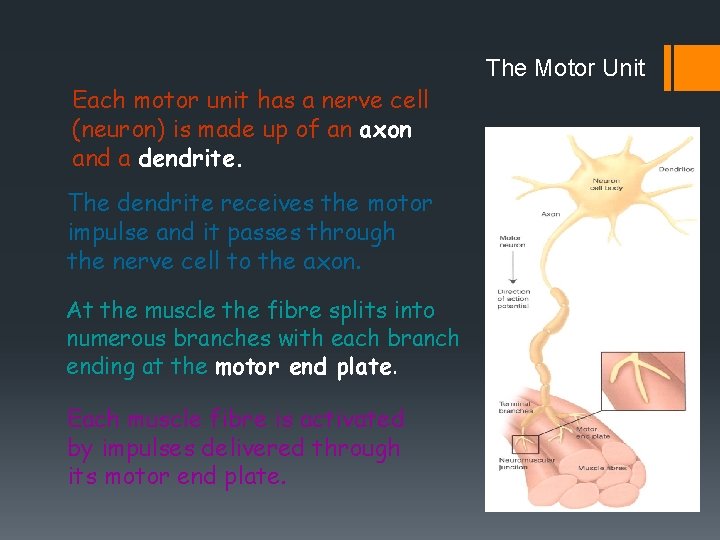
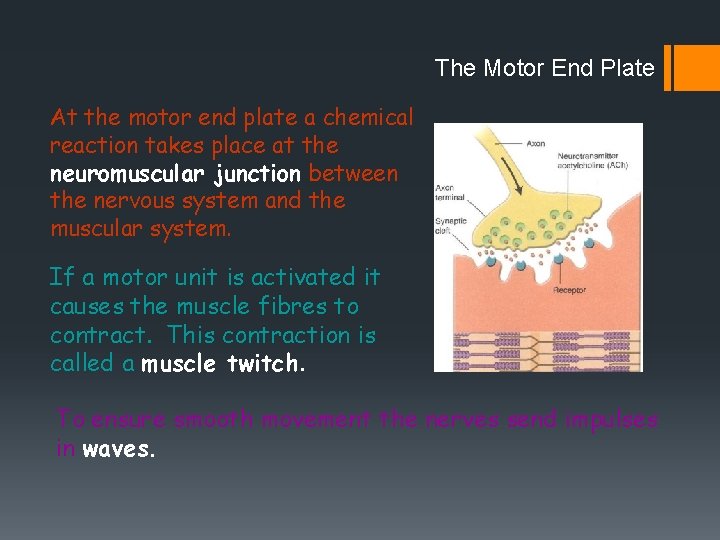
The Motor Unit Each motor unit has a nerve cell (neuron) is made up of an axon and a dendrite. The dendrite receives the motor impulse and it passes through the nerve cell to the axon. At the muscle the fibre splits into numerous branches with each branch ending at the motor end plate. Each muscle fibre is activated by impulses delivered through its motor end plate.
Mechanics of a Muscle Contraction § What stimulates a muscle to contract? § Your nervous system § What cells are involved? § Muscle cells and a motor neuron § Motor neuron sends impulse to muscle cells § One neuron will form synapses with many muscle cells § What is this called? § A motor unit § Let’s take a look under A motor the unitmicroscope. …
The Motor End Plate At the motor end plate a chemical reaction takes place at the neuromuscular junction between the nervous system and the muscular system. If a motor unit is activated it causes the muscle fibres to contract. This contraction is called a muscle twitch. To ensure smooth movement the nerves send impulses in waves.
All or None Principle In order for maximum muscle force to be produced all of the motor units in a muscle or muscle group must be activated. Every motor unit has a specific threshold that must be reached in order to be activated. Each motor unit must be activated at the same time.
All or None Principle Once enough strength is transmitted the entire muscle fibre or group of fibres will contract according to the all or none principle. When a motor unit contracts it will contract completely or not at all. As the resistance increases, more motor units must be activated by stronger, more intense impulses. A weak nerve impulse will activate only those motor units that have a low threshold of activation. A stronger nerve impulse will activate additional motor units with higher thresholds.
Intra-muscle Coordination The ability to use motor units simultaneously is known as intra-muscle coordination Trained athletes have not only a larger muscle mass than untrained individuals, but can also exploit a larger number of muscle fibres Many highly trained power athletes, such as football linemen weightlifters and shot putters, are able to activate up to 85% of their available muscle fibres at the same time as compared to 60% for the untrained.
Inter-muscle Coordination The interplay between muscles that generate movement through contraction (agonists) and muscles responsible for opposing movement (antagonists) is called intermuscle coordination The greater the participation of muscles and muscle groups, the higher the importance of inter-muscle coordination High-level inter-muscle coordination greatly improves strength performance and also enhances the flow, rhythm, and precision of movement Trained athlete is able to translate strength potential to enhance inter-muscle coordination
Reciprocal Innervation Muscles seldom work alone. In almost all cases muscles work in pairs or groups to produce movement. When you move your body, a coordinated action of several muscles must occur. Different muscles attached around the joint cooperate to produce a smooth efficient movement. Reciprocal innervation is a process which produces the exact amount of relaxation in the antagonist to balance the amount of contraction generated in the agonist.
Reciprocal Innervation For example, in the human arm, the triceps acts to extend the lower arm outward while the biceps acts to * the lower arm inward. In order to reach optimum efficiency, contraction of opposing muscles must be inhibited while muscles with the desired action are excited. This reciprocal innervation occurs so that the contraction of a muscle results in the simultaneous relaxation of its corresponding antagonist.